

Sample Category Title
Oil Falls After Trump Targets OPEC
Oil fell after US President Trump targeted the Organization of the Petroleum Exporting Countries (OPEC) for not doing enough to keep crude prices low. This comes ahead of the organization’s meeting in Algeria with other major producers. The production cut agreement has been the most important factor in the stabilization of crude prices since the 2014 drop. Supply disruptions have kept prices in current ranges even as the OPEC and partners such as Russia will be discussing ramping up production.
The biggest disruption to supply this year has come from the reapplication of US sanctions against Iranian exports. Global producers that are part of the supply curb have telegraphed their intentions but weather and geopolitical factors have been offset with global growth and energy demand forecast downgrades.
Weekly US inventories threw another drawdown data point on Wednesday and have kept the black stuff bid. President Trump has used twitter as a macro policy tool and this time his aim fell on the OPEC. The organization has limited options and will look to Saudi Arabia for leadership as some members have pressured internally to increase production for their own national interests. This time the US is mixing political and economic factors to force an increase in supply, even though the White House is the one who triggered the latest disruption.
British Pound Rises to 10-Week High on Higher Retail Sales
GBP/USD has posted strong gains in the Thursday session. Currently, the pair is trading at 1.3260, up 0.85% on the day. On the release front, British retail sales posted a gain of 0.3%, beating the estimate of -0.2%. Over in the U.S indicators looked sharp, as Philly Fed Manufacturing Index and unemployment claims both beat expectations. On Friday, the UK releases public sector net borrowing.
A positive retail sales report on Thursday has boosted the British pound. Earlier in the day, GBP/USD climbed to 1.3299. its highest level since July 10. The currency moved higher after retail sales posted its fourth gain in five months. However, the gain of 0.3% in August was substantially lower than the July release of 0.7%. The respectable retail sales report follows a strong CPI release on Wednesday – the reading of 2.7% beat the estimate of 2.4%. This marked the strongest inflation reading since February.
After a brief respite, the US-China trade spat ratcheted upwards this week. Following weeks of speculation, U.S President Trump announced 10% tariffs on some $200 billion worth of Chinese goods. Only this time, investors didn’t panic and the Japanese yen and other currencies have held their own against the greenback. Investors appeared to have been ready for a move by Trump, and may be sighing in relief that the tariff was set at 10% rather than at 25%. One senior economist summed up Trump’s most recent salvo as “bad but manageable”. However, if the Chinese do indeed retaliate and the U.S takes further measures, this would likely shake up the currency markets and boost the U.S dollar.
OECD downgrades global outlook, trade tensions are starting to bite
In its interim economic outlook, OECD downgraded global growth forecast for 2018 and 2019. More importantly, almost all countries covered were downgraded, in either year or both, except Australia, Japan, China, Russia and Saudi Arabia. OECD warned that "escalating trade tensions, tightening financial conditions in emerging markets and political risks could further undermine strong and sustainable medium-term growth worldwide.
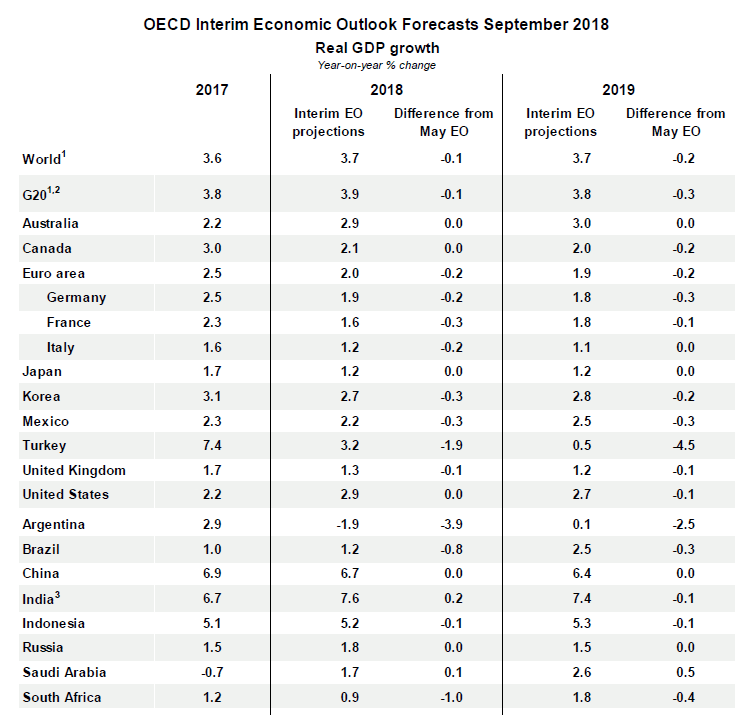
OECD Chief Economist Laurence Boone:
- Trade tensions are starting to bite, and are already having adverse effects on confidence and investment plans.
- Trade growth has stalled, restrictions are having marked sectoral effects and the level of uncertainty on trade stances remains high.
- It is urgent for countries to end the slide towards further protectionism, reinforce the global rules‑based international trade system and boost international dialogue, which will provide business with the confidence to invest
- With tighter financial conditions creating stress on a number of emerging economies, especially Turkey and Argentina, a strong and stable policy framework will be key to avoid further turbulence.
UK PM May insists Chequers plan is the only Brexit proposal on the table
After meeting with her EU counter parts in Austria, UK Prime Minister Theresa May insisted that her Chequers plan is the only Brexit proposal that's on the table.
She said, "there is no counter proposal on the table at the moment that actually deals, delivers on what we need to do and respects the integrity of the United Kingdom and respects the result of the referendum,"
Separately, it's reported that UK Finance Minister Philip Hammond has urged urged the European Commission to work with UK together on preparation of no-deal Brexit to reduce or avoid disruption to the financial sector.
Japanese Inflation Data Unlikely to Move the Yen as Safe-Haven Flows Remain Currency’s Primary Driver
Japanese inflation data for August will be hitting the markets on Thursday at 2330 GMT. The figures are expected to confirm that the Bank of Japan remains far off from achieving its inflation target and barring a significant deviation from analysts’ forecasts, they’re unlikely to spur considerable movements in yen pairs. What is instead likely to remain a primary driver of the currency’s direction are safe-haven flows – or the lack thereof – stemming from issues having to do with global trade.
The data released later in the day out of Japan are projected to show core CPI – this being the measure of inflation that excludes fresh food items but includes energy – growing by 0.9% y/y in August, above July’s 0.8% but still considerably below the BoJ’s target for inflation of 2% on an annual basis. The gauge has been rising since effectively the second half of 2016, eventually peaking at 1.0% in February of the current year, its highest since Q1 2015. This helped fuel growing speculation at the time that the Japanese central bank would soon enter into a path of policy normalization after years of ultra-loose monetary policies, and hence supported the yen. However, the reading has retreated in recent months, ranging between 0.7% and 0.9%. Its fall was accompanied with investors scaling back their bets for a more hawkish tilt by the BoJ, with dollar/yen advancing for the most part after touching its lowest since November 2016 of 104.55 in late March.
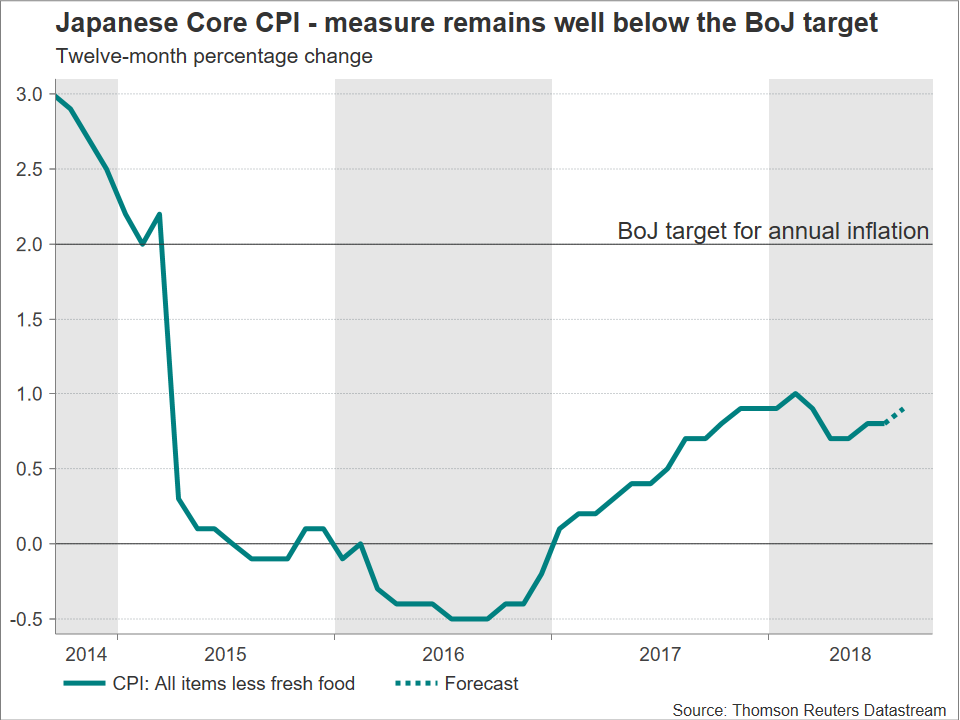
Elsewhere, headline inflation grew by 0.9% in July, also handily undershooting the central bank’s target; no August polls are available for this print, though it bears mention that the corresponding reading for the city of Tokyo that is considered a forward gauge of the nationwide number stood at 1.2%. Overall, the inflation landscape in Japan remains subdued, supporting the case for a BoJ that maintains its ultra-accommodative stance for the foreseeable future. Contrast this with the US central bank: next week the Federal Reserve is widely anticipated to deliver its eighth quarter percentage point rate increase since it begun normalizing rates in late 2015, while it is expected to signal that it remains firmly on policy-tightening mode. All these are pointing to further policy divergence between the US and Japan and thus higher yield differentials in the US’ favor, which are supportive of a stronger dollar/yen moving forward.
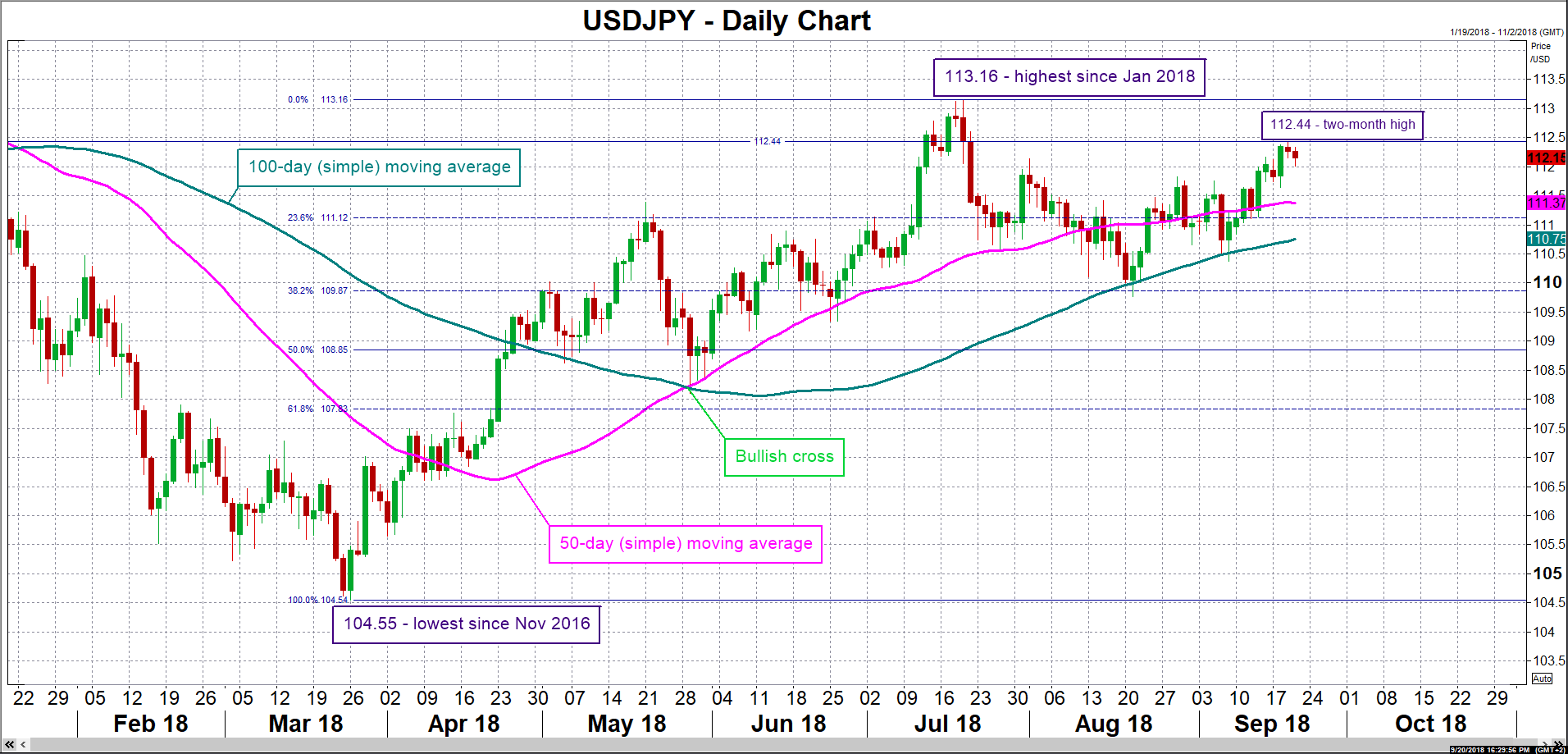
Beyond monetary policy, other factors are at play that can sway USDJPY in either direction. First on the list is trade uncertainty on the back of the confrontational rhetoric between the US and China that resulted in the two sides firing tariff shots at one another. Such uncertainty has in the past found the yen on the receiving end of safe-haven flows. To this end, investors seem to have largely set aside trade concerns in recent days, something which has allowed the greenback to track a two-month high of 112.44 versus the Japanese currency on Wednesday. Should the relationship between the world’s two largest economies significantly worsen though, then the yen is yet again likely to come under buying interest.
A rising dollar/yen on easing Sino-US trade tensions or sizably weaker inflation numbers relative to expectations, may meet immediate resistance around Wednesday’s two-month high of 112.44. Stronger advances will turn the attention to the zone around 113.16, the pair’s highest since the beginning of the year, recorded in late July. Conversely, market angst over an imminent deterioration in Chinese-American relationships or unexpectedly upbeat inflation prints, will likely lead to a falling USDJPY. The area between 111.37 and 110.75 captures the 50- and 100-day moving average lines, as well as the 23.6% Fibonacci retracement level of the upleg from 104.55 to 113.16 and may thus be of importance, providing support to losses in the pair. Further below, the region around the 38.2% Fibonacci mark at 109.87 would be eyed.
Remaining on trade, the US and Japan were planning their second round of trade talks during the current week. However, according to Japanese government sources, those will be delayed until after fresh tariffs imposed on China by the United States come into effect on September 24.
Lastly, September’s Nikkei manufacturing PMI will be made public on Friday at 0030 GMT (one hour after the numbers on inflation).
Yen Trading Sideways, Japanese Inflation Report Next
USD/JPY is showing little movement in the Thursday session. In North American trade, the pair is trading at 112.17, down 0.09% on the day. In economic news, U.S manufacturing and employment reports beat expectations. In Japan, Japanese National Core CPI is expected to tick up to 0.9%. As well, Flash Manufacturing PMI is forecast to improve to 53.1 points.
At the BoJ policy meeting this week, policymakers held its short-term interest rate target at -0.1 percent and a pledge to guide 10-year government bond yields around zero percent. The BoJ also maintained a pledge to keep interest rates extremely low for an extended period. The Bank sounded optimistic in its rate statement, noting that the economy was “expanding moderately”.
After a brief respite, the US-China trade spat ratcheted upwards this week. Following weeks of speculation, U.S President Trump announced 10% tariffs on some $200 billion worth of Chinese goods. Only this time, investors didn’t panic and the Japanese yen and other currencies have held their own against the greenback. Investors appeared to have been ready for a move by Trump, and may be sighing in relief that the tariff was set at 10% rather than at 25%. One senior economist summed up Trump’s most recent salvo as “bad but manageable”. However, if the Chinese do indeed retaliate and the U.S takes further measures, this would likely shake up the currency markets and boost the U.S dollar.
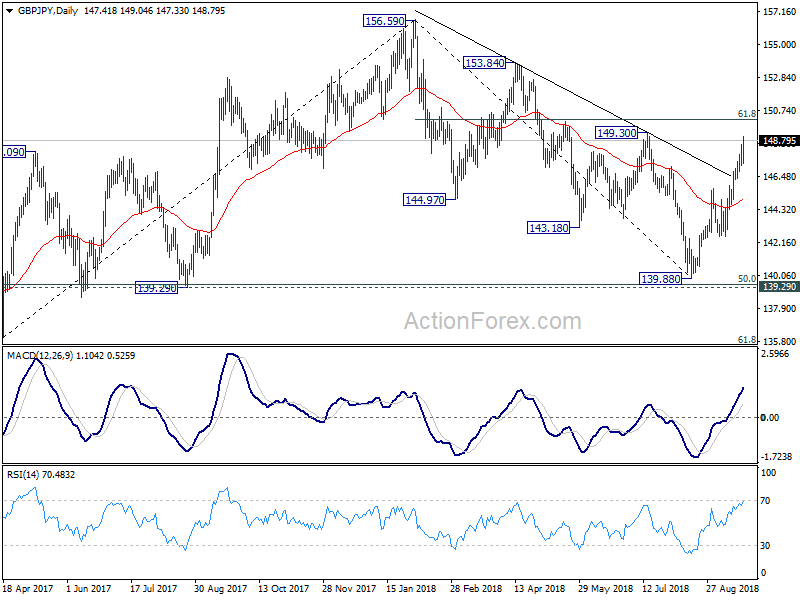
GBP/JPY Mid-Day Outlook
Daily Pivots: (S1) 147.10; (P) 147.83; (R1) 148.33; More...
GBP/JPY's rally continues to as high as 149.04 so far. Intraday bias remains on the upside for 149.30 resistance. Decisive break there will confirm that whole decline from 156.59 has completed at 139.88. Further rally should then seen back to 153.84/156.59 resistance zone. On the downside, below 147.17 minor support will turn intraday bias neutral first. But near term outlook will remain cautiously bullish as long as 145.67 resistance turned support holds.
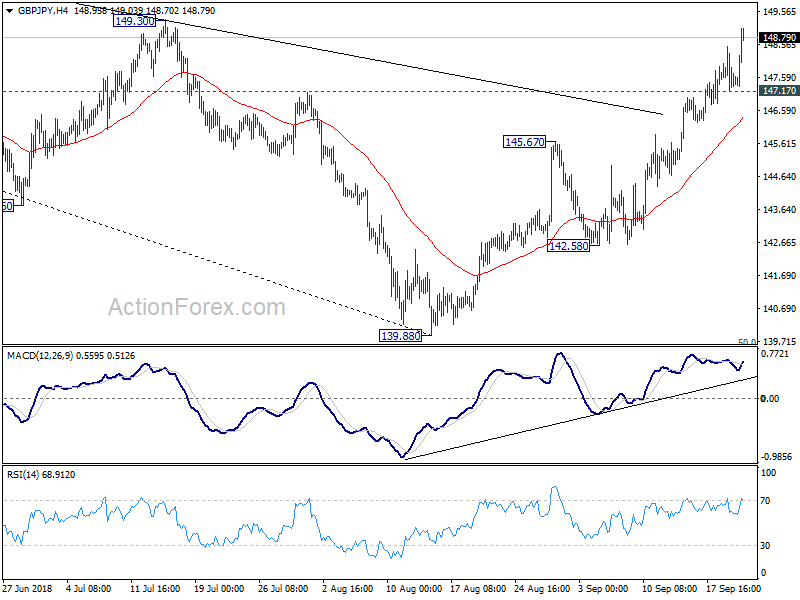
In the bigger picture, as long as 139.29 cluster support (50% retracement of 122.36 to 156.59 at 139.47) holds, the decline from 156.69 is seen as corrective move. That is, rise from 122.36 (2016 low), is still expected to extend higher through 156.69. However, sustained break of 139.29/47 should confirm medium term reversal and turn outlook bearish.
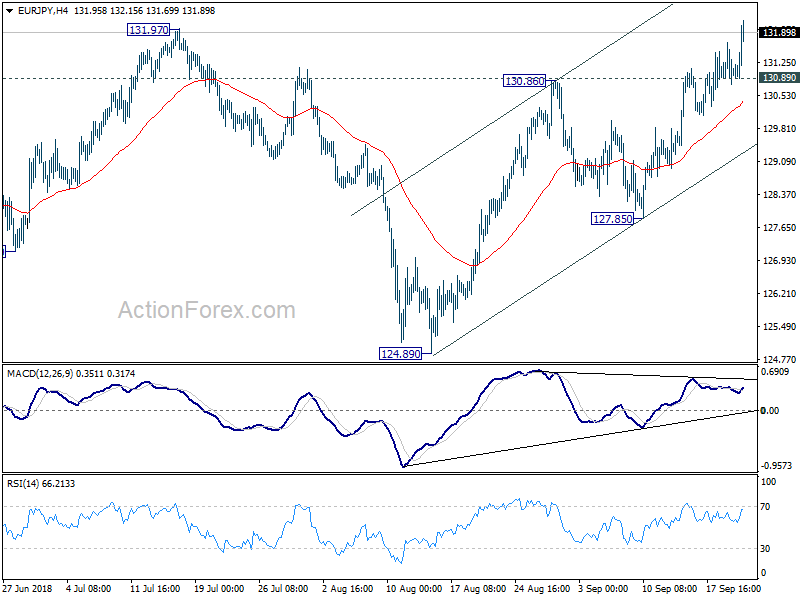
EUR/JPY Mid-Day Outlook
Daily Pivots: (S1) 130.69; (P) 131.19; (R1) 131.58; More....
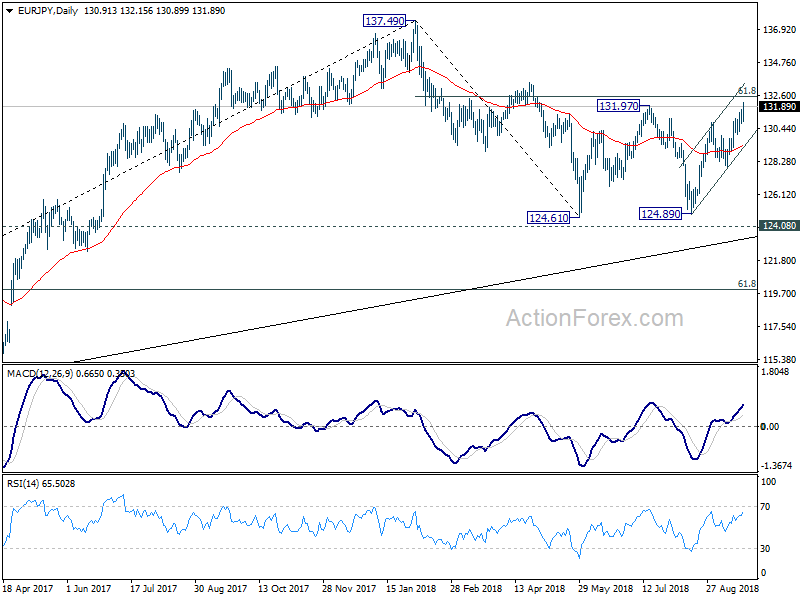
EUR/JPY's rally continues today and reaches as high as 132.15, breaking 131.97 resistance. Intraday bias stays on the upside for key fibonacci resistance at 132.56. sustained break there should pave the way to retest 137.49 high. On the downside, below 130.89 minor support will turn intraday bias neutral first. But near term outlook will stay cautiously bullish as long as channel support holds (now at 129.42).
In the bigger picture, as long as 124.08 key resistance turned support, larger up trend from 109.03 (2016 low) remains in favor to continue. Decisive break of 61.8% retracement of 137.49 to 124.61 at 132.56 will pave the way to retest 137.49 high. However, firm break of 124.08 will argue that whole rise from 109.03 (2016 low) has completed at 137.49. Deeper decline would be seen to 61.8% retracement of 109.03 to 137.49 at 119.90 next.
Sunset Market Commentary
Markets
The downtrend on global core bond markets simply continued today as risk sentiment thrived. Trading was sentiment-driven and technically inspired. Strong US eco data (weekly jobless claims & Philly Fed business outlook) contributed to US Treasuries’ underperformance vs German Bunds. The German 10-yr yield bumped into 0.5% resistance for a second straight session and helped limit losses in the Bund. We wonder how long this resistance level will hold in the current market environment. Brent crude briefly spiked lower as US President Trump blasted OPEC, but the oil price soon recovered. The US yield curve bear flattens at the time of writing with yields 2.1 bps (2-yr) to 1.2 bps (30-yr) higher. The US 2- and 5-yr yields set new cycle highs at 2.82% and 2.97% respectively. The US 10- and 30-yr yields close in on the cycle peaks at 3.12% and 3.26%. We eye a test going into next week’s FOMC meeting, where the Fed is expected to confirm the June dot plot, which is still more hawkish than markets are currently positioned, especially for 2019 and 2020. Increases on the German yield curve are limited to +0.6 bps. Peripheral yield spreads vs Germany narrow by 2 to 3 bps.
Over the previous days, the euro showed already quite resilient and EUR/USD tried to regain the 1.17 big figure, but the attempt failed. The dollar lost some momentum as tensions on global markets eased. Today, sentiment on (European) equity markets improved further. China indicating a possible decline in import tariffs maybe supported sentiment. This time, it was enough to trigger a EUR/USD short-squeeze. EUR/USD finally cleared the 1.1722/33 resistance, causing further stop-loss buying. US data (Philly Fed outlook and jobless claims) were strong and US yields/interest rate differentials rose further. However, it didn’t help the dollar. Risk sentiment prevailed. EUR/USD trades in the 1.1770 area. Remarkably, also USD/JPY didn’t profit from higher US yields and a risk-on sentiment. USD/JPY trades in the 112.10 area.
Today, sterling recorded a nice rally. The move was inspired by good UK data. Some investors also saw tentative positive signs coming from the EU summit in Salzburg. EUR/GBP traded in the 0.8890 area this morning, but soon took the way south. UK August retail sales were better than expected (0.3% M/M) and a strong July figure was still upwardly revised suggesting a nice contribution from consumption to Q3 UK growth. The news flow from Salzburg was mixed, at best. There were few indications of substantial progress on a solution for the Irish boarder. At the same time, there are headlines on a Brexit summit scheduled for November. Question remains whether this is a guarantee that key issues will be solved at that time. Whatever, sterling extended gains. EUR/GBP trades in the 0.8860 area. Cable is changing hands just below 1.33.
News Headlines
UK retail sales unexpectedly grew last month caused by a hot summer and an improvement in real income. Retail sales rose 0.3% in August, compared to the median estimate of a 0.2% decline. The July numbers were also revised upwardly. Almost all sectors note an increase, with household goods outperforming other sectors.
Norway’s central bank raised its interest rates for the first time since 2011. The Norges Bank added, as expected, a quarter point to its benchmark rate, raising it to 0.75%, taking the first step in the normalization of its monetary policy. However, it outlined a slightly more dovish rate path for the future. The krone lost ground on the news.
US President Trump expressed his dissatisfaction on the high oil prices again. In a tweet, Trump urged OPEC to lower prices immediately. He said the US is protecting the countries of the Middle East and will not forget these nations are continuing to push for higher oil prices. The current oil price stands at $79.4 per barrel.
EU Tusk: Chequers Brexit proposal will not work. Oct the moment of turth
European Council President Donald Tusk said after meeting between EU leaders that "everybody shared the view that while there are positive elements in the Chequers proposal, the suggested framework for economic cooperation will not work, not least because it risks undermining the single market."
And, he added "the moment of truth for Brexit negotiations will be the October European Council. In October we expect maximum progress and results in the Brexit talks."
Separately, UK Foreign Minister Jeremy Hunt said "we are confident if we can get the support of the European Union, ultimately it would get through parliament." Also, "people will be very angry indeed if we had a second referendum and it's certainly not the government's policy."