

Sample Category Title
EUR/USD Mid-Day Outlook
Daily Pivots: (S1) 1.1643; (P) 1.1680; (R1) 1.1709; More.....
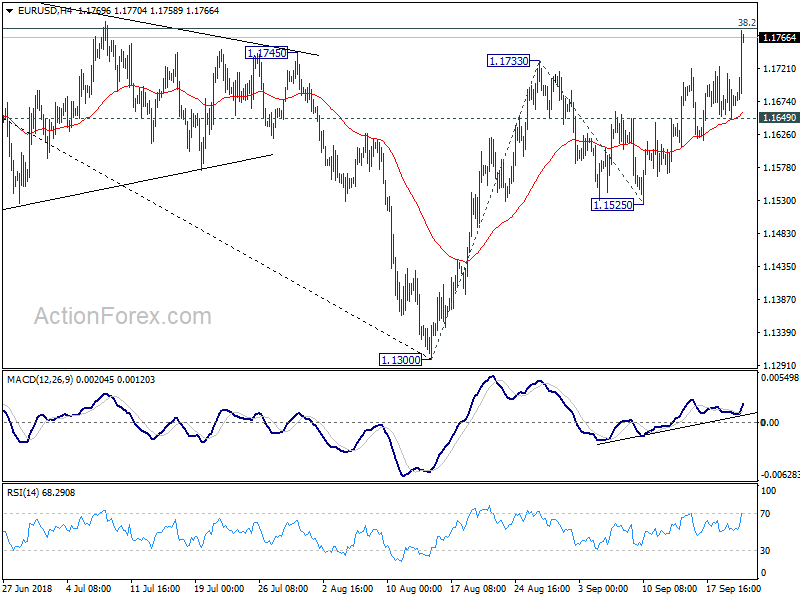
EUR/USD's rebound from 1.1300 finally resumes and surges to as high as 1.7766 so far. Intraday bias is back on the upside, with focus back 38.2% retracement of 1.2555 to 1.1300 at 1.1779. Rejection from 1.1779 and break of 1.1649 minor support will indicate that corrective rise from 1.1300 has completed. That will be in line with our original view and turn bias to the downside for 1.1525 support for confirmation. However, sustained break of 1.1779 will extend the corrective rise from 1.1300 to 100% projection of 1.1300 to 1.1733 from 1.1525 at 1.1958 before completion.
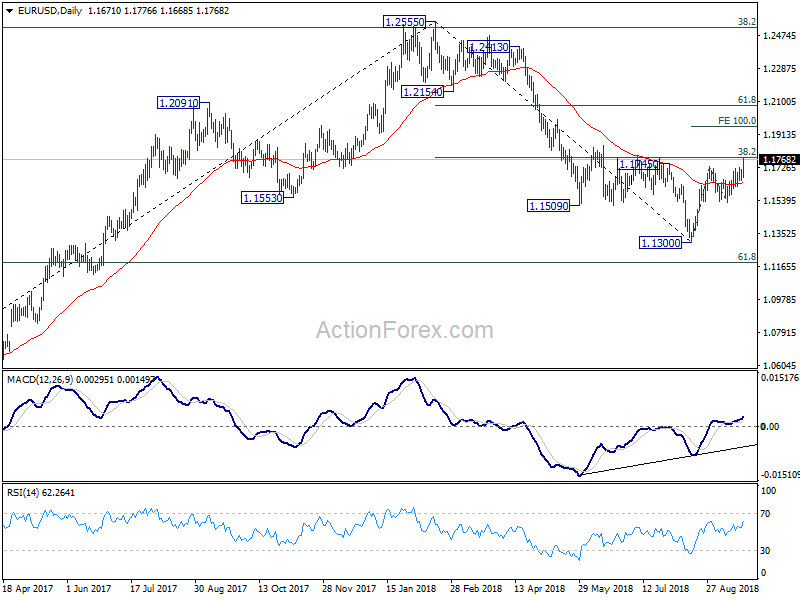
In the bigger picture, a medium term bottom should be in place at 1.1300, on bullish convergence condition in daily MACD and some consolidations would be seen. But still, note that EUR/USD was rejected by 38.2% retracement of 1.6039 (2008 high) to 1.0339 (2017 low) at 1.2516. That carries some long term bearish implications. Thus, we'd expect fall from 1.2555 high to resume after consolidation completes. Below 1.1300 should send EUR/USD through 61.8% retracement of 1.0339 to 1.2555 at 1.1186. And, in that case, EUR/USD would head to retest 1.0339 (2017 low).
Pound Shines after Unexpected Rise in Retail Sales
Here are the latest developments in global markets:
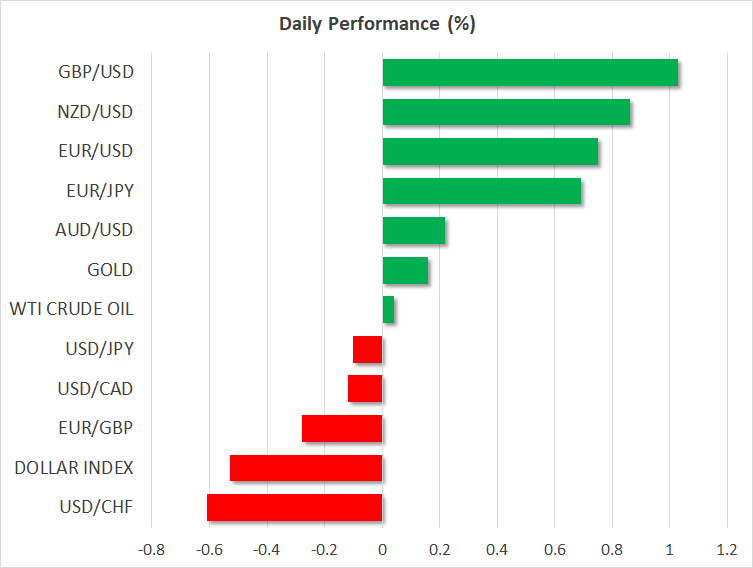
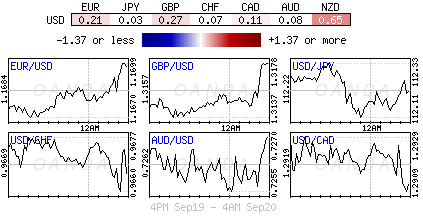
FOREX: British retail sales beat expectations today rising by 0.3% m/m in August, above the -0.2% forecasted, from 0.9% m/m in the preceding month. Yearly, retail sales advanced by 3.5% instead of 2.5% predicted and versus 3.8% in July, driving pound/dollar higher by 1.10% to a fresh 2-month high of 1.3288. Also, pound/yen advanced by 0.96%, jumping above 148.00. In Brexit-related news, the Irish RTE media reported that May sees no deal before October’s EU regular summit, while the Irish foreign minister said that required talks have not happened yet. The US dollar remained negative. Dollar/yen dropped by 0.03%, while theUS dollar index slipped by 0.19%. Euro/dollar pierced the 1.1700 level to rise as high as 1.1777 (+0.78%). Meanwhile, kiwi/dollar was another overperformer, gaining 0.83% on the back of upbeat GDP growth figures out of New Zealand. The New Zealand economy grew by 1.0% q/q in the second quarter of this year from 0.5% previously. It was the largest quarterly rise in two years. Aussie/dollar remained positive, adding 0.22% to its performance, while dollar/loonie lost some ground (-0.12%) and is set to post the third consecutive red day.
STOCKS: European equities were a sea of green on Thursday. The UK’s FTSE 100 was up by 0.23% despite a strong upside move in sterling. The Spanish IBEX 35 was the best performer, surging by 1.13%. Germany’s DAX 30 moved higher by 0.40% and Italy’s FTSE MIB rose by 0.77%, while the French CAC 40 increased by 0.73%. The STOXX 50 and the STOXX 600 edged up by 0.55% and 0.47% respectively. In the US, futures tracking the S&P 500, Dow Jones, and Nasdaq 100 are pointing to a higher open today, albeit only marginally so.
COMMODITIES: West Texas Intermediate (WTI) crude oil steadied at $71.13/barrel today and Brent tumbled by $78.83/barrel (-0.72%) after the US President twitted once again his opposition to higher oil prices. The comments came after reports that Saudi Arabia is comfortable with Brent above $80. Gold prices improved by 0.10% to trade at $1,205/ounce.
Day ahead: Philly Fed Manufacturing Index and Eurozone flash Consumer Confidence index due; Japanese inflation in focus
A number of economic releases are expected later in the day, with investors keeping a close eye on trade developments and Brexit updates too amid noise in US-Sino trade relations, the NAFTA deadlock, and rising uncertainties about whether the EU and the UK will manage to strike a divorce deal.
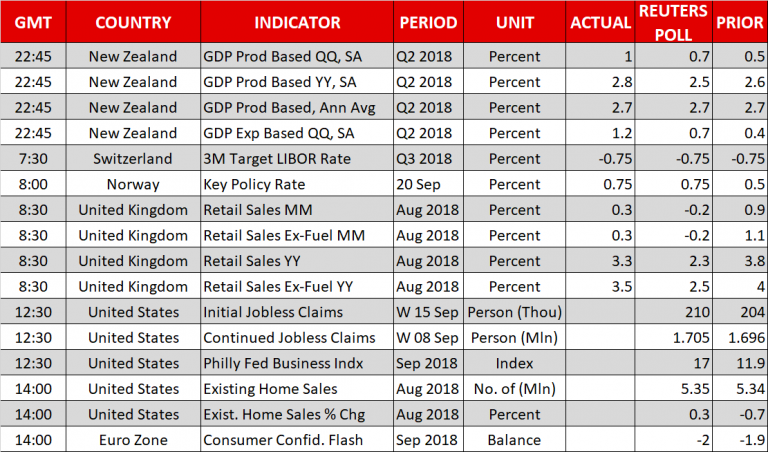
At 1230 GMT, US initial claims for unemployment benefits for the week ending September 15 are expected to come higher by 6k at 210k, after dropping to a 49-year low of 204k in the preceding month. At the same time the Philadelphia Federal Reserve Bank will be delivering its Manufacturing index for the month of September and analysts forecast a significant rise to 17.0 from 11.9 in August, when the index touched a three-year low.
Later at 1400 GMT, existing home sales in August are projected to inch up by 10k to 5.35mn, marking a growth of 0.3% compared to the 0.7% contraction in July.
Meanwhile in the Eurozone, the European Commission will issue September’s preliminary figures on consumer confidence, though no good news is expected on this front as consumers are said to have turned more pessimistic about future economic activities in the bloc, driving the measure to a 1-year low of -2.0 from -1.9 in August. Any upside or downside deviation from forecasts could move the euro accordingly.
Yet, recent disappointing Brexit headlines could continue to weigh on the euro market and more importantly on the pound. Although investors were somewhat positive that an agreement on divorce terms could be reached before November’s deadline, yesterday EU leaders who are meeting in an informal summit in Salzburg, Austria, showed no enthusiasm on May’s Irish border plans, saying that the UK must move its position over on the topic, while some others did not hesitate to call for a second referendum. Meanwhile risks for the UK Prime Minister, Theresa May, remain alive back in Britain as May has to convince her Conservative party on September 30 that she can successfully lead the party and the country through Brexit.
In Canada, the focus will be on NAFTA as negotiations between US and Canadian officials stretch to Thursday in an effort to resolve disagreements before October 1, a deadline set by Washington. Recall that Trump has reached a preliminary trade agreement with Mexico and threatened to exclude Canada from the pact. However, the US Congress wants NAFTA to be renegotiated as a trilateral agreement.
Elsewhere, data on consumer prices are scheduled to come out of Japan at 2330 GMT. While the numbers might not affect much the safe-haven yen which barely reacts to economic releases, inflation readings might attract investors interest given their influence on monetary policy decisions. The nationwide core CPI is anticipated to strengthen from 0.8% to 0.9% on a yearly basis, holding far below the BoJ’s inflation target of 2.0%. Japan will also see flash estimates on the Nikkei Manufacturing PMI at 0030 GMT on Wednesday.
In terms of public appearances, Bundesbank chief Jens Weidman, a possible Draghi successor at the helm of the ECB when his term expires in late 2019, will be giving a speech at 1515 GMT. Additionally, ECB chief economist Peter Praet will be talking on “Challenges to monetary policy normalization” at 1720 GMT.
EURUSD: Breaks Above Key Resistance, Targets 1.1790/99 Region
EURUSD: The pair saw a strong price rally on Thursday opening the door for more gain in the days ahead. On the upside, resistance comes in at 1.1790/1.1800 levels with a break through here opening the door for more upside pressure towards the 1.1850 level. Further up, resistance lies at the 1.1900 level where a break will expose the 1.1950 level. Its daily RSI is bullish and pointing higher suggesting further pressure. Conversely, support lies at the 1.1750 level where a violation will aim at the 1.1700 level. A break of here will aim at the 1.1650 level. Below here will open the door for more weakness towards the 1.1600. All in all, EURUSD continues to face further upside pressure.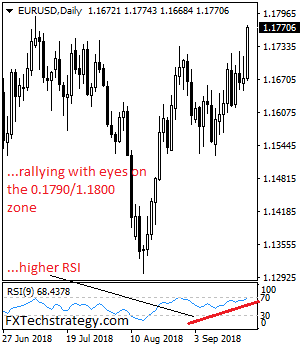
Brent Oil Outlook: Oil Prices Fell after Trump Criticized OPEC for High Prices
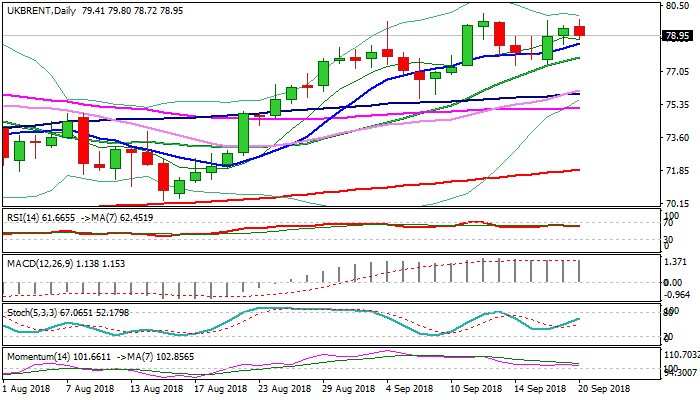
Brent oil fell over $1 on Thursday after US President Trump criticized high oil prices and urged OPEC to lower them. Oil prices moved lower in immediate reaction to Trump's tweet, in which he linked American support to the countries in the Middle east to oil prices. Bulls were dented again after rallying on recent comments from Saudi Arabia regarding higher oil prices and were additionally boosted by strong fall in US crude stocks. The latest news pushed prices lower, raising a question mark over expected renewed attack at psychological $80 barrier which was cracked last week on short-lived tick to $80.10. Daily techs continues to lose bullish momentum which could add pressure on bulls and risk deeper pullback. Rising 10SMA offers initial support at $78.49, loss of which would further weaken near-term structure and risk dip towards pivotal rising 20SMA support ($77.78). Sustained break here would put bulls on hold and open way for stronger correction of $70.29/$80.10 ascend. Bullish scenario sees limited dips ahead of fresh push higher, with sustained break above $80.00/48 pivots needed to signal bullish continuation.
Res: 79.80; 80.10; 80.48; 81.00
Sup: 78.50; 77.78; 77.36; 76.35
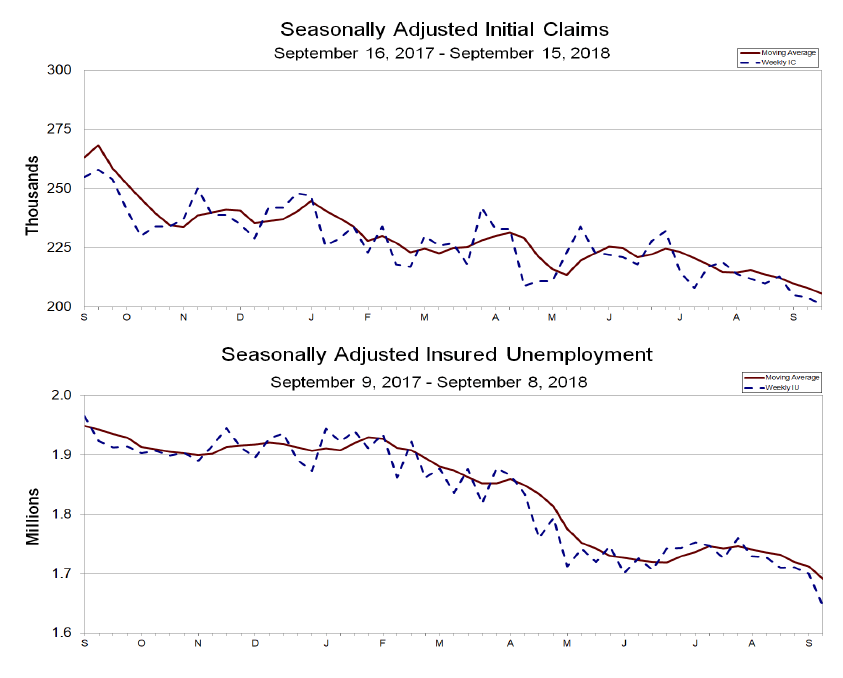
US initial jobless claims dropped to 201k, Philly Fed business outlook rose to 22.9
US initial jobless claims dropped -3k to 201k in the week ended September 15, below expectation of 210k. It's also the lowest level since November 15, 1969, when it was 197k. The four week moving average of initial claims dropped -2.25k to 205.75k, lowest since December 6, 1969.
Continuing claims dropped -55k to 1.645m in the week ended September 8. It's the lowest level since August 4, 1973. Four-week moving average of continuing claims dropped -20.75k to 1.6915m, lowest since November 17, 1973.
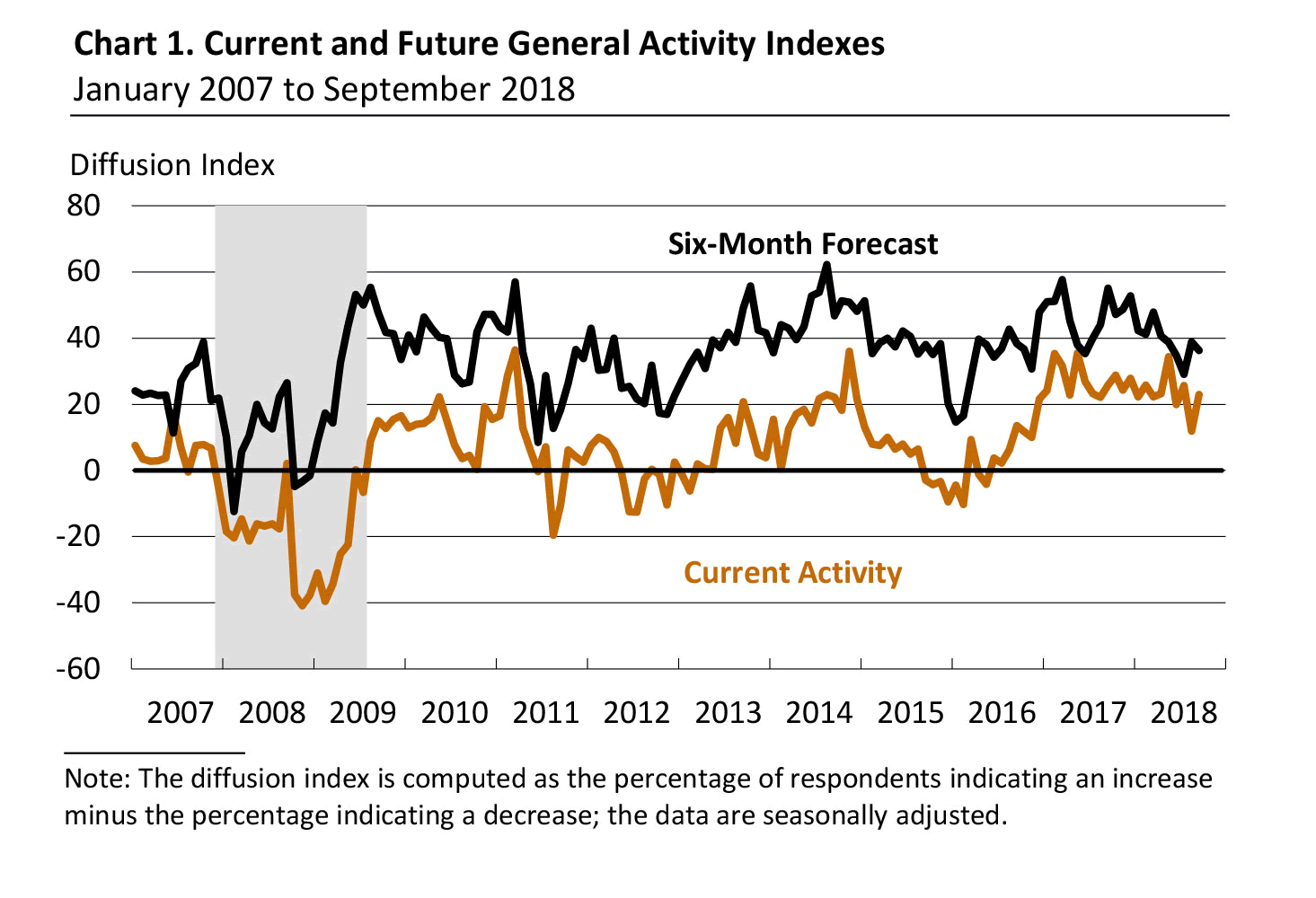
Philly Fed business outlook diffusion index for current general activity rose 11 pts to 22.9 in August. , above expectation of 16.3. Six-month indicator dropped to 36.3, down from 38.8.
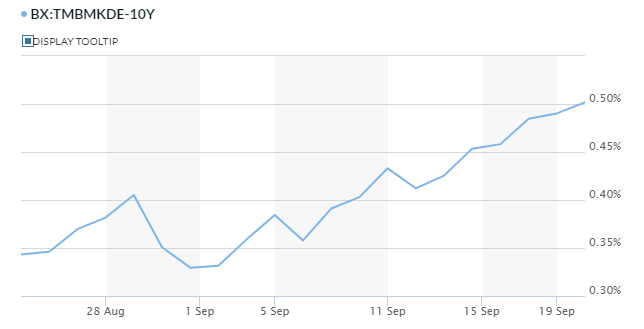
Into US session: Dollar in free fall as German 10 yield bund yield breaks 0.5%
Entering into US session. Dollar suffers a fresh round of selling against European majors in particular. It's unsure what's the exact reason that drives the greenback down, together with Yen. Could it be Trump's rant that his border wall is excluded from the spending of the Republican-led Congress?
Well, jokes aside, German 10 year bund yield's surge through 0.5% is likely the reason. It is currently up 0.011 at 0.501.
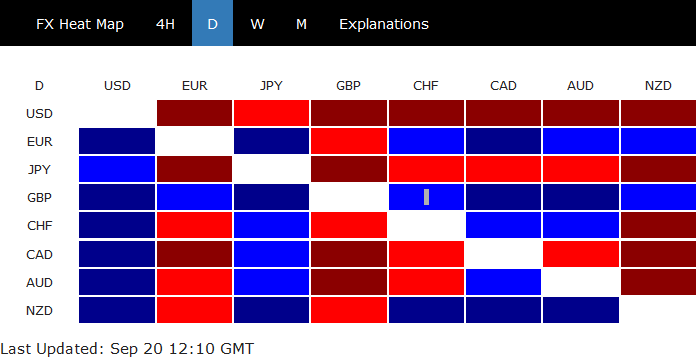
For now, Sterling remains the strongest one for today as helped by much stronger than retail sales. Additional support is given by positive words from EU leaders on Brexit agreement. At least, they're working towards a deal rather than away from it. New Zealand is trading as the third strongest one. It's second place was taken by Euro.
In other markets, European stock indices are strong with CAC leading the way up by 0.81%, DAX by 0.51% and FTSE by 0.16%. Earlier today, Asian markets were firm with Nikkei up 0.01%, Hong Kong HSI up 0.26%, Singapore Strait Times up 0.12%. China SSE closed slightly down by -0.06%.
Canadian Dollar at 3-Week High as Greenback Retreats
The Canadian dollar has posted small gains in the Thursday session. Currently, USD/CAD is trading at 1.2908, down 0.10% on the day. On the release front, Canada releases ADP nonfarm employment change. In the U.S, the Philly Fed Manufacturing Index is expected to jump to 17.5 points, while unemployment claims are forecast to climb to 210 thousand. On Friday, Canada releases CPI, which is expected to post a rare decline.
On Wednesday, there were key events on both sides of the border. Canada released Manufacturing Sales, posting a gain of 0.9%, which was within expectations. Still, the indicator has weakened for a third straight month, which could raise concern about the strength of the manufacturing sector. In the U.S, construction numbers were a mixed bag. Building Permits disappointed, dropping from 1.31 million to 1.23 million. This was well short of the estimate of 1.31 million and marked the weakest gain since September. There was better news from Housing Starts, which jumped from 1.17 million to 1.28 million, above the estimate of 1.24 million. This was a three-month high. On Thursday, we’ll get a look at Existing Home Sales, which has been on a nasty downtrend, losing ground for four straight months. The indicator is expected to improve slightly, to 5.36 million.
U.S President Trump fired another tariff salvo earlier this week, and the Chinese have vowed to retaliate. This has become an all-too familiar script, which was repeated on Monday, as the U.S announced 10% tariffs on some $200 billion worth of Chinese goods. Only this time, investors didn’t panic and the Canadian dollar and other currencies have held their own against the greenback. Why have the currency markets reacted so calmly? Investors appeared to have been ready for a move by Trump, and may be sighing in relief that the tariff was set at 10% rather than at 25%. One senior economist summed up Trump’s most recent salvo as “bad but manageable”. However, if the Chinese do indeed retaliate and the U.S takes further measures, this would likely shake up the currency markets and boost the U.S dollar.
Pound Boosted by Retail Sales, EU Summit in Focus
The Pound was thrown back into the limelight today after UK retail sales unexpectedly rose in August.
UK retail sales dished out an upside surprise by rising 0.3% last month as shoppers shrugged off Brexit concerns over the summer period. While this encouraging report adds to a number of solid economic indicators produced by the UK, investors are likely to remain more concerned with Brexit developments.
Market optimism over Britain striking a Brexit deal with the European Union has been the primary driver behind the Pound’s appreciation in recent weeks. However, it is becoming evident that Sterling remains extremely sensitive and highly reactive to Brexit talks. The explosive price action witnessed yesterday following reports of Theresa May set to reject the European Union’s “improved” offer on the Irish border is a testament to this.
Investors will be keeping a close eye on today’s informal EU summit in Salzburg which will play a major role in where the Pound concludes this week. It is worth noting that the Irish border puzzle remains a fierce obstacle to a deal, and it will be interesting to see if both sides are able to overcome this issue.
Taking a look at the technical picture, the GBPUSD is firmly bullish on the daily charts with prices trading above 1.3200 as of writing. While Dollar weakness has played a role in the Pound’s upside, most of the gains remain attributed to Brexit optimism and positive UK economic data. A solid daily close above the 1.3200 level could inject bulls with enough inspiration to challenge 1.3280 and 1.3320, respectively.
Dollar bulls were nowhere to be seen on Thursday as easing trade war fears boosted risk sentiment – ultimately dampening the Greenback’s safe-haven appeal. A bout of profit taking ahead of the FOMC statement next week fueled the downside with the Dollar Index trading marginally below 94.30 as of writing. Sustained weakness under the 94.30 level could send prices towards 94.00 in the near term.
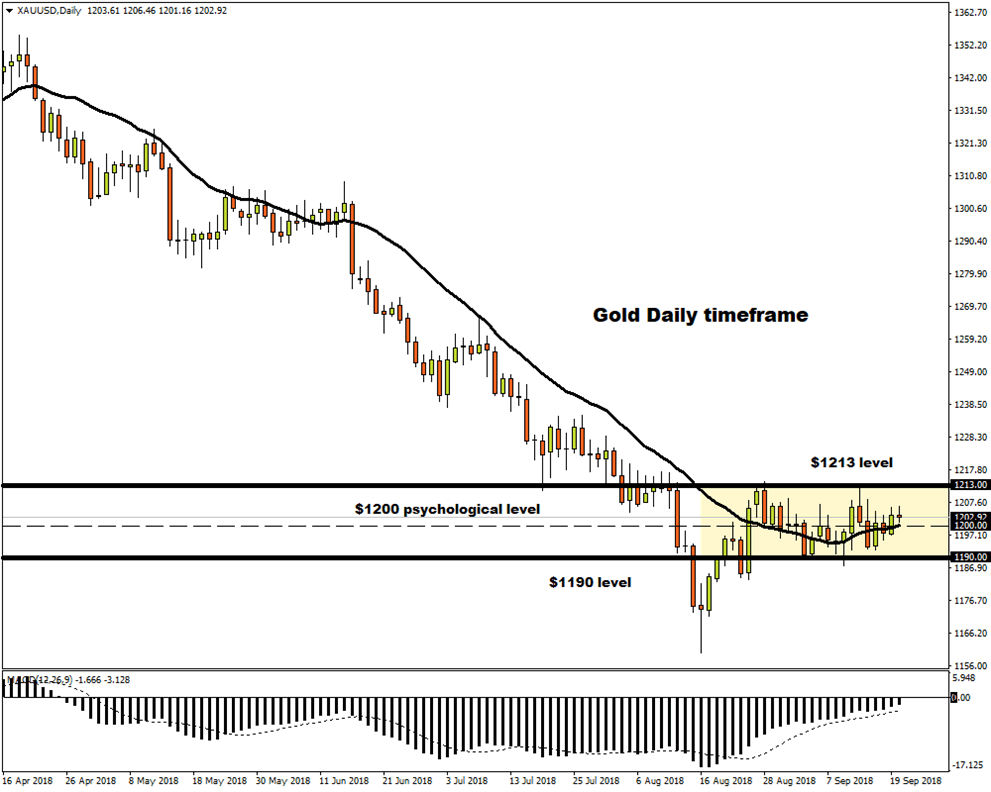
In the commodity markets, Gold prices struggled for direction despite easing trade tensions softening the Dollar. Price action suggests that the yellow metal is currently hunting for a fresh directional catalyst to make the next major move. In regards to the technical perspective, the $1,200 psychological level remains a significant point of interest with $1,213 acting as resistance and $1,190 a support.
U.S Safe-Haven Appeal Diminishes
Thursday September 20: Five things the markets are talking about
It's not been easy, two and two do not add up when trading these Twitter directional asset classes. Fundamentals have been temporary ignored as the ‘lemming' trades takes a grip.
Fading market fears over a Sino-U.S trade row has the U.S dollar trading within striking distance of its two-month lows. Even emerging-market currency pairs have found some traction after China said it would not retaliate with competitive currency devaluations.
Global equities are beginning to struggle as U.S yields approach their highest level this year.
In Europe, U.K Consumer spending remains buoyant despite Brexit uncertainties. Norway raises interest rates for the first time in seven-years and the Swiss kept rates on hold.
1. Stocks mixed results
In Japan, the Nikkei ended little changed overnight as an extended rally in financial sector was largely offset by profit taking after this weeks rally. The Nikkei inched up +0.01%, just about staying in positive territory for the fifth consecutive session. The broader Topix added +0.11%.
Down-under, Aussie shares slipped overnight, led lower by banks and consumer staples as investors shifted funds to emerging markets as they became less worried about a U.S-China trade war. The S&P/ASX 200 index fell -0.3% at the close of trade. The benchmark gained +0.5% yesterday. In S. Korea, the Kospi index rallied +0.65%, supported again mostly by Samsung.
Stocks in China fell overnight, as investor sentiment remained fragile following the latest hit of tariffs in the Sino-U.S. trade war. At the close, the Shanghai Composite index and the blue-chip CSI300 index were both down -0.1%.
In Hong Kong, there were mixed results as some investors held on to hopes that China and the U.S would eventually reach an agreement to avert an all-out trade war. The Hang Seng Index rose +0.26%, while the Shanghai Composite Index slipped -0.06%.
In Europe, regional bourses have opened broadly higher. Market will focus on the ‘informal' E.U leaders summit comments.
U.S stocks are set to open little changed (+0.0%).
Indices: Stoxx50 +0.3% at 3,379, FTSE +0.1% at 7,334, DAX +0.2% at 12,248, CAC-40 +0.4% at 5,415, IBEX-35 +0.4% at 9,526, FTSE MIB +0.5% at 21,396, SMI +0.4% at 8,974, S&P 500 Futures flat
2. Oil steady, supported by U.S. stocks and supply concerns
Oil prices trade steady, nevertheless, the market remains a tad better ‘bullish' after this week's U.S crude inventory reports and on signs that OPEC may not raise production enough to compensate for the loss of Iranian exports hit by U.S. sanctions.
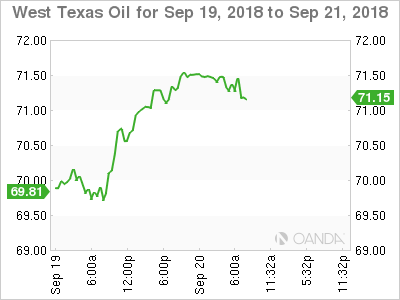
Brent crude oil is unchanged at +$79.40 a barrel, while U.S light crude oil is +40c higher at +$71.52 after rising nearly +2% in yesterday's session.
Note: Brent has been trading below $80 for the past week after conflicting reports of the market views of Saudi Arabia, the biggest producer in OPEC. They wanted oil to stay between +$70 and +$80 a barrel for now, seeking a balance between maximizing revenue and keeping a lid on prices until U.S midterms. However, giving the market a bid undertone are reports yesterday indicating that the Saudi's were happy with prices above +$80 a barrel.
EIA data Wednesday showed that U.S crude oil stockpiles fell for a fifth consecutive week to a three-year low in the week to Sept. 14, while gas stocks also showed a larger than expected draw on unseasonably strong demand. Crude inventories fell by -2.1m barrels, compared with expectations for a decrease of -2.7m.
Note: OPEC and other producers, including Russia, meet on Sunday in Algeria to discuss how to allocate supply increases to offset the loss of Iranian barrels.
Ahead of the U.S open, gold prices have inched higher as the ‘big' dollar softened amid easing Sino-U.S trade tensions. Nevertheless, expect investors to remain cautious ahead of next week's Fed meeting. Spot gold is up +0.1% at +$1,204.69, after rising +0.5%yesterday.
3. Norway hikes rates for the first time in seven years, SNB on hold
Earlier this morning, Norway's central bank hiked its key interest rate for the first time in more than seven-years. Norges Bank increased the rate to +0.75% from +0.5%.
The central bank said another rate increase is likely in the first three months of next year, with a gradual series of moves taking it to +2% by the end of 2021.
“If the key policy rate is kept at the current level for too long, price and wage inflation may accelerate and financial imbalances build up further,” said Governor Olsen. “That would increase the risk of a sharp economic downturn further out.”
Note: Sweden has also indicated that it may raise its key rate before the end of the year, while the ECB plans to end QE in December.
Elsewhere, the Swiss National Bank (SNB) kept its deposit rate at -0.75%, as expected. The accompanying statement painted two different pictures – the negative rate and willingness to intervene in FX markets “remain essential in order to keep the attractiveness of CHF low and thus ease pressure on the currency.” That said, policy makers also painted a brighter economic future and raised its 2018 GDP forecast to between +2.5% and +3%.
4. Dollar downfall
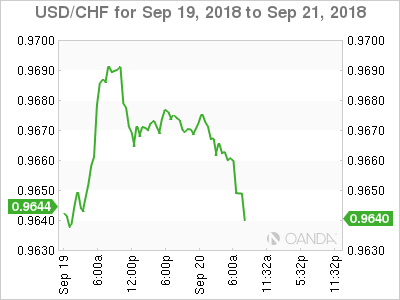
The CHF ($0.9659) is a tad weaker after the Swiss National Bank (SNB) left rates on hold. The fact that the franc remains “highly valued and has appreciated noticeably” has investors wary of the bank's next moves.
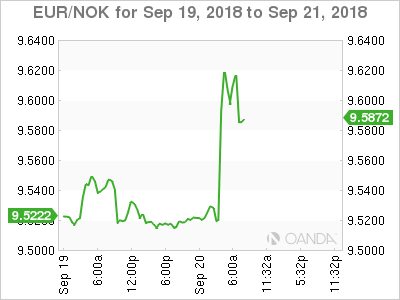
EUR/NOK (€9.6068) initially fell following the Norges rate hike, but has since reversed and is trading down -1% outright after the bank cut its policy rate forecasts.
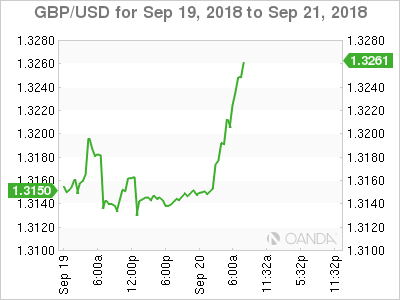
GBP/USD (£1.3226) has rallied sharply, again testing yesterday's intraday highs, on Brexit talk and on stronger than expected U.K retail sales (see below).
USD/ZAR is down by -1.5% at $14.4793 – some investors are anticipating a surprised rate hike this morning. Nevertheless, the consensus expects rates to remain unchanged, given that prices remain within the bank's inflation target range and that the economy has slid into a recession.
5. U.K retail sales slowed in August
Data this morning showed that U.K. retail sales slowed in August but continued to point to buoyant consumer spending in Q3, which suggests that the economy has kept expanding despite uncertainty over Brexit.
According to the ONS, U.K retail sales rose +0.3% on month in August, after a revised +0.9% rise in July.
Digging deeper, consumer spending continues to power the U.K economy as sales increased across most store categories with the exception of food and clothing outlets.
But is it sustainable, given high inflation, low wage growth and rising interest rates? Uncertainty over the U.K's future continues to deter investment.
Five Things to Consider When Choosing a Forex Broker
There is so much money being traded daily in the forex markets, making it one of the hottest investment opportunities around.
Because of this, the number of brokers is increasing and so choosing the right one can difficult due to all the advertising claiming they have the best offers etc.
Here are 5 things to consider when choosing a forex broker.
1. They comply with regulation
First and foremost, they must be a licenced broker. Speaking for the US, a reputable forex broker will be a member of the National Futures Association (or NFA) and will be officially registered with the US Commodity Futures Trading Commission (CFTC) as a futures commission merchant, as well as a retail foreign exchange dealer.
Furthermore, the NFA is an industry-wide, entirely self-regulatory organisation for the futures industry in the USA. Its main functions are to develop rules, programs and services to provide protect the market and its participants. Besides that, it is there to ensure members meet regulatory responsibilities and certain obligations.
Do your homework on the site. Just because a broker looks professional doesn’t mean that it is licensed and regulated properly.
2. The trading platform
The trading platform is the investor's portal to the market. As such, forex traders should make sure the platform can be easily operated. It should also have all the necessary financial market analysis tools to help you with your trading.
Most importantly, they must make it easy to enter and exit trades. A well-designed trading platform will have clear ‘buy' and ‘sell' buttons, and some even have a "panic" button that closes all open positions. A poorly designed interface, on the other hand, could lead to costly order entry mistakes, such as accidentally adding to a position rather than closing it, or going short when you meant to go long.
Other considerations include customization options, order entry types, automated trading options, elite forex trading strategy building, back testing newly learned theories and trading alerts. Most brokers offer free demo accounts so that traders can try out the trading platform prior to opening and funding an account.
3. Account details
While every forex broker will be different, they will all have similar account offerings:
- Forex participants have access to a range of leverage amounts depending on the broker, like 50:1 or 200:1. Leverage is a loan extended to margin account holders by their brokers. For instance, by applying a 50:1 leverage, a forex trader with an account size of $1,000 can hold a position that is valued at $50,000. Leverage works in a trader's favour with winning positions as the potential for profits is considerably amplified. However, leverage is capable of hastily destroying a trader's account because the potential for losses is augmented as well. This leads us to the point that leverage is should only be used with caution.
- A forex broker makes money through established commissions and spreads by charging a certain percentage. Nonetheless, a lot of brokers advertise that they don't charge commissions and instead make their money with wider spreads. For instance, the spread could be a fixed spread of three pips, or the spread could be variable depending on market volatility. For example, let’s say that a GBP/USD quote of 1.5551 - 1.5554 has a three-pip spread. This implies that once a market participant purchases at 1.5554, the position has already lost three pips of value, as it could solely be sold instantly for 1.5551. Therefore, the wider the spread, the more complicated it can be to make a profit. In fact, common trading pairs like the GBP/USD and EUR/USD will generally have tighter spreads than the more thinly-traded pairs.
- Mostforex accounts can be funded with a very limited initial deposit, even being as low as $50. Of course, with leverage purchasing power it can be considerably greater than the minimum deposit. That is one of many reasons why forex trading is so appealing to new traders and investors. Many brokers offer standard, mini and micro accounts with changeable initial deposit requirements.
- Every forex broker has their own account withdrawal, as well as funding policies. Brokers may permit account holders to fund accounts online via PayPal, simply with a credit card or via ACH payment, not to mention wire transfer, bank cheques or either business or personal cheques. Usually withdrawals can be made by cheque or by wire transfer. Those that are reputable and good forex brokers might charge a fee for each service.
4. Execution
It is mandatory that your broker fills you at the best possible price for your orders.
Under normal market conditions (e.g. normal liquidity, no important news releases or surprise events), there really is no reason for your broker to not fill you at, or very close to, the market price you see when you click the “buy” or “sell” button.
For example, assuming you have a stable internet connection, if you click “buy” EUR/USD for 1.3000, you should get filled at that price or within micro-pips of it. The speed at which your orders get filled is very important.
A few pips difference in price can make that much harder on you to win that trade.
5. Customer Service
Forex trading occurs 24 hours a day, so a broker's customer support should be available at any time. Therefore, you must pick a broker that you could easily contact if and when problems arise.
The competence of brokers when dealing with account or technical support issues is just as important as their performance on executing trades.
Brokers may be kind and helpful during the account opening process but have terrible “after sales” support.
When considering a broker, a quick call can give you an idea of the type of customer service they provide, wait times and the representative's ability to concisely answer questions regarding spreads, leverage, regulations and company details.