Sample Category Title
(SNB) Swiss National Bank leaves expansionary monetary policy unchanged
The Swiss National Bank (SNB) is maintaining its expansionary monetary policy, thereby stabilising price developments and supporting economic activity. Interest on sight deposits at the SNB remains at –0.75% and the target range for the three-month Libor is unchanged at between –1.25% and –0.25%. The SNB will remain active in the foreign exchange market as necessary, while taking the overall currency situation into consideration.
Since the monetary policy assessment of June 2018, the Swiss franc has appreciated noticeably, against the major currencies as well as against emerging market currencies. The Swiss franc is highly valued, and the situation on the foreign exchange market is still fragile. The negative interest rate and the SNB's willingness to intervene in the foreign exchange market as necessary remain essential in order to keep the attractiveness of Swiss franc investments low and thus ease pressure on the currency.
The new conditional inflation forecast suggests that inflation up to the beginning of 2019 will be higher than predicted in June due to a slight rise in domestic inflation. From the second quarter of 2019, the new conditional forecast lies below the June forecast as a result of the appreciation in the Swiss franc. For 2018, the SNB continues to anticipate inflation of 0.9%, while the inflation forecast of 0.8% for 2019 is 0.1 percentage points lower than projected at the last assessment. For 2020, the SNB expects to see inflation of 1.2%, compared with the 1.6% forecast in the last quarter. The conditional inflation forecast is based on the assumption that the three-month Libor remains at –0.75% over the entire forecast horizon.
Overall, global economic growth was solid in the second quarter. In the advanced economies, utilisation of production capacity continued to improve and employment figures once again rose. In the emerging economies, too, economic momentum remained generally robust. International goods trade nonetheless slowed somewhat.
Economic signals for the coming months remain favourable. Supported by ongoing expansionary monetary policy in the advanced economies and improved labour markets, the global economy is likely to continue to grow. However, following strong growth in the previous quarters, the pace is expected to slow slightly. To date, the crises of confidence in Turkey and Argentina have not materially impacted the global economic outlook.
The risks to this positive baseline scenario are more to the downside. Chief among them are political uncertainties in some countries as well as potential international tensions and protectionist tendencies.
Switzerland's economy has continued to recover. The revised GDP figures for recent years reveal stronger growth momentum than was originally reported. In the second quarter 2018, GDP once again grew faster than estimated potential output, at an annualised rate of 2.9%. The positive development in the first half of the year was, however, partly due to special factors. Overall, utilisation of total production capacity has improved further, and unemployment has also continued to decline over recent months.
Leading indicators suggest that the economic outlook remains favourable. Some loss of momentum is expected, however, due to a slight slowdown in global growth and the dampening effect of recent Swiss franc appreciation. The SNB now anticipates GDP growth of between 2.5% and 3% for the current year and a further slight fall in unemployment. The stronger growth forecast is attributable to the upward revision for the previous quarters.
Imbalances on the mortgage and real estate markets persist. Both mortgage lending and prices for single-family homes and privately owned apartments continued to rise at a moderate rate over recent quarters. Although prices in the residential investment property segment have stabilised, there is the risk of a correction due to strong price increases in recent years and growing vacancy rates. The SNB will continue to monitor developments on the mortgage and real estate markets closely, and will regularly reassess the need for an adjustment of the countercyclical capital buffer.
NZDUSD Extends Gains Near 3-Week High But Bearish Outlook Still Holds
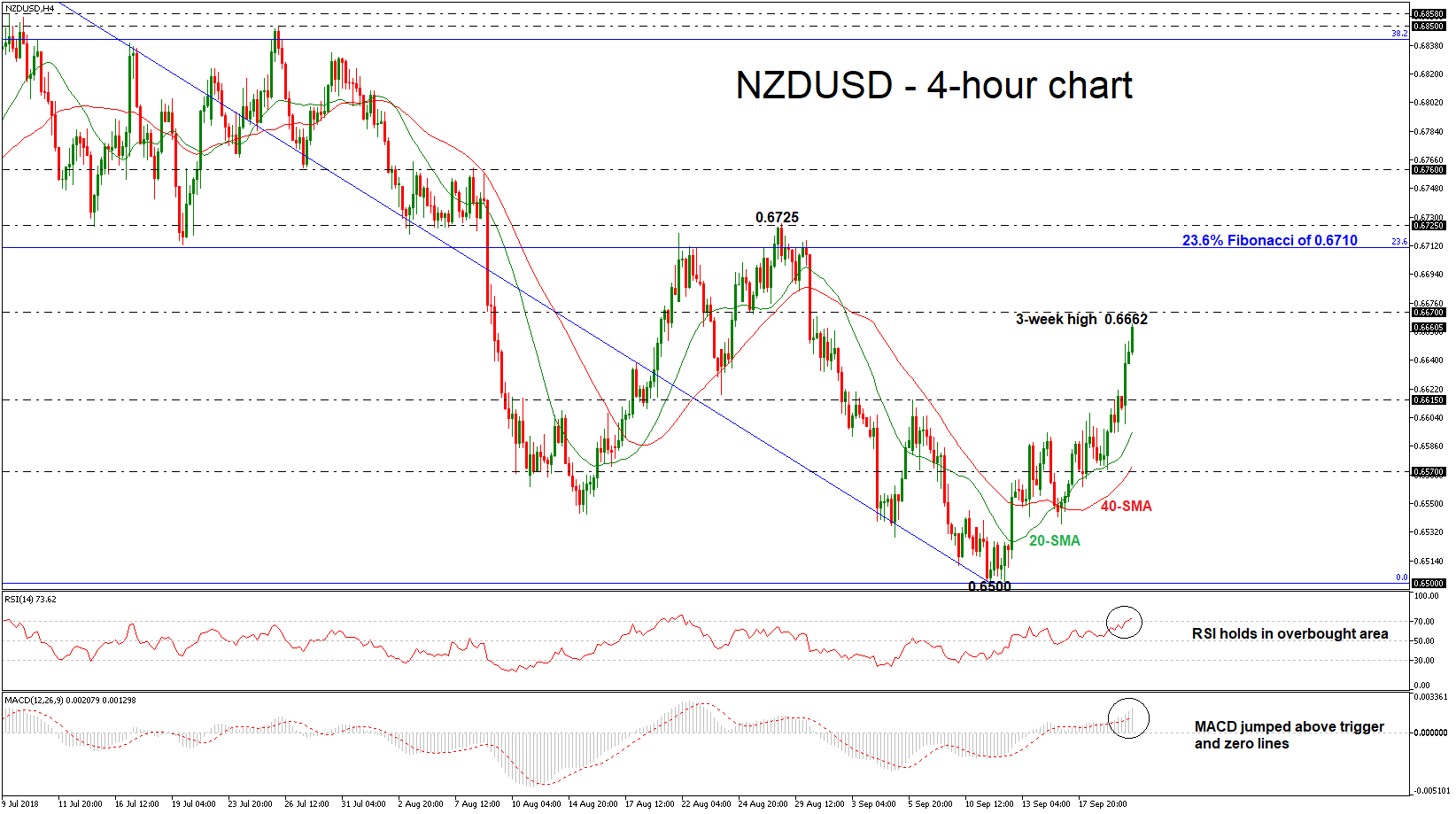
NZDUSD has been edging higher over the last three days, heading above the 20- and 40-simple moving averages (SMAs) in the 4-hour chart. The price reached a new three-week high of 0.6662 earlier in the day, while the technical indicators are confirming the recent bullish bias in the short term. The RSI indicator entered the overbought zone, surpassing 70 level with strong momentum and the MACD oscillator is strengthening its positive movement above trigger and zero lines.
Should the price decisively close above the roof of the 0.6670 resistance barrier, taken from the lows on August 27, bulls could extend the upside correction mode towards the 23.6% Fibonacci retracement level of the downleg from 0.7390 to 0.6500, near 0.6710. Further advances above this level, could then target the area around 0.6725, which had successfully halted upside movements during the aforementioned month as well.
On the other side, a bounce off the 0.6670 barrier could drive the pair lower until the 0.6615 support level. In case of a bearish movement below this level, the price could retest the 20- and then the 40-SMAs at 0.6595 and at 0.6570.
In the medium-term, NZDUSD has been trading bearish in the past five months after the pullback on the 0.7390 hurdle, but if the price jumps above 0.6725, this could shift the outlook to more neutral to bullish one.
Sterling jumps as retail sales beat expectations, growth in all four sectors
Sterling surges broadly again after August retail sales data beat market expectations.
- Retail sales include fuel rose 0.3% mom versus expectation of -0.2% mom
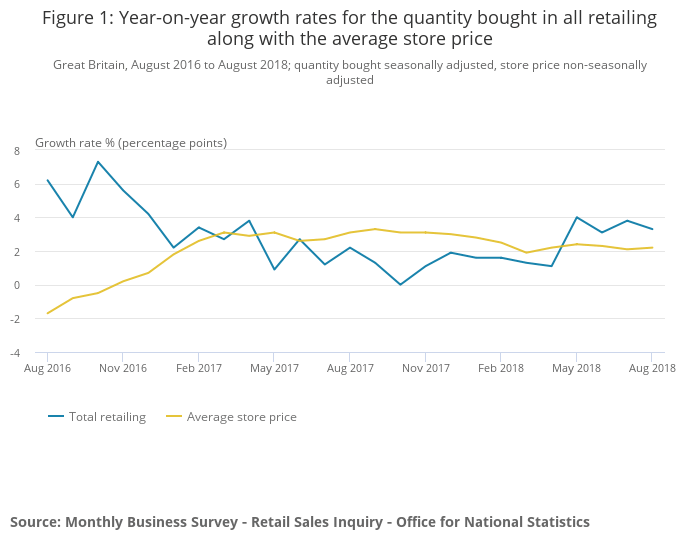
- Retail sales include fuel rose 3.3% yoy versus expectation of 2.3% yoy
- Retail sales exclude fuel rose 0.3% mom versus expectation of -0.3% mom
- Retail sales exclude fuel rose 3.5% yoy versus expectation of 2.3% yoy
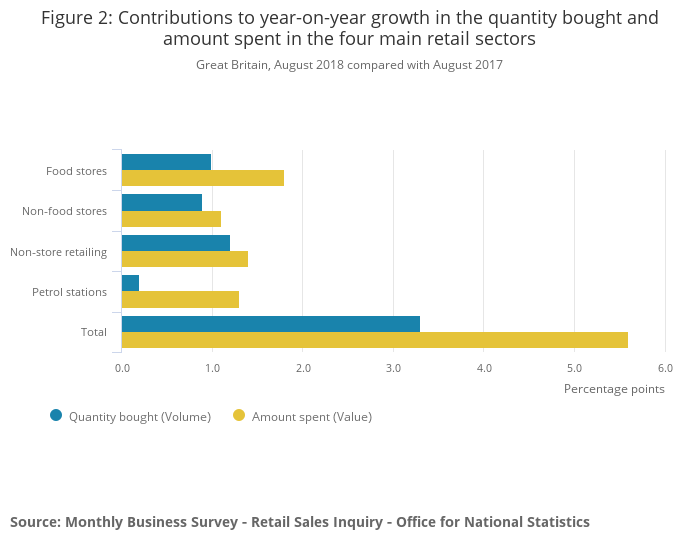
All four main sectors contributed positively to growth. In volume term, Food stores contributed 1.0% yoy, non-food stores 0.9% yoy, non-retailing stores 1.2% yoy and petrol stations 0.2% yoy.
SNB Stands Idle, ZAR Recovers
SNB plays the same record!
Switzerland's foreign trade remained subdued in August amid weak demand from the US and Asia. Exports rose 0.6%m/m in August, while previous month figure was downwardly revised to -2%m/m from -1.4%. Imports contracted 2.8%m/m, compared to -1.3% in July. The trade balance rose to CHF 1.4bn, up CHF 200mn from the previous month. Trade activity with the European Union remains solid, even though imports has been contracting over the last few months. However, it looks like the trade war initiated by the Donald is weighting on the US-Switzerland trade activity as well. Finally, the Swiss franc appreciated during the second half of August; therefore, it would reasonable to expect further contraction of trade activity in the coming months.
Separately, the Swiss National Bank left its expansionary monetary policy unchanged, as widely expected. The monetary institution sticks to its usually wording as it maintains its view that the Swiss franc is “highly valued” and acknowledges that the Swissie “appreciated noticeably” since the June monetary policy assessment. Not surprisingly, the SNB did not miss the occasion to highlight the risks posed to the positive outlook by international trade tensions and political uncertainties, mostly in Europe. Despite this warning, the SNB acknowledges the solid momentum in economic growth, both domestically and internationally. Finally, the inflation forecast for the third quarter has been revised to the upside, but the institution revised 2019 forecast to the downside.
Overall, the SNB is true to itself and didn't budge as it reiterates its promise to intervene in the FX to weaken the Swiss franc should conditions warrant. Thomas Jordan will not take the risk to increase rate before the ECB. Higher interest rate in Switzerland is therefore not for tomorrow.
South African rand up
Today's South African Reserve Bank MPC decision is expected to maintain its Repo rate stable at 6.50% due to moderating inflation expectations within target corridor of 3-6% along with improving framework conditions for EM countries.
Therefore, we expect the SARB to avoid raising rates for now, due to current weak economic condition. However, the economic growth outlook is expected to improve, as the country will be benefitting from a weaker currency, thus improving its export potential. Nonetheless, the SARB will be taking careful attention at the impact of imported inflation, the side effect of depreciating currencies.
USD/ZAR is currently trading at 14.45, as EM currencies are strengthening across the board. The pair is expected to head along 14.30 in the short-term.
EURUSD Flat Top Ascending Pattern Formation
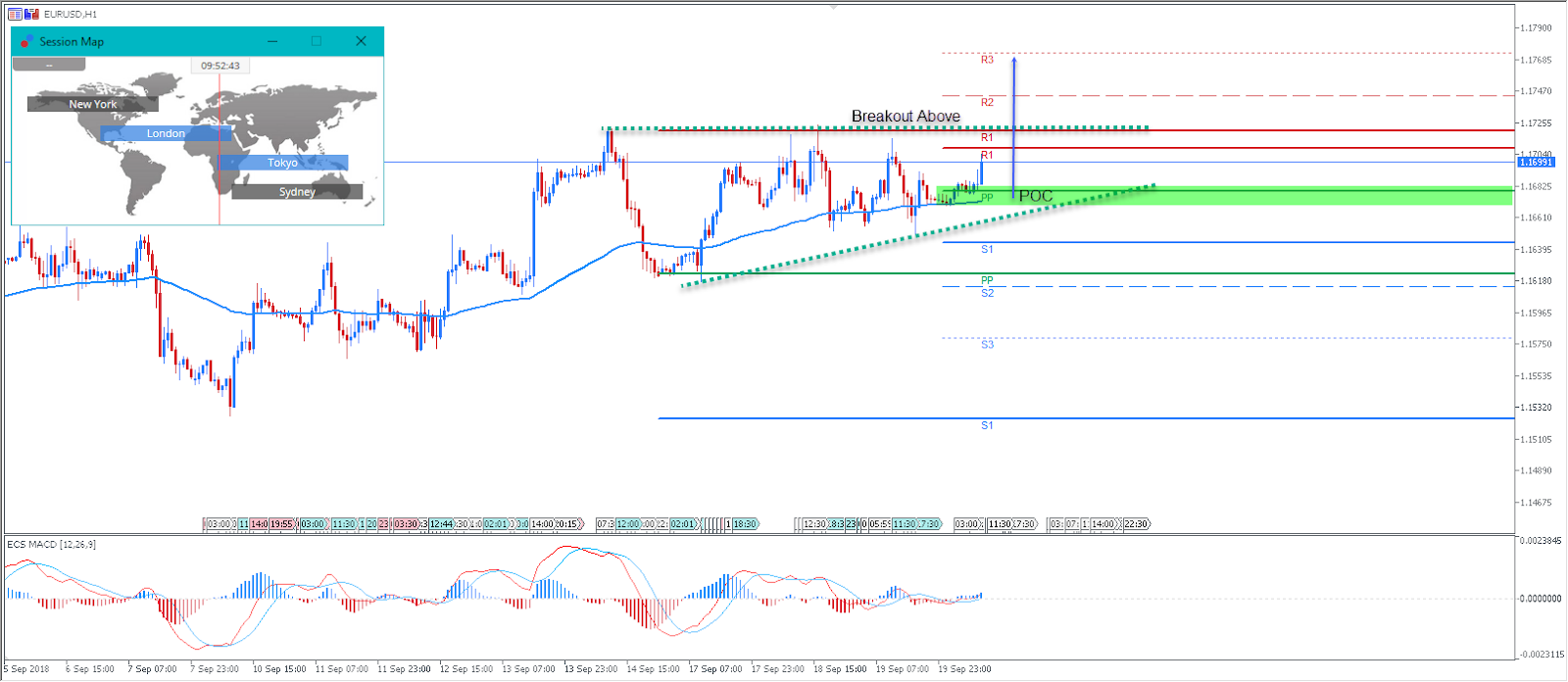
The EURUSD currency pair has formed a consolidation between the two important pivot points that have been consolidating in the bigger bullish formation. The formation is known as the flat top ascending pattern, that could actually make a triangle. This is a bullish formation, and we might see some bullish price action throughout the rest of the day. The speech from Deutsche Bundesbank President Jens Weidmann will occur at 3:15 PM GMT time, which may have an impact on the EURUSD. The Deutsche Bundesbank President is also a voting member of the ECB Governing Council (between May 2011 - Apr 2019). He's believed to be one of the most influential members of the council. The ECB Governing Council members vote on where to set the Eurozone's key interest rates, and their public engagements are often used to drop subtle clues about their future monetary guidance.
Technically, the EUR/USD currency pair is bullish above 1.1660, and its targets are 1.1700, 1.1725 and 1.1770. Bears might get the advantage if the pair drops below S1 , but nevertheless, the pair might still be supported around 1.1618. If anything happens that would cause a drop in the price, buyers might also look at the 1.1610-20 zone for a potential scalp trade towards the S1 Admiral Pivot point. For all new traders, bear in mind that the best sessions for trading the EURUSD are London and New York, so the actual bullish move should occur during those two sessions. On the chart (see above) we included a 'Session Map' indicator, to help you out if you are still struggling to know which session you should actually trade in.
Short Pivot Lines - Daily Support and Resistance
Long Pivot Lines - Weekly Support and Resistance
POC - POC - Point Of Confluence (The zone where we expect the price to react - aka the entry zone)
Sterling Jumps On Brexit Comments And Retail Sales Data
- Investors take tariffs in their stride, focused on White House response;
- GBP climbs on optimistic Brexit comments;
- Strong spending figures could weigh on data in Q4.
It's been a positive start to trading in Europe on Thursday as investors continue to shrug off the latest tariffs from the US and China.
US futures are currently trading flat and failing to take much of a lead from across the pond. Investors are continuing to monitor the main political stories, which have been an important driver of risk appetite for much of the year, but the latest tariffs didn't catch anyone off guard and so the impact has been marginal. Of far more interest to investors is what comes next with Trump having threatened to begin “phase three” if China responded with counter-tariffs, which they have.
The speed and aggression with which Trump responds will be interesting now, especially given China's apparent willingness to forge closer relationships elsewhere as ties with the US become increasingly strained. The mid-terms in November may well be a defining moment for these negotiations as a big defeat for Republicans could force a change of strategy. I think Trump will want to avoid “phase three” if possible due to the impact on the consumer but he's backed himself into a corner now, his response will be very interesting.
The pound is climbing again on Thursday, following some optimistic views on the prospect of a Brexit deal from the UK Cabinet Office Minister David Lidington and the release of stronger retail sales figures for August. With exit day fast approaching and clear divisions remaining, particularly on the Irish border, we seem to be getting a constant flow of commentary from a variety of officials on the progress of negotiations which is having a big impact on sterling.
The latest comments – in which Lidington claimed there is a 85-95% chance of getting a deal and that he believes it can be done by October – gave the pound a nice boost early in the European session. This is a perfect example of the kind of noise that's impacting the markets at the moment despite not really offering anything of substance and giving any indication of whether talks are moving forward, which they don't appear to be. But with the October and November meetings just around the corner, I don't see this changing as traders try to get ahead of the curve.
The UK retail sales figures were arguably more interesting and while they did provide an additional lift – taking the pound back above 1.32 against the dollar – the impact was much smaller than with Lidington's comments, which shows just how big an impact politics is having in markets right now compared to the data. Sales grew by 3.3% last month – 3.5% on a core basis – which easily exceeded expectations and included an upward revision to the July figure.
While I'm not convinced this momentum will continue into the end of the year, with the squeeze on real incomes more than likely to negatively impact spending after a bumper summer, it should provide a nice boost to third quarter growth. The question now is whether it will in turn act as a drag on the fourth quarter as consumers tighten the purse strings after a splurge during the sunny summer months.
WTI Oil Outlook: Bulls Look For Clear Break Above $71.17 Fibo Barrier To Signal Continuation
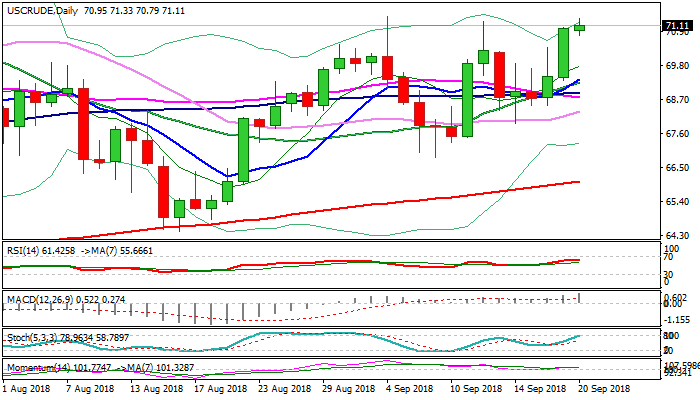
WTI oil hit two-week high at $71.33 on Thursday on renewed probe through pivotal $71.17 barrier (Fibo 61.8% of $75.34/$64.43 descend).
Bulls remain firmly in play and look for extension of previous day’s strong rally, when oil price advanced 2.3%.
Oil rose on recent comments that Saudi Arabia is comfortable with higher oil prices, with Wednesday’s release of EIA crude inventories report which showed that crude stocks fell by 2.1 million barrels to new 3.5 year low, adding to bullish outlook.
Bullish daily techs are supportive, however, flat momentum may cause bulls troubles at key resistance zone.
Firm break above $71.17 Fibo barrier (after two recent attempts were strongly rejected at $71.25 and $71.38) is needed to signal continuation of recovery phase from $64.43 (16 Aug low) and unmask next barrier at $72.77 (Fibo 76.4%).
Conversely, repeated failure to close above $71.17 pivot would signal consolidation before fresh attempts higher, with bullish outlook expected above rising 10SMA ($69.35) which formed bull-cross with 20SMA.
Res: 71.33, 71.38, 71.64, 72.00
Sup: 70.40, 70.00, 69.46, 69.35
Forex Technical Analysis: EUR/USD, USD/JPY, GBP/USD
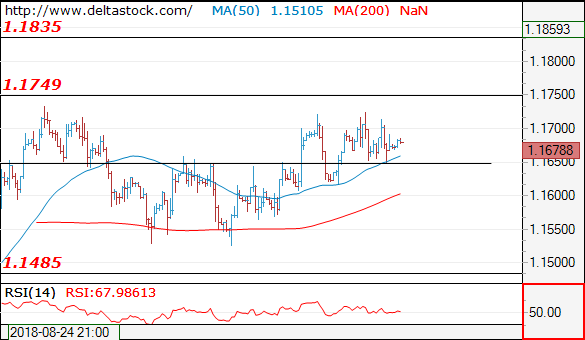
EUR/USD
Current level - 1.1678
Nothing interesting here, as only a violation of 1.1730 area will unleash a move towards 1.1835.
| Resistance | Support | ||
| intraday | intraweek | intraday | intraweek |
| 1.1730 | 1.1730 | 1.1650 | 1.1300 |
| 1.1840 | 1.1840 | 1.1530 | 1.1100 |
USD/JPY
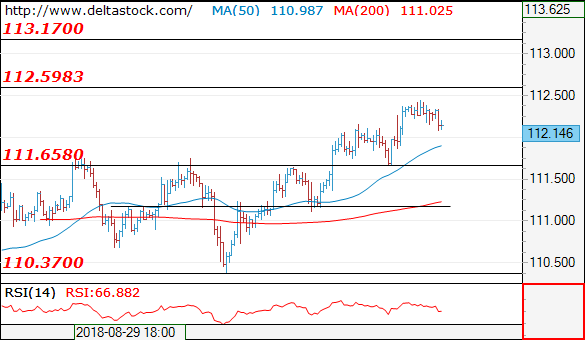
Current level - 112.14
The uptrend remains intact heading for a break through 112.60, en route to 113.20 area. Crucial low is projected at 111.65.
| Resistance | Support | ||
| intraday | intraweek | intraday | intraweek |
| 112.60 | 113.20 | 111.65 | 109.30 |
| 113.20 | 114.50 | 109.70 | 109.30 |
GBP/USD
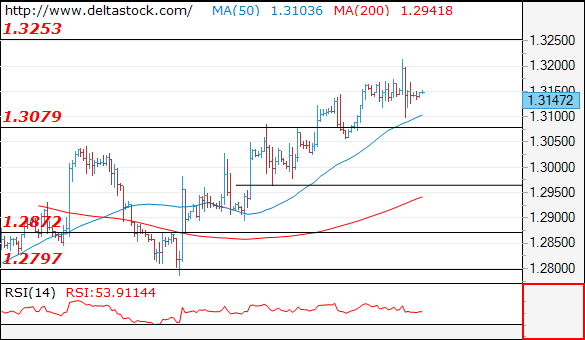
Current level - 1.3147
The recent reversal at 1.3215 is only a minor one and the overall outlook is still bullish, for 1.3250. Key support lies at 1.3050-80.
| Resistance | Support | ||
| intraday | intraweek | intraday | intraweek |
| 1.3215 | 1.3120 | 1.3050 | 1.2570 |
| 1.3250 | 1.3250 | 1.2960 | 1.2570 |
XAUUSD Intraday Analysis
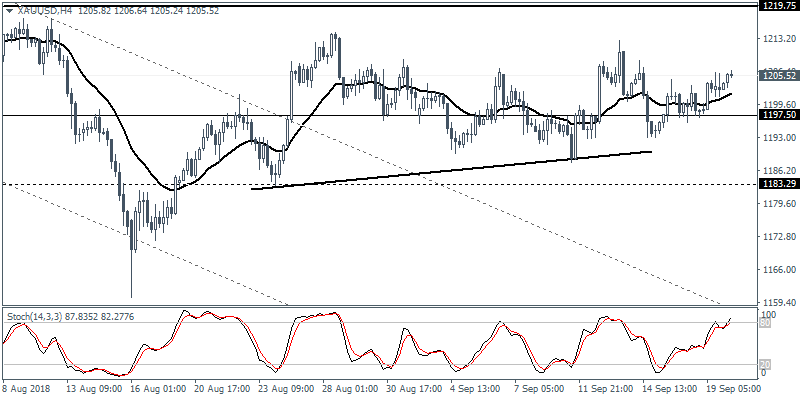
XAUUSD (1205.52): Gold prices continue to consolidate above 1197.50 level of support. Price action remains broadly muted at this level. With gold trading above 1197.50, the sideways range is expected to continue. The upside resistance at 1219.75 is likely to cap any further gains. To the downside, we expect the support at 1197.50 to hold in the near term. A decline below this level could, however, post further losses pushing gold prices down to 1183.30 support.
GBPUSD Intraday Analysis
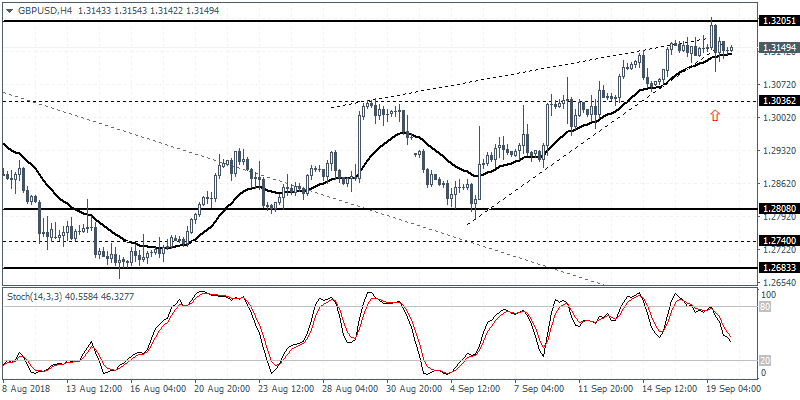
GBPUSD (1.3149): The GBPUSD currency pair was seen briefly testing the resistance level at 1.3205 before easing back. We expect to see a solid retest of this level once again before price action could potentially post a pullback. The retest of the support at 1.3036 is likely to form. Establishing support at this level could put GBPUSD on track to breach the current resistance level at 1.3205.