Sample Category Title
Bullish GBP/USD Testing Tops And Support Of Wave-1
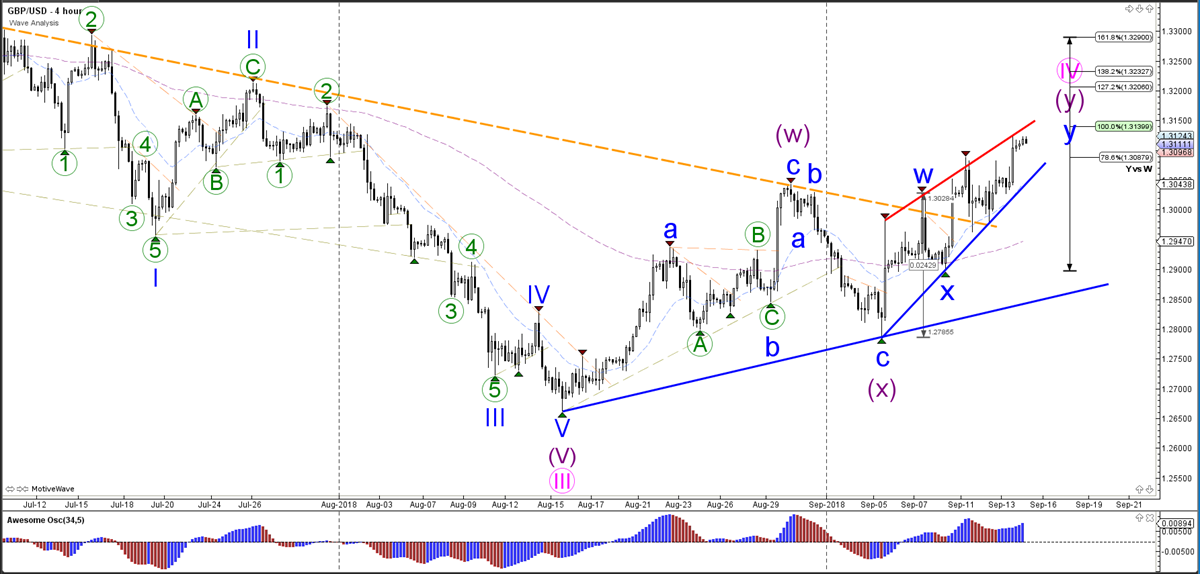
The GBP/USD is challenging the resistance trend line (red), which A bullish breakout could see price continue to the Fibonacci targets of wave Y vs W whereas a bearish bounce could see a move back to the support trend line (blue). The angle of the resistance trend line is converging with the support, which is indicating a rising wedge chart pattern.
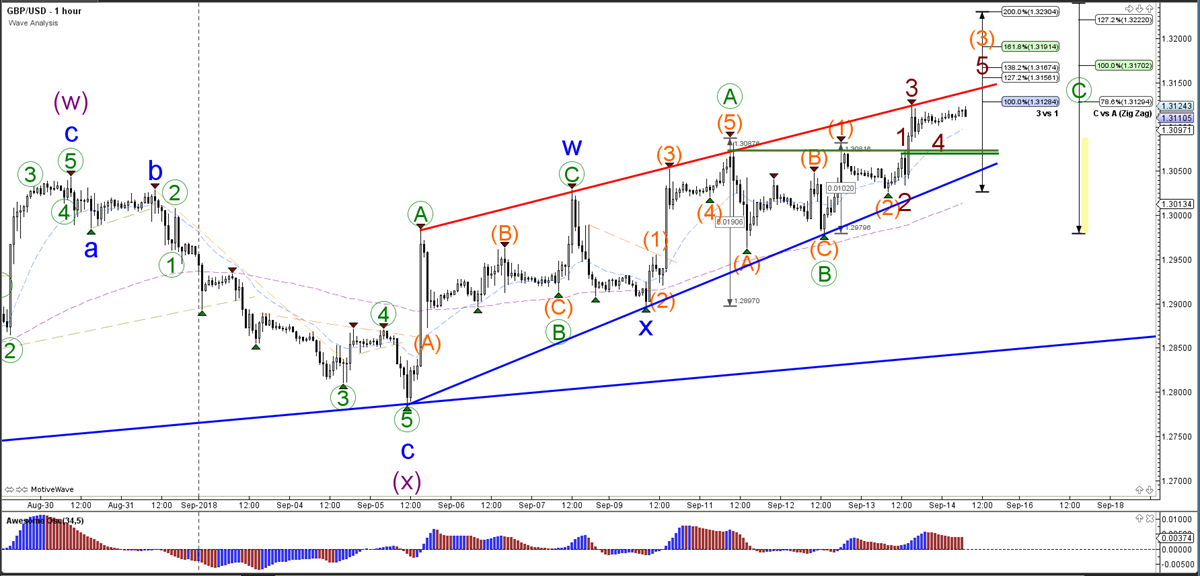
The GBP/USD is in a potential wave 4 (dark red) as long as price stays above the top of wave 1 which is indicated by the green trend line. A bullish continuation could be part of a wave 5 of wave 3 (orange).
Bonds Lost Slightly Ground Going Into The Publication Of The US CPI
Markets
Yesterday, global bonds faced a series of conflicting drivers. Turkey raising its policy rate to 24%, easing uncertainty on EM. It was a slightly positive for global risk sentiment. Bonds lost slightly ground going into the publication of the US CPI. US August price rises disappointed and propelled US Treasuries. At the same time, European bond market kept a close eye on the ECB press conference. The ECB basically confirmed its assessment from the June meeting. 2018 & 2019 growth was revised marginally lower, but inflation was seen unchanged at 1.7% for the 2018/2020 period. The ECB still sees risks to the outlook as balanced and Draghi showed confident that inflation is moving toward the ECB target further out. Draghi's conviction on inflation finally weighed on EGB's. A further improvement in global sentiment also reversed part of the post-CPI gains in US Treasuries. US yields even closed marginally higher (up to 1 bp). Changes in German yields were similar with the belly of the curve slightly underperforming (+1.1/1.2 bp). Today, global risk sentiment (is any progress possible in the US-China trade dispute?) and the US data (retail sales, production data and Michigan consumer confidence) will be the main drivers for bond markets. Yesterday, US Treasuries couldn't keep the post-CPI gains. Today's US eco data are expected to confirm the scenario of ongoing solid US growth. Will such an outcome allow the US 10-y yield to return (or even surpass) the 3.0% mark?
Yesterday, soft US August inflation and a positive risk sentiment weighed on the dollar (ex USD/JPY). At the same time, the euro profited as ECB's Draghi showed convinced that EMU inflation remains on track to meet the bank's inflation target over time. EUR/USD tested the 1.17 big figure and close the session at 1.1690 (from 1.1626) . USD/JPY was supported by the improved risk sentiment and finished at 111.92 (from 111.26). This morning, risk sentiment remains constructive. Pressure on EM currencies showed tentative signs of easing, but gains of most EM currencies (if any) remain modest. The dollar consolidates yesterday's loss. EUR/USD is holding within reach of the 1.17 big figure. Today's environment might be more neutral for the US currency. USD eco data might be USD supportive, but this might be counterbalanced by an ongoing positive risk sentiment. If so, USD/JPY might still outperform.
Yesterday, sterling hardly reacted to the BoE policy decision. The bank slightly raised its ST growth outlook. At the same time, Carney and co didn't change their assessment from August in any profound way. EUR/GBP closed the session marginally higher at 0.8920. There are no UK eco data today. BoE's Carney will speak in Dublin. Sterling trading most probably will continue to be guided by Brexit headlines.
News Headlines
Bank of England governor, Mark Carney, has addressed PM May's cabinet, warning for the risks of a no-deal brexit. He says it could lead to economic chaos, including a crash in property prices. He added that this time, the BoE will not be able to avert a crisis by cutting interest rates, as it did after the 2016 referendum vote.
Chinese retail sales rose slightly in August, from 8.8% in July to 9.0% (YoY), while the year-to-date figure remained stable. Industrial production (YoY) also gained some pace with a 6.1% increase last month against 6.0% in July. Investment growth in fixed assets slowed further to 5.3%, coming from 6.0% in June and 5.5% in July.
The Atlanta Federal Reserve President Bostic said he's taking a "wait and see" attitude whether one or two hikes are appropriate by the end of 2018. He feels the US labour market has room to improve, despite its already solid condition. The process of interest rates gradually moving higher should continue for at least "a handful of quarters".
USDCAD Turns Flat In Short Term After Dramatic Slump, Remains In Bearish Correction
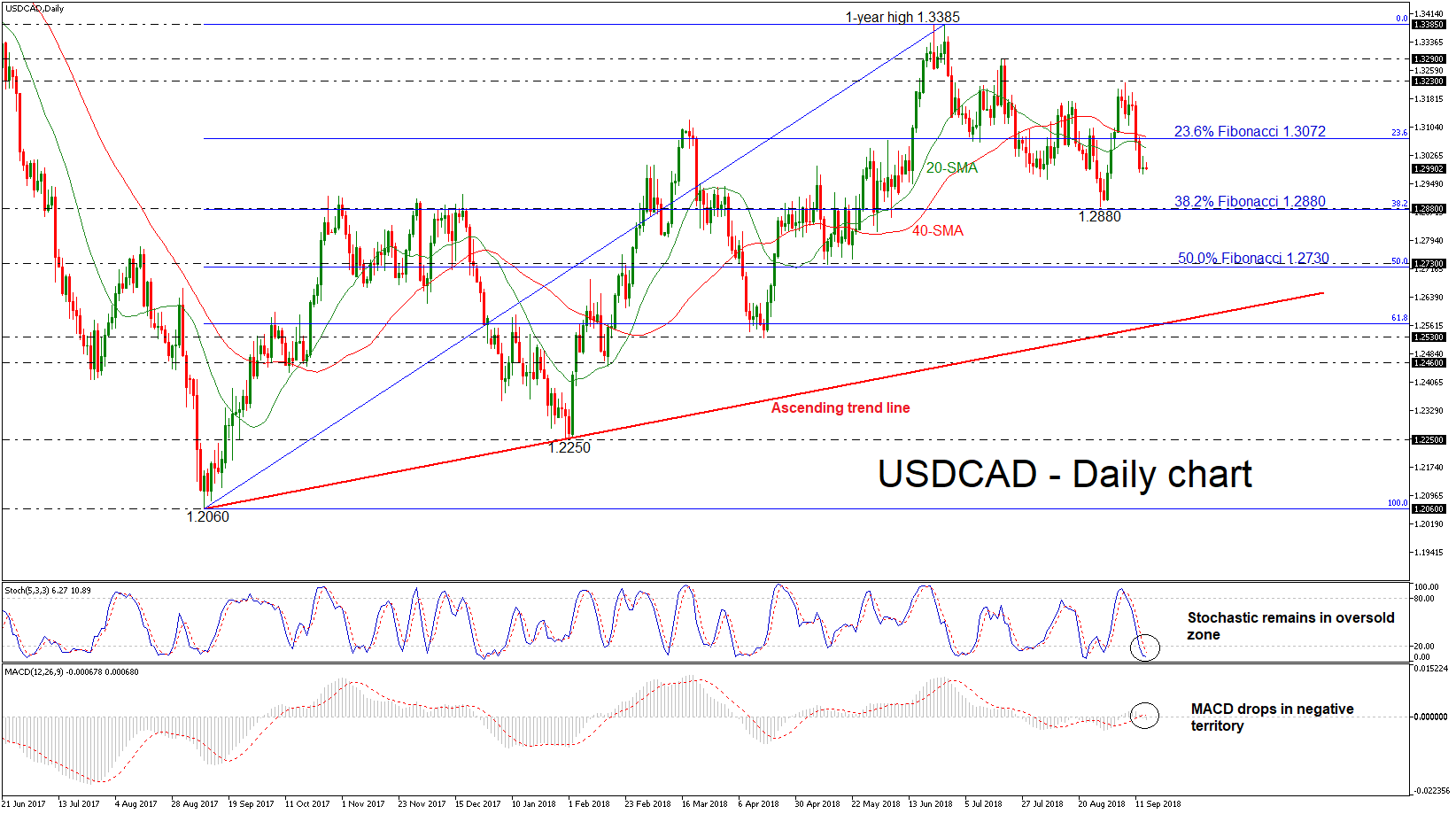
USDCAD has reversed to the downside this week, recording sharp losses following the bounce off the 1.3230 resistance level. Moreover, the pair plunged below the 23.6% Fibonacci retracement level of the upleg from 1.2060 to 1.3385 of 1.3072, and the 20- and 40-simple moving averages (SMAs) in the daily timeframe. However, since yesterday, the pair remains flat.
Momentum indicators are currently supporting that negative momentum is likely to strengthen in the short-term. Specifically, the stochastic oscillator is still holding in the oversold zone, while the MACD oscillator dropped below the trigger and zero lines, signaling selling pressures.
Should the market extend losses, support could be met at the 38.2% Fibonacci mark, which overlaps with the 1.2880 support level. A significant leg below this area could send prices towards the 1.2730 region, which stands around the 50.0% Fibonacci.
On the other side, if the price bounces up, immediate resistance could be met at the 23.6% Fibonacci of 1.3072 and near the moving averages, which act as strong obstacles for the bulls. Steeper increases, though, could drive the price south towards the 1.3230 barrier, where it topped on September 6.
In the bigger picture, over the last three months, USDCAD has been moving lower, creating lower lows and lower highs, posting a bearish correction. However, in the long-term timeframe the pair is bullish as long as it holds above the ascending trend line, which has been holding over the last year. A touch of the diagonal line is possible in the next weekly sessions.
EURUSD Now Bullish Above 1.1650 Level
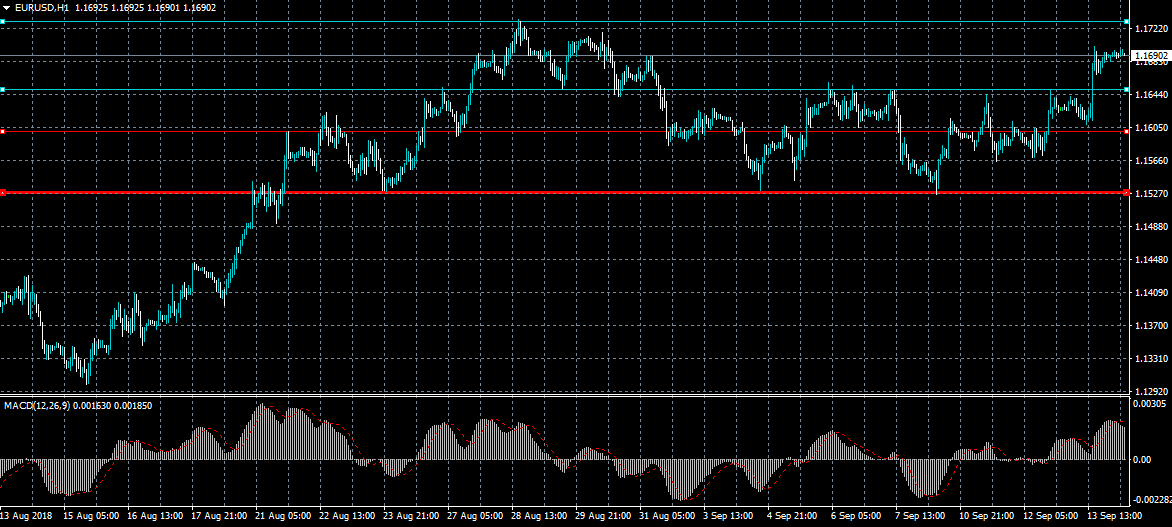
The euro currency has moved above the 1.1650 level against the US dollar after ECB President Mario Draghi struck a bullish tone towards future eurozone inflation. The EURUSD pair may create a bullish inverted head and shoulders pattern if buyers can push price towards the 1.1730 level. Sellers will need to edge price back below the 1.1600 level to change the intraday bullish bias, while buyers are currently probing the 1.1700 resistance level.
The EURUSD pair is intraday bullish while trading above the 1.1650 level, key resistance is now located at the 1.1700 and 1.1730 levels.
If the EURUSD pair moves below the 1.1650 level, sellers may test towards the 1.1600 and 1.1577 levels.
USDJPY Intraday Bullish Above 111.75 Level
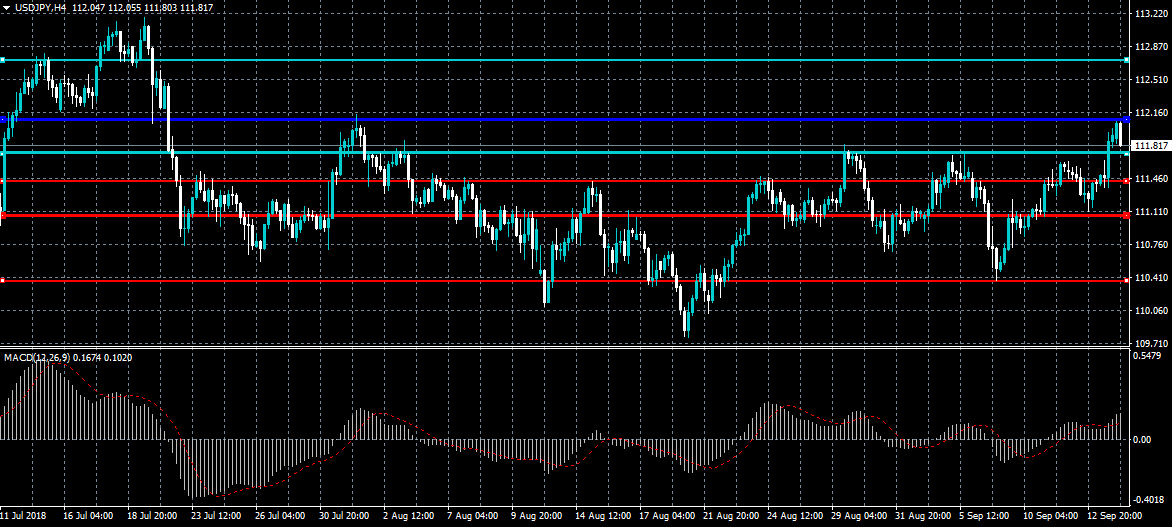
The US dollar has moved to a fresh monthly trading high against the Japanese yen, as rising equity markets and improving risk-on trading sentiment prompts traders to sell the yen currency. The USDJPY pair remains intraday bullish while trading above the 111.75 level, and is further supported by a bullish inverted head and shoulders pattern across the four-hour time frame.
The USDJPY pair is strongly bullish while trading above the 111.75 level, key resistance is found at the 112.10 and 112.80 levels.
If the USDJPY pair moves below the 111.75 level, key support is found at the 111.40 and 111.00 levels.
USD Falls Against Euro As Traders Wait For Key US Data
The USD fell against the euro after US data on inflation missed forecasted expectations. The core CPI rose by an annualized rate of 2.2%. This was lower than the 2.4% traders were expecting. The core CPI strips the volatile energy and food prices. The headline CPI number rose by an annual rate of 2.7%, which was lower than the expected 2.8%. In July, the CPI rose by 2.9%, which was the highest level since 2012. This data came a day after the PPI data also failed to meet expectations. On Wednesday, the data showed that producer prices rose by 2.8%, which was lower than the expected 3.2%. Still, the Fed is expected to hike interest rates later this month and in December.
Today, the USD will be the most active currency for two reasons. Firstly, traders will continue to focus on the current hurricane that has left more than 250K people without power in North and South Carolina. More than 1 million people have been forced to flee. Secondly, the US will release key data including retail sales, industrial and manufacturing production, consumer confidence, and business inventories. Also, the Chicago Fed president, Charles Evans will deliver a speech, which will be followed closely.
Asian stocks rose as the US and China tried to restart trade talks. These talks are meant to prevent a further escalation of the ongoing trade conflict. The US has pledged to add tariffs on Chinese goods worth more than $267 billion. Today, data from China showed that it is not being affected by the trade war. Its industrial production rose by 6.1% in August. This was higher than the expected 6.0%. Retail sales increased by 9.0%, which was higher than the expected 8.8%. On the other hand, the fixed asset investments rose by 5.3%, lower than the expected 5.5%. This was the lowest growth pace in record. Recent data showed that Chinese exports to the US were increasing too.
EUR/USD
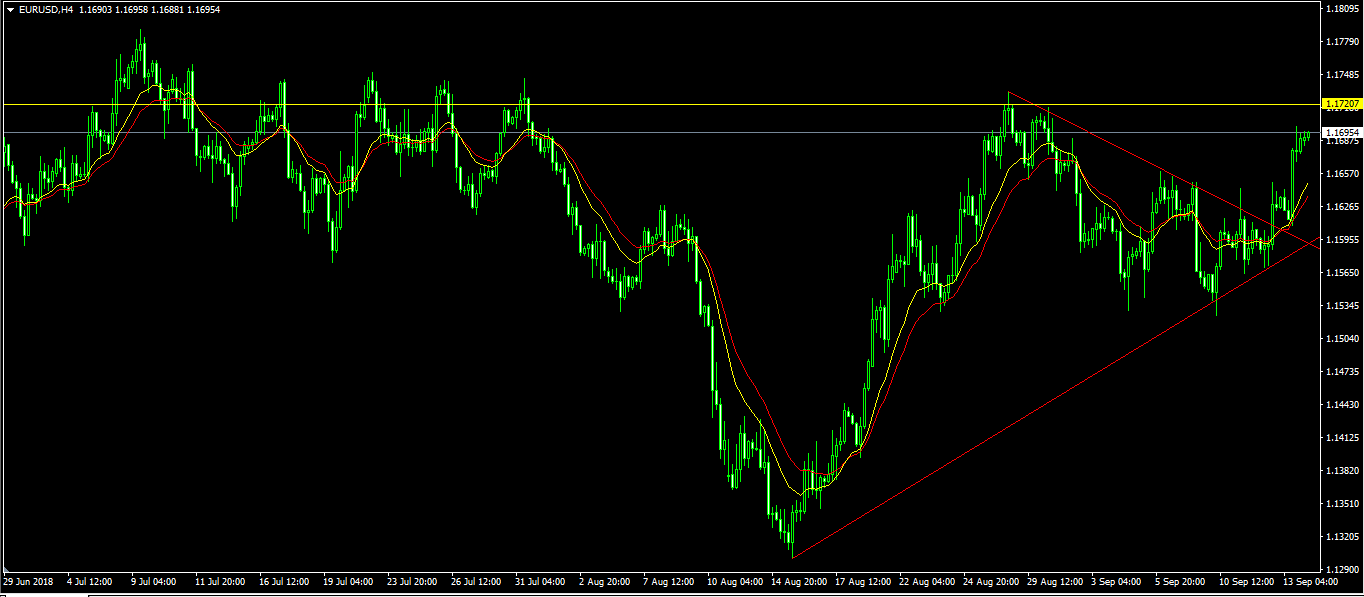
Yesterday, the EUR/USD pair moved above the symmetrical triangle pattern that had formed in recent weeks. It is now trading at 1.1694 as it attempts to reach the important support of 1.1720. As it traded past the upper line of the triangle, the pair’s 21 and 14-day EMA had a crossover as shown below. This is an indication that the pair will likely continue moving higher as traders wait for US data.
GBP/USD
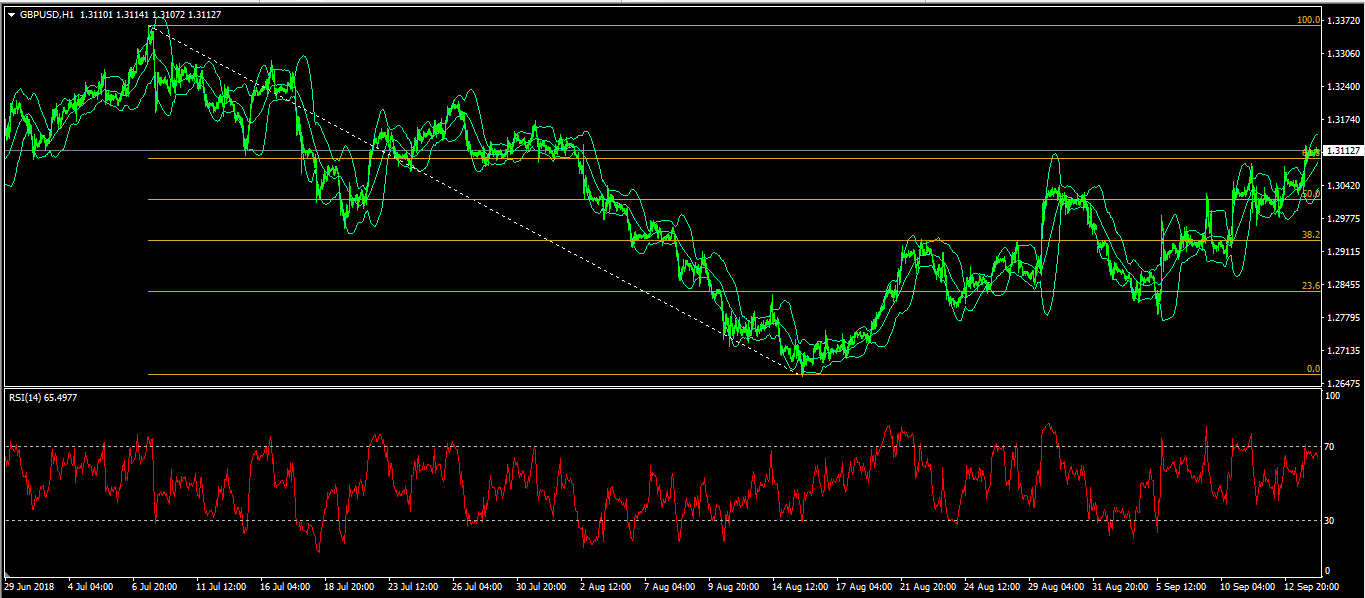
The GBP/USD pair rose sharply yesterday after the BoE committed itself to a gradual tightening process. It rose from an intraday low of 1.3025 to a high of 1.3122. Today, it was little moved in the Asian session. It is now trading at 1.3110, which is between the middle and upper line of the Bollinger Band. It is also along the 61.8% Fibonacci Retracement level. The RSI is flat at about 65. Today, the pair could continue moving higher and if it does, it will test the 1.3200 resistance level. If it moves lower, it will test the 50% Fibonacci level of 1.3010.
USD/CHF
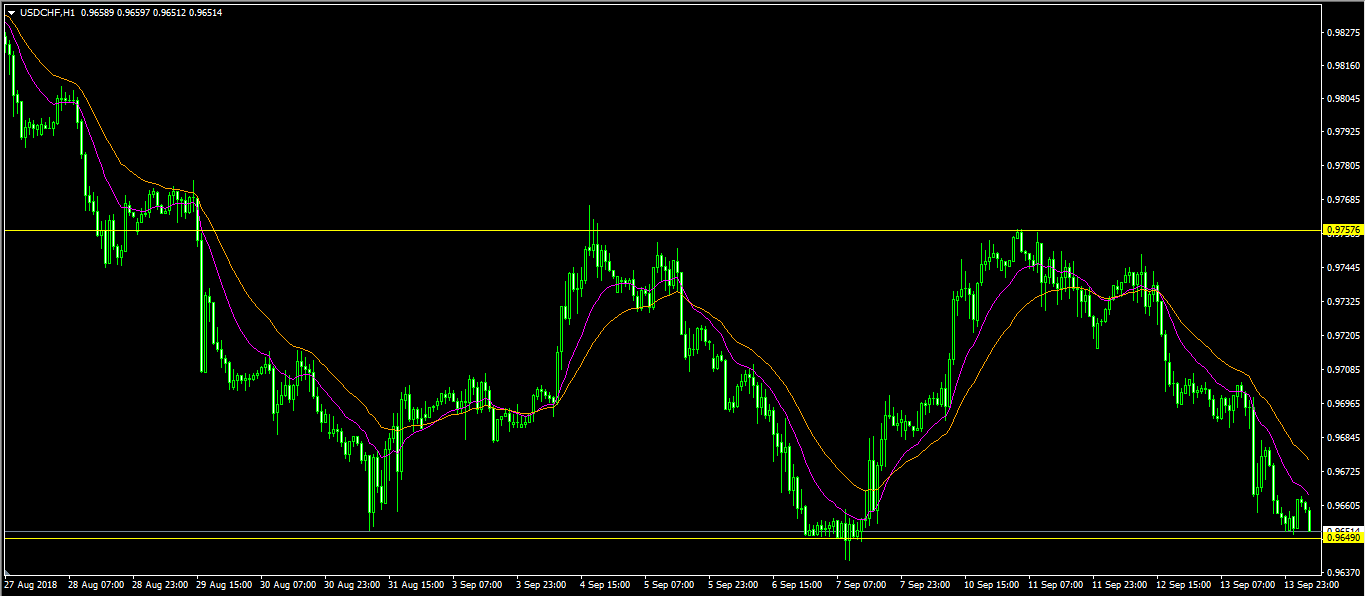
In the past few days, the USD/CHF pair has been moving in a horizontal pattern. It has traded between 0.9757 and 0.9640, which are now its key support and resistance levels. It is now trading at 0.9650, which is close to the support level. Today, the pair is likely to reverse and start moving up again.
Forex Technical Analysis: EUR/USD, USD/JPY, GBP/USD
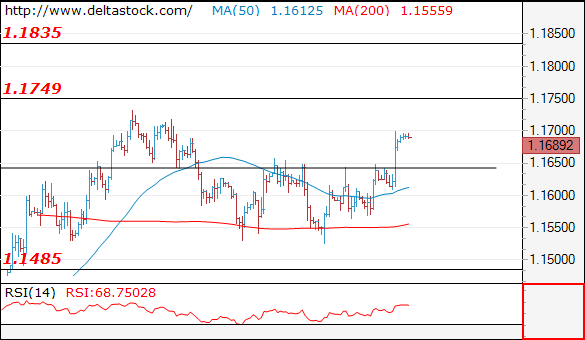
EUR/USD
Current level - 1.1682
The bias is positive above 1.1650, for a rise through 1.1730, en route to 1.1840 area.
| Resistance | Support | ||
| intraday | intraweek | intraday | intraweek |
| 1.1730 | 1.1730 | 1.1650 | 1.1300 |
| 1.1840 | 1.1840 | 1.1530 | 1.1100 |
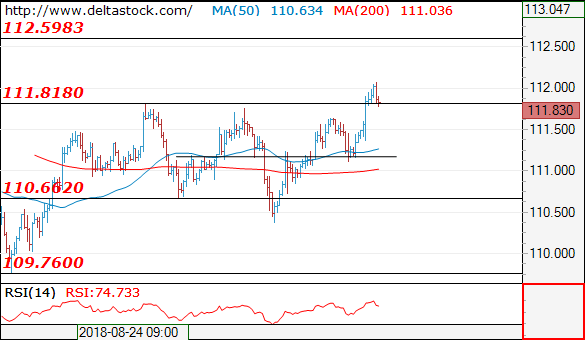
USD/JPY
Current level - 111.83
The outlook is positive above 111.60 static support, for a rise towards 112.60. Crucial on the downside is 111.10.
| Resistance | Support | ||
| intraday | intraweek | intraday | intraweek |
| 111.80 | 114.50 | 111.15 | 109.30 |
| 112.50 | 114.50 | 109.70 | 109.30 |
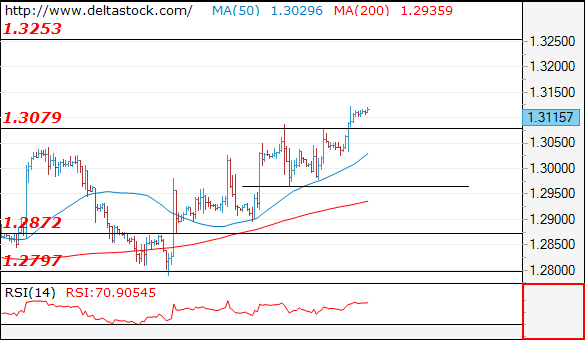
GBP/USD
Current level - 1.3115
With the violation of 1.3080 the overall outlook is bullish, for a rise towards 1.3250 zone. Crucial on the downside is 1.2960.
| Resistance | Support | ||
| intraday | intraweek | intraday | intraweek |
| 1.3130 | 1.3120 | 1.3080 | 1.2570 |
| 1.3250 | 1.3250 | 1.2960 | 1.2570 |
China Aug Data Mixed
General Trend:
- Equity markets trade generally higher, Shanghai lags
- Nikkei 225 tests early Feb highs above 23,050
- China fixed asset investment growth hits new multi-year low
Headlines/Economic Data
Australia/New Zealand
- ASX 200 opened +0.1%
- (NZ) NEW ZEALAND AUG MANUFACTURING PMI: 52.0 V 51.2 PRIOR
- (NZ) Reserve Bank of New Zealand (RBNZ): Offers to buy bonds for liquidity management purposes; will open offer to buy March 2019 government bonds on Sept 17th
China/Hong Kong
- Shanghai Composite opened +0.1%, Hang Seng +0.8%
- (CN) CHINA AUG INDUSTRIAL PRODUCTION Y/Y: 6.1% V 6.1%E
- (CN) CHINA AUG FIXED ASSETS INVESTMENT (EX RURAL) YTD Y/Y: 5.3% V 5.6%E (new multi-year low)
- (CN) CHINA AUG RETAIL SALES Y/Y: 9.0% V 8.8%E
- (CN) China Aug Surveyed Jobless Rate: 5.0% v 5.1% prior
- (CN) China PBoC Open Market Operation (OMO): Injects CNY150B in 7 and 14-day reverse repos v CNY120B injected in 7 and 14-day reverse repos prior: Net: CNY150B injection v CNY120B injection prior
- (CN) China PBoC set yuan reference rate: 6.8362 v 6.8488 prior
- (CN) FTSE Russell said it plans to decide on the inclusion of China A-shares into its indices 'very soon' - FT
Japan
- Nikkei 225 opened
- (JP) Nikkei 225 options and futures said to settle at ~23,057
- (JP) Japan PM Abe: Wants BoJ to deal 'thoroughly' with price stability target; don't think Japan should maintain ultra-easy policy 'forever'
- (JP) Japan Cabinet Office Sept Monthly Economic Report: Maintains economic assessment, economy is recovering at moderate pace
- (JP) Japan Econ Min Motegi: Still setting date for next trade talks with the US
Korea
- Kospi opened +0.8%
- (KR) Bank of Korea (BoK) Vice Chief Yoon: Policy rate decision should be made according to relevant central bank law and independently
- (KR) South Korea Fin Min: Not right to say income-led growth policies and minimum wage hikes are failing the domestic economy
- (KR) South Korea prices 10 and 30-year US dollar denominated bonds; total bid to cover 5.7x
- (KR) South Korea Aug Export Price Index M/M: -0.1% v 2.5% prior; Y/Y: 2.1% v 2.8% prior
Other
- (IN) India PM Economic Advisory Panel Official: 'Extreme vigilance' needed to check weak Rupee (INR) currency; reasonable to expect the Rupee to weaken 4-6% vs the US dollar annually without external shocks
North America
- US equity markets closed mixed: Dow +0.6%, S&P500 +0.5%, Nasdaq +0.8%, Russell 2000 -0.1%
- S&P500 Healthcare +1.2%, Technology +1.2%; Financials -0.1%
- (US) Fed's Kaplan (dove, non-voter): Reiterates Fed should be moving toward neutral rate, neutral Fed Funds Rate (FFR) seen 2.50-2.75% range
Europe
- (UK) BOE Gov Carney warns Cabinet of consequences of a 'no deal' Brexit, says could be as dire as the 2008 financial crash - press
Levels as of 01:30ET
- Nikkei 225, +0.9%, ASX 200 +0.7%, Hang Seng +0.8%; Shanghai Composite -0.1%; Kospi +1.3%
- Equity Futures: S&P500 flat; Nasdaq100 +0.1%, Dax +0.1%; FTSE100 +0.2%
- EUR 1.1698-1.1686; JPY 112.11-111.78 ; AUD 0.7199-0.7176 ;NZD 0.6590-0.6561
- Dec Gold +0.2% at $1,210/oz; Oct Crude Oil +0.4% at $68.86/brl; Dec Copper +0.8% at $2.698/lb
Swedish Inflation Coming Up
Market movers today
In Sweden, we are due to get inflation numbers. We expect around 0.1 percentage point higher inflation for August than the Riksbank's new forecasts, both for headline CPIF and core CPIF excluding energy. See more in Scandi section overleaf.
In Russia, the central bank decision will be announced. We currently expect the CBR to keep the key rate unchanged but we are paying close attention to the external environment. Real rates remain extremely high in Russia. A hike by the CBR would weigh on economic growth in 2019.
In Denmark, Finance Denmark's housing market statistics for Q2 are due. We already know from Statistics Denmark how prices have moved nationwide but it will be interesting to see what has been happening at a local level.
Finally, today it is 10 years since Lehman Brothers filed for bankruptcy, which should imply a lot of media focus on the causes and consequences of the financial crisis.
Selected market news
The Bank of England (BoE), central bank of Turkey (TCMB) and ECB delivered broadly as expected yesterday. First, the BoE announcement was a dull affair, with no new forecasts or policy signals. We still expect the BoE to hike around once a year and our base case is that the next hike will arrive in May 2019, after the UK formally leaves the EU (see also Bank of England Review , 13 September). Then more action was seen in Turkey: while Turkey's president Recep Erdogan was out rattling TRY markets ahead of the TCMB decision, the central bank managed to surprise markets by delivering a significant rate hike of 625bp for its one-week repo rate, sending it to 24.00%. The accompanying statement further stroked a hawkish tone promising more monetary tightening 'if needed'. The decision fuelled a risk-on move across emerging market currencies and sent the TRY up more than 4% up against the USD from yesterday's open levels. Finally, the ECB did not deliver new policy signals in a meeting that on the face of it was rather uneventful. However, Mario Draghi notably highlighted risks 'gaining more prominence' - albeit still seen as balanced for growth - and importantly the ECB's confidence in the inflation outlook prevailed. Rates markets were trading broadly sideways through the press conference but EUR/USD jumped towards 1.17 lifted also by a weak US CPI. While the asset-purchase programme will end by New Year, we still do not see a first rate hike from the ECB until December 2019. See more details in ECB Review , 13 September.
Markets have been reasonably calm overnight , despite a tweet from US President Donald Trump in relation to the trade talks that his Treasury Secretary Steven Mnuchin has reportedly been initiating, stressing that the US feels 'no pressure to make a deal' with China. Nevertheless, equities kept the upbeat tone in both the US and Asian session. US Treasury yields fell slightly after US CPI data came out on the weak side yesterday. Hurricane Florence has now reached the US East Coast (North Carolina) and its associated storm surge is projected to create severe damage.
ECB Leaves Its Key Interest Rate Unchanged, Maintains Guidance For Quantitative Easing
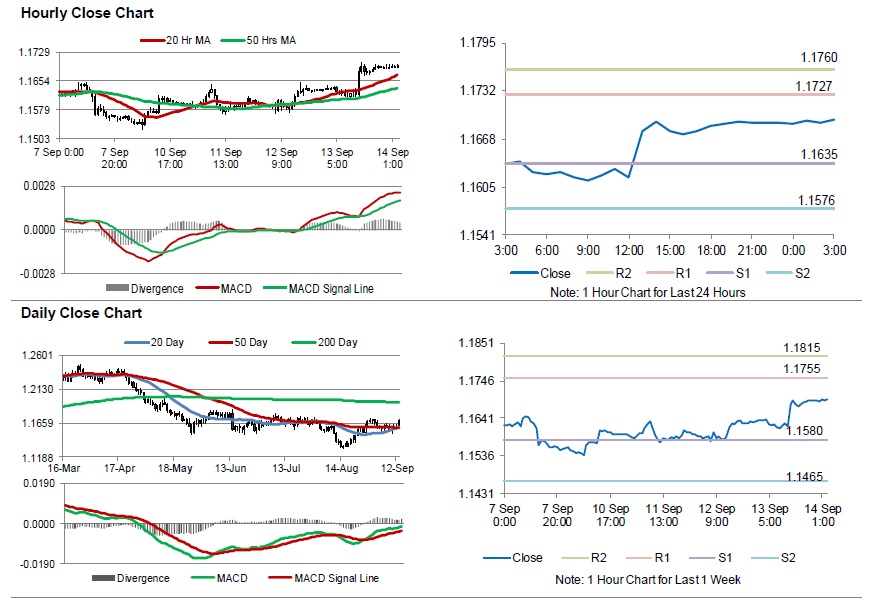
For the 24 hours to 23:00 GMT, the EUR rose 0.52% against the USD and closed at 1.1690.
The European Central Bank (ECB), at its September monetary policy meeting, decided to keep the benchmark interest rate steady at 0.00%. Further, the policymakers reiterated that the bond purchasing will be lowered to €15 billion per month from October until the end of December. Meanwhile, the ECB cut its growth forecasts for the euro-area. The bank now expects growth of 2.0% in 2018 and 1.8% in 2019, slightly lower than its previous forecast of 2.1% and 1.9%. In a statement post-meeting, the ECB President, Mario Draghi, warned that uncertainties relating to protectionism and international trade tensions weigh down the economic expansion and could impact global economy.
The US dollar fell against the EUR, following weaker than expected US inflation data.
In the US, data showed that the consumer price index rose less-than-expected to 2.7% on an annual basis in August, compared to a rise of 2.9% in the previous month. Market participants had anticipated the index to climb 2.8%. Moreover, seasonally adjusted initial jobless claims unexpectedly declined to 204.0K, compared to market consensus for an advance to 210.0K. In the previous week, initial jobless claims had registered a revised level of 205.0K. Meanwhile, average weekly earnings rose 0.5% on an annual basis in August, compared to an advance of 0.1% in the previous month.
In the Asian session, at GMT0300, the pair is trading at 1.1694, with the EUR trading a tad higher against the USD from yesterday’s close.
The pair is expected to find support at 1.1635, and a fall through could take it to the next support level of 1.1576. The pair is expected to find its first resistance at 1.1727, and a rise through could take it to the next resistance level of 1.1760.
Trading trend in the Euro today is expected to be determined by the Euro-zone’s trade balance data for July, scheduled to release in a few hours. Later in the day, the US advance retail sales, manufacturing and industrial production, all for August, will pique investors attention. Additionally, the US business inventories for July and the Michigan consumer sentiment index for September, will be on investors radar.
The currency pair is trading above its 20 Hr and 50 Hr moving averages.