Sample Category Title
British Pound Climbs to 6-Week High, Shrugs off BoE Warning
GBP/USD has posted gains on Thursday. In the North American session, the pair is trading at 1.3104, up 0.44% on the day. On the release front, there were key events on both sides of the pond. The Bank of England maintained rates at 0.75% in a unanimous (9-0) decision. In the U.S, key consumer inflation reports missed their mark. CPI came in at 0.2%, shy of the estimate of 0.3%. Core CPI dipped lower to 0.1%, missing the forecast of 0.2%. Unemployment claims sparkled with a reading of 203 thousand, beating the forecast of 213 thousand. On Friday, the U.S release retail sales and UoM Consumer Sentiment.
There were no surprises from the BoE, which held the benchmark rate at 0.75%. The Bank raised rates in August, for the only the second time since 2007. In the rate statement, policymakers noted that there had been little change on the domestic front since the August rate hike, but added that there was “greater uncertainty” in the financial markets over the Brexit withdrawal next March. The BoE may decide to stay on the sidelines and hold rates until after the UK leaves the EU in March, in order to minimize the expected disruption that the Brexit will have on the British economy. A lack of rate hikes will make it tougher for the pound to gain, unless the UK economy shows stronger growth than expected.
In the U.S, the red-hot labor market continues to be the envy of industrialized countries around the globe. The unemployment rate is at a remarkable 3.8% and unemployment claims were almost unchanged at 204 thousand, another excellent reading. Despite the strong employment front and a booming economy, inflation remains well short of the Federal Reserve’s target of 2 percent. In August, CPI and Core CPI came in at 0.1% and 0.2%, respectively, falling short of their estimates. The markets are braced for soft consumer spending data on Friday, which could send the dollar lower.
Oil Price Accelerates Lower as Global Inventories Hit Record
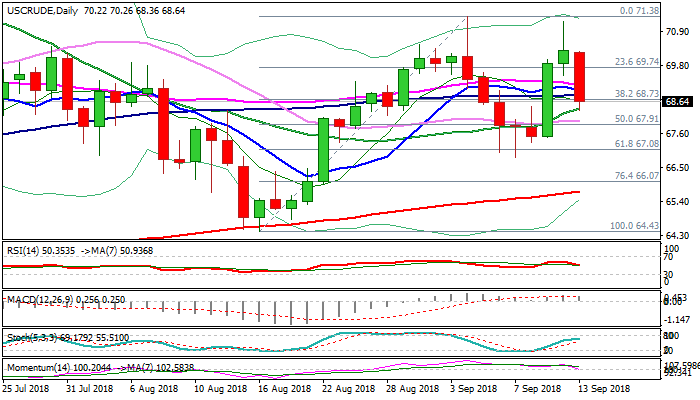
WTI oil fell sharply and hit session low at $68.36, coming under pressure after monthly report from International Energy Agency showed surge in OPEC production, with global oil inventories hitting record high.
Global supplies reached record of hundred million barrels a day, which could fully offset negative impact from expected from supply shortage on US sanctions on Iran.
Oil price was down nearly 2.5% for the day so far, on track for the biggest one-day fall since 08 August.
Reversal pattern is forming on daily chart and leaving a double-top at $71.38/25, which could spark further weakness.
South-turning 14-d momentum is breaking into negative territory and maintain bearish pressure.
Bears look for extension and close below 30SMA ($68.00) to open way towards $66.85 (07 Sep trough), break of which is needed to confirm double-top and stretch towards rising 200SMA ($65.73).
Broken daily Tenkan-sen ($69.11) marks initial resistance and is expected to protect the upside and maintain fresh bearish bias.
Res: 69.11; 69.46; 70.00; 70.26
Sup: 68.36; 67.91; 67.48; 66.85
Yen Dips Despite Weak US Consumer Inflation
USD/JPY has posted gains in the Thursday session, erasing the losses seen on Wednesday. In North American trade, the pair is trading at 111.84, up 0.52% on the day. In economic news, Japanese Core Machinery Orders jumped 11.0%, its sharpest gain since January 2016. Japanese PPI ticked lower to 3.0%, just shy of the forecast of 3.1%. In the U.S, key consumer inflation reports missed their mark. CPI came in at 0.2%, shy of the estimate of 0.3%. Core CPI dipped lower to 0.1%, missing the forecast of 0.2%. Unemployment claims sparkled with a reading of 203 thousand, beating the forecast of 213 thousand. On Friday, the U.S release retail sales and UoM Consumer Sentiment.
The Japanese economy showed strong expansion in the second quarter. GDP gained 0.7%, matching the estimate. This was an impressive rebound after a decline of 0.2% in Q1. On an annualized basis, GDP in Q2 was revised upwards to 3.0%, up from 1.9%. This gain marked the strongest gain in over two years. Despite the good economic news, the Bank of Japan rate meeting on September 18-19 is likely to be a non-event. Policymakers are expected to maintain the short-term interest rate target at -0.1 percent and a pledge to guide long-term rates near zero percent. With regard to long-term monetary policy, the menu is likely to consist of “more of the same”. With the government planning to introduce a sales tax in 2019, the BoJ will want to stay on the sidelines. This could mean that interest rates will not be adjusted before 2020.
The U.S labor market remains at full capacity. The unemployment rate is at a remarkable 3.8% and unemployment claims were almost unchanged at 204 thousand, another excellent reading. Despite the strong employment front and a booming economy, inflation remains well short of the Federal Reserve’s target of 2 percent. In August, CPI and Core CPI came in at 0.1% and 0.2%, respectively, falling short of their estimates. The markets are braced for soft consumer spending data on Friday, which could send the dollar lower.
ECB Review: For the Feinschmeckers – Part II
- ECB didn't deliver new policy signals during today's meeting, which on the face of it was rather uneventful. As usual, the devil is in the detail and today's meeting highlighted risks 'gaining more prominence' and the confidence in its inflation outlook prevailed.
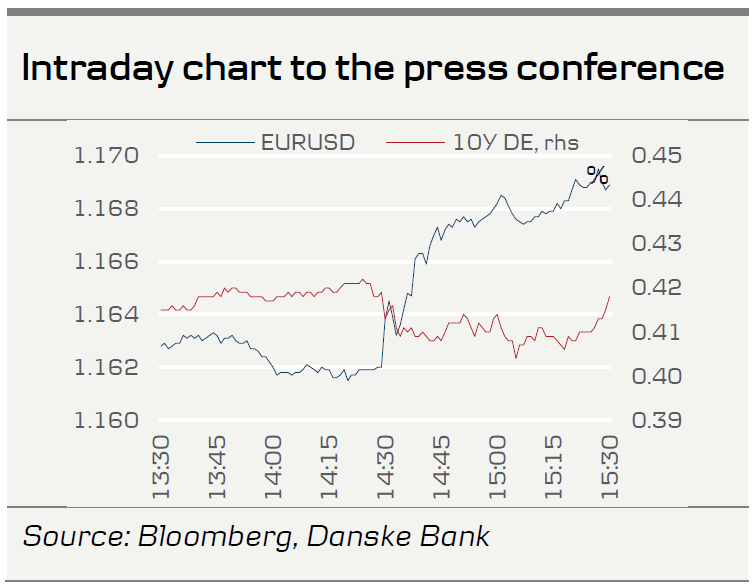
- Rates markets were trading broadly sideways through the press conference, while the EUR/USD traded higher also, weighted by the weak US CPI number.
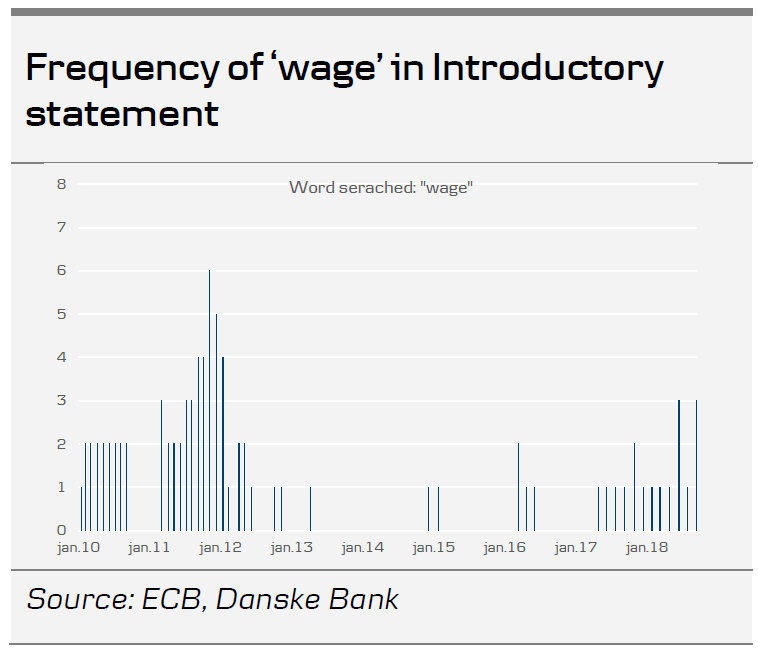
Just like the July meeting, today's meeting was cut short of the usual 15:30CET limit. The most interesting today was the update of the staff projections (see below) and the inflation assessment: not to forget the increased prominence of the wage dynamics in the introductory statement (IS) and the press conference ('wage' was mentioned three times in the IS).
The reinvestment strategy was not discussed today, not even when to discuss it, although he later clarified it would be in October or December this year. In June Draghi said that they would revisit this in the coming meetings. We favour a decision at the December meeting. It was mentioned that the capital key is the guiding principle.
ECB staff projections
ECB's new economic forecasts saw downward revisions to the growth outlook but broadly unchanged confidence in building up inflation pressures:
- Rising global headwinds to growth outlook: Reflecting weaker external demand, the ECB lowered the growth forecasts for 2018 to 2.0% - in line with our view - from 2.1% and for 2019 to 1.8% from 1.9%, while leaving the projections for 2020 unchanged at 1.7%. Risks to the growth outlook were still judged to be broadly balanced but uncertainties related to rising protectionism, vulnerabilities in emerging markets and financial market volatility have gained more prominence.
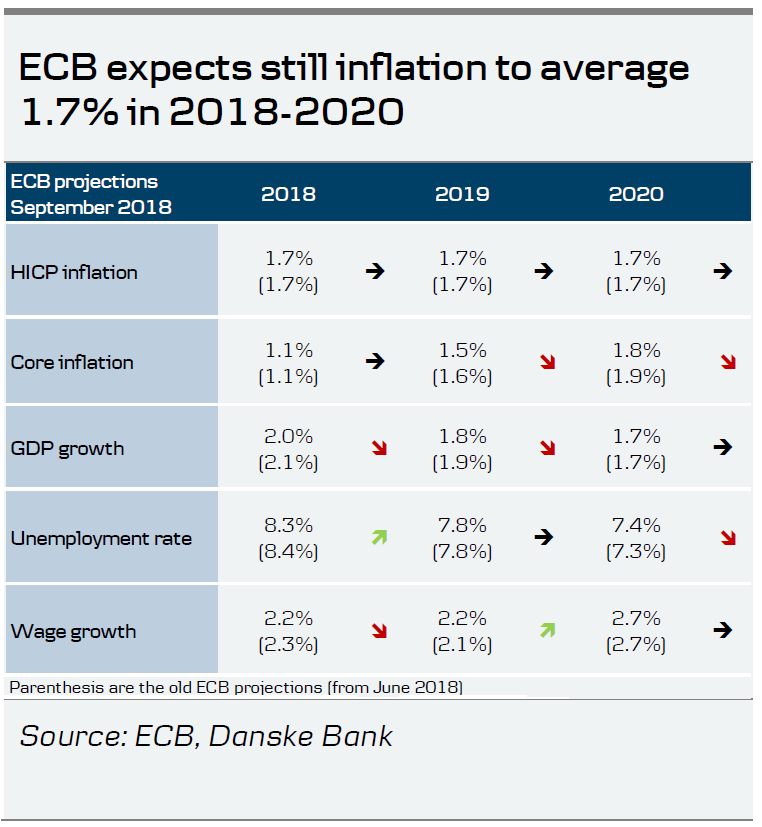
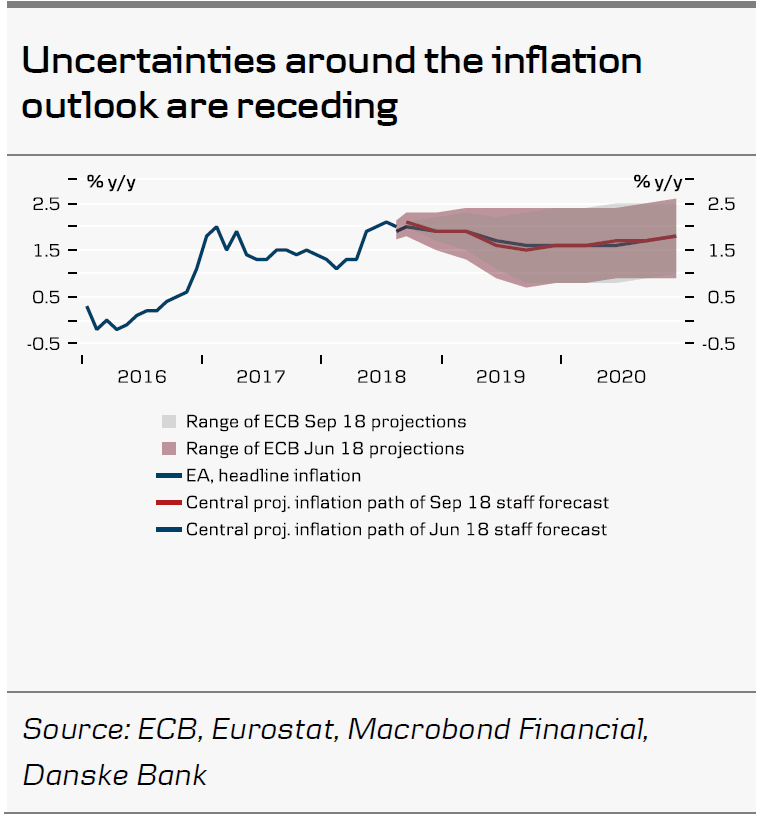
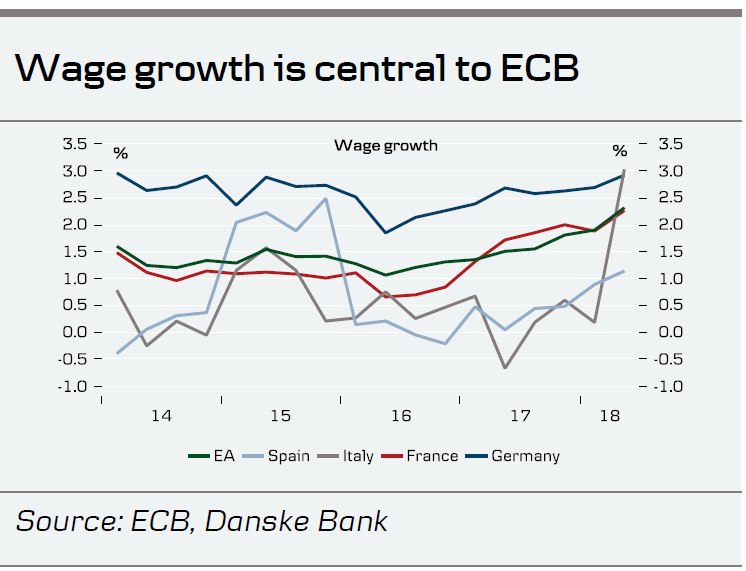
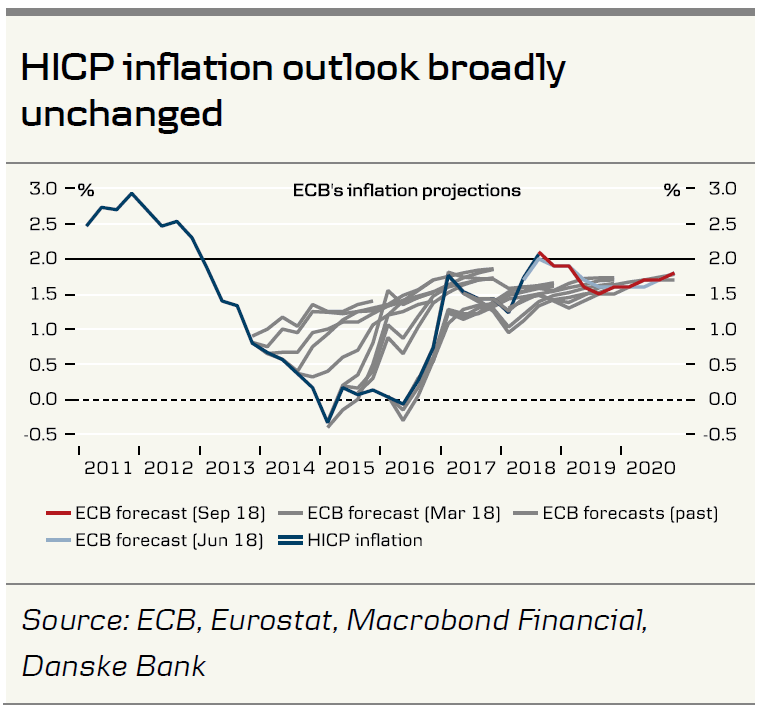
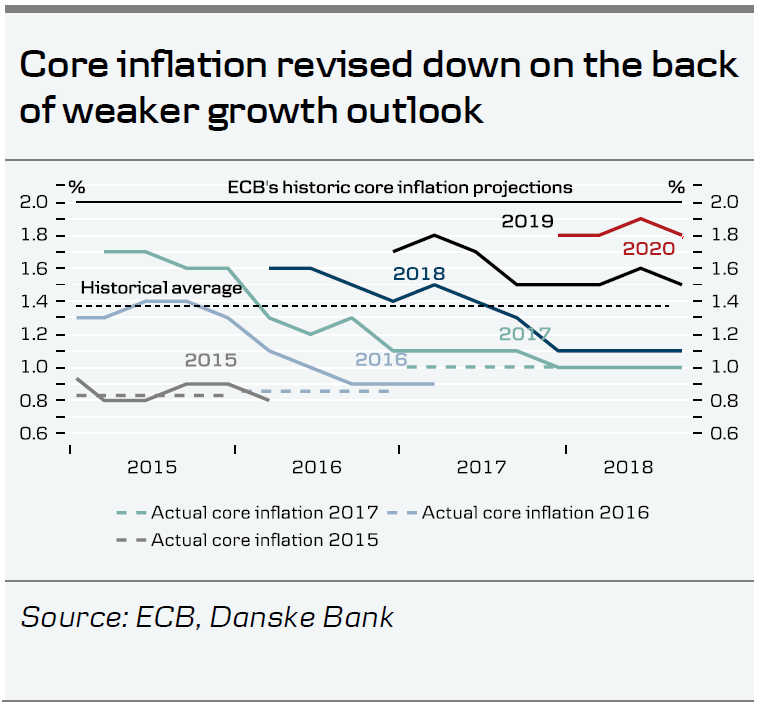
- Unchanged inflation confidence: The ECB expects headline inflation to hover around current levels for the remainder of the year, while core inflation is expected to pick-up toward end-2018. Draghi stressed that underlying inflation pressures remain subdued, but at the same time rising wages (2.3% y/y in Q2 18) means that uncertainties around the inflation outlook are receding. Core inflation was slightly revised down reflecting the weaker growth outlook. But upward revisions to the energy component resulted in an unchanged headline forecast profile. The ECB still projects core inflation to accelerate significantly to 1.8% in 2020, supported by an expected strong pick-up in wage growth to 2.7%. We see core inflation only at 1.5% in 2020, as the pass-through from higher wages will happen more gradually in our view.
Fixed income
The ECB did not provide the market with much new information, and the impact on the market from today's meeting on the future is likely to be modest. Hence, we expect that Bunds will still be caught in a narrow trading range between 0.3% and 0.70%. The "floor" for the 10Y German government bond will continue to be 0.3%, which it has been for almost two years despite such significant events such as Frexit (the French presidential election) and more recently the EM crisis and the uncertainty regarding the Italian fiscal policy as shown below.
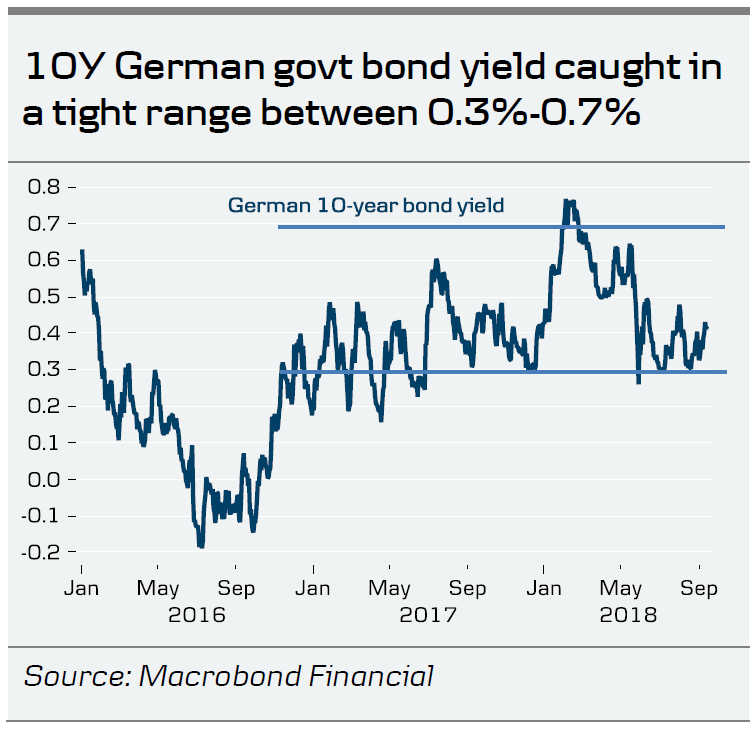
However, as we are getting closer to exit of the QE as well as possible rate hikes, then it is difficult to see 10Y German government bond yield decline below 30bp. The combination of low supply and reinvestment need relative to issuance of govts, corporates, covereds and financial will keep the Bund ASW-spread in a tight range between 50-60bp for the coming months.
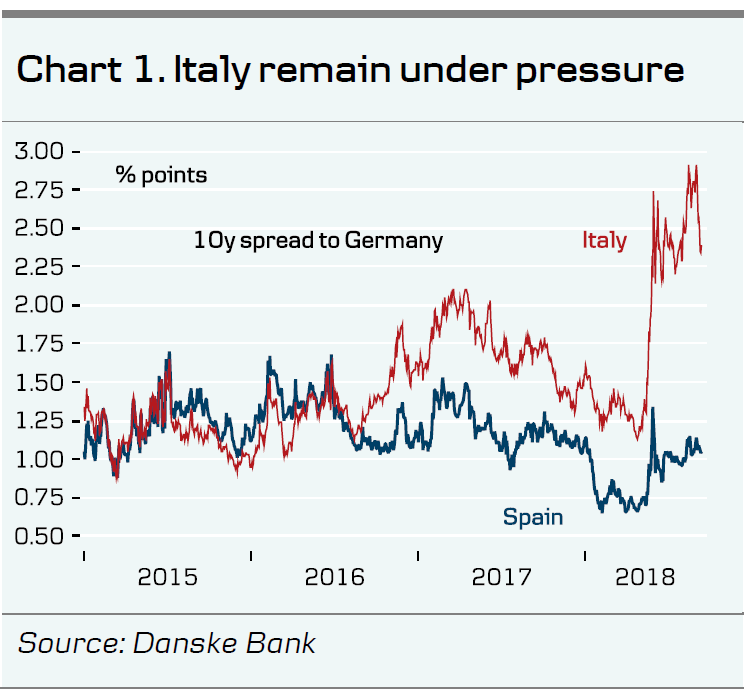
The spread between Italy and core-EU is still very high, and ECB is not expected to step in to support Italy through additional purchases of Italian government bonds. This is also very visible in the QE-data for Italy. Here, the ECB continue to follow the "capital key rule". ECB has also made it clear that no amunt of QE buying in a sovereign bond issuer can help the market, if the issuer does not follow the EU rules on fiscal policy. Hence, for the BTPS-Bund spread to tighten we need to see more information from the Italian government on the budget for 2019, and that they will comply with EU rules.
FX: 'confident' ECB but still too early for sustained EUR uptrend
With Draghi's confidence that the euro zone is heading in the right direction dominating any dovish impulse from the small downward growth adjustments, EUR crosses jumped during the press conference with EUR/USD reaching 1.1697, helped also by a weaker-than-expected US inflation print. While it is still a tad too early for the FX market to discount an end to negative rates – which will be key for delivering more broad-based EUR strength - as we argued in last week's FX Strategy - Monetary conditions have started to turn EUR positive, 7 September, monetary conditions have started to turn less EUR negative judging from notably M3 growth. That is in our view a pre-warning of what to watch as the ECB stops adding to its balance sheet by year end.
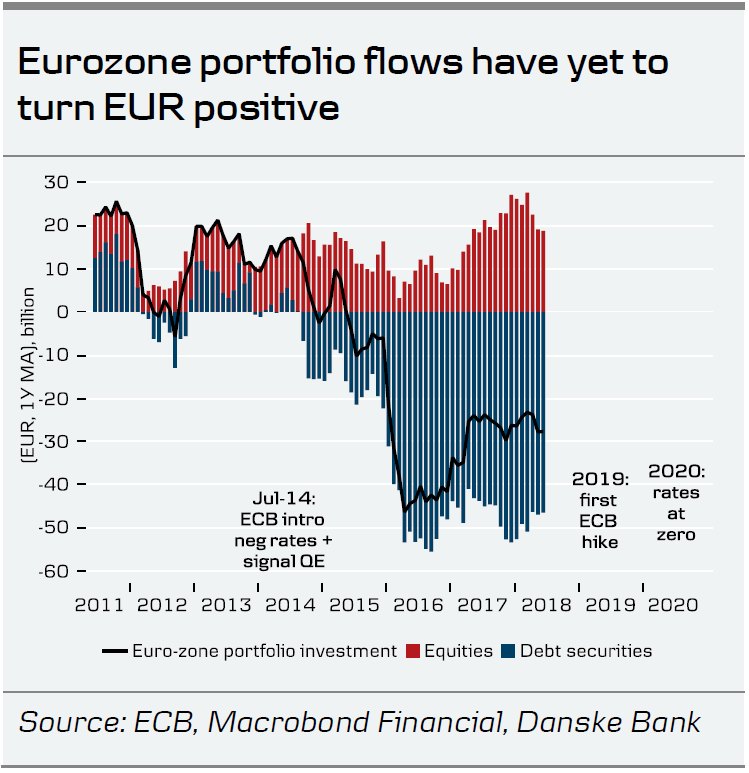
That said, we still see a risk that USD strength will linger in H2 due to the prospect for relative rates to move in favour of the greenback and trade woes and EM worries to weigh still. However, in relation to EUR, we are less worried about Italy-led risks near term, see Italian Politics Monitor: A postcard from Rome: the die is cast! , and hence the potential for a significant dip in EUR/USD near term is smaller than we previously anticipated and dips below 1.15 should be bought into. The key trigger for EUR/USD to invoke on a more sustained uptrend remains a turn in capital flows (see chart) and those will likely not be triggered until the market sense that the ECB is growing ever more confident in initiating a hiking cycle (not likely until H1 2019). But, it is still too early for a sustained EUR uptrend driven by ECB in our view.
Gold fails below 1214.3 resistance, knocked down by Trump’s tweet
Gold surged to as high as 1212.64 earlier today. It rode on Dollar's weakness on optimism that US and China is back on the negotiation table. However, Gold failed to take out 1214.30 resistance and was then knocked down as Trump tried to re-escalate trade tension with his tweet.
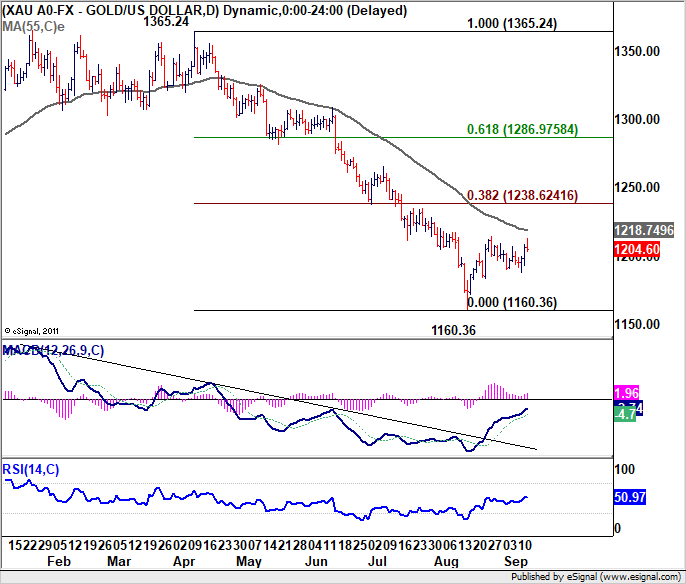
So, for now, it's technically staying in consolidation pattern from 1214.30. More sideway trading could be seen. For now, as long as 1187.58 support holds, further rally is expected. Break of 1214.30 will eventually resume the rebound from 1160.36 medium term bottom towards 38.2% retracement of 1365.24 to 1160.36 at 1238.62. We'd expect strong resistance from there to limit upside.
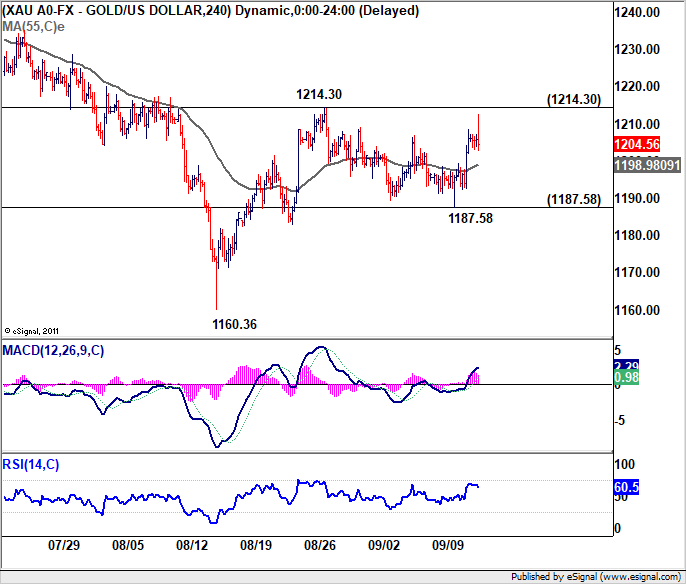
On the downside, break of 1187.58 will suggests that the rebound is completed and bring retest of 1160.36 low.
GBPJPY Posts 6-Week High, Increasingly Challenges Bearish Medium-Term Picture
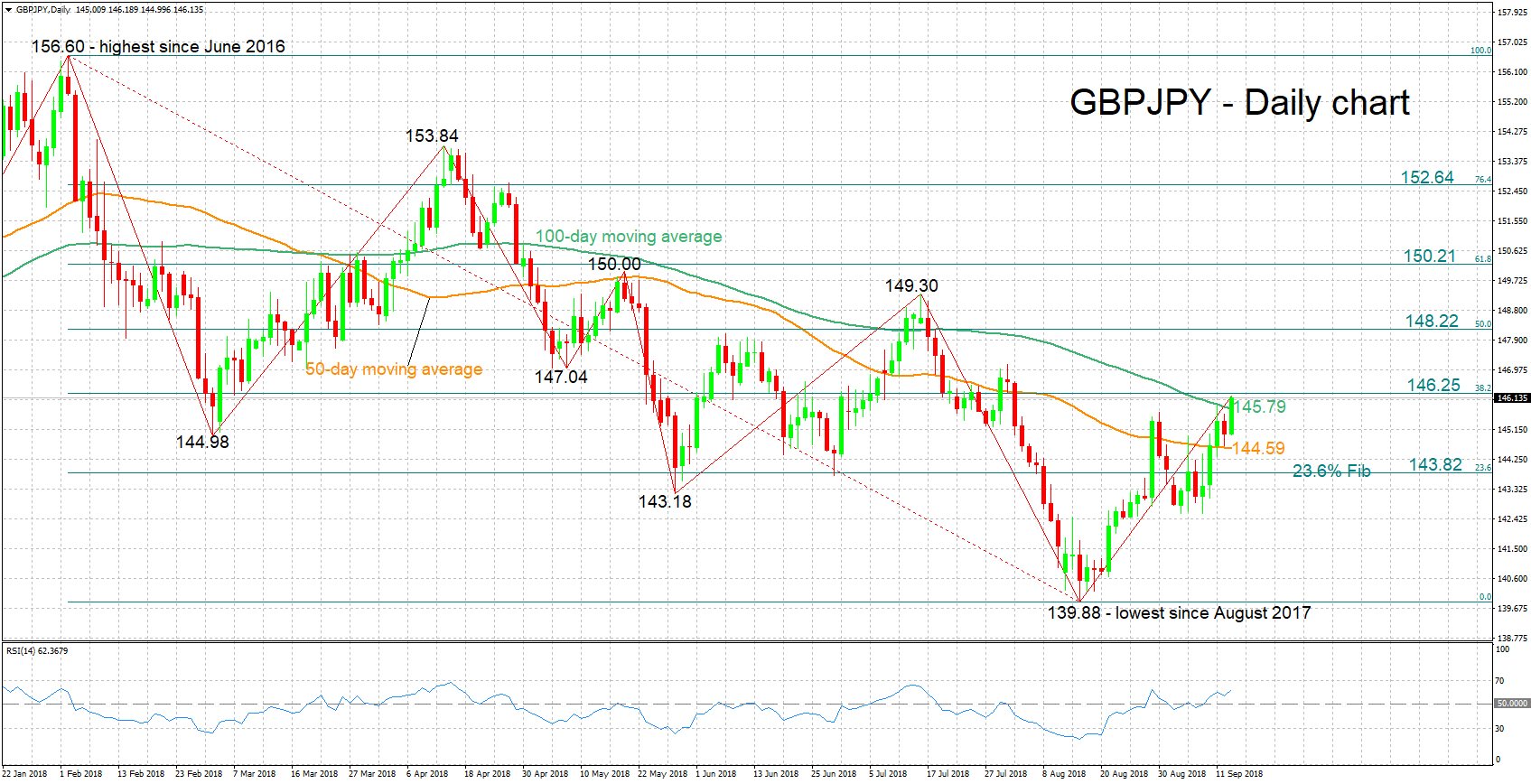
GBPJPY staged a spectacular comeback after falling to its lowest since August 2017 of 139.88 in mid-August. The pair is currently trading more than 600 pips above the aforementioned nadir, having risen to a six-week high of 146.19 earlier on Thursday.
The RSI continues heading higher, serving as a testament of the bullish momentum in the short term.
A more conclusive break above the current level of the 100-day moving average line at 145.79 could meet immediate resistance around the 38.2% Fibonacci retracement level of the downleg from 156.60 to 139.88 at 146.25. Steeper advances would turn the attention to the 50% Fibonacci mark at 148.22.
A move back down may meet support around the 50-day MA at 144.59, with more bearish activity potentially eyeing the zone around the 23.6% Fibonacci level at 143.82 for additional support.
The medium-term outlook remains mostly negative: the pair has been recording lower highs and lower lows from April onwards. However, the considerable gains over the last four weeks are increasingly challenging the bearish market structure in the medium-term. Should the bullish movement continue, and especially if the previous peak of 149.30 is violated to the upside, then that would clearly mark a shift in the pair’s outlook to a positive direction.
Overall, the short-term bias is bullish, while the negative medium-term outlook is becoming increasingly fragile.
Trump trying to re-escalate trade tension with his tweets
Trump complains WSJ and said the US is under no pressure to make a deal with China. Instead he claims that China is the one who's under pressure. And he added "we will soon be taking in biliions in tariffs & making products at home."
So now, Trump tries to re-escalate trade tension? But anyway, we don't quite understand. If Americans are going to "make products at home", that means, they import way less from China. Then, how can he take billions in tariffs? He want tariffs to cover the deficit he creates? Or he wants jobs to move back to the US? You can't have both.
https://twitter.com/realDonaldTrump/status/1040242677877551104
Sunset Market Commentary
Markets
Main FI and FX markets treaded water during European trading, awaiting the outcomes of policy meetings in Turkey, the UK and EMU. The Turkish central bank raised its policy rate significantly, managing to lift TRY. Some expected spill-over into EUR/USD gains via improved risk sentiment on EM FX didn’t occur. August US CPI data disappointed and pulled the dollar and core bond yields (temporary) lower with US Treasuries outperforming. EUR/USD started ECB President Draghi’s press conference around 1.1650 and managed to build out some additional gains towards 1.17 afterwards. The ECB’s June policy decisions still stand. There was no discussion about apply special tactics to the reinvestment policy, but this will be on the table in November or December (extending maturity portfolio even further?). September GDP projections showed minor downward revisions in 2018 (2.1% to 2%) and 2019 (1.9% to 1.8%) because of a weaker contribution from foreign demand. The 2020 forecast was unchanged at 1.7%. Risks to the eco outlook remain broadly balanced, but protectionism, EM turmoil and financial market volatility gained more prominence. Last time around the ECB used the wording “remain prominent”. Underlying inflationary pressures remain muted, but uncertainty about the outlook is receding. The ECB expects a pick-up towards the end of the year and afterwards, driven by wage growth, the economic expansion and accommodative monetary policy. ECB Draghi answered that the EMU economy has grown above potential for some time when asked whether the EMU output gap was closed, further indicating that inflationary pressure might start showing up. German yields started rising after the inflation comments, adding 0.9 bps (2-yr) to 2.6 bps (10-yr). US yields drop up to 0.4 bps across the curve 10-yr yield spread changes vs Germany are nearly unchanged with Greece outperforming (-6 bps).
The focus for sterling trading turned from Brexit to the BoE today. The BoE, as expected, voted unanimously to keep its policy rate unchanged at 0.75%. The BoE basically maintained its assessment from the August inflation report. A very limited and gradual increase is deemed necessary to bring inflation to the policy target by the end of the policy horizon. There are several sources of (growing) uncertainty (Brexit, EM, trade tensions). However, in a very short-term perspective, UK Q3 growth might even accelerate slightly more than expected (from 0.4% Q/Q to 0.5Q/Q). However, this change in the ST economic momentum doesn’t change the overall assessment for the path of monetary policy going forward. The BOE policy announcement had hardly any impact on sterling trading. EUR/GBP (0.8925 area) gained a few ticks, probably inspired by overall EUR/USD strength. Cable is testing the 1.31 big figure, profiting from a weaker dollar after soft US inflation data.
News Headlines
The Turkish central bank has raised its interest rate from 17.75% to 24%, while consensus was only at 21%. Despite claims from President Erdogan earlier today that he opposes higher rates, the central bank proves to be independent. EUR/TRY dropped from 7.60 towards 7.20.
US inflation eased in August as the CPI (YoY) unexpectedly slows to 2.7%, from the decade high a month earlier (2.9%). Core inflation, without food and energy prices, also slowed down to 2.2% YoY (2.4% in July). The Fed is expected to increase its policy rate later this month, but slowing inflation could affect the outlook for future increase.
A supply squeeze in global oil production could push the oil price to levels well beyond $80 per barrel, said the International Energy Agency. If global producers fail to compensate for the dip in the global oil supply, stemming from the problems in Venezuela and the US sanctions on Iran, the supply squeeze could push prices up.
GBPUSD Outlook: Cable Penetrates Daily Cloud on Fresh Bullish Acceleration after BoE/Downbeat US Data
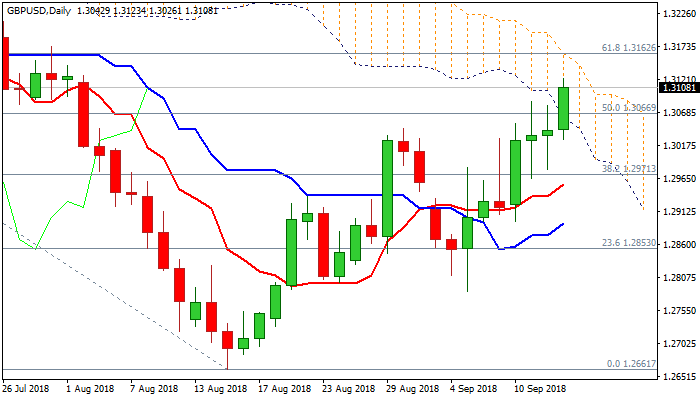
Cable rallied into falling daily cloud, pulled higher by weaker dollar on disappointing US data. Fresh bullish acceleration neutralized downside risk seen after double long-legged Doji candles on Tue/Wed, keeping in play broader bulls from 15 Aug low at 1.2661. The Bank of England kept rates unchanged at 0.75% in widely expected action after the central bank raised interest rates in August and now leaving markets to digest the decision. The central bank is widely expected not to take any rate decision until Brexit divorce process is completed, but indicated further rate hikes at a gradual pace and according to the evidence from the economy. Daily tech show bullish momentum building and supporting further advance, as bulls look to generate fresh positive signal on break and close above daily cloud top (1.3162), also Fibo 61.8% of 1.3472/1.2661 fall. Meanwhile, bulls might be delayed as daily slow stochastic turned sideways in overbought territory and on track to generate bearish signal for consolidative / corrective action. Broken cloud base marks solid support at 1.3060, which should ideally contain corrective action and keep bulls intact. Only return and close below 55SMA (1.3013) would sideline bulls for deeper correction.
Res: 1.3123; 1.3162; 1.3185; 1.3213
Sup: 1.3066; 1.3026; 1.3013; 1.2963
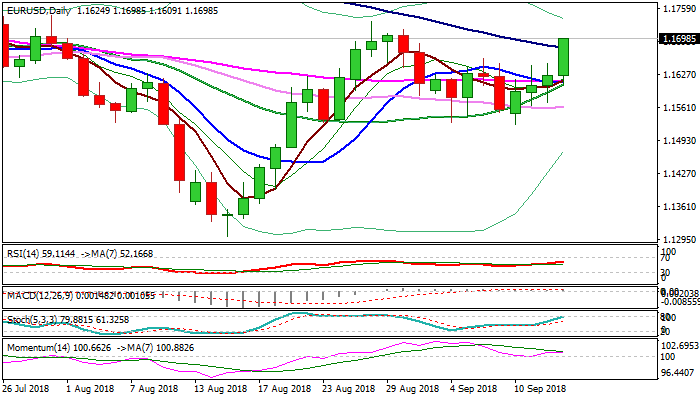
EURUSD Outlook: Euro Surges on Post-ECB Comments/Weaker than Expected US CPI Data
The Euro accelerated higher and eventually broke above multiple upside rejections at 1.1650 and extended gains above top of thin daily cloud. Fresh rally was sparked by comments from the ECB chief Draghi in post-policy meeting press conference and also inflated by weaker than expected US inflation numbers. The European central bank made no surprise, keeping interest rates unchanged, with next hike expected in the second half of 2019 and staying on track to start winding down bond purchases by the end of this year. But some comments from Mario Draghi were seen as hawkish and boosted the single currency. Draghi expects underlying inflation to pick up towards the end of the year and continue to gradually increase over the medium term. Growth rates showed increase above expectations, with risk surrounding zone's growth outlook, being broadly balanced. Draghi also highlighted that broad-based expansion of the Eurozone economy goes along with previous estimations and inflation continues to gradually rise. In addition, data released today showed that US CPI rose less than expected in August. Annualized figure showed inflation rose 2.7%, falling under forecast at 2.8% and previous month's 2.9%. Monthly figure stayed unchanged at 0.2% from the previous month, but undershot forecast for 0.3% increase. Downbeat US data weakened the greenback, offering fresh tailwind to the single currency. Bulls extended through falling 100SMA (1.1681), opening way for retest of key barriers at 1.1733 (28 Aug high); 1.1750 zone (17/31 July lower platform, formed after multiple upside rejections) and 1.1780 (Fibo 38.2% of 1.2555/1.1300 Feb/Aug fall). Bulls need confirmation on close above daily cloud top/100SMA.
Res: 1.1718; 1.1733; 1.1750; 1.1780
Sup: 1.1681; 1.1649; 1.1614; 1.1606