

Sample Category Title
EUR/USD Mid-Day Outlook
Daily Pivots: (S1) 1.1580; (P) 1.1615; (R1) 1.1661; More.....
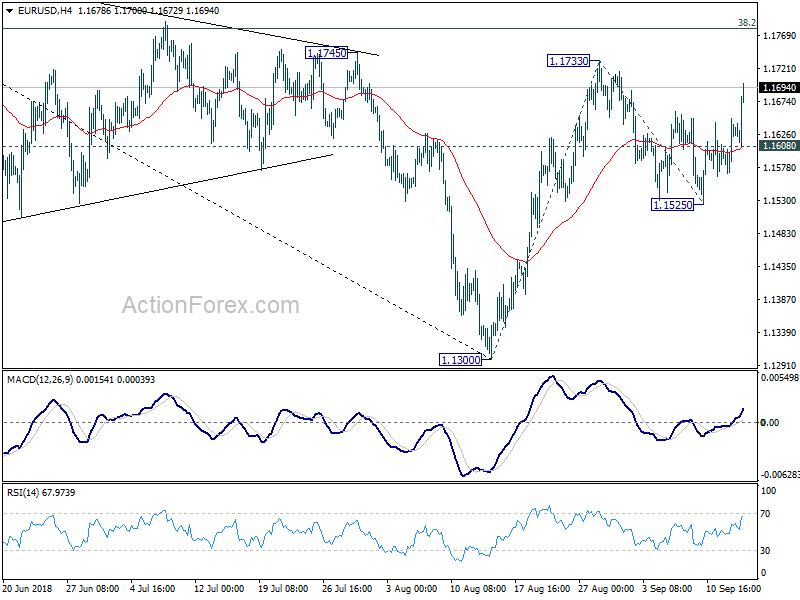
EUR/USD's rebound from 1.1525 accelerates higher and intraday bias is now on the upside for 1.1733 and above. At this point, we'd still expect strong resistance from 38.2% retracement of 1.2555 to 1.1300 at 1.1779 to limit upside. On the downside, break of 1.1608 minor support will turn bias to the downside for 1.1525 support. Break will indicate completion of whole rebound from 1.1300. However, firm break of 1.1779 will extend the rise to 100% projection of 1.1300 to 1.1733 from 1.1525 at 1.1958.
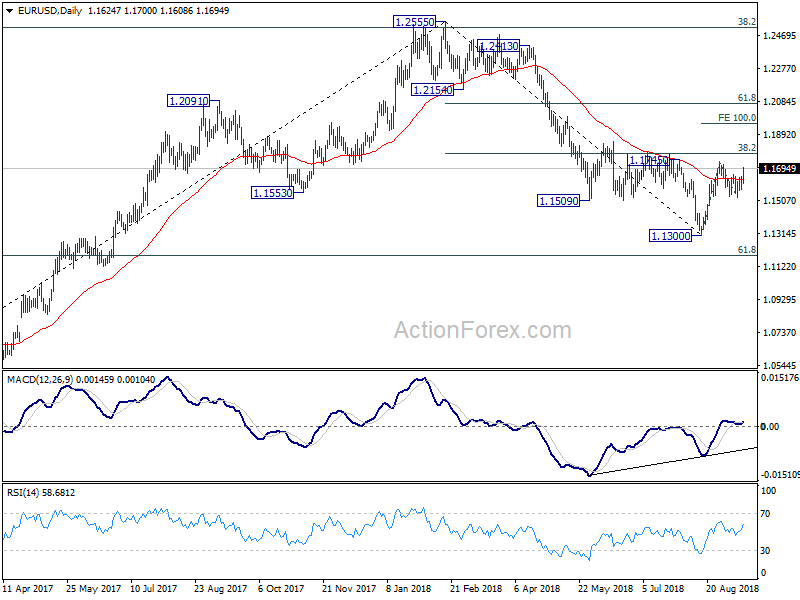
In the bigger picture, a medium term bottom should be in place at 1.1300, on bullish convergence condition in daily MACD and some consolidations would be seen. But still, note that EUR/USD was rejected by 38.2% retracement of 1.6039 (2008 high) to 1.0339 (2017 low) at 1.2516. That carries some long term bearish implications. Thus, we'd expect fall from 1.2555 high to resume after consolidation completes. Below 1.1300 should send EUR/USD through 61.8% retracement of 1.0339 to 1.2555 at 1.1186. And, in that case, EUR/USD would head to retest 1.0339 (2017 low).
U.S. August CPI Growth Softer-than-Expected But Still Firm
Highlights:
- All items CPI rose 0.2% on month-over-month basis in August with the year-over-year rate dipping to 2.7% from 2.9% in July.
- Energy prices rose 1.9% from July. The year-over-year rate slowed to 10.2% from 12.1% in July, though.
- Year-over-year food price growth held steady at 1.4%.
- Core (ex-food & energy) prices inched up 0.1% on a month-over-month basis. The year-over-year rate fell to 2.2% from 2.4% in July.
Our Take:
The moderation in the headline year-over-year rate to 2.7% from 2.9% was partly due to an expected slowing in annual energy price growth. Ex-food & energy price growth was a larger surprise with just a 0.1% increase on a month-over-month basis sending the year-over-year rate down to 2.2% from 2.4% in July. That’s still above the Fed’s 2% inflation objective, though, and the moderation probably reflected more ‘noise’ than underlying trend anyway. Apparel prices posted their largest one-month decline since 1949 in August (-1.6%) and medical costs dipped again. Neither of those declines seem likely to last — particularly for apparel prices if the Trump administration follows through on threats to levy further tariffs on imports from China. Looking through monthly wiggles, underlying price growth is still more likely trending upward than downwards. The combination of already tight labour markets and tailwinds from deficit-financed government tax cuts that continue to spur economic growth have been pushing wages gradually higher. Inflation around 2% alongside strong labour market and GDP data should only reinforce expectations that policymakers will continue to gradually hike rates.
Bank of England Review: Repeats Hiking Bias amid Brexit Uncertainties
As expected, the Bank of England (BoE) voted unanimously to keep the Bank Rate at 0.75%. As it was one of the small meetings without an updated Inflation Report or press conference and following last month's hike, this did not come as a surprise.
The BoE did not make any big policy signal shifts either, although it recognises Q3 growth may be higher than previously anticipated after the stronger-than-expected GDP growth print in July. The statement still says that 'any future increases in the Bank rate are likely to be at a gradual pace and to a limited extent' and that 'ongoing tightening of monetary policy […] would be appropriate'. At the August meeting, the BoE hinted that while the nominal natural rate of interest (the rate where monetary policy is neither expansionary nor contractionary) is probably around 2-3% in the long run, it is around 1.5% currently – basically only three hikes away.
We still expect the BoE to hike around once a year and our base case is that the next hike will arrive in May 2019; therefore, after the UK formally leaves the EU. It may be earlier if the economy continues to surprise on the upside. On the other hand, the central bank also stated that Brexit uncertainty has gone up among businesses and in particular investors since the August meeting. The rate decision also depends on the outcome of the Brexit negotiations, as we are approaching the 'end game' in Q4.
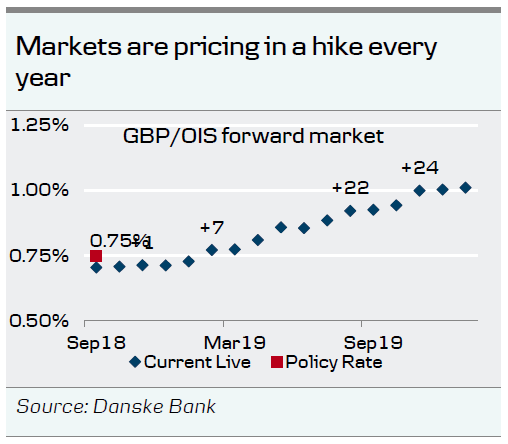
EUR/GBP is little changed as the 9-0 vote for an unchanged Bank Rate was widely expected. The UK money market curve is relatively flat, with the next BoE rate hike priced to arrive in November 2019. While this is slightly dovish compared to our call for a hike in May 2019, we think pricing is fair for now – especially given the uncertainty related to Brexit.
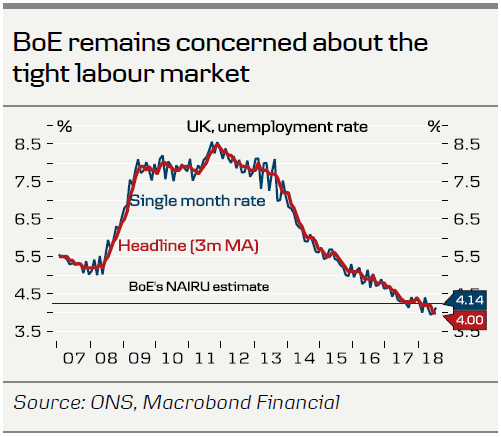
We expect GBP to remain very volatile and sensitive to Brexit news in coming months and, overall, we still see EUR/GBP risks skewed to the upside ahead of the UK Conservative party's annual congress, due to start on 30 September.
It was announced earlier this week that BoE Governor Mark Carney has extended his term to January 2020 'to support a smooth exit of the United Kingdom from the European Union'. This should not have any policy implications in the short run.
Macro charts
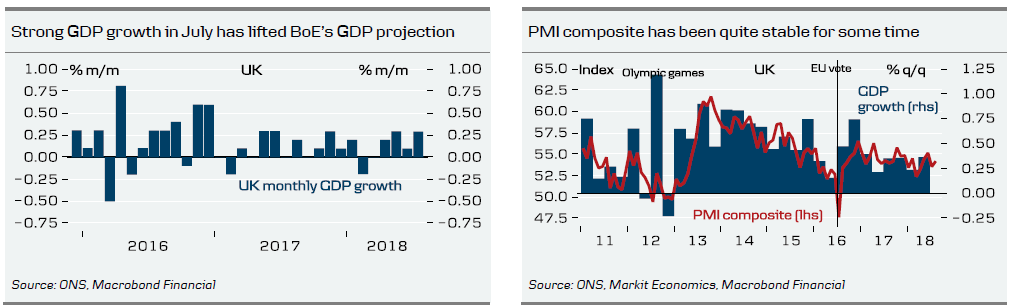
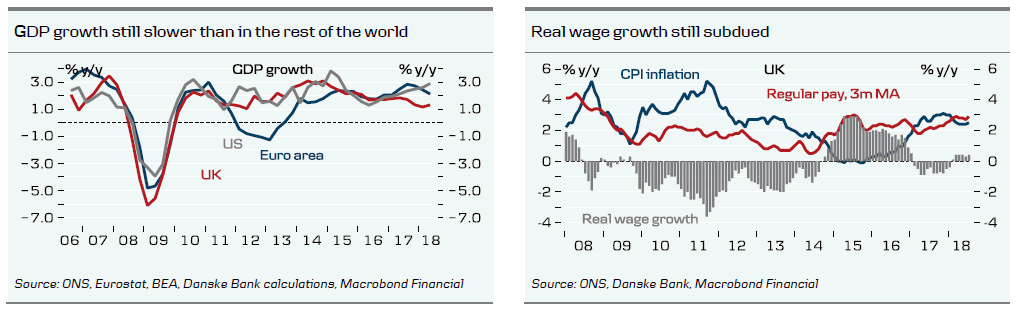
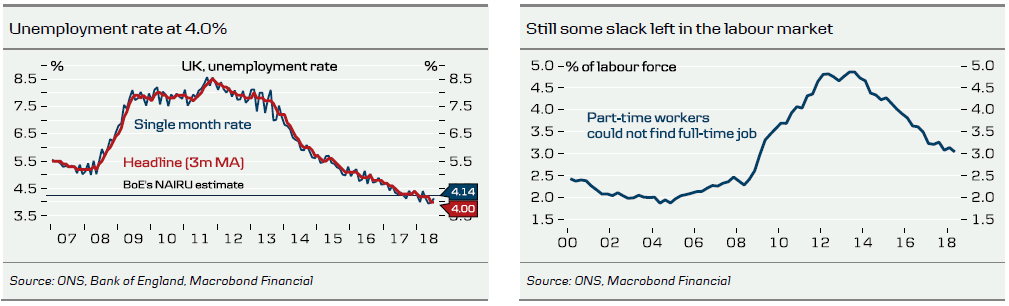
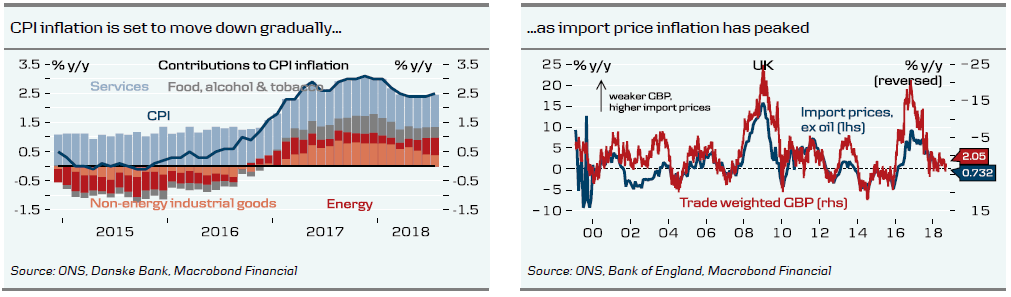
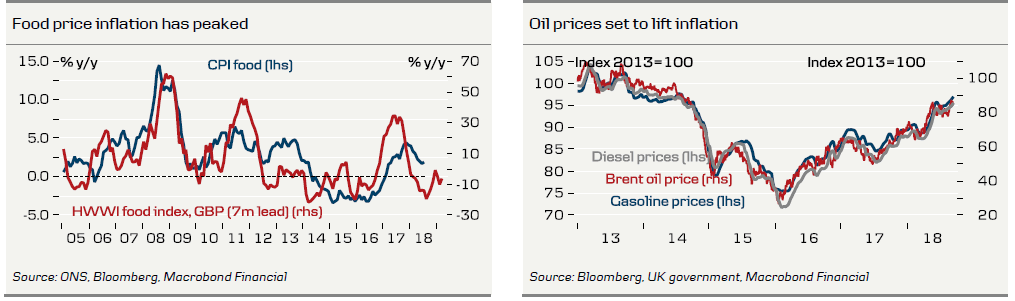
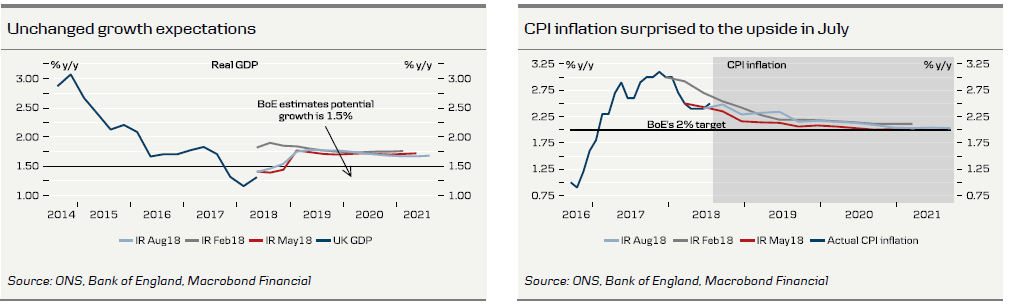
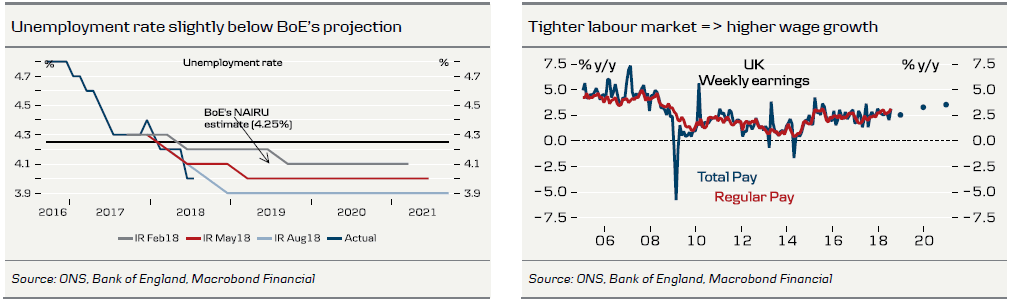
Bank of England’s projections
GBPCAD Downside Prevails But SMAs Point Up
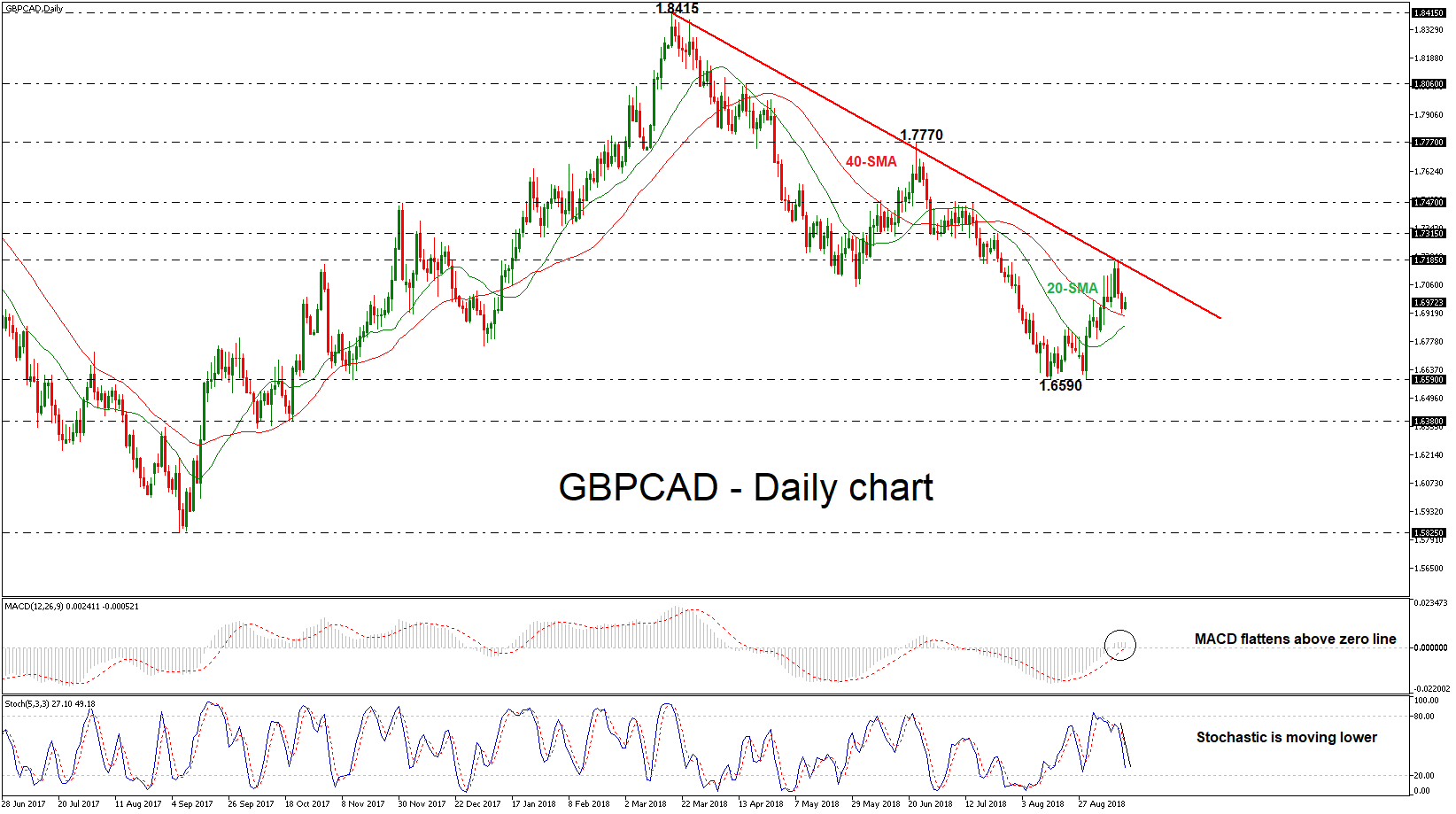
GBPCAD has lost its positive momentum after the bounce off the medium-term descending trend line at 1.7185 on Monday. In the short-term, the market could retain the bearish structure as the MACD is flattening above the zero and trigger lines, while the stochastic oscillator is moving lower. Despite those signs, the 20-day simple moving average (SMA) is ready to cross to the upside of the 40-day SMA in the next few sessions in case of a bullish movement.
Should the pair stretch south and plunge below the moving averages, the 1.6590 barrier could provide immediate support to investors. A significant step lower could create a new lower low sending the price probably towards the 1.6380 hurdle, identified by the bottom on October 2010.
On the other hand, if the pair strengthens, the price could re-challenge the falling trend line and the 1.7185 resistance obstacle. Even higher, the 1.7315 could attract greater attention as any leg higher could endorse the scenario for a bullish retracement, opening the way towards the 1.7470 hurdle, taken from the highs on July 16.
In the medium-term picture, GBPCAD has been trading bearish in the past six months after the close below 1.8415. Still, if the pair manages to cross above 1.7185 the bearish outlook could switch to a bullish one.
EURUSD: Recovers Higher, Eyes Key Resistance Zone
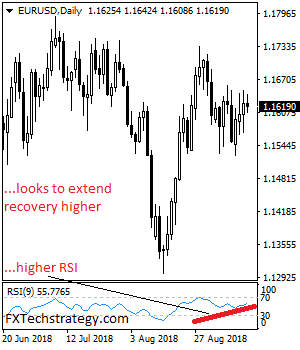
EURUSD: The pair now faces further corrective higher as it looks to extend strength. On the upside, resistance comes in at 1.1650 level with a break through there opening the door for more upside towards the 1.1700 level. Further up, resistance lies at the 1.1750 level where a break will expose the 1.1800 level. Conversely, support lies at the 5level where a violation will aim at the 1.1400 level. A break of here will aim at the 1.1350 level. Below here will open the door for more weakness towards the 1.1300. All in all, EURUSD still faces further downside pressure though hesitating.
USDTRY Outlook: Turkish Lira at Front Foot after CBRT Surprise 625bps Rate Hike
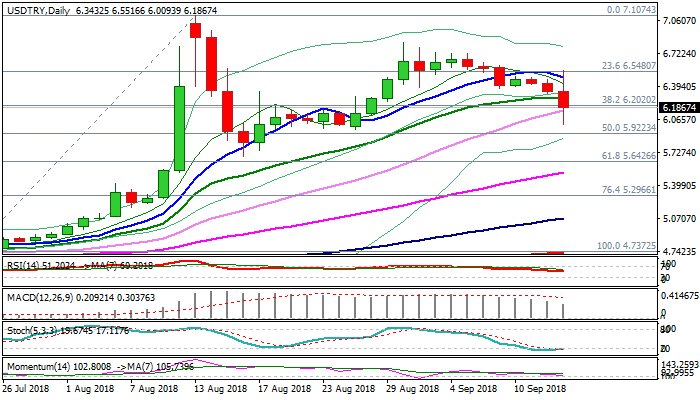
Turkish lira rose to new 2 1/2 week high against the dollar after Turkey's central bank surprised on higher than expected rate hike on today's monetary policy meeting. The CBRT increased one-week repo rate to 24% on 625 basis points hike, beating wide expectations for 425bps increase. The lira dipped around 3% in hours preceding the central bank's decision as speech of President Erdogan spiced up the sentiment. Erdogan said that the central bank is independent but stressed that his sensitivity towards interest rates hasn't changed and that high interest rates harm the economy. The lira fell to session low at 6.5516 on Erdogan's remarks but quickly regained traction after CBRT's surprise. The central bank did what was required to tackle double-digit inflation in the proper way, however, lira stays away from its 16 Aug high at 5.6875, posted on strong pullback from new record low at 7.1074 (13 Aug). Also, lira stands far below highs at 4.45 zone, hit after last CBRT's 425bps hike in June. This suggests that lira remains in troubles and vulnerable of further losses, as sentiment remains negative, after the latest measures from Turkey's government who ordered all property transactions must be paid in Turkish lira. The USDTRY pair probed below pivotal support at 6.2020 (Fibo 38.2% of 4.7372/7.1074) with daily close below needed spark further downside. Key supports lay at 5.6875 (16 Aug low) and 5.6426 (Fibo 61.8%) with sustained break lower to generate reversal signal. However, lira remains weak and it is a question how long it could hold positive post-CBRT sentiment. Early lira's bulls stall would risk fresh renewed weakness and may turn focus towards all-time low again.
Res: 6.2020; 6.2719; 6.4865; 6.5516
Sup: 6.1530; 6.0093; 5.9223; 5.6875
US: Inflation Pressures Remained Steady in August
Consumer prices rose 0.2% in August, slightly below expectations. Core CPI (excluding food and energy) was also a little softer than expected, rising 0.1% on the month – the smallest increase since April.
The August softness saw headline inflation ease two ticks to 2.7% year-on-year. Similarly, the core rate fell back to 2.2%.
Energy prices rose 1.9% (month-on-month), snapping back from two months of declines. Food prices were up a modest 0.1%.
Core goods prices once again fell into negative territory, down 0.3% on the month. After heating up in July, core services prices moderated to 0.2%. However, key services categories remained hot. Owners' equivalent rent rose 0.3% in August, and is up 3.3% versus a year ago. Rent prices were even hotter, up 0.4% in August and 3.6% versus a year ago. Medical care services (-0.2% m/m), communication (-0.2%) and recreation and personal care (both -0.1%) leaned against these price increases.
Key Implications
The August inflation report shows that while inflation has picked up over the course of 2018, there are few signs of a breakout in price pressures. A strong U.S. dollar and a competitive retail sector are clearly helping to keep a lid on core goods prices. Services price pressures are hotter overall, but haven't really broken above a 3% pace since the spring.
Overall, we expect inflationary pressures to pick up slightly over the coming quarters. There is little debate that the labor market is tight, and domestic demand is being buoyed by tax cuts and spending. A strong U.S. dollar is helping to keep a lid on price pressures for many imported goods. This backdrop supports our expectation for a continued gradual pace of rate increases, with hikes looking likely at the September and December meetings.
GBP/USD Mid-Day Outlook
Daily Pivots: (S1) 1.2994; (P) 1.3033; (R1) 1.3085; More...
GBP/USD's rebound picks up momentum ahead and hits as high as 1.3092 so far. Intraday bias remains on the upside for 100% projection of 1.2661 to 1.3042 from 1.2784 at 1.3165, and possibly above. However, as this is seen as a corrective move, upside should be e limited by 1.3316 key fibonacci level to bring near term reversal. On the downside, break of 1.2963 minor support will now argue that rebound from 1.2661 has completed. In such case, intraday bias will be turned back to the downside for 1.2784 and then 1.2661.
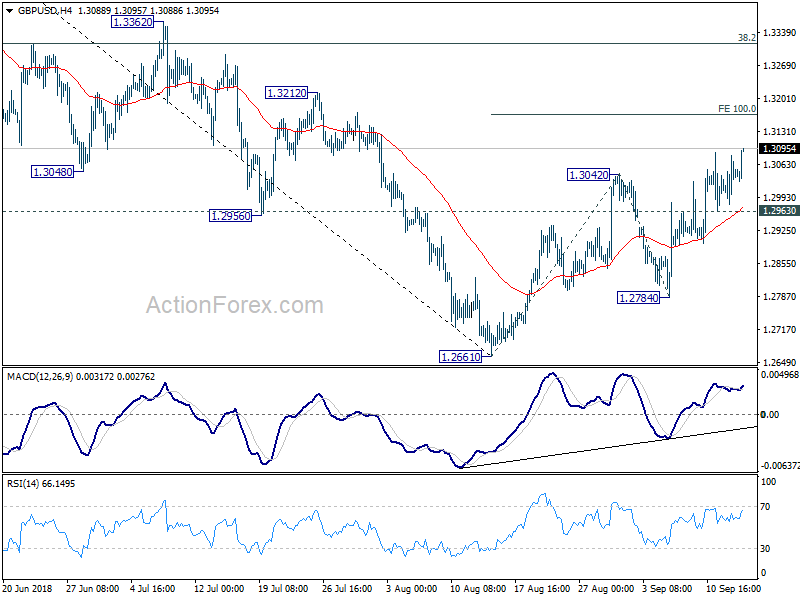
In the bigger picture, whole medium term rebound from 1.1946 (2016 low) should have completed at 1.4376 already, after rejection from 55 month EMA (now at 1.4099). The structure and momentum of the fall from 1.4376 argues that it's resuming long term down trend. And this will be the preferred case as long as 38.2% retracement of 1.4376 to 1.2661 at 1.3316 holds. However, firm break of 1.3316 would bring stronger rebound to 61.8% retracement at 1.3721. And, the eventual depth of the fall from 1.4376, and the chance of hitting 1.1946 low, will depend on the strength of the interim corrective rebound from 1.2661.
Fresh Dollar Selling after Core CPI Miss, ECB & BoE Stand Pat While CBRT Hikes
Dollar has been relatively today and risks of escalation in trade war diminished. Deeper selling is seen after inflation data showed larger than expected fall in core CPI in August. Though, the greenback is currently underperformed by Yen due to easing risk aversion. In addition to trade optimism, Turkish central bank also delivered the anticipated rate hike, which helps lift the Lira by more than 2%. Talking about central banks, both BoE and ECB stand pat today and their decisions are widely expected.
On the other hand, Australian Dollar continues to be the biggest winner today, as additionally supported by strong job data. Euro followed as the second strongest.
Technically, we could Dollar and Yen extending this week's decline further in US session. In particular, EUR/USD will likely take on 1.1733 resistance while USD/CHF will take on 0.9640 support. EUR/JPY breaks 129.97 minor resistance and should now be heading to 130.86 and above. USD/JPY, however, is staying in range and show no intention of a breakout.
Dollar falls as core CPI slowed more than expected, ignore strong job data
Dollar suffers renewed sell after core consumer came in lower than expected. Headline CPI rose 0.2% mom, 2.7% yoy versus expectation of 0.1% mom, 2.7% yoy. That slowed from prior month's 0.2% mom, 2.9% yoy. Core CPI rose 0.1% mom, 2.2%, missed expectation of 0.2% mom, 2.4% yoy. Also it missed expectation of 0.2% mom, 2.4% yoy.
Job data was solid though. Initial jobless claims dropped -1k to 204k in the week ended September 8. That's the new lowest since December 6 1969. Four-week moving average of initial claims dropped -2k to 208k, lowest since December 6, 1969. Continuing claims dropped -15k to 1.696m, lowest since December 1, 1973. Four week moving average of continuing claims dropped -8.25k to 1.71125m., lowest since November 24, 1973.
ECB stands pat, half asset purchase starting October, lowers growth forecast
ECB kept main refinancing rate unchanged at 0.00% as widely expected. The marginal lending facility and the deposit facility are kept at 0.25% and -0.40% respectively. ECB also maintained forward guidance that "the Governing Council expects the key ECB interest rates to remain at their present levels at least through the summer of 2019". Also, starting October, monthly asset purchase will be halved to EUR 15B, and end after December. ECB also said it intends to reinvest the principal payments "for an extended period of time".
In the new staff projections, ECB lowered 2018 and 2019 growth forecasts but kept 2020 growth forecast unchanged. For 2018, growth is projected to be 2.0%, down from 2.1%. For 2019, growth is projected to be 1.8%, down from prior 1.9%. For 2020, growth is projected to be 1.7%, unchanged. Inflation forecasts were kept unchanged, at 1.7% in 2018, 2019 and 2020.
From Germany, CPI was finalized at 0.1% mom, 2.0% yoy in August. From Swiss, PPI rose 0.0% mom, 3.4% yoy in August.
BoE kept bank rate unchanged at 0.75%, August projections broadly on track
BoE kept bank rate unchanged at 0.75% as widely expected. Asset purchase target was also unchanged at GBP 435B. Both were made by unanimous decision. The central bank maintained tightening bias and said "an ongoing tightening of monetary policy over the forecast period would be appropriate to return inflation sustainably to the 2% target at a conventional horizon." But it also reiterated that the projections were conditioned on the expectation of a smooth Brexit.
BoE noted that economic projections as presented in the August Inflation Report "appear to be broadly on track". Downside risk to global economy increased "to some degree". Growth has softened and financial conditions tightened in emerging markets, "in some cases markedly". Further protectionist measures by the US and China could a larger negative impact than expected. Domestically, economic outlook could be influenced by Brexit process and responses from households, business and markets. BOE noted that there were indications of "greater uncertainty" regarding Brexit.
Turkish Lira surges as CBRT hikes policy rate from 17.75% to 24%
What a volatile day for the Turkish Lira. It originally plunged on President Tayyip Erdogan's comments against interest rate. But then CBRT announce to raise policy rate (one week repo auction rate) from 17.75% to 24%. USDTRY drops more than -3% after the release and is now set to take on 6.000 handle. Last month's low at 5.7000 suddenly looks within reach.
CBRT said in the statement that "recent developments regarding the inflation outlook point to significant risks to price stability." Further, "deterioration in the pricing behavior continues to pose upside risks on the inflation outlook". Thus, ", the Committee has decided to implement a strong monetary tightening to support price stability." Also, "other factors affecting inflation will be closely monitored and, if needed, further monetary tightening will be delivered."
China received trade talk invitation, working on details
Chinese Foreign Ministry spokesman Geng Shuang said at a regular press briefing that it received the invitation from the US for restarting trade talks. And the countries are now in discussion about the details. Geng said that "China has always held that an escalation of the trade conflict is not in anyone's interests. In fact, from last month's preliminary talks in Washington, the two sides' trade talk teams have maintained various forms of contact, and held discussions on the concerns of each side."
Ministry of Commerce spokesman Gao Feng also said the two side are discussing details for future talks. And, he added that trade escalation is not in interest of either country. But he also emphasized that trade deficit with US is due to its low saving and control on export to China. He hoped that US will not find excuses for trade protectionism and urged it to comply with WTO rules.
AmCham survey showed US-China trade war already negatively impacting US companies
A joint survey by AmCham China and AmCham Shanghai showed that over nearly two-thirds of survey respondents experienced negative impact from US-China tariff war. Moreover, for additional US tariffs, 74.3% expected negative impact and 47.2% expected "strong negative impact. For additional China tariffs, 67.6% expected negative impact and 38.2% expected "strong negative impacts". Increased cost of manufacturing (47.1) and decreased demand for products (41.8%) were the to most significant downside of the tariffs.
William Zarit, Chairman of AmCham China said "the White House has threatened to fire the next barrage of tariffs at $200 billion more Chinese goods, expecting with this onslaught, or subsequent ones, China will wave a white flag. But that scenario risks underestimating China's capability to continue meeting fire with fire."
Eric Zheng, Chairman of AmCham Shanghai warned that "tariffs are already negatively impacting U.S. companies and the imposition of a proposed $200 billion tranche will bring a lot more pain". And "if almost a half of American companies anticipate a strong negative impact from the next round of U.S. tariffs, then the U.S. administration will be hurting the companies it should be helping."
The survey was conducted between August 29 and September 5, 2018. Over 430 companies responded.
Overwhelmingly negative impact of US-China tariffs on European companies in China
European Union Chamber of Commerce in China, also carried out a survey regarding US-China tariff war. Results showed that 53.9% responding said US tariffs on China affected their company. 42.9% said China tariff on US products affected their company. There is, roughly 11% difference. The Chamber said that "the high rate of negative views on either side of the trade war is emblematic of the degree of interconnectivity in the global economy." But at the same time 72.5% said they're taking no action to cope with the trade war, but just monitoring the situation.
Mats Harborn, president of the European Union Chamber of Commerce in China said "the effects of the US-China trade war on European firms in China are significant and overwhelmingly negative." The Chamber shared the concerns regarding China's trade and in vestment practices. However, Harborn warned that "continuing along the path of tariff escalation is extremely dangerous". He added "it threatens to dismantle the entire global, rules-based system at a time when we should be working together to modernise it."
Strong 44k job growth in Australia, unemployment rate unchanged at 5.3%
Australia job market grew 44k in August, well pass expectation of 18.4k. Full time employment grew strongly by 33.7k. Part time jobs added 10.2k. Unemployment was unchanged at 5.3%, matched expectation. Labor force participation rate rose to 65.7%, up from 65.6%.
Overall, the set of data affirmed RBA's view that spare capacity is gradually being taken out, which is a prelude to meaningful wage growth. However, wages have actually need to show the increase before RBA is convinced that eventually there is enough upward pressure on inflation. Talk of rate hike is premature based on just today's data.
Japan core machine orders jumped 11.0% yoy in July
In Japan, private machinery orders, excluding volatile ones, rose 11.0% yoy in July, well above expectation of 5.8% yoy. Total machinery orders rose 18.8% yoy. The strong growth suggests that companies were keen to invest despite the threat of trade protectionism. And rising capex will likely add to economic growth. So far, trade war worries haven't materialized in economic data yet.
Also released, domestic CGPI rose 3.0% yoy in August, below expectation of 3.1% yoy.
GBP/USD Mid-Day Outlook
Daily Pivots: (S1) 1.2994; (P) 1.3033; (R1) 1.3085; More...
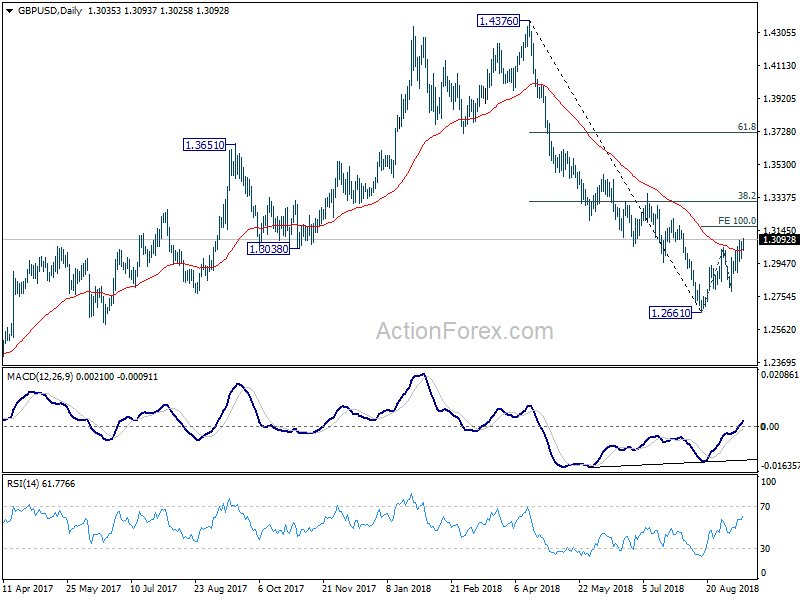
GBP/USD's rebound picks up momentum ahead and hits as high as 1.3092 so far. Intraday bias remains on the upside for 100% projection of 1.2661 to 1.3042 from 1.2784 at 1.3165, and possibly above. However, as this is seen as a corrective move, upside should be e limited by 1.3316 key fibonacci level to bring near term reversal. On the downside, break of 1.2963 minor support will now argue that rebound from 1.2661 has completed. In such case, intraday bias will be turned back to the downside for 1.2784 and then 1.2661.
In the bigger picture, whole medium term rebound from 1.1946 (2016 low) should have completed at 1.4376 already, after rejection from 55 month EMA (now at 1.4099). The structure and momentum of the fall from 1.4376 argues that it's resuming long term down trend. And this will be the preferred case as long as 38.2% retracement of 1.4376 to 1.2661 at 1.3316 holds. However, firm break of 1.3316 would bring stronger rebound to 61.8% retracement at 1.3721. And, the eventual depth of the fall from 1.4376, and the chance of hitting 1.1946 low, will depend on the strength of the interim corrective rebound from 1.2661.
Economic Indicators Update
| GMT | Ccy | Events | Actual | Forecast | Previous | Revised |
|---|---|---|---|---|---|---|
| 23:01 | GBP | RICS House Price Balance Aug | 2% | 2% | 4% | |
| 23:50 | JPY | Domestic CGPI Y/Y Aug | 3.00% | 3.10% | 3.10% | 3.00% |
| 23:50 | JPY | Machine Orders M/M Jul | 11.00% | 5.80% | -8.80% | |
| 01:00 | AUD | Consumer Inflation Expectation Sep | 4.00% | 4.00% | ||
| 01:30 | AUD | Employment Change Aug | 44.0K | 18.4K | -3.9K | -4.3K |
| 01:30 | AUD | Unemployment Rate Aug | 5.30% | 5.30% | 5.30% | |
| 06:00 | EUR | German CPI M/M Aug F | 0.10% | 0.10% | 0.10% | |
| 06:00 | EUR | German CPI Y/Y Aug F | 2.00% | 2.00% | 2.00% | |
| 07:15 | CHF | Producer & Import Prices M/M Aug | 0.00% | 0.10% | 0.10% | |
| 07:15 | CHF | Producer & Import Prices Y/Y Aug | 3.40% | 3.40% | 3.60% | |
| 11:00 | GBP | BoE Bank Rate | 0.75% | 0.75% | 0.75% | |
| 11:00 | GBP | BoE Asset Purchase Target Sep | 435B | 435B | 435B | |
| 11:00 | GBP | MPC Official Bank Rate Votes | 0--0--9 | 0--0--9 | 0--0--9 | |
| 11:00 | GBP | MPC Asset Purchase Facility Votes | 0--0--9 | 0--0--9 | 0--0--9 | |
| 11:45 | EUR | ECB Rate Decision | 0.00% | 0.00% | 0.00% | |
| 12:30 | EUR | ECB Press Conference | ||||
| 12:30 | CAD | New Housing Price Index M/M Jul | 0.10% | 0.10% | 0.10% | |
| 12:30 | USD | CPI M/M Aug | 0.20% | 0.10% | 0.20% | |
| 12:30 | USD | CPI Y/Y Aug | 2.70% | 2.70% | 2.90% | |
| 12:30 | USD | CPI Core M/M Aug | 0.10% | 0.20% | 0.20% | |
| 12:30 | USD | CPI Core Y/Y Aug | 2.20% | 2.40% | 2.40% | |
| 12:30 | USD | Initial Jobless Claims (SEP 8) | 204K | 210K | 203K | 205K |
| 14:30 | USD | Natural Gas Storage | 65B | 63B | ||
| 18:00 | USD | Monthly Budget Statement Aug | -183.0B | -76.9B |
Dollar falls as core CPI slowed more than expected, ignore strong job data
Dollar suffers renewed sell after core consumer came in lower than expected. Headline CPI rose 0.2% mom, 2.7% yoy versus expectation of 0.1% mom, 2.7% yoy. That slowed from prior month's 0.2% mom, 2.9% yoy. Core CPI rose 0.1% mom, 2.2%, missed expectation of 0.2% mom, 2.4% yoy. Also it missed expectation of 0.2% mom, 2.4% yoy.
Job data was solid though. Initial jobless claims dropped -1k to 204k in the week ended September 8. That's the new lowest since December 6 1969. Four-week moving average of initial claims dropped -2k to 208k, lowest since December 6, 1969. Continuing claims dropped -15k to 1.696m, lowest since December 1, 1973. Four week moving average of continuing claims dropped -8.25k to 1.71125m., lowest since November 24, 1973.