

Sample Category Title
ECB Mario Draghi press conference live stream
https://www.youtube.com/watch?v=ZZBPUfDnY6M
Prepred remark:
Mario Draghi, President of the ECB,
Luis de Guindos, Vice-President of the ECB,
Frankfurt am Main, 13 September 2018
INTRODUCTORY STATEMENT
Ladies and gentlemen, the Vice-President and I are very pleased to welcome you to our press conference. We will now report on the outcome of today’s meeting of the Governing Council, which was also attended by the Commission Vice-President, Mr Dombrovskis.
Based on our regular economic and monetary analyses, we decided to keep the key ECB interest rates unchanged. We continue to expect them to remain at their present levels at least through the summer of 2019, and in any case for as long as necessary to ensure the continued sustained convergence of inflation to levels that are below, but close to, 2% over the medium term.
Regarding non-standard monetary policy measures, we will continue to make net purchases under the asset purchase programme (APP) at the current monthly pace of €30 billion until the end of this month. After September 2018, we will reduce the monthly pace of the net asset purchases to €15 billion until the end of December 2018 and we anticipate that, subject to incoming data confirming our medium-term inflation outlook, we will then end net purchases. We intend to reinvest the principal payments from maturing securities purchased under the APP for an extended period of time after the end of our net asset purchases, and in any case for as long as necessary to maintain favourable liquidity conditions and an ample degree of monetary accommodation.
The incoming information, including our new September 2018 staff projections, broadly confirms our previous assessment of an ongoing broad-based expansion of the euro area economy and gradually rising inflation. The underlying strength of the economy continues to support our confidence that the sustained convergence of inflation to our aim will proceed and will be maintained even after a gradual winding-down of our net asset purchases. At the same time, uncertainties relating to rising protectionism, vulnerabilities in emerging markets and financial market volatility have gained more prominence recently. Significant monetary policy stimulus is still needed to support the further build-up of domestic price pressures and headline inflation developments over the medium term. This support will continue to be provided by the net asset purchases until the end of the year, by the sizeable stock of acquired assets and the associated reinvestments, and by our enhanced forward guidance on the key ECB interest rates. In any event, the Governing Council stands ready to adjust all of its instruments as appropriate to ensure that inflation continues to move towards the Governing Council’s inflation aim in a sustained manner.
Let me now explain our assessment in greater detail, starting with the economic analysis. Euro area real GDP increased by 0.4%, quarter on quarter, in the second quarter of 2018, following growth at the same rate in the previous quarter. Despite some moderation following the strong growth performance in 2017, the latest economic indicators and survey results overall confirm ongoing broad-based growth of the euro area economy. Our monetary policy measures continue to underpin domestic demand. Private consumption is supported by ongoing employment gains, which, in turn, partly reflect past labour market reforms, and by rising wages. Business investment is fostered by the favourable financing conditions, rising corporate profitability and solid demand. Housing investment remains robust. In addition, the expansion in global activity is expected to continue, supporting euro area exports.
This assessment is broadly reflected in the September 2018 ECB staff macroeconomic projections for the euro area. These projections foresee annual real GDP increasing by 2.0% in 2018, 1.8% in 2019 and 1.7% in 2020. Compared with the June 2018 Eurosystem staff macroeconomic projections, the outlook for real GDP growth has been revised down slightly for 2018 and 2019, mainly due to a somewhat weaker contribution from foreign demand.
The risks surrounding the euro area growth outlook can still be assessed as broadly balanced. At the same time, risks relating to rising protectionism, vulnerabilities in emerging markets and financial market volatility have gained more prominence recently.
According to Eurostat’s flash estimate, euro area annual HICP inflation was 2.0% in August 2018, down from 2.1% in July. On the basis of current futures prices for oil, annual rates of headline inflation are likely to hover around the current level for the remainder of the year. While measures of underlying inflation remain generally muted, they have been increasing from earlier lows. Domestic cost pressures are strengthening and broadening amid high levels of capacity utilisation and tightening labour markets, which is pushing up wage growth. Uncertainty around the inflation outlook is receding. Looking ahead, underlying inflation is expected to pick up towards the end of the year and thereafter to increase gradually over the medium term, supported by our monetary policy measures, the continuing economic expansion and rising wage growth.
This assessment is also broadly reflected in the September 2018 ECB staff macroeconomic projections for the euro area, which foresee annual HICP inflation at 1.7% in 2018, 2019 and 2020, which is unchanged from the June 2018 Eurosystem staff macroeconomic projections.
Turning to the monetary analysis, broad money (M3) growth declined to 4.0% in July 2018, from 4.5% in June. Apart from some volatility in monthly flows, M3 growth is increasingly supported by bank credit creation. The narrow monetary aggregate M1 remained the main contributor to broad money growth.
The recovery in the growth of loans to the private sector observed since the beginning of 2014 is proceeding. The annual growth rate of loans to non-financial corporations stood at 4.1% in July 2018, while the annual growth rate of loans to households stood at 3.0%, both unchanged from June.
The pass-through of the monetary policy measures put in place since June 2014 continues to significantly support borrowing conditions for firms and households, access to financing – in particular for small and medium-sized enterprises – and credit flows across the euro area.
To sum up, a cross-check of the outcome of the economic analysis with the signals coming from the monetary analysis confirmed that an ample degree of monetary accommodation is still necessary for the continued sustained convergence of inflation to levels that are below, but close to, 2% over the medium term.
In order to reap the full benefits from our monetary policy measures, other policy areas must contribute more decisively to raising the longer-term growth potential and reducing vulnerabilities. The implementation of structural reforms in euro area countries needs to be substantially stepped up to increase resilience, reduce structural unemployment and boost euro area productivity and growth potential. Regarding fiscal policies, the broad-based expansion calls for rebuilding fiscal buffers. This is particularly important in countries where government debt is high and for which full adherence to the Stability and Growth Pact is critical for safeguarding sound fiscal positions. Likewise, the transparent and consistent implementation of the EU’s fiscal and economic governance framework over time and across countries remains essential to bolster the resilience of the euro area economy. Improving the functioning of Economic and Monetary Union remains a priority. The Governing Council urges specific and decisive steps to complete the banking union and the capital markets union.
We are now at your disposal for questions.
Canadian Dollar at 2-Week High, US Consumer Inflation Next
The Canadian dollar is almost unchanged in the Thursday session. Currently, USD/CAD is trading at 1.3006, up 0.05% on the day. On the release front, Canada releases NHPI, which is expected to post a gain of 0.1% for a second straight month. In the U.S, the focus will be on key consumer inflation reports. CPI is expected to edge up to 0.3%, while Core CPI is forecast to remain pegged at 0.2%. As well, unemployment claims are expected to rise to 213 thousand. On Friday, the U.S release retail sales and UoM Consumer Sentiment.
The Canadian dollar has rallied this week, gaining 1.2%, as it hovers at the symbolic 1.30 level. Trade talks between the U.S and Canada are continuing, with the parties hoping to wrap up an agreement shortly. The Bank of Canada is also keeping a close eye on the NAFTA negotiations Last week’s rate announcement that policymakers would be “monitoring closely the course of the NAFTA negotiations and other trade policy developments, and their impact on the inflation outlook”. With the Canadian economy performing well and the Fed likely raising rates later this month, there is pressure on the BoC to again raise rates in 2018. However, concerns over NAFTA and global trade tensions have won the day for now, as the BoC took a pass on a rate hike.
Into US session: BoE & ECB stand pat, CBRT hikes, TRY had a wild ride
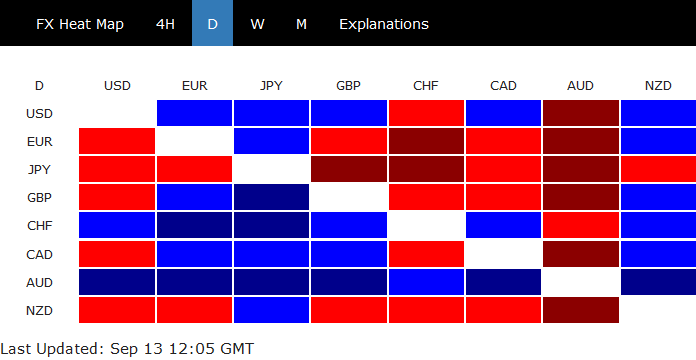
Entering into US session, Australian Dollar is trading as the strongest one today, followed by Swiss Franc. On the other hand Yen is the weakest one, followed by New Zealand Dollar. Optimism on easing US-China trade tension is a generally theme today, lifting Asian and European stocks, except UK. Buying jumped in after China confirmed that they received the invitation from the US for meeting, and both side are working on the details.
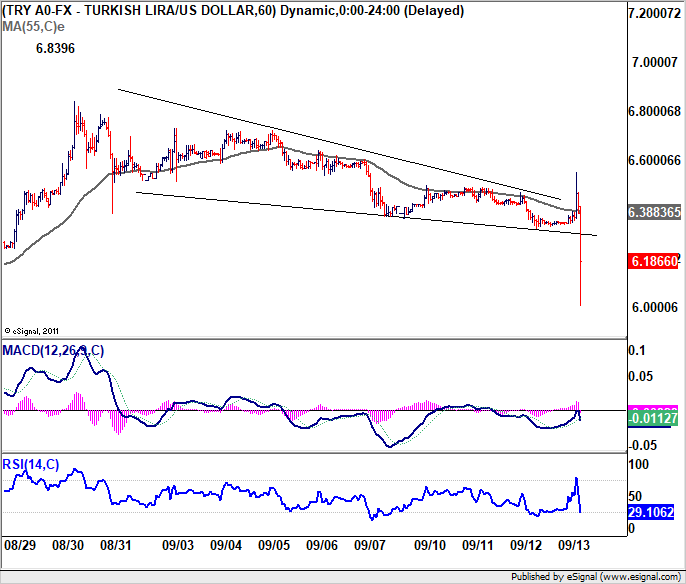
Three central bank announced rate decision today. It's Turkish central bank CBRT that stole the show. The Turkish Lira was firstly hammered down by President Tayyip Erdogan's comments that interest rate is "tool of exploitation". But that the CBRT delivered its promise and raised policy rate (one week repo auction rate) from 17.75% to 24%. USD/TRY hit as high as 6.5514 but the tumbled to 6.0619. It's now down around -2.8%.
BoE kept Bank Rate unchanged at 0.75% as widely expected, by unanimous vote. ECB kept main refinancing rate unchanged at 0.00% as widely expected. Also, starting October, monthly asset purchase will be halved to EUR 15B, and end after December. ECB also said it intends to reinvest the principal payments "for an extended period of time". Both decision triggered little reactions in the markets.
At the time of writing, FTSE is down -0.15%, DAX Up 0.59%, CAC up 0.51%. Earlier today, China SSE rose 1.15% to 2686.58 but failed to reclaim 2700. Hong Kong HSI rose 2.54%. Singapore Strait Times rose 0.23%. Nikkei added 0.96%.
US CPI and jobless claims are the next focuses.
(ECB) Monetary Policy Decisions
At today's meeting the Governing Council of the European Central Bank (ECB) decided that the interest rate on the main refinancing operations and the interest rates on the marginal lending facility and the deposit facility will remain unchanged at 0.00%, 0.25% and -0.40% respectively. The Governing Council expects the key ECB interest rates to remain at their present levels at least through the summer of 2019, and in any case for as long as necessary to ensure the continued sustained convergence of inflation to levels that are below, but close to, 2% over the medium term.
Regarding non-standard monetary policy measures, the Governing Council will continue to make net purchases under the asset purchase programme (APP) at the current monthly pace of €30 billion until the end of this month. After September 2018, the Governing Council will reduce the monthly pace of the net asset purchases to €15 billion until the end of December 2018 and anticipates that, subject to incoming data confirming the medium-term inflation outlook, net purchases will then end. The Governing Council intends to reinvest the principal payments from maturing securities purchased under the APP for an extended period of time after the end of the net asset purchases, and in any case for as long as necessary to maintain favourable liquidity conditions and an ample degree of monetary accommodation.
The President of the ECB will comment on the considerations underlying these decisions at a press conference starting at 14:30 CET today.
ECB kept main refinancing rate unchanged at 0.00%, half asset purchase starting October, full statement
ECB kept main refinancing rate unchanged at 0.00% as widely expected. Also, starting Otober, monthly asset purhcase will be halved to EUR 15B, and end after December. ECB also said it intends to reinvest the principal payments "for an extended period of time".
Full statement below.
Monetary policy decisions
At today’s meeting the Governing Council of the European Central Bank (ECB) decided that the interest rate on the main refinancing operations and the interest rates on the marginal lending facility and the deposit facility will remain unchanged at 0.00%, 0.25% and -0.40% respectively. The Governing Council expects the key ECB interest rates to remain at their present levels at least through the summer of 2019, and in any case for as long as necessary to ensure the continued sustained convergence of inflation to levels that are below, but close to, 2% over the medium term.
Regarding non-standard monetary policy measures, the Governing Council will continue to make net purchases under the asset purchase programme (APP) at the current monthly pace of €30 billion until the end of this month. After September 2018, the Governing Council will reduce the monthly pace of the net asset purchases to €15 billion until the end of December 2018 and anticipates that, subject to incoming data confirming the medium-term inflation outlook, net purchases will then end. The Governing Council intends to reinvest the principal payments from maturing securities purchased under the APP for an extended period of time after the end of the net asset purchases, and in any case for as long as necessary to maintain favourable liquidity conditions and an ample degree of monetary accommodation.
The President of the ECB will comment on the considerations underlying these decisions at a press conference starting at 14:30 CET today.
DAX Gains Ground As US-China Talks Boost Automaker Shares
The DAX index has posted considerable gains in the Thursday session. Currently, the index is at 12,116, up 0.70% on the day. On the release front, German Final CPI dipped to 0.1%, matching the forecast. The ECB releases its main refinancing rate, which is expected to remain at 0.00%. On Friday, the eurozone releases trade balance.
The ECB will set interest rates later on Thursday. With the Bank expected to maintain rates at 0.00%, investors will be focusing on the rate announcement and Mario Draghi’s press conference. The Bank is expected to lower its growth forecast due to weaker global growth and could spell out downside risks to growth. If the message is indeed on the dovish side, the euro could react with losses. Inflation in the eurozone is expected to remain steady at 1.8% in 2018 in 2019, which means that the ECB is on track to wind up its asset-purchase program in December. Any change in monetary policy will not occur before next year, and an interest rate hike is unlikely before the second half of 2019.
The DAX has touched a 1-week high on Thursday, courtesy of automobile maker shares. BMW is up 2.37% on the day, Daimler has risen 1.71% and Volkswagen his climbed 2.17%. Investors gave a thumbs-up to reports that the U.S and China have renewed trade talks, which could spell relief for the auto sector, which has been hit by the recent tariff spat between the two economic giants.
This week’s German data has looked soft, causing some concern about the health of the German economy. Earlier in the week, ZEW Economic Sentiment improved in September, but remains mired in negative territory. The indicator came in at -10.6, posting a decline for a sixth straight month. The survey press release noted that during the survey period, Turkey and Argentina saw their currencies plunge, and German industrial production was soft. On Thursday, German Final CPI dipped to 0.1%, down from 0.3% a month earlier.
Gold Witnessing Strength As Dollar Faces Pressure| Oil Prices Decline As Demand Drops
Gold witnessing strength as dollar faces pressure
Gold has begun to experience strength while the dollar declines. The potential new round of U.S. and China trade talks has pushed the precious metal price up as investors are worried about an economic growth slowdown. The possibilities of a slowdown in economic growth has forced senior U.S. officials to suggest another trade meeting with China which could possibly make a change in Washington's policy.
The constant trade dispute between the United States and China had led to investors to invest into the U.S. dollar in faith that the state has less to lose from this trade war. However, it has at the same time led investors into short positions in Comex gold and gold exchange traded funds has seen substantial liquidations. Moreover, if these short positions continue gold prices may continue to be on the rise. The market price for gold has been seen to be at $1211.30. This shows how beneficial a decrease in the dollar can be for the yellow gold.
Gold is taking full advantage of the dollar's weakness where it is known to rely upon the greenbacks decline in price. However, the rate hikes which are scheduled to be carried out in September are yet to commence and are expected to startle the gold prices and increase dollar's strength. Therefore, investors will stay wary of this.
Oil prices decline as demand drops
Oil prices have seen a decline in price as the economy's growth becomes a stronger concern. West Texas Intermediate (WTI) and Brent crude futures were seeing constant increases in price while supply had shortened. On the other hand, at present it seems the prices have declined where WTI had decreased by 46 cents which had left it at $69.21 per barrel. Similarly, Brent crude futures had also been affecting as the oil had declined by 38 cents, leaving the price at $79.35 per barrel.
The declines which are present in the market for oil had originated from concerns of economic growth slowdown as the demand for fuel had dropped. This was because of the trade disputes which are on-going between U.S. and China. Additionally, American companies which are operating in China are taking abuse by the tariffs being imposed by Trump. The concerns of a slow down in economic growth has pushed individuals to convince the Trump administration to reassess its tactics towards the trade wars, in order to rectify any concerns of a slowdown.
At present sanctions being placed on Iran were pushing prices for oil up. This is because of a shortage of supply. This alone affects economic growth as with prices increasing, the demand for oil drops. Along with this, economic growth and currencies are affected by continuous trade disputes where Trump has planned to impose $267 billion worth of tariffs on Chinese goods.
Turkish Lira surges as CBRT hikes policy rate from 17.75% to 24%
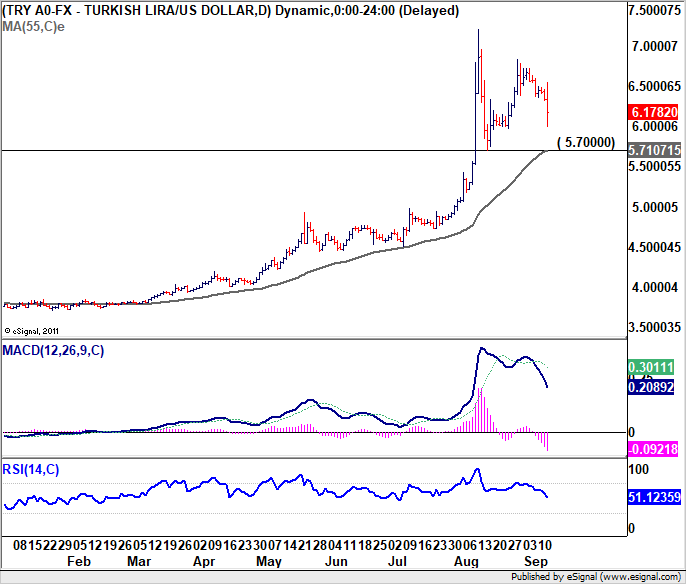
What a volatile day for the Turkish Lira. It originally plunged on President Tayyip Erdogan's comments against interest rate. But then CBRT announce to raise policy rate (one week repo auction rate) from 17.75% to 24%. USDTRY drops more than -3% after the release and is now set to take on 6.000 handle. Last month's low at 5.7000 suddenly looks within reach.
Here is the full statement:
Decision of the Monetary Policy Committee
Participating Committee Members: Murat Çetinkaya (Governor), Ömer Duman, Uğur Namık Küçük, Emrah Şener, Murat Uysal, Abdullah Yavaş.
The Monetary Policy Committee (the Committee) has decided to increase the policy rate (one week repo auction rate) from 17.75 percent to 24 percent.
Recently released data indicate a more significant rebalancing trend in the economic activity. External demand maintains its strength, while slowdown in domestic demand accelerates.
Recent developments regarding the inflation outlook point to significant risks to price stability. Price increases have shown a generalized pattern across subsectors, reflecting the movements in exchange rates. Deterioration in the pricing behavior continues to pose upside risks on the inflation outlook, despite weaker domestic demand conditions. Accordingly, the Committee has decided to implement a strong monetary tightening to support price stability.
The Central Bank will continue to use all available instruments in pursuit of the price stability objective. Tight stance in monetary policy will be maintained decisively until inflation outlook displays a significant improvement. Inflation expectations, pricing behavior, lagged impact of recent monetary policy decisions, contribution of fiscal policy to rebalancing process, and other factors affecting inflation will be closely monitored and, if needed, further monetary tightening will be delivered.
It should be emphasized that any new data or information may lead the Committee to revise its stance.
The summary of the Monetary Policy Committee Meeting will be released within five working days.
Euro, Pound In A Sideline Ahead Of BoE And ECB Rate Announcements, Turkey Decides On Rates Too
Here are the latest developments in global markets:
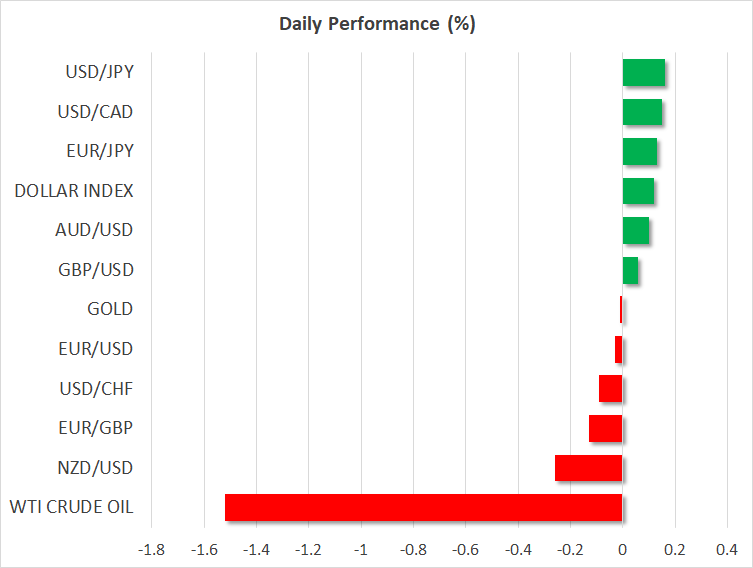
FOREX: The euro and the pound were in a quiet trade a few hours before the European Central Bank and the Bank of England make announcements on interest rates, with euro/dollar edging slightly down to 1.1610 (-0.13%) and pound/dollar consolidating around 1.3045. The Turkish central bank is also scheduled to decide on interest rates later today (1100 GMT) and unlike its European counterparts who are projected to stand pat, it is expected to pick up borrowing costs to save the battered lira which was losing 1.50% versus the greenback ahead of the event. President Erdogan said today that interest rates should be lowered instead. Dollar/yen was erasing yesterday’s losses at 111.43 (+0.16%) after news that the US and China are seeking to resolve trade conflicts with new dialogues. China confirmed and welcomed the invitation for trade talks from Washington despite US warnings to impose tariffs on all Chinese goods. The dollar index was also in recovery, rising to 94.92 after reaching an almost two-week low of 94.73 on Wednesday. Dollar/loonie was marginally up at 1.3009 (+0.12%) after a steep decline yesterday following comments from the Mexican Minister of Economy who expressed that NAFTA’s trilateral nature is a “great asset”, though, the Mexican economy must be prepared for a potential bilateral agreement. In antipodean currencies, aussie/dollar improved to 0.7174 (+0.11%), benefitting from a trade relief and better-than-expected employment figures for the month of August. On the other hand, kiwi/dollar was on the back foot declining by 0.30% to 0.6542. The Chinese yuan retreated by 0.18% in offshore trade.
STOCKS: European equities extended higher for the second day on Thursday except the British FTSE 100 which was down by 0.16% at 0830 GMT. The pan-European STOXX 600 and the blue-chip Euro STOXX 50 rose by 0.28% and 0.30% respectively, with all sectors being in the green apart energy. The German DAX 30 climbed by 0.48%, the French CAC 40 increased by 0.29%, while the Italian FTSE MIB inched up by 0.16%. In Asia, the majority of stocks closed strongly positive, while futures tracking US indices such the S&P 500, Dow Jones and Nasdaq 100 were slightly up, pointing to a softer positive open.
COMMODITIES: WTI crude and the London-based Brent were under pressure early in the European session, trading lower at $69.38/barrel (-1.41%) and $79.05/barrel (-0.87%) correspondingly. On Wednesday, the former reached one-week highs at $71.26, while the latter rallied towards $80.13, the highest since May 25 after the EIA weekly oil report indicated surprisingly a sharper downfall in US oil inventories. Agency’s worries, however, that US-Sino trade conflicts and depreciating currencies in emerging markets could have a negative impact on demand, pushed prices lower today. In precious metals, gold slowly returned back above $1200/ounce, last seen at $1206.9 (+0.05%).
Day Ahead: Spotlight events of the day are ECB, BOE and Turkish central bank interest rate decisions; US CPI pending
Traders are expected to have a relatively busy day at the office on Thursday as central bank events would be in the spotlight with the Bank of England (BOE), the European Central Bank (ECB) and the Central Bank of the Republic of Turkey (CBRT) making announcements on interest rates.
At 1100 GMT, the BOE, concluding its two-day policy meeting, is expected to leave rates on hold while remaining upbeat about recent economic developments, but cautious over Brexit. Following previous month’s rate hike of 25 basis points, no change is expected at September meeting.
A bit later at 1145 GMT, the ECB is widely anticipated to hold benchmark interest rates unchanged as well as the central bank has already guided markets that borrowing costs will remain steady at least through the summer of 2019 as it was agreed in June. Adjustments in the asset purchase program will be also monitored as policymakers plan to reduce monthly asset net purchases from 30 billion euros to 15 billion euros at the end of September before terminating the program in December. Any comments expressing bigger fears regarding US trade protectionism, emerging markets and political conditions in Italy could bring volatility to the euro. Note that policymakers will release fresh economic projections today, while a press conference by the ECB chief Mario Draghi is scheduled at 1230 GMT.
Continuing with central bank meetings, Turkey’s central bank is highly projected to raise its one-week repo rate to 22.00% from 17.75% on Thursday at 1100 GMT. Also, investors are waiting for further guidance from policymakers after the bank said that it “will take the necessary actions to support price stability”.
Out of the US, CPI inflation figures for August will be closely watched at 1230 GMT after PPI data for the same month came in worse than expected yesterday. Headline inflation is predicted to tick lower to 2.8% y/y versus 2.9% in the preceding month. However, the core rate, which excludes volatile food and energy items, is expected to hold the same as before at 2.4%. In addition, initial jobless claims will be available at 1230 GMT, with analysts projecting the number of people claiming unemployment benefits for the first time to increase by 7,000 to 210,000 in the week ending September 8.
Trade developments will continue to affect market sentiment, with investors waiting eagerly to see whether China and the US will re-start negotiations. White House Economic Advisor Lary Kudlow confirmed on Wednesday that the US Treasury Secretary Steven Mnuchin has proposed renewed trade talks with China.
In terms of public appearances, Federal Reserve Bank of Atlanta President Raphael Bostic will be talking on the economic outlook and monetary policy at 1715 GMT.
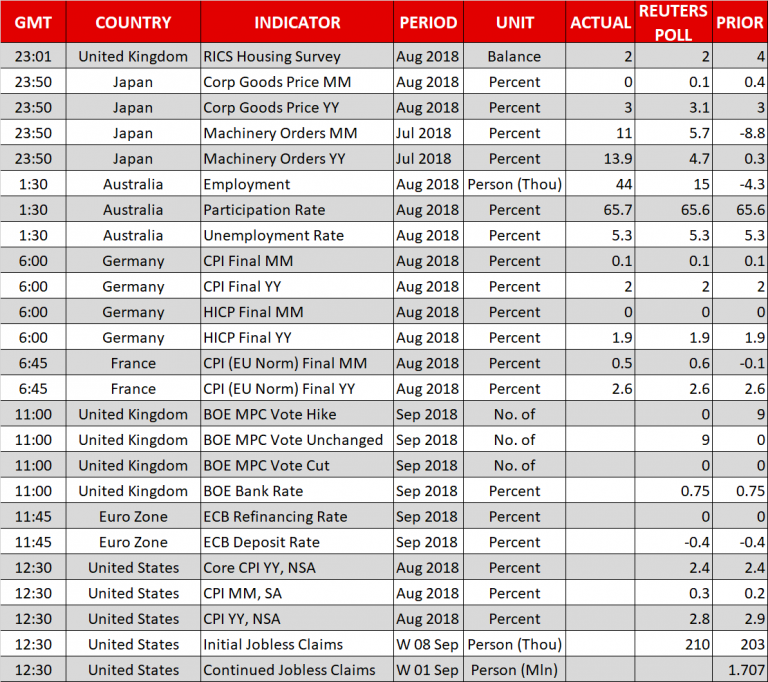
(BOE) Bank Rate Maintained at 0.75%
The Bank of England's Monetary Policy Committee (MPC) sets monetary policy to meet the 2% inflation target, and in a way that helps to sustain growth and employment. At its meeting ending on 12 September 2018, the MPC voted unanimously to maintain Bank Rate at 0.75%.
The Committee voted unanimously to maintain the stock of sterling non-financial investment-grade corporate bond purchases, financed by the issuance of central bank reserves, at £10 billion. The Committee also voted unanimously to maintain the stock of UK government bond purchases, financed by the issuance of central bank reserves, at £435 billion.
In the MPC's most recent economic projections, set out in the August Inflation Report, GDP was expected to grow by around 1¾% per year on average over the forecast period, conditioned on the gently rising path of Bank Rate implied by market yields at that time. Although modest by historical standards, the projected pace of GDP growth was slightly faster than the diminished rate of supply growth, which averaged around 1½% per year. With a very limited degree of slack remaining, a small margin of excess demand was therefore projected to emerge by late 2019 and build thereafter, feeding through into higher growth in domestic costs than has been seen over recent years. The contribution of external cost pressures, which has accounted for above-target inflation since the beginning of 2017, was projected to ease over the forecast period. Taking these influences together, and conditioned on the gently rising path of Bank Rate, CPI inflation remained slightly above 2% through most of the forecast period, reaching the target in the third year.
Recent news in UK macroeconomic data has been limited and the MPC's August projections appear to be broadly on track. UK GDP grew by 0.4% in 2018 Q2 and by 0.6% in the three months to July. The UK labour market has continued to tighten, with the unemployment rate falling to 4.0% and the number of vacancies rising further. Regular pay growth has risen further to around 3% on a year earlier. CPI inflation was 2.5% in July.
The global economy still appears to be growing at above-trend rates, although recent developments are likely to have increased downside risks around global growth to some degree. In emerging market economies, indicators of growth have continued to soften and financial conditions have tightened further, in some cases markedly. Recent announcements of further protectionist measures by the United States and China, if implemented, could have a somewhat more negative impact on global growth than was anticipated at the time of the August Report.
The MPC continues to recognise that the economic outlook could be influenced significantly by the response of households, businesses and financial markets to developments related to the process of EU withdrawal. Since the Committee's previous meeting, there have been indications, most prominently in financial markets, of greater uncertainty about future developments in the withdrawal process.
The Committee judges that, were the economy to continue to develop broadly in line with the August Inflation Report projections, an ongoing tightening of monetary policy over the forecast period would be appropriate to return inflation sustainably to the 2% target at a conventional horizon. As before, these projections were conditioned on the expectation of a smooth adjustment to the average of a range of possible outcomes for the United Kingdom's eventual trading relationship with the European Union. At this meeting, the Committee judged that the current stance of monetary policy remained appropriate. Any future increases in Bank Rate are likely to be at a gradual pace and to a limited extent.