

Sample Category Title
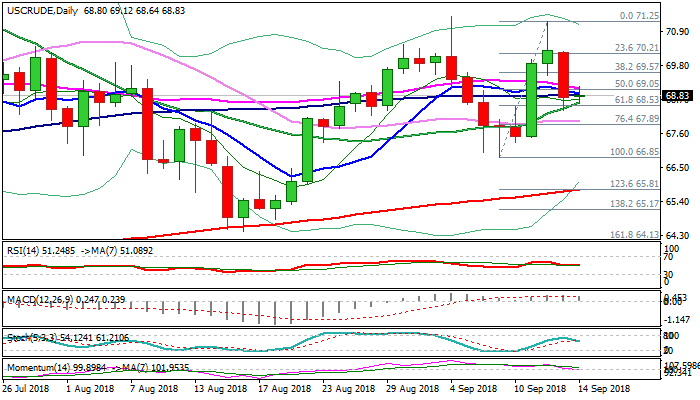
WTI Oil Outlook: Bears Need Close Below $68.53 Fibo Support To Signal Continuation
WTI oil holds within narrow consolidation above $68.34 low, posted after strong 2% fall previous day.
Oil prices came under increased pressure after report showed global oil inventories rose to their record, which temporarily offsets positive impact from strong fall in US crude stocks previous week.
Thursday’s strong fall which resulted in close below a cluster of daily MA’s (55/10/100) was negative signal, with price being pressured by widening daily cloud which twisted today.
Negative momentum is building and adding to bearish outlook, which needs confirmation on close below cracked pivotal Fibo support at $68.53 (61.8% of $66.85/$71.25 upleg), reinforced by rising 20SMA.
Broken daily Tenkan-sen ($69.11) caps today’s action so far and should stay intact to keep fresh bearish bias in play.
Res: 69.11, 69.46, 70.00, 70.26
Sup: 68.64, 68.34, 67.91, 67.48
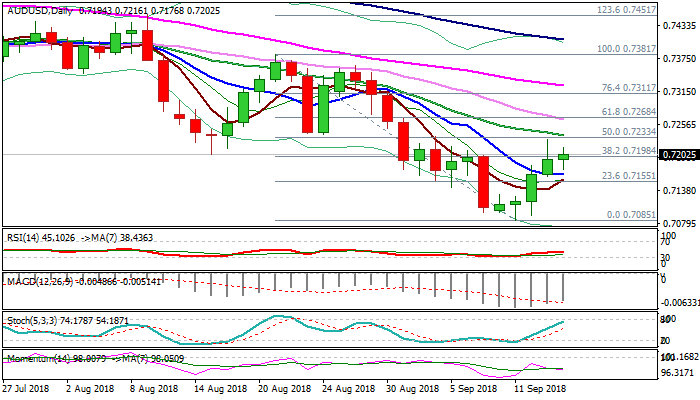
AUDUSD Outlook: Aussie Is Looking For Close Above 0.72 Pivot To Signal Recovery Extension
The Aussie dollar remains steady on Friday and probes again above 0.72 pivotal barrier after spike to 0.7229 on Thursday.
Fresh positive sentiment was boosted by solid Chinese IP and retail sales data, with improving near-term outlook on stronger momentum studies and action being underpinned by rising and thickening hourly cloud.
Bulls need a confirmation on close above cracked 0.7198 barrier (Fibo 38.2% of 0.7381/0.7085 descend), which would open way for extension of recovery leg from 0.7085 low towards barriers at 0.7237 (falling 20SMA) and 0.7265 (falling 30SMA).
Reversal scenario is supported by long bullish candle on weekly chart, which is forming bullish engulfing pattern.
Res: 0.7237, 0.7265, 0.7311, 0.7327
Sup: 0.7176, 0.7167, 0.7143, 0.7085
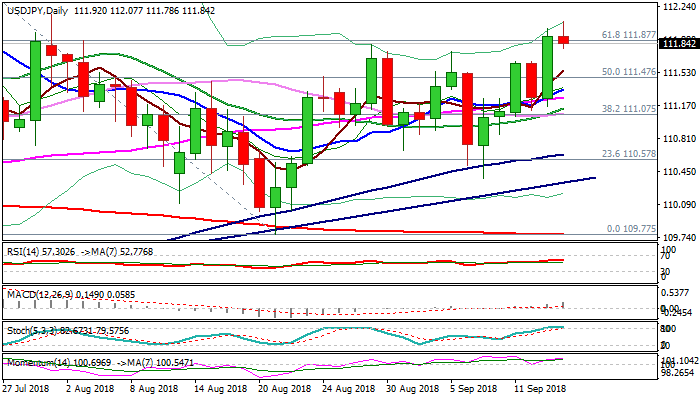
USDJPY Outlook: Bulls Eye Targets At 112.15/37 But May Take A Breather On Pre-Weekend Profit-Taking
The pair eases from new six-week high at 112.07 on Friday, consolidating strong rally of 0.61% previous day, when strong bullish signals were generated on break and close above daily cloud top 111.58) and key Fibo barrier at 111.87 (61.8% of 113.17/109.77 fall).
Bulls are taking a breather ahead of next strong barriers at 112.15 (01 Aug high) and 112.37 (Fibo 76.4%), with deeper dips anticipated on pre-weekend profit taking.
Bullish daily / weekly techs and dollar’s positive sentiment suggest further advance, with another positive signal seen from long bullish candle on weekly chart.
Corrective dips are seen as positioning for fresh upside, with broken cloud top (111.54) expected to contain.
Caution on narrowing daily cloud which twists next week and may trigger deeper dips.
Res: 112.15, 112.37, 112.62, 112.92
Sup: 111.75, 111.54, 111.34, 111.25
EUR/USD – Euro Punches Past 1.17
EUR/USD has posted slight gains in the Friday session. Currently, the pair is trading at 1.1712, up 0.22% on the day. On the release front, Eurozone trade balance is expected to dip to EUR 16.3 billion. In the U.S, the focus is on consumer spending data. Core retail sales and retail sales are both expected to tick lower, with readings of 0.5% and 0.4%, respectively. We’ll also get a look at UoM Consumer Sentiment, which is forecast to climb to 96.7 points.
As expected, the ECB held the course on its rate policy, keeping the benchmark rate at 0.00%. However, there were some noteworthy items at the meeting. In a slight change to guidance, the Bank announced that it would wind up asset purchases at the end of this year. As well, the ECB will trim its monthly bond purchases from EUR 30 billion to 15 billion, starting in October. These measures mark a vote of confidence in the eurozone economy, which has softened in the second quarter, but still remains solid. The euro moved higher on the news, and the currency has enjoyed a strong week, with gains of 1.4 percent. The ECB reiterated that it will maintain monetary policy “through next summer”, so there is little chance of a rate hike before the second half of 2019.
German ZEW economic surveys are well respected and often have an impact on the movement of the euro. Earlier in the week, ZEW Economic Sentiment improved in September, but remains mired in negative territory. The indicator came in at -10.6, posting a decline for a sixth straight month. The survey press release noted that during the survey period, Turkey and Argentina saw their currencies plunge, and German industrial production was soft. On Thursday, German Final CPI dipped to 0.1%, down from 0.3% a month earlier.
In the U.S, the red-hot labor market continues to be the envy of industrialized countries around the globe. The unemployment rate is at a remarkable 3.8% and unemployment claims were almost unchanged at 204 thousand, another excellent reading. Despite the strong employment front and a booming economy, inflation remains well short of the Federal Reserve’s target of 2 percent. In August, CPI and Core CPI came in at 0.1% and 0.2%, respectively, falling short of their estimates.
EUR/USD Flat Top Ascending Triangle Breakout Suggests A Bullish Continuation
The EUR/USD edged a bit higher after Thursday's ECB Meeting. The ECB lowered its projections for economic growth, and warned about potential dangers with the US-China Trade War. Mr.Draghi, the ECB president, explained that rising protectionism, vulnerabilities in emerging markets, and financial market volatility had "gained more prominence." There is still a fear of a potential escalation. What is also important is that the rates are put on hold. The Refi rate is still 0%, while the deposit rate is at -0.4%.
Technically the EUR/USD is bullish, as it is breaking above the ascending flat top triangle, which suggests bullish continuation. This is the bullish formation with explicit support and resistance levels that traders should monitor. 1.1635-50 is the POC zone, and any pullback to the zone might be used for fresh buying. Targets are Pivot confluence points 1.1724 and 1.1758, with a possible extension to 1.1816 if we see a close above 1.1760. Bear in mind that today is Friday, so we could see a profit taking. If the pair makes a weekly close above 1.1760, then the door to 1.1816 could be open next week.
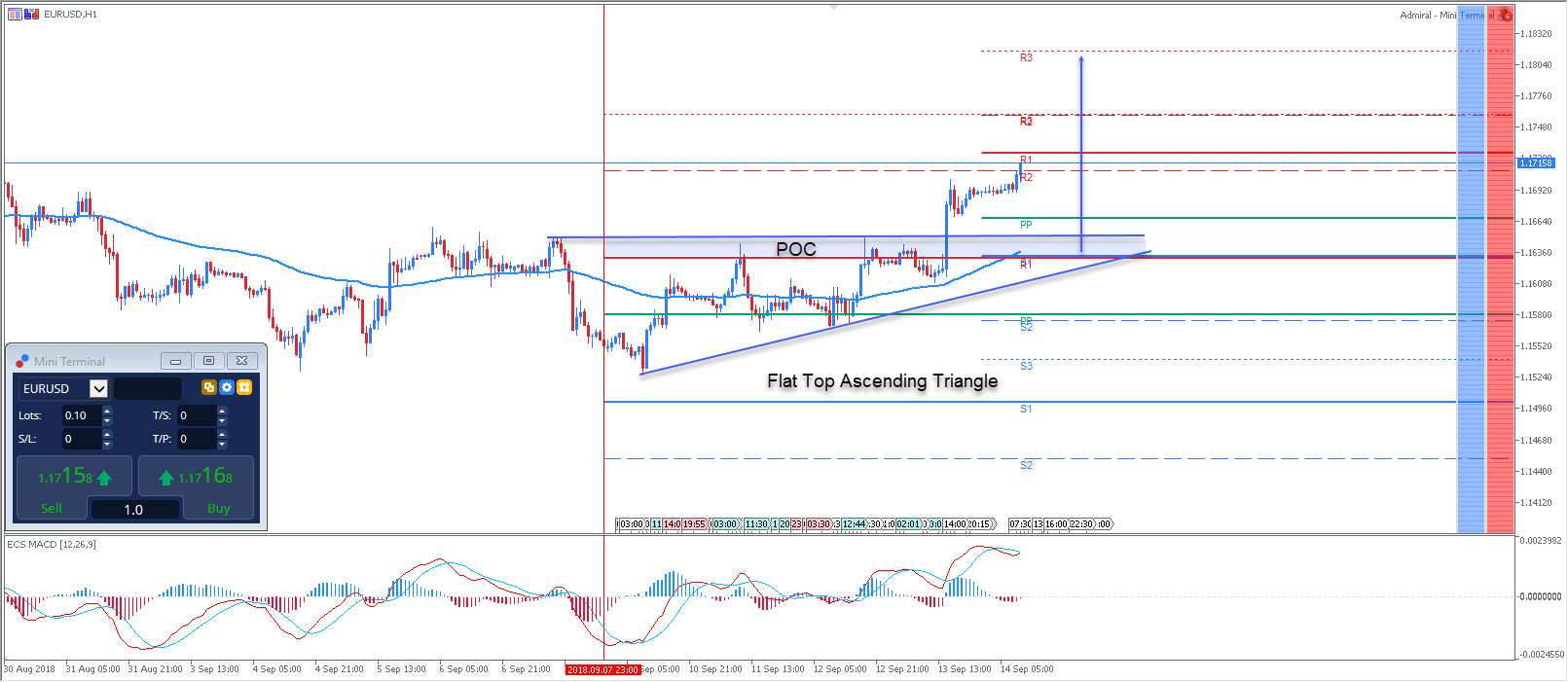
Short Pivot Lines - Daily Support and Resistance
Long Pivot Lines - Weekly Support and Resistance
POC - POC - Point Of Confluence (The zone where we expect the price to react - aka the entry zone)
Rebound In Asian Markets Intensifies, Dollar Recedes
On Friday morning, the demand for risks on the Asian bourses continues to recover. MSCI for Asia ex Japan is adding more than 1.2% this morning, having evolved the increase from 14-month lows to 2.8%. Hong Kong’s Heng Seng recovered to 1.5 week’s levels. Previously, we pointed out that the technical factors were in favor of this rebound after the indices had entered the oversold zone. The current rebound can last for a while, as the wave of short speculative positions on the indices of developing countries continues winding down.
A similar movement is observed for the EM currencies. The central bank of Turkey became a hero yesterday, raising the rates by 625 bps to 24%. This action has reduced investors’ fears that the CB loses its policy independence hesitating to tighten after the calls of President Erdogan.
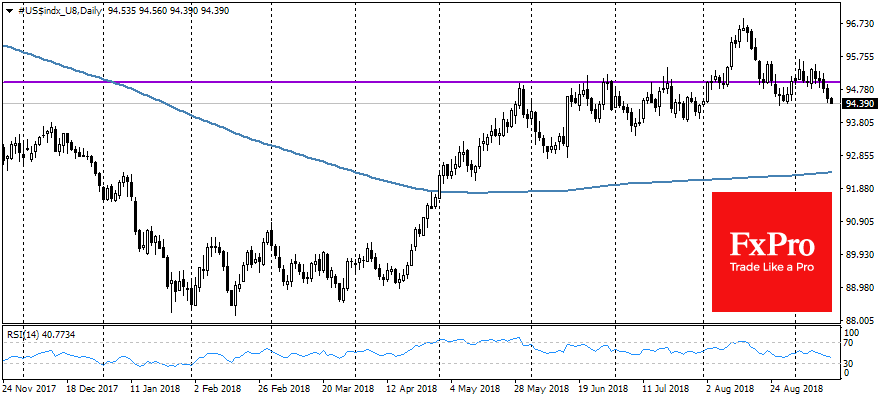
It is also important that the dollar has been losing to the basket of developed countries currencies for the fifth day in a row, declining by 0.9% this week to lows of the beginning of August. The weakening of the US currency increases optimism in the markets of developing countries.
Fibonacci theory suggests the potential for a further rebound about 1.5% on MSCI Asia index that will reflect the correction to 61.8% of the reduction from local highs since August 30. The resolute market’s overcoming of this level and further strengthening above 529 on MSCI against current 520 will be the evidence of the optimism predominance in the markets and increased chances of returning to local highs near 543. 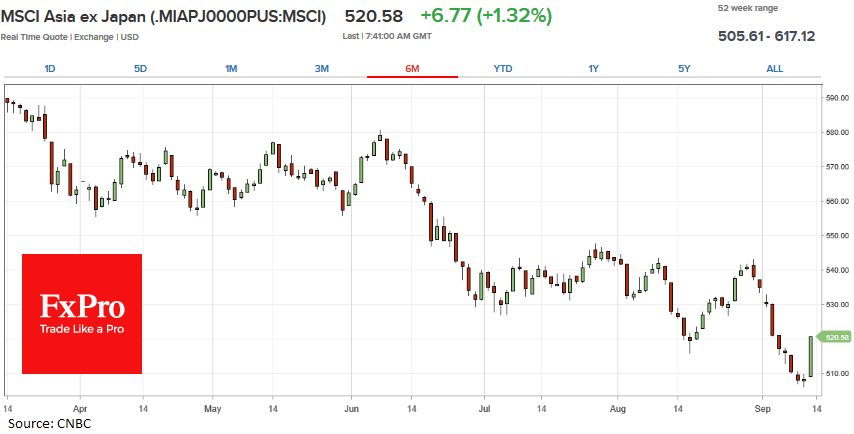
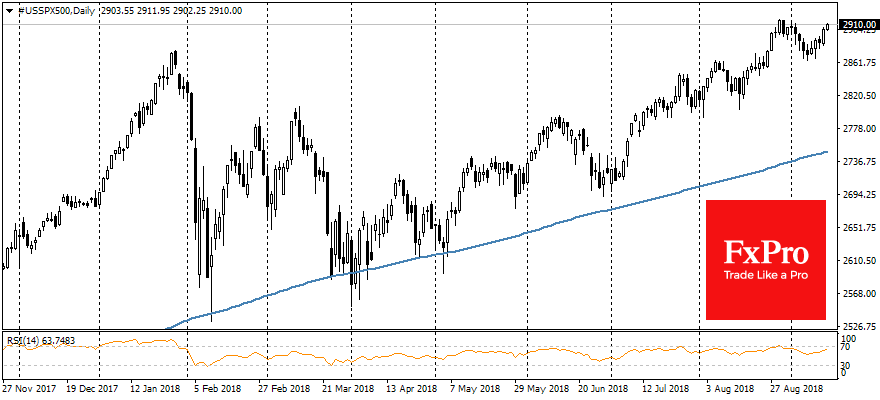
At the same time, the futures on the index S&P500 is only 0.3% lower than the global highs, adding due to the optimism of Asian sites and on the background of weak inflation data. The PPI and CPI indicators unfulfilled expectations and caused a decrease in the chances of two increases in rates by the end of the year from 81% to 75%.
The Dollar Index Has Been Declining
Yesterday, the US dollar continued to lose ground relative to currency majors. The dollar index (#DX) moved away from the local highs and closed the trading session in the negative zone (-0.25%). The US published weak data on inflation, which caused pressure on the US currency. In August, the core consumer price index slowed down from 0.2% to 0.1%. At the moment, investors expect a report on retail sales in the US.
The Bank of England and the ECB, as expected, kept all main parameters of the monetary policy. The central bank of the UK expects a slowdown in inflation next year. The regulator plans to adhere to a gradual increase in the interest rates taking into account market conditions. The ECB lowered the forecast for GDP growth in the Eurozone for 2018 and 2019 to 2.0% and 1.9%, respectively. The head of the Central Bank is concerned about the risks related to the trade conflict and the unstable situation in the markets of developing countries. The regulator plans to adhere to the current rate of monetary policy.
The "black gold" prices are consolidating. At the moment, futures for the WTI crude oil are testing a mark of $69.00 per barrel.
Market Indicators
Yesterday, the major US stock indices closed in the positive zone: #SPY (+0.59%), #DIA (+0.59%), #QQQ (+1.07%).
At the moment, the 10-year US government bonds yield is at the level of 2.97-2.98%.
The news feed on 14.09.2018:
At 15:30 (GMT+3:00) a report on retail sales will be published in the United States.
We also recommend paying attention to the speech by the Bank of England governor Carney at 13:00 (GMT+3:00).
Yen Crumbles Amid Risk-On Mood, US Retail Sales In The Spotlight
Here are the latest developments in global markets:
FOREX: The US dollar index is nearly unchanged on Friday (-0.02%), holding on to the losses it posted in the previous session following a disappointment in the US CPI inflation data. The yen also retreated across the board, as risk appetite remained firm and investors rotated funds out of haven assets and into riskier ones. Meanwhile, the euro gained slightly after the ECB confirmed its normalization plans remain on track yesterday, while the pound was little changed after the respective BoE policy gathering.
STOCKS: Wall Street closed in the green on Thursday, with risk appetite boosted by China's foreign ministry welcoming the invitation for trade talks with the US. The tech-heavy Nasdaq Composite (+0.75%) surged the most, aided by a rebound in Apple (+2.42%), while the Dow Jones (+0.57%) and the S&P 500 (+0.53%) also advanced. Futures suggest the S&P, Dow, and Nasdaq 100 are all set for a significantly higher open today as well. Asia was a sea of green on Friday, with Japan's Nikkei 225 (+1.20%) and Topix (+1.09%) posting notable gains, while the Hang Seng in Hong Kong (+0.97%) also climbed. In Europe, all the major indices were set to open higher today, futures suggest, with the only exception being the Italian FTSE MIB.
COMMODITIES: Oil is trading slightly higher on Friday, recovering some of the notable losses recorded in the previous session. The tumble came after the International Energy Agency (IEA) warned that mounting risks around emerging markets and global trade are clouding the outlook for future oil demand. WTI is up by 0.22% at $68.86 per barrel today, while Brent rose by 0.14% to $78.37 a barrel. In precious metals, gold is higher by 0.44% on Friday, last seen around the $1,207 per ounce zone. The dollar-denominated yellow metal has firmed in recent days, albeit only marginally, drawing strength from a continued pullback in the greenback.
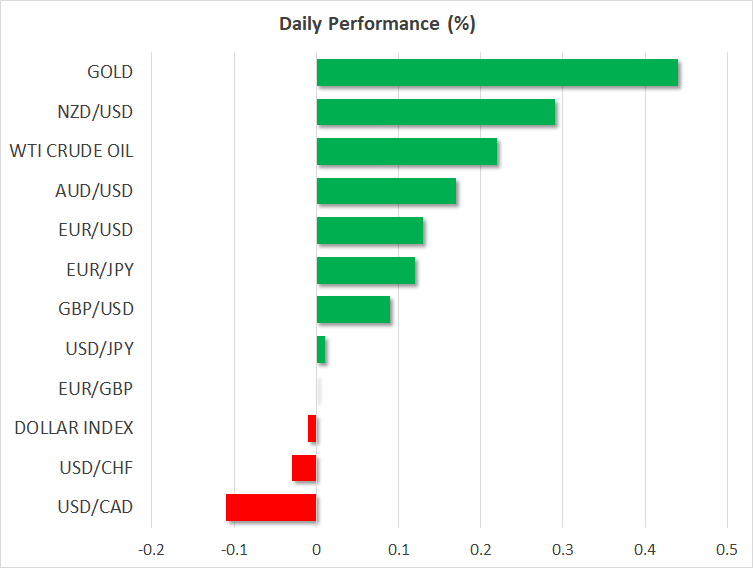
Major movers: Yen sharply lower as risk appetite firms; dollar dips after CPIs
The BoE and the ECB delivered no surprises at their respective meetings on Thursday, with both Banks largely reiterating previous forward guidance. The BoE stood pat, noting that signs of greater uncertainty around Brexit are causing investment plans to soften. On a more positive note, it also upgraded its Q3 GDP estimate, striking a rather balanced tone overall. Hence, the pound barely reacted, though sterling/dollar did close the session higher amid dollar-weakness. Market-implied pricing (UK OIS) suggests the BoE will hike again in September next year – an expectation so pessimistic relative to the healthy state of the UK economy that it likely incorporates some jitters around Brexit as well.
The ECB gathering was equally uneventful, with the Bank revising marginally lower its growth forecasts, as had been expected. Draghi repeated the ECB is proceeding with tapering its QE program – highlighting that although protectionism and EM wobbles pose risks, they aren't dire enough to derail the Bank's normalization plans. Meanwhile, he shrugged off the lower GDP forecasts, noting instead that policymakers are becoming more confident in their core inflation forecasts amid rising wages. He maintained a neutral tone in general, which likely surprised some investors that expected him to lean dovish amid softer growth projections. Hence, the euro rose in the aftermath, touching a two-week high against the dollar.
Surprisingly, it was the Japanese yen that was the biggest mover – and underperformer – in Thursday's session. The safe-haven currency plunged across the board, recording a six-week low against the dollar, euro, and pound amid strong risk appetite in markets. On the trade front, China welcomed the US invitation for trade talks, which may have aided the rotation out of haven assets. While Trump said a few hours later he feels “no pressure” to strike a deal with China, his comments were likely perceived as more posturing, evident by the limited market reaction.
In the US, the dollar dipped after the US CPI data for August disappointed, with the headline inflation rate falling by more than expected, and the core CPI rate unexpectedly declining to 2.2% in yearly terms, instead of holding steady at 2.4% as expected. While the dollar did tumble on the news, it's interesting to note that market pricing for further Fed rate hikes this year remained surprisingly stable.
In EM, the Turkish lira soared yesterday after the nation's central bank raised interest rates by 625bps to 24.00%, in an attempt to stabilize the battered currency and rein in double-digit inflation.
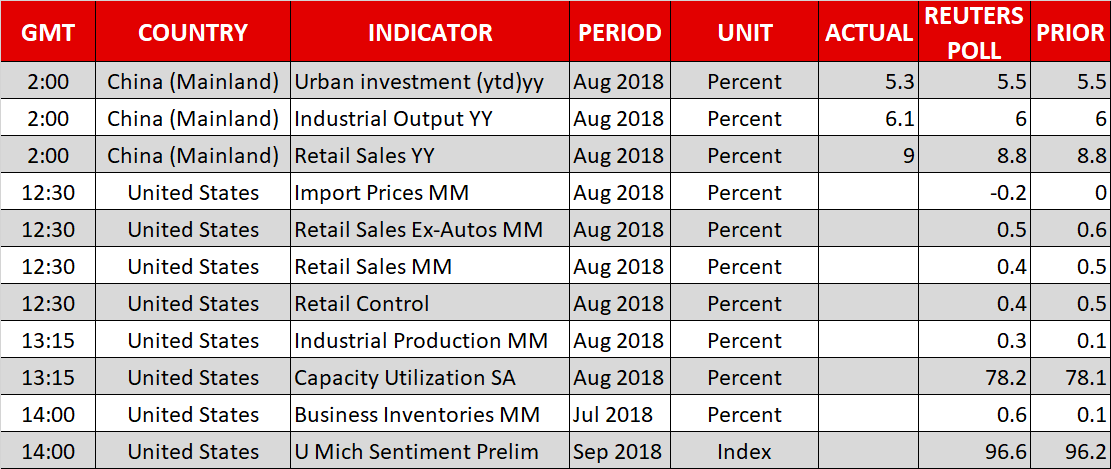
Day ahead: US retail sales, industrial output and U of M consumer sentiment due; trade remains in focus
The highlight out of Friday's calendar are US retail sales data, with the figures on industrial and manufacturing output out of the country, as well as the University of Michigan's (U of M) index that gauges consumer morale, attracting attention as well. Besides economic releases, trade developments will again be in focus.
On trade, news that the US and China are preparing to enter a new round of trade talks boosted market sentiment. However, the two parties' confrontational stance may not easily change; President Trump yesterday tweeted that the US was under “no pressure” to reach a trade deal with China, something which led US stocks to give back some of their earlier gains.
In terms of US retail sales due out at 1230 GMT, those are anticipated to grow by 0.4% m/m in August, down from 0.5% in July. Core retail sales – the measure of sales that excludes automobiles and which more closely aligns with the consumer spending component of GDP – are projected to expand by 0.5% on a monthly basis, again reflecting a slowdown compared to July's 0.6%. More data disappointment, building on PPI and CPI misses from earlier in the week, is likely to lead to further losses in the dollar; the dollar index is looking set to finish the week in the red after advancing during the preceding week. Elsewhere, import and export price data for August will also be released at 1230 GMT.
US industrial production figures for August will be hitting the markets at 1115 GMT. The numbers are forecast to show output accelerating to 0.3% m/m from 0.1% in July. The prints on manufacturing production, a subset of industrial output, will also be generating attention. In light of Trump's trade policies and the disruptions they cause on global supply chains, it would be interesting to see whether such actions materially affect factory activity. The reading on August's capacity utilization will be released at the same time.
Also out of the US, the U of M's preliminary survey on September consumer sentiment is due at 1400 GMT and is anticipated to show a slight improvement in morale relative to August. Furthermore, the survey's sub-indices measuring inflation expectations will also be monitored. Meanwhile, data on July's business inventories will be made public at the same time.
In terms of policymakers' appearances, Bank of England Governor Mark Carney will be giving a lecture at 1000 GMT, while Chicago Fed President Charles Evans (non-voting FOMC member in 2018) will be speaking at 1300 GMT.
In energy markets, the weekly report by Baker Hughes on active US oil rigs is due at 1700 GMT, while traders will also be keeping an eye on Hurricane Florence's path to the US east coast.
Lastly, EM-market action will be watched: Thursday's surge in the Turkish lira after the country's central bank raised its benchmark rate by 625bps helped lift other EM currencies as well.
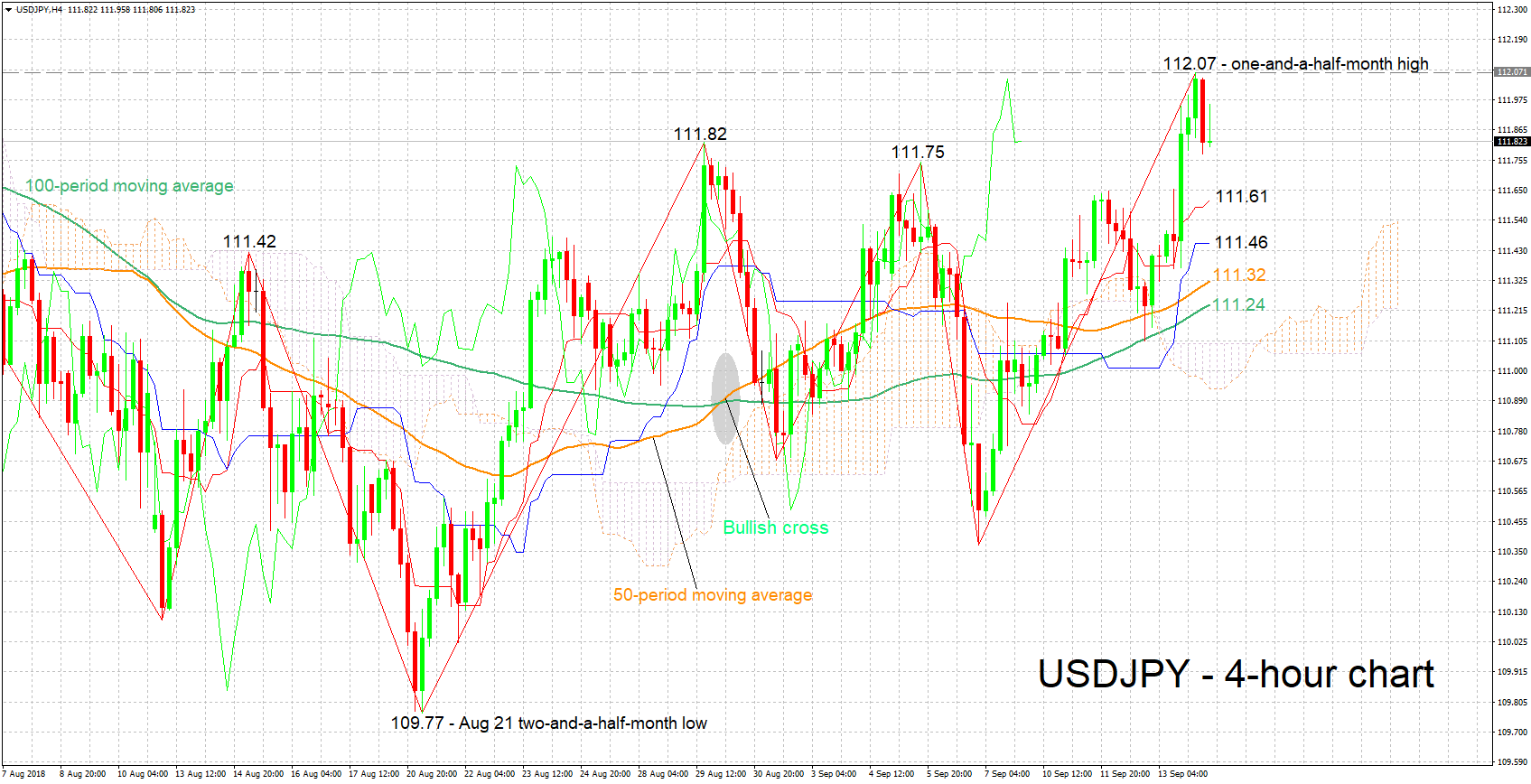
Technical Analysis: USDJPY hits 1½-month high but bullish momentum appears to ease
USDJPY hit a one-and-a-half-month high of 112.07 earlier on Friday before pulling back somewhat. The Tenkan- and Kijun-sen lines are positively aligned, supporting the view for a bullish bias. The latter though has flatlined, signalling that positive momentum has weakened.
Overall positive US data later today – especially on the retail sales front – are expected to boost the pair. The area around the earlier recorded peak of 112.07 may act as resistance to gains, with an upside violation increasingly bringing into view the 113 round figure.
On the downside and in case of disappointing US data, the range from 111.61 to 111.24 encapsulates the Tenkan- and Kijun lines, as well as the 50- and 100-day moving average lines, and may thus be of significance, providing support to losses. At the moment, the zone around a previous high at 111.82, which also captures another top at 111.75, may be offering immediate support to losses.
Developments on the trade front can also move the pair.
Japan PM Abe would like BoJ to end ultra-loose policy in his next term
Japan Prime Minister Shinzo Abe said BoJ's ultra loose monetary policy should not last "forever". Now, he said that "wages are finally picking up ... We're starting to see consumption and capital expenditure boost growth." And he'd like to end the ultra-loose policy "during my next term".
But "when to modify the easy policy is up to (BOJ Governor Haruhiko) Kuroda. I've left that decision to him." He added that "the BOJ's price target is one measurement in guiding policy but the real goal is to boost growth and employment." "We've seen a significant improvement in job growth."
Super Interesting Day Is Over But Trade Tensions Still Linger
ECB decided not to pull the trigger on the interest rate hike and lowered the growth forecast. The BOE increased the growth forecast despite serious Brexit issues
The supper interesting day is over but the effects of this can still be seen in the markets. The European Central Bank decided to hold the fire and the action was the same at the Bank of England- no change in the interest rate. What stimulated the move in the Euro against the dollar was the fact that the ECB lowered the growth forecast a little for this year and this brought the excitement for the bulls. Draghi now expects the growth in the eurozone to grow at 2% for this year and 1.9% for the next year The bank maintains its view that the growth would remain robust in the eurozone and this is despite the fact that German economic data, an economic engine of the eurozone, has started to show some weakness.
On top of this, the ECB is also confident that the inflation equation in the eurozone would continue to improve. The euro could continue its bull move against the dollar. Thus, we could touch the 1.18 handle. However, a major obstacle in the way is the protectionism polices introduced by Donald Trump which are fuelling the rally for the dollar index.
Speaking of protectionism policies, President Trump contends that there is no pressure on him to make a deal with China. Both sides need to strike a deal because the trade war isn’t in any one’s favour and it would have devastating effects. Trump is still trying to strong arm China and maintains the view that it is China which needs to come to terms with the US. This kind of posture would only escalate tension between the two major economic powers of the world and it would not lead them to any kind of peaceful resolution. This is especially true if Trump goes ahead with his plans to impose another $200 billion worth of tariffs on Chinese products. The mid-term elections are nearly on the door step and if Trump doesn’t find a viable resolution for this issue, it could have unfavourable impact.
Closer to home, concerns about Brexit are becoming more problematic for the Bank of England and this was the message that was delivered by the governor of the Bank of England. The business activity over in the UK has one clear trend; tighten the expenses and hold off any kind of expansion strategy until the future becomes certain. Despite this, the bank of England increased its growth forecast , unlike the ECB, for the third quarter to 0.5% from 0.4%. Regardless of the growth forecast, the Brexit risk are real and it would be sensible thing for the bank to touch the interest rates again until well after the Brexit period. Strong consumer spending is the only part of the equation which is supporting the economy and any further increase in the interest rates would make the consumers to dig deep into their pocket or they would have to make other cuts in their spending habits.