Sample Category Title
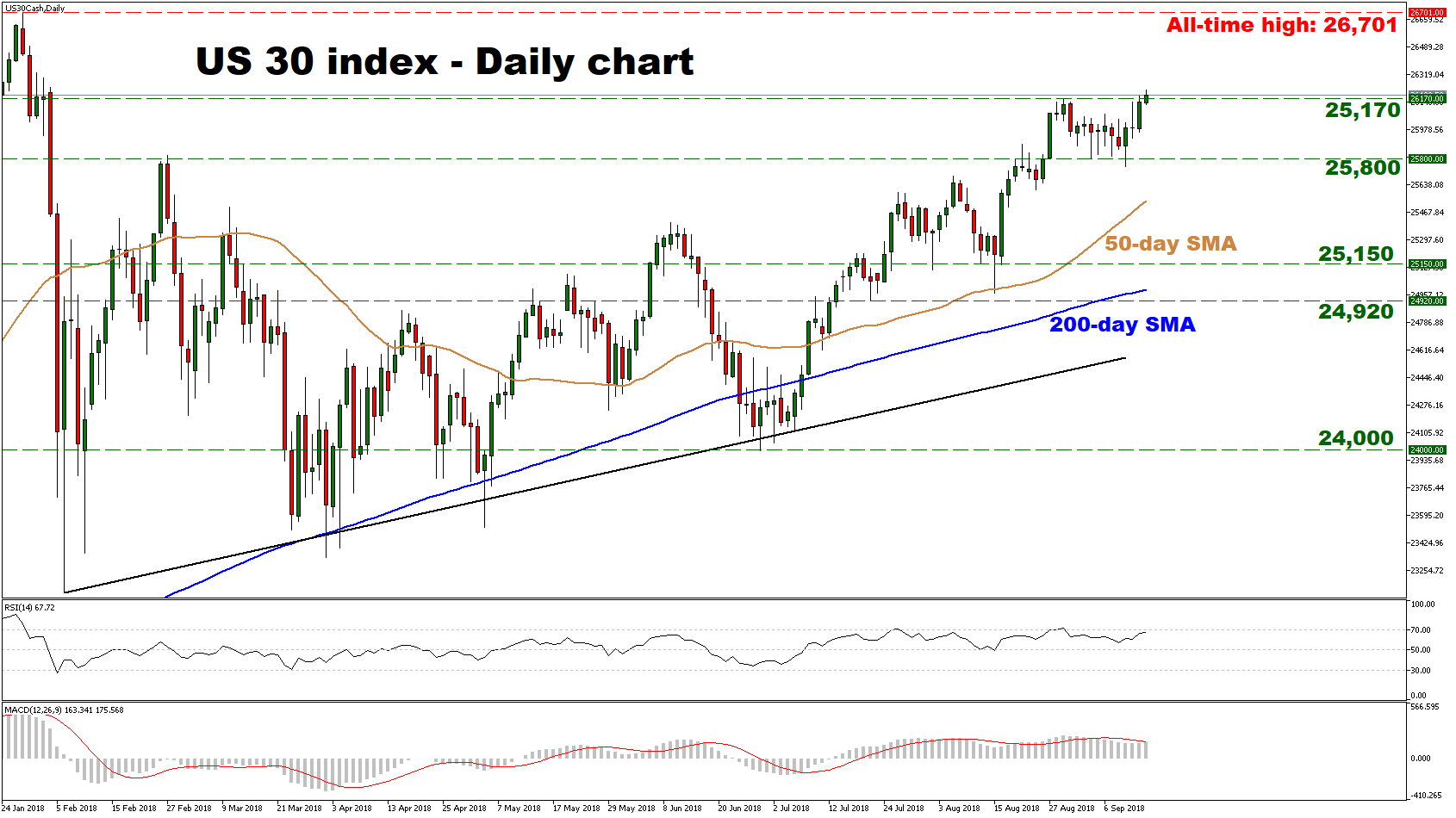
US 30 Index Remains Bullish, Eyes All-Time Highs
The US 30 index continued to advance in recent weeks, posting higher highs and higher lows on the daily chart while remaining above both its 50- and 200-day simple moving averages, which are positively aligned in support of a bullish outlook. The index is also trading above a medium-term uptrend line drawn from the lows of February 6, and having recovered nearly all of its early-February losses, now appears to be headed for a test of its all-time highs.
The RSI, already above its neutral 50 level, looks to be flatlining near its overbought 70 line. Note, that the RSI has failed to hold above 70 since late-January, which implies a short-term pullback shouldn’t be ruled out before the potential next leg higher. Meanwhile the MACD – already positive – stands fractionally below its red trigger line.
Further advances in the index could encounter resistance at the all-time high of 26,701. If the bulls pierce above it, that would bring prices into uncharted waters, with the next barrier to offer resistance likely being the round figure of 27,000 and then 28,000, which may hold some psychological importance.
On the downside, a slip below 25,170, the peak of August 29 could see scope for a test of 25,800, an area that halted several declines during the September 4 – 11 period. Stronger bearish moves may stall around the 50-day moving average located at 25,538 at the time of writing, before the 25,150 zone comes into view, this being the low of August 13. Even lower, the attention would increasingly turn to 24,920, the July 20 trough.
In general, both the short- and medium-term outlooks for the index remain broadly positive overall, though take note that the RSI suggests a near-term pullback may be on the cards.
British Pound at 10-Week High, US Retail Sales ahead
GBP/USD continues to head higher on Friday. In the North American session, the pair is trading at 1.3126, up 0.15% on the day. On the release front, there are no data indicators out of Britain. In the U.S, the focus is on consumer spending data. Core retail sales and retail sales are both expected to tick lower, with readings of 0.5% and 0.4%, respectively. We’ll also get a look at UoM Consumer Sentiment, which is forecast to climb to 96.7 points.
The pound is enjoying an excellent week, with gains of 1.5%. Earlier on Friday, the currency hit its highest level since the end of July. Investor risk appetite has improved after reports that the U.S and China could renew trade talks, as well as signs from the EU that it may be more flexible in the Brexit negotiations.
As expected, the Bank of England opted to hold the course on monetary policy, keeping the benchmark rate pegged at 0.75%. In August, the BoE raised rates for only the second time since 2007. In the rate statement, policymakers noted that there had been little change on the domestic front since the August rate hike, but added that there was “greater uncertainty” in the financial markets over the Brexit withdrawal next March. The BoE may decide to stay on the sidelines and hold rates until after the UK leaves the European Union in March, in order to minimize the expected disruption that the Brexit will have on the British economy. A lack of rate hikes will make it tougher for the pound to gain ground, unless the British economy shows stronger growth than expected.
In the U.S, the red-hot labor market continues to be the envy of industrialized countries around the globe. The unemployment rate is at a remarkable 3.8% and unemployment claims were almost unchanged at 204 thousand, another excellent reading. Despite the strong employment front and a booming economy, inflation remains well short of the Federal Reserve’s target of 2 percent. In August, CPI and Core CPI came in at 0.1% and 0.2%, respectively, falling short of their estimates. The markets are braced for soft consumer spending data on Friday, which could send the dollar lower.
BoE Carney on Brexit: Hope for the best but plan for the worst
In a speech at the Irish central bank, BoE Governor Mark Carney emphasized that BoE is " well-prepared for whatever path the economy takes, including a wide range of potential Brexit outcomes." And, "we have used our stress test to ensure that the largest UK banks can continue to meet the needs of UK households and businesses even through a disorderly Brexit, however unlikely that may be." He emphasized that "our job, after all, is not to hope for the best but to plan for the worst."
It's reported that Carney told Prime Minister Theresa May's cabinet a no-deal Brexit could trigger 25-35% fall in UK house prices over three years. He said today that this is not a prediction but something that the central bank needs to be prepared for.
As NAFTA Talks Enter Final Stretch, is the Loonie Set to Rally?
The US-Canada trade talks have heated up lately, with a deal by the end of this month looking increasingly more realistic. In such a case, the loonie could surge in relief as the NAFTA risk premium on the currency fades, with broader market risk appetite also receiving a boost. While there may be a few wobbles in the meantime as the US continues playing “hardball”, there is probably too much at stake for either side to let the talks collapse, particularly with the US midterm elections looming in the background.
Markets have turned their attention firmly back to the NAFTA negotiations in recent weeks. The US and Mexico reached a “preliminary agreement in principle” on August 27, fueling speculation that a full-fledged trilateral deal may be delivered soon, once Canada joined in. Alas, that hasn’t transpired, with talks between the US and Canada dragging on amid disagreements on key areas such as dairy products and dispute settlement mechanisms (see ‘sticking points’ below).
The new implicit deadline for a deal is now October 1, and US and Canadian negotiators appear to be working round the clock to reach common ground before then. Given the outsized effects a deal – or the lack thereof – could have on the Canadian economy, the loonie has been particularly sensitive to incoming headlines, jumping on any hints that an accord is inching closer, and vice-versa.
Canadian economy is booming despite trade worries
Although one wouldn’t realize by looking at the struggling Canadian dollar, the nation’s economy is actually thriving even in the face of trade uncertainties, which are likely holding back some business investments. Economic growth rebounded to an annualized rate of 2.9% in Q2 amid a surge in exports, the unemployment rate continues to flirt with four-decade lows, and core inflation measures are nearly in-line with the Bank of Canada’s (BoC) 2% target. Meanwhile, oil prices remain elevated; recall that crude is among Canada’s biggest exports. The only worrisome spot is wage growth, which has slowed for two months now to 2.9% on a yearly basis in August, from 3.6% back in June. To be fair though, wages growing by 2.9% is still faster than nearly all other major economies.
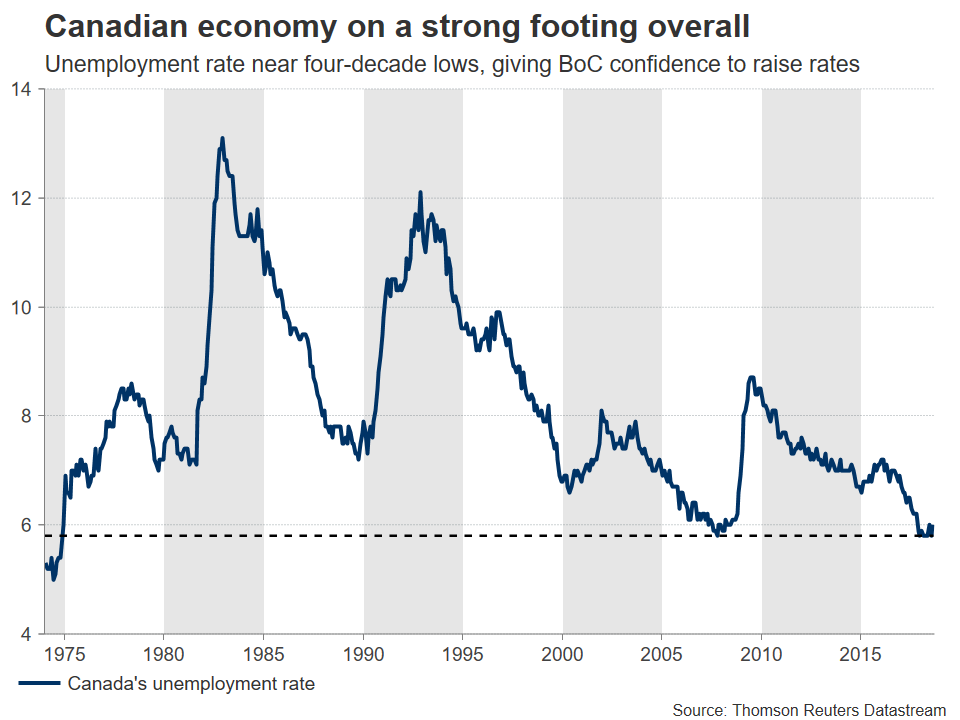
In other words, the economy is operating near full capacity and this has given the BoC enough confidence to begin raising interest rates. It has done so twice already this year, and market-implied pricing derived from Canada’s overnight index swaps suggests another hike before year-end is practically certain. Yet, the loonie continues to trade at relatively low levels, which seem disconnected from an overall healthy economy and a central bank raising rates at a time when very few others are. This suggests there is likely a NAFTA risk-premium priced into the currency, with investors limiting their exposure to the loonie amid concerns the negotiations may ultimately fail to bear fruit.
Trump characteristically playing “hardball”
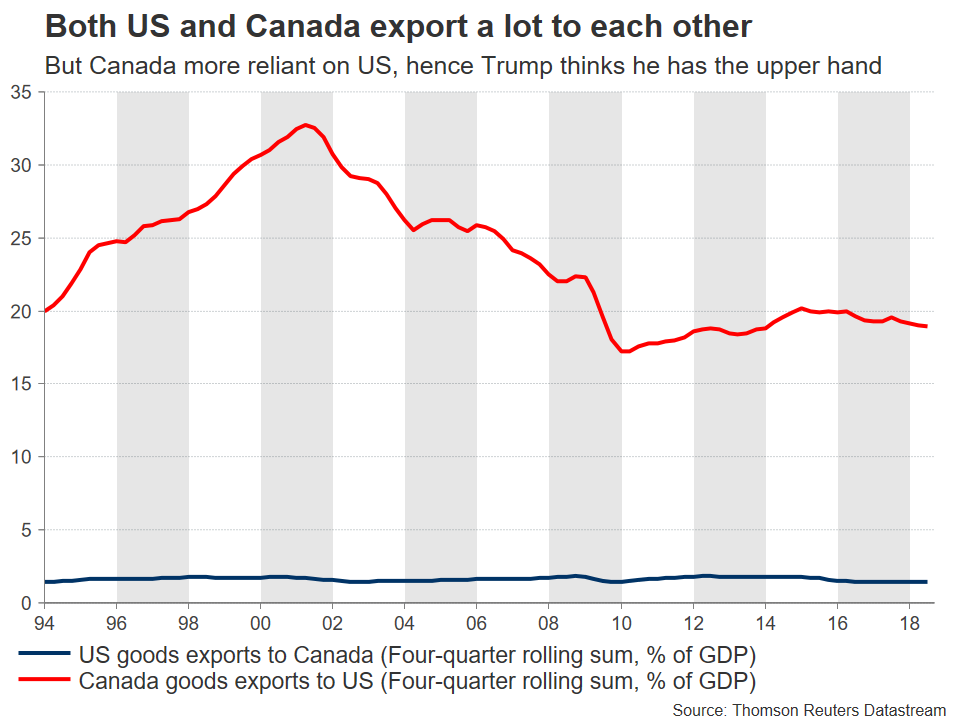
Holding true to his typical method of operation, President Trump sought to rachet up pressure on Canada to strike a deal – first by saying that the US and Mexico will proceed bilaterally if Canada doesn’t sign, and then by threatening to impose new tariffs on automobiles and parts from Canada. In truth, both would be very difficult to implement.
Firstly, Congress would need to approve the US-Mexico agreement, and with Canada absent, the chances of approval are slim. Not to mention that even Republican Senators have said Congress only gave the White House approval to negotiate a trilateral deal, not a bilateral one, so the US-Mexico accord has a dubious legal standing. Meanwhile, the US cannot impose tariffs on Canadian cars unless the Commerce Department concludes auto imports are a threat to national security. While such a report is being prepared now, most experts suggest it will be rather challenging to find rationale connecting automobiles with security issues.
Sticking points
Notable disagreements persist in three key areas. The first relates to Canada’s dairy industry protections. The nation has traditionally supported its dairy farmers, effectively shielding them from the massive competition across the border that could see their incomes plunge if US products flood in. The US wants expanded access to Canada’s dairy market, and encouragingly, recent headlines suggest Canada is willing to make some concessions.
The second has to do with dispute settlement mechanisms within NAFTA, which Canada wants to retain and the US to scrap. This clause – called Chapter 19 – gives NAFTA nations the ability to appeal to an independent panel when they believe another signatory has unfairly imposed tariffs on them. Canadian PM Trudeau has said this is mandatory for him, as the US President doesn’t always “follow the rules”. Lastly, his nation wants some guarantees that US media conglomerates cannot take over Canadian television and radio stations, to ensure the local culture is insulated from its neighbors.
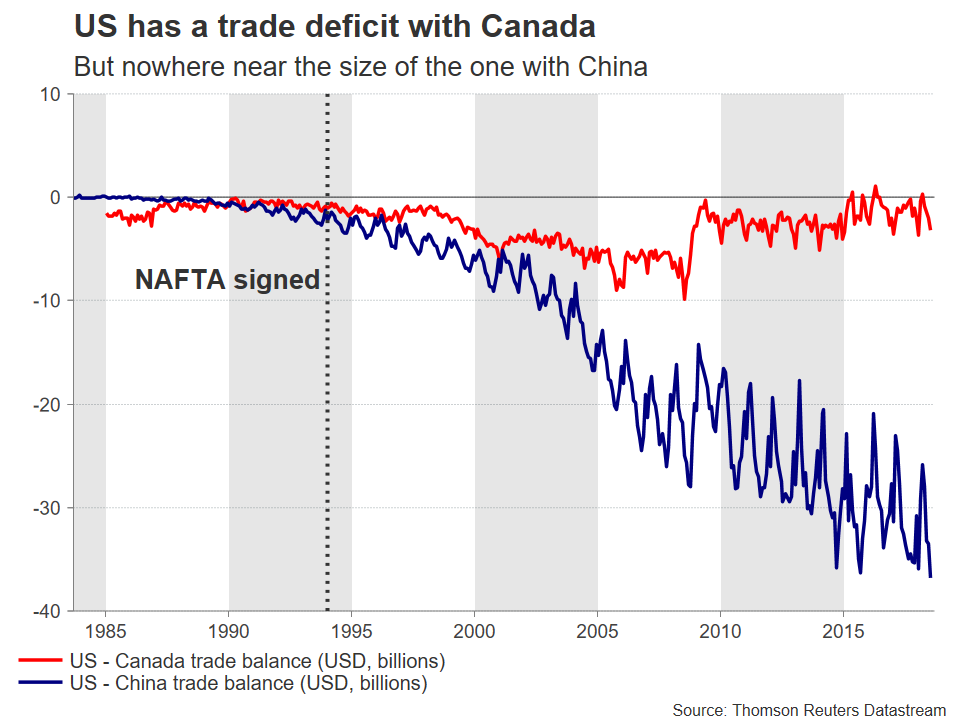
What happens in case of a deal?
Simply put, the loonie is likely to surge as the risk premium on the currency fades. While the magnitude and duration of such a relief rally are difficult to predict, it’s useful to note that the currency wouldn’t only gain due to new-found clarity around the trade outlook, but also from investors pricing in a more aggressive rate-hike path by the BoC. Trade uncertainties have been holding the BoC in slow gear; if they fade, it’s reasonable to expect faster rate increases. Of course, the specifics of any deal would also be crucial.
Beyond the loonie, stock investors would probably breathe a sigh of relief too, leading to some gains in both US and Canadian stock indices, particularly for automakers that have operations across the border like Ford or General Motors. In similar logic, a NAFTA resolution could lead to an unwinding of safe-haven bets, causing currencies like the Japanese yen – and to a lesser extent the dollar – to tumble. Hence, a cross that’s likely to skyrocket in case of a deal is loonie/yen.
And what if the talks collapse?
If the talks fall apart, or worse yet the US slaps tariffs on Canadian autos, the opposite market reactions are likely to occur. Namely, the loonie will probably tank alongside Canadian stocks, with US equities potentially feeling some collateral damage too. Moreover, the yen may experience inflows, as funds are rotated out of riskier assets and into safer ones.
That said, the likelihood for striking a deal may be higher than no-deal. Business interests on both sides of the border are very keen to see an accord, and although Trump may decide to play hardball for a while longer, he is unlikely to throw Canada under the proverbial bus, as that could have sizeable negative implications for US firms and workers that he surely wants to avoid. Indeed, seeing this through Trump’s eyes, a deal prior to the US midterm elections in November could be valuable politically too, in the sense that it can be presented to the electorate as a victory – and something concrete with which to justify his administration’s confrontational trade policies.
Technical outlook
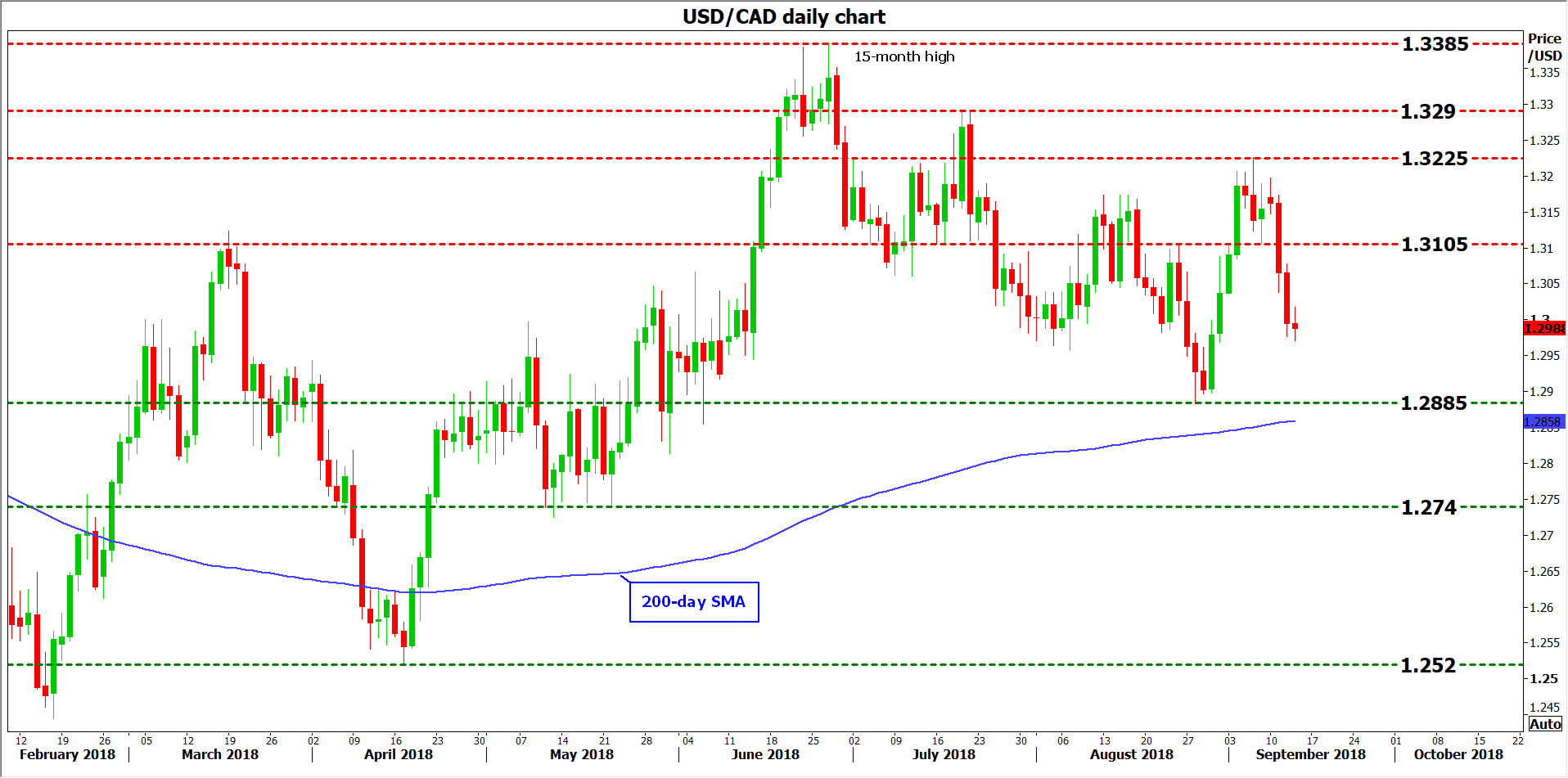
Looking at dollar/loonie, a potential agreement could see the pair decline, with the first wave of support likely to come near 1.2885, the August 28 low. A downside break could open the way for the 1.2740 zone, this being the May 22 trough, before the April 17 low of 1.2520 attracts attention.
On the flipside, advances in the pair may encounter initial resistance around 1.3105, marked by the inside swing low on September 7. If the bulls pierce through it, further upside moves may stall first near the September 6 high of 1.3225, and subsequently around 1.3290, the July 20 peak. Even higher, the 15-month high of 1.3385 would increasingly come into view.
European Indices Trade Mostly Higher With Positive Sentiment Carries Over From Asia On Trade Hopes
Notes/Observations
- European Indices advance buoyed by a second day of gains in Hong Kong and Japan, and strength in US futures
- Continued volatility seen in the Turkish Lira on President Erdogen comments
- UK Homebuilders trade under pressure following downbeat comments from BoE Carney on house prices if there is a no deal Brexit
- Hurricane Florence makes landfall in North Carolina
Asia:
- China August Retail sales beats estimates, Industrial production comes in line
Europe:
- BOE Gov Carney warns Cabinet of consequences of a 'no deal' Brexit, says could be as dire as the 2008 financial crash; No deal could lead to 35% drop in house prices
- Italy Dep Fin Min Castelli tell press that Universal income of €780/month to start beginning of 2019
- Reportedly EU Commissioner Oettinger (Germany) would prefer a French person head up ECB after Draghi's term ends
- Lira declines as Turkey President Erdogen says his patience is up to a point on Central bank rates, with the rate hike quite high
Economic Data:
- (SE) SWEDEN AUG CPI M/M: -0.2% V 0.0%E; Y/Y: 2.0% V 2.2%E
- (EU) Euro Zone July Trade Balance (Seasonally Adj): €12.8B v €16.2Be; Trade Balance NSA (unadj): €17.6B v €22.5B prior
- (NL) Netherlands July Retail Sales Y/Y: 2.4% v 4.0% prior
- (FI) Finland Aug CPI M/M: 0.1% v -0.1% prior; Y/Y: 1.3% v 1.4% prior
- (FI) Finland July GDP Indicator WDA Y/Y: 1.5% v 2.8% prior
- (IN) India Aug Wholesale Prices (WPI) Y/Y: 4.5% v 4.6%e
- (TR) Turkey July Current Account: -$1.8B v -$1.8Be
- (IT) Italy July Final CPI (includes tobacco) M/M: 0.4% v 0.5% prelim; Y/Y: 1.6% v 1.7% prelim
Fixed Income Issuance:
- Non seen
SPEAKERS/FIXED INCOME/FX/COMMODITIES/ERRATUM
Equities
- Indices [Stoxx50 +0.2% at 3,342, FTSE +0.1% at 7,290, DAX +0.4% at 12,105, CAC-40 +0.4% at 5,346; IBEX-35 +0.2% at 9,344, FTSE MIB +0.2% at 20,881, SMI -0.1% at 8,954, S&P 500 Futures +0.1%]
- Market Focal Points/Key Themes: European indices open higher across the board and remained positive as the session wore on; Materials sector among best performing along with consumer discretionary; Financials among the underperformers; UK homebuilders under pressure following BOE's Carney comments; Atlantia impacted after rumors JPMorgan mulling to withdraw from capital raise; Carige given 15 days to be compliant; upcoming events expected in the US session include Dave and Buster's earnings
Equities
- Consumer discretionary: Aryzta ARYN.CH -1.4% (agreement with lenders), Connect Group CNCT.UK -8.4% (trading update), Metro B4B.DE -1.1% (asset sale), Ryanair RYA.UK +1.5% (reaches agreement with Italian union), Solocal LOCAL.FR +4.0% (analyst action)
- Financials: Investec INVP.UK +9.1% (demerger, trading update)
- Healthcare: Bone Therapeutics BOTHE.BE +6.7% (study reaches primary endpoints)
- Industrials: Image Scan Holdings IGE.UK -14.7% (trading update), Landi Renzo LR.IT +8.0% (results), Touax TOUP.FR +4.3% (results)
- Technology: Dassault Systems DSY.FR +0.3% (to enter CAC-40), Rocket Internet RKET.DE -5.2% (analyst action), STMicroelectronics STM.FR +1.7% (analyst action)
Speakers
- (IT) Italy Dep Fin Min Castelli: citizen's income to start Jan 1, 2019; to be €780M minimum - Italian press
- (FR) ECB's Villeroy (France): sees French economy catching up with euro area by 2020
- (TR) Turkey President Erdogen: Lira decline proves economic assassination attempt; Central bank has made a very high rate increase, his patience is up to a point on Central bank rates
Currencies
- GBPUSD rises to 6 week high extending upon yesterdays gains following weaker US inflation figures yesterday and comments from BoE Carney noting a no-deal Brexit would probably see interest rates rise rather than fall.
- USDTRY weakened following President Erdogen comments on currency decline, before fading the move as the pair trades just above 6.00
Fixed Income
- Bund Futures trades at 159.36 down 11 ticks as the ECB lowers growth forecasts while confirming plans to end easy money. Resistance moves to 161.82 then 163. A downside break of 159.85 sees 158.69 initially.
- Gilt futures trades at 121.47 down 25 ticks following the move in Treasuries. Continued support at 122.50, with a continued move higher targeting 123.93 then 124.00.
- Friday 's liquidity report showed Thursday's excess liquidity fell from €1.909T to €1.904T. Use of the marginal lending facility declined from €47M to €40M.
- Corporate issuance saw 2 issuers raise $7B in the primary market. Lipper reports equity fund outflows of $1.8B
Looking Ahead
- 06:00 (IE) Ireland July Trade Balance: No est v €4.1B prior
- 06:30 (RU) Russia Central Bank (CBR) Interest Rate Decision: Expected to leave Key Rate unchanged at 7.25%
- 07:00 (IL) Israel Aug CPI M/M: 0.2%e v 0.0% prior; Y/Y: 1.3%e v 1.4% prior
- 07:00 (BR) Brazil Sept FGV Inflation IGP-10 M/M: 0.8%e v 0.5% prior
- 07:30 (IN) India Weekly Forex Reserves
- 08:00 (PL) Poland Aug CPI Core M/M: 0.0%e v -0.1% prior; Y/Y: 0.8%e v 0.6% prior
- 08:00 (BR) Brazil July IBGE Services Sector Volume Y/Y: No est v 0.9% prior
- 08:00 (IS) Iceland Aug Unemployment Rate: No est v 2.2% prior
- 08:15 (UK) Baltic Dry Bulk Index
- 08:30 (US) Aug Import Price Index M/M: -0.2%e v 0.0% prior; Y/Y: 4.1%e v 4.8% prior; Import Price Index ex Petroleum M/M: -0.2%e v -0.1% prior
- 08:30 (US) Aug Export Price Index M/M: 0.0%e v -0.5% prior; Y/Y: No est v 4.3% prior
- 08:30 (US) Aug Advance Retail Sales M/M: 0.4%e v 0.5% prior; Retail Sales Ex Auto M/M: 0.5%e v 0.6% prior, Retail Sales Ex Auto and Gas: 0.5%e v 0.6% prior; , Retail Sales Control Group: 0.4%e v 0.5% prior
- 09:00 (BE) Belgium July Trade Balance: No est v €0.6B prior
- 09:15 (US) Aug Industrial Production M/M: 0.3%e v 0.1% prior; Capacity Utilization: 78.2%e v 78.1% prior, Manufacturing Production: 0.3%e v 0.3% prior
- 10:00 (US) July Business Inventories: 0.6%e v 0.1% prior
- 10:00 (US) Sept Preliminary University of Michigan Confidence: 96.6e v 96.2 prior
- 11:00 (CO) Colombia July Industrial Production Y/Y: 3.0%e v 1.3% prior
- 11:00 (CO) Colombia July Retail Sales Y/Y: 5.5%e v 6.3% prior
- 13:00 (US) Weekly Baker Hughes Rig Count data
- 21:30 (CN) China Aug New Home Prices M/M: No est v 1.2% prior
USD/CAD – Canadian Dollar Unchanged Ahead Of US Consumer Spending Data
The Canadian dollar is unchanged in the Friday session. Currently, USD/CAD is trading at 1.2997, down 0.01% on the day. In the U.S, the focus is on consumer spending data. Core retail sales and retail sales are both expected to tick lower, with readings of 0.5% and 0.4%, respectively. We’ll also get a look at UoM Consumer Sentiment, which is forecast to climb to 96.7 points.
Investors continue to keep a worried eye on the NAFTA negotiations, nervous over the economic repercussions to the Canadian economy if a trade agreement is not hammered out with the United States. However, a PwC report earlier this week points to a far more troubling event – President Trump’s massive corporate tax cuts. The PwC report estimates that the tax reforms could cost Canada 635,000 jobs (3.4% of the labor market) and reduce Canada’s GDP by up to $85 billion (4.9% of the economy). The damage to the Canadian economy would be felt most keenly in the business sector, as lower corporate taxes in the U.S will reduce the incentive for U.S companies to set up operations north of the border.
In the U.S, the red-hot labor market continues to be the envy of industrialized countries around the globe. The unemployment rate is at a remarkable 3.8% and unemployment claims were almost unchanged at 204 thousand, another excellent reading. Despite the strong employment front and a booming economy, inflation remains well short of the Federal Reserve’s target of 2 percent. In August, CPI and Core CPI came in at 0.1% and 0.2%, respectively, falling short of their estimates.
XAU/USD Analysis: Was Located At 1,208
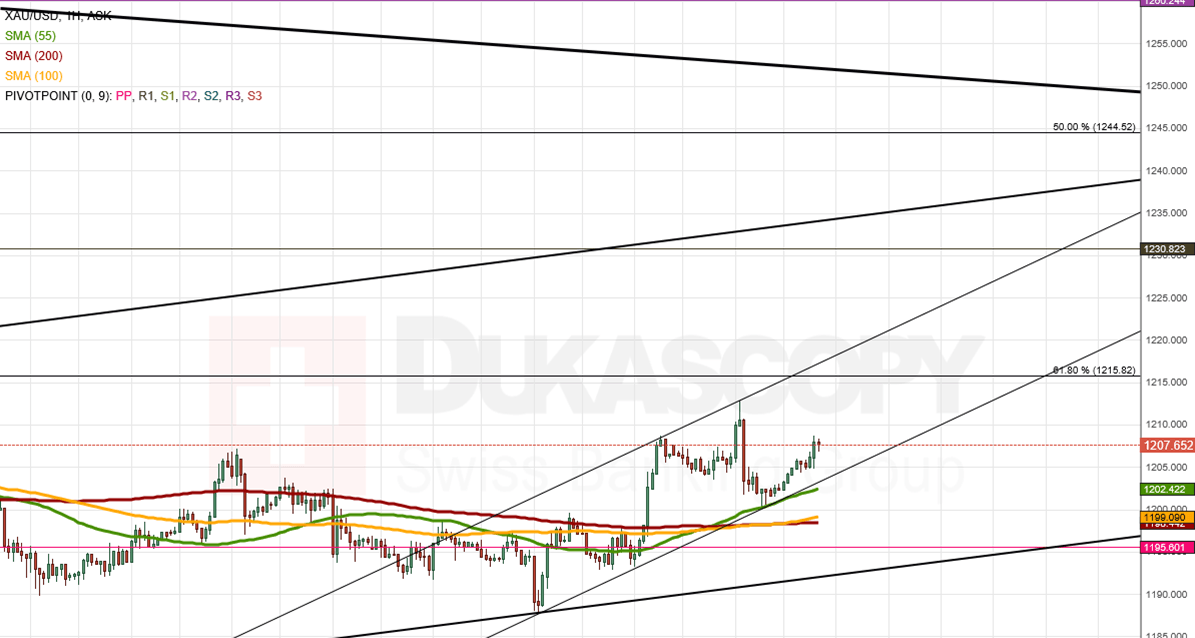
The gold price appreciated 0.09% since Thursday's trading session. During Friday morning hours, the yellow was surging upwards into the pattern and was located at the 1,208.00 level.
In regards to the near future, the yellow metal should bounce off the bottom boundary of the ascending trend and surge upwards due to the support of the 55-hour simple moving average, which will catch up the rate in a couple of hours on Friday session.
Besides, gold could continue to surge upwards without the help of the bottom boundary of the trend-line and the 55-hour simple moving average.
EUR/USD Analysis: Is At Weekly R2
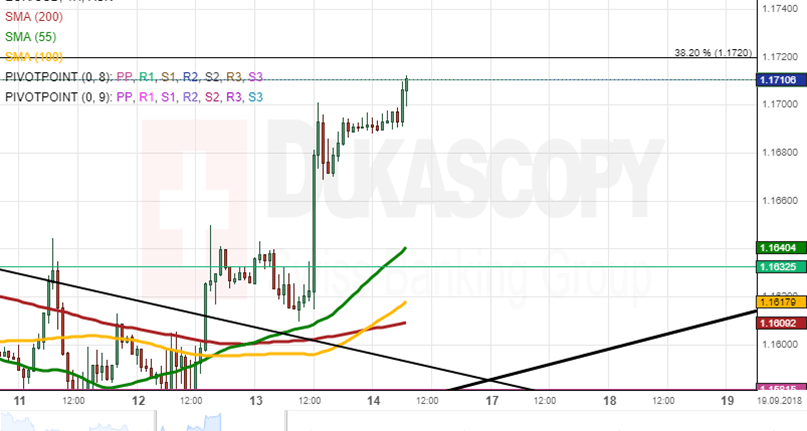
The European Single Currency appreciated 0.64% against the US Dollar since Thursday's session. The currency exchange rate was located near the weekly R2 at the 1.1710 level during Friday morning hours.
In regards to the near future, most likely, the rate should retrace backwards due to the resistance of the weekly R2 at the 1.1710 level and 38.20% Fibonacci retracement level at 1.1720.
On the other hand, the European Single Currency might ignore resistance of the weekly R2 and the 38.20% Fibo level and surge upwards.
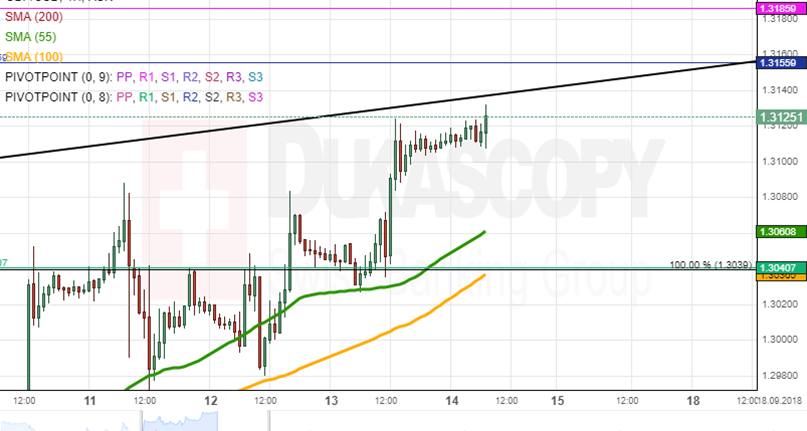
GBP/USD Analysis: Locates At 1.3120 Mark
The British pound appreciated 0.48 % against the US Dollar. The upper boundary of the medium ascending line resisted the rate and force it to stay into the pattern at the 1.1320 mark during Friday.
In regards to the near future, the 55-hour and the 100-hour simple moving averages will try to catch up the rate to give additional support on Friday. Most likely, the British pound will move sideways among the upper boundary line of the pattern until the SMAs catch up the rate during the day.
However, the BOE Government Carney speech at 10:00 GMT this Friday may affect the rate to move any ways. Watch out for the news!
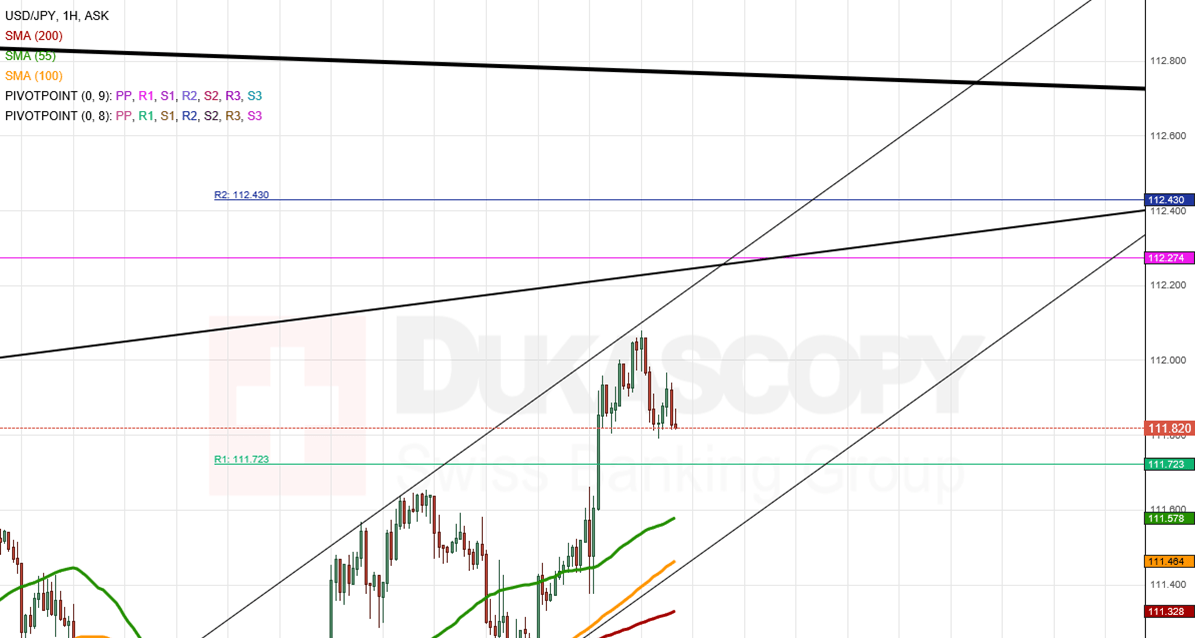
USD/JPY Analysis: Trades At 111.80 level
The US Dollar appreciated 0.58% against the Japanese Yen since Thursday's session. On Friday, the currency pair was located at the 111.80 level between the weekly R1 at the 111.72 mark and the monthly R1 at the 112.27 mark.
In regards to the near future, most likely, the rate will surge upwards to the 112.20 level near the monthly R1 at the 112.27 mark, which could push the rate to retrace backwards into the trend-line during the trading day.
However, the rate can pass the support of the weekly R1 at the 111.72 reach for the 55– hour simple moving average, which might push the rate upwards to break the weekly R1 one more time.