Sample Category Title
US: Retail Sales Disappoint in August, but July’s Print Looks Even Better
Retail sales rose by a modest 0.1% in August, missing expectations for 0.4% gain and marked the weakest print since February. The disappointment was tempered somewhat by the positive revisions to July's data, with monthly growth upgraded from the already-solid 0.5% to 0.7%.
Sales at gasoline stations rose 1.65%, the largest monthly gain since May, but those at auto & parts dealers fell by 0.8%, a third consecutive monthly decline.
Sales at building material stores were flat in August, little changed since May. Following three blockbuster months, sales at food services grew by just 0.2% in August, but are still up 10% from a year-ago level. Indeed, putting aside the 20% increase over the past year in gasoline station receipts (which is largely a move in prices), growth in food services is the second fastest growing category.
Excluding the above categories (gas, autos, building materials, and food services), the 'control group' used in calculating GDP rose by just 0.1% on the month – also below market expectations for a 0.4% gain. Delving into the details, sales of clothing were down 1.7%, while sales of furniture fell 0.3% and sales at food and beverage stores were flat.
Among the few categories where performance improved, sales at miscellaneous store retailers rose by a hefty 2.3%, while sales at health and electronics stores were up by 0.5% and 0.4%, respectively.
Key Implications
After several months of very solid spending, consumers took a break from shopping in August, perhaps enjoying the final days of summer in the pool rather than in the shopping malls. This was not what forecasters were expecting, but after several months of very solid numbers some moderation was bound to materialize, particularly in categories such as restaurants and eating out, which previously saw a string of very strong numbers.
Other categories, such as auto sales are feeling the pinch from rising interest rates and tighter lending standards, while sales of building materials are likely weaker due to the recent slowdown in the housing market.
The August break will likely prove short-lived (and data could still be revised higher). Given the incredibly hot labor market, signs of accelerating wage growth, and healthy household balance sheets, consumer spending is expected to remain solid in the months ahead. That being said, the pace of spending is not likely to match that of the past several months. As the tax cut boost fades, and higher rates weigh on interest-sensitive purchases, sales growth is likely to slow to around 0.2% to 0.3% a month.
U of Michigan consumer sentiment rose to 100.8, second highest since 2004
U of Michigan consumer sentiment rose to 100.8 in September, up from 96.2 and beat expectation of 96.9. That's the second highest level since 2004.
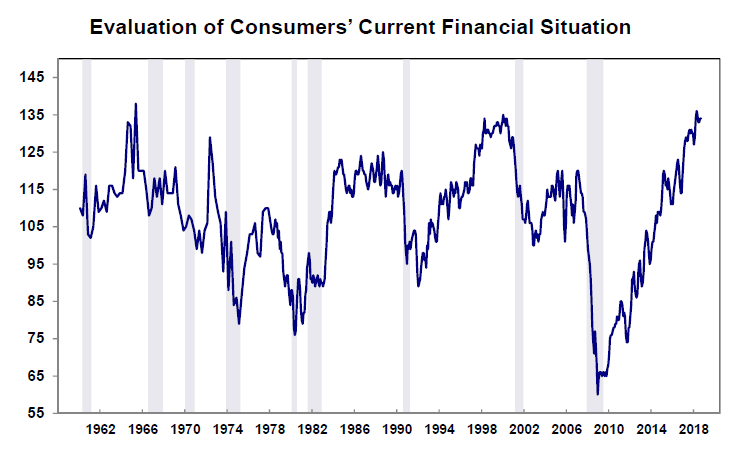
Surveys of Consumers chief economist, Richard Curtin: Consumer sentiment posted a robust rise in early September, reaching 100.8, the second highest level since 2004-only behind the March 2018 reading of 101.4. Importantly, the gains were widespread across all major socioeconomic subgroups. The Expectations Index reached its highest level since July 2004, largely due to more favorable prospects for jobs and income. Despite a lessening of expected gains in nominal incomes in September, inflation expectations also declined, acting to offset concerns about declining living standards. Consumers anticipated continued growth in the economy that would produce more jobs and an even lower unemployment rate during the year ahead. While consumers were somewhat more likely to anticipate that the economic expansion would continue uninterrupted over the next five years, nearly as many expected another downturn sometime in the next five years. The largest problem cited on the economic horizon involved the anticipated negative impact from tariffs. Concerns about the negative impact of tariffs on the domestic economy were spontaneously mentioned by nearly one-third of all consumers in the past three months, up from one-in-five in the prior four months.
Chicago Fed Evans: Normal to hike interest rate to restrictive given unemployment rate falls below natural rate
In a speech titled "Monetary Policy: The Road Ahead", Chicago Fed President Charles Evans said the economy is now "approaching the tenth year of the expansion" and "fundamentals for growth are solid". He expected unemployment rate to drop further to around 3.5% by the end of 2020, a full percent point below "natural rate". Evans also expected inflation to "rise a bit further" over the next few years. And he added " I expect tighter labor markets to lead to higher wage growth before too long."
On monetary policy, he noted that most FOMC members put neutral rate somewhere between 2.5 - 3.0%. The 3-3.5% projected for 2019 and 2020 is "mildly restrictive". Evans noted that "given an unemployment rate forecast below the natural rate, such a policy stance would be quite normal and consistent with some moderation in growth and a gradual return of employment to its longer-run sustainable level."
Nonetheless, he also pointed out there may be need to tighten further is the "currently unexpected tailwinds emerge that push the economy too far beyond sustainable growth and employment levels, potentially leading to unacceptably high inflation beyond our symmetric 2 percent objective. " On the other hand, Fed may need a "shallower policy path if expected headwinds emerge", such as trade tensions.
Evans also said it's premature to read a signal into flattening yield curve. He noted that long-term borrowing costs have been declining for a while. And all other signals suggest a strong economy.
Overall, Evans just repeated what he said before. He was one of the few who openly said recently that interest rate may need to enter into restrictive region.
USDJPY Outlook: Bulls Look for Close above Broken 111.87 Fibo Barrier to Signal Continuation
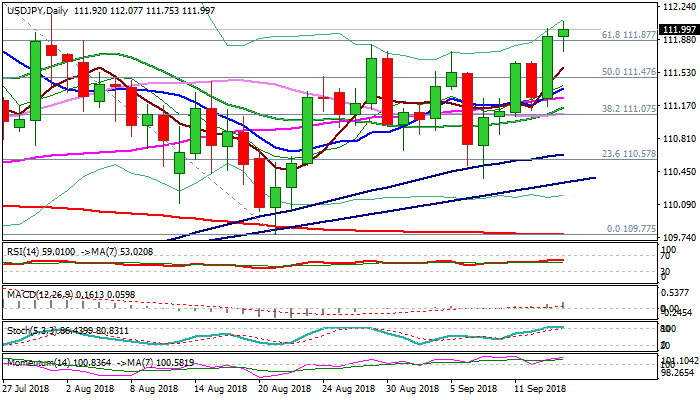
The dollar remains steady despite weaker than expected US retail sales (Aug m/m 0.1% vs 0.4% f/c/core Aug m/m 0.3% vs 0.5% f/c), as upward-revised data from July signal solid growth in Q3. The USDJPY pair retested daily high at 112.07, posted during Asian session, maintaining bullish bias after shallow correction was contained at 111.75 (European session low). Bulls keep focus at key barriers at 112.15/37 (01 Aug high/Fibo 76.4% of 113.17/109.77) as fears of deeper pullback on pre-weekend profit-taking fade. Close above broken Fibo barrier at 111.87 (61.8% of 113.17/109.77) is needed to confirm strong bullish stance.
Res: 112.15; 112.37; 112.62; 112.92
Sup: 111.75; 111.54; 111.36; 111.26
USD/CHF Mid-Day Outlook
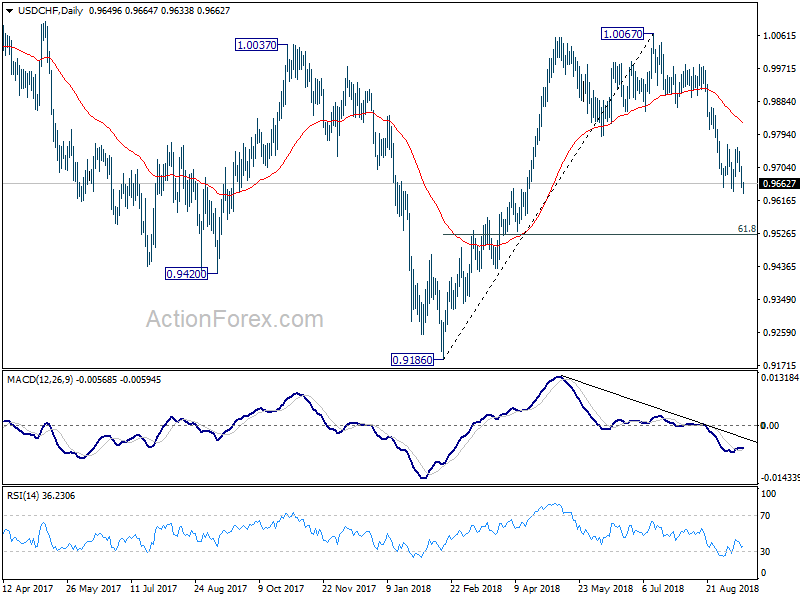
Daily Pivots: (S1) 0.9633; (P) 0.9675; (R1) 0.9699; More.....
USD/CHF's breach of 0.9640 low suggests that recent decline from 1.0067 is resuming. Intraday bias is back on the downside for 0.9523 fibonacci level. On the upside, above 0.9688 minor resistance will dampen this bearish case and turn bias neutral first. Break of 0.9757 resistance will indicate near term reversal and bring stronger rebound back to 0.9866 support turned resistance.
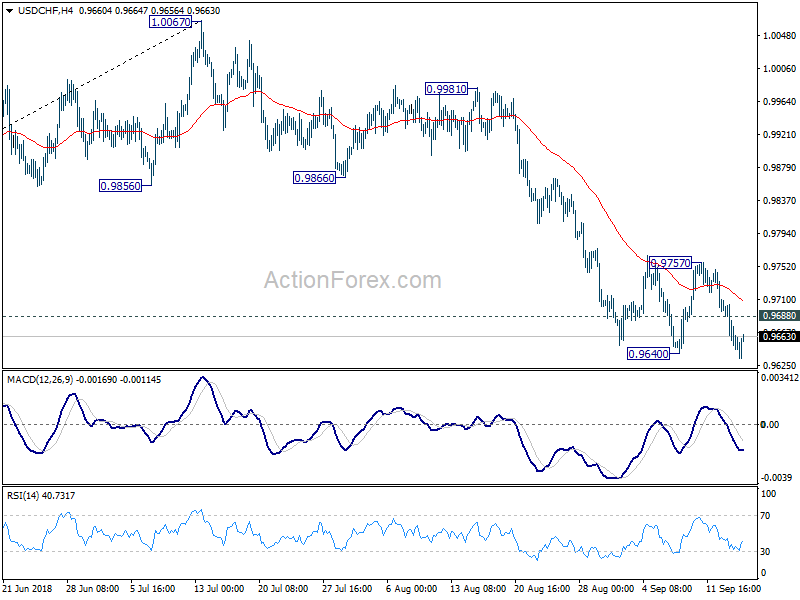
In the bigger picture, current development suggests that rise from 0.9186 low has completed at 1.0067, after failing to sustain above 1.0037 resistance. Fall from 1.0067 could extend to 61.8% retracement of 0.9816 to 1.0067 at 0.9523 and below. But for now, we don't expect a break of 0.9186 low. On the upside, firm break of 0.9866 support turned resistance will suggests that fall from 1.0067 has completed and rise from 0.9186 is resuming.
Dollar Ignores Mixed Data and Recovers, Digesting This Week’s Losses
As the week is heading towards the close, Dollar is trying to pare back some of the losses over the few days. Mixed economic from the US are ignored by the markets. Nonetheless, the greenback is outshone slightly by the Swiss Franc, which is so far to strongest for today. On the other hand, Australian and Canadian Dollar weakens generally. Over the week, Sterling is the strongest one, followed by Canadian Dollar. Yen is the worst performing one, followed by Dollar.
In other markets, major European stock indices are trading up slightly today. FTSE is up 0.22% at the time of writing, DAX up 0.34% and CAC also up 0.34%. German 10 year bund yield display some sustainable strength and is up 0.33% 0.458. Two weeks ago on August 31, 10 year bund yield was at 0.330. Earlier in Asia, Nikkei closed up 1.2%, Hong Kong HSI up 1.01%, Singapore Strait Times up 0.95%. But China Shanghai SSE dropped -0.18%.
Released from the US, headline retail sales rose 0.1% mom in August, below expectation of 0.4% mom. Ex-auto sales rose 0.3% mom, below expectation of 0.5% mom. Import price index dropped -0.6% mom versus expectation of -0.2% mom. Industrial production rose 0.4% mom in August, above expectation of 0.3% mom. Capacity utilization rose to 78.1%.
UK Raab: Substantive differences remain with EU and Brexit agreement
UK Brexit Minister Dominic Raab held a phone call with EU chief negotiator Michel Barnier. After that, Raab said "while there remain some substantive differences we need to resolve, it is clear our teams are closing in on workable solutions to the outstanding issues in the Withdrawal Agreement, and are having productive discussions in the right spirit on the future relationship."
Raab added that "we agreed to review the state of play in the negotiations following the informal meeting of heads of state or government of the European Union in Salzburg next Thursday, and we reiterated our willingness to devote the necessary time and energy to bring these negotiations to a successful conclusion."
BoE Carney on Brexit: Hope for the best but plan for the worst
In a speech at the Irish central bank, BoE Governor Mark Carney emphasized that BoE is " well-prepared for whatever path the economy takes, including a wide range of potential Brexit outcomes." And, "we have used our stress test to ensure that the largest UK banks can continue to meet the needs of UK households and businesses even through a disorderly Brexit, however unlikely that may be." He emphasized that "our job, after all, is not to hope for the best but to plan for the worst."
It's reported that Carney told Prime Minister Theresa May's cabinet a no-deal Brexit could trigger 25-35% fall in UK house prices over three years. He said today that this is not a prediction but something that the central bank needs to be prepared for.
ECB Smets: Gradual policy normalization support reflationary process
ECB Governing Council member Jan Smets reiterated the central bank's forward guidance and the implication that policy normalization will be slow and gradual. He said in a conference that "we reiterated the forward guidance on the reinvestment and on policy rates, implying that we do foresee a very gradual process of policy normalization." And, "that will allow financing conditions to remain very favorable and to support both the economy and the associated reflationary process we are aiming for."
Released fro Eurozone, trade surplus narrowed to EUR 12.8B in July.
Japan PM Abe would like BoJ to end ultra-loose policy in his next term
Japan Prime Minister Shinzo Abe said BoJ's ultra loose monetary policy should not last "forever". Now, he said that "wages are finally picking up … We're starting to see consumption and capital expenditure boost growth." And he'd like to end the ultra-loose policy "during my next term".
But "when to modify the easy policy is up to (BOJ Governor Haruhiko) Kuroda. I've left that decision to him." He added that "the BOJ's price target is one measurement in guiding policy but the real goal is to boost growth and employment." "We've seen a significant improvement in job growth."
Elsewhere, New Zealand Business NZ manufacturing PMI rose to 52 in August up from 51.2. China retail sales grew 9.0% yoy in August, beat expectation of 8.8%. However, industrial production grew 6.1% yoy, below expectation of 6.2% yoy. Fixed assets investment few 5.3% yoy, below expectation of 5.7% yoy.
EUR/USD Mid-Day Outlook
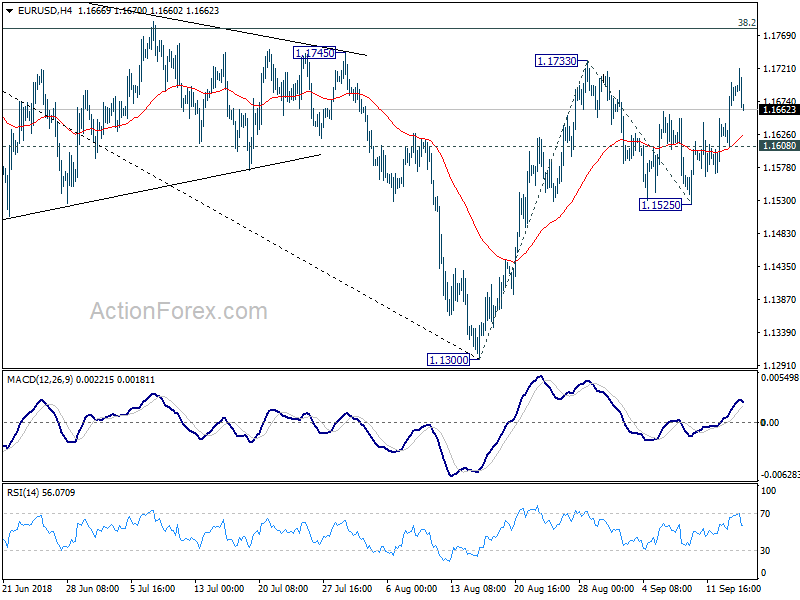
Daily Pivots: (S1) 1.1632; (P) 1.1667; (R1) 1.1725; More.....
EUR/USD failed to break through 1.1733 resistance and retreats notably in early US session. Intraday bias is turned neutral first. Further rise cannot be ruled out as long as 1.1608 minor support holds. However, we'd still expect strong resistance from 38.2% retracement of 1.2555 to 1.1300 at 1.1779 to limit upside. On the downside, break of 1.1608 minor support will turn bias to the downside for 1.1525 support. Break will indicate completion of whole rebound from 1.1300. However, firm break of 1.1779 will extend the rise to 100% projection of 1.1300 to 1.1733 from 1.1525 at 1.1958.
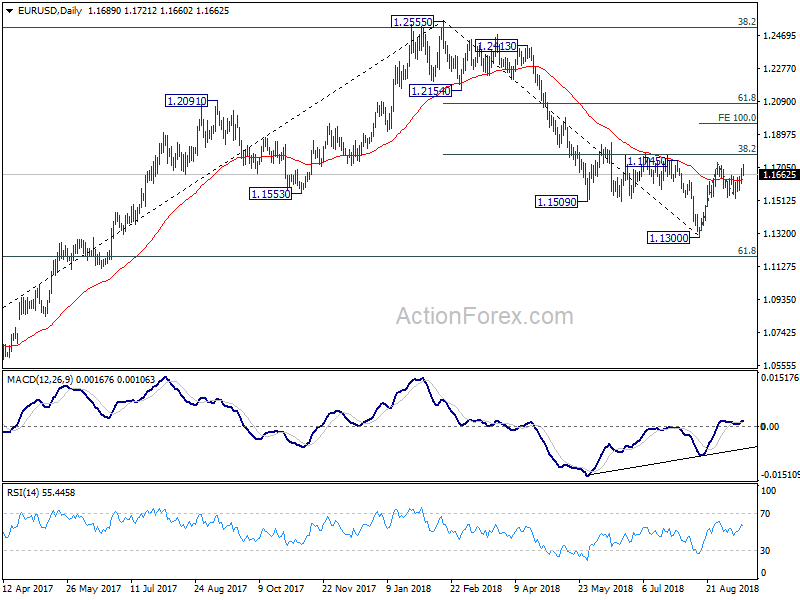
In the bigger picture, a medium term bottom should be in place at 1.1300, on bullish convergence condition in daily MACD and some consolidations would be seen. But still, note that EUR/USD was rejected by 38.2% retracement of 1.6039 (2008 high) to 1.0339 (2017 low) at 1.2516. That carries some long term bearish implications. Thus, we'd expect fall from 1.2555 high to resume after consolidation completes. Below 1.1300 should send EUR/USD through 61.8% retracement of 1.0339 to 1.2555 at 1.1186. And, in that case, EUR/USD would head to retest 1.0339 (2017 low).
Economic Indicators Update
| GMT | Ccy | Events | Actual | Forecast | Previous | Revised |
|---|---|---|---|---|---|---|
| 22:30 | NZD | BusinessNZ Manufacturing PMI Aug | 52 | 51.2 | ||
| 02:00 | CNY | Retail Sales Y/Y Aug | 9.00% | 8.80% | 8.80% | |
| 02:00 | CNY | Industrial Production Y/Y Aug | 6.10% | 6.20% | 6.00% | |
| 02:00 | CNY | Fixed Assets Ex Rural YTD Y/Y Aug | 5.30% | 5.70% | 5.50% | |
| 04:30 | JPY | Industrial Production M/M Jul F | -0.20% | -0.10% | -0.10% | |
| 09:00 | EUR | Eurozone Trade Balance (EUR) Jul | 12.8B | 16.3B | 16.7B | |
| 12:30 | USD | Retail Sales Advance M/M Aug | 0.10% | 0.40% | 0.50% | 0.70% |
| 12:30 | USD | Retail Sales Ex Auto M/M Aug | 0.30% | 0.50% | 0.60% | 0.90% |
| 12:30 | USD | Import Price Index M/M Aug | -0.60% | -0.20% | 0.00% | -0.10% |
| 13:15 | USD | Industrial Production M/M Aug | 0.40% | 0.30% | 0.10% | 0.40% |
| 13:15 | USD | Capacity Utilization Aug | 78.10% | 78.40% | 78.10% | 77.90% |
| 14:00 | USD | Business Inventories Jul | 0.50% | 0.10% | ||
| 14:00 | USD | U. of Mich. Sentiment Sep P | 96.9 | 96.2 |
USD/JPY Mid-Day Outlook
Daily Pivots: (S1) 111.39; (P) 111.69; (R1) 112.24; More...
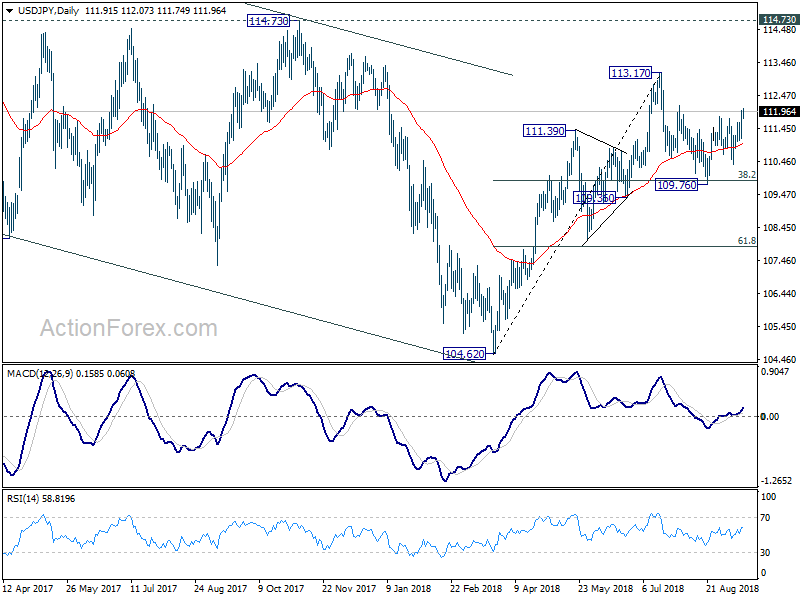
USD/JPY's rebound fro 109.76 is still in progress for 100% projection of 109.76 to 111.82 from 110.37 at 112.43 first. Break will target a test on 113.17 high. On the downside, below 111.10 minor support will delay the bullish case again and turn bias neutral first.
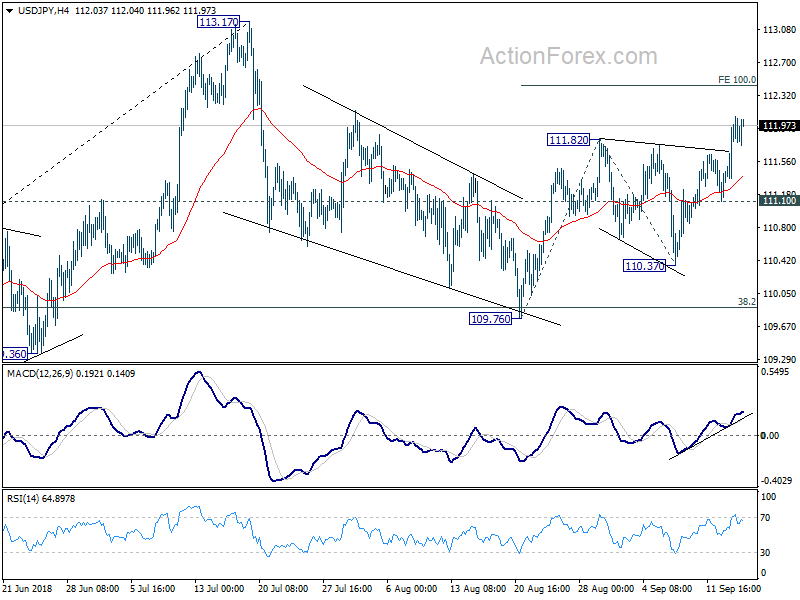
In the bigger picture, corrective fall from 118.65 (2016 high) should have completed with three waves down to 104.62. Decisive break of 114.73 resistance will likely resume whole rally from 98.97 (2016 low) to 100% projection of 98.97 to 118.65 from 104.62 at 124.30, which is reasonably close to 125.85 (2015 high). This will stay as the preferred case as long as 109.36 support holds. However, decisive break of 109.36 will mix up the outlook again. And deeper fall should be seen back to 61.8% retracement of 104.62 to 113.17 at 107.88 and below.
GBP/USD Mid-Day Outlook
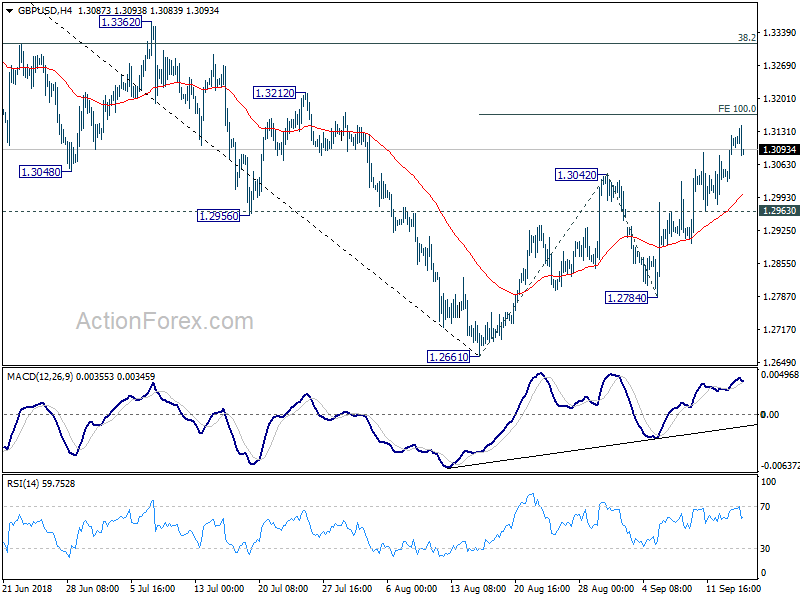
Daily Pivots: (S1) 1.3048; (P) 1.3085; (R1) 1.3143; More...
For now, further rise could be seen in GBP/USD to 100% projection of 1.2661 to 1.3042 from 1.2784 at 1.3165 and above. However, rebound from 1.2661 is seen as a corrective move. Hence, Upside should be limited by 1.3316 key fibonacci level to bring near term reversal. On the downside, break of 1.2963 minor support will now argue that rebound from 1.2661 has completed. In such case, intraday bias will be turned back to the downside for 1.2784 and then 1.2661.
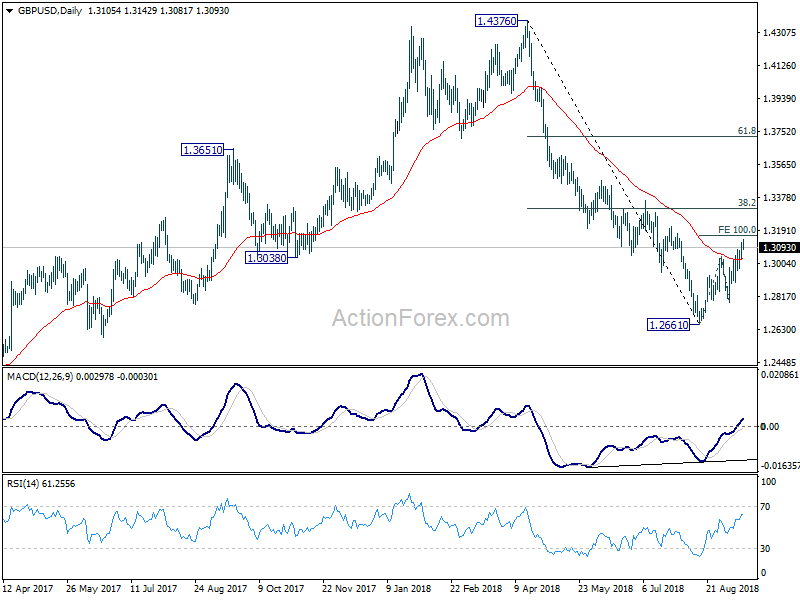
In the bigger picture, whole medium term rebound from 1.1946 (2016 low) should have completed at 1.4376 already, after rejection from 55 month EMA (now at 1.4099). The structure and momentum of the fall from 1.4376 argues that it's resuming long term down trend. And this will be the preferred case as long as 38.2% retracement of 1.4376 to 1.2661 at 1.3316 holds. However, firm break of 1.3316 would bring stronger rebound to 61.8% retracement at 1.3721. And, the eventual depth of the fall from 1.4376, and the chance of hitting 1.1946 low, will depend on the strength of the interim corrective rebound from 1.2661.
EUR/USD Mid-Day Outlook
Daily Pivots: (S1) 1.1632; (P) 1.1667; (R1) 1.1725; More.....
EUR/USD failed to break through 1.1733 resistance and retreats notably in early US session. Intraday bias is turned neutral first. Further rise cannot be ruled out as long as 1.1608 minor support holds. However, we'd still expect strong resistance from 38.2% retracement of 1.2555 to 1.1300 at 1.1779 to limit upside. On the downside, break of 1.1608 minor support will turn bias to the downside for 1.1525 support. Break will indicate completion of whole rebound from 1.1300. However, firm break of 1.1779 will extend the rise to 100% projection of 1.1300 to 1.1733 from 1.1525 at 1.1958.
In the bigger picture, a medium term bottom should be in place at 1.1300, on bullish convergence condition in daily MACD and some consolidations would be seen. But still, note that EUR/USD was rejected by 38.2% retracement of 1.6039 (2008 high) to 1.0339 (2017 low) at 1.2516. That carries some long term bearish implications. Thus, we'd expect fall from 1.2555 high to resume after consolidation completes. Below 1.1300 should send EUR/USD through 61.8% retracement of 1.0339 to 1.2555 at 1.1186. And, in that case, EUR/USD would head to retest 1.0339 (2017 low).
GBPUSD Outlook: Sterling Falls on News that UK Labor Party Would Vote against PM May’s Brexit Deal
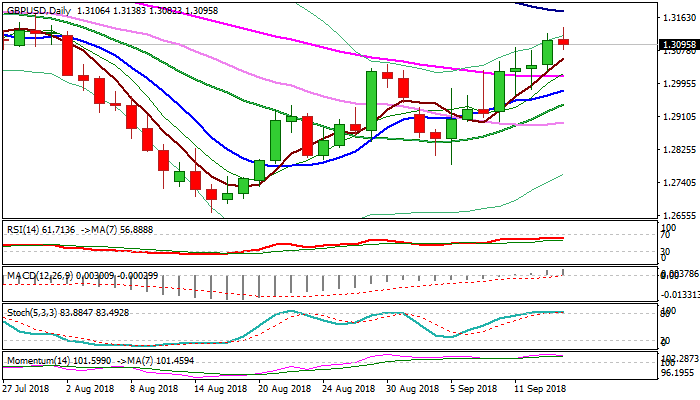
Sterling fell across the board in mid-European session trading after announcement that Britain’s Labor party will vote against any Brexit deal reached by PM Theresa May. Labor party expects that their decision would result in no viable deal in divorce process between the UK and the European union, which would force PM May to step down from her position before Christmas. Fresh political turmoil in the UK comes just days after calming and optimistic comments from top EU Brexit negotiator, increasing volatility in the markets. Cable dipped back below 1.31 handle, trading in the middle of daily cloud after fresh bulls cracked cloud top earlier today. South-turning overbought daily slow stochastic and weakening momentum warn of deeper pullback, as sentiment was soured by recent news. Consolidation within daily cloud would keep bullish bias in play for renewed attempts higher and attack at falling 100SMA (1.3178) on break above cloud. Conversely weaker tone could be expected on return and close below cloud base (1.3043).
Res: 1.3145; 1.3162; 1.3179; 1.3213
Sup: 1.3101; 1.3066; 1.3043; 1.3011