Sample Category Title
ECB Vasiliauskas pushes banking union, but Knot said risk reduction first
ECB Governing Council member Klaas Knot urged that risk must be reduced before the Eurozone banking union is shared more widely among member states. The measures under the union include bank deposit insurance scheme and streamlining liquidity provision for banks under resolution. Knot argued that "these elements all imply more public risk-sharing in (the European Monetary Union) as liability for bank failures in other countries is shared at the European level." And he emphasized that " risk-sharing should be preceded by sufficient risk-reduction."
Separately, another Governing Council member Vitas Vasiliauskas reiterated the call for an "EU-wide banking union". And he said that "allow for a centralized supervisory approach for all of the EU's largest systemically important banks, regardless of host-country membership in the monetary union." Also, he added that "we need to do a better job at convincing decision-makers in non-euro area countries to enter into the "close cooperation" regime (with the ECB)."
Dollar Enjoys Gains in a Cloudy Trade Environment; Pound Down ahead of Carney’s Testimony
Here are the latest developments in global markets:
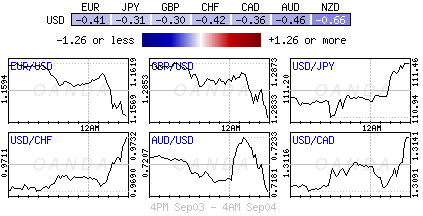
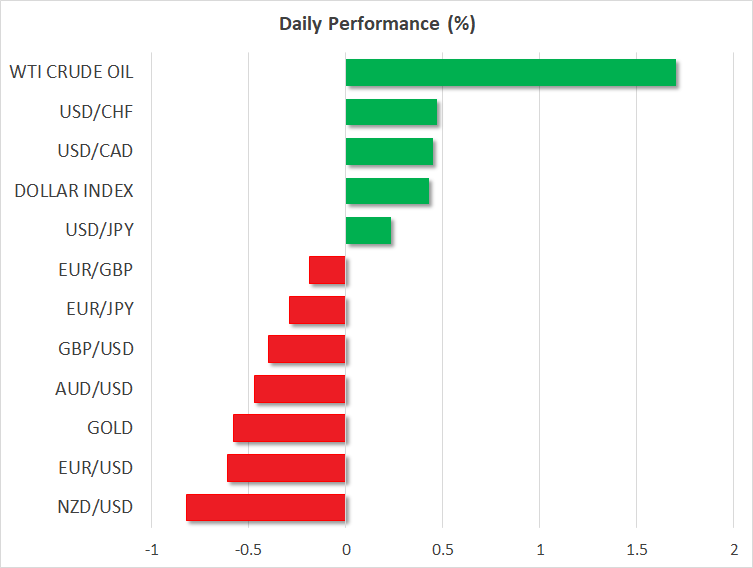
FOREX: The US dollar index traded 0.42% higher on Monday, posting a 10-day high, while dollar/yen advanced by 0.30% despite heightened global trade risks; the dollar remained resilient and the buying interest continued on the back of investors optimism in the US economy. In Eurozone, producer prices beat expectations, rising by 4.0% y/y in July from 3.6% before. However, euro/dollar failed to gain on the data, falling by 0.52% to 1.1560. Pound/dollar extended losses to reach 1-week lows at 1.2811 today (-0.37%) after disappointing construction PMI readings added to the bearish sentiment before Bank of England Governor Mark Carney testifies in parliament. In the antipodean sphere, aussie/dollar headed lower by 0.55% to a new 21-month low of 0.7155 after the RBA left interest rates unchanged. Also, kiwi/dollar plummeted by 0.83% towards a new 18-month low of 0.6539. Dollar/loonie rose by 0.44% and is set to complete the fourth straight green day.
STOCKS: European equities erased earlier gains to trade lower on Tuesday, with all the sectors turning negative. The pan-European STOXX 600 and the blue-chip Euro STOXX 50 were down by 0.63% and 0.61% respectively at 1100 GMT. Meanwhile, the UK’s FTSE 100, Spanish IBEX 35, German DAX and the French CAC 40 were trading lower by 0.27%, 0.17%, 0.94% and 1.14% correspondingly. In US stocks, futures suggest the Dow Jones, the S&P 500, and the tech-heavy Nasdaq 100 are poised to open lower today.
COMMODITIES: Oil prices surged on Tuesday as two oil platforms in the Gulf of Mexico were evacuated in fears of a hurricane, threatening US production with temporary disruptions. West Texas Intermediate (WTI) crude oil posted an aggressive upside rally (+2.18%), surpassing $71/barrel and recording a new more than 6-week high at $71.30. Brent oil climbed to an almost 2-month high of $79.72/barrel before inching down to $79.53 (+1.77%). In precious metals, dollar-denominated gold and silver fell by 0.54% and 1.49% respectively.
Day ahead: ISM manufacturing PMI & Australian Q2 GDP growth pending; trade in the forefront
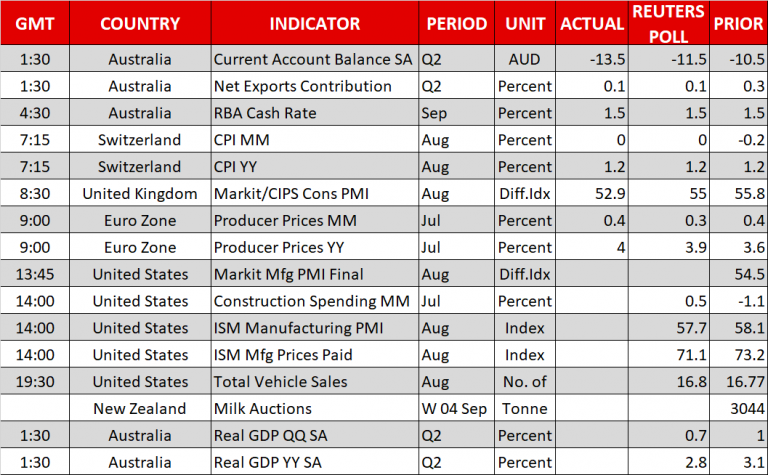
In terms of data releases, ISM and Markit manufacturing PMIs will dominate investors’ interest later on Tuesday, while in New Zealand milk auctions could add further volatility to the battered kiwi. Aussie could move as well in the wake of Australian GDP growth figures for the second quarter early on Wednesday, while trade uncertainties are expected to keep investors on their toes during the week.
At 1345 GMT, the Markit Institute will publish its final August PMI manufacturing readings for the US. That said, the manufacturing PMI delivered at 1400 GMT by the Institute of Supply Management, which has a much longer history, could prove a bigger market mover, with analysts expecting the ISM measure to decline to 58.1 in August from 57.7 in July. If true, the indicator would post its third straight month of weakness. At the same time, the Census Bureau will be publishing July’s construction spending, while later at 1930 GMT, US total vehicles sales for the month of August will be also available for review.
In New Zealand, the outcome of the bi-weekly milk auction due at a tentative time could give direction to the bruised kiwi. In neighboring Australia, however, the focus will shift from monetary policy to GDP data early on Wednesday at 0130 GMT following the Reserve Bank’s decision to stand pat on interest rates for the 25th consecutive month. Analysts believe that GDP growth in the three months to June has eased by 0.3 percentage points to 2.8% in yearly terms, which would be below the RBA’s own forecasts for 3.0% in Q2. While a miss in data could weigh on market sentiment and drive the aussie lower, the RBA will likely stick to its rate course, probably until late next year as markets are currently pricing in. Chinese Caixin Services PMI due at 0145 GMT could affect the aussie as well, given the strong trade relationship between Australia and China.
Emergency currencies will remain under the spotlight as the trade story and the political noise between the US and Turkey keep damaging EM currencies, with the Indian rupee bottoming at fresh record lows on Tuesday. Meanwhile, the African rand, the Mexican peso and the Argentine were the worst performers in the FX space today, losing more than 1%. Note that yesterday stats out of the EM showed that a number of countries faced a downfall in their manufacturing activities in August, including Turkey and South Africa which posted the largest declines. Also, South Africa entered a technical recession, after Q2 GDP figures earlier today showed a surprise contraction. As investors hold optimistic about the US economy and the Fed’s rate strategy, EM markets could continue to trade heavily during the week following a potential escalation in trade tensions between Washington and China which are set to exchange another set of import tariffs after Thursday’s deadline. The US readies to activate tariffs on $200 billion Chinese imports, whereas Beijing is said to retaliate with tariffs on $60 billion US goods.
Brexit headlines will be closely watched during the week after the British Prime Minister was criticized for her exit plans at home and in Brussels. In the meantime, news stated today that the UK has accomplished some work on the economic impact of the Chequers Brexit plan.
In terms of public appearances, Bank of England’s Governor Mark Carney will be testifying on the August inflation report and policy decision to raise rates by 25bps at 1215 GMT. MPC policymakers Andy Haldane, Silvana Tenreyro and Michael Saunders will be participating as well.
Into US session: Dollar firm as ISM manfacturing awaited
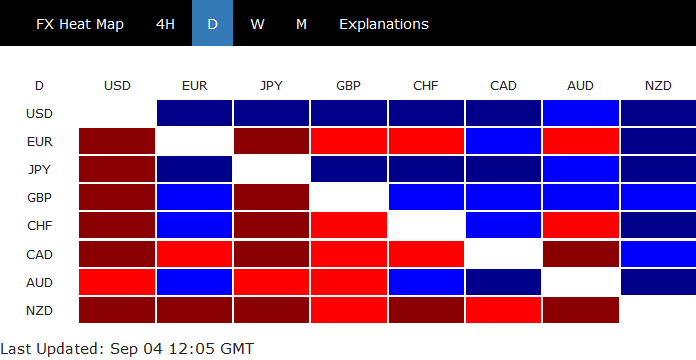
Entering into US session, Dollar is trading as the strongest one for today. A wave of buying flushed into markets in European session. But the greenback's rally somewhat stalled quickly. Yen is trading as the second strongest while Sterling is the third. On the other hand, New Zealand Dollar's selloff resumes today. Canadian Dollar and Euro are the second and third weakest ones.
In other markets, European stocks are are trading generally lower. DAX is down -1.35% while CAC is down -1.57% at the time of writing. FTSE is down -0.54%. Earlier today, Asian markets strengthened towards the end of the session as led by China. The Chinese SSE rose 1.1% to close at 2750.58. Hong Kong HSI rose 0.94% and Singapore Strait Times rose 0.10%. Nikkei closed much earlier and didn't catch the ride, closed down -0.05%.
Immediate focus in early US session as BoE Governor Mark Carney's parliamentary hearing. The most interesting question is whether he'll stay after his term expires next year. US ISM manufacturing will catch a lot of attention too.
BoE Inflation Report Hearings in Focus, Dollar Powers Higher
A sense of gloom was evident across financial markets today as worries over rising trade tensions and emerging market weakness weighed heavily on global sentiment.
Looming U.S. tariffs set to be imposed on $200 billion worth of Chinese goods as soon as Thursday brings on oppressive feelings, while uncertainty over NAFTA negotiations has compounded anxieties. Caution can be reflected across global equity markets, with Asian stocks concluding mixed while European shares struggle for direction.
Emerging market currencies witnessed further weakness on global trade tensions and Dollar strength. No prisoners were taken as the Turkish Lira, Argentina Peso, South African Rand and many other EM currencies felt the burn. The outlook for EM currencies remains gloomy, especially when considering the turmoil in Turkey and Argentina, trade war fears and prospects of higher US interest rates all present downside risks ahead.
The British Pound had a rocky start to the week after Brexit negotiator Michel Barnier warned that he “strongly” disagreed with key sections of Theresa May’s Brexit proposal. Sellers attacked the Pound further this morning on reports that UK construction activity slowed in August.
Much attention will be directed towards the UK’s inflation report hearings where Mark Carney and several MPC members are set to testify before parliament. Investors will be paying very close attention to any comments around monetary policy, economic outlook and ongoing Brexit developments. Will he stay or will he go? This remains a recurrent question on the mind of many investors. Lawmakers are likely to use this opportunity to quiz Carney about his future plans. The battered Pound could receive a knock out blow if Carney strikes a dovish tone and talks down rate hike prospects.
In the currency markets, the Dollar was King as concerns over escalating US-China trade tensions boosted safe-haven demand for the currency. Another key driver behind the Greenback’s healthy appreciation is speculation over higher US interest rates this year. Taking a peek at the technical picture, the Dollar Index punched above the 95.50 level. A solid daily close above this region could inspire a move towards 95.80.
Gold bears were back in action on Tuesday thanks to a broadly stronger US Dollar. With the mighty Dollar set to dim Gold’s shine and US rate hike expectations denting appetite for the zero-yielding metal further, the outlook remains tilted to the downside. Sustained weakness below the $1,200 psychological level could open a path towards $1,180.
DAX Slides on Trade War Jitters
The DAX index has posted sharp losses in the Tuesday session. Currently, the index is at 12,180, down 1.35% on the day. On the release front, eurozone industrial producer prices rose 0.4% in July. On Wednesday, Germany and the eurozone release Services PMI and we’ll also get a look at eurozone retail sales.
With investors again focused on global trade tensions, European equity markets have nosedived on Tuesday. The DAX has dropped to its lowest level since August 17. Foremost in investors’ mind is the simmering trade dispute between the U.S and China. So far, the two economic giants have imposed $50 billion in tariffs on each other, and President Trump has threatened further tariffs worth some $200 billion, which could be imposed as early as this week. The U.S could elect to impose the tariffs in smaller bites, such as a $50 billion tariff. Trade trouble brews elsewhere as well. Talks are continuing between the U.S and Canada, after Friday’s deadline passed with no agreement in place. The EU has engaged in a tit-for-tat tariff exchange with the United States. The dollar has climbed significantly since trade tensions began in April, at the expense of the equity markets and other major currencies. If trade tensions continue to worsen, equity markets could continue to move lower.
In December, the ECB plans to wind up its asset-purchase program, which has been in play since March 2015. ECB policymakers have taken pains to provide themselves some wiggle room, saying that the program could be extended if inflation suddenly weakens. Still, the markets expect this stimulus plan to be terminated on schedule. In August, the Bank purchased EUR $29 billion, the lowest level since this stimulus program started. Traditionally, August is a quiet month, with many sellers on holiday.
WTI Oil Futures Move Higher In Near Term Approaching 61.8% Fibonacci
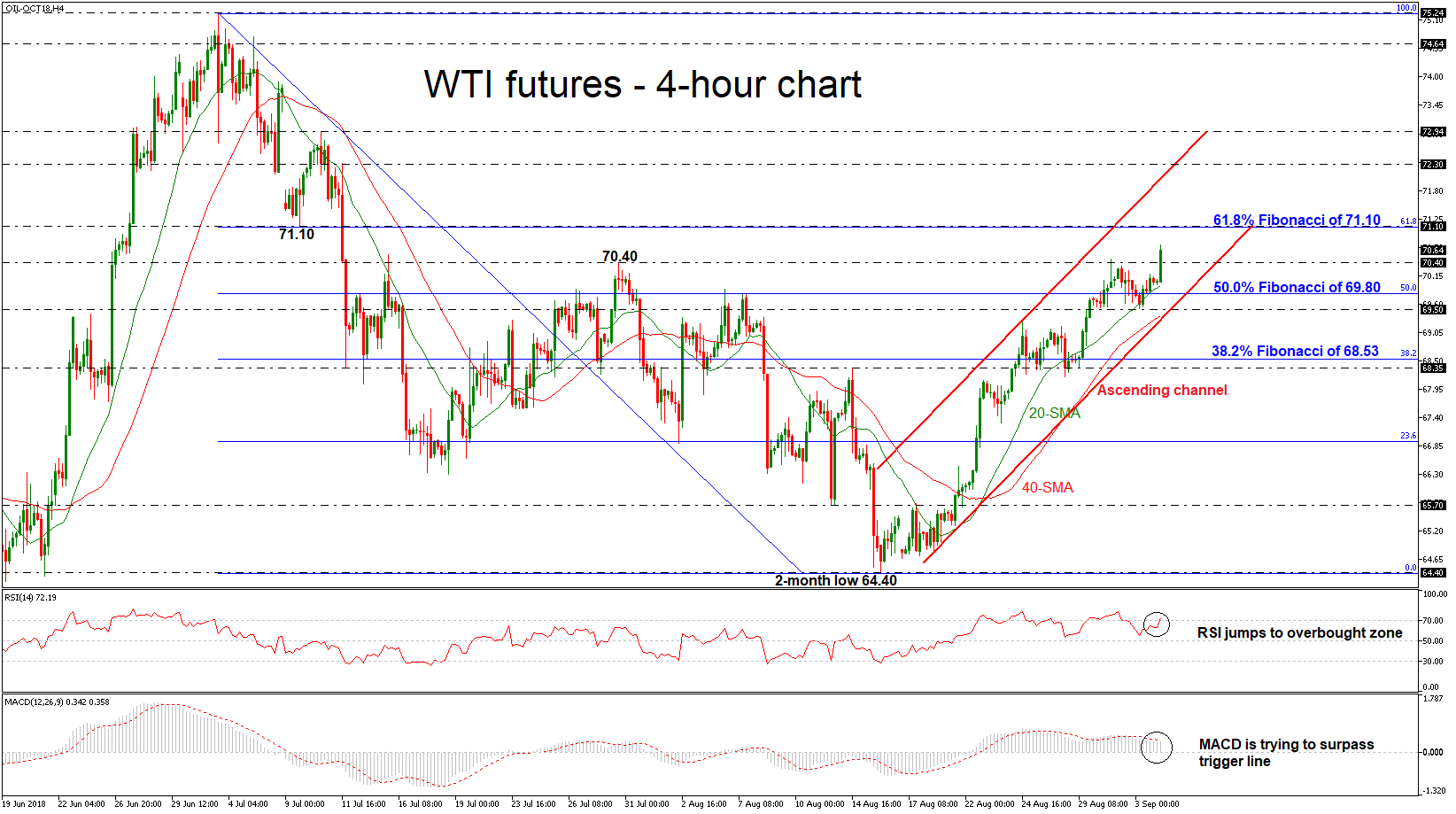
WTI crude oil futures (October delivery) have been trading within a sharp ascending channel over the past two weeks in the 4-hour chart, creating a bullish correction after the rebound on the 2-month low of 64.40.
Currently, the oil is edging higher and remains above the 20- and 40-simple moving averages (SMAs), while the technical indicators are endorsing the scenario for a bullish tendency. The RSI indicator is approaching the overbought zone and the MACD is trying to surpass the trigger line in the positive zone.
The price is moving towards the next resistance level of 61.8% Fibonacci retracement level of the downleg from 75.24 to 64.40, around 71.10. If there is a successful close above this zone the market could run until the 72.30 high, taken from the top on July 11.
On the flip side, in case of a declining pressure and a drop below 70.40, the price could challenge the 50.0% Fibonacci of 69.80 before touching 69.50. A significant leg below it could change the short-term view from bullish to bearish and the price may hit the 38.2% Fibonacci near 68.53 as the oil would penetrate the upward sloping channel.
Overall, WTI crude continues the aggressive upside momentum in the near term, while any decisive close above the channel could turn the bullish outlook even brighter.
BoC To Hold Rates Steady But Signal October Hike? Trade Developments Another Loonie Driver
The Bank of Canada will be deciding on monetary policy this week, with a rate decision being made public on Wednesday at 1400 GMT. The central bank is expected to hold rates steady and proceed with a rate increase during next month’s meeting. Beyond monetary policy, talks to forge a new North American trade pact will resume later in the week, after last week’s fruitless discussions which led the loonie to lose ground versus the US currency, more than giving back earlier gains that came on the back of growing speculation for a deal.
After steadily rising odds for a 25bps interest rate increase during this week’s meeting, a GDP miss last week, in combination with no agreement between the US and Canada on Friday on a new North American deal on trade, led those odds to fall to a mere 19% as of today. Additionally, the probabilities for a second rate rise during the remainder of the year have recorded a marked decline to stand at 14% according to Canadian OIS; at one point during the previous week they stood at roughly one-in-five.
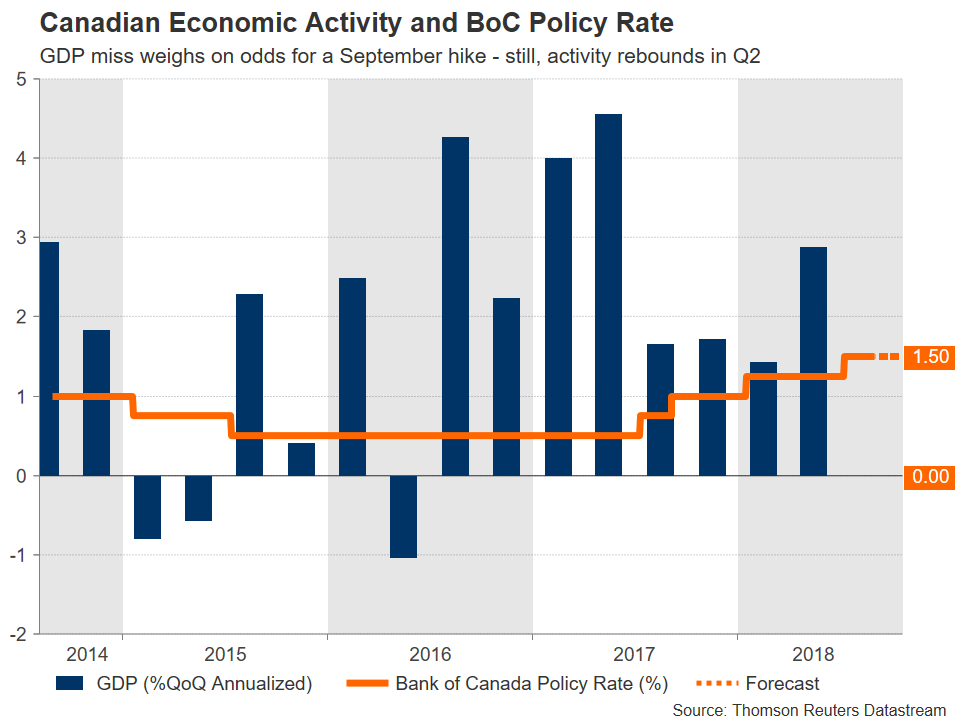
While it appears the Canadian central bank will not be delivering a rate move on Wednesday, market participants have for the most part priced in such a move during the late October meeting (78% chance). In other words, expectations are for a “hawkish hold” of rates at current levels, with the focus falling on the BoC's guidance as evidenced by the policy statement accompanying the rate decision: Will the Bank indeed firmly put on the table an October hike or not? Traders will position themselves accordingly.
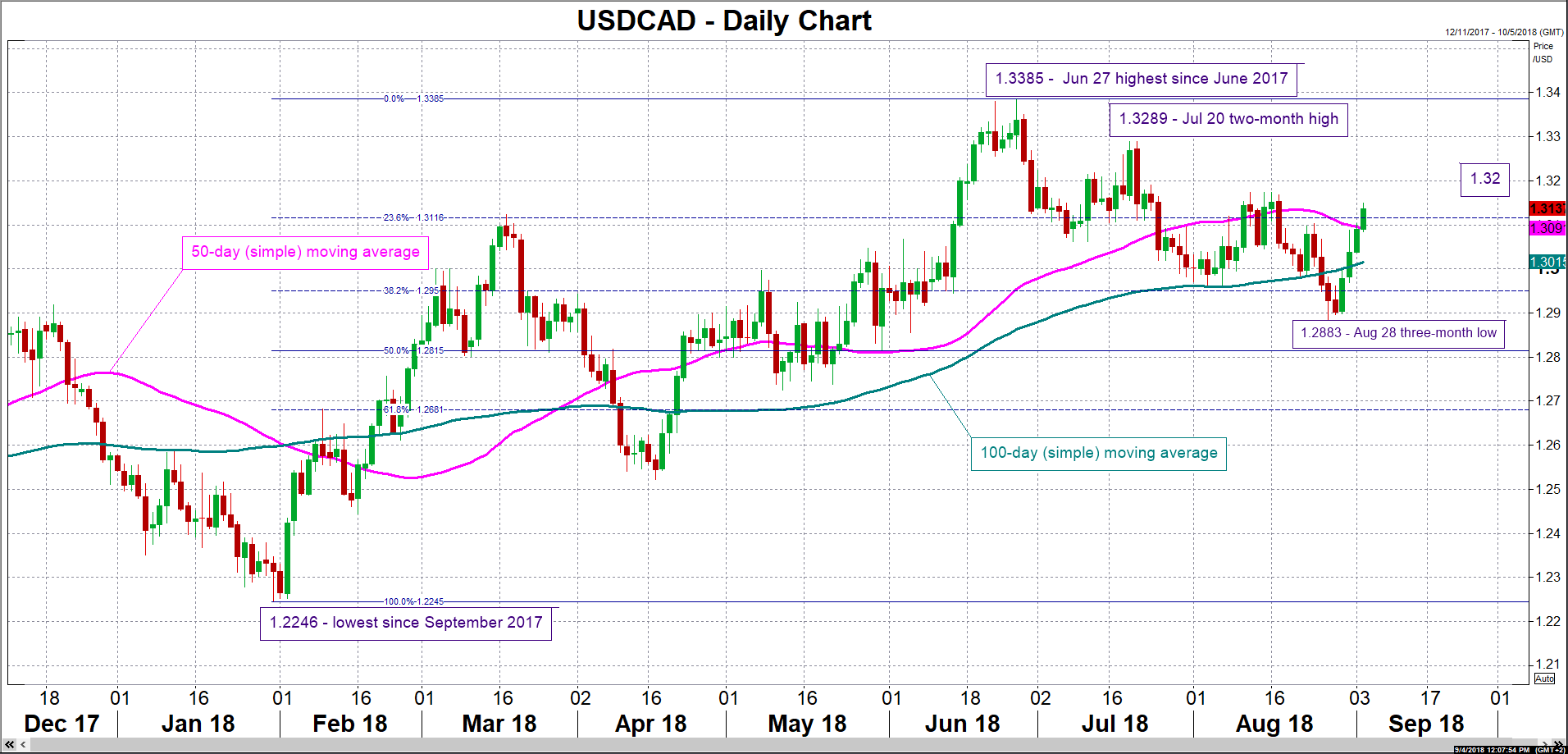
An overall hawkish message by Canada's central bank that signals an October rate rise is likely to boost the loonie, pushing USDCAD lower. A first line of support to a declining pair could occur around 1.3116, this being the 23.6% Fibonacci retracement level of the upleg from 1.2246 to 1.3385 which was violated on the way up earlier on Tuesday; notice that the current level of the 50-day moving average at 1.3091 is also part of the area around this point. Further below, the zone around the 100-day MA at 1.3015, including the 1.30 mark that may hold psychological importance, may provide support as well, with the 38.2% Fibonacci mark lying not far below at 1.2950.
Conversely, a cautious BoC that abstains from paving the way for a move next month, is expected to lead to a higher USDCAD. Resistance to advances may take place around the 1.32 round figure, with an upside break possibly meeting an additional barrier around the two-month high of 1.3289 recorded on July 20.
It bears mention that asymmetric risks are in place given that investors have already mostly priced in a quarter percentage point hike by the BoC in October. Put differently, the loonie stands to lose much more in case of any signals that put an October hike in doubt, than it stands to gain if market projections are confirmed. Furthermore, while a press conference by Stephen Poloz, the Bank's governor, will not follow after the decision later in the week, the central bank's Senior Deputy Governor Carolyn Wilkins will be making a public appearance on Thursday and she might share her views on the rate outlook on that occasion.
Elsewhere, NAFTA negotiations between the US and Canada did not bear a “tangible” outcome last week, after the US and Mexico have already agreed on their future trade relationship. Talks will resume today. In the meantime, the White House has notified Congress that it plans to sign a deal with Mexico before the end of the year and that Canada can “join if it is willing”. A breakthrough that sees Canada being part of a new trilateral agreement may be met with a relief rally in the loonie that has the capacity to also bring into scope the aforementioned key levels in the dollar/loonie pair; of course, the content of the deal is also of significance for the loonie's direction. In this respect, any comments by BoC policymakers on trade upon completion of their policy meeting can prove market moving, with the actual deliberations and updates on talks carrying even greater magnitude.
Lastly, other notable releases out of Canada as the week unfolds are July's trade figures on Wednesday and Friday's employment report for August, which will be hitting the markets at the same time as the respective labor market data out of the US (1230 GMT).
USDJPY Only Bullish Above 111.39
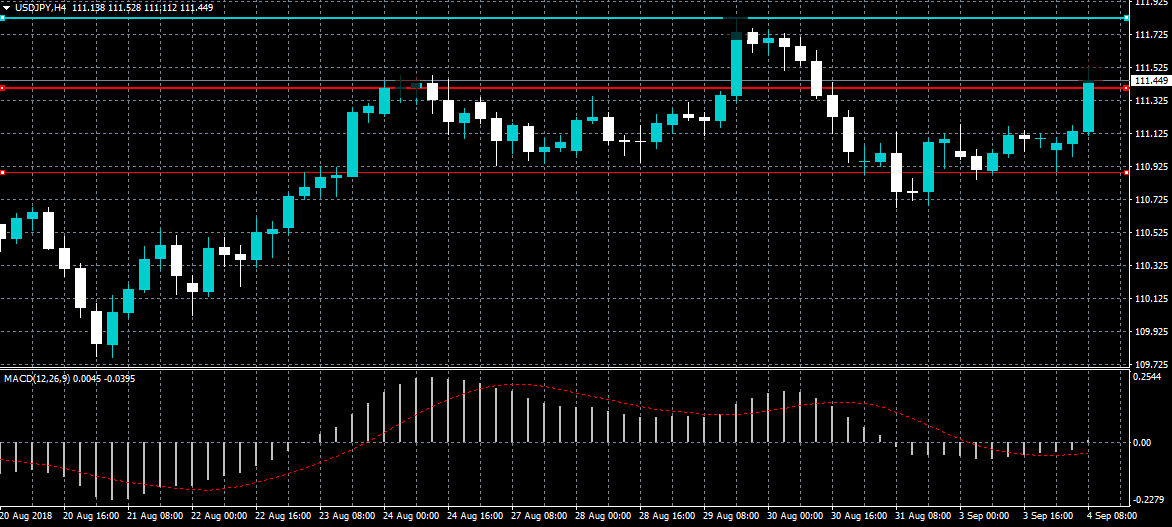
The US dollar trades sharply higher against the Japanese yen on Tuesday, as rising US bond-yields are supporting a move higher in the greenback. The USDJPY pair is intraday bullish while trading above the 111.39 level, with buyers looking increasingly likely to test the former weekly trading high, at 111.80. Caution is still warranted in the medium-term, as a bearish head and shoulders pattern is visible and the USDJPY pair is vulnerable to moves lower.
The USDJPY pair is bullish while trading above the 111.39 level, key resistance is found at the 111.80 and 112.05 levels.
If the USDJPY pair trades below 111.39 level, key support is found at the 111.10 and 110.90 levels.
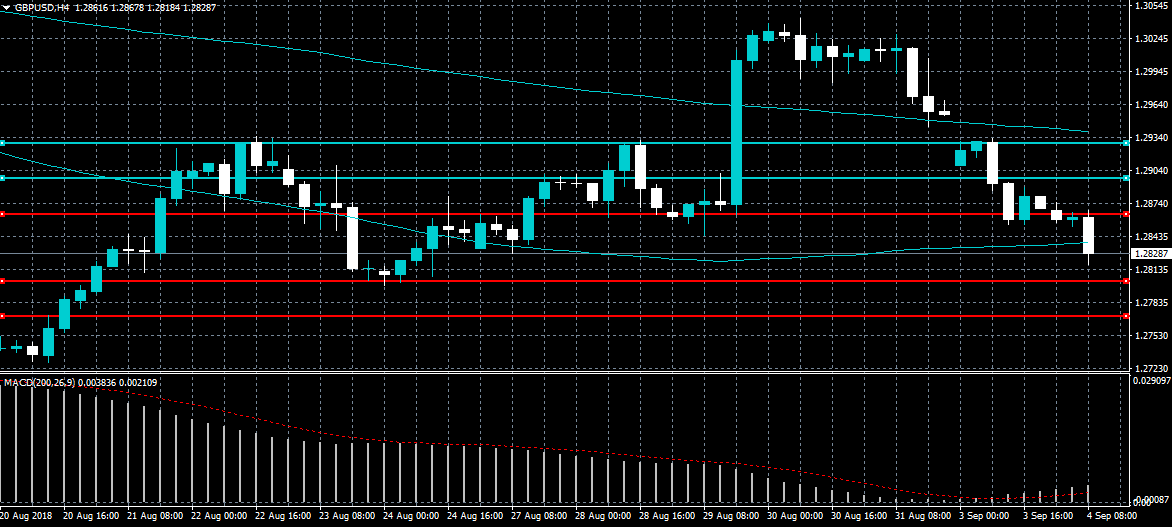
GBPUSD Weakens After Another Data Miss
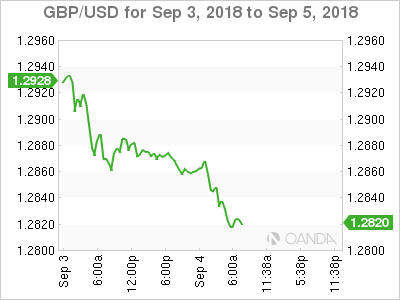
The British pound has fallen to a fresh weekly trading low against the US dollar after the UK Construction PMI came in much weaker than expected. The GBPUSD pair had been under selling pressure for much of the European trading session after falling below 1.2850 support level. Traders now look to Bank of England Governor Mark Carney’s speech at the UK Inflation Hearing.
The GBPUSD pair remains bearish while trading below the 1.2863 level, key support is now found at the 1.2800 and 1.2775 levels.
If the GBPUSD pair moves above the 1.2863 level, we may see a price correction back towards the 1.2900 resistance levels.
EM Rout Not Yet Complete
Tuesday September 4: Five things the markets are talking about
In the last week of August, it was trade and tariff wars along with EM currency capitulation that were the driving forces behind asset prices.
Thrown into the mix, G10 central banks and geopolitical risks, the month of September volatility should not disappoint.
Topping investors’ agenda this week is the Sino-U.S trade dispute and Canada Nafta talks, which are both threatening to escalate along with EM fallout as Argentina’s austerity measures shake emerging markets.
Note: Trump may announce implementation of tariffs on as much as +$200B in additional Chinese products as soon as Thursday.
Brexit discussions are again pressuring sterling (£1.2830), now that the market is pricing +25% odds that Britain could leave the E.U next March without a deal.
Currently, Euro stocks are climbing and U.S futures point to a higher open this morning after a listless session in Asia. The ‘big’ dollar again has found some momentum and EM stocks have pushed higher for the first time in a week
On the data front, the first of the month brings final PMI readings for manufacturing, services and a composite reading. Down-under, Australia releases Q2 GDP data this evening and Canada will release its important merchandise trade (Sep 5) and employment report (Sep 7). The Bank of Canada (BoC) is expected to hold rates steady tomorrow (Sep 5).
Stateside, international trade, construction spending, factory orders and Friday’s non-farm payrolls (NFP) are the key releases this week.
1. Some Asian stocks rally after early losses
On the whole, Asian shares rallied overnight, but investors remain apprehensive as the Sino-U.S trade dispute threatens to escalate this week.
In Japan, the Nikkei edged a tad lower, falling -0.1%, after trading often between positive and negative territory. The broader Topix also fell -0.1% as investors wait to take their cue this week from the states.
Down-under, Aussie shares fell overnight as reports of fresh investigations into financial institutions kept investors on edge. The S&P/ASX 200 index dropped -0.3% at the close of trade. In S. Korea, the Kospi stock index rallied +0.38%, following the turnaround in Chinese shares, despite the escalation of a Sino-U.S tariff war.
In Hong Kong, stocks ended higher as telecom shares rallied on merger speculations. The Hang Seng index ended +0.9% higher, while the China Enterprises Index closed up +0.7%.
In China, equities snapped a five-day losing streak, as investors hunted for bargains in beaten-down real estate and banking stocks. However, pending U.S tariffs capped gains. The Shanghai Composite index closed up +1.1%, while the blue-chip CSI300 index ended +1.27% higher.
In Europe, regional bourses are trading mixed and are off their intraday high open. The FTSE trades little changed after outperformance yesterday ahead of testimony from BoE members in front of the Treasury select committee.
U.S stocks are set to open in the ‘black’ (+0.1%).
Indices: Stoxx600 -0.4% at 381.2, FTSE -0.2% 7493, DAX -0.7% at 12259, CAC-40 -0.7% at 5373, IBEX-35 -0.7% at 9380, FTSE MIB +0.2% at 20436, SMI -0.3% at 8980, S&P 500 Futures +0.1%
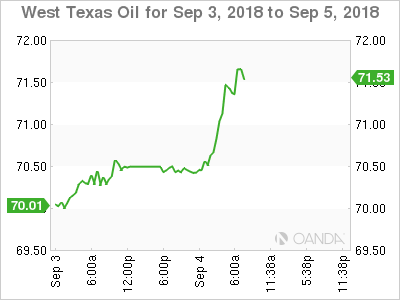
2. Oil rallies as Gulf of Mexico rigs evacuated, gold lower
Oil prices have rallied aggressively overnight on news of the immediate evacuation of two Gulf of Mexico oil platforms in preparation for a hurricane (Gordon).
U.S light crude has rallied +$1.31 a barrel from Friday’s close to +$71.11, its highest since mid-July, while Brent crude is up +$1.00 at +$79.15 a barrel.
Note: the jump is more significant since U.S crude did not trade Monday due to the Labour Day holiday.
Oil markets have tightened over the past four weeks, pushing up Brent prices by more than +10% as investors anticipate less supply from Iran as U.S sanctions on Tehran begin to hurt.
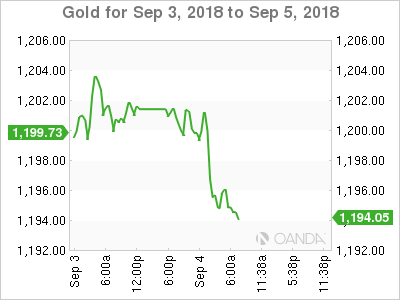
Ahead of the U.S open, gold prices are under pressure as the ‘big’ dollar hits a one week-high on the back of intensifying global trade tensions and economic worries in emerging markets. Spot gold is down -0.3% at +$1,196.90 an ounce, while U.S gold futures have dropped -0.4% at +$1,202.10 an ounce.
Note: The yellow metal is down -8% this year amid rising U.S interest rates, trade disputes and the Turkish currency crisis – the U.S dollar remains the safe haven currency of choice.
3. RBA to eventually raise interest rates
Reserve Bank of Australia (RBA) left their cash rate target unchanged at +1.50% as expected overnight and the accompanying statement was little changed from the last go-around. Policy makers reiterated their stance that low rates were supporting the economy and inflation, and that progress on unemployment/inflation is expected to be gradual. They saw GDP to average slightly higher than +3% in both 2019 and 2020.
In Europe, tame Swiss inflation data support the view that the Swiss National Bank (SNB) will not be raising rates before the ECB does (currently expected in September 2019). Data this morning showed that annual Swiss inflation was 1.2% last month, while core inflation was just +0.5%.
Elsewhere, the yield on 10-year Treasuries has gained +2 bps to +2.88%, the biggest advance in a week. In Germany, the 10-year Bund yield has climbed +2 bps to +0.35%. In the U.K, the 10-year Gilt yield has declined -2 bps to +1.404%, the lowest in more than a week.
4. EM rout not yet complete
The USD continues to find safe-haven support related to concerns about trade tensions as EM currency pairs suffer.
Yesterday, Argentine President Macri announced new taxes on exports and steep cuts to government spending in what he termed “emergency” measures to balance next year’s budget. The Argentine peso closed -3.14% weaker and is expected to face further pressure this week.
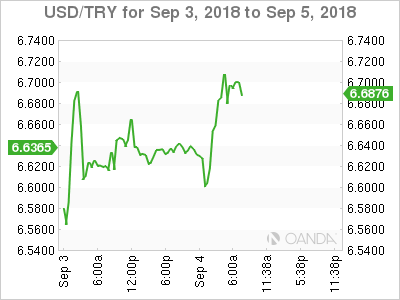
In Turkey, the Central Bank of the Republic of Turkey (CBRT) signalled yesterday that it would take steps to combat “significant risks” to price stability and also hinted of interest rate hikes. Investors have lost fait in the central banks independent authority – the TRY is trading down another -1% at $6.6920.
USD/INR has hit a fresh record high as the pair approaches $71.54 level. It’s expected that state banks have been selling U.S dollars on behalf of the Reserve Bank of India (RBI).
In South Africa, the country has officially entered a recession after this morning’s GDP data. Q2 GDP annualized q/q: -0.7% vs. +0.6%E; y/y: +0.4% vs. +1.0%E (moves into recession for first time since 2009) – USD/ZAR is up +2.25% at $15.2520.
In Europe, GBP/USD is lower for the fifth consecutive session, probing the lower end of the £1.28 handle as doubts continue to linger on Brexit negotiations and weaker UK PMI data (see below). Focus for the pound now shifts to the BoE Treasury-select testimony this morning where Governor Carney (08:15 am EDT) would likely be questioned on whether he plans to stay on beyond his June 2019 term end-date.
5. UK PMI data continues to miss expectations, but holds onto growth territory
Data this morning shows that the U.K’s latest purchasing managers’ index on construction activity fell to 52.9 in August, well below July’s 55.8 and below market expectations for a smaller fall to 54.9. Nevertheless, the index does remain in expansion territory.
Digging deeper, Markit reported a weak performance in housing activity, while civil engineering work decreased for the first-time in five-months. New business growth slowed, with Markit citing reports that Brexit-related uncertainty “continued to hold back investment spending.”