

Sample Category Title
Dollar rally accelerates on super strong ISM manufacturing, highest since 2004
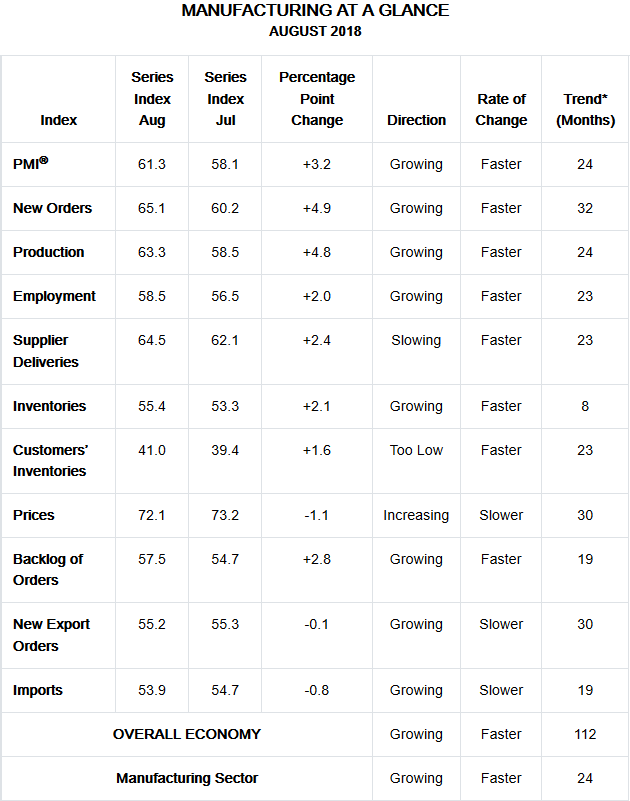
Dollar rally accelerates on much stronger than expected manufacturing data. ISM manufacturing index rose to 61.3 in August, up from 58.1 and beat expectation of 57.8. That's also the highest level since May 2004. Prices paid index dropped to 72.1, down from 73.2 and missed expectation of 74. Employment component improved 2 points from 56.5 to 58.5.
ISM noted in the released that
- Comments from the panel reflect continued expanding business strength.
- Demand remains strong, with the New Orders Index at 60 percent or above for the 16th straight month, and the Customers' Inventories Index remaining low.
- The Backlog of Orders Index continued to expand, at higher levels compared to the previous month.
- Consumption improved, with production and employment continuing to expand, at higher levels compared to July, despite shortages in labor and materials.
- Inputs (expressed as supplier deliveries, inventories and imports) expanded strongly due to continuing supply chain inefficiencies, positive increases in inventory levels and a slight easing of imports. Lead-time extensions, steel and aluminum disruptions, supplier labor issues, and transportation difficulties continue, but at more manageable levels.
- Export orders expanded at stable levels.
- Prices pressure continues, but the index softened for the third straight month and remains above 70.
- Demand is still robust, but the nation's employment resources and supply chains continue to struggle.
- Respondents are again overwhelmingly concerned about tariff-related activity, including how reciprocal tariffs will impact company revenue and current manufacturing locations. Panelists are actively evaluating how to respond to these business changes, given the uncertainty.
Dollar Surges as Ex-US Markets Back in Risk Aversion, Canadian Dollar Tumbles Sharply
Dollar strengthens broadly today, in particular against commodity currencies, as global ex-US markets are back in risk averse mode. Trade tensions and emerging market problems are staying as the two main themes that weigh on investors' sentiments. The greenback is followed by Yen and Sterling as the next strongest. Nonetheless, the Pound showed little reaction despite BoE Carney's indication that he could stay longer to help Brexit transition. On the other hand, New Zealand Dollar is trading as the weakest one, followed by Canadian Dollar. NAFTA, or US-Canada trade negotiation will restart this week but there is little hope of any progress. Quick udpate: Dollar rally accelerates after ISM surges sharply to 61.3, highest since May 2004.
In other markets, European stocks are trading generally lower at the time of writing. CAC leads the way down by -1.61%, DAX down -1.36% and FTSE down -0.72%. Earlier today, Asian markets strengthened towards the end of the session as led by China. The Chinese SSE rose 1.1% to close at 2750.58. Hong Kong HSI rose 0.94% and Singapore Strait Times rose 0.10%. Nikkei closed much earlier and didn't catch the ride, closed down -0.05%. Gold dips to as low as 1191.35 as consolidation from 1214.30 extends.
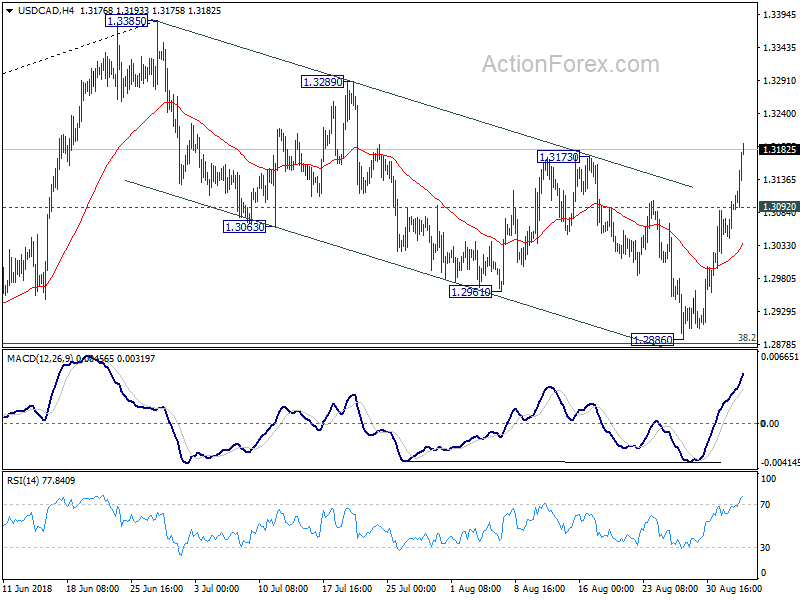
Technically, USD/CAD's strong rise and break of 1.3173 resistance indicates that corrective fall from 1.3385 has already completed at 1.2886 already. More importantly, it reaffirms that medium term rise from 2017 low at 1.2061 is still on course for another high above 1.3385. Now, focus will be on 1.1529 in support in EUR/USD and 0.9775 in resistance in USD/CHF to confirm underlying Dollar strength.
BoE Carney indicates he's willing to stay beyond June 2019
At the Inflation Report at the UK Parliament, BoE Governor Mark Carney indicated that he's willing to stay longer at the central bank. He said it's a "critical period" and it is "important that everyone does everything they can to help with the transition of exiting the European Union".
He added that "even though I have already agreed to extend my time to support a smooth Brexit, I am willing to do whatever else I can in order to promote both a smooth Brexit and an effective transition at the Bank of England.".
Carney also indicated that he has already discussed this issue with the Chancellor, Philip Hammond, and he expects an announcement to be made in due course. It's generally taken as a hint that Carney will stay beyond June 2019, when the current term expires.
On Brexit, Carney said it's unlikely for exiting EU without a deal. And, for now the UK economy is operating as if there will be a deal, with less than 20% of business putting in contingency plans.
Regarding impact of "no-deal" Brexit, Chief Economist Andy Haldane says it would be a "material rise in the cost of things in the shops", particularly imported products. And that would be due to a weaker pound and higher tariffs. Haldane added that the impact could last for a few years, as history shows.
UK DExEU Rycroft: No-deal Brexit plans in place, economic analysis of Chequers plan ongoing
In UK, Philip Rycroft, Permanent Secretary at the Department for Exiting the European Union (DExEU) told the parliament that the plans for no-deal Brexit are "in place". And, "they are at a level of detail which satisfies the team at DEXEU … we are constantly monitoring those plans to make sure they are kept up to date." Also Rycroft said there were studies on the economic impact of Prime Minister Theresa May's Chequers plan and "the work is ongoing".
Reuters poll showed chance disorder Brexit at 25%
According to a Reuters poll conducted between August 29 and September 3, chance of disorderly Brexit stood at 25%, unchanged from a month ago. Opinions were divided as nine of the 34 contributors raised the chance, but four lowered the odds. Highest prediction was 60% chance.
Nevertheless, chance of a recession in the year post-Brexit was seen at 15%, down from July's 20%. Chance for recessions within two year of Brexit was at 25%.
On BoE policies, the poll suggested that the central bank would have a 25bps rate hike soon after March 2019 Brexit date. Then, another 25bps would be added in 2020.
UK construction PMI dropped to 52.9, optimism constrained by external factors
UK construction PMI dropped notably to 52.9 in August, down from 55.8 and missed expectation of 54.9. Tim Moore Associate Director at IHS Markit said that "the construction sector slipped back into a slower growth phase in August". But there are "some encouraging takeaways from the latest survey, especially the resilient degree of new business growth in August and a strong upturn in staff recruitment." However, "the degree of optimism reported in August remained constrained by external factors, including domestic political uncertainty, stretched supply chains and shortages of suitably skilled labour."
Also released from Europe, UK BRC sales monitor rose 0.2% yoy in August. Swiss CPI rose 0.01% mom, 1.2% yoy in August, versus expectation of 0.0% mom, 1.0% yoy. Eurozone PPI rose 0.4% mom, 4.0% yoy in July versus expectation of 0.1% mom, 4.3% yoy.
ECB Vasiliauskas pushes banking union, but Knot said risk reduction first
ECB Governing Council member Klaas Knot urged that risk must be reduced before the Eurozone banking union is shared more widely among member states. The measures under the union include bank deposit insurance scheme and streamlining liquidity provision for banks under resolution. Knot argued that "these elements all imply more public risk-sharing in (the European Monetary Union) as liability for bank failures in other countries is shared at the European level." And he emphasized that " risk-sharing should be preceded by sufficient risk-reduction."
Separately, another Governing Council member Vitas Vasiliauskas reiterated the call for an "EU-wide banking union". And he said that "allow for a centralized supervisory approach for all of the EU's largest systemically important banks, regardless of host-country membership in the monetary union." Also, he added that "we need to do a better job at convincing decision-makers in non-euro area countries to enter into the "close cooperation" regime (with the ECB)."
RBA Lowe talked international uncertainties at board dinner remarks
RBA Governor Philip Lowe warned of a number of international uncertainties at in his remarks at the RBA board dinner today. He said escalation in trade disputes would "materially affect trade flows and investment plans around the world.". And he emphasized that "as a country that has benefited greatly from an open rules-based international system, Australia has a strong interest in this not happening."
Another risk is "material lift in inflation" in the US. Past experience of "large fiscal stimulus" when economy is at full employment with fast growth suggests that could "lead to inflation increasing significantly."
Also, RBA is monitoring carefully the financial and economic problems in a number of emerging market economies with structural or institutional weaknesses, including Turkey, Brazil and Argentina.
RBA stands pat as expected, delivered no surprise
Today, RBA left the cash rate unchanged at 1.5% for a 25th consecutive month. Similar to previous meetings, policymakers were upbeat over the growth and the employment outlook, while acknowledging soft wage growth and inflation. In short, the central bank is optimistic over the business conditions and higher levels of investment in public infrastructure. It acknowledged the strong growth in employment, projecting the unemployment rate to drop to around 5% over the next couple of years.
The members, however, judged that low inflation and soft wage growth worth ongoing monitor before another rate hike. The policy statement was almost identical to the previous one, with only some changes seen in the assessments of the job market and exchange rate.
More in RBA Left Cash Rate Unchanged for 25 Months in a Row
Also fro Australia, current account deficit widened to AUD -13.5B in Q2.
USD/CAD Mid-Day Outlook
Daily Pivots: (S1) 1.3061; (P) 1.3082; (R1) 1.3119; More...
USD/CAD surges to as high as 1.3193 today. The break of 1.3173 resistance confirm that corrective pull back from 1.3385 has completed at 1.2886, just ahead of 1.2879 key fibonacci level . Intraday bias stays on the upside for 1.3385 first. Break will resume the whole up trend form 1.2061 and target next key resistance level at 1.3685. On the downside, below 1.3092 minor support will turn intraday bias neutral and bring consolidation first, before staging another rally.
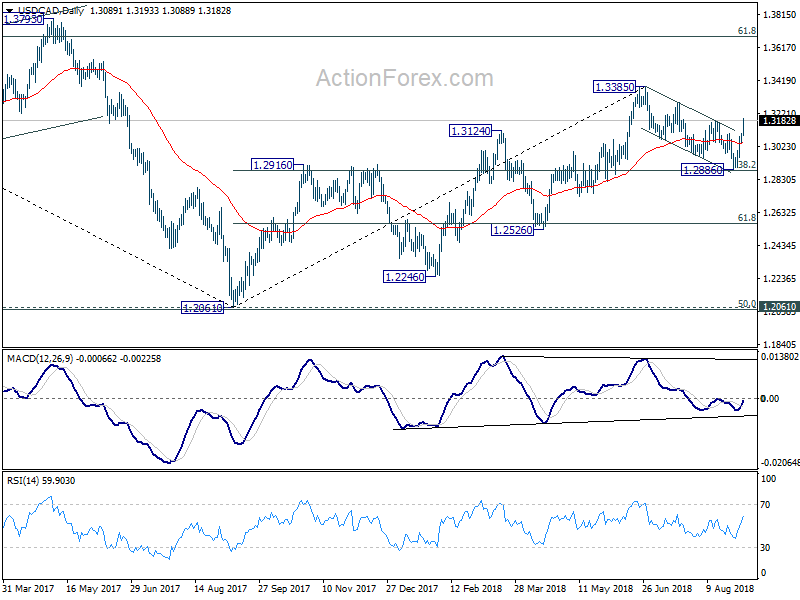
In the bigger picture, strong rebound ahead of 38.2% retracement of 1.2061 to 1.3385 at 1.2879 key fibonacci level retains medium term bullishness. That is, rise from 2017 low at 1.2061 is still in progress. Break of 1.3384 should target 61.8% retracement of 1.4689 (2015 high) to 1.2061 (2017 low) at 1.3685. On the downside, as long as 1.2886 support holds, outlook will now remain bullish.
Economic Indicators Update
| GMT | Ccy | Events | Actual | Forecast | Previous | Revised |
|---|---|---|---|---|---|---|
| 23:01 | GBP | BRC Sales Monitor Y/Y Aug | 0.20% | 1.20% | 0.50% | |
| 23:50 | JPY | Monetary Base Y/Y Aug | 6.90% | 6.30% | 7.00% | |
| 01:30 | AUD | Current Account Balance (AUD) Q2 | -13.5B | -11.1B | -10.5B | -11.7B |
| 04:30 | AUD | RBA Rate Decision | 1.50% | 1.50% | 1.50% | |
| 07:15 | CHF | CPI M/M Aug | 0.00% | 0.00% | -0.20% | |
| 07:15 | CHF | CPI Y/Y Aug | 1.20% | 1.00% | 1.20% | |
| 08:30 | GBP | Construction PMI Aug | 52.9 | 54.9 | 55.8 | |
| 09:00 | EUR | Eurozone PPI M/M Jul | 0.40% | 0.10% | 0.40% | |
| 09:00 | EUR | Eurozone PPI Y/Y Jul | 4.00% | 4.30% | 3.60% | |
| 13:30 | CAD | Manufacturing PMI Aug | 56.8 | 56.9 | ||
| 13:45 | USD | Manufacturing PMI Aug F | 54.7 | 54.5 | 54.5 | |
| 14:00 | USD | Construction Spending M/M Jul | 0.10% | 0.50% | -1.10% | -0.80% |
| 14:00 | USD | ISM Manufacturing Aug | 61.3 | 57.8 | 58.1 | |
| 14:00 | USD | ISM Prices Paid Aug | 72.1 | 74 | 73.2 | |
| 14:00 | USD | ISM Employment Aug | 58.5 | 56.5 |
USD/CHF Mid-Day Outlook
Daily Pivots: (S1) 0.9681; (P) 0.9695; (R1) 0.9706; More.....
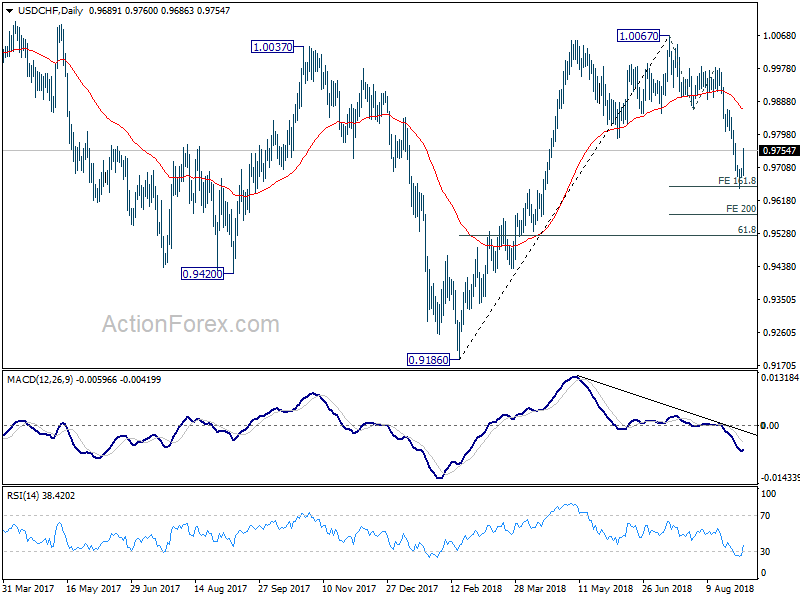
USD/CHF's rebound from 0.9651 extends higher today but it's staying below 0.9775 minor resistance. Intraday bias remains neutral and deeper decline is still in favor. On the downside, break of 0.9651 will target 200% projection of 1.0067 to 0.9866 from 0.9981 at 0.8579 next. However, Firm break of 0.9775 will be an early sign of near term reversal. That is, fall from 1.0067 could have completed. In this case, further rally would be seen back to 0.9866 support turned resistance for confirmation.
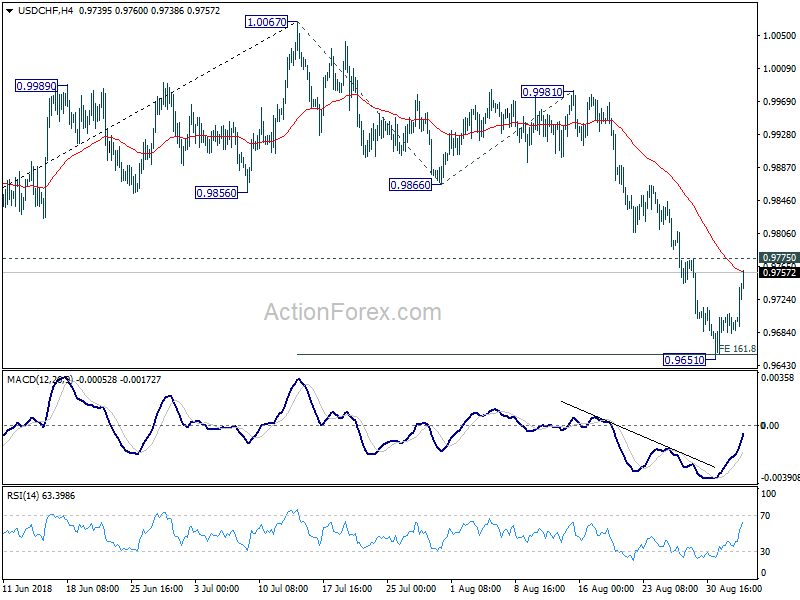
In the bigger picture, current development suggests that rise from 0.9186 low has completed at 1.0067, after failing to sustain above 1.0037 resistance. Fall from 1.0067 could extend to 61.8% retracement of 0.9816 to 1.0067 at 0.9523 and below. But for now, we don't expect a break of 0.9186 low. On the upside, firm break of 0.9866 support turned resistance will suggests that fall from 1.0067 has completed and rise from 0.9186 is resuming.
USD/JPY Mid-Day Outlook
Daily Pivots: (S1) 110.90; (P) 111.04; (R1) 111.25; More...
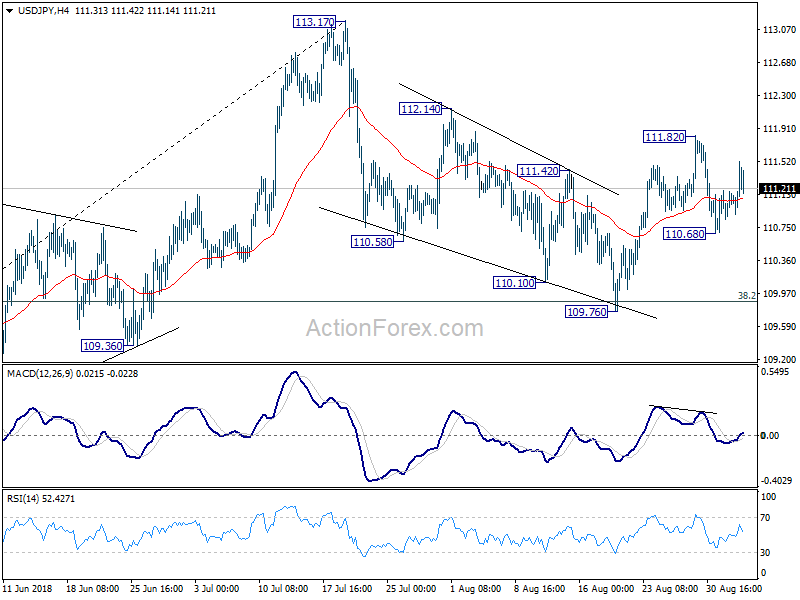
USD/JPY is staying in familiar range below 111.82 temporary top and intraday bias remains neutral. Below 110.68 will bring another fall. But downside should be contained by 38.2% retracement of 104.62 to 113.17 at 109.90 to bring rebound. Price actions from 113.17 are viewed as a corrective pattern. Break of 111.82 will reaffirm the case that such correction has completed at 109.76. And in that case, further rise should be seen back to retest 113.17 high.
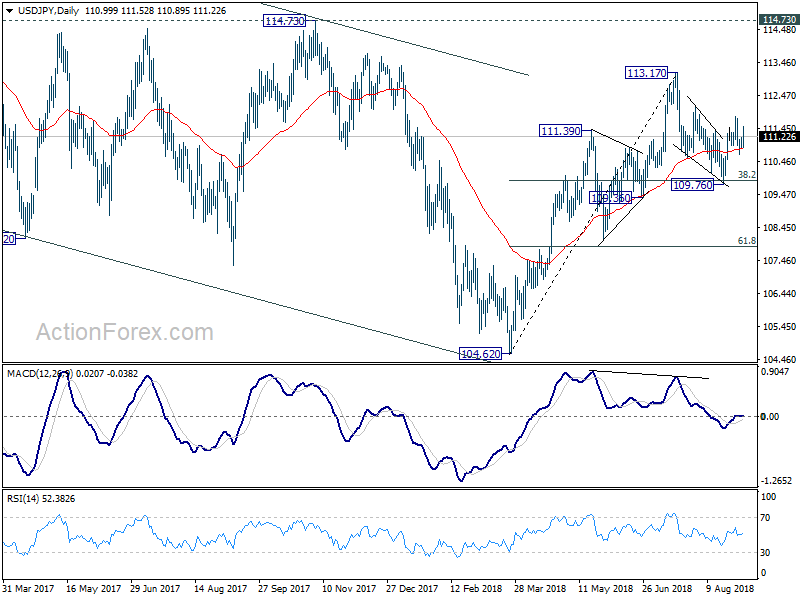
In the bigger picture, corrective fall from 118.65 (2016 high) should have completed with three waves down to 104.62. Decisive break of 114.73 resistance will likely resume whole rally from 98.97 (2016 low) to 100% projection of 98.97 to 118.65 from 104.62 at 124.30, which is reasonably close to 125.85 (2015 high). This will stay as the preferred case as long as 109.36 support holds. However, decisive break of 109.36 will mix up the outlook again. And deeper fall should be seen back to 61.8% retracement of 104.62 to 113.17 at 107.88 and below.
USDCAD Outlook: Rallies Through Series of Significant Barriers
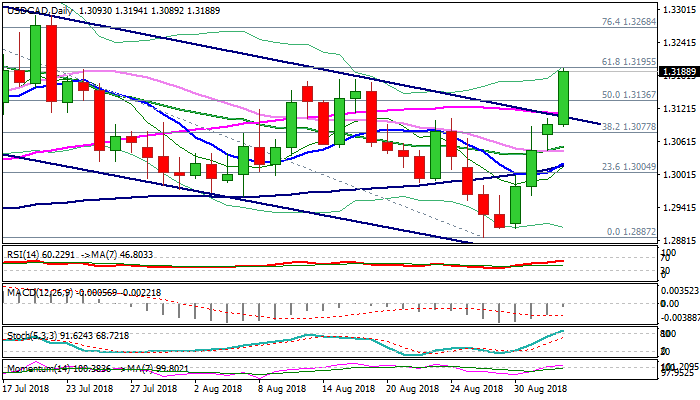
The pair accelerated higher on Tuesday, extending strong recovery rally from 1.2887 (28 Aug low) into fourth straight day.
Fresh bulls, boosted by rising fears about escalation of US/China trade tensions, broke above significant barriers at 1.3107/12 (bear-channel upper boundary/55SMA); 1.3136 (50% of 1.3386/1.2887) and 1.3166/74 (top of daily cloud/former high of 16 Aug), generating strong bullish signal.
The rally is on track for the biggest one-day gains since 19 July and pressures pivotal barrier at 1.3195 (Fibo 61.8% of 1.3386/1.2887 descend), break of which would mark another bullish signal.
However, bulls may show hesitation here as slow stochastic is overbought and momentum turned to sideways mode.
Focus turns towards release of US Manufacturing PMI as forecast signals slowing in August, with outcome at/below consensus to likely slow down dollar’s bulls. Corrective dips could be seen as positioning for fresh upside, as sentiment remains positive, with broken 55SMA expected to ideally contain.
Res: 1.3195; 1.3227; 1.3268; 1.3289
Sup: 1.3136; 1.3112; 1.3077; 1.3051
USD/CAD Mid-Day Outlook
Daily Pivots: (S1) 1.3061; (P) 1.3082; (R1) 1.3119; More...
USD/CAD surges to as high as 1.3193 today. The break of 1.3173 resistance confirm that corrective pull back from 1.3385 has completed at 1.2886, just ahead of 1.2879 key fibonacci level . Intraday bias stays on the upside for 1.3385 first. Break will resume the whole up trend form 1.2061 and target next key resistance level at 1.3685. On the downside, below 1.3092 minor support will turn intraday bias neutral and bring consolidation first, before staging another rally.
In the bigger picture, strong rebound ahead of 38.2% retracement of 1.2061 to 1.3385 at 1.2879 key fibonacci level retains medium term bullishness. That is, rise from 2017 low at 1.2061 is still in progress. Break of 1.3384 should target 61.8% retracement of 1.4689 (2015 high) to 1.2061 (2017 low) at 1.3685. On the downside, as long as 1.2886 support holds, outlook will now remain bullish.
Canadian Dollar Falls to 6-Week Low on NAFTA Concerns
The Canadian dollar continues to lose ground this week. In the North American session, USD/CAD is trading at 1.3167, up 0.56% on the day. On the release front, manufacturing data will be in focus on both sides of the border. Canada will release Manufacturing PMI, and the key release in the U.S is ISM Manufacturing PMI. On Wednesday, Canada releases Trade Balance and the Bank of Canada is expected to maintain the benchmark rate at 1.50%.
The markets may have been closed for Labor Day, but the Canadian dollar still lost ground, as global tensions continue to spook investors. The simmering trade dispute between the U.S and China shows no signs of easing and resident Trump has threatened further tariffs worth some $200 billion, which could be imposed as early as this Thursday. So far, the two economic giants have imposed $50 billion in tariffs on each other. Canada and the U.S have already exchanged tariffs on each other’s products, and Canadian and U.S negotiators are scrambling to reach an agreement after a Friday deadline was missed. The U.S and Mexico reached an agreement in August, leaving Canada out in the cold, much to the annoyance of Canadian policymakers. In order to reach a new trade agreement with the U.S, Canada will likely have to make some concessions, such as reducing hefty tariffs which protect the Canadian dairy industry. The uncertainty over NAFTA is weighing on the Canadian dollar, which has lost 1.0% so far this week.
BoE Carney indicates he’s willing to stay beyond June 2019
At the Inflation Report at the UK Parliament, BoE Governor Mark Carney indicated that he's willing to stay longer at the central bank. He said it's a "critical period" and it is "important that everyone does everything they can to help with the transition of exiting the European Union".
He added that "even though I have already agreed to extend my time to support a smooth Brexit, I am willing to do whatever else I can in order to promote both a smooth Brexit and an effective transition at the Bank of England.".
Carney also indicated that he has already discussed this issue with the Chancellor, Philip Hammond, and he expects an announcement to be made in due course. It's generally taken as a hint that Carney will stay beyond June 2019, when the current term expires.
On Brexit, Carney said it's unlikely for exiting EU without a deal. And, for now the UK economy is operating as if there will be a deal, with less than 20% of business putting in contingency plans.
Regarding impact of "no-deal" Brexit, Chief Economist Andy Haldane says it would be a "material rise in the cost of things in the shops", particularly imported products. And that would be due to a weaker pound and higher tariffs. Haldane added that the impact could last for a few years, as history shows.
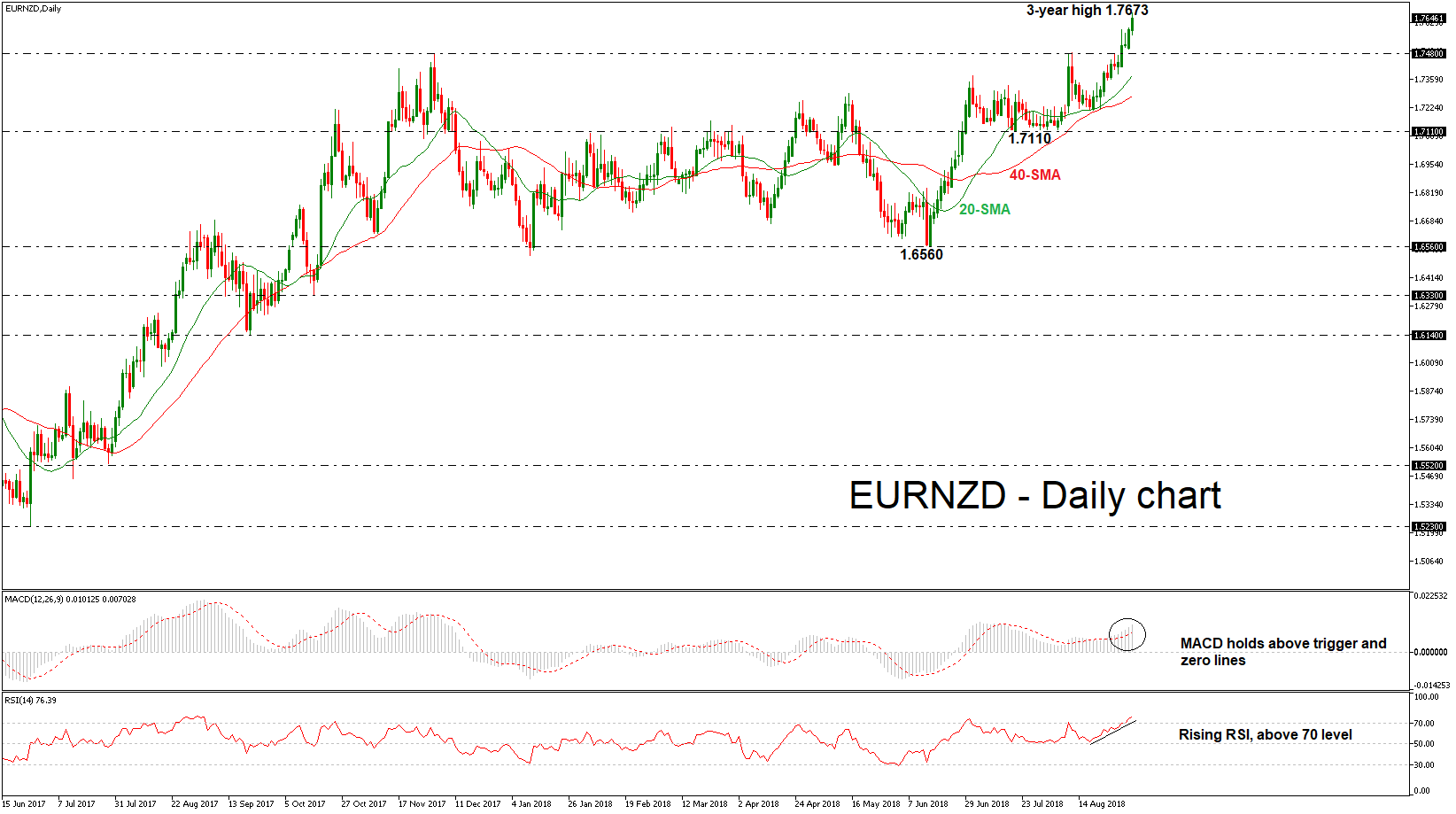
EURNZD challenges 3-year high; looks overbought
EURNZD has been outperforming over the last couple weeks, after the rebound on 20- and 40-simple moving averages (SMAs) in the daily timeframe. The price reached a fresh almost three-year high of 1.7673, during today’s trading session with strong momentum. The MACD oscillator is strengthening its positive momentum as it lies above its red-trigger and the zero lines. Moreover, the RSI indicator entered the overbought zone after the bounce off the threshold of 50.
If price action remains above the 1.7480 support barrier, there is scope to test the next psychological resistance of 1.8000, where it topped in September 2015.
On the flip side, if the pair fails to extend gains and changes direction, it would shift the focus to the downside. The next support to watch is the 20-and then the 40-SMAs at 1.7374 and 1.7277 respectively. Further bearish movement could push the pair until the 1.7110 support.
Overall, both the short- and medium-term outlooks are currently looking bullish, though caution is warranted in the near-term as there are signs of an overbought market, especially in the technical indicators.
RBA Lowe talked international uncertainties at board dinner remarks
RBA Governor Philip Lowe warned of a number of international uncertainties at in his remarks at the RBA board dinner today.
He said escalation in trade disputes would "materially affect trade flows and investment plans around the world.". And he emphasized that "as a country that has benefited greatly from an open rules-based international system, Australia has a strong interest in this not happening."
Another risk is "material lift in inflation" in the US. Past experience of "large fiscal stimulus" when economy is at full employment with fast growth suggests that could "lead to inflation increasing significantly."
Also, RBA is monitoring carefully the financial and economic problems in a number of emerging market economies with structural or institutional weaknesses, including Turkey, Brazil and Argentina.