

Sample Category Title
Market Morning Briefing: Pound Is Trading Below Resistance Near 1.287
STOCKS
Stocks look bearish globally except Dax which could bounce from support below current levels. Nifty and Nikkei has some more room on the downside. Shanghai could trade sideways this week with some bearish possibilities.
Dow (25952.48, -0.048%) could see a short dip towards 25500 before again bouncing back to higher levels. Overall the long term trend looks bullish. A bounce from 25500 would open up chances of attempting levels near 26250-26500 in the medium to long term.
Dax (12210.21, -1.10%) came off sharply to test support near 12200 as expected. A bounce from here is possible in the rest of week targeting 12400-12600 again. In case Dax breaks below 12200, it could be vulnerable to a sharp fall towards 12000-11800 levels in the next 1-2 weeks.
Nikkei (22627.10, -0.31%) has been falling and is on its way to test support near 22400-22300 levels which could be the downside limit for the near term. Thereafter, the index could rise back towards current levels again within the next 1-2 weeks.
Shanghai (2743.17, -0.27%) looks weak in the near to medium term. While below 2800-2750 levels, there could be chances of a fall towards 2700-2650. Only on a break above 2800, we may negate the downside possibility.
Nifty (11520.30, -0.54%) has chances of testing 11400-11300 levels on the downside. A break below 11500 would keep it bearish to stable for the medium term.
COMMODITIES
Brent (78.03) tested 79.72 yesterday before coming off sharply to close at 78.17. The current resistance is expected to hold dragging the prices to lower levels of 76 in the near term. Downside view may be negated only on a sustained rise above 78.50-79.00 in the near term. If Brent falls from here, it could pull down Nymex WTI (69.48) also with itself and bring it towards 68. However, looking at the WTI charts, there is enough room on the upside if it breaks above 70-71.
Gold (1199.70) is trading below 1200 and could possibly come off to re-test 1190 also as mentioned in our earlier editions. Broad sideways trade in the 1230-1190 region could hold for now.
Copper (2.6025) has come off in line with our expectation and while below 2.55, we may well consider a possible test of 2.50-2.45 on the downside as seen on the weekly charts.
FOREX
Keep a watch on Dollar Yuan (6.8373) : a break above 6.847 could be crucial - bringing in more weakness for Indian Rupee. We prefer some correction from 71.70-80 on USDINR. A break below 1.155 necessary for bearishness in the Euro.
Euro (1.1597): As per expectation, Euro did break below support near 1.16 yesterday, but then rose again from lower support near 1.155. It now has resistance near 1.165 which should again push it down towards 1.155. On weekly candles, it looks particularly bearish in the weeks ahead. A test of 1.15 might happen sometime next week.
Dollar Index (95.33) could not move above the 95.5-95.7 resistance level and could now attempt another test of support near 95 on daily candles before moving back up. On weekly candles, earlier support line is providing resistance near 95.5-96.0 which needs to break for bullishness in the weeks ahead.
Dollar Yen (111.52): Instead of our expected dip to 110.5, Dollar Yen has moved up to test resistance near 111.5 on daily candles - a breaks above this resistance could lead to a test of 112 in this week and then, a test of 113 in the next 1-2 weeks.
Euro Yen (129.34) looks like it could attempt another test of resistance on daily line chart near 130 before moving down towards 127 in the next 1-2 weeks. An upmove towards 1.165 for Euro and towards 112 for Dollar Yen could make Euro Yen test 130.0-130.5.
Pound (1.2861): Pound is trading below resistance near 1.287 on daily candles. It also has some interim support near 1.28, which it needs to break to test lower levels. We prefer bearishness towards 1.27-1.26 in the near term.
Dollar-Yuan (6.8373) moved above crucial trendline resistance near 6.837 yesterday and is now facing resistance near 6.847. If it goes above 6.847, it might become bullish towards 6.90 again.
Dollar Rupee (71.585):
We prefer some correction from 71.70-80. However a straight rise past 71.70-80 could be very bullish. If EURUSD breaks below 1.155 and USDCNY above 6.847, it could add to Rupee weakness.
INTEREST RATES
As expected, the Indian 10 year GOI (8.065%) has risen more after breaking above crucial resistance near 7.95% couple of sessions back - the upside could extend till 8.15%-8.20% in the current move.
Improvement in US manufacturing data has led to a moderate rise in US yields. However, the long term yields continue to stay below crucial resistances and might continue to remain sluggish in the near term. USA and Canada's inability to reach a trade deal, coupled with the impending possibility of $200 bn worth of tariifs by USA on China are major factors which could pull down US yields once again.
Note that the May high of 3.125% for the US 10 year yield might have been the year's top.
US 10 Year Yield (2.90%) is testing the crucial 2.9% resistance level. A breach above 2.9% could lead to another test of the psychological barrier of 3%. A break above 3% is not preferred. Infact, the preference still remains tilted for a downmove towards 2.82%-2.75%.
As mentioned yesterday, the German-US 10 Year spread (-2.54%) is continuing its dip from resistance near -2.45% and could test -2.6% in the next couple of weeks. The German-US 2 Year spread (-3.24%) has also dipped from resistance near -3.20% and looks bearish towards -3.3% in the near term.
Canada Trudeau firm on Chapter 19 as talk with US to resume
Canada-US trade talk is set to resume today. Ahead of that, Canadian Prime Minister Justin Trudeau appears to be firm on his negotiation stance. He reiterated that "No NAFTA is better than a bad NAFTA deal for Canadians and that's what we are going to stay with." And to him, "there are a number of things we absolutely must see in a renegotiated NAFTA."
One of them is the Chapter 19 dispute resolution mechanism, which Trump is keen to scrap. Trudeau said "we will not sign a deal that is bad for Canadians, and quiet frankly, not having a Chapter 19 to ensure the rules are followed would be bad for Canadians."
Separately, Mexican Economy Minister Ildefonso Guajardo said he hope there will be "white smoke" for this Friday, as there will be an agreement between the US and Canada. That would pave the way to completing the original trilateral NAFTA.
USD/CHF Recovery Could Be Capped Near 0.9780
Key Highlights
- The US Dollar found support near 0.9650 and recovered against the Swiss Franc.
- There is a key bearish trend line in place with resistance at 0.9775 on the 4-hour chart of USD/CHF.
- The Swiss Consumer Price Index remained flat in August 2018 (MoM).
- Today, the US Trade Balance figure will be released for July 2018, which is forecasted to post a deficit of $-50.1B.
USDCHF Technical Analysis
The US Dollar was under a lot of pressure in August 2018 after it failed to break the 1.0000 resistance against the Swiss franc. The USD/CHF pair tumbled and broke the 0.9850 and 0.9700 levels before finding support.
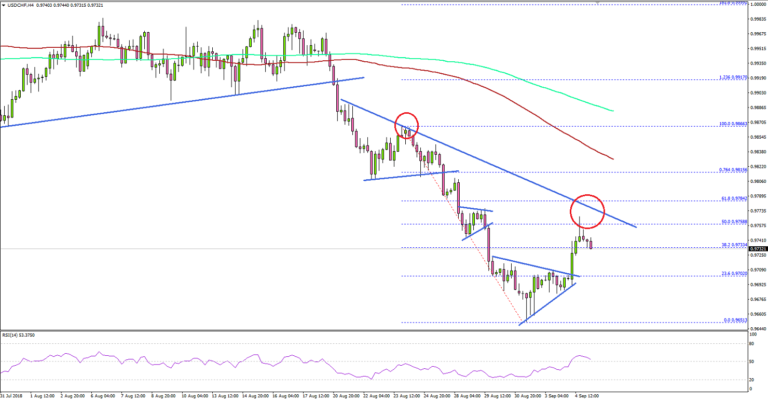
Looking at the 4-hours chart, the pair started a downside move from the $0.9985 swing high and settled below both the 200 simple moving average (green, 4-hours) and the 100 simple moving average (red, 4-hours).
During the decline, many bearish patterns were formed, resulting in a push below the 0.9700 support. The pair finally found support near the 0.9650 level and started a decent recovery.
It broke a contracting triangle pattern with resistance at 0.9700 and moved higher. It also climbed above the 23.6% Fib retracement level of the last decline from the 0.9866 high to 0.9651 low.
On the upside, there is a key bearish trend line in place with resistance at 0.9775 on the same chart. Moreover, the 50% Fib retracement level of the last decline from the 0.9866 high to 0.9651 low is near 0.9758.
Therefore, if the pair continues to move higher, it is likely to find a strong selling interest near the 0.9760-0.9780 zone. A daily close above 0.9800 could push the pair back in a positive zone for a run to 0.9900.
Fundamentally, the Swiss Consumer Price Index for August 2018 was issued by the Swiss Federal Statistical Office. The market was looking for no change in the CPI compared with the previous month.
The actual result was similar to the forecast and better than the last decline of 0.2%. The yearly change was 1.2%, similar to the forecast and the last reading.
Overall, the USD/CHF pair is showing recovery signs, but it won't be easy for buyers to surpass the 0.9760-80 hurdle.
Economic Releases to Watch Today
- Germany's Services PMI for August 2018 – Forecast 55.2, versus 55.2 previous.
- France Services PMI August 2018 – Forecast 55.7, versus 55.7 previous.
- Spanish Services PMI for August 2018 – Forecast 52.1, versus 52.6 previous.
- Euro Zone Services PMI for August 2018 – Forecast 54.4, versus 54.4 previous.
- UK Services PMI for August 2018 – Forecast 53.9, versus 53.5 previous.
- BoC Interest Rate Decision – Forecast 1.5%, versus 1.5% previous.
I’m Interested But Not Worried, Oddly Enough
I'm interested but not worried, oddly enough
Markets continue to roil as the September 6 deadline for public comments on the next slice of Section 301 of China tariffs approaches. But it's been very mixed bag across global equity markets, and while there's a seller bias, however, investors are surprisingly far from losing the plot. Of course, bull markets never run forever, but the US markets resilience in the face of a possible escalation of trade war is mighty impressive.
Miners are feeling the pain as concern about weaker global growth is pressuring base metals, but more so in China which is at the epicentre of the trade war saga. Indeed, the Shanghai Futures exchange could see more speculative selling of base metal anticipating an economic downswing in China due to the tariffs effects.
But was Amazon to the rescue once again, who is the latest tech heavyweight burst through 1 trillion in market value which resoundingly supported investors today given how widely held the stock is.
In summation, some US stocks fell, Treasures were in fashion, and the US dollar continued to find reserve currency haven appeal as emerging market currencies along with the weaker links in the G-10 currency chain on escalation trade tension, AUD -CAD and NZD, remain on that slippery slope.” Heigh ho, Heigh-ho it's off to work we go ” as G-10 traders keep it simple
Oil Markets
Oil markets orchestrated an upswing with Brent testing May levels after Tropical Storm Gordon hit the Gulf of Mexico. But prices pulled back considerably, as the magnitude of the storm suggest production losses will be limited.
The other critical piece of the supply disrupting quandary, Libyan oil production moved above 1.0 million barrels per day level despite the recent bellicose upheaval in Tripoli. Given this was one highlight reel and a keen focus for Oil traders, it makes for a compelling argument to reduce speculative longs.
With oil market short-term specs caught long and wrong over the past 24 hours due to Tropical Storm buying frenzy, the decline could have been amplified as weaker longs headed for the exits as stops triggered on a break of CL1: WTI 69.80.
According to the BSEE, less than 10 % of Gulf production was affected.
However, with the anticipation of up to 1.5 million barrels per day will be affected by the US sanctions on Iran, one would expect prices to move higher in the weeks ahead as hedge funds start to re-engage long position. After all its unlikely that OPEC, with the assistance of Russia or even the US for that matter, will be able to offset this considerable decline.
A bit of an exciting day is shaping on the cusp of Section 301 tariffs. Commodities, in general, are under pressure but the ease of which oil markets have recovered since mid-August suggests we're in further gains despite the USTR tariffs announcement.
Gold Markets
On the backdrop, of a stronger US dollar, as capital outflows continued to weigh on emerging market currencies, gold failed to hold the critical $1200 support levels and then fell like a stone touching below $1190.00 before finding some tentative support. Indeed, provided the USD remains the oasis of calm amidst a toxic combination of trade tensions exacerbated by emerging market currency turmoil, short gold positions will be rewarded. The stream stellar US economic data, as supported by today weighty ISM manufacturing beat, coming in 61.3 vs 57.6 expected, while recording a 14-year high, reinforces the market view the Federal Reserve Board will remain on autopilot throughout 2018 and contributing the bullish dollar narrative.
Currency Markets
The Australian Dollar
On the back of the RBA being little changed, there remains disappointment from those expecting a more dovish delivery.
The deep dive to .7160 overnight was much as function as USD turning bid throughout London, as it was an expression of Aussie weakness.
Is there cause to be bullish in this market. With the RBA sticking to their status quo rate policy, I think it comes down to China and how useful the countercyclical measure is.
So, if you can make a case for a weaker Yuan you most certainly can for the Aussie.
Yuan
There's an abundance of noise to decipher near term but buy on dip strategy is back in vogue after yesterday's fixing induced dip. But if I'm to maintain my pragmatic view despite the Pboc countercyclical effect. If if the wrath of Trump lays down 200 billion at 25% tariff, letting the Yuan exchange rate weaken might be the easiest go to decision for mainland authorities over the short term. As such being long USD should continue to be the favoured position
Canadain Dollar
It's always tough trading the Lonnie on a ” wing, and a prayer” as Foreign Affairs Minister Chrystia Freeland is heading to Washington, yet again, on veiled hopes of singing a NAFTA agreement. But with the Liberal Caucus puppet masters pulling strings, PM Trudeau has raised US-CAD NAFT barrier by suggesting a high level of inflexibility when it comes the terms. After the Euphoria of breaking through 1.3000 traders are now facing another the prospects of another agonising test of 1.3200. Let hope for cooler heads to prevail!!
Malaysian Ringgit
“Hit the bid” has been a common theme across the MGS curve as the market has little choice than to cut risk and short bonds anticipation for offshore selling the global EM tumult is showing few signs of abating ahead of the US tariff day of reckoning. Traders are placing long dollar hedges and wait calmly for better days with the USDMYR is tracking toward 4.15
The focus will be today MPC but, it's unlikely that Governor Datuk Nor Shamsiah binti Mohd Yunus will rock the boat, and I'm expected and RBA type glass half full approach to the economic outlook as well as BNM monetary policy.
Canadian Dollar Falls As NAFTA 2.0 Agreement Remain Elusive
Canadian Dollar Falls as NAFTA 2.0 Agreement Remain Elusive
The USD/CAD rose 0.66 percent on Tuesday. The currency pair is trading at 1.3178 ahead of the release of the Bank of Canada (BoC) monetary policy decision on Wednesday. That same day the US-Canada trade negotiations are set to restart after failing to reach a deal last week. Coming back from the Labour day holiday in both Canada and the United States the comments from US President Trump during there weekend depreciated the loonie. Trump tweeted that there is no political necessity to keep Canada in the new NAFTA deal. The US reached an agreement with Mexico and it was widely expected that Canada would join that trade deal that will eventually replace NAFTA.
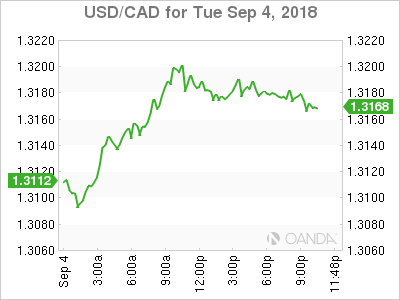
With a very short time for negotiation after Canada was cut out of the bilateral talks between the US and Mexico it is no surprise that a deal was not reached in the arbitrary deadline, but the market was optimistic about both sides getting to work after the long weekend. The CAD fell to a six week low awaiting the restart of negotiations.
The Bank of Canada (BoC) is not expected to lift interest rates tomorrow. The Canadian benchmark rate stands at 1.50 after a 25 basis point rate hike in July. Canadian fundamentals were softer in August making the case for a rate hike less likely. Trade uncertainty has also spiked even as a deal between the US, Mexico and Canada is the closest it has been since the start of the NAFTA renegotiations. The October policy meeting has risen in probability as there will be more facts around the negotiation and also more economic data to validate the BoC tightening pace.
Peso Lower as US Trade Talks Set to Resume with Canada
The USD/MXN gained on Tuesday. The currency pair is trading at 19.3678 and is in an upward trend that could erase all the peso gains after the Mexican elections. Political uncertainty as a party of the left took a lead in the polls and never let up put the currency above the 20 peso price level. Once Andres Manuel Lopez Obrador was the clear winner of the elections the peso quickly started to appreciate. The Mexican presidential transition gave US negotiators an opportunity to push for a bilateral deal and in a short time a US-Mexico trade agreement was signed. Mexican diplomats kept Canada in the conversation, if not the room as the US preferred the bilateral approach.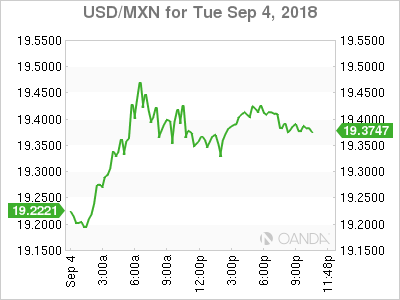
Now trade negotiations have hit a rough patch with Canada after failing to reach a fast agreement last week. The two teams will meet in Washington with emerging markets under pressure as trade concerns are on the rise and the appetite for risk diminishes. The Mexican peso is using up its goodwill due to the US-Mexico trade deal and could get dragged lower along other EM currencies.
Sterling Gets Carney Boost as Governor May Extend Term
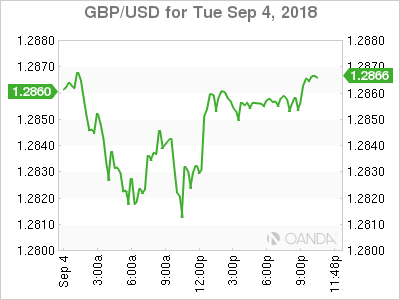
The GBP/USD gained on Tuesday. The currency pair is trading at 1.2858 after Bank of England (BoE) Governor Mark Carney hinted that he might stay beyond June 2019. The five year term that started in 2013 has already been extended by one year to deal with Brexit uncertainty and today’s comments from Governor Carney were positive for the pound. After achieving rockstar status as the head of the Bank of Canada (BoC) Carney was appointed as the first non UK born Governor due to his track record on policy making during turbulent times. Carney’s comments today show that he is willing to stay until the end of the Brexit process and insure a smooth transition. Earlier that date was around the March 29,2019 Brexit deadline, but could now be extended by one or two years.
Brexit concerns are on the rise as after encouraging words by the EU’s chief negotiator Michel Barnier last week, the realities of the divorce are becoming more clear. The Irish border continue to be a hard item on the agenda and lobbying efforts from UK Prime Minister Theresa May have done little to provide encouraging news. Today’s remarks from the BoE Governor ends the uncertainty who will be at the helm during the aftermath of the separation.
Brexit regret appears to keep gaining momentum and two polls this week put it around 2.6 million people who voted for the divorce are having second thoughts. The political pressure at home and abroad will continue to comedown from all sides on Theresa May’s and could be the end of her political career.
Gold Lower as US Dollar Rises on Risk Aversion
Gold fell on Tuesday as the US dollar soared against major pairs. The yellow metal dropped below the $1,200 price level as US fundamentals firmed after the positive manufacturing data confirms the steady pace of the American economy. Trade war risk remains on the radar as additional US tariffs on China are set to kick in this week and weekend comments from President Trump did not help the US-Canada trade negotiations.
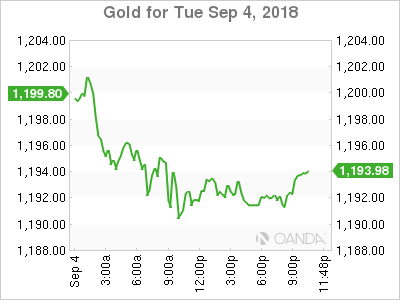
The market is worried about the potential side-effects of a full blown trade war on global growth. The tough stance on trade by the Trump administration has made the US dollar the main destination as investors shed their exposures to a protectionist scenario and buy into the greenback.
Iran and Weather Keep Crude Bid
Crude prices spiked on Tuesday after supply concerns followed the emergency evacuation of two oil platforms in the Gulf of Mexico. Oil came down to levels seen before the weather related disruption as the storm’s true impact will not be known in the short term. The US Bureau of Safety and Environmental Enforcement reported earlier that only 9.2% of Gulf of Mexico oil production would be affected by Tropical Storm Gordon.
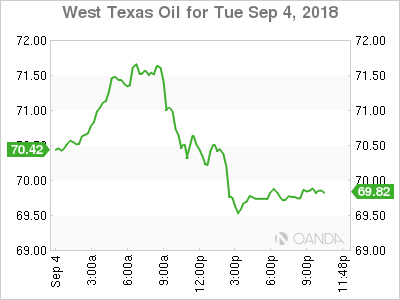
Due to the Labour day holiday the Energy Information Administration (EIA) will release its crude oil inventories on Thursday at 11:00 am, instead of its regular schedule of Wednesday at 10:30 am.
Trade disputes have been oil negative this year as higher tariffs could have a negative impact on global growth estimates and hit demand for energy. Supply disruptions on the other hand have kept crude rising as the Iran sanctions, weather and other geopolitical supply concerns are balancing out the forecasted rise in production by OPEC members.
Eco Data 9/5/18
[php_everywhere instance="1"]
As US Set to Ramp Up Trade War with China, Where Next for the Dollar?
The US-China trade dispute is showing no sign of abating anytime soon as the Trump administration looks set to press ahead with its threat of $200 billion of additional tariffs on Chinese imports. Financial markets started the month and the week on a negative tone as the prospect of further trader barriers between the United States and China dampened the market mood amid growing fears that the ongoing tensions and uncertainty will hurt global growth. Safe havens such as the US dollar, yen and the Swiss franc have been the main winners from the trade frictions, while risk assets, particularly those of Emerging Markets have been the biggest losers. US equities have been the exception.
The latest market rout was triggered after President Trump indicated in a Bloomberg interview last Thursday that he is ready to move ahead with the next round of tariffs as early as next week when the public comment period ends. The public notice and comment process – where companies and members of the US public are invited to submit their views on the proposed tariffs – expires on September 6. In practice, however, it may take a bit longer for the additional duties to come into force as the administration would need some time to finalize the list of products that would be included.
With the markets now almost convinced that the $200 billion worth of tariffs are a done deal, traders will be paying attention to whether the size of the new levy will be 10% or 25%. Also of significance will be whether they will be enacted all at once, or in stages like the $50 billion tariffs, which were split into tranches of $34 billion and $16 billion. Should President Trump decide to apply all the tariffs in one go and choose the higher rate, it would signal a more forceful approach towards China, which has yet to give in to US demands to open up its domestic market to American companies and toughen its laws on intellectual property theft.
The most concerning aspect of the ongoing trade row is that no new talks are currently planned by the two sides, with Trump last week saying, “It’s too one-sided for too many years and too many decades, and so it’s not the right time to talk”. Adding to the trade pessimism is the failure of Canada and the US to conclude talks on a revised NAFTA accord last week. While negotiations will resume this week, there is a risk Canada could be left out from an overhauled NAFTA after the US reached a preliminary agreement with Mexico and Trump later threatened in a tweet that “there is no political necessity to keep Canada in the new NAFTA deal”.
So far in the trade war, the US appears to have the upper hand as not only does America import far more from China than what the Chinese purchase from their US counterparts, but the US economy is booming and stands out as the strongest among the world’s largest economies. In contrast, trade tensions have dragged Chinese stocks to their lowest since early 2016 and the yuan to 19-month lows. But while investors have started fleeing from Chinese assets, there is little evidence so far of a notable impact on economic output, though the latest manufacturing surveys point to a deterioration in the export picture.
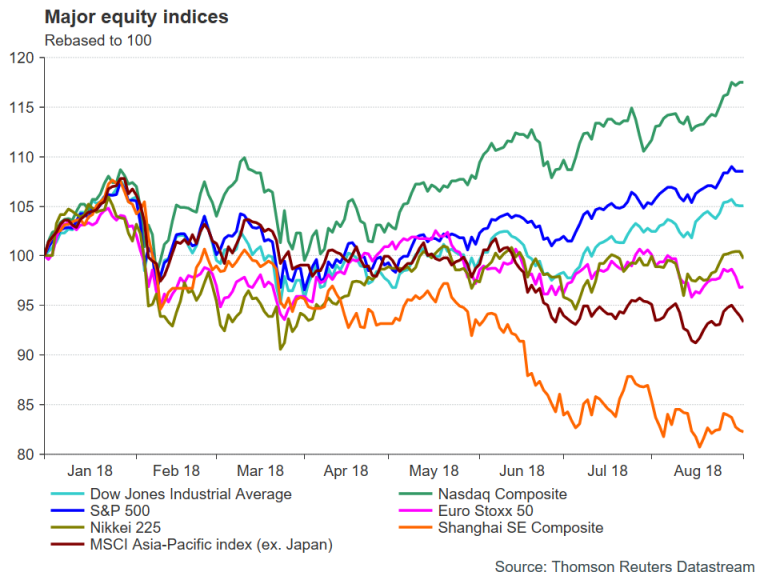
With a series of both fiscal and monetary stimulus measures announced by Chinese authorities in recent months, the government in China is confident it can defend itself from Trump’s actions and stave off a sharp slowdown. However, even if that proved to be the case, the Sino-US trade spat has created some unintended casualties as the combination of the resulting strong dollar and the worsening growth outlook has given way to a new Emerging Market (EM) crisis.
Like China, many EM stock markets and currencies have suffered sharp losses this year, with some analysts calling on the US Federal Reserve to pause raising interest rates as higher US yields are drawing funds away from EM economies and the strong greenback is making it more expensive for them to repay their dollar-denominated debts. While so far, the troubles are confined to countries with existing domestic weaknesses and are therefore unlikely to spill-over to other regions, a worsening crisis from a possible deepening of the trade tensions could eventually spread to other markets and weigh on growth.
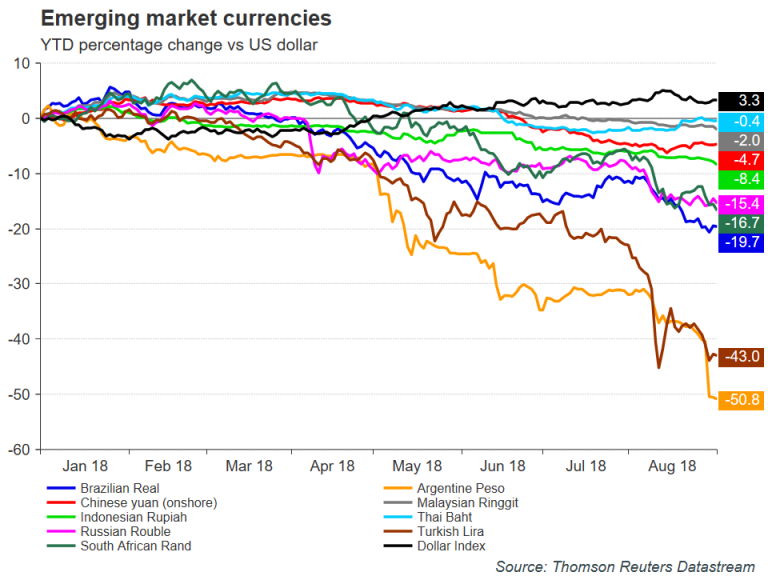
But even if fears of a wider and bigger crisis are overblown, the EM rout looks set to continue in the near term, adding to the growing gloom about the outlook for the global economy. Recent data points to deteriorating business sentiment in both Asia and Europe as there doesn’t appear to be any let up in Trump’s trade fight with major trading partners. While the direct impact of the tariffs already in place is seen as limited, the threat of higher tariffs on European auto imports, Canada’s exclusion from NAFTA and further barriers to Chinese trade are dampening investor confidence.
A weaker global growth backdrop would eventually start to impact the US economy, which, so far, has been immune from the deceleration in growth observed by much of the rest of the world during 2018. Without strong growth elsewhere in the world, the US economy would struggle to maintain its momentum, especially as the effects of Trump’s tax cuts start to subside.
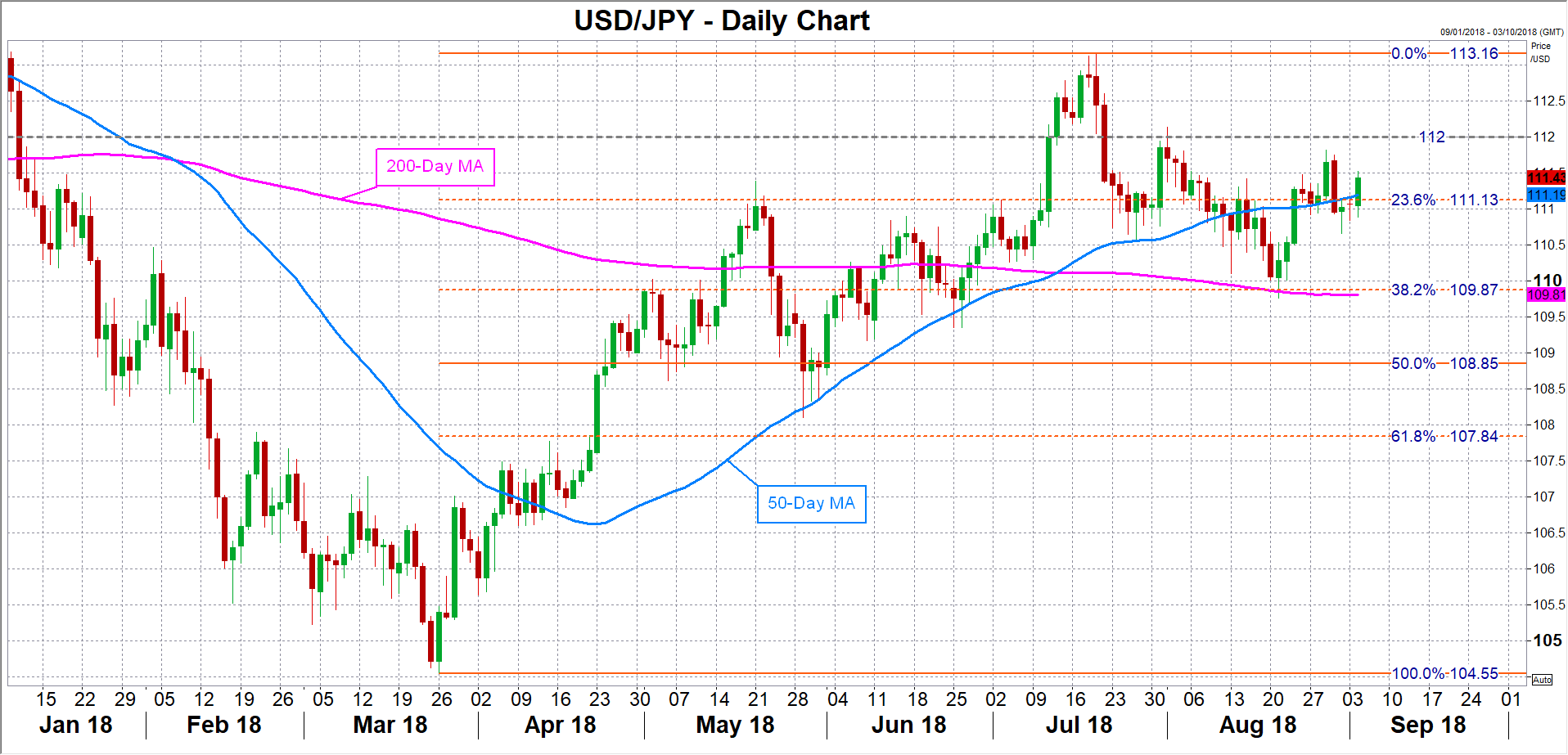
Until that happens though and depending on how the Fed would respond to slowing US growth, the dollar will probably remain well bid in forex markets. Having broken above the 50% Fibonacci retracement of the January 2017 to February 2018 downtrend in mid-August (around 96.0), the dollar index could next target the 61.8% Fibonacci at 97.87 in the coming weeks. Looking at dollar/yen, a major advance could be more difficult given that the yen has also been benefiting from trade-related safe-haven flows. The pair would need to beat its July top of 113.16 to signal a return to bullish mode but overcoming the 112-level to get there could prove more challenging.
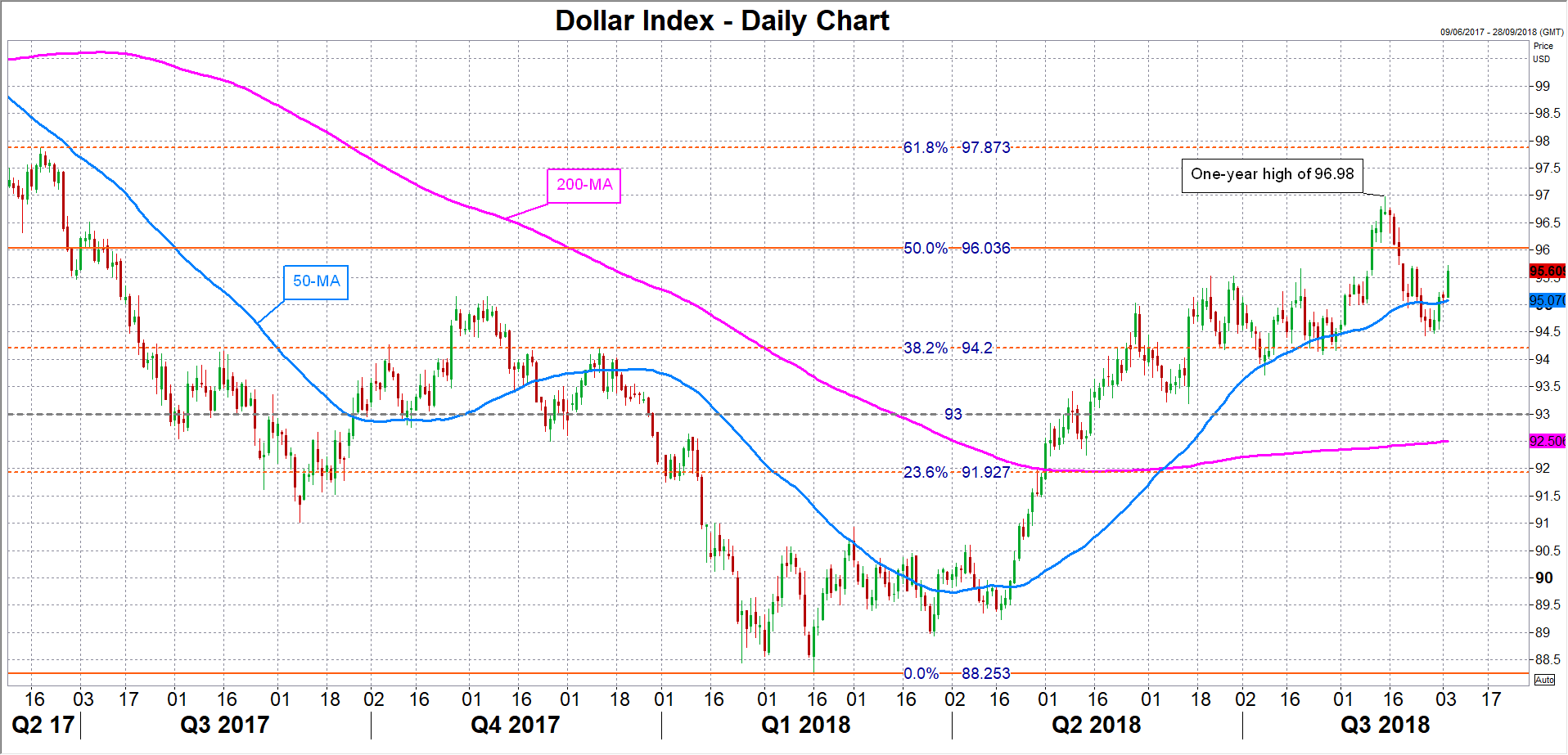
Possible risks in the near term for the dollar are positive developments on the trade front. A deal with Canada this week to conclude the NAFTA renegotiation would add some-much needed optimism to the trade outlook. Another trigger of a dollar pullback could come from a measured response by President Trump in proceeding with the next round of tariffs on Chinese imports. The dollar index could retreat towards 94.20 – the 38.2% Fibonacci level. Heavier losses would see the 93-level coming into range. As for dollar/yen, the pair could slip to the 38.2% Fibonacci at 109.87, with a drop below this area opening the prospect of a test of the 50% Fibonacci at 108.85.
However, even in the event of any positive surprises from the US trade talks with its various partners, the dollar is unlikely to suffer too heavy losses. The rising interest rate differentials between the US and most other advanced economies isn’t about to disappear anytime soon and should keep the dollar supported for some time yet and curb short-term slides.
Another factor keeping the dollar buoyant during 2018 is the rally in US equities. Although traditional US stocks have been held back by trade war fears (the Dow Jones Industrial Average has been underperforming), technology shares have had an outstanding year, helped in part by the corporate tax cuts. This has seen the S&P 500 and Nasdaq Composite indices break into record territory as other stock indices in Europe and Asia head lower, further attracting funds into the US and keeping the dollar in demand.
Looking at the more longer-term outlook, the dollar is viewed by many analysts as nearing the peak of its current upswing, even if the US-China trade dispute gets worse before it starts to get better. The main reason for this is that the Fed could begin slowing, and even pausing its pace of rate hikes in 2019 as the federal funds rate nears what is considered to be the neutral rate. The Fed policymakers’ estimates of the neutral rate (defined as the level of interest rate that the keeps the economy growing at trend and inflation stable) range between 2.3-3.0%. With rates currently at 1.75-2.00%, another two increases of 25 basis points would put them at or very near their neutral level.
This, coupled with recent signals by the central bank that it could soon do away with describing its monetary stance as “accommodative”, add to speculation that the Fed will draw to a close its policy of gradually raising rates. With inflation under control, the Fed would have little reason to continue tightening once the neutral rate is reached. A confirmation of this could come as early as the December policy meeting when updated economic projections for 2019 will become more prominent. A dollar reversal to the downside could soon follow.
Mid-US update: Dollar can’t ride on strong ISM, US yield surges at the long ened
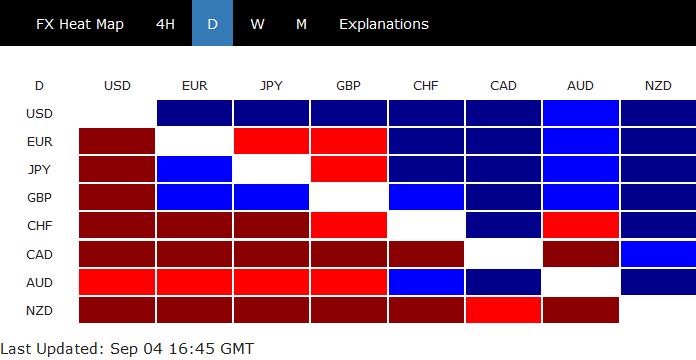
Dollar remains the strongest one today , followed by Yen and then Sterling. On the other hand, New Zealand Dollar is the weakest one, followed by Canadian Dollar and then Swiss Franc. The greenback attempted to extend recent rise after super strong ISM manufacturing index. However, firstly, EUR/USD managed to rebound after touching 1.529 minor support. USD/JPY showed no reaction and stays in range of 110.68/111.82. USD/CHF is also held blow 0.9775 minor resistance. For now, there is no confirmation of underlying strength in the greenback yet. More is needed to trigger a decisive rally, possibly NFP later this week.
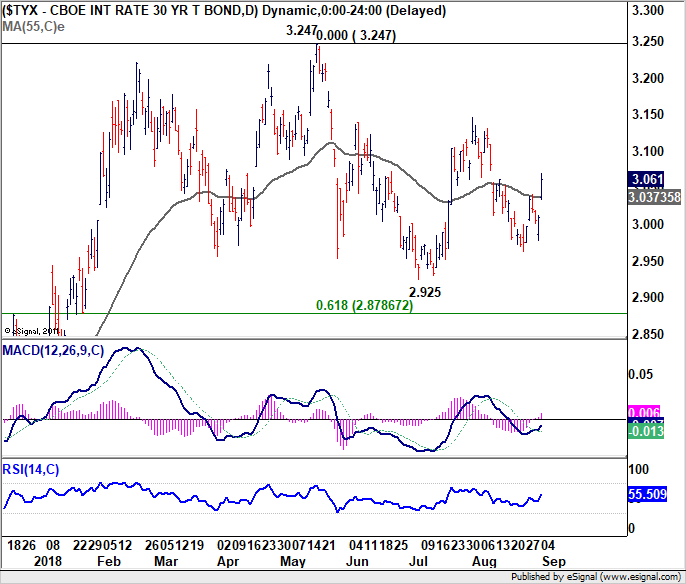
In other markets, a notable development in the surge in US treasury yields. At the time of writing, 30 year yield is up 0.051, 10 year yield up 0.044, and five year yield is up 0.035. That is, yields rise more in the long end. That's a development that Fed hawk would like to see. in the stock markets, US indices are in red with DOW down -0.34%, S&P 500 down -0.4% and NASDAQ down -0.56%. Declines in the European markets were much more serious, with CAC down -1.13%, DAX down -1.1% and FTSE down -0.62%.
Gold Slips Below $1200 as Tariff Jitters Boost Dollar
Gold has posted sharp losses in the Tuesday session. In North American trade, the spot price for one ounce of gold is $1192.75, down 0.72% on the day. Earlier in the day, gold prices dropped to $1189, their lowest level since August 24. On the release front, ISM Manufacturing PMI jumped to 61.3, well above the estimate of 57.6 points.
Escalating trade tensions have boosted the U.S dollar, at the expense of gold as well as other currencies. The dollar is benefiting from being the primary reserve currency. The most important trade dispute, which could cause serious damage to the global economy, is the spat between the U.S and China. So far, the two economic giants have imposed $50 billion in tariffs on each other, and President Trump has threatened further tariffs worth some $200 billion, which could be imposed as early as Thursday. The U.S could elect to impose the tariffs in smaller bites, such as a $50 billion tariff. Trade talks continue between the U.S and Canada, as the NAFTA agreement, worth some $1 trillion in trade, has yet to be finalized. The EU has also engaged in a tit-for-tat tariff exchange with the United States, and Japan has also been subject to U.S tariffs. With the U.S economy running smoothly and showing little ill-effect from the tariffs, President Trump could be emboldened to ratchet up tariffs, particularly against China. If the trade tensions worsen, the US currency could continue to gain ground and gold prices could suffer.
US Midterm Elections: Mostly a Political Event with Limited Implications for Markets and the Economy
Key takeaways –macro and politics
- We believe the US midterm election, which takes place on Tuesday 6 November, is mostly a political event, not an economic event.
- The most likely outcome is that the Democrats win the House but the Republicans retain Senate control. That would make President Donald Trump a 'lame duck' in the sense that he cannot get through with his domestic agenda. Trump's focus would remain on foreign and trade policy.
- If the Democrats win the House, we believe they are likely to start an impeachment process against Trump. While this would create a lot of headlines and noise, we do not think he would be convicted, as this requires super-majority in the Senate.
- Even if the Democrats win control of both chambers, it is difficult for them to roll back Trump's laws/policies, as Trump can veto any attempt to do that.
- If the Republicans retain control of both chambers, Trump has another chance to pass domestic policy. If so, Trump may shift focus away from foreign/trade policy and back to domestic policy (new initiatives on tax and infrastructure spending?).
- As we think the midterm elections are a political event, it does not change our view on the economic outlook. We believe the US expansion is set to continue in coming years, as optimism remains high and fiscal policy remains expansionary
Key takeaways –market implications
- That the midterm election is mostly a political event and not an economic event means that the market implications are limited.
- EUR/USD and real rates have moved apart under Trump. In a scenario where Trump ends up a 'lame duck' after the midterms, it could support the USD somewhat (and weigh on EUR/USD), as the 'Trump discount' may start to be priced out.
- Risk scenario: Although the probability is very low (<10% in our view), Trump may start US FX interventions in order to weaken the USD, which would reduce the current account deficit and support exports.
- We believe the impact on US Treasuries is limited. Even if Trump becomes a lame duck, it would be difficult for the Democrats to roll back Trumponomics. The higher government deficits ahead would increase US treasury issuance and put upward pressure on long-end yields. The midterm elections are also unlikely to change the Fed's outlook. The flattening of the US yield curve remains the main focus.
- We also think the midterm elections are secondary for equities. This is also what history suggests. We expect a return over the next 12 months of between 5% and 10%, with returns being more dependent on macro than politics.