

Sample Category Title
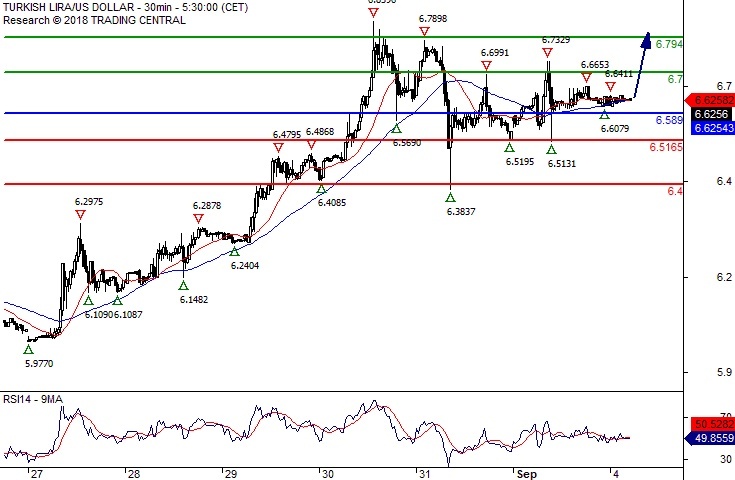
USD/TRY Bullish Bias Above 6.5890
Pivot (invalidation): 6.5890
Our preference Long positions above 6.5890 with targets at 6.7000 & 6.7940 in extension.
Alternative scenario Below 6.5890 look for further downside with 6.5165 & 6.4000 as targets.
Comment The RSI lacks downward momentum.
An update on AUD/JPY short
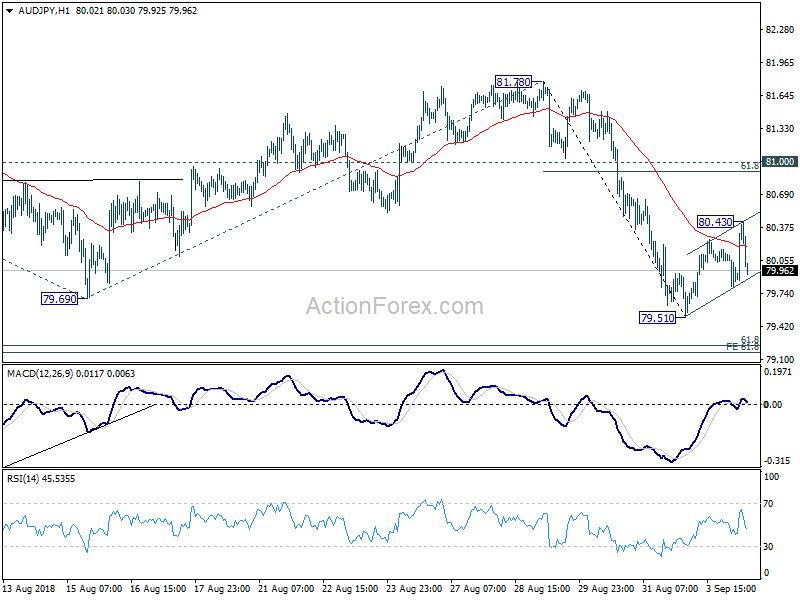
As we planned in the weekly report here, we've sold AUD/JPY today at 80.25 when the cross recovered to 80.43 after RBA rate decision. Currently, the AUD/JPY is in consolidation pattern from 79.51 temporary low and it's uncertain how long such consolidation will last. Hence, we'll keep the stop unchanged at 81.00. That is slightly above 61.8% retracement of 81.78 to 79.51 at 80.91, as well as 4 hour 55 EMA (now at 80.76). We'll lower the stop when AUD/JPY breaks 79.51 low.
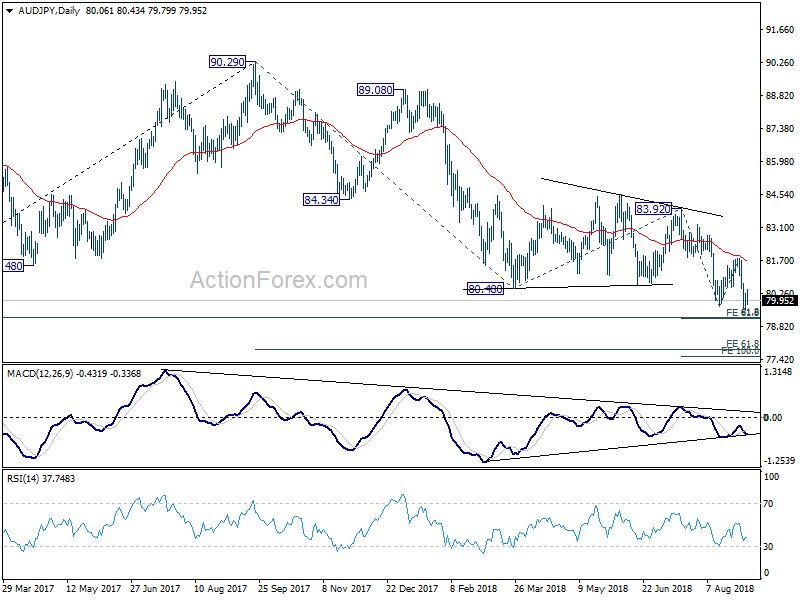
Overall outlook is unchanged that AUD/JPY is extending the larger down trend form 90.29. First target is 61.8% projection of 83.92 to 79.69 from 81.78 at 79.16. This level is close to 61.8% retracement of 72.39 to 90.29 at 79.22. Even though it's a cluster, based on current momentum, we'd expect it to be taken out with relative ease. The real test lies in 77.55/85 (61.8% projection of 90.29 to 80.48 from 83.92 at 77.85, 100% projection of 83.92 to 79.69 from 81.78 at 77.55). We haven't decided whether to get out from there yet and will look at the downside momentum to decide.
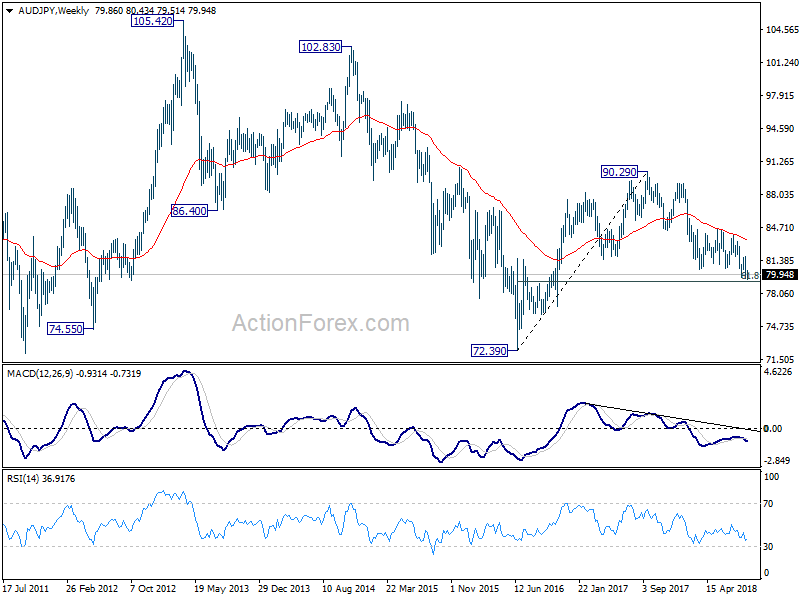
We're indeed looking at the prospect of deeper fall towards 72.39 low, as the rejection from falling 55 week EMA was rather bearish in medium term.
XAUUSD Intraday Analysis
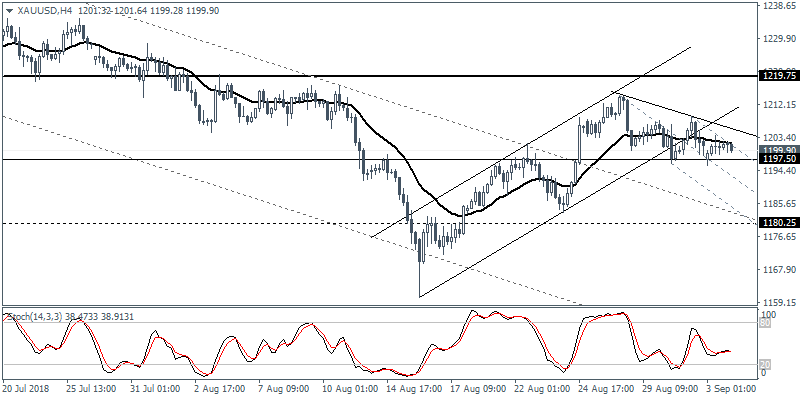
XAUUSD (1199.90): Gold prices continue to consolidate above 1197.50 support. Price action is, however, pointing to a potential correction to the downside if the support fails. The descending triangle pattern also validates this view. The downside target is seen around the 1180.25 level following the breakout from the rising price channel. A correction toward the 1180.25 region could spell a retest of the support level with gold prices likely to stay in a range within 1197.50 and 1180.25.
GBPUSD Intraday Analysis
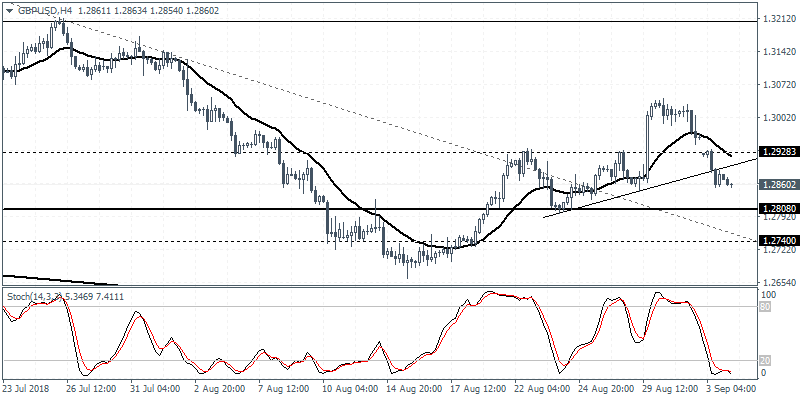
GBPUSD (1.2860): The GBPUSD currency pair gapped lower on Monday and briefly consolidated near the 1.2928 level of support. However, price action broke below this level and the minor trend line in the process as well. The declines are expected to push the cable down to the 1.2808 level of support. A rebound off this level is likely in the short term as price action could potentially reverse the losses. In the event that the GBPUSD closes below 1.2808 support, further losses could be expected.
EURUSD Intraday Analysis
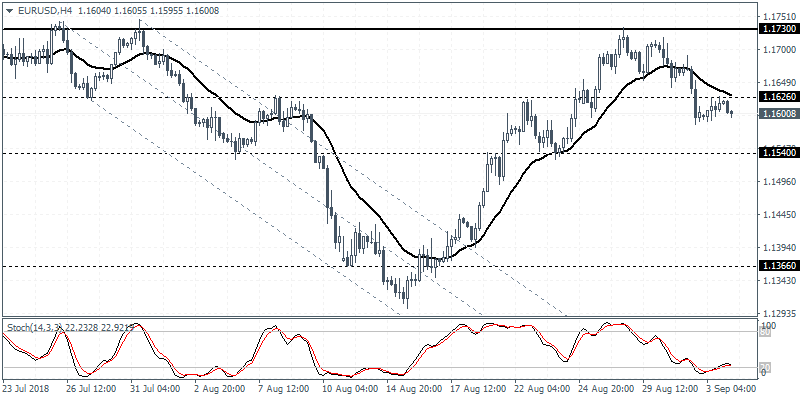
EURUSD (1.1600): The EURUSD was slightly bullish on Monday but trading was subdued with the U.S. markets closed. Price action, however, was seen resuming the declines earlier on Tuesday. The euro currency briefly tested the resistance level at 1.1626 before reversing the gains below the 20-period moving average. Following the previous low posted at 1.1583, a close below this low could trigger further declines. The euro currency could be seen posting declines to the 1.1540 level of support in the near term.
RBA Keeps Rates Unchanged
The British pound slumped on Monday after renewed concerns on Brexit. The Pound sterling fell as the UK’s manufacturing PMI fell to a 25-month low. Economic data from the U.S. was sparse with the U.S. and Canadian markets closed on account of the Labor Day holiday.
The RBA held its monetary policy meeting earlier today. Interest rates were left changed as widely expected. Later in the morning, the RBA Governor Lowe is expected to speak.
The European trading session is relatively quiet today. The UK will see the inflation report hearings scheduled while Switzerland will be releasing its monthly inflation figures.
The NY trading session will see the ISM manufacturing PMI report coming out. Median estimates forecast a decline in the index to 57.6 from 58.1 in the previous month. The construction spending data is expected to rise 0.5% on the month following a 1.1% decline previously.
The Dollar Index Has Been Growing
Yesterday, trading on currency majors was fairly calm. Weak trading activity and volatility were observed in the market. The financial markets of the US and Canada were closed due to the holidays. The pound was under pressure because of weak economic reports. In August, the index of economic activity in the UK manufacturing sector fell to 52.8 (two-year minimum). Market expectations were at the level of 53.9. Today, the dollar index (#DX) has been growing.
During the Asian trading session, the Reserve Bank of Australia, as expected, has kept the key interest rate at the previous level of 1.50%. Financial market participants expect important statistics from the UK and the US. Demand for the American currency is at a fairly high level. We recommend monitoring the current information regarding Brexit, as well as the trade conflict between the US and China.
The bullish sentiment prevails in the market of "black gold". At the moment, futures for the WTI crude oil are testing a mark of $70.25 per barrel.
Market Indicators
On Friday, the major US stock indices showed mixed results: #SPY (0.00%), #DIA (-0.06%), #QQQ (+0.13%).
At the moment, the 10-year US government bonds yield is at the level of 2.87-2.88%.
The news feed on 04.09.2018:
The index of economic activity in the UK construction sector at 11:30 (GMT+3:00);
The Bank of England inflation report hearings at 15:15 (GMT+3:00);
The index of economic activity in the US manufacturing sector from ISM at 17:00 (GMT+3:00).
Dollar Bounces, BoE Testimonies And US ISM Manufacturing In Focus
Here are the latest developments in global markets:
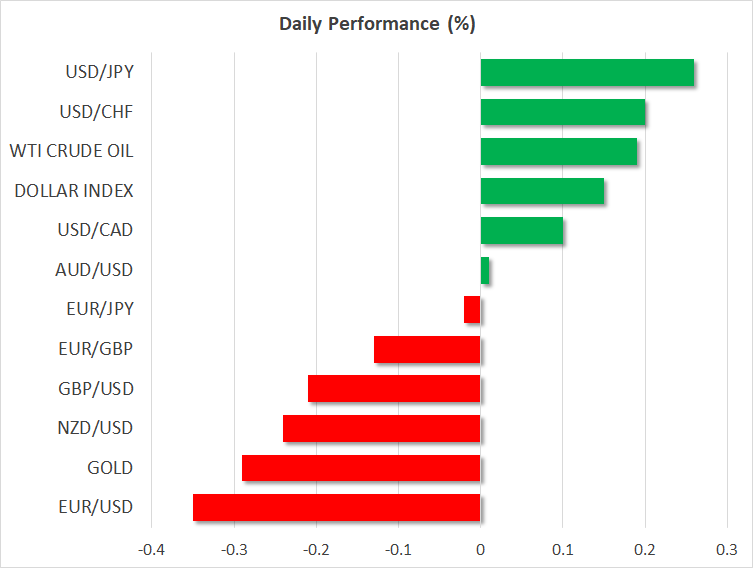
FOREX: The greenback is higher across the board on Tuesday, with the dollar index advancing by 0.15% in the absence of any major new developments. The aussie jumped overnight after the RBA struck a less-cautious tone than many expected, erasing losses it posted earlier in the session after Australia’s current account data for Q2 disappointed. Earlier on Monday, the British pound came under renewed selling interest, following a miss in the UK manufacturing PMI.
STOCKS: Wall Street remained closed on Monday for the Labor Day public holiday. As for today, futures suggest that the S&P 500, Dow Jones, and Nasdaq 100 are all set to open higher, which would bring the S&P and the Nasdaq back within breathing distance of their recent all-time highs. It was a mixed session in Asia on Tuesday, as a looming escalation in the Sino-US trade skirmish continued to cast a long shadow. Even yen-weakness was unable to lift Japanese markets, with the Nikkei 225 (-0.05%) and the Topix (-0.12%) pulling back somewhat. In Hong Kong though, the Hang Seng managed to climb by 0.75%. In Europe, futures tracking all the major benchmarks were flashing green, pointing to a higher open today.
COMMODITIES: Oil prices edged higher on Tuesday, extending gains from yesterday. WTI rose by 0.19% to trade at $70.35 per barrel, while Brent was up by 0.09% at $78.22/barrel. The latest leg higher is seemingly owed to reports that two oil platforms in the Gulf of Mexico were evacuated in anticipation of a hurricane, likely amplifying speculation for temporary supply disruptions. In precious metals, gold is down by 0.29% at $1196 per troy ounce on Tuesday, weighed on by a recovery in the US dollar. Since the yellow metal is denominated in dollars, a stronger greenback renders it less attractive for investors using foreign currencies, and vice-versa.
Major movers: Pound extends losses, looks to BoE-talk for relief; dollar bounces
The British pound extended its recent losses on Monday, with euro/sterling crossing back above the 0.9000 handle after disappointing UK manufacturing PMI data for August provided traders another reason to limit their sterling exposure. Market attention will likely remain on the UK today, as several BoE officials including Governor Carney and chief economist Haldane are due to testify before Parliament at 1215 GMT. In the midst of Brexit worries, investors have pushed back the anticipated timing of the next BoE rate increase to November 2019, according to UK OIS. Any hints from policymakers suggesting a hike may come earlier than that could provide some temporary relief to the battered pound. More broadly though, Brexit worries may continue to cap any sustained rallies in sterling, after the EU’s Barnier implicitly rejected the UK’s plan on trade recently.
In Australia, the RBA kept its policy unchanged overnight, as was widely expected. Policymakers appeared slightly more optimistic than previously on the the labor market, while they also brushed aside some worrisome developments, like rising mortgage rates in commercial banks. The officials’ overall neutral tone likely came as a surprise to investors anticipating a more cautious bias, causing aussie/dollar to jump on the decision, erasing earlier losses that came on the back of lackluster current account data for Q2.
Meanwhile, the dollar is higher across the board on Tuesday, with little in the way of fresh news behind the move – recall that the US and Canada were closed for a public holiday yesterday. Ahead of the payrolls report on Friday, the US currency will likely stay sensitive to any potential escalation in trade tensions between the US and China, with any increase in frictions possible to divert safe-haven flows into the greenback.
Elsewhere, the loonie continued to lose ground after Trump tweeted over the weekend that Congress should not interfere with the NAFTA talks, otherwise he will terminate NAFTA entirely – which interestingly he cannot do without Congressional approval. Dollar/loonie broke back above 1.3000, with the US-Canada talks set to resume tomorrow.
Day ahead: US manufacturing PMI, eurozone producer prices and UK construction PMI due; trade and EM angst lingers
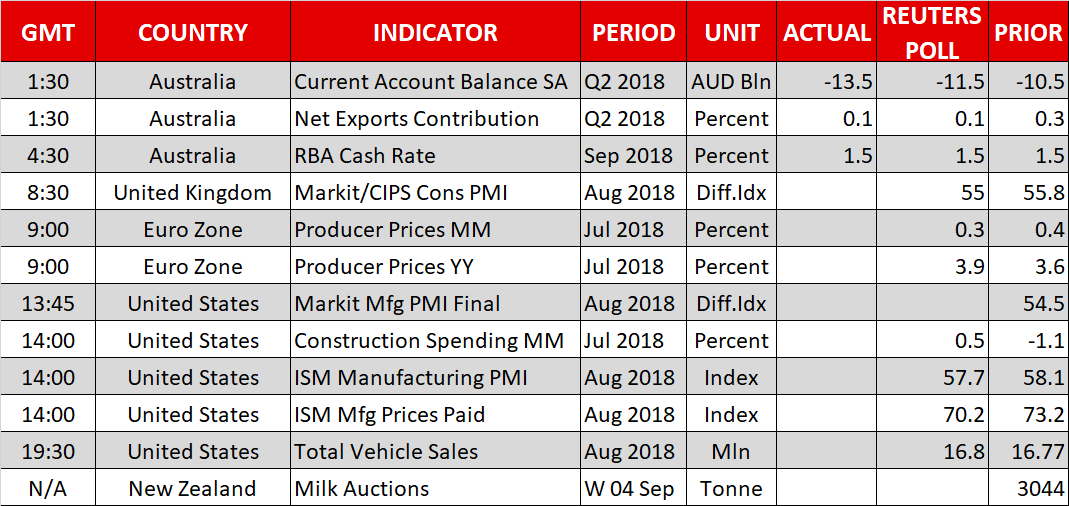
Tuesday’s economic releases include manufacturing PMI and total vehicle sales out of the US, as well as eurozone producer prices and UK construction PMI numbers. Investor focus though will continue to remain on ongoing trade and emerging market worries.
On the trade front, the US and Canada will be looking into whether they can enter into a new North American trade deal; an agreement by the US and Mexico already materialized last week. As regards China, President Donald Trump last week showed willingness to push forward with tariffs on $200 billion in additional Chinese products as soon as Thursday.
In terms of data, construction PMI data due out of the UK at 0830 GMT are anticipated to show the gauge weakening to 55.0 in August from July’s 55.8. Yesterday’s respective data for the manufacturing sector showed the relevant measure unexpectedly falling to its lowest since July 2016 – immediately after the Brexit referendum – and acted as a drag on sterling. The PMI print for the all-important services sector will be released tomorrow.
At 0900 GMT, eurozone producer prices for July will be made public. The monthly pace of growth is projected to ease to 0.3% from June’s 0.4%, though this is still enough to push the year-on-year rate to 3.9% from 3.6% in June.
The ISM’s manufacturing PMI for August will be hitting the markets at 1400 GMT. The measure is forecast to weaken for the third straight month, though still – at 57.7 – comfortably remain in expansion territory above 50. It will be interesting to see whether the lingering trade disputes will weigh on the print to a significant extent. The numbers on manufacturing prices paid for August and July’s construction spending are due at the same time, while the final reading on Markit’s manufacturing PMI for August will be released a little earlier (1345 GMT).
Also out of the US are August’s total vehicle sales, scheduled for release at 1930 GMT. A small recovery in sales is predicted, specifically to 16.80 million, from July’s 16.77m which was the weakest since August 2017. Higher interest rates are a negative for auto sales.
Dairy products are New Zealand’s largest goods export earner, and in this respect the outcome of today’s bi-weekly milk auction may move the local dollar; higher prices are generally seen as kiwi-positive. The results of the auction lack a specific time of release.
RBA Governor Philip Lowe will be making some comments at 0930 GMT, following the central bank’s policy decision earlier today.
Elsewhere, at 1200 GMT, Bank of England Governor Mark Carney will be testifying on the August inflation report and policy decision to raise rates by 25bps. He will be accompanied by MPC policymakers Andy Haldane, Silvana Tenreyro and Michael Saunders. Important for sterling will be any updates on Brexit; PM May’s Brexit proposal was criticized both at home and in Brussels.
In EM, the Argentine peso is losing ground on Tuesday even as the government took steps to boost investor confidence and the central bank considerably bumped up rates last week. The Turkish lira, South African rand, Brazilian real, and Indian rupee are some other EM currencies that have come to the fore in recent weeks.
Technical Analysis: EURUSD looking bearish in the short-term, touches 11-day low
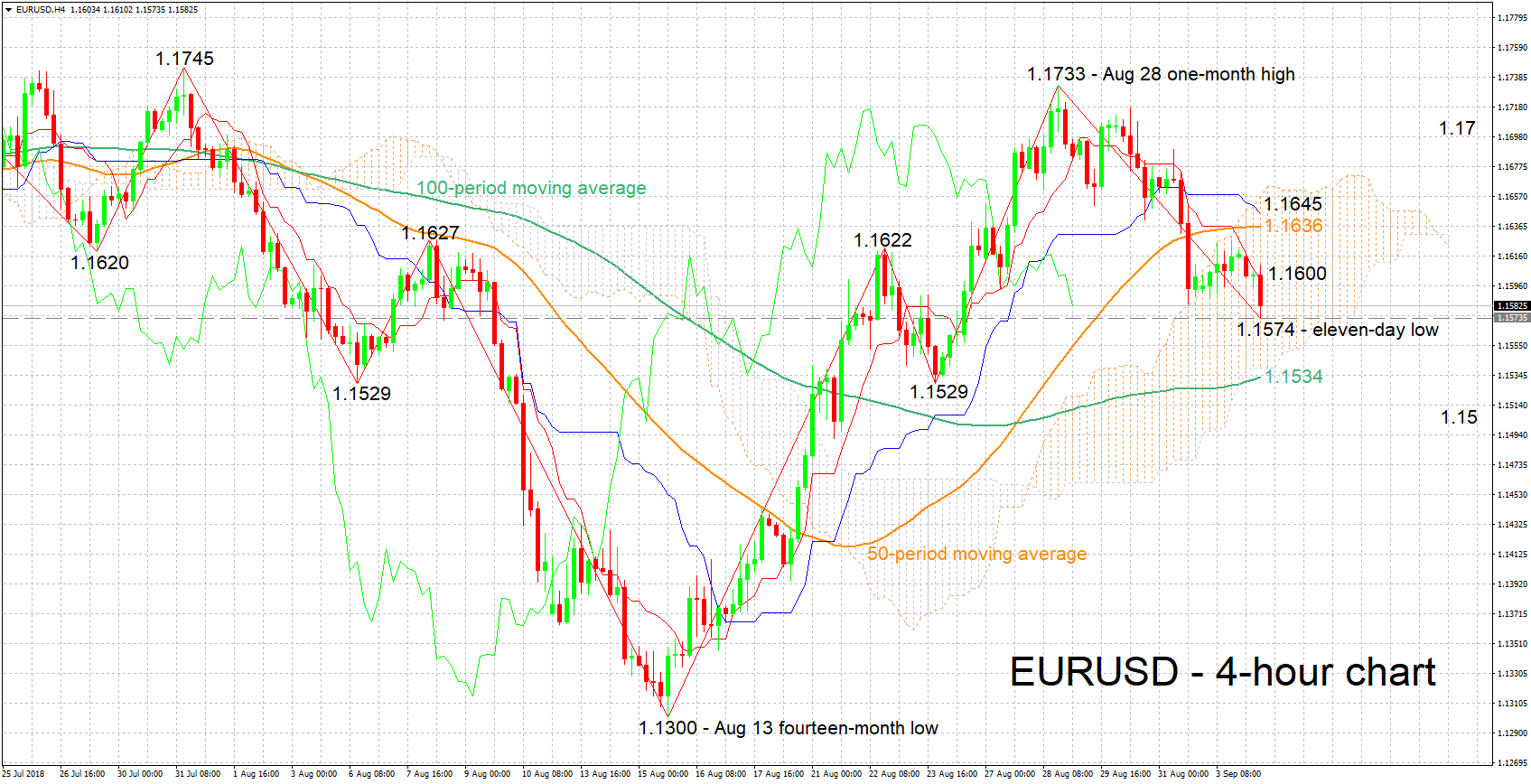
EURUSD is trading not far above the 11-day low of 1.1574 hit earlier in the day. The Tenkan-sen line is below the Kijun-sen in support of a bearish short-term picture. Today’s releases out of the eurozone and the US do not usually act as major market movers, but they could still lead to some positioning on the pair.
Upbeat eurozone releases or downbeat US ones may boost EURUSD. Given a move above the 1.16 round figure which is where the Tenkan-sen also lies, resistance may come around the current level of the 50-period moving average line at 1.1636; the Kijun-sen (1.1645) and Ichimoku cloud top (1.1664) are also part of the area around this level. Further above, the 1.17 handle would be eyed and then the one-month high of 1.1733 from late August.
Conversely, weak eurozone numbers or overall strong US figures are likely to exert pressure on EURUSD. A move below the earlier recorded 11-day low of 1.1574 may find support around the 100-period MA; this is where the Ichimoku cloud bottom roughly lies as well, while the zone around this also includes a couple of bottoms from the recent past. Steeper losses would bring the 1.15 mark within scope.
GBPUSD Further Losses Are Expected In Short- And Medium- Terms
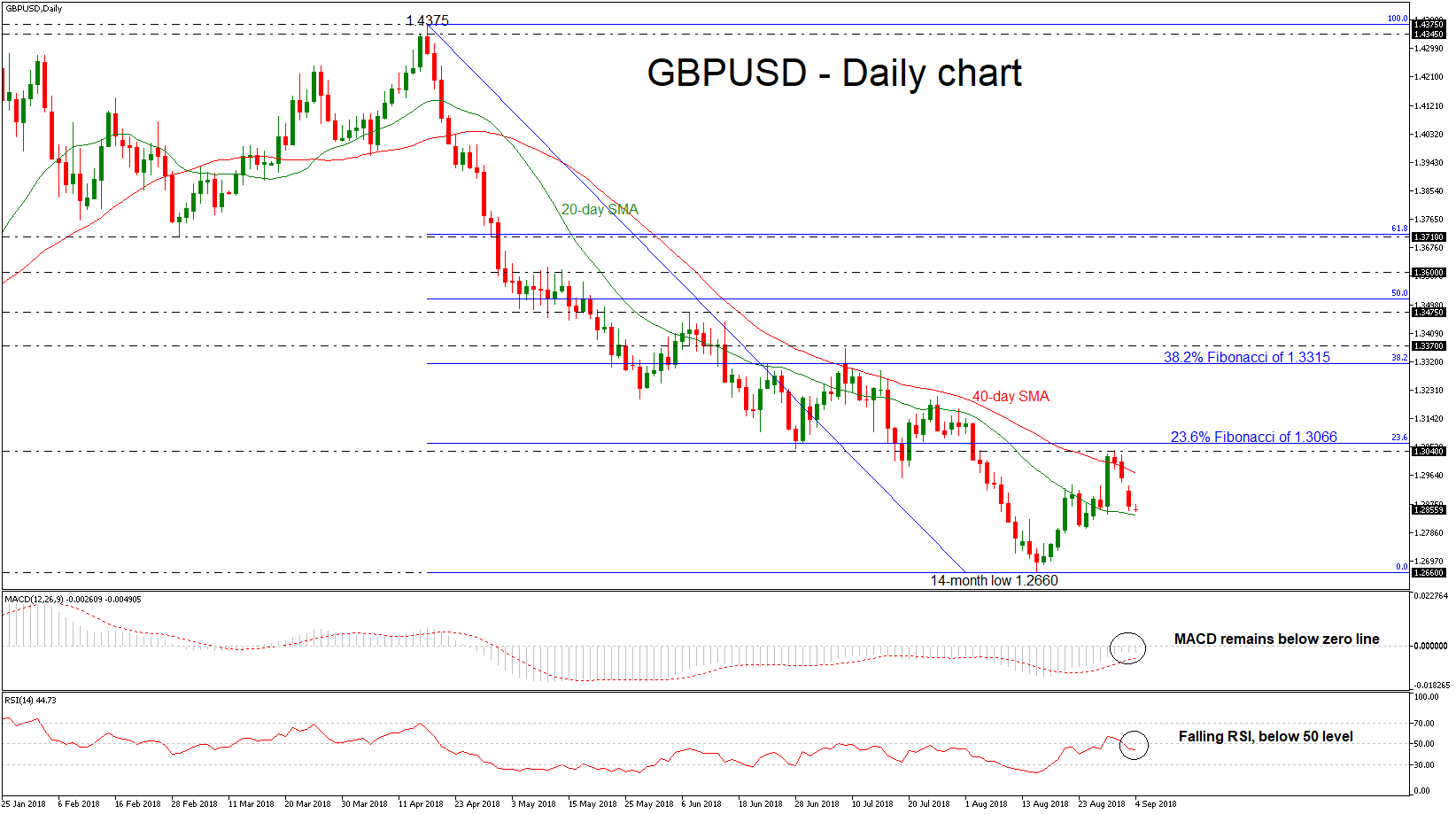
GBPUSD completed the third consecutive bearish day after it opened with a gap down on Monday and found a strong resistance on the four-week high of 1.3040. In the short-term, the market could maintain declines if the RSI keeps losing momentum below the 50 level and the MACD holds below the zero line. However, regarding the trend, this is likely to remain on the downside in the near-term as the 20- and 40-day simple moving average (SMAs) continue to lose strength.
If the price continues to slip lower and drops below the 20-SMA, the 14-month low of 1.2660 could provide immediate support before being able to challenge the 1.2580 key level, where it bottomed on June 2017.
An extension to the upside could push the cable until the 40-SMA, around 1.2973 at the time of writing. Further up, resistance could run towards the latest high of 1.3040 before being able to touch again the 23.6% Fibonacci retracement level of the downleg from 1.4375 to 1.2660, near 1.3066. Steeper increases could also hit the 38.2% Fibonacci of 1.3315.
In the long-term timeframe, GBPUSD recorded the fifth negative month in a row, creating a sharp downside rally after the bounce off the 1.4375 barrier last April.
Currencies: Dollar Going Nowhere. Uncertainty Provides Tentative Downside Protection
Rates: End to Summer trading lull
Yesterday's US Labour Day traditionally marks the end of the Summer trading lull with volumes set to increase again from now onwards. Risks to the US manufacturing ISM are on the upside of expectations. US Treasuries could suffer with this month's FOMC meeting and new dot plot in mind. Or will stress on EM or Trump's trade war interfere again.
Currencies: Dollar going nowhere. Uncertainty provides tentative downside protection
Today, the US manufacturing ISM and the next steps in the trade conflict might turn out to be a tentative positive for the dollar. However, the US currency doesn't look like preparing a clear directional break-out. Sterling reversed a big part of last week's rebound as the political rift on brexit persists and as UK eco data are unconvincing
The Sunrise Headlines
- US stock markets were closed yesterday due to a national holiday (Labour Day), but are back in business today. Asian markets opened all but some in the negative this morning, with Japan underperforming.
- Argentina's president Macri has admitted his country faces an “emergency' in the wake of market panic after the collapse of the peso. He unveiled a new austerity programme to win over international investors and bailout lenders.
- Italy's Deputy Prime Minister Matteo Salvini and his League party will commence budget talks today. On Sunday he said the deficit will ‘touch' EU's 3%-limit, but yesterday he announced to respect all the rules.
- The Reserve Bank of Australia kept its policy rate at a record low of 1.5% today, as expected. The Australian dollar dropped 10% since February but showed little sign of recovery on the news.
- Japan's Prime Minister Shinzo Abe repeated yesterday that he will continue “by all means” with next year's scheduled sales tax hike and take steps to soften an expected hit to consumption from the higher levy.
- US President Trump has yesterday abruptly cancelled his Labour day plans to “make some calls on trade and other international issues”. The president is preparing the continuation of trade talks with China and Canada this week.
- Today's eco calendar contains the August manufacturing ISM. Bank of England's Carney, Haldane, Tenreyro and Saunders speak in London. Germany taps the (I/L) bond market.
Currencies: Dollar Going Nowhere. Uncertainty Provides Tentative Downside Protection
Dollar awaiting next steps on trade spat
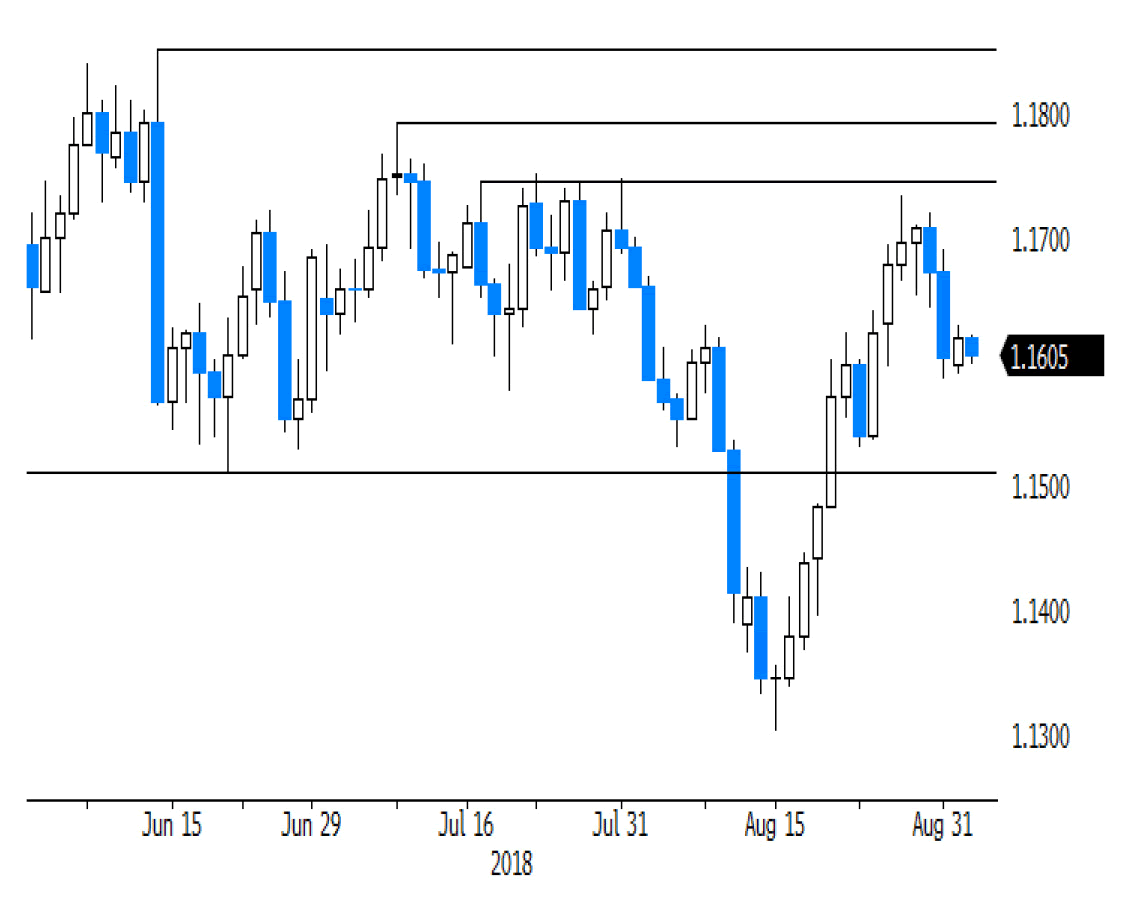
On Monday, the dollar held tight ranges and in low volume trading as US markets were closed. There was little news on the global trade issues. The EMU manufacturing PMI was confirmed at 54.6, but details from individual countries, especially Italy, were unconvincing. Still they didn't hurt the euro. EUR/USD hovered in a tight range mostly slightly north of 1.16. USD/JPY (close at 111.07) reversed an earlier dip. This morning, Asian markets are trading little changed. Markets especially look out for the next steps in the US trade policy. Caution prevails on most EM. EUR/USD is going nowhere (1.16 area). USD/JPY reversed an earlier dip as the BOJ step up the amount of JGBS purchases with short maturities. The RBA left its policy rate unchanged at 1.5%. The Bank kept a constructive tone on the economy but maintains a neutral policy bias. Today, the EMU calendar is thin. US investors receive the ISM manufacturing as they return from a long weekend. The headline ISM is expected to hold at a solid 57.6 (from 58.1). However, FX markets reacted only modestly to US data of late. The focus remains on US trade policy. Investors are looking out whether a constructive deal can be found with Canada and whether the president Trump will impose additional tariffs on Chinese imports. Uncertainty on trade recently weighed on markets outside the US and was tentatively supportive for the dollar. The USD correction from late August slowed last week. The EUR/USD rebound was blocked in the low 1.17 area. Eco fundamentals and uncertainty on trade are in theory USD supportive. We assume a EUR/USD break beyond 1.1791/1.1850 to be difficult as long as trade tensions persist. We keep a cautious negative bias on EUR/USD.
Yesterday, sterling came again under pressure as UK domestic discord on brexit returned to the forefront and as the UK manufacturing PMI unexpectedly declined to 52.6. EUR/GBP jumped back above 0.90. Overnight, BRC like for like sales slowed to 0.2% Y/Y (from 0.5%). Later today, BoE's Carney and other MPC members will testify on the August BoE inflation report and policy decision before parliament. One can expect the BoE to give a balanced assessment defending the rate hike. However, the next BoE step is probably still quite far away. We expect little support for sterling. The 0.91 area remains the next point of reference in case sentiment on sterling deteriorates further
EUR/USD awaiting guidance from next steps in US trade policy