

Sample Category Title
EURUSD Still Bearish Below 1.1650
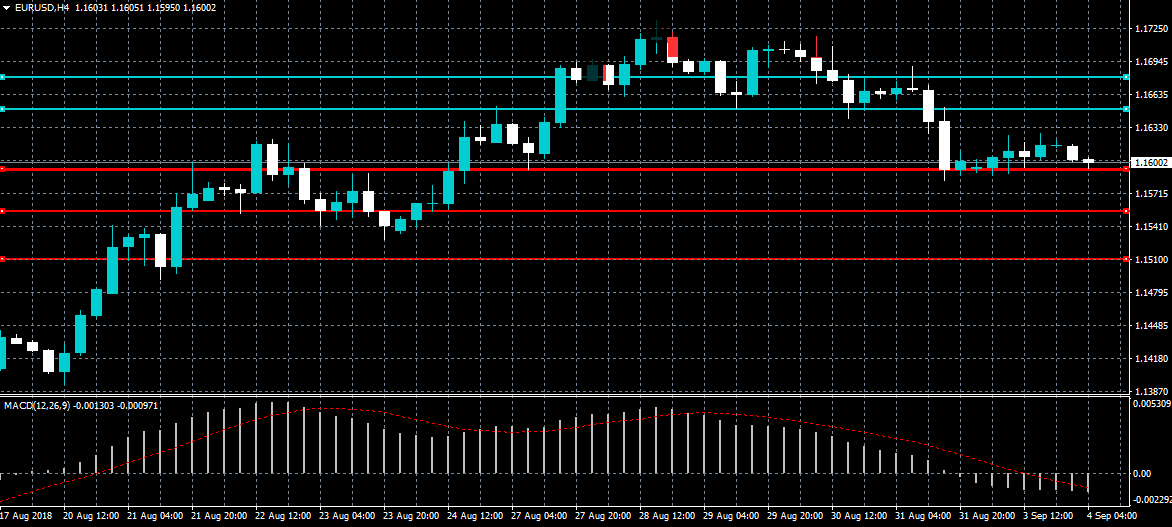
The euro currency is weakening back towards the 1.1600 level against the US dollar on Tuesday, as the greenback firms across the board. The EURUSD pair retains its intraday bearish bias while trading below the 1.1650 level, as it represents the neckline of a bearish head and shoulders pattern. Traders now look to eurozone PPI data and the ISM Manufacturing survey from the US economy.
The EURUSD pair remains intraday bearish while trading below the 1.1650 level, key technical support is found at the 1.1553 and 1.1500 levels.
If the EURUSD buyers move price above the 1.1650 level, further upside towards the 1.1681 and 1.1713 resistance levels remains possible.
GBPUSD Strongly Bearish Below 1.2863
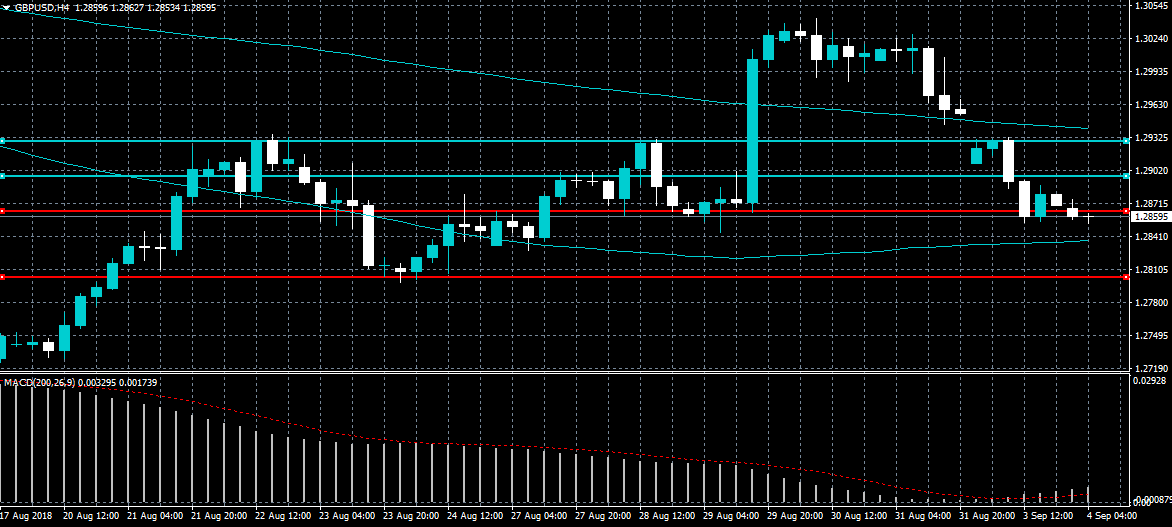
The British pound continues to drift lower against the US dollar in early Tuesday trade, as fears over a Brexit no-deal weigh on sterlings intraday sentiment. The GBPUSD pair is likely to weaken further while trading below the 1.2863 technical level, as it represents the start of last weeks spike higher. Traders now look to the release of the United Kingdom’s Construction PMI.
The GBPUSD pair is strongly bearish while trading below the 1.2863 level, key support is found at the 1.2810 and 1.2775 levels.
If the GBPUSD pair moves above the 1.2863 level, the price may correct back towards the 1.2900 and 1.2930 levels.
Bitcoin Upswing Following Etf Review BY The Sec
Over the past two weeks, the price of Bitcoin has moved higher from a low of $5800 to the current $7190. The upswing came as senior management of the Securities and Exchange Commission (SEC) started reviewing the reasons why the ETFs were rejected. Traders hope that the SEC will overturn the decision and allow ETFs, which they hope will attract more capital from investment managers.
Bitcoin expert and author, Andreas Antonopoulos, said that a Bitcoin ETF will happen. However, he cautioned that this will have a short-term boost to the price of Bitcoin and cause long-term harm. In a statement, he said: “ETFs fundamentally violates the underlying principle of peer-to-peer money, where each user is not operating through a custodian but has direct control of their money because they have direct control of their keys.”
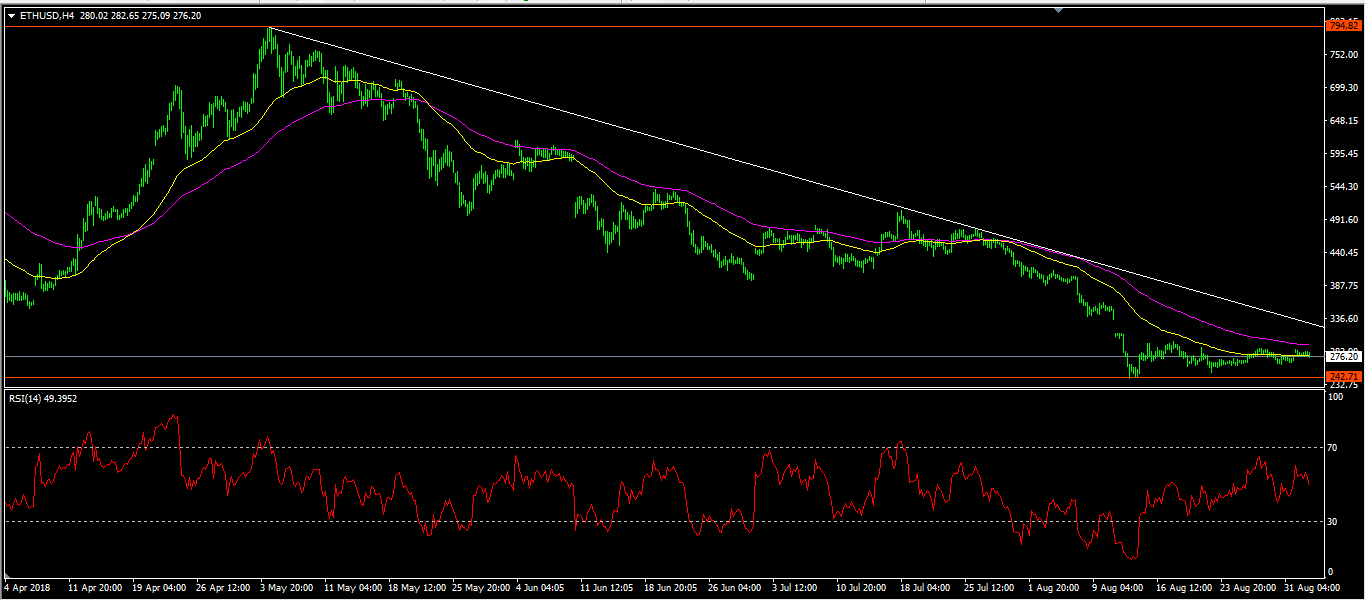
Meanwhile, the price of Ethereum has remained below the $300 level for more than two weeks. Ethereum traders ignored the news that the Chicago Board of Options Exchange (CBOE) will launch Ethereum futures by the end of the year. The lack of movement in the ETH price was probably because of the lessons that came with the listing of Bitcoin futures at the CBOE and CME. Instead of increasing demand for Bitcoin, most investors shorted Bitcoin causing its price to fall sharply.
In early May, the ETH/USD pair reached a high of 795. Since then, it started a sharp decline that saw it reach a year-to-date low of 242 in early August. It is now trading at 275, which is in line with the 50-day moving average. The pair is likely to follow Bitcoin, which has made some gains in recent weeks. If this happens, it will trade above the 300 level.
Sterling Falls As Traders Wait For Inflation Hearings
The Australian dollar is lower ahead of the interest rate decision by the RBA. The bank is expected to leave rates unchanged although the accompanying monetary policy statement (MPC) will be watched closely. Australia has experienced a few economic problems this year that could make it difficult for the RBA to hike. It has had a major drought that has affected the most populated areas while the housing market has continued to deteriorate in Sydney and Melbourne.
The upward momentum started by the sterling two weeks ago eased yesterday when the GBP/USD pair fell. Today, the pair is trading lower ahead of important inflation hearings. During these hearings, the central bank governor and a few of his colleagues will testify before Parliament on the status of inflation. These will be the first hearings after the bank hiked interest rates in July. The Chartered Institute of Purchasing and Supply (CIPS) will also release important construction PMI data. Traders expect activity in the construction industry to fall to 54.9 in August from July’s rise of 55.8.
The dollar traded higher against its peers in the Asian session as Emerging Markets (EM) worries continues to rise. In recent weeks, leading EM countries like Turkey, Argentina, South Africa, and Indonesia have seen their currencies fall leading to huge losses by EM investors. Yesterday, it was reported that American money manager Franklin Templeton lost more than $1.5 billion last week as Argentina’s peso crashed. Today, the Institute of Supply Management (ISM) will release the PMI data for August. Traders expect the PMI to ease a bit to 57.6 in August from a 58.1 increase in July.
EUR/USD
Yesterday, the EUR/USD pair was little moved as the US participants celebrated the Labour Day weekend. It is now trading at 1.1600. This level is below an important support which the pair crossed yesterday. It is also in line with the 61.8% Fibonacci Retracement level. If the pair moves downwards, it will likely test the 1.1550 level, which is in line with the 50% Fibonacci Retracement level. If the pair moves higher, it will test the important resistance level of 1.1700.EURUSD

GBP/USD
Last week, the GBP/USD pair started falling after reaching the 1.3040 level. The declines were mostly because of the disagreements between the EU and the UK on Brexit. It is now trading at the 1.2857 level, which is the lowest since Thursday. Today’s inflation hearings and the inflation data will likely be the highlight of the day. If sterling continues to weaken, there is a possibility that it will test the 1.2800 support level.

XAU/USD
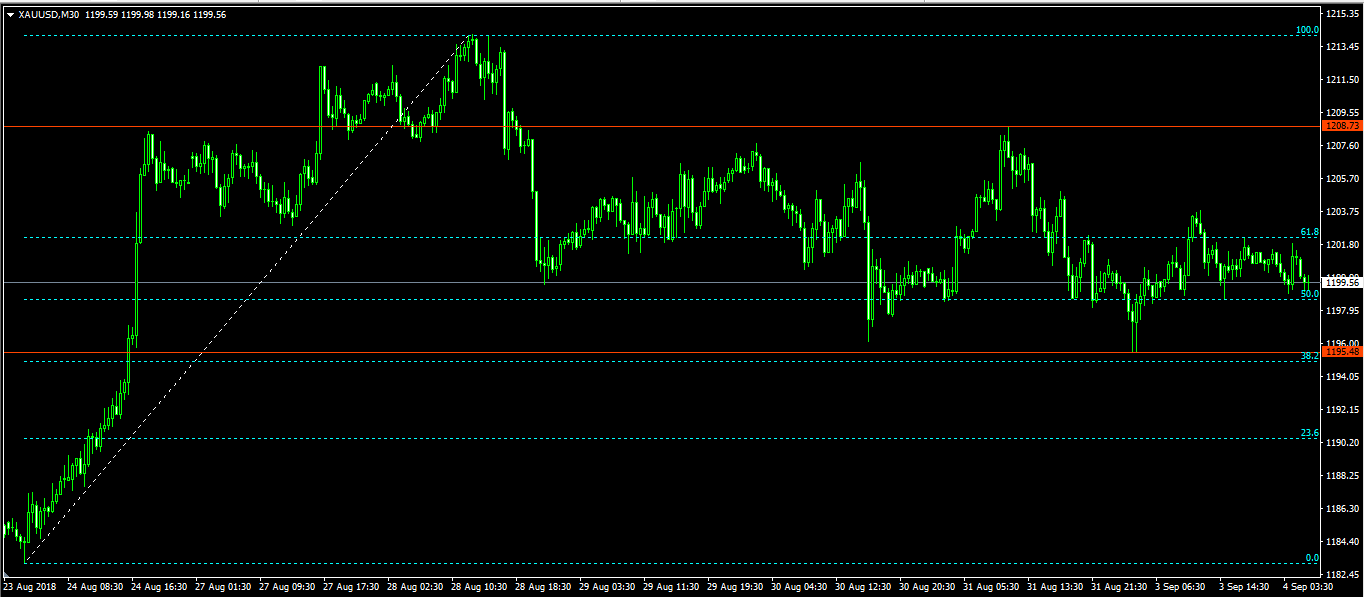
In the past three days, the XAU/USD pair has traded within the narrow range of 1195.48 and 1208.73. It is now trading at 1200, which is an important technical and psychological level. It is also along the 50% Fibonacci Retracement level. The movement on the pair will depend on the dollar strength or weakness. A stronger dollar will see the pair test the 1195 support while a weaker dollar will see it test the 1205 resistance.
More Pain For Emerging Markets?
Asian equities were mixed on Tuesday as U.S. markets were closed on Monday and investors continued to price in a further escalation of trade tensions between the U.S. and China. When broad tariffs on steel and aluminum were first imposed in March, it was seen as a cold war that may soon be resolved after some negotiations. After six months it seems there are no signs of this trade war ending anytime soon. Markets are expecting now that the U.S. will impose an additional $200 billion on Chinese imports as soon as Thursday when public consultations end. This will not only harm the two largest economies but would severely disrupt global supply chains, particularly emerging markets which may see their currencies fall further in the weeks ahead.
FX traders were focused on the free fall of the Argentina Peso and Turkish Lira which have both lost half their value this year. However, Indonesia’s rupiah fell to its weakest level since the 1998 Asian financial crisis, the Indian and Sri Lankan Rupee dropped to all-time lows, and a whole range of other emerging market currencies continue to lose ground this year forcing their central banks to take action.
Trade tensions are not the only factordragging emerging currencies lower against the dollar. It’s the end of QE and a decade of near-zero interest rates that are hitting emerging markets and expect the situation to become even worse if the U.S. Federal Reserve doesn’t slow down the tightening of its monetary policy. Weaker currencies mean that dollar-denominated debt will be harder to pay off, businesses will cut off expansion plans, consumers will slow down spending, and the risk of default begins to rise. The only way governments can react is to implement austerity measures and raise interest rates which will deepen the economic slowdown further.
High oil prices will also magnify problems in emerging markets problem. With Brent near $80 per barrel, consumption is expected to take a big hit in the coming months, so expect global demand to begin slowing down significantly. That’s why current oil prices do not seem to be sustainable even if Iranian exports dropped by 1 million barrels by November. I think it’s in everyone’s interest to see oil return to a range of $60-$70 to help prevent a contagion of the emerging markets crisis.
USD/JPY Testing Fibonacci Resistance Levels Of Wave B
The USD/JPY has indeed made a pullback to the Fibonacci retracement levels of wave B vs A (purple). A bearish breakout below the support trend line (blue) could confirm the continuation of wave Y (pink) of wave E (purple), whereas a bullish breakout would invalidate this pattern, and would indicate a potentially larger wave X (pink) correction.
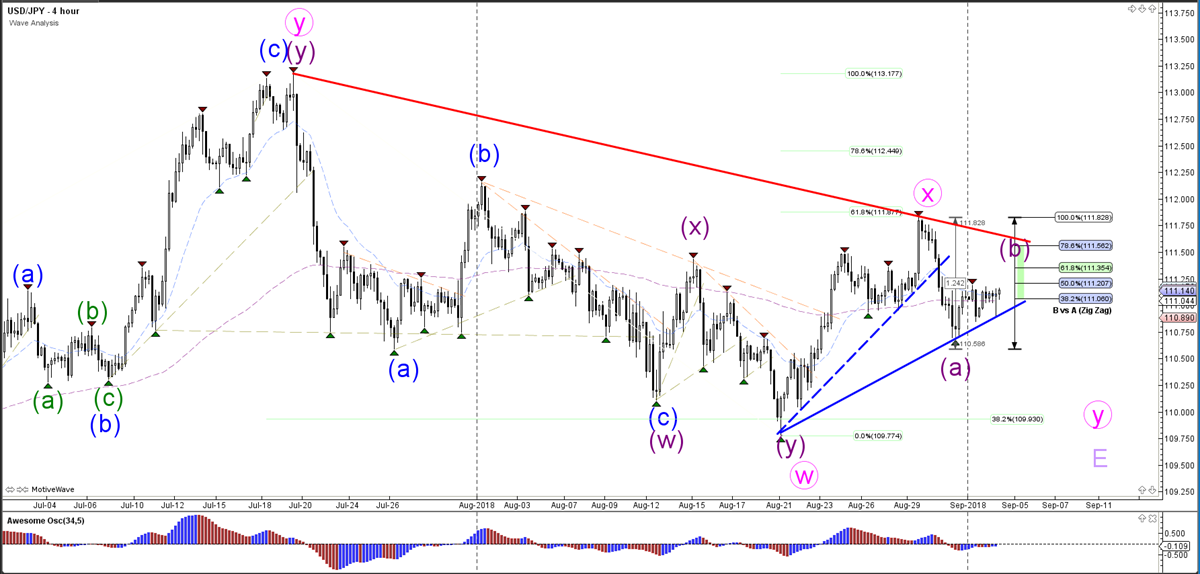
The USD/JPY seems to be building a bullish ABC (blue) zigzag corrective pattern within wave B (purple). If the ABC is correct, then the price is expected to bounce at the Fibonacci levels of wave B (purple), and then break below the support trend line for a bearish breakout.

Bearish GBP/USD Shows Impulsive Wave-3 Price Action
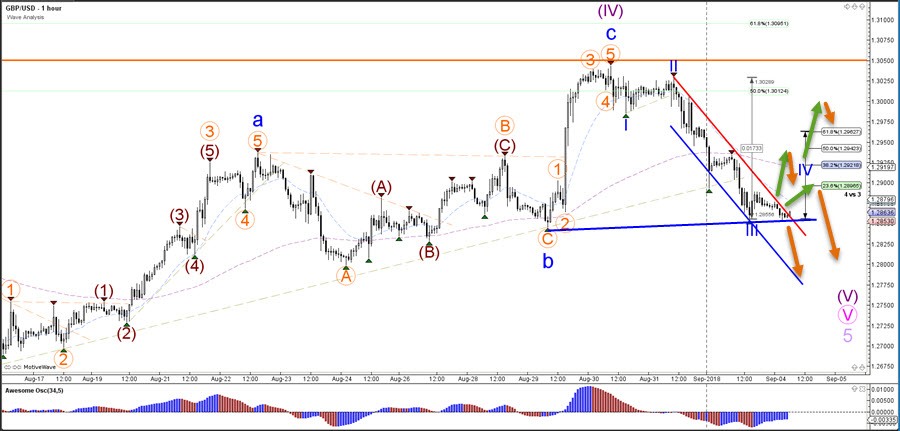
The GBP/USD made a bearish breakout below the support trend line (blue), which is indicating the potential end of a wave 4 (purple) and a bearish continuation within waves 5.
The GBP/USD remains in a downtrend and the bullish price action seems to be a pullback rather than a reversal.

The GBP/USD bearish channel could have completed a wave 3 (blue), although price can extend the 3rd wave if price breaks below the support trend line. A pullback could be part of a wave 4 (blue) and bounce at the Fibonacci levels of wave 4 vs 3. The 5 wave pattern could finish a potential wave 1 of wave 5 rather than the wave 5. A break above the 38.2-50% Fibonacci retracement level of wave 4 could indicate that 5 waves have already been completed at the recent low.
Elliott Wave View: Netflix Pullbacks Should Remain Supported
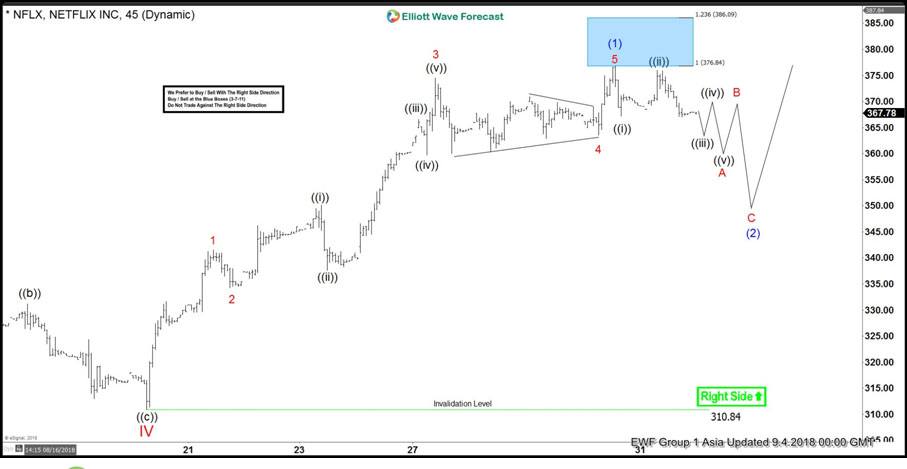
Netflix ticker symbol: $NFLX short-term Elliott wave view suggests that the decline to $310.84 low ended cycle degree wave “IV” pullback. Up from there, cycle degree wave “V” can have started but a break above $423.21 6/21/2018 high remains to be seen for final confirmation. Above from $310.84 low, the rally higher $376.81 high ended intermediate wave (1). The internals of that rally unfolded in 5 waves impulse structure with the sub-division of 5 waves structure in lesser degree cycles in Minor wave 1, 3 & 5.
Up from $310.84 low, the initial rally to $341.50 high ended Minor 1 in lesser degree 5 waves. The pullback to $334.30 low ended Minor wave 2. Then the rally higher towards $374.49 high ended Minor wave 3 in lesser degree 5 waves structure. Down from there, the pullback to $363.54 low ended Minor wave 4. Finally, a rally higher to $376.81 high ended Minor wave 5 & also completed intermediate wave (1). Currently, the stock is doing a pullback in intermediate wave (2) & expected to unfold in lesser degree Zigzag correction before the rally resumes again provided the pivot at $310.84 low stays intact. We don’t like selling it and prefer more upside against $310.84 low.
Netflix 1 Hour Elliott Wave Chart
Emerging Markets Put To Work On Labour Day
Market movers today
In the US, ISM manufacturing is due out today. It has been very high for a long time compared to both hard data and the Markit PMI manufacturing index. It remains our base case that ISM will fall over in the coming months and we expect that the index was 57.3 in August versus 58.1 in July.
In the UK, BoE Governor Mark Carney, Chief Economist Andy Haldane and MPC members Silvana Tenreyro and Michael Saunders testify before parliament's Treasury Committee today. Watch out for any comments on whether to expect further hikes in the short term. We think the next hike is unlikely to occur before May.
In Denmark, we get currency reserves data this afternoon. We are not far from the levels at which Danmarks Nationalbank has previously intervened in support of the Danish krone. As we still did not reach that level in August, we think Danmarks Nationalbank did not intervene last month.
Selected market news
While the US was closed for Labour Day, emerging markets were put to work amid thinner-than-usual USD liquidity, with both Argentina and Turkey testing investor confidence.
Turkish data showed yesterday that inflation accelerated to 17.9% y/y in August - the highest level for 15 years and far from the target of 5%. This led the Turkish central bank (TCMB) to announce that it will 'adjust' its policy at its meeting next week, and we now expect a rate hike. TRY remains vulnerable in our view though, as markets sense that any action will be 'too little, too late' to stem the lira. Indeed, we doubt that president Erdogan will be willing to accept a rate hike of the 600-700bp at least that we deem is required to turn sentiment around, as he likely fears its adverse consequences for growth.
Later in the day, Argentina's president Macri presented a large package of austerity measures in a renewed attempt to stem the currency crisis. Macri acknowledged that foreign investors were signalling his country has been 'living beyond its means', but a seeming lack of coordination with the IMF - which is already heavily involved in Argentina - served to limit the immediate effect on markets from the new measures. That said, the announced tax on exporters could bring some relief to the ARS down the road in our view.
Overnight, the Reserve Bank of Australia (RBA) held its cash target rate unchanged at 1.50% as widely expected, which led to a jump in AUD/USD on slightly hawkish comments from Governor Lowe. Equities were mixed in Asia and US equity futures trading alike. Similarly, futures trading also hinted at only small moves in US Treasury yields.
This morning, the Maklarstatistik revealed that Swedish house prices were unchanged on the month in August; apartment prices rose 1% during the month. We still see the Swedish property market being under pressure near term and being a hindrance for the Riksbank. Indeed, the Riksbank may delay the timing of its first hike later this week.
Asian Equities Move Between Gains And Losses Amid Lack Of Leads Due To US Holiday
General Trend:
- Little news seen in the RBA’s policy statement
- Fast Retailing is expected to report Aug sales after the close
- Australia Q2 GDP due for release on Wed
Headlines/Economic Data
Australia/New Zealand
- ASX 200 opened -0.2%
- ASX 200 Telecom index +0.1%, REIT +0.1%; Energy -1.2%, Financials -0.9%, Utilities -0.7%, Consumer Discretionary -0.2%, Resources -0.2%
- (AU) RESERVE BANK OF AUSTRALIA (RBA) LEAVES RATES UNCHANGED AT 1.50% (AS EXPECTED); In the first half of 2018, the economy is estimated to have grown at an above-trend rate.
- (AU) AUSTRALIA Q2 BOP CURRENT ACCOUNT BALANCE: -A$13.5B V –A$11.0BE; NET EXPORTS OF GDP: 0.1 V 0.1E
- (NZ) New Zealand Commission will not consider deregulating mobile roaming
China/Hong Kong
- Shanghai Composite opened flat, Hang Seng -0.3%
- Hang Seng Info Tech index +1.3%, Services +0.3%, Telecom +0.2%; Consumer Goods -0.3%, Financials -0.3%, Energy -0.2%, Property/Construction -0.1%
- (CN) China PBoC set yuan reference rate: 6.8183 v 6.8347 prior
- (CN) China PBoC Open Market Operation (OMO): Skips OMO (10th straight skip)
- (CN) China said to make revisions to the repayment rules for local government bonds, to raise the limits for commercial banks investments in local gov't bonds - Chinese Press
- (HK) Hong Kong may consider additional curbs on home purchases - HK Press
Japan
- Nikkei 225 opened +0.1%
- TOPIX Iron & Steel index -0.3%, Marine Transportation -0.1%; Securities +0.8%, Electric Appliances +0.2%, Real Estate +0.2%, Retail Trade flat
- (JP) BoJ announcement related to daily bond buying operation; Increases daily purchases of 1-3 and 3-5 year JGBs
- (JP) Japan Aug Monetary Base End of Period: ¥502T v ¥501.7Te; Y/Y: 6.9% v 7.0% prior
- (JP) Japan Finance Min Aso: Initial budget request for FY19 is likely around ¥102T (as speculated); Reiterates need to think about getting companies to use cash stores
- (JP) Japan FSA said to consider probe into the real estate loans of regional banks- Japanese Press
Korea
- Kospi opened +0.1%
- (KR) South Korea Q2 Final GDP Q/Q: 0.6% v 0.7%e; Y/Y: 2.8% v 2.9%e
- (KR) South Korea Aug CPI M/M: 0.5% v 0.4%e; Y/Y: 1.4% v 1.4%e
- (KR) Fitch: South Korea budget might add to long-term challenges
North America
- (US) National Hurricane Center (NHC): Tropical Storm Gordon is strengthening as it moves away from Florida, expected to be a hurricane when it makes landfall
- Anadarko Petroleum: Shut oil and gas production at two platforms in the Gulf of Mexico due to the approach of Tropical Storm Gordon - financial press
- (AR) Argentina Fin Min Dujovne: Sets 2018 Primary fiscal deficit target to GDP of 2.6%; seek to balance budget in 2020; To impose temporary tax on exports through Dec 2020
Europe
- (UK) UK Chancellor of the Exchequer Hammond (Fin Min) may unveil the budget by as early as Oct - UK Press
- (UK) UK Aug BRC Life-For-Like Sales Y/Y: 0.2% v 0.5% prior (weakest reading since April)
- (UK) FTSE100 Quarterly Review is expected on Wed (Sept 5th), no changes are expected to the index - US financial press
- (EU) ECB Weidmann (Germany) said the digital revolution only has a small impact on inflation – financial press
Levels as of 01:30ET
- Nikkei 225, -0.2%, ASX 200 +0.1%, Hang Seng +0.1%; Shanghai Composite -0.1%; Kospi +0.3%
- Equity Futures: S&P500 +0.2%; Nasdaq100 +0.2%, Dax flat; FTSE100 +0.1%
- EUR 1.1625-1.1594 ; JPY 111.17-110.89 ; AUD 0.7216-0.7186 ;NZD 0.6607-0.6586
- Aug Gold -0.1% at $1,205/oz; Sept Crude Oil +0.3% at $70.04/brl; Sept Copper flat at $2.656 /lb