Sample Category Title
GBP/JPY Daily Outlook
Daily Pivots: (S1) 142.57; (P) 143.30; (R1) 143.76; More...
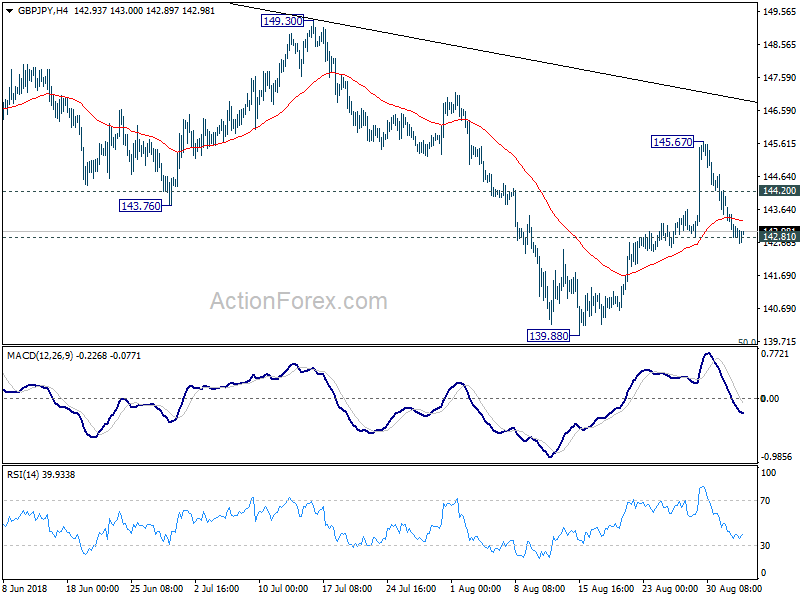
GBP/JPY's breach of 142.81 minor support argues that rebound from 139.88 has completed at 145.67. Intraday bias is back on the downside for retesting 139.88 first. Break will target 139.29/47 key support zone. On the upside, above 144.20 minor resistance will turn bias back to the upside for 145.67 and possibly above.
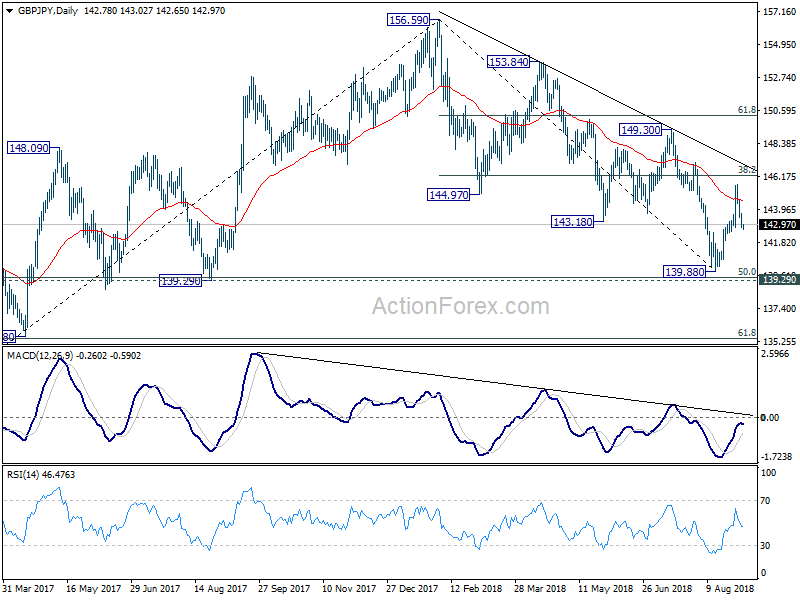
In the bigger picture, at this point decline from 156.59 is still seen as a corrective move. Focus remains on 139.29 cluster support (50% retracement of 122.36 to 156.59 at 139.47). Strong rebound from there will re-affirm the bullish case that rise from 122.36 is still to extend through 156.59 high. However, sustained break of 139.29/47 should confirm medium term reversal. GBP/JPY would then target a retest on 122.26 (2016 low).
EUR/JPY Daily Outlook
Daily Pivots: (S1) 128.70; (P) 128.93; (R1) 129.28; More....
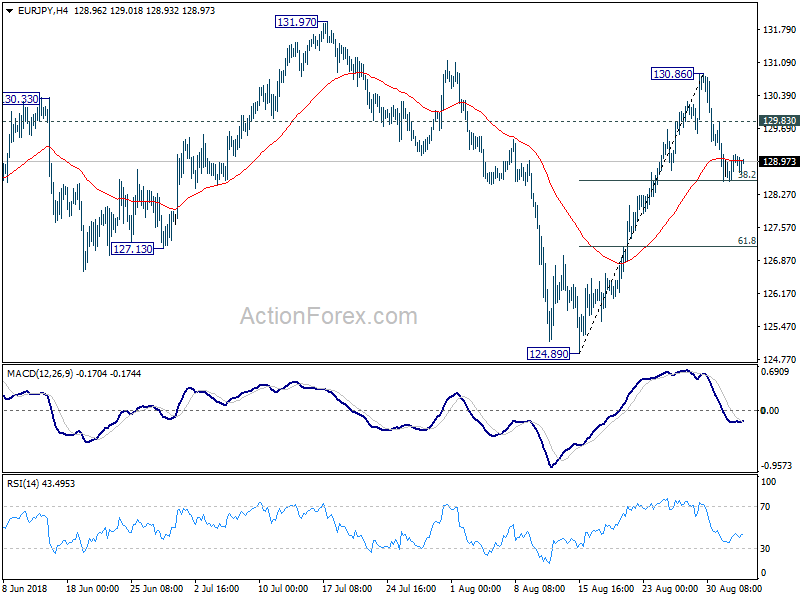
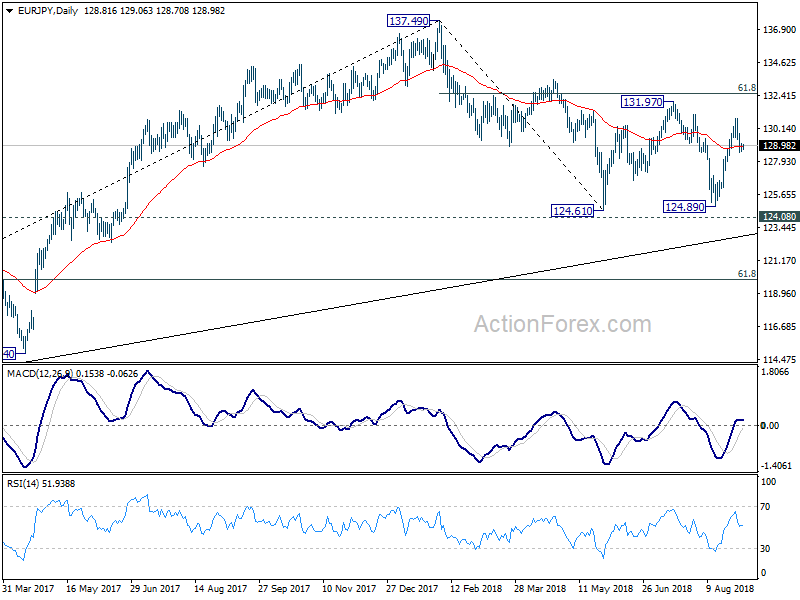
Intraday bias in EUR/JPY stays neutral with focus on 38.2% retracement of 124.89 to 130.86 at 128.57. As long as 128.57 holds, another rise is still mildly in favor. On the upside, above 129.83 minor resistance will turn bias back to the upside for 130.86 first and then resistance zone between 131.97 and 61.8% retracement of 137.49 to 124.61 at 132.56. However, firm break of 128.57 will argue that rebound from 124.89 has completed, and it's the third leg of consolidation pattern from 124.61. In that case, intraday bias will be turned back to the downside for 124.61/89.
In the bigger picture, EUR/JPY once again rebounded ahead of 124.08 key resistance turned support. It's also held well above long term trend line from 109.03 (2016 low). The development argues that such rise from 109.03 might not be over yet. Decisive break of 61.8% retracement of 137.49 to 124.61 at 132.56 will pave the way to retest 137.49 high. But, firm break of 124.08 will argue that whole rise from 109.03 (2016 low) has completed at 137.49. Deeper decline would be seen to 61.8% retracement of 109.03 to 137.49 at 119.90 next.
Australian Dollar Supported by Dull RBA Statement, Canadian Dollar Weakens Further
The forex markets are rather quiet in Asian session today, with the exception of some notable weakness in Canadian Dollar. Euro is so far the weakest one but it's kept above yesterday's low. Sterling follows as second weakest together with Loonie. On the other hand, Dollar, Australia and New Zealand Dollar are the strongest one so far. Aussie is in consolidation after last week's steep selloff. As there is no dovish surprise in RBA statement, Aussie will likely be supported for some more sideway trading in near term.
In other markets, Asian stocks stabilized from yesterday's weakness and tread water today. At the time of writing, Nikkei is down -0.14%, China Shanghai SSE is down -0.06%, Hong Kong HSI is up 0.03%, Singapore Strait Times is down -0.08%. 10 year JGB yield is down -0.0066 at 0.113, which is firm. WTI crude oil continues to hover just around 70 handle. Gold dips back below 1200 as consolidation continues. But loss is very limited.
Technically, USD/CAD's breach of near term channel resistance suggests that corrective fall from 1.3385 might be completed at 1.2886 already. Focus will be on 1.3173 resistance today for confirmation of this bullish implication. GBP/JPY breached 142.81 support but there is no follow through selling yet. GBP/USD is also held above 1.2844 equivalent support. UK construction PMI will probably provide the trigger for making or breaking this level.
RBA kept cash rate unchanged at 1.50%, issued carbon copy statement
RBA kept cash rate unchanged at 1.50%. The accompany statement is over 90% a carbon copy of the prior one.
Globally, RBA noted that advanced economies are growing at above-trend rate with low unemployment which China's growth slowed a little. Inflation remains low but further increases are expected. There is one ongoing uncertainty due to US international trade policy. Domestically, RBA maintain the forecasts of a bit above 3% growth in 2018 and 2019. Household consumption is one continuing source of uncertainty.
Terms of trade are expected to decline over time but stay at relatively high level. Australian Dollar has "depreciated against the US dollar along with most other currencies."
Labor market outlook remains positive and further gradual decline in unemployment is expected to around 5%. Wage grow should pick up over time, gradually. Inflation is expected to slow to 1.75% in Q3 due to once-off declines in some administered prices. But it's expected to pick up in 2019 and 2020.
BoE Carney's future to be asked in inflation report hearing
BoE Governor Mark Carney will appear in the Parliament for Inflation Report hearing today. While his views on the economy and interest rates will be scrutinized as usual, there's another topic to watch. That is, whether Carney will extend his term or not.
The BBC reported yesterday that Treasury is in talks for extending Carney's term once more. Carney, started the job in 2013, originally planned to just serve just five years and has already extended the term once to mid 2019. On the other hand, the government's spokesman James Slack reiterated that "the governor has said that he intends to step down in 2019. That is still the plan,"
To stay or not to stay is definitely a questions to be asked by lawmakers today.
For now, it's uncertain who will succeed Carney. It appears that Andrew Bailey the chief executive of Britain's Financial Conduct Authority and a former BoE deputy governor, is a front-runner. But the government could look abroad again for the candidate.
Reuters poll showed chance disorder Brexit at 25%
According to a Reuters poll conducted between August 29 and September 3, chance of disorderly Brexit stood at 25%, unchanged from a month ago. Opinions were divided as nine of the 34 contributors raised the chance, but four lowered the odds. Highest prediction was 60% chance.
Nevertheless, chance of a recession in the year post-Brexit was seen at 15%, down from July's 20%. Chance for recessions within two year of Brexit was at 25%.
On BoE policies, the poll suggested that the central bank would have a 25bps rate hike soon after March 2019 Brexit date. Then, another 25bps would be added in 2020.
Japan PM Abe to raise retirement age beyond 65
Japan Prime Minister Shinzo Abe said in a Nikkei Asian Review interview that while, BoJ hasn't reached the 2% inflation target yet, Japan is "no longer in deflation". And Abe emphasized "what we are really focused on is employment." He outlined a plan to overhaul the social security system for the new three years.
Abe intend to raise retirement age beyond 65. And he said "more labor participation would boost economic growth, raise tax revenue and generate more social security premium receipts." The first year of his next three year term will focus on labor issues. Pension and medical care system will be tackled in the following two years.
Additionally, Abe pledged to ease the impact of the planned sales take hikes, from 8% to 10% with "bold countermeasures".
He also played down the threats of US trade policy and said "the U.S. and Japan share a broader goal of expanding bilateral trade and investment for the benefit of both countries and achieving a free and open Indo-Pacific based on fair trade."
Abe will compete with former Defense Minister Shigeru Ishiba in a ruling party leadership contest on September 20.
On the data front
UK BRC sales monitor rose 0.2% yoy in August. Japan monetary base rose 6.9% yoy in August. Australia current account deficit widened to AUD -13.5B in Q2.
Swiss will release CPI in European session and Eurozone will release PPI. But UK construction PMI will catch more attention.
Later in the day, US ISM manufacturing in the major focus and construction spending will also be featured. Canada will release PMI manufacturing.
AUD/USD Daily Outlook
Daily Pivots: (S1) 0.7179; (P) 0.7202; (R1) 0.7237; More...
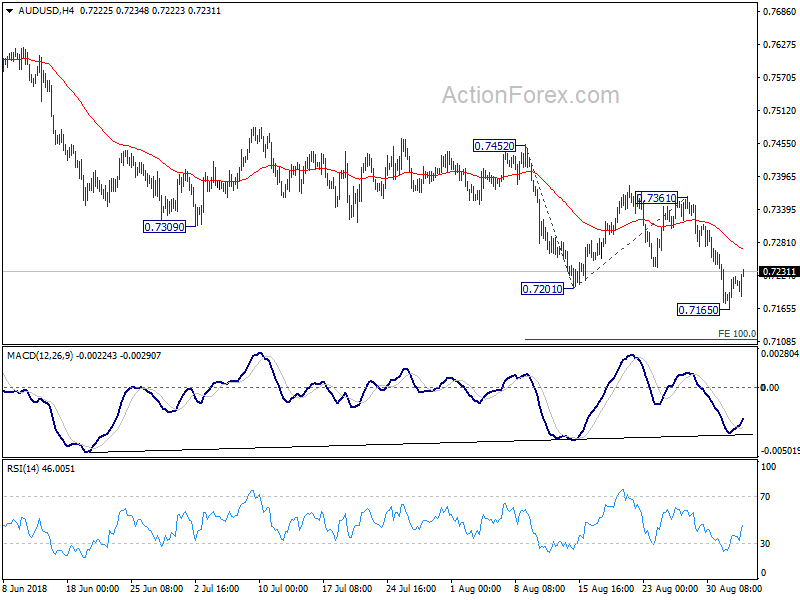
With 4 hour MACD crossed above signal line, a temporary low is in place at 0.7165 in AUD/USD. Intraday bias is turned neutral for consolidation. Stronger recovery could be seen back to 4 hour 55 EMA (now at 0.7269. But upside should be limited well below 0.7361 resistance to bring fall resumption. On the downside, below 0.7165 will target 100% projection of 0.7452 to 0.7201 from 0.7361 at 0.7110. Break will target 161.8% projection at 0.6955.
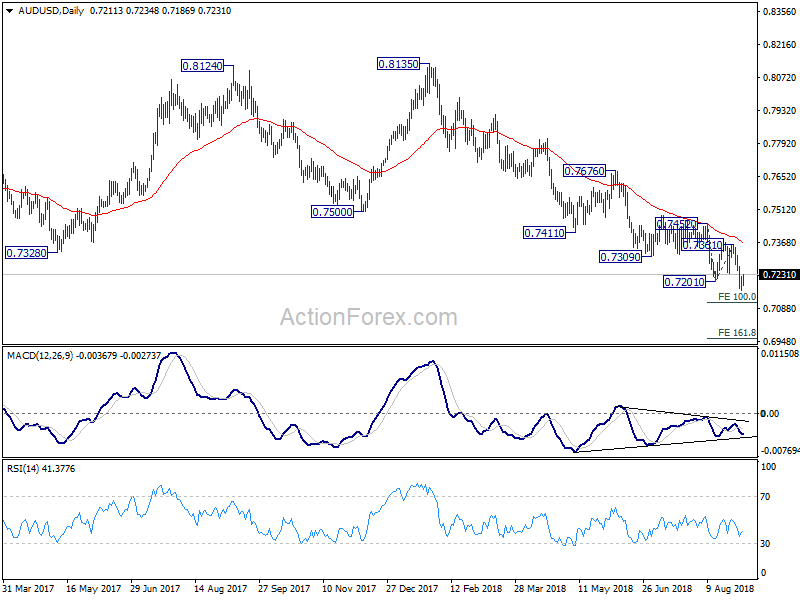
In the bigger picture, rebound from 0.6826 (2016 low) is seen as a corrective move that should be completed at 0.8135. Fall from there would extend to have a test on 0.6826. There is prospect of resuming long term down trend from 1.1079 (2011 high). But we'll look at downside momentum to assess at a later stage. On the upside, break of 0.7452 resistance, however, will indicate medium term bottoming, on bullish convergence condition in daily MACD. In that case, a medium term correction should be seen first before down trend resumption.
Economic Indicators Update
| GMT | Ccy | Events | Actual | Forecast | Previous | Revised |
|---|---|---|---|---|---|---|
| 23:01 | GBP | BRC Sales Monitor Y/Y Aug | 0.20% | 1.20% | 0.50% | |
| 23:50 | JPY | Monetary Base Y/Y Aug | 6.90% | 6.30% | 7.00% | |
| 01:30 | AUD | Current Account Balance (AUD) Q2 | -13.5B | -11.1B | -10.5B | -11.7B |
| 04:30 | AUD | RBA Rate Decision | 1.50% | 1.50% | ||
| 07:15 | CHF | CPI M/M Aug | 0.00% | -0.20% | ||
| 07:15 | CHF | CPI Y/Y Aug | 1.00% | 1.20% | ||
| 08:30 | GBP | Construction PMI Aug | 54.9 | 55.8 | ||
| 09:00 | EUR | Eurozone PPI M/M Jul | 0.10% | 0.40% | ||
| 09:00 | EUR | Eurozone PPI Y/Y Jul | 4.30% | 3.60% | ||
| 13:30 | CAD | Manufacturing PMI Aug | 56.9 | |||
| 13:45 | USD | Manufacturing PMI Aug F | 54.5 | 54.5 | ||
| 14:00 | USD | Construction Spending M/M Jul | 0.50% | -1.10% | ||
| 14:00 | USD | ISM Manufacturing Aug | 57.8 | 58.1 | ||
| 14:00 | USD | ISM Prices Paid Aug | 74 | 73.2 | ||
| 14:00 | USD | ISM Employment Aug | 56.5 |
BOC Preview – Growth Upbeat, Just Not Justifies Another Rate Hike Until October
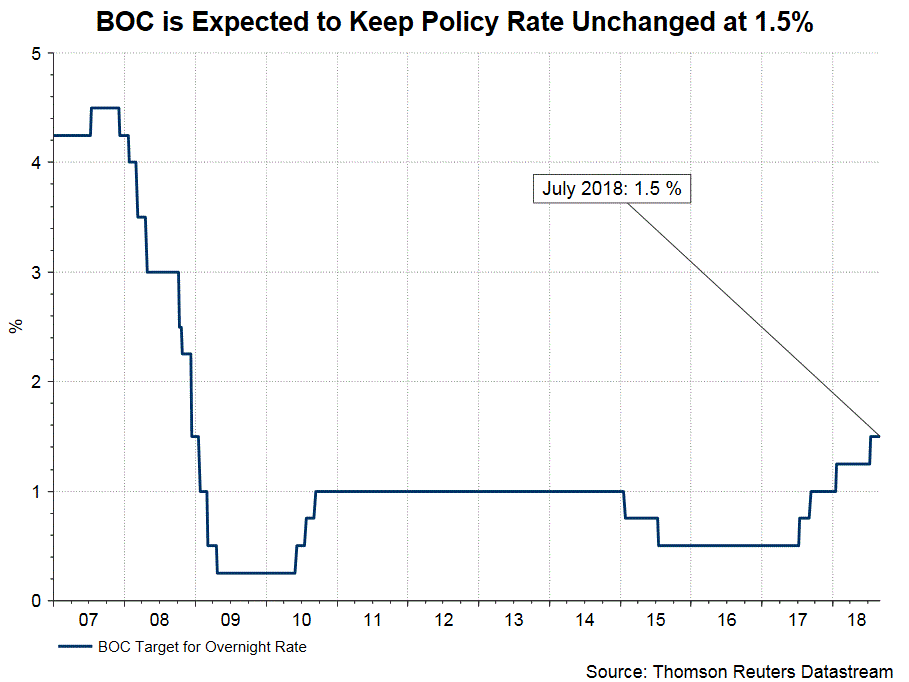
Recent upbeat macroeconomic data has lifted speculations for a BOC rate hike in September. Yet, we do not expect the developments since the last meeting should change the central bank’s gradual normalization policy. Policymakers should bear in mind the lesson of a back-to-back rate hike (July and September) last year – a stronger than expected moderation in economic growth and inflation. Meanwhile, as the outcome of NAFTA negotiations appears highly uncertain, the central bank would prefer to take a more cautious approach on the monetary policy decisions. As such, a rate hike in October, rather than in September, is more justified.
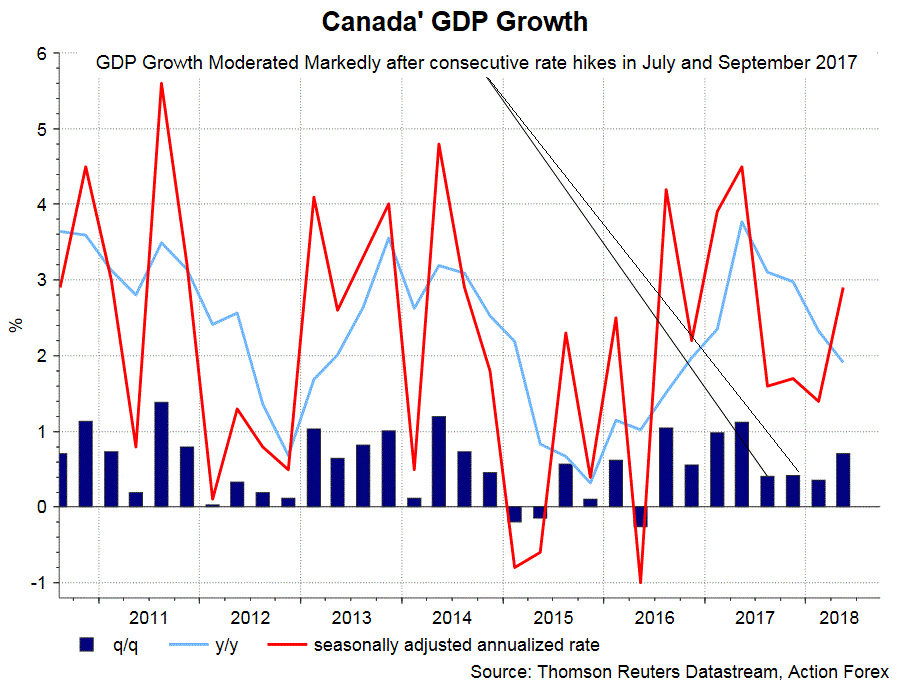
GDP expanded +2.9% q/q (annualized) in 2Q18, up from +1.4% a quarter ago. While this has missed market expectations of +3%, it came in above BOC’s estimate of +2.8%. The details suggest resilient domestic demand, accompanied by surging exports. Indeed, trade for the first time this year contributed to economic growth. Growth was +5.2% in the good-producing sector, compared with +2.7% in the service-producing sector.
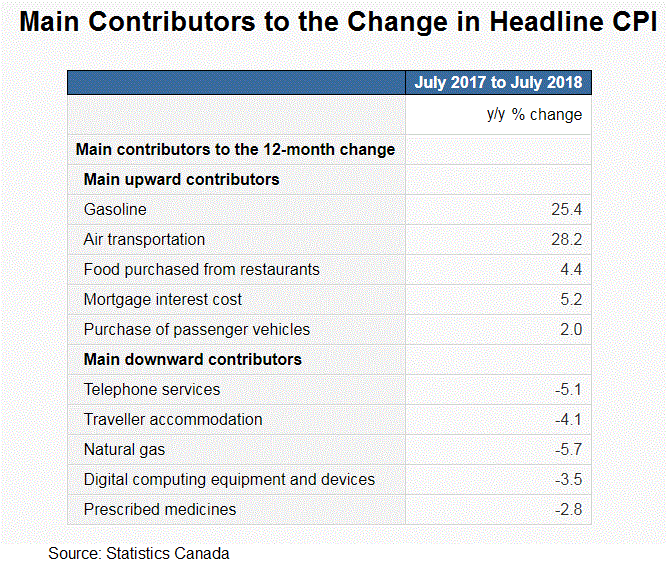
Headline inflation accelerated to +3% y/y in July, beat consensus of, and July’s, +2.5%. Despite the rise to almost a 7-year high, much of it was driven by temporary factors- higher gasoline price and air transportation cost.
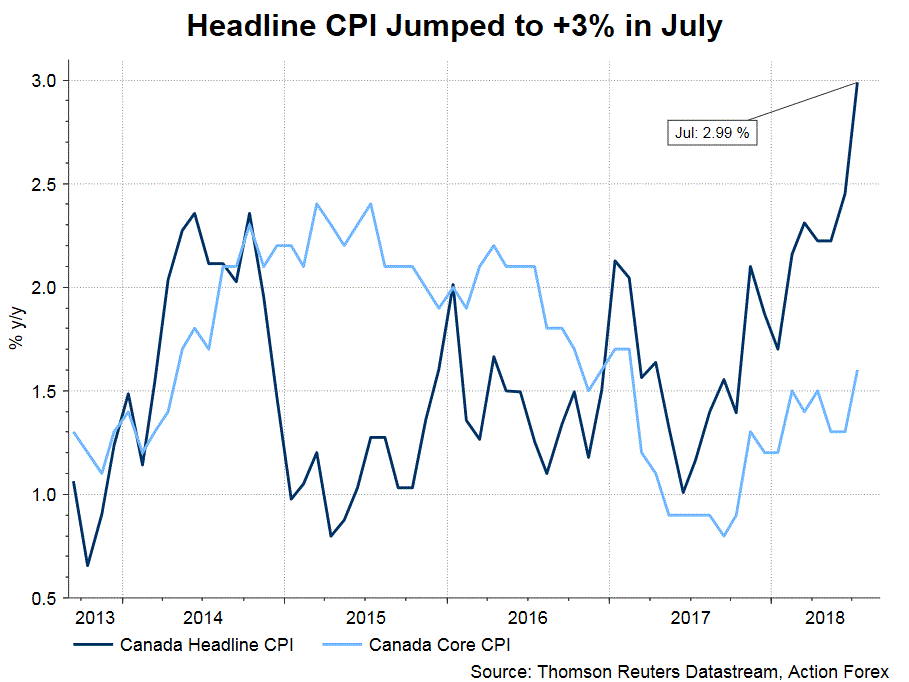
The various core measures suggested underlying inflation has stayed around +2%. BOC core CPI climbed higher to +1.6% y/y, from +1.3% in June, while the median and trim CPI readings were at +2% (June: +2%) and +2.1% (June: +2.1%), respectively. While inflation has progressed on track, there is no overheating that requires acceleration of policy tightening.
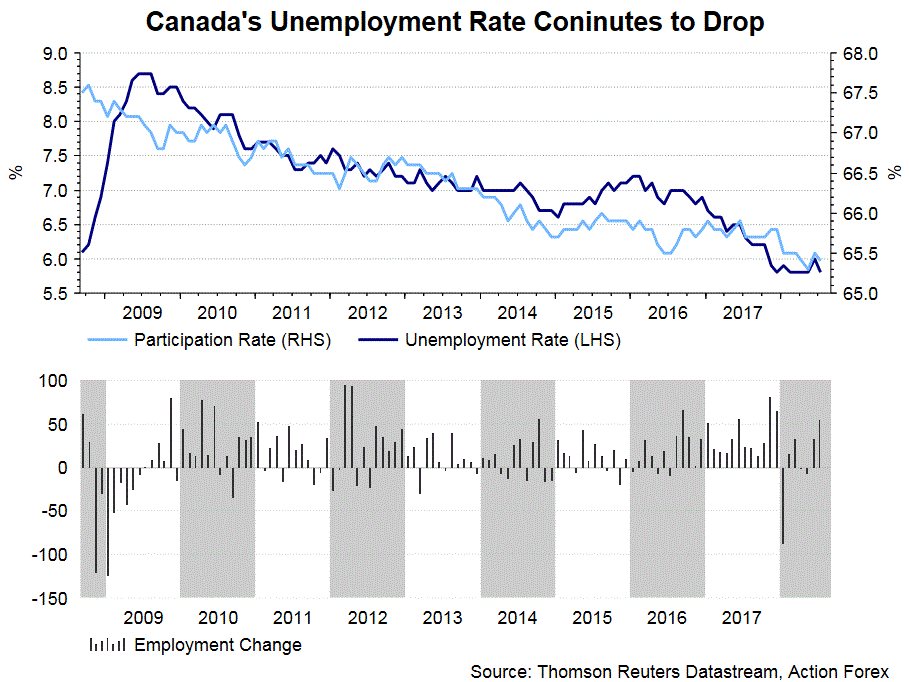
 The job market continues to improve, with the unemployment rate falling to 5.8% in July, from 6% a month ago. However, the increase in payrolls mainly came from part-time jobs, which added +82K in July (June +22.7K), while full-time jobs actually contracted -28K (June: +9.1K). Average weekly earnings climbed higher to +2.8% in June, from a downwardly revised +2.75% in the prior month. Overall, employment situation is resilient, remaining on track but not calling for faster rate hike.
On trade issues, the US and Canada failed to strike a deal last Friday with talks expected to resume on Wednesday. The US and Mexico announced in late-August that they have reached a bilateral trade deal. It is believed that Trump attempts to force Canada to join their deal, thus converting the bilateral deal to a trilateral one and replacing NAFTA. As we mentioned in a previous report, the most contentious issues between the US and Canada are dairy and the dispute settlement mechanism (Chapter 19). We do not expect Canada would easily surrender in these areas and anticipate a long way to go for the trade deal negotiations.
Back in 2017, BOC raised the policy rate for the first time in 7 years, by +25 bps, in July. This was followed by another surprising rate hike in September, leading to faster-than-expected moderation in growth. Over the past months, economic developments have progressed in line with BOC’s expectations. Meanwhile, the central bank has cautioned over NAFTA uncertainty. We expect BOC would be more cautious this time and stick to the gradual normalization approach.
AUD/USD Daily Outlook
Daily Pivots: (S1) 0.7179; (P) 0.7202; (R1) 0.7237; More...
With 4 hour MACD crossed above signal line, a temporary low is in place at 0.7165 in AUD/USD. Intraday bias is turned neutral for consolidation. Stronger recovery could be seen back to 4 hour 55 EMA (now at 0.7269. But upside should be limited well below 0.7361 resistance to bring fall resumption. On the downside, below 0.7165 will target 100% projection of 0.7452 to 0.7201 from 0.7361 at 0.7110. Break will target 161.8% projection at 0.6955.
In the bigger picture, rebound from 0.6826 (2016 low) is seen as a corrective move that should be completed at 0.8135. Fall from there would extend to have a test on 0.6826. There is prospect of resuming long term down trend from 1.1079 (2011 high). But we'll look at downside momentum to assess at a later stage. On the upside, break of 0.7452 resistance, however, will indicate medium term bottoming, on bullish convergence condition in daily MACD. In that case, a medium term correction should be seen first before down trend resumption.
RBA kept cash rate unchanged at 1.50%, full statement
RBA kept cash rate unchanged at 1.50%. The accompany statement is over 90% a carbon copy of the prior one.
Globally, RBA noted that advanced economies are growing at above-trend rate with low unemployment which China's growth slowed a little. Inflation remains low but further increases are expected. There is one ongoing uncertainty due to US international trade policy. Domestically, RBA maintain the forecasts of a bit above 3% growth in 2018 and 2019. Household consumption is one continuing source of uncertainty.
Terms of trade are expected to decline over time but stay at relatively high level. Australian Dollar has "depreciated against the US dollar along with most other currencies."
Labor market outlook remains positive and further gradual decline in unemployment is expected to around 5%. Wage grow should pick up over time, gradually. Inflation is expected to slow to 1.75% in Q3 due to once-off declines in some administered prices. But it's expected to pick up in 2019 and 2020.
Full statement below:
Statement by Philip Lowe, Governor: Monetary Policy Decision
At its meeting today, the Board decided to leave the cash rate unchanged at 1.50 per cent.
The global economic expansion is continuing. A number of advanced economies are growing at an above-trend rate and unemployment rates are low. Growth in China has slowed a little, with the authorities easing policy while continuing to pay close attention to the risks in the financial sector. Globally, inflation remains low, although it has increased in some economies and further increases are expected given the tight labour markets. One ongoing uncertainty regarding the global outlook stems from the direction of international trade policy in the United States.
Financial conditions remain expansionary, although they are gradually becoming less so in some countries. There has been a broad-based appreciation of the US dollar this year. In Australia, money-market interest rates are higher than they were at the start of the year, although they have declined somewhat since the end of June. These higher money-market rates have not fed through into higher interest rates on retail deposits. Some lenders have increased mortgage rates by small amounts, although the average mortgage rate paid is lower than a year ago.
The Bank's central forecast is for growth of the Australian economy to average a bit above 3 per cent in 2018 and 2019. In the first half of 2018, the economy is estimated to have grown at an above-trend rate. Business conditions are positive and non-mining business investment is expected to increase. Higher levels of public infrastructure investment are also supporting the economy, as is growth in resource exports. One continuing source of uncertainty is the outlook for household consumption. Household income has been growing slowly and debt levels are high. The drought has led to difficult conditions in parts of the farm sector.
Australia's terms of trade have increased over the past couple of years due to rises in some commodity prices. While the terms of trade are expected to decline over time, they are likely to stay at a relatively high level. The Australian dollar remains within the range that it has been in over the past two years on a trade-weighted basis, but it has depreciated against the US dollar along with most other currencies.
The outlook for the labour market remains positive. The unemployment rate has fallen to 5.3 per cent, the lowest level in almost six years. The vacancy rate is high and there are reports of skills shortages in some areas. A further gradual decline in the unemployment rate is expected over the next couple of years to around 5 per cent. Wages growth remains low, although it has picked up a little recently. The improvement in the economy should see some further lift in wages growth over time, although this is likely to be a gradual process.
Inflation is around 2 per cent. The central forecast is for inflation to be higher in 2019 and 2020 than it is currently. In the interim, once-off declines in some administered prices in the September quarter are expected to result in headline inflation in 2018 being a little lower, at 1¾ per cent.
Conditions in the Sydney and Melbourne housing markets have continued to ease and nationwide measures of rent inflation remain low. Housing credit growth has declined to an annual rate of 5½ per cent. This is largely due to reduced demand by investors as the dynamics of the housing market have changed. Lending standards are also tighter than they were a few years ago, partly reflecting APRA's earlier supervisory measures to help contain the build-up of risk in household balance sheets. There is competition for borrowers of high credit quality.
The low level of interest rates is continuing to support the Australian economy. Further progress in reducing unemployment and having inflation return to target is expected, although this progress is likely to be gradual. Taking account of the available information, the Board judged that holding the stance of monetary policy unchanged at this meeting would be consistent with sustainable growth in the economy and achieving the inflation target over time.
(RBA) Statement by Philip Lowe, Governor: Monetary Policy Decision
At its meeting today, the Board decided to leave the cash rate unchanged at 1.50 per cent.
The global economic expansion is continuing. A number of advanced economies are growing at an above-trend rate and unemployment rates are low. Growth in China has slowed a little, with the authorities easing policy while continuing to pay close attention to the risks in the financial sector. Globally, inflation remains low, although it has increased in some economies and further increases are expected given the tight labour markets. One ongoing uncertainty regarding the global outlook stems from the direction of international trade policy in the United States.
Financial conditions remain expansionary, although they are gradually becoming less so in some countries. There has been a broad-based appreciation of the US dollar this year. In Australia, money-market interest rates are higher than they were at the start of the year, although they have declined somewhat since the end of June. These higher money-market rates have not fed through into higher interest rates on retail deposits. Some lenders have increased mortgage rates by small amounts, although the average mortgage rate paid is lower than a year ago.
The Bank's central forecast is for growth of the Australian economy to average a bit above 3 per cent in 2018 and 2019. In the first half of 2018, the economy is estimated to have grown at an above-trend rate. Business conditions are positive and non-mining business investment is expected to increase. Higher levels of public infrastructure investment are also supporting the economy, as is growth in resource exports. One continuing source of uncertainty is the outlook for household consumption. Household income has been growing slowly and debt levels are high. The drought has led to difficult conditions in parts of the farm sector.
Australia's terms of trade have increased over the past couple of years due to rises in some commodity prices. While the terms of trade are expected to decline over time, they are likely to stay at a relatively high level. The Australian dollar remains within the range that it has been in over the past two years on a trade-weighted basis, but it has depreciated against the US dollar along with most other currencies.
The outlook for the labour market remains positive. The unemployment rate has fallen to 5.3 per cent, the lowest level in almost six years. The vacancy rate is high and there are reports of skills shortages in some areas. A further gradual decline in the unemployment rate is expected over the next couple of years to around 5 per cent. Wages growth remains low, although it has picked up a little recently. The improvement in the economy should see some further lift in wages growth over time, although this is likely to be a gradual process.
Inflation is around 2 per cent. The central forecast is for inflation to be higher in 2019 and 2020 than it is currently. In the interim, once-off declines in some administered prices in the September quarter are expected to result in headline inflation in 2018 being a little lower, at 1¾ per cent.
Conditions in the Sydney and Melbourne housing markets have continued to ease and nationwide measures of rent inflation remain low. Housing credit growth has declined to an annual rate of 5½ per cent. This is largely due to reduced demand by investors as the dynamics of the housing market have changed. Lending standards are also tighter than they were a few years ago, partly reflecting APRA's earlier supervisory measures to help contain the build-up of risk in household balance sheets. There is competition for borrowers of high credit quality.
The low level of interest rates is continuing to support the Australian economy. Further progress in reducing unemployment and having inflation return to target is expected, although this progress is likely to be gradual. Taking account of the available information, the Board judged that holding the stance of monetary policy unchanged at this meeting would be consistent with sustainable growth in the economy and achieving the inflation target over time.
EUR/GBP Daily Outlook
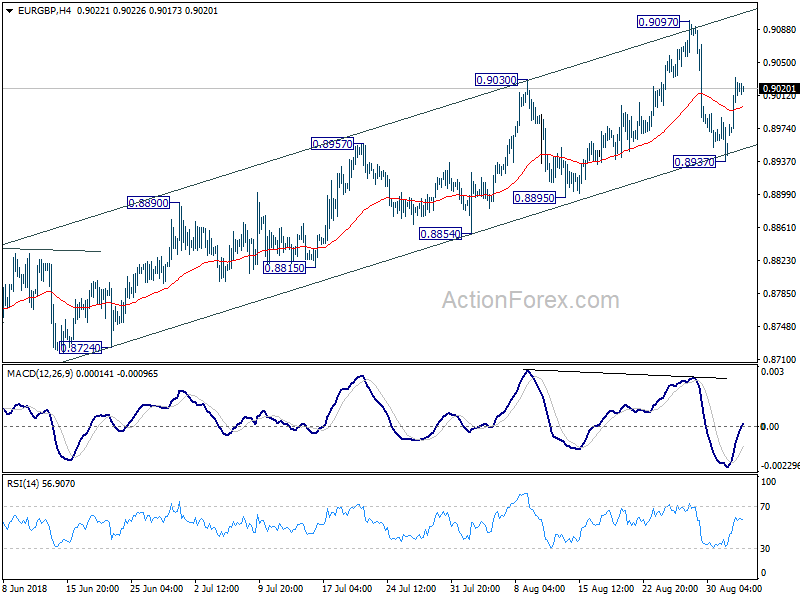
Daily Pivots: (S1) 0.8982; (P) 0.9009; (R1) 0.9051; More...
Intraday bias in EUR/GBP remains on the upside for retesting 0.9097 resistance. Break there will resume larger rally from 0.8620 towards 0.9305 high. On the downside, however, break of 0.8937 support should have near term channel support firmly taken out. And that will indicate completion of rise from 0.8620 and turn outlook bearish.
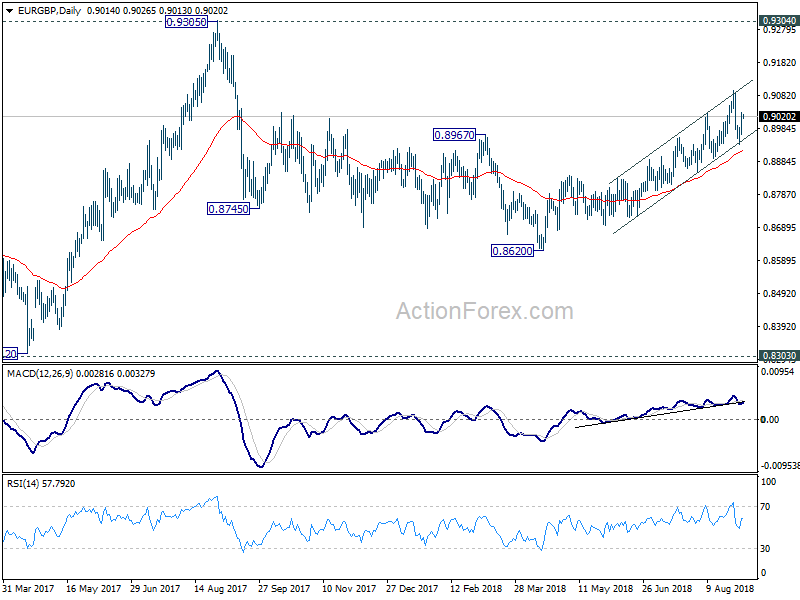
In the bigger picture, EUR/GBP is staying in long term range pattern from 0.9304 (2016 high). The corrective structure of the fall from 0.9305 to 0.8620 is raising the chance that rise from 0.8312 to 0.9305 is an impulsive move. But we're not too confident on it yet. In any case, we'd stay cautious on strong resistance from 0.9304/5 to limit upside in case of further rally. Meanwhile, if there is another medium term decline, strong support will likely be seen from 0.8303 to contain downside.
EUR/CHF Daily Outlook
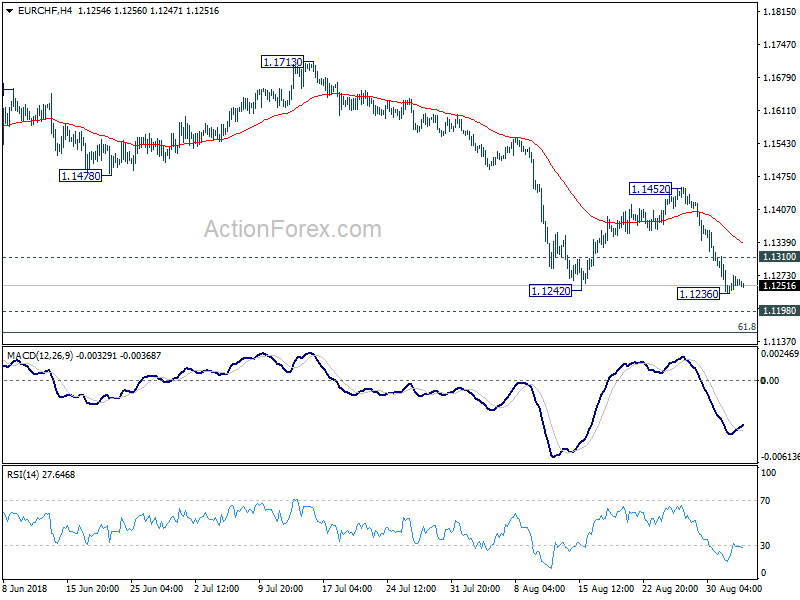
Daily Pivots: (S1) 1.1243; (P) 1.1258; (R1) 1.1277; More...
With 4 hour MACD crossed above signal line, a temporary low is in place at 1.1236 after breaching 1.1242 support. Intraday bias is turned neutral for consolidation. Further fall is expected as long as 1.1310 minor resistance holds. Below 1.1236 will target key support zone at 1.1154/98. At this point, we'd still expect strong support from there to bring rebound. On the upside, above 1.1310 minor resistance will turn bias back to the upside for 1.1452 resistance. However, sustained break of 1.1154/98 will carry larger bearish implications.
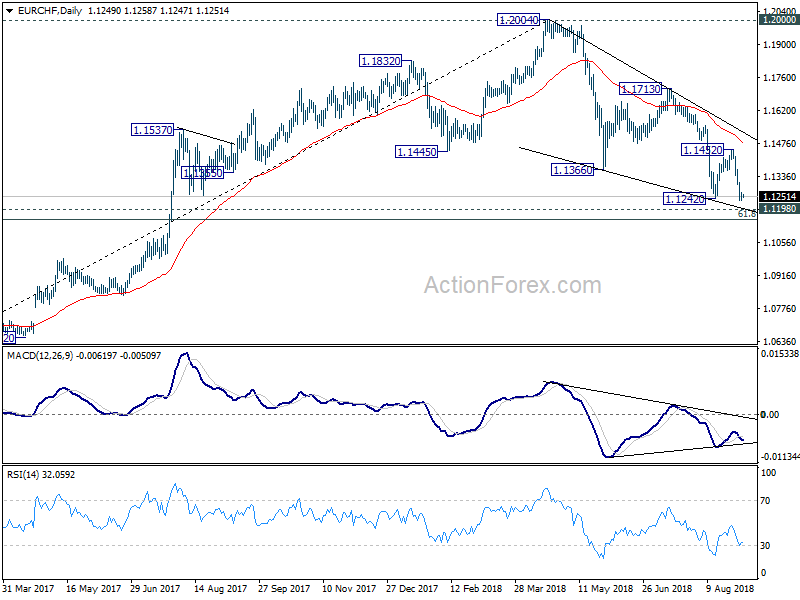
In the bigger picture, for now, the price actions from 1.2004 medium term top is seen as a correction only. Downside should be contained by support zone of 1.1198 (2016 high) and 61.8% retracement of 1.0629 to 1.2004 at 1.1154 to complete it and bring rebound. This cluster level is in proximity to long term channel support (now at 1.1173) too. A break of 1.2 key resistance is still expected in the medium term long term. However, sustained break of the mentioned support zone will mark reversal of the long term trend. In that case, 1.0629 key support will be back into focus.
EUR/USD Daily Outlook
Daily Pivots: (S1) 1.1595; (P) 1.1611; (R1) 1.1634; More.....
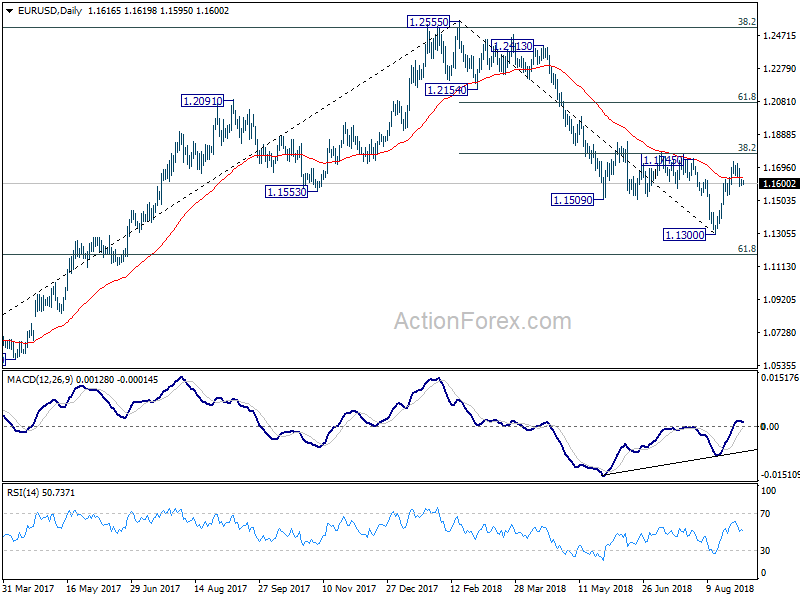
At this point, intraday bias in EUR/USD remains neutral first. As long as 1.1529 minor support holds, another rise cannot be ruled out. However, in that case, we'd continue to expect strong resistance from 38.2% retracement of 1.2555 to 1.1300 at 1.1779 to limit upside, at least on first attempt, to bring near term reversal. On the downside, break of 1.1529 minor will indicate completion of the corrective rebound and turn bias to the downside for retesting 1.1300 low. After all, consolidation from 1.1300 will likely extend for a while before completion.
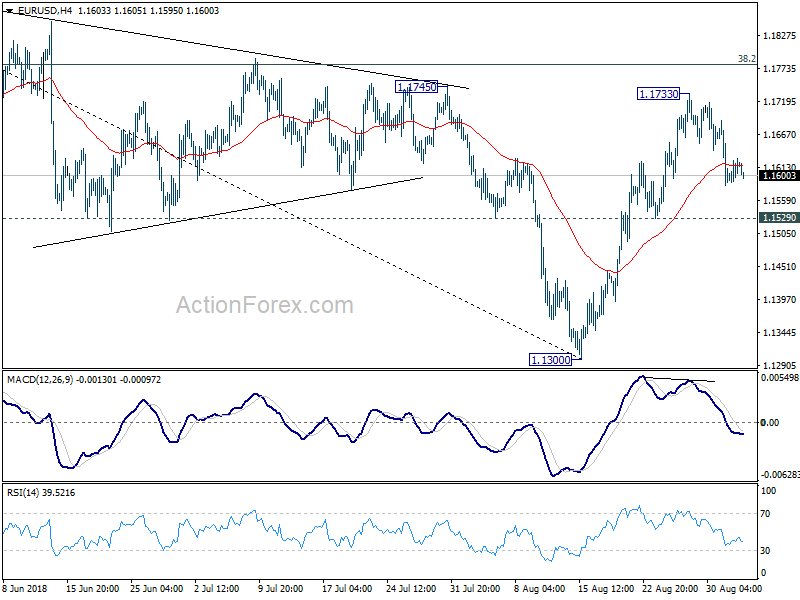
In the bigger picture, a medium term bottom should be in place at 1.1300, on bullish convergence condition in daily MACD and some consolidations would be seen. But still, note that EUR/USD was rejected by 38.2% retracement of 1.6039 (2008 high) to 1.0339 (2017 low) at 1.2516. That carries some long term bearish implications. Thus, we'd expect fall from 1.2555 high to resume after consolidation completes. Below 1.1300 should send EUR/USD through 61.8% retracement of 1.0339 to 1.2555 at 1.1186. And, in that case, EUR/USD would head to retest 1.0339 (2017 low).