Sample Category Title
USD/JPY Mid-Day Outlook
Daily Pivots: (S1) 110.82; (P) 110.98; (R1) 111.27; More...
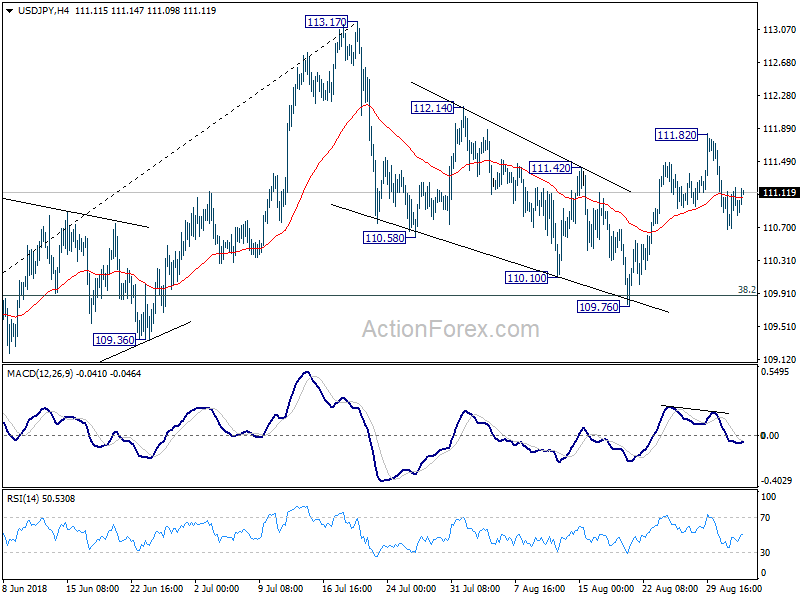
No change in USD/JPY's outlook and intraday bias remains neutral. In case, retreat from 111.82 extends, should be contained by 38.2% retracement of 104.62 to 113.17 at 109.90 to bring rebound. Price actions from 113.17 are viewed as a corrective pattern. Break of 111.82 will reaffirm the case that such correction has completed at 109.76. And in that case, further rise should be seen back to retest 113.17 high.
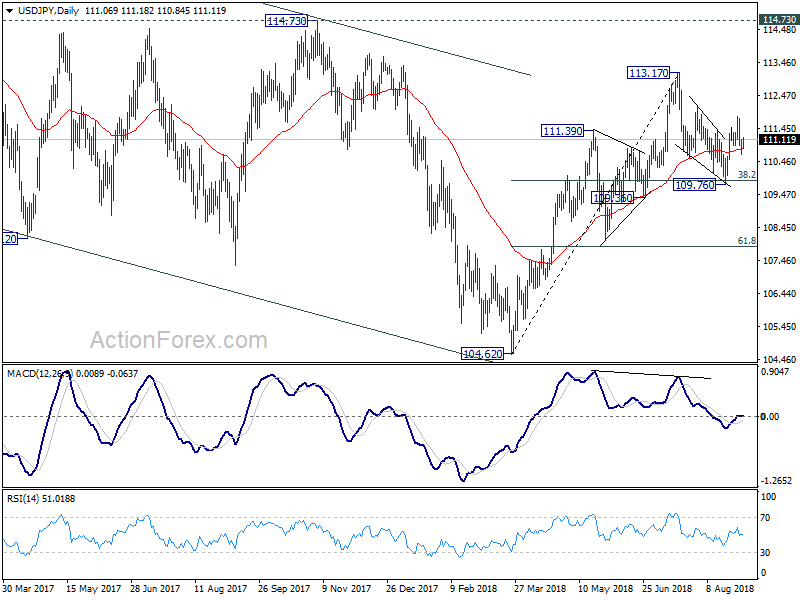
In the bigger picture, corrective fall from 118.65 (2016 high) should have completed with three waves down to 104.62. Decisive break of 114.73 resistance will likely resume whole rally from 98.97 (2016 low) to 100% projection of 98.97 to 118.65 from 104.62 at 124.30, which is reasonably close to 125.85 (2015 high). This will stay as the preferred case as long as 109.36 support holds. However, decisive break of 109.36 will mix up the outlook again. And deeper fall should be seen back to 61.8% retracement of 104.62 to 113.17 at 107.88 and below.
USD/CHF Mid-Day Outlook
Daily Pivots: (S1) 0.9658; (P) 0.9683; (R1) 0.9713; More.....
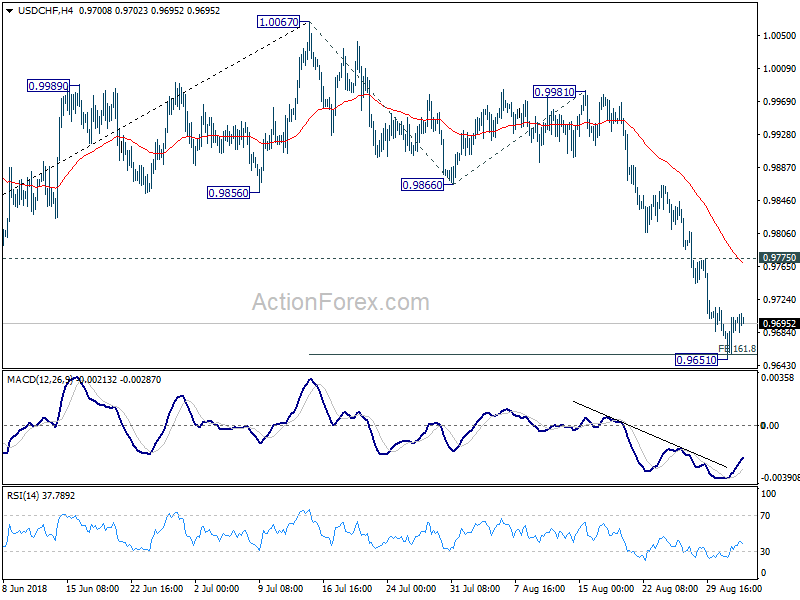
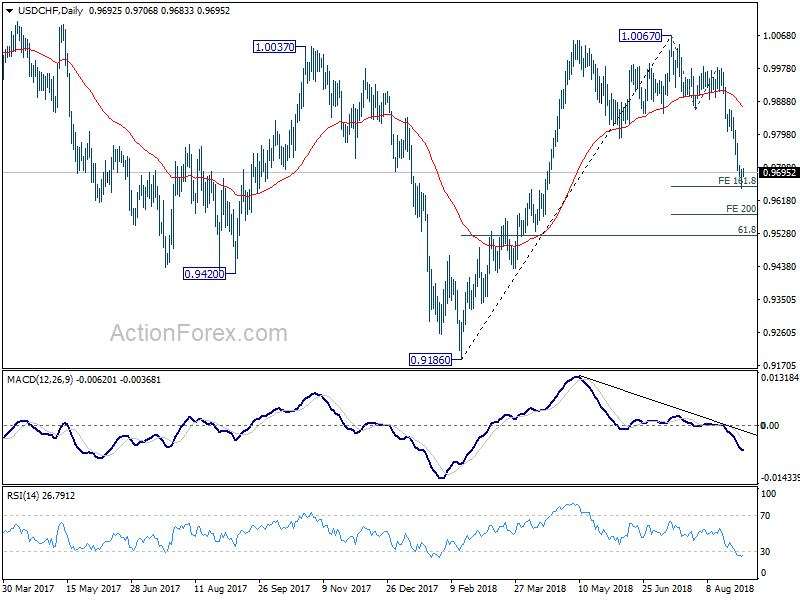
USD/CHF's consolidation from 0.9651 temporary low is still in progress and intraday bias remains neutral for the moment. Further recovery could be seen. But upside should be limited by 0.9775 minor resistance to bring another fall. On the downside, break of 0.9651 will target 200% projection of 1.0067 to 0.9866 from 0.9981 at 0.8579 next.
In the bigger picture, current development suggests that rise from 0.9186 low has completed at 1.0067, after failing to sustain above 1.0037 resistance. Fall from 1.0067 could extend to 61.8% retracement of 0.9816 to 1.0067 at 0.9523 and below. But for now, we don't expect a break of 0.9186 low. On the upside, firm break of 0.9866 support turned resistance will suggests that fall from 1.0067 has completed and rise from 0.9186 is resuming.
EUR/USD Mid-Day Outlook
Daily Pivots: (S1) 1.1562; (P) 1.1626; (R1) 1.1667; More.....
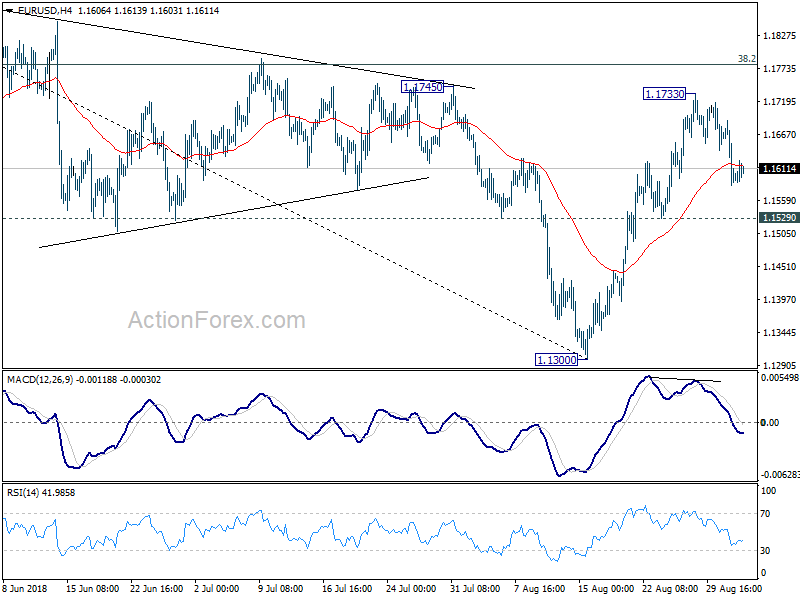
EUR/USD is staying in range of 1.1529/1733 and intraday bias remains neutral for the moment. As long as 1.1529 minor support holds, another rise cannot be ruled out. However, in that case, we'd continue to expect strong resistance from 38.2% retracement of 1.2555 to 1.1300 at 1.1779 to limit upside, at least on first attempt, to bring near term reversal. On the downside, break of 1.1529 minor will indicate completion of the rebound and turn bias to the downside for retesting 1.1300 low. After all, consolidation from 1.1300 will likely extend for a while before completion.
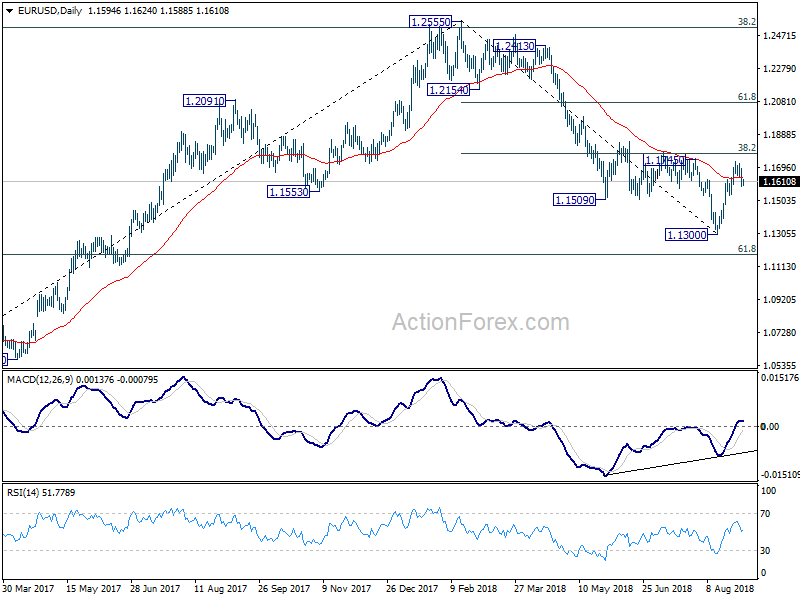
In the bigger picture, a medium term bottom should be in place at 1.1300, on bullish convergence condition in daily MACD and some consolidations would be seen. But still, note that EUR/USD was rejected by 38.2% retracement of 1.6039 (2008 high) to 1.0339 (2017 low) at 1.2516. That carries some long term bearish implications. Thus, we'd expect fall from 1.2555 high to resume after consolidation completes. Below 1.1300 should send EUR/USD through 61.8% retracement of 1.0339 to 1.2555 at 1.1186. And, in that case, EUR/USD would head to retest 1.0339 (2017 low).
DAX Dips as German Manufacturing PMI Drops in August
The DAX index has posted slight losses in the Monday session. Currently, the index is at 12,319, down 0.36% on the day. On the release front, eurozone and German Final Manufacturing PMIs both weakened in August, but were within expectations. On Tuesday, the eurozone releases PPI.
Eurozone and German manufacturing PMIs are still pointing to expansion, but there is concern in the markets as the downward trend continued in August. This was particularly evident in Eurozone Final Manufacturing PMI, which lost ground for an eighth straight month. The reading of 54.6, which matched the estimate, marked the lowest level since November 2016. In Germany, Final Manufacturing PMI fell from 56.9 to 55.9. Although this is a respectable reading, it is significantly lower than the readings we saw early in 2018, when the indicator was above the 60-level. German manufacturers remain generally optimistic, but have growing concerns over tariffs which the U.S has slapped on China and the EU.
Will the trade war between the U.S and China continue to escalate? So far, the two economic giants have imposed $50 billion in tariffs on each other, and President Trump has threatened further tariffs worth some $200 billion, which could be imposed as early as this week. The U.S could elect to impose the tariffs in smaller bites, such as a $50 billion tariff. With the U.S economy booming, there is little pressure on the Trump administration to shy away from imposing further tariffs. The current trade spat has already seen the U.S dollar gain ground against rivals such as the euro, and further tariffs could boost the U.S dollar.
GBP/USD Mid-Day Outlook
Daily Pivots: (S1) 1.2924; (P) 1.2976; (R1) 1.3009; More...
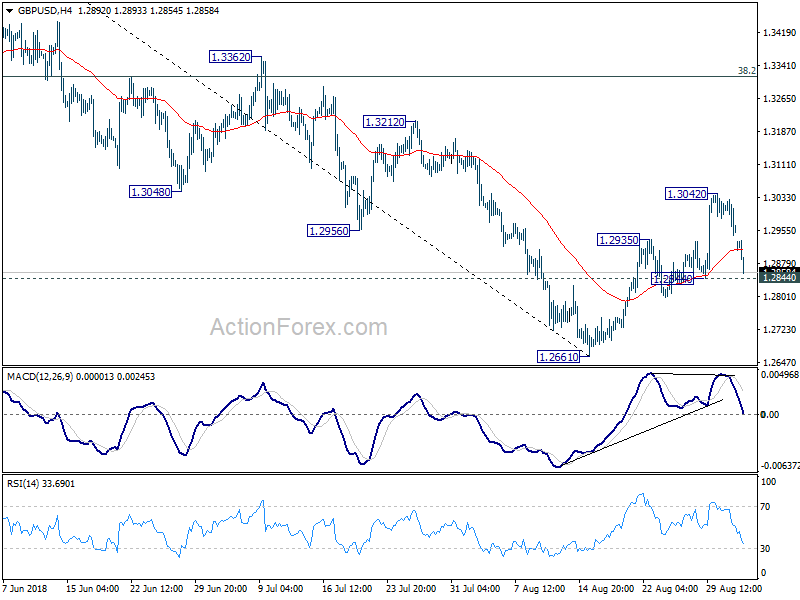
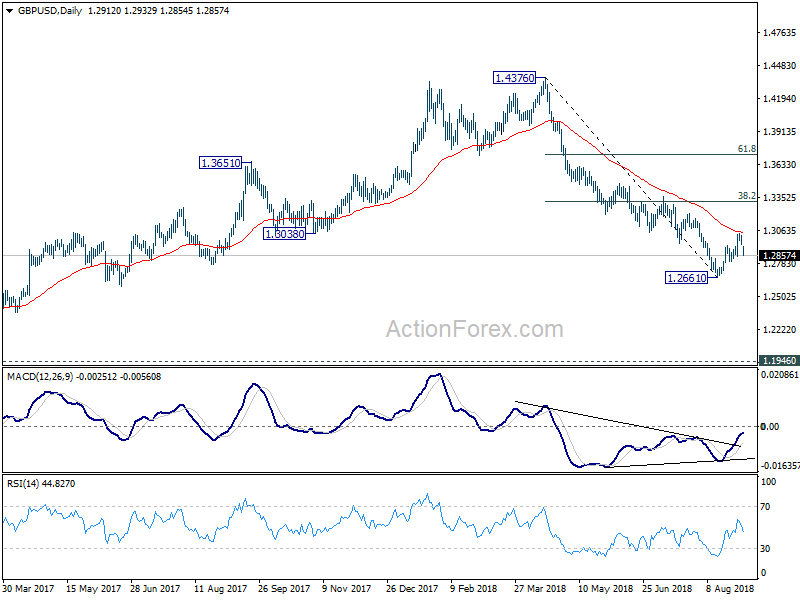
GBP/USD's fall from 1.3042 accelerates to as low as 1.2854 so far and focus in on 1.2844 minor support. Firm break there will confirm completion of the corrective rebound from 1.2661. In such case, deeper fall should be seen to retest 1.2661. Decisive break there will resume larger down trend from 1.4376. On the upside, above 1.3042 will bring another rise. But upside should be limited by 1.3316 fibonacci level to bring near term reversal.
In the bigger picture, whole medium term rebound from 1.1946 (2016 low) should have completed at 1.4376 already, after rejection from 55 month EMA (now at 1.4099). The structure and momentum of the fall from 1.4376 argues that it's resuming long term down trend. And this will be the preferred case as long as 38.2% retracement of 1.4376 to 1.2661 at 1.3316 holds. However, firm break of 1.3316 would bring stronger rebound to 61.8% retracement at 1.3721. And, the eventual depth of the fall from 1.4376, and the chance of hitting 1.1946 low, will depend on the strength of the interim corrective rebound from 1.2661.
Sterling Selloff Accelerates on PMI Manufacturing, Australian Dollar Recovers ahead of RBA
Sterling's selloff accelerates today and Brexit optimistic faded. The Pound was lifted by EU chief Brexit negotiator Michel Barnier's offer of an unprecedented relationship last week. It's now single-handedly hammered by Barnier too as he blasted UK's Brexit plan. Adding further pressure to the Sterling, UK PMI manufacturing dropped to 25-month low in August. More data risks are lining up ahead including construction and services PMI. Canadian Dollar follows as the second weakest because even though trade negotiation with US will resume this week, there is no sign of a conclusion. Resilience in oil price, with WTI continuing to press 70, is ignored by the Loonie.
On the other hand, Australian Dollar trades broadly higher, ahead of tomorrow's RBA rate decision. There is absolutely no chance for RBA to adjust interest rate. And the central bank is expected to reiterate its stance that interest rate will stay low for a while as pick-up in inflation and wage growth will be gradual. Euro follows as the second strongest one for today. Turkish central bank CBRT said it will adjust its monetary stance in September meeting given the "significant risks" to price stability. Some volatility is seen in USD/TRY but there is hardly any direction as sideway trading continues. A risk on Lira, and Euro, is that CBRT is now setting itself up to disappoint the markets.
In other markets, European stocks are mixed at the time of writing. FTSE continues it's inverse relationship with the Pound and is up 0.92%. CAC opened lower and turned positive to up 0.04%. DAX, on the other hand, stays in red, down -0.37%. Earlier today, all major Asian indices declined. Nikkei closed down -0.69%, Hong Kong HSI down -0.63%, China Shanghai SSE down -0.17%. Singapore Strait Times down -0.20%. WTI crude oil is back above 70 but it's uncertain which this level can be kept. Gold continues to hover around 1200.
Technically, EUR/GBP's rebound accelerates as it drew strong support from near term rising channel. Outlook in the cross remains bullish and a retest and then break of 0.9097 resistance should be seen in near term. A focus in US session, where US and Canada are on bank holiday), is on 1.2844 minor support in GBP/USD. Break there will confirm recent rebound from 1.2661 and deeper fall would be seen back to retest this low. Similarly, Break of 142.81 in GBP/JPY will indicate completion of rebound from 139.88 and bring retest of this low next.
UK PMI manufacturing dropped to 25-month low, no support to economy in Q3
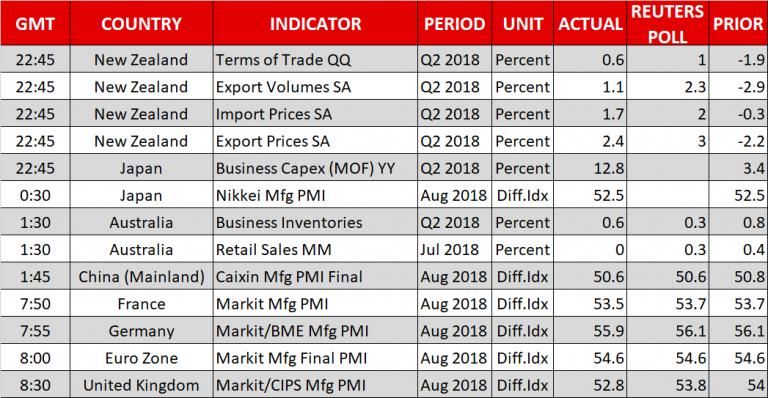
UK PMI manufacturing dropped to 52.8 in August, down from 53.8 and missed expectation of 53.9. That's also the lowest level in 25 months. Markit noted that job creation slowed to "near-stagnation" and business optimism dipped to 22-month low.
Rob Dobson, Director at IHS Markit, said in the release that "performance of the UK manufacturing sector looked increasingly lacklustre." And the result is "broadly consistent with zero growth in manufacturing production". That is, "the sector will likely fail to provide any support to the wider UK economy in the third quarter. Besides, "optimism about the outlook for the year ahead has been receding in recent months and is now at a 22-month low." "Manufacturers are also expressing rising concerns about the uncertain backdrop of Brexit."
EU Barnier blasted Theresa May's Chequers plan
Over the weekend, EU chief Brexit negotiator Michel Barnier blasted UK Prime Minister Theresa May's . And, Barnier "strongly opposed" May's proposals. On the customs proposals, Barnier said its "not practical". He added, "it is impossible to tell exactly where a product ends up, on the UK market or in the internal market." And, "the British proposal would be an invitation to fraud if implemented."
He also criticized that the "common rulebook" idea as outdated with modern world of trade. He said "the interest of Europeans is to preserve the integrity of the common market. That is our special strength and the reason why we are respected throughout the world, even in the United States." He added "we have a coherent market for goods, services, capital and people – our own ecosystem that has grown over decades. You cannot play with it by picking pieces." Therefore, the EU must prevent unfair competition if the United Kingdom has weaker legal requirements than we do. Otherwise we would discriminate and weaken our own companies."
On the other hand, a UK government spokeswoman defended that the proposal is "precise, pragmatic and that will work for the UK and the EU." And, "this proposal achieves a new balance of rights and obligations that fulfils our joint ambition to establish a deep and special partnership once the UK has left the EU while preserving the constitutional integrity of the UK. There is no other proposal that does that.
Eurozone PMI manufacturing: Business optimism dampened by trade war, tariffs and Brexit
Eurozone PMI manufacturing was finalized at 54.6 in August, unrevised. It's -0.5 lower than July's final reading at 55.1. Among the countries, the Netherlands scored 59.1 and hit a 2-month high. Ireland record 57.5 and hit a 7-month high. German PMI manufacturing was revised down by -0.2 to 55.9 and hit a 2-month low. France PMI manufacturing was revised down by -0.2 to 53.5 but still hit a 3 month high. Italy PMI manufacturing dropped to 50.1, down by -1.4 and hit 24-month low.
Chris Williamson, Chief Business Economist at IHS Markit noted in the release that, "prospects dimmed further as growth of new orders hit a two-year low and worries about the outlook deepened." The slowdown in exports can be attributed to the appreciation of the euro since earlier in the year". But risk aversion was intensifying too. "Worries about trade wars and the damaging impact of tariffs, as well as Brexit and other political worries, all contributed to a dampening of business optimism about the year ahead. "
Japan PMI manufacturing finalized at 52.5, potential escalations in trade conflict weigh on sentiment
Japan PMI manufacturing was finalized at 52.5 in August, unrevised, up from July's 52.3. Markit noted in the released that "production rises amid faster new order growth", "export orders fall for second time in three months", and "geopolitical risks weigh on business sentiment".
Joe Hayes, Economist at IHS Markit, noted that the "goods-producing sector continued to record growth at the midway point in Q3". That extended the current stretch of expansion to two years - the "longest since the global financial crisis". But he also pointed out that "upturn in demand was domestic-led," with "export sales falling over the month." And, "potential escalations in trade conflict also contributed to a softening of business confidence."
However, the so called softening business confidence was not quite reflected in other data. Japan capital spending has increased 12.8% in Q2, nearly double of expectation of 6.6% and almost four times of prior quarter's 3.4%.
Mixed Australia data: Retail sales missed, manufacturing PMI rose
Australian Dollar weakened in early Asian session after mixed economic data. But Aussie quickly recovered, partly helped by oversold conditions. On the negative side, retails sales rose 0.0% mom in July, below expectation of 0.3% mom. There were falls in three of the six industries, including household goods retailing (-1.2%), clothing, footwear and personal accessory retailing (-2.0%) and department stores (-1.9%). The declines were offset by other retailing (1.7%), food (0.3%) and cafes, restaurants and takeaway food services (0.6%)". Also, ANZ job advertisements dropped -0.6% mom in August. That could point to easing momentum in job growth.
On the positive side, AiG Performance of Manufacturing Index rose 4.7 pts to 56.7 in August, indicating faster growth across the manufacturing sector. In particular, exports sub-index has jumped 8.5 points to 58.4 points. However, drought conditions in New South Wales and Queensland are now having an adverse impact on input costs and sales for some manufacturers. Company operating profits rose 2.0% qoq in Q2. TD securities inflation rose 0.1% mom in August.
New Zealand Terms of Trade rose only 0.6% qoq, missed expectations
New Zealand Dollar weakens broadly today and stays generally weak as Terms of Trade Index rose only 0.6% qoq in Q2, versus expectation of 1.1% qoq. Prior quarter's figure was also revised down from 1.9% qoq to -2.0% qoq. Looking at the details, export prices for goods rose 2.4%, while import prices for goods rose 1.7%. Seasonally adjusted goods export volumes rose 1.1%, and goods import volumes rose 0.9%. Seasonally adjusted goods export values rose 3.0%, and goods import values rose 1.7%.
China Caixin PMI manufacturing dropped to 50.6, Economy facing obvious downward pressure
China Caixin PMI manufacturing dropped -0.2 to 50.6 in August, missed expectation of 50.7. In the release, it's noted that "output expands at faster pace... but new order growth weakens and employment continues to decline". Also, confidence towards the 12-month business outlook remains lacklustre". Also it's the third straight month of decline and the lowest level since June 2017.
Dr. Zhengsheng Zhong, Director of Macroeconomic Analysis at CEBM Group noted that "the manufacturing sector continued to weaken amid soft demand, even though the supply side was still stable". Also, "worsening employment situation is likely to have an impact on consumption growth." He warned that "China's economy is now facing relatively obvious downward pressure."
GBP/USD Mid-Day Outlook
Daily Pivots: (S1) 1.2924; (P) 1.2976; (R1) 1.3009; More...
GBP/USD's fall from 1.3042 accelerates to as low as 1.2854 so far and focus in on 1.2844 minor support. Firm break there will confirm completion of the corrective rebound from 1.2661. In such case, deeper fall should be seen to retest 1.2661. Decisive break there will resume larger down trend from 1.4376. On the upside, above 1.3042 will bring another rise. But upside should be limited by 1.3316 fibonacci level to bring near term reversal.
In the bigger picture, whole medium term rebound from 1.1946 (2016 low) should have completed at 1.4376 already, after rejection from 55 month EMA (now at 1.4099). The structure and momentum of the fall from 1.4376 argues that it's resuming long term down trend. And this will be the preferred case as long as 38.2% retracement of 1.4376 to 1.2661 at 1.3316 holds. However, firm break of 1.3316 would bring stronger rebound to 61.8% retracement at 1.3721. And, the eventual depth of the fall from 1.4376, and the chance of hitting 1.1946 low, will depend on the strength of the interim corrective rebound from 1.2661.
Economic Indicators Update
| GMT | Ccy | Events | Actual | Forecast | Previous | Revised |
|---|---|---|---|---|---|---|
| 22:30 | AUD | AiG Performance of Manufacturing Index Aug | 56.7 | 52 | ||
| 22:45 | NZD | Terms of Trade Index Q/Q Q2 | 0.60% | 1.10% | -1.90% | -2.00% |
| 23:50 | JPY | Capital Spending Q2 | 12.80% | 6.60% | 3.40% | |
| 0:30 | JPY | PMI Manufacturing Aug F | 52.5 | 52.5 | 52.5 | |
| 1:00 | AUD | TD Securities Inflation M/M Aug | 0.10% | 0.10% | ||
| 1:30 | AUD | ANZ Job Advertisements M/M Aug | -0.60% | 1.50% | 1.40% | |
| 1:30 | AUD | Company Operating Profit Q/Q Q2 | 2.00% | 1.40% | 5.90% | |
| 1:30 | AUD | Retail Sales M/M Jul | 0.00% | 0.30% | 0.40% | |
| 1:45 | CNY | PMI Manufacturing Aug | 50.6 | 50.7 | 50.8 | |
| 7:15 | CHF | Retail Sales Real Y/Y Jul | -0.30% | 1.20% | 0.30% | 0.20% |
| 7:30 | CHF | PMI Manufacturing Aug | 64.8 | 61 | 61.9 | |
| 7:45 | EUR | Italy Manufacturing PMI Aug | 50.1 | 51.2 | 51.5 | |
| 7:50 | EUR | France Manufacturing PMI Aug F | 53.5 | 53.7 | 53.7 | |
| 7:55 | EUR | Germany Manufacturing PMI Aug F | 55.9 | 56.1 | 56.1 | |
| 8:00 | EUR | Eurozone Manufacturing PMI Aug F | 54.6 | 54.6 | 54.6 | |
| 8:30 | GBP | PMI Manufacturing Aug | 52.8 | 53.9 | 54 | 53.8 |
Further Acceleration in Turkish inflation
Fears of contagion related to the Turkish banking system continues to spread, pushing the Turkish lira downward as inflation continues to grow at a higher pace than expected. Further bearish move on the TRY is expected as long as no obvious intervention from the Turkish Central Bank is communicated and implemented.
For now, August CPI data are given at a higher rate than what market participants would have expected. Annual and monthly figures are given at +17.90% and +2.30% (consensus: +17.60% and +1.84%), its highest rate in 15 years and this is certainly not going to stop for now, as inflation could reach as much as 25% by the end of 2018, thus remaining far from actual 5% target set by the Turkish Central Bank. Accordingly, with weaker domestic demand and economic confidence (at 9-years low) along with a drastic slowdown in industrial production, Turkey’s GDP growth is expected to slowdown in Q3 while given along 7% in Q2.
Pound Extends Downside; Aussie Bounces ahead of RBA Rate Decision
Here are the latest developments in global markets:
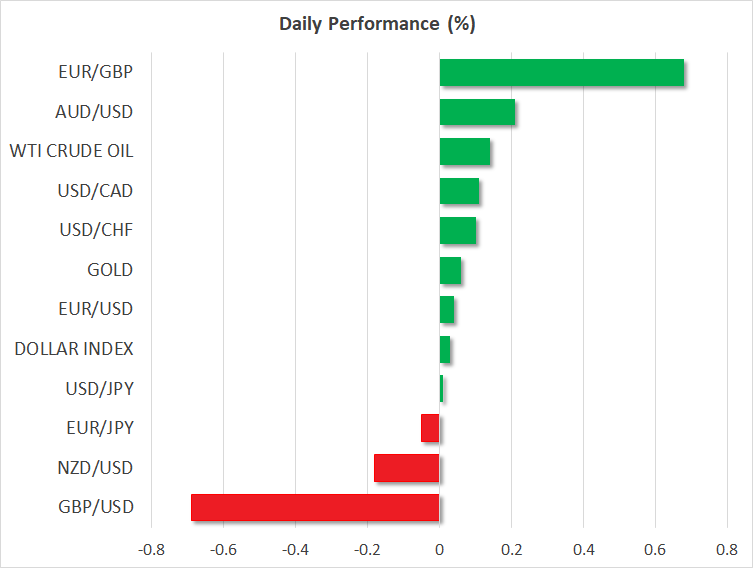
FOREX: Sterling opened with a gap down on Monday’s Asian session after EU chief Brexit negotiator Michel Barnier said he strictly opposes the UK’s offer on future EU-UK trade relations. Pound/dollar, which has come off from a 1-month high last week, recorded the fifth red month in a row. Today, the pair dipped by 0.64% and slipped below the 1.2900 handle, increasing negative momentum after the UK manufacturing PMI clocked in at 52.8 in August, below the forecast of 53.8. Also, euro/pound edged higher by 0.61%. The dollar’s index against a basket of six currencies steadied at 95.16 (+0.03%) and dollar/yen was also flat at 111.05 (+0.02%) after the US and Canada ended contentious trade negotiations without a deal on Friday; the US President Donald Trump said on Saturday there was no need to keep Canada in NAFTA. Euro/dollar traded higher by 0.11% at 1.1612, losing little from a downward revision in the final German manufacturing PMI for August. The Eurozone’s final manufacturing PMI was confirmed at 54.6 in the aforementioned month. In the antipodean space, aussie/dollar advanced by 0.24% following the touch on the 21-month low of 0.7165 earlier today before the RBA rate decision on Tuesday, while kiwi/dollar moved near 2-week lows (-0.14%). Finally, dollar/loonie headed higher by 0.12%.
STOCKS: European equities were mixed on Monday as worries about US trade policy kept investors cautious. The pan-European STOXX 600 and the blue-chip Euro STOXX 50 were up by 0.11% and 0.07% respectively at 1040 GMT. The German DAX 30 was down by 0.16%, while the French CAC 40 inched up by 0.04%. The Italian FTSE MIB and the UK’s FTSE 100 were the best performers, gaining 0.55% and 0.81% respectively. In Asia, equities closed in the negative territory, while US markets will remain closed today for the Labor Day holiday.
COMMODITIES: Oil prices edged higher today with West Texas Intermediate (WTI) crude adding 0.2% to its performance, hovering around $70 per barrel, while Brent’s oil reached an almost 2-month high at $78.22 before slipping back to $78 per barrel (+0.50%). In precious metals, the price of gold remained near its opening level, marginally above $1,200/ounce despite worries over US-Sino tensions and inconclusive trade talks between the US and Canada.
Day ahead: Trade drama and Brexit to feed risk aversion; RBA decides on interest rates
US and Canadian markets will be closed for the Labor Day holiday on Monday, while the economic calendar will be light in terms of data releases, leaving investors fully concentrated on the trade drama and the Brexit noise during the day.
Friday’s NAFTA deadline passed without any agreement between the US and its neighbor Canada, with the US President warning on Saturday he may terminate the trade pact entirely if the Congress interferes with negotiations which resume on Wednesday. Meanwhile, he showed interest to sign a bilateral deal with Mexico after the two countries were said to have secured a preliminary trade deal last week. This week, markets will face another deadline on September 6, the day the US prepares to unleash tariffs on $200 billion Chinese imports, considered as the largest hit to Beijing in the multi-month US-Sino trade battle so far. But the failure to renew the NAFTA deal, raised fears that Washington will not pull back this time either, leaving import tariffs to go ahead, a move that would add another layer of uncertainty to the trade story and therefore further pressure to riskier assets such as stocks.
On the Brexit front, the bearish sentiment returned as well after the EU Brexit negotiator, Michel Barnier noted that he is strongly opposed to the British Prime Minister’s proposals on the future EU-UK trade relations, fueling concerns that a deal won’t be achievable by October’s 18-19 EU summit in Brussels. Yet, more Brexit headlines could follow until that day, as EU leaders are planning to discuss the topic at their summit in Austria on September 20, with the pound expected to register further pivot turns in the wake of new developments. Meanwhile in the UK, a spokesman to the British Prime Minister told reporters on Monday that the Chequers proposals are the only credible and negotiable Brexit plan while regarding monetary issues, he confirmed that the Bank of England’s chief Mark Carney will leave his office in 2019 despite being asked to stay in the role until 2020.
In Australia, the focus will shift to monetary policy and the Reserve Bank of Australia’s (RBA) rate decision due on Tuesday at 0430 GMT. Forecasts are for the central bank to keep interest rates unchanged at the record low of 1.5%, for the second year in a row, pointing to rising global trade risks and still-subdued wage growth in Australia. While a no change decision is already priced in, traders will read the rate statement and listen to the RBA’s governor, Philip Lowe’s remarks later in the same day at 0930 GMT for more clues on how policymakers assess the Australian economic conditions. Earlier at 0130 GTM, current account readings for the second quarter are expected to give direction on what investors should expect from Australia’s Q2 GDP growth figures released on Wednesday. Note that retail sales showed no growth in July, missing expectations for an expansion, while business inventories in the three months to June increased by more than analysts expected.
Italy will remain under the spotlight in the Eurozone after Fitch ratings reaffirmed its overall BBB rating on the economy, but downgraded its outlook from stable to negative, citing the government’s potential fiscal reforms as risks to Italy’s financial credibility. On September 27, the government will form new fiscal and economic growth targets, while on October 15, a draft budget will be sent to the European Commission.
Developments in Turkey will be of interest ahead of the central bank’s rate decision on September 13. Analysts believe that policymakers will continue to raise rates despite the Turkish President’s calls to keep borrowing costs low.
Into US session: Sterling stays weakest on Brexit and PMI manufacturing, Euro and Aussie paring recent losses
Entering into US session, Sterling remains the weakest one for today. Selloff started as EU chief negotiator slammed UK's Brexit plan. Further pressure is added to the Pound as PMI manufacturing dropped to 25 month low in August. The BBC reported that UK finance ministry is trying to persuade BoE Governor Mark Carney to stay longer. But Prime Minister May's spokesman said Carney still plans to leave when his term expires next year. Canadian Dollar and New Zealand dollar takes turn to be the second weakest. Canada will resume trade talk with the US this Wednesday. But there is no hope on concluding a deal.
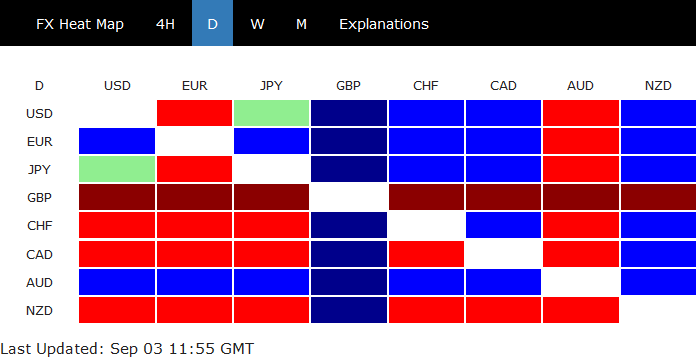
On the other hand, Australian Dollar and Euro are the strongest ones for today so far. That's partly due to selloff in Sterling. But more importantly, these two currencies are just digesting last week's steep selloff. Turkish central bank CBRT said it will adjust its monetary stance in September meeting given the "significant risks" to price stability. Some volatility is seen in USD/TRY but there is hardly any direction as sideway trading continues. A risk on Lira, and Euro, is that CBRT is now setting itself up to disappoint the markets.
In other markets, European stocks are mixed at the time of writing. FTSE continues it's inverse relationship with the Pound and is up 0.93%. CAC opened lower and turned positive to up 0.18%. DAX, on the other hand, stays in red, down -0.13%. Italy concerns seemed to have eased a bit as 10 year Italian bond yield drops -0.41 to 3.193. German 10 year bund yield is up slightly by 0.005 at 0.335. Earlier today, all major Asian indices declined. Nikkei closed down -0.69%, Hong Kong HSI down -0.63%, China Shanghai SSE down -0.17%. Singapore Strait Times down -0.20%. WTI crude oil is back above 70 but it's uncertain which this level can be kept. Gold continues to hover around 1200.
GBPUSD Outlook: Pound Extends Weakness after Disappointing Manufacturing Data
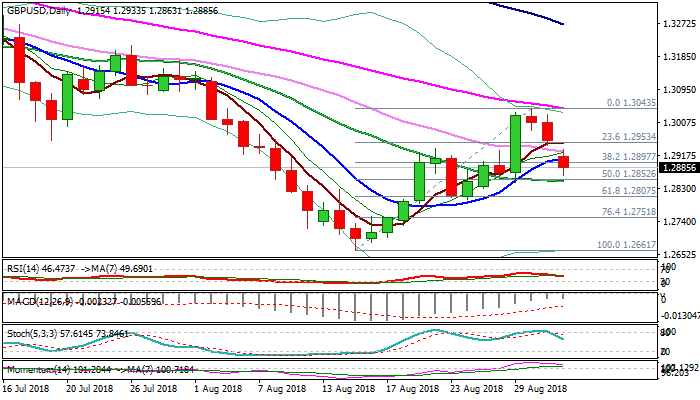
The pound fell further on Monday, hitting session low at 1.2863, after UK manufacturing PMI disappointed in August (52.8 vs 53.9 f/c) falling to the lowest levels in two years. Downbeat data add to negative near-term outlook, as the pair extends pullback of past two days, with Monday's action opening with gap-lower. Sterling came under pressure on comments from EU top Brexit negotiator who strongly opposed proposals of Britain's PM Theresa May on post-Brexit trade, with weak figures adding to negative near-term outlook. Fresh weakness pressures next pivotal support at 1.2850 (20SMA), close below which would generate bearish signal for further easing. Momentum studies continue to weaken and support scenario. With thin markets expected during the US session due to Labor day holiday, focus turns towards tomorrow's release of Construction PMI and Inflation report, as well as UK Services PMI on Wednesday.
Res: 1.2910; 1.2933; 1.2950; 1.3000
Sup: 1.2863; 1.2850; 1.2807; 1.2751