Sample Category Title
Will He Or Will He Not Apply $200 Billion Tariffs On China
Trump has a strong stance towards china and this can become even firmer if he brings Canada on the table this week
Trump is famous for not easily backing down from his agenda hence the trade war and the new trade agreement with Canada will remain the focus for the markets during this week as we said yesterday. Trump promised to impose another $200 billion of tariffs on the Chinese import in order to balance the trade because he calls the current landscape unfair. Therefore, investors will be watching how he is going to bring this in the system and most importantly, a tit-for-tat reaction from Beijing.
There is a possibility that Trump may actually start to apply these tariffs in different chunks to keep China on its toes. Such a strategy creates more pressure on the counter party as the pain from the headline makes the blood bleed more.
Remember during the previous round of the tariffs, the United States applied the whole $50 billion of tariffs in two stages, first it was an introduction of $34 billion of tariffs and then came the $16 billion of tariffs. What it did to the sentiment is that the markets were in panic mode every time these specified dates came closer to the time. However, to the Chinese luck, we didn’t see much impact on the actual economic data as the factory orders remain stable.
However, the recent PMI reading for Caxin wasn’t supporting the above argument as it confirmed sign of weakness. If you look at the private manufacturing survey, it paints a very dull picture, it has hit a 14-month low reading. The new order figure expanded at the lowest pace since May 2017, however the output remained the same. Hence, today's Caxin services data will provide us more information about the shape of the economy.
The fact is that Trump is taking all these actions because the economic data is still coming strong and in many occasions, a lot more better than the forecast. Hence he is fearless with his approach, however it is important to remember that it takes time for the effect of this data to tickle down the economy.
The net impact of this trade war would leave a kind of scare which may not go away any time soon. Another important aspect to pay attention to is this that trade war isn’t something like a weekly data where one could easily forecast what the expected reading could be, so anyone who is trying to make any kind of prediction could be equal to some taking a stab in dark. So by the time we may see any hick-up in the economic numbers, it may be too late to apply any policy for collateral damage.
RBA Meeting: There’s A Story To Be Told Here
RBA meeting: there's a story to be told here
Monday's price action predictably stalled out during the NY session – as liquidity was negatively impacted by the Labor Day holiday in the US. But the dearth of data nor any principal Fed speakers to stir the pot, the sparsely serviced trading desks in New York were content to scan headlines while storm-proofing positions for an exceedingly eventful month ahead.
Tuesday kicks off with a well subscribed RBA meeting, and I think there's a story to be told here. The market will be keenly focused on RBA guidance. Since the market has bought into an increasing dovish RBA narrative on the Westpac effect and weaker economic data, so unless the RBA does endorse the markets bearish lean; we could see a decent relief rally on the AUD. But of course, the markets will be looking to build on or re-engage on any significant uptick. On the other hand, if the RBA does validate the markets current bearish view, it will be a free for all as the market scrambles of increased downside exposure.
US equity market futures held there own overnight showing few knock-on effects from the Asian session that saw equities in the red across the board after President Trump celebrated the Labour Day holiday with some negative tweets towards his neighbours to the north. However, the President then cancelled his Labour Day golf game to get down to the business of putting this NAFTA deal together. And knowing the Presidents love of the links, could this be a foreshadowing of positive things to come??
However, I expect markets to trade incredibly mixed but I'm continually passing on words of wisdom that I learned from my bosses in the early days, to keep in simple and don't overthink it!
Oil Markets
Iran sanction remains the cornerstone support for Oil markets, but by any metric supply stays very tight as refiners' clamber to mop up any available barrels before the re-imposition of U.S. Iranian sanctions in early November. Which of course is providing the underbelly of support from prompt contracts.
For Oil to move higher amidst this contentious escalation of US-China trade war, it all comes down to how quickly the lost Iranian barrels can be replaced if at all. Let's face it Iranian sanctions are an absolute game changer and will continue to dictate bullish market sentiment for no other reason than losing a significant OPEC oil supplier is a huge event.
Gold Markets
While it feels like a dead money trade for long gold positions, but with all the noise building around trade dispute along with unsettling economic prospects of Turkey and Argentina, while likely drag more EM economies down that slippery slope, Gold should be in demand.
However, with US equity markets holding stable and the USD showing few signs of buckling, until the worm turns for the Greenbank, the strong dollar narrative will remain the chink in the gold armour.
EM Currencies
Argentine Peso
Now we have the Argentine government attempting to pull off a “Hans Brinker”. Their latest attempt to stem the flood of capital outflows is taxing grain exports and slashing government largess all of which is likely a day late and a penny short. While these moves are a step in the right direction, but they're unlikely to be convincing enough to remove currency speculators from the driver seat. I guess its all down the IMF's “White Knight” to the rescue. However, we are getting into the realm of unquantifiability which makes the market utterly untradeable in my view.
G-10 Currency markets
My focus remains on both Aussie and Loonie
Canadian Dollar
G-10 traders expressed little optimism overnight thinking that damage was done on Friday when there was no agreement. And while hope springs eternal, the words of Gandalf are coming to mind as we approach 1.3100. “There never was much hope. Just a fool's hope”?
Asian Markets
I fully expect an air of caution to permeate regional equity markets as the China& US trade agenda focal point nears. However, with the Pboc biasing the fix below expectations the central bank provided some comfort to some regional currencies After all that investor doesn't appreciate currency stability. And with the Pboc drawing an impressive line in the sand dare I say the brave at heart is running against and shorting USDCNH ahead of tariff decision day.
Malaysian Ringgit
Yesterday price action was a combination of catch up to Friday's news and pre-positioning ahead of tomorrows well subscribed MPC. I expect no change in policy but anticipate a slight dovish lean after GDP, and inflation metrics both missed the marks. And with trade wars front and centre, although I believe the MYR is better insulated from this external shock due to higher oil prices over the long-term, near-term there is not a great deal to be bullish about, and predictably USDMYR remains firmly bid on dips with dollar bulls targeting USDMYR 4.15
Korean Won
There was a wave of long liquidation of trade war hedges which was a bit surprising considering the Kospi was trading in negative territory with a reported -170 million USD in outflows yesterday. The move has all the hallmarks of exporter driven flows, reminding us that real money flows do count!
Eco Data 9/4/18
[php_everywhere instance="1"]
RBA Decision and GDP Data Up Next for the Battered Aussie
After political drama kept the Australian dollar under pressure over the past weeks, the currency will now turn its sights back to economic developments, with a policy decision by the RBA and updated GDP figures being on tap this week. Some remarks by RBA chief Philip Lowe will also be closely watched. Downside risks linger for aussie/dollar, though a clear break below the 0.7160 area that provided reliable support in the past is needed to reaffirm the downtrend.
The Reserve Bank of Australia (RBA) is virtually certain to keep its benchmark interest rate unchanged when it announces its policy decision on Tuesday at 0430 GMT, with investors pricing in a zero probability for a rate increase according to Australia’s overnight index swaps. In fact, the Bank is not expected to act at all in the foreseeable future, with market pricing pointing to practically no odds for a rate hike over the remainder of 2018. Looking at Australian economic indicators, one may consider such pricing to be overly pessimistic, at first glance. The economy grew by an impressive 3.1% y/y in Q1, inflation clocked in at 2.1% y/y in Q2 to reenter the RBA’s 2-3% target band, and the unemployment rate declined to a six-year low of 5.3% in July.

A closer inspection though, reveals that Australian consumers continue to struggle. Wages grew by 2.1% in Q2, the same pace as inflation, keeping real wage growth flat and providing little relief for the heavily-indebted Australian households that have been waiting for a pay rise to ease their debt burden. Cautiousness among consumers, in turn, clouds the outlook for spending and economic growth. Making a bad situation worse, mortgage rates provided by major Australian banks have risen lately even despite the RBA keeping its own borrowing costs unchanged, squeezing consumers even more. Then, there’s the uncertain outlook for global trade, which renders Australia vulnerable to an external shock given its dependence on exports.
Considering these hazards, and especially the recent surge in mortgage rates, the risks appear tilted towards a more cautious-sounding narrative by the RBA. While policymakers are unlikely to go as far as placing the prospect of a rate cut back on the table, they could well reinforce the concept that rates will stay on hold for a prolonged period. As for the aussie, such a tone is unlikely to provide relief to the battered currency, which touched a fresh 21-month low of 0.7164 against the dollar earlier today. Downside risks linger, though note that the 0.7160 zone in aussie/dollar provided reliable support in the past, and a clear break below it is needed to signal a resumption of the downtrend. A few hours after the decision, at 0930 GMT, RBA Governor Lowe will deliver remarks. His comments will be scrutinized for any policy hints, particularly on topics the meeting statement may not elaborate much on, like rising mortgage rates.
Turning to the GDP data for Q2, which will be released on Wednesday at 0130 GMT, the forecast is for economic growth to have slowed in both yearly and quarterly terms. Specifically, the economy is projected to have grown by 0.8% q/q, from 1.0% q/q previously, which would drag the yearly rate down to 2.8%, from 3.1% in Q1. In fact, after Australia’s capex data for the quarter surprisingly showed a fall in capital investments last week, a weaker-than-expected GDP reading should not be ruled out. For the record, the RBA’s own forecasts imply a growth rate of 3.0% y/y in Q2, so even the anticipated 2.8% may come as a disappointment for policymakers.

Technically, further declines in aussie/dollar below the 0.7160 area could open the way for the round figure of 0.7100. Even lower, the psychological handle of 0.7000 would increasingly come into view.
On the contrary, in case of a rebound, immediate resistance may be found near the 0.7240 area, marked by the inside swing low on August 23-24. An upside break may see scope for a test of the 0.7380 hurdle, defined by the highs on August 21, with even further advances aiming for the 0.7485 barrier – this being the high of July 10.
Pound Slide Continues as UK Manufacturing PMI Misses Estimate
GBP/USD has started the week with considerable losses. In North American trade, the pair is trading at 1.2880, down 0.62% on the day. On the release front, British Manufacturing PMI dropped to 52.8, missing the estimate of 53.9 points. There are no U.S events, with markets closed for Labor Day. On Tuesday, the UK releases Construction PMI and BoE Governor Mark Carney will testify before Parliament’s Treasury Committee. In the U.S, the key event is ISM Manufacturing PMI.
The pound has lost ground for a third straight day, as investors reacted negatively to a soft manufacturing PMI in August. The indicator dropped to its lowest level since July 2016, which was right after the Brexit referendum. A drop in exports in August was a key factor in the PMI downturn, which slipped from 54.0 to 52.8 points. With the global economy showing signs of a slowdown and the lack of clarity over Brexit, Britain’s manufacturing sector could run into further headwinds during the next several months.
Investors are keeping a nervous eye on the tariff spat between China and the U.S. So far, the two economic giants have imposed $50 billion in tariffs on each other, and President Trump has threatened further tariffs worth some $200 billion, which could be imposed as early as this week. The U.S could elect to impose the tariffs in smaller bites, such as a $50 billion tariff. With the U.S economy booming, there is little pressure on the Trump administration to shy away from imposing further tariffs. The current trade spat has already seen the U.S dollar gain ground against the pound and further tariffs could boost the U.S dollar.
Japanese Yen Unchanged in Thin Holiday Trade
The Japanese yen is showing little movement in the Monday session. In North American trade, the pair is trading at 111.14, up 0.04% on the day. In economic news, Japanese Capital Spending jumped 12.8% in the second quarter, crushing the estimate of 6.6%. This marked the strongest reading since 2007. Final Manufacturing PMI edged up to 52.5 points, matching the forecast. On Tuesday, the U.S releases ISM Manufacturing PMI.
There was some good news from Japan’s inflation front on Thursday, as Tokyo Core CPI strengthened for a third straight month, with a gain of 0.9%. This indicator is considered the primary gauge of consumer inflation, and the strong reading propelled the yen higher on Thursday. Still, inflation remains well below the Bank of Japan’s target of just below 2%, despite the Bank’s ultra-accommodative monetary policy.
Investors are keeping a nervous eye on the tariff spat between China and the U.S. So far, the two economic giants have imposed $50 billion in tariffs on each other, and President Trump has threatened further tariffs worth some $200 billion, which could be imposed as early as this week. The U.S could elect to impose the tariffs in smaller bites, such as a $50 billion tariff. With the U.S economy booming, there is little pressure on the Trump administration to shy away from imposing further tariffs. The current trade spat has already seen the U.S dollar gain ground against rivals such as the euro, and further tariffs could boost the U.S dollar.
Sunset Market Commentary
Markets
US markets are closed for Labour Day. The Bund eked out gains in technical trade. European markets and EM FX faced some selling pressure, resulting in some safe haven flows. We don’t draw conclusions from today’s low volume action. The eco/event calendar didn’t inspire neither. The German yield curve bull flattens marginally with yields up to 0.7 bps (30-yr) lower. 10-yr yield spread changes vs Germany are virtually unchanged with Greece underperforming (+4 bps) and Italy outperforming (-2 bps). There’s a small sell-the-rumour, buy-the-fact reaction as Fitch didn’t pull the trigger yet on the country’s BBB rating. Lega leader Salvini signaled that the Italian budget deficit will touch the 3% of GDP limit without breaching it. It remains to be seen whether Europe/rating agencies will accept this provocative stance.
Trading in the major USD cross rates was confined to tight ranges and in low volume as US markets with US markets closed. The news flow on key trade issues (US vs Canada, the EU or China tariffs) also didn’t bring much guidance for USD trading. The EMU final manufacturing PMI was confirmed at 54.6, but details from the member countries showed some worrisome developments. Especially Italian manufacturing growth almost came to a stand-still (50.1). Comments from Italian politicians on the country’s budget intentions remains diffuse, but didn’t hurt the euro. EUR/USD was paralyzed in a tight range close to, but mostly slightly north of the 1.16 big figure. USD/JPY (111.10 area) reversed modest losses from Asia, but is also holding near Friday’s closing level.
Sterling investors temporary saw the brexit glass half full last week as the UK currency enjoyed quite a strong short-squeeze. However, the sterling rebound already slowed and fortunes eroded further today. Comments from several UK policy makers during the weekend, including Boris Johnson, only confirmed that it will be difficult for PM May to secure a political majority in her own party/parliament on whatever brexit deal. At the same time, headlines from EU’s Barnier further questioned the hope that the EU might have become more conciliatory on any key brexit topics. In addition to this renewed brexit noise, the UK August manufacturing PMI unexpectedly dropped from 53.8 to 52.8 (53.9 was expected). Sterling already started the session at a weaker footing and the decline continued after the PMI release. EUR/GBP trades again north of 0.90 (currently 0.9020 area). Cable has stopped last week’s attempt to regain the 1.30 mark and trades again in the 1.2875 area.
News Headlines
Italy’s finance minister Giovanni Tria is trying hard to contain public spending and said (EU) budget stability will be respected. His Deputy Prime Minister, Matteo Salvini, on the other hand, said Italy will try to respect all the constraints Europe imposes, but “the well-being of Italian citizens comes first”.
UK’s IHS Markit’s Purchasing Manager’s Index fell to 52.8 in August, from 53.8 in July (and below market consensus of 53.9). The indicator for UK manufacturing growth unexpectedly slowed to its lowest level in two years, as export orders decreased caused by a weakening of the global economy.
Turkey’s CPI’s rose more than expected in August as the fall of the lira boosted prices. The annual inflation rate rose to 17.9% from 15.9% in July. Monthly inflation was 2.3%, against 0.55% in July. Finance minister Albayrak said its central bank is independent of government and will take all necessary steps to combat inflation.
EURAUD Hits Upper Boundary of Trading Range after Sharp Buying Rrally
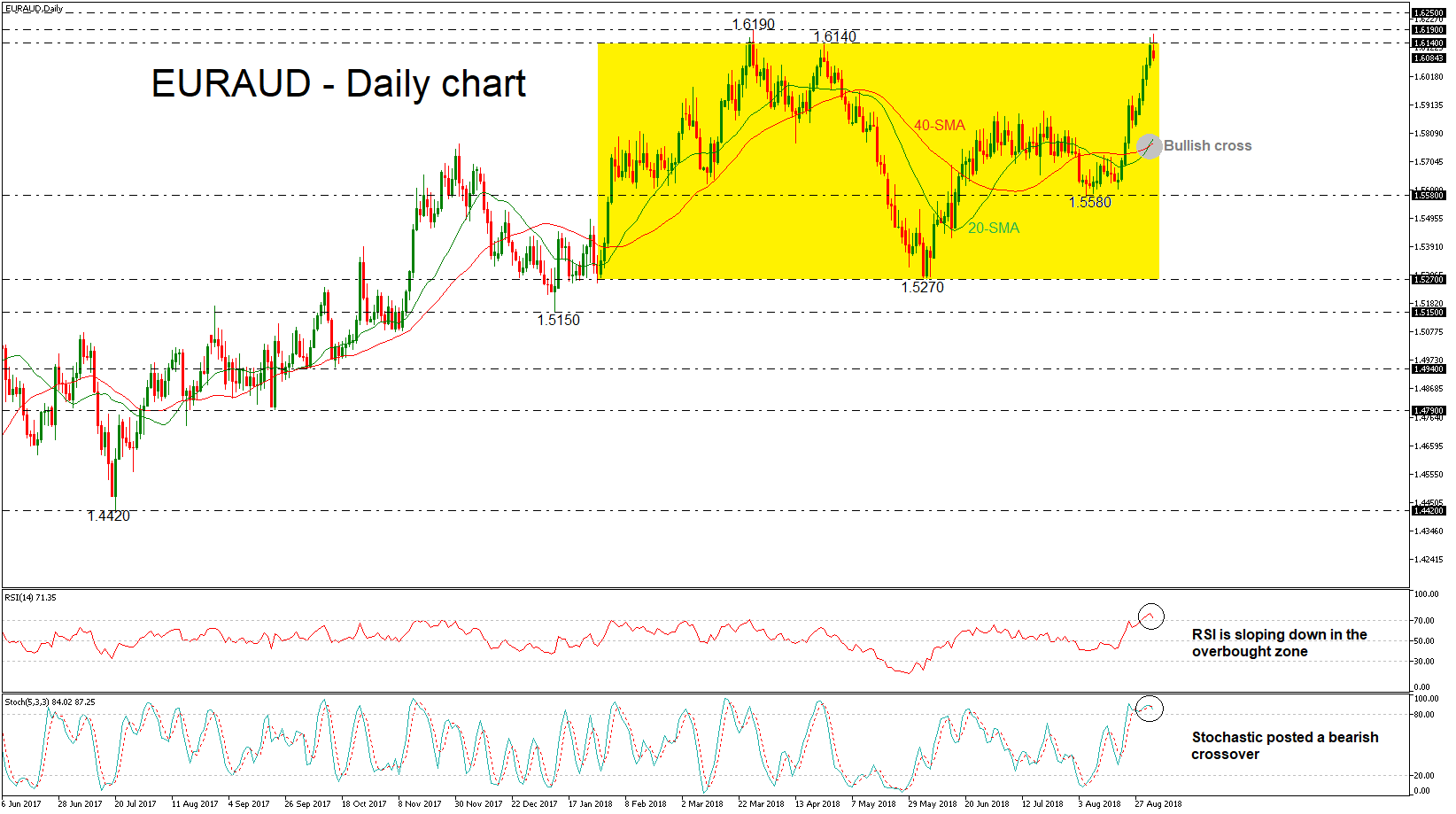
EURAUD posted an aggressive bullish rally in the previous couple of weeks after the bounce off the 1.5580 level. However, the pair has been developing within a consolidation area since the end of January. The price trades within the upper boundary of 1.6140 and lower boundary of 1.5270.
Moreover, the pair stands above the 20- and 40-simple moving averages (SMAs), which recently recorded a bullish crossover. However, the technical indicators are suggesting for a bearish movement. The RSI indicator is sloping south in the overbought zone, while the %K line of the stochastic oscillator holds below the %D line, indicating further declines.
Currently, the price is returning below the upper boundary and the next barrier to have in mind is the 20-SMA around 1.5785 at the time of writing. In case of deeper moves, the price could challenge the 1.5580 hurdle.
On the flip side, if EURAUD surpasses the 1.6140 and 1.6190 resistance levels it could move towards the 1.6250 barrier, taken from the highs on February 2016. Clearing this key level, the upside pressure could drive the price until the next major resistance at 1.6580, where it topped on August 2015.
In the bigger picture, having a look at the weekly chart, the price has been in an upward trend since February 2017 following the touch on the 1.3620 support zone.
Italy’s Debt Problem Returns to Spotlight as Agencies Threaten to Downgrade
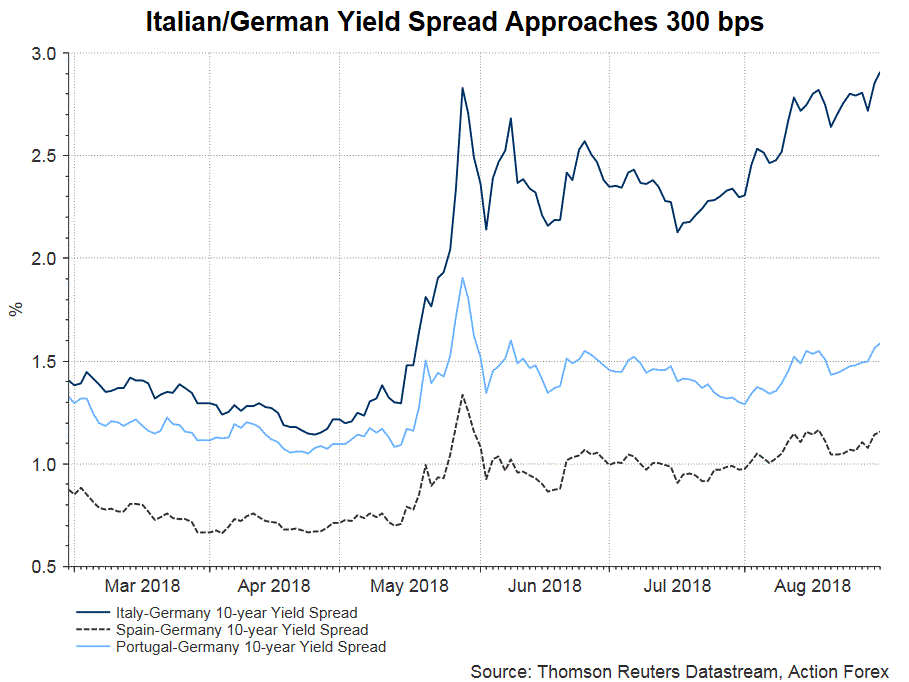
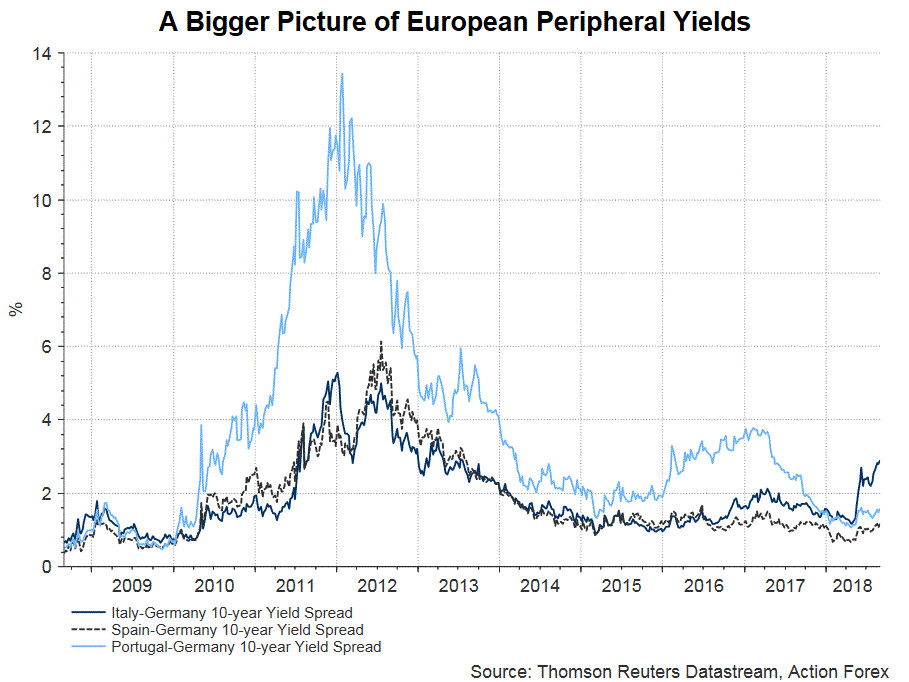
There is a comeback of concerns over Italy’s financial situation as next year’s fiscal budget would soon be revealed. As an election promise, the populist M5S/League coalition government could likely propose a number of expansionary measures including tax cut and increase in welfare. Such worries have been exacerbated by actions of credit rating agencies, triggering panic selloff of the country’s bonds. 10-year Italy –German yield spread has widened to the highest level since 2013, surpassing the level in May when the market was unnerved by the formation of the new government.
Fiscal Budget to Worsen Debt Situation
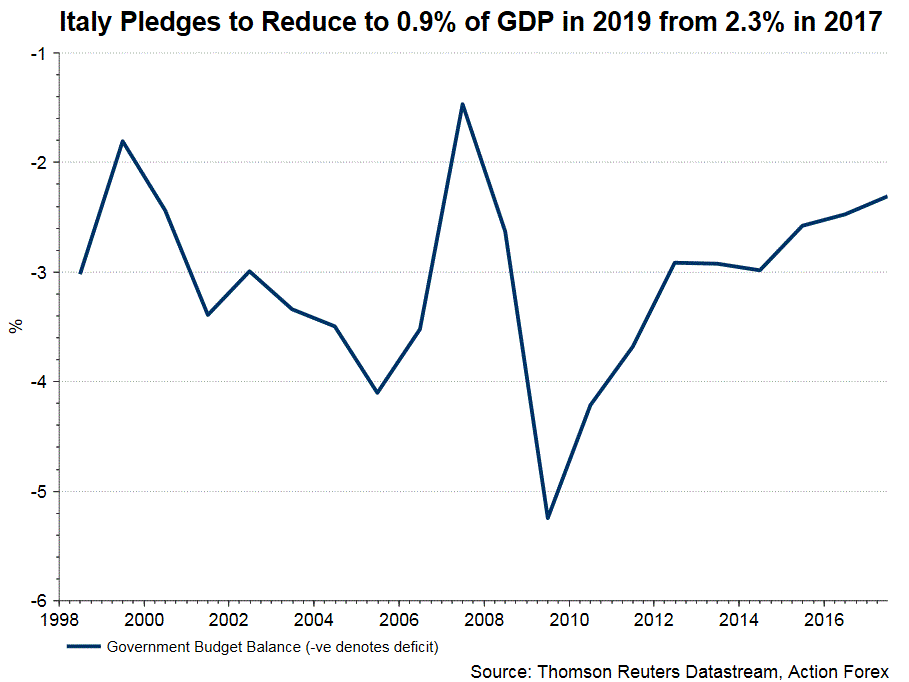
Back in May, M5S and the League reached an agreement in principle on a program called "Contract for the government of change". Notwithstanding the vague and general language used, the government’s aim at fiscal loosening is obvious. One of the important points lain down in the agreement was flat tax and simplification, proposing to freeze VAT and excise taxes. At the time same, it also proposed to reduce public debt through GDP growth, rather than through tax- and austerity-based measures. According to former fiscal commissioner and IMF alumnus Cottarelli, the measures might result in a deficit slippage of 108-125B euro (6-7% GDP), in addition to the current 30B euro (1.7% GDP).
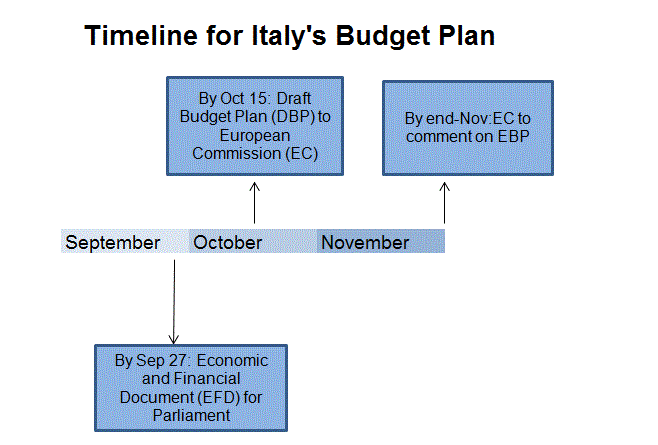
We expect to get more details about the budget plan as the government releases the Economic and Financial Document (DEF) by September 27. The document should paths for public debt and deficit targets for the period from 2018 to 2021. This would be followed by submission of draft budget plan (DBP) to the European Commission by October 15. The European Commission would announce its assessment by November 30.
We expect huge volatility in the financial markets as we approach the key dates. However, the Italian government is not free to implement whatever policy it wants. For instance, the European Commission could request the government to amend the DBP if it judged that the plan is non-compliant. It could even launch a significant deviation procedure or an Excessive Deficit Procedure (EDP). Meanwhile, the plan would have to be voted in the Italy’s parliament for approval. The coalition government has a thin majority in the upper house, making the hurdle for passing any bill quite high.
Rating Downgrades can Further Erode Borrowing Ability
Last Friday, Fitch revised Italy’s sovereign outlook to “negative” from “stable, while affirming the rating at BBB. As the accompanying suggested, Fitch expects Italy’s fiscal loosening would leave the country's “very high level of public debt more exposed to potential shocks”. The agency noted that the downside risks to the fiscal forecast projected in March have increased, as a result of “the new and untested nature of the government, the sizeable policy differences between its coalition partners, and inconsistencies between the high cost of implementing new pledges as set out in its policy "Contract" and its stated objective to reduce public debt”. Weeks ago, Moody’s announced to extend its review on the country’s possible downgrade to end-October, as the agency seeks to clarify on Italy’s fiscal path and reform agenda. The potential downgrade has been driven by “(1) the significant risk of a material weakening of Italy's fiscal strength, given the fiscal plans of the new government that took office in early June; and (2) the risk that structural reform efforts may stall, or that important past reforms such as the 2011 pension, or the 2015 labour market reforms, could be reversed”.
Italy's Sovereign Rating by Major Credit Rating Agencies
| Agency | Rating | Outlook | Notch above Junk Grade | Last Review | Next Review |
| Fitch | BBB | Negative | 2 | Aug 31, 18 | Jan-Feb, 19 |
| Moody's | Baa2 | Negative | 2 | May 25, 18 | End-Oct,18 |
| S&P | BBB | Stable | 2 | Apr 27, 18 | Oct 26,18 |
Downgrades of the sovereign rating would future erode the government’s ability to borrow in the international capital markets, creating a vicious debt cycle that could be detrimental to the economy. We have all learnt a painful lesson from Greece in the European sovereign debt crisis almost a decade ago. In October 2009, the newly election Greek government unveiled its previous government had grossly under-reported its budget deficit which was in fact expected to reach 12.5% of GDP, compared with Eurozone membership's threshold of 3%.This had quickly eroded investor confidence, causing bond spreads to rise to unsustainable levels. Fears spread that the fiscal positions and debt levels of a number of Eurozone countries were unsustainable. Over the 2 months through December, the top 3 credit rating agencies downgraded Greece's sovereign rating by 4 times. The Greek/German 10-year debt yield spread surpassed 300 bps in January 2010. Despite austerity measures, S&P’s downgraded Greek credit rating to “junk” in April, lifting the debt yield spread to above 1000 bps. Completely shutting the door for the country to borrow from the financial markets, Greece had to seek bailout from IMF/EU/EC bailout in May, together with the third austerity package. While Italy's rating is still 2 notches above junk level in all three agencies, we expect the market would closely monitoring any possible actions.
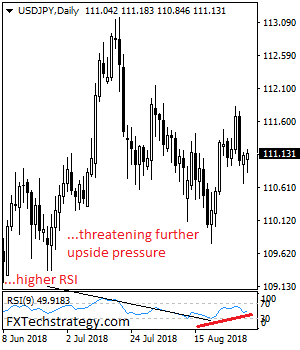
USDJPY: Sets Up To Recover Further Higher On Correction
USDJPY: The pair still faces price recovery threats as it looks to build up on its Friday price correction. On the downside, support lies at the 111.00 level where a break if seen will aim at the 110.50 level. A cut through here will turn focus to the 110.00 level and possibly lower towards the 109.50 level. On the upside, resistance resides at the 111.50 level. Further out, we envisage a possible move towards the 112.00 level. Further out, resistance resides at the 112.50 level with a turn above here aiming at the 113.00 level. On the whole, USDJPY faces further upside pressure on correction.