

Sample Category Title
Gold lost momentum after hitting 1214.3, turns into near term consoldiation
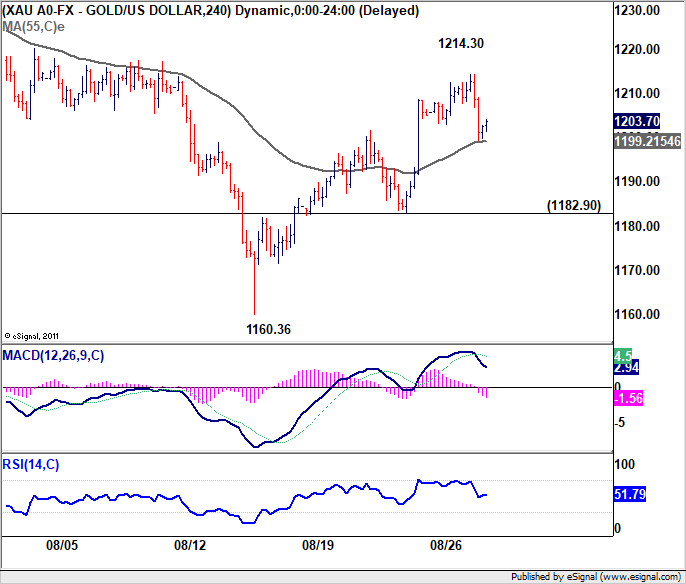
Gold's rebound lost momentum after hitting 1214.30 and retreated sharply. Nonetheless, it's try to draw support from 4 hour 55 EMA. For now some consolidations would be seen below 1214.30 first. But downside of retreat should be contained above 1182.90 support to bring another rise.
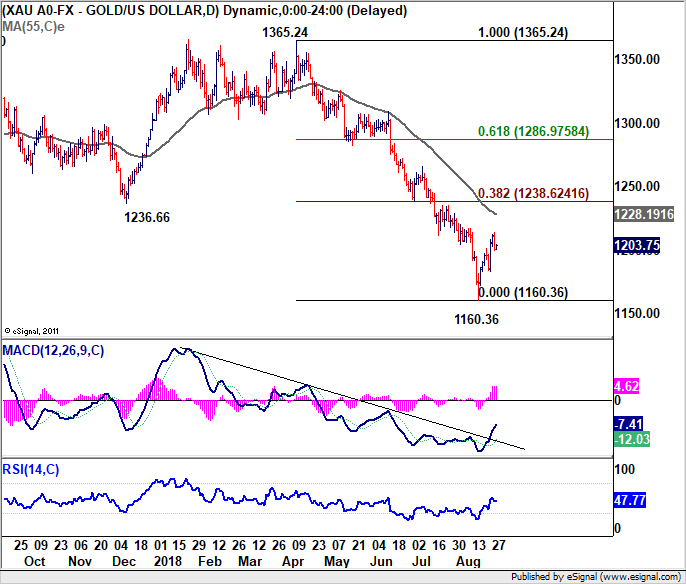
Overall outlook is unchanged. 1160.26 is seen as a medium term bottom. The corrective rise from there should extend to 55 day EMA (now at 1228.18) and possibly above. But we'd expect upside to be limited by 38.2% retracement of 1365.25 to 1160.36 at 1238.62 to bring down trend resumption at a later stage.
UK in shop price inflation for the first time in five years
UK BRC shop price index rose 0.1% yoy in August, up from July's -0.3% yoy fall. More importantly, that's the first rise in over five years, breaking a deflation cycle of 63 months. BRC noted in the release that "both higher food price inflation and lower non-food price deflation contributed to the return of Shop Prices to inflation". However, Shop Price inflation remains well below headline CPI as a result of "high levels of competition".
BRC Chief Executive Helen Dickinson noted that for now, "retailers are keeping price increases faced by consumers to a minimum". However, "current inflationary pressures pale in comparison to potential increases in costs retailers will face in the event the we leave the EU without a deal". And if that happens, "retailers will not be able to shield consumers from price increases." She also urged that "the EU and UK negotiating teams must deliver a Withdrawal Agreement in the coming weeks to avoid the severe consequences that would result from such a cliff edge scenario next March."
Canada Freeland had very constructive meeting with Lighthizer, but MILK is the word
Canadian Dollar trades firmer in Asian session today and remains the strongest one for the week. All eyes are on the trade negotiations between Canada and the US. Canadian Foreign Minister Chrystia Freeland, who cut short a European trip to Washington, said she had "very constructive meeting" with US Trade Representative Robert Lighthizer yesterday, and the meeting will continue today. She failed that Mexico had made some "significant concessions" in the are of labor and auto rules of original. And that has "really paved the way for what Canada believes will be a good week".
Dairy products is believed to be a key area that the US will press Canada on. White House top economic adviser Larry Kudlow said in a TV interview that "there's a word that Canada has trouble with and it's M-I-L-K. Milk. Anything to do with milk and dairy — they have this government-run, centrally planned system and some tariffs run upwards of 300 per cent. They're going to have to fix that." And, Kudlow warned that "the president did say if he cannot satisfactorily negotiate with [Canada] he may have to go to a large 20 to 25 per cent tax on Canadian automobiles headed for the U.S." Trump also imposed a Friday deadline for Canada to join the U.S, and Mexico, which is when the administration plans to give Congress its mandatory 90-day notification of the new trade deal.
According to a report by the Globe and Mail, Canada is ready to make a major concession on Diary products.
The Dollar Drift
The Dollar Drift
Capital markets continue to digest various narratives getting pushed in many directions but continue to position on a very short horizon given absolute uncertainties, while US equity markets continue to print fresh record highs to start the week this despite a US 10 year yields firming several pips higher overnight.
S&P 500 breaking 2900 for the first time confirm yet again another bullish break higher. With the NAFTA breakthrough Carmakers were the big winners. But overall the US -Mex deal has deflected attention away from Trump’s legal setbacks as investors may see the light at the end of the tunnel hoping that the US -Sino trade dispute can end in an equally friendly manner.
The firming US yields are likely a result, in the absence of any significant news, a factor of positioning and a growing sense that traders have squeezed about as much juice out of this move as possible.
Oil Markets
Oil prices had fallen after the API reported a crude build when the markets were positioned for a draw while bullish bets remain on Iran sanction sentiment swings. Again, global supply concerns continue to act as a Foyle against bullish positions as the data does suggest higher global supply than anticipated. However, keep in mind API total was still 2.8 million barrels lower than last week’s DOE total and so the expected decline may still be in tomorrow’s more definitive report. As such, prices are unlikely to fall off the edge on the API data
Gold Markets
Higher US yields, the S&P pushing above 2900 and general re risking has Gold price precariously perched above the $ 1200 levels as Gold continues to lose its lustre once again. The dollar, however, continues to trade mixed but both currency and precious metals traders will be keeping a close eye on the 2.90 % 10-year yield level for some near-term USD guidance. Again the Greenback direction will be key
The Euro
After a 750 pips, round trip the EURUSD is as likely overbought at 1.1700 as it was oversold at 1.1300. And despite the positivity from this weeks IFO Expectations index and some conciliatory overtones from Italy regarding EU budget compliance, with the ECB firmly planted on sidelines, traders were fading above 1.1700 thinking the 1.1750 could prove a tough nut to crack without a push from the ECB.
The Malaysian Ringgit
Trade has been relatively quiet as the Rigging remains thinly trades with Asia traders focused on CNH but with a tepid inflation outlook and the miss on Q2 GDP their likelihood of a rate cut rises which of course will play out negatively for the Ringgit
The Chinese Yuan
The market remains fixed on the Counter-Cyclical Mechanism but appear bidding time just waiting to re-engage long USDCNH positions.
Gold Edges Lower, Investors Eye GDP
Gold has posted small losses in the Tuesday session. In the North American session, the spot price for one ounce of gold is $1208.36, down 0.20% on the day. On the release front, there was positive news from manufacturing and consumer confidence data. CB Consumer Confidence jumped to 133.4, crushing the estimate of 126.6 points. On Wednesday, the U.S publishes Preliminary GDP for the second quarter and Pending Home Sales.
It has been a rough road for gold, which has shed 8.7% of its value since April 1. Months of escalating trade tensions and tit-for-tat tariffs between the U.S and China rocked risk appetite, as the U.S dollar has made strong gains at the expense of other major currencies. Even though gold is a safe-haven asset, it failed to benefit from nervous investors, who flocked to the U.S dollar. A booming U.S economy has also contributed to a strong greenback and weighted on gold prices. Traders should keep a close eye on U.S Preliminary GDP for Q2, which is expected to post a gain of 4.0%. If GDP misses this estimate, investors could get cold feet and boost gold prices.
Gold ended the week on a high note, posting gains of 1.7% on Friday. The gains were in response to comments from Federal Reserve Chair Jerome Powell, who spoke at the Jackson Hole Economic Symposium on Friday. Powell reiterated that the Fed would continue its policy of gradual interest rate hikes, and this pledge not to change policy sent the dollar lower and boosted gold prices. Powell argued that current monetary policy is prudent, but the Fed continues to face criticism on both ends. Some analysts have argued that the Fed has been too aggressive, given weak inflation, while others say the Fed should tighten more quickly, due to the extremely tight labor market. Powell appeared to take a middle approach of raising rates, but slowly. The Fed has already raised rates twice this year, and a September hike is practically a given, with the CME Group estimating the odds of a hike at 96%. The odds of a December hike currently stand at 66%.
Eco Data 8/29/18
[php_everywhere instance="1"]
IMF: Substantial time lag in transmission of Eurozone labor market improvements to inflation
In an IMF blog article titled "Euro Area Inflation: Why Low For So Long?", the puzzle of the broken relationship of core inflation and unemployment was discussed. The study found that the key is "strong persistence of euro area inflation". That is, for example, "coefficient on past inflation is high, much higher than for US inflation". Also, "coefficient on inflation expectations is much lower for the euro area than for the US".
In layman terms, the implication is that "in the euro area, following a period of weak demand and low inflation, it will take a much longer period of strong demand to get inflation back to the inflation objective". Or in more technical term, " there is a substantial time lag in the transmission of improving labor market developments to prices."
The implication to ECB's monetary policy is that it reinforces the case for being "patient, prudent and persistent". And, that will "support the slow process of returning inflation to its objective, through both stronger demand and well anchored inflation expectations."
Mid-US update: Stock rally losing momentum, treasury yield jumps
US stocks surge in initial trading, with S&P 500 and NASDAQ extending recent record run. The moves seem to have exhausted their momentum. No follow through buying is seen after S&P 500 hit 2903.77 and NASDAQ hit 8046.31. Both indices have indeed turned red at the time of writing and DOW is up only 0.06%.
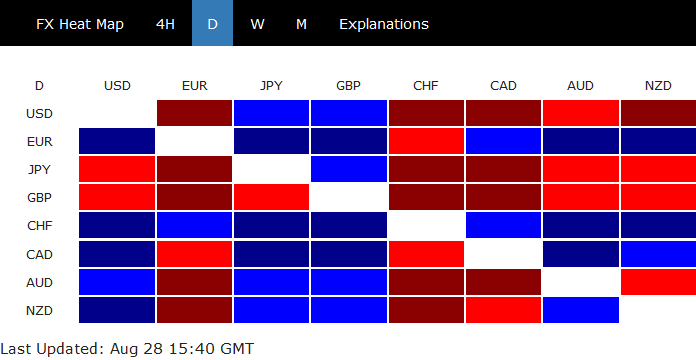
In the currency markets, Canadian Dollar is now the strongest one, followed by Swiss Franc and then Euro. The US seems to be optimistic in the trade negotiations with Canada. Treasury Secretary Mnuchin said today that "the U.S. market and the Canadian markets are very intertwined." And, 'it's important for them to get this deal and it's important for us to get this deal." He said the agreement could be concluded within this week.
On the other hand, Sterling suffers fresh selling in US session, in particular against Euro and Swiss Franc. Yen follows as the second weakest. Dollar is the third weakest even though data showed consumer confidence rose to highest since October 2000.
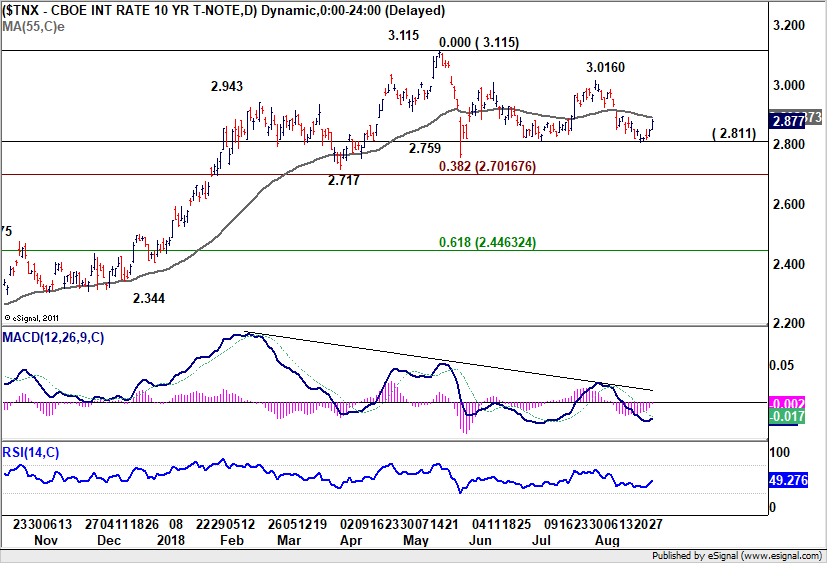
One development to note is the strong rally in treasury yields. It's believed to have started from Germany as 10 year bund yield jumps 0.10 to 0.38. The move is on the back on news that Germany is considering to extend financial aid to Turkey, to prevent knock-on effect from deterioration in the latter's economy. But the WSJ report also noted that the discussions are in very early stage, and the talk could eventually fall apart.
Nevertheless, the over developments help lift 10 year US yield sharply higher. At the time of writing it's up 0.27 at 2.875. The rebound also marks strong support from 2.811 and focus is back of 55 day EMA (now at 2.892). Break there will bring 3% handle back in radar.
British Pound Subdued as Pound Hugs 1.29
GBP/USD is unchanged in the Tuesday session. In North American trade, the pair is trading at 1.2886, down 0.06% on the day. On the release front, U.S manufacturing and consumer confidence data was stronger than expected. CB Consumer Confidence jumped to 133.4, crushing the estimate of 126.6 points. On Wednesday, the U.S publishes Preliminary GDP and Pending Home Sales.
With the negotiations over Brexit stalled, there is an increasing likelihood of a ‘no deal’ Brexit, which would mean that Britain would leave the EU next March without a new trade agreement in place. This scenario could have significant economic repercussions on the UK economy, which has been integrated into the EU economy for decades. The Bank of England will be expected to help guide the economy through Brexit. The current Governor of the BoE, Mark Carney, is scheduled to be replaced in June, 2019, only three months after Brexit. On Wednesday, a report surfaced that Carney has been asked to remain at the helm of the BoE for an additional year in order to provide continuity at the Bank after Brexit.
The Federal Reserve monetary policy has been one of gradual rate increases, as the U.S economy continues to expand. The Fed stance can be summed up as “proceed with caution”. Fed Chair Jerome Powell reiterated this position, with a dovish speech at the Jackson Hole Economic Symposium on Friday. However, the Fed has faced criticism about its current policy from both sides. Some analysts have argued that the Fed has been too aggressive, given weak inflation, while others say the Fed should tighten more quickly, due to the extremely tight labor market. Powell appeared to take a middle approach of raising rates, but slowly. The Fed has already raised rates twice this year, and a September hike is practically a given, with the CME Group estimating the odds of a hike at 96%. The odds of a December hike currently stand at 66%.
Yen Trading Sideways, as Japanese, U.S Data Beats Expectations
The Japanese yen is unchanged in the Tuesday session. In North American trade, the pair is trading at 111.05, down 0.03% on the day. On the release front, BoJ Core CPI edged up to 0.5%, above the estimate of 0.3%. In the U.S, manufacturing and consumer confidence data was stronger than expected. CB Consumer Confidence jumped to 133.4, crushing the estimate of 126.6 points. On Wednesday, Japan releases consumer confidence, while the U.S publishes Preliminary GDP and Pending Home Sales.
Japanese inflation numbers have been a mix this week. BoJ Core CPI, the Bank of Japan’s preferred inflation indicator, improved to 0.5%. Earlier in the week, National Core CPI remained pegged at 0.8%, shy of the estimate of 0.9%. The Services Producer Price Index edged lower to 1.1%, missing the estimate of 1.2%. Despite an ultra-accommodative monetary policy, inflation remains well below the BoJ target of just below 2 percent. Rather than reduce the inflation target, the Bank will likely postpone yet again the timeline for its 2% target to fiscal year 2020 or beyond. Massive quantitative and qualitative easing have failed to coax inflation higher, so policymakers may have to consider other means of fiscal easing in order to encourage more spending and push inflation higher. The markets will get another look at inflation on Thursday, with the release of Tokyo Core CPI. The indicator is expected to remain unchanged at 0.8%.
The Federal Reserve monetary policy has been one of gradual rate increases, as the U.S economy continues to expand. The Fed stance can be summed up as “proceed with caution”. Fed Chair Jerome Powell reiterated this position, with a dovish speech at the Jackson Hole Economic Symposium on Friday. However, the Fed has faced criticism about its current policy from both sides. Some analysts have argued that the Fed has been too aggressive, given weak inflation, while others say the Fed should tighten more quickly, due to the extremely tight labor market. Powell appeared to take a middle approach of raising rates, but slowly. The Fed has already raised rates twice this year, and a September hike is practically a given, with the CME Group estimating the odds of a hike at 96%. The odds of a December hike currently stand at 66%.