

Sample Category Title
Early Dispatches From the Trade War
Highlights
- Trade policy has been a priority of the Trump administration. Apart from NAFTA re-negotiations being back in the headlines recently, the U.S. has implemented and threatened actual tariffs on a variety of its trading partners so far in 2018. These efforts are starting to show up in prices and economic activity. But, they are not expected to derail U.S. economic momentum or add to inflation in a serious way.
- The tariffs in place so far are only the tip of the iceberg relative to those under review or threatened. If enacted, these would put a more serious damper on the U.S. and global economy. Given the size of the potential impacts, it is in the U.S.'s interest to negotiate with its trading partners and avoid a worst-case scenario.
- Tariffs also raise the risk that the Fed misinterprets the inflation momentum in the economy. It is difficult to fully disentangle one-time tariff impacts on prices.
- Even threatened tariffs can have a negative impact. Experience has shown impending tariffs can affect prices and distort business decisions. There is also early evidence that worries about tariffs are causing businesses to reassess their investment plans. That is a key downside risk to our U.S. outlook.
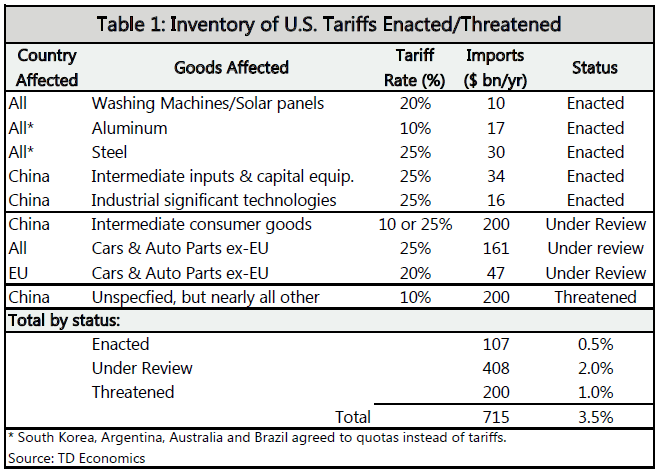
Negotiating better trade agreements for the U.S. was a key platform of President Trump's election campaign. NAFTA has been going through a re-negotiation process for over a year now, and it appears a deal is getting closer (at least with Mexico). Since the tax cuts were signed into law in late 2017, the White House's focus has shifted to trade policy, and the administration has taken actions on tariffs on numerous fronts. So far this year, the U.S. has levied tariffs on $107 billion (bn) in imports into the U.S. A variety of goods from solar panels, to steel and aluminum, to various goods from China are subject to tariffs ranging from 10-25%. America's trading partners have increasingly responded in kind. Actual tariff action combined with those under threat or investigation amount to $715 bn. These threats and actual tariffs are having real effects on price volatility, business sentiment and trade patterns, but early dispatches suggest that the overall impact so far on the $20 trillion U.S. economy is small. However, this is not to dismiss the possibility that local impacts may be more severe due to their industry and country trade exposures.
The fact that U.S. growth is running at a healthy 3% pace in real terms on a trend basis offers a deep cushion to absorb these impacts. However, this cushion would become thinner if there is follow through on some of the larger threats at hand via both direct linkages and indirect risks. Among them, the Fed's job of calibrating the pace of rate hikes to growing inflation pressures becomes difficult. In theory the Fed looks through the one-time impacts on inflation, but will carefully consider the potential downside risks to growth. But this may be trickier than it seems. If the Fed misjudges, it could raise rates too fast, and risk triggering the next recession. Or it might chalk inflation up to tariffs and hike rates too slowly, risking a faster pace of rate hikes later on, more in tune with slamming the brakes on economic growth later on.
Trade war has multiple fronts
It's a full-time job keeping tabs of all the tariff threats, actions or reviews these days. The administration is fighting tariff battles on three fronts: against China, on steel and aluminum with many of its closest trading partners and allies and against auto exporting nations. Table 1 breaks it all down into actions that are in place, under review and further action that has been threatened. The U.S. has notably put tariffs on all of its top five trading partners: Canada, Mexico, China, the EU and Japan. Most countries have retaliated, but not necessarily in kind when it comes to products. Japan is the only country that hasn't countered with tariffs on U.S. goods, although it has made threats. China has borne the brunt of the import tariffs, with about $65 bn in goods impacted so far, and tariffs up to 25% threatened on another $200 bn possible as early as next month. Knowing that retaliation impacts are small within a large U.S. economy, countries have tried to act strategically, targeting products, corporations and states that may expedite resolution.
Early signs of impacts in prices
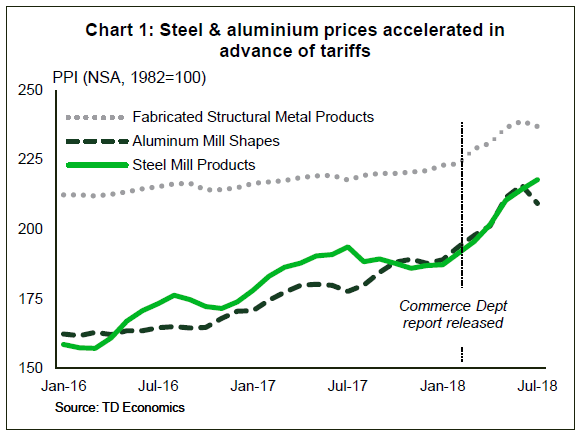
It may be tempting to dismiss tariff threats as immaterial until they look like they will actually be implemented. But, tariffs can have an impact even before they are actually in force. For example, prices for steel and aluminum started rising once the Commerce department released its report, before tariffs were even implemented.
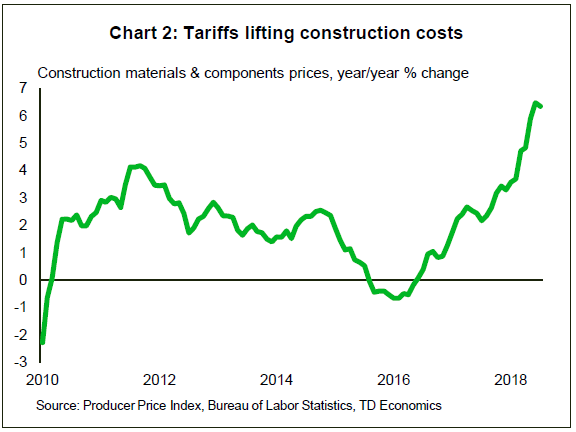
This is evident in price data up to July, which includes two months of the broadest steel and aluminum tariffs, and the early days of Chinese import tariffs. Since January, prices for steel and aluminum mill products are up around 15% as measured by the U.S. Producer Price index (Chart 1). Moreover, steel and aluminum tariffs are also adding to cost pressures in the construction sector. Materials and components prices had already been lifted by lumber prices, affected by softwood lumber duties levied on Canadian lumber imports in 2017 (Chart 2).
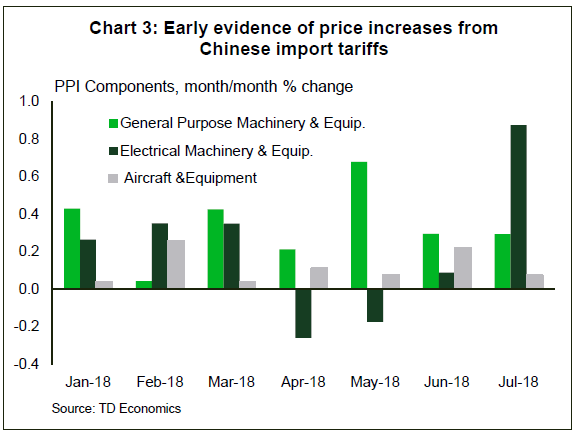
Looking at producer prices for categories that would contain many of the Chinese goods subject to tariffs, some reflected an upward thrust in July (Chart 3). Intermediate core goods inflation reached a seven-year high of 5.3%. But, some of this is likely being absorbed in profit margins because prices for producer final goods are up only 2.8% in comparison. There is also little evidence that these price increases are showing up at the consumer level yet. Core CPI inflation did reach a cycle high of 2.4% in July, but that has been driven by higher services prices rather than core goods prices.
Higher costs are likely to be passed on to consumers in part, but the transmission is typically slow (i.e. over several quarters). Many big companies have announced that they will pass along these costs to their customers. But, depending on the competitiveness of the sector, businesses may opt to cut costs, either through reduced investment or reducing staff. For now it seems that manufacturing margins are pretty healthy to absorb some of the hit. Retail and wholesale margins are a bit less favorable compared to history. Overall we expect the tariffs implemented thus far will result in a marginal 0.2%-point increase in inflation over the next four to eight quarters.
Impact of threatened tariffs much larger
Tariffs are a tax. Sometimes this simple fact can get lost in the sequence of threats and retaliation by trading partners. When the U.S. government imposes a tariff on an imported good, it is a tax on that good. The incidence of the tax is a complicated matter that depends on the structure and competitive nature of the particular industry. For example, if there is a tariff on a China-sourced input where a company has many alternate suppliers in other countries from where to source that good, the Chinese producer may have to absorb more of the impact, including a possible decline in production. If there are few substitutes than the U.S. importer would incur the higher cost of the part, and must decide whether it's capable of either passing it along to its customers, or absorbing the cost increase. On a cumulative basis, these supply chain and price decisions by individual firms determine the ultimate growth impact on the U.S. economy. To the extent that the incidence of the import taxes falls on U.S. businesses and consumers, it hits their purchasing power and crimps spending on other things.
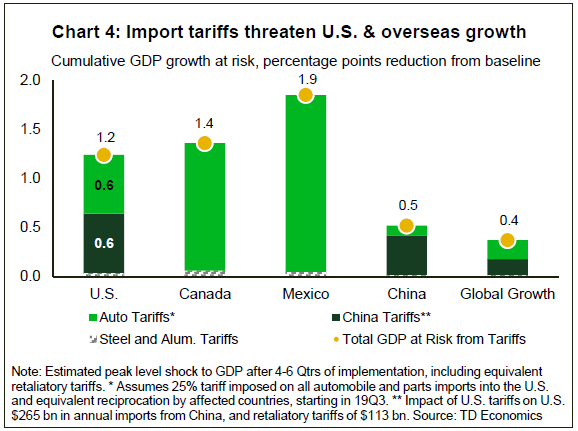
Thus far, the estimated growth implications of the tariffs in force are relatively small. Adding up the $50 bn in import tariffs on China to the steel and aluminum tariffs, we get roughly 0.2 percentage points (ppts) off of real GDP growth in about a year's time, and about two tenths of a point to inflation. But when you consider the tariffs that have been threatened by the White House, the potential economic impacts become more notable (Chart 4). Auto tariffs would have material negative impact automotive exporters, and could place about 0.4 ppts of global growth at risk.
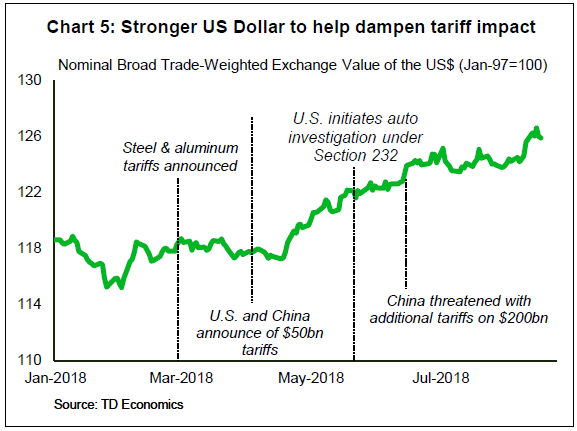
In addition, the laws of economics come into force in providing a partial, but not full, offsetting impact. Currencies react quickly to news, and often can help to facilitate the economic adjustment to tariffs. Since the beginning of the year, widening interest rate differentials and geopolitical risks have helped the green back appreciate (Chart 5). These have been compounded by trade threats and actions. The Chinese yuan in particular has depreciated approximately 8% since U.S. trade threats heated up against China in late March. These moves have acted to offset some of the impact of tariffs on the price of imported goods, and thereby mitigating the impact on importers. But, obviously not the full extent for those tariffs that can be in the double-digit range.
Another more nuanced impact of the tariffs is that they are regressive1. To the extent that higher prices are passed on to consumers, they will disproportionately be paid by lower income households who spend a larger share of their income on tradeable goods.
Apart from inflation and overall growth impacts, pending tariffs can cause distortions in business activity. Most notably, shippers ramped up U.S. soybean exports to China in the second quarter to get ahead of the tariffs, even before they knew tariffs were a certainty. This added half a percentage point to real GDP growth in the second quarter, which is likely to be reversed this quarter.
Macro impacts may be small, but localized impacts could be severe
Apart from prices, reports are becoming more commonplace of businesses taking note of the tariff environment. For example, Harley Davidson has shifted some production to Europe to avoid steel and aluminum tariffs. BMW has moved the manufacture of some vehicles to China, which are destined for that market, to avoid the retaliatory import tariffs imposed on U.S.-made SUVs. Any significant slowdown in production at BMWs South Carolina plant would cascade to many other businesses in the state, as there is a network of niche suppliers who support production at the BMW plant. The U.S. Chamber of Commerce estimates that South Carolina will be among one of the hardest hit states (8th) by the tariff measures. On this note, a TV manufacturer has already reported to be closing a South Carolina plant due to the higher cost of imported Chinese components2.
There are also anecdotal reports that steel and aluminum production has increased, or previously shuttered facilities have been reopened. But it is difficult to see a notable impact in the production or employment data as of July. The manufacturing sector had been on a cyclical upswing since mid-2016, prior to the current administration ratcheting up the rhetoric on tariffs earlier this year. Hiring in the sector accelerated since mid-2016, reflecting stronger global growth and an American product and manufacturing process that has moved up the value-chain from low cost processes and products in the past. The risk is that tariff worries dampen sentiment in the sector to an extent that actual investment takes a hit.
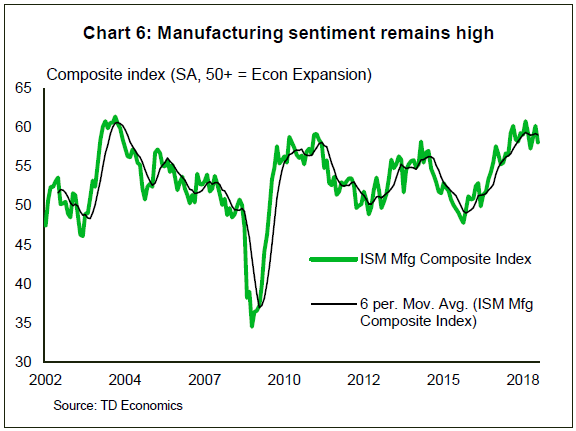
That is a big downside risk, and there are early signs that this may be occurring. The Fed's July Beige Book, which covered the late May to early July period, reported that "manufacturers in all Districts expressed concern about tariffs and in many Districts reported higher prices and supply disruptions that they attributed to the new trade policies". Overall evidence from manufacturing confidence surveys is mixed. The ISM manufacturing index has oscillated recently, but the trend looks more like a plateau at this point around a cyclical high, rather than deterioration (Chart 6). Regionally, the forward looking components of Fed manufacturing confidence surveys have held up well for the most part. The Empire Fed (New York) manufacturing index is the notable exception. It has seen the outlook component weaken in 2018.
The Atlanta Fed conducted a survey in mid-July to see how worries about tariffs are affecting investment plans3. The survey found that announced tariffs or retaliation has caused one-fifth of firms to reassess their capital expenditure plans. That share was higher at 30% for manufacturers. Of those examining their plans, two-thirds are still reassessing, while 31% have postponed or dropped previously planned expenditures and 14% have accelerated their spending plans. Overall, the Atlanta Fed finds that tariff worries have had only a small negative effect on business investment to date. Cracks are certainly showing up in business confidence, but it seems to be only at the margin. Again, this is occurring against a backdrop of very healthy investment growth expected over the coming quarters and with a number of trade threats remaining only that. If they come to pass, the downside risks will become much larger.
Potential for collateral damage
Another risk from import tariffs is a bit less obvious than investment plans. Given that tariffs are starting to show up in inflation at the producer level and are likely to filter through to some extent to consumer prices, they could be a factor raising inflation over the coming quarters. This complicates the Fed's delicate task of calibrating its pace of rate hikes so as to keep inflation roughly around 2%. In a perfect world, the Fed will look through one-time price increases caused by tariffs. However, with Chinese tariffs are placed on a wide variety of goods along the supply chain, making it more difficult to disentangle how much inflation is due to a hot economy, and how much is the result of tariffs. That raises the risk the Fed misinterprets the inflation signal and hikes rates too quickly or not enough. The Fed will likely be very cautious in reacting to accelerating inflation in the months ahead. For now we are comfortable with our view that the Fed is set to hike rates two more times in 2018.
The Bottom line
The possibility that the current administration makes good on all of its current tariff threats is the biggest downside risk to our otherwise healthy economic outlook. However, we see this as a minimal risk at this time. The bigger likelihood is that the U.S. continues to rattle the tariff sabre, but not take full action. However, as noted above, this does carry negative knock-on effects to business investment intentions. If evidence of investment delays becomes more widespread, this can necessitate downside revisions to our forecast, particularly for business investment spending. But for now, the incoming data remains solid and the negative impact of tariffs on businesses is not widespread. The fact the U.S. economy is running at a healthy 3% pace in real terms does provide a deep cushion to absorb the negative impacts, mitigating concerns on our front.
End Notes
Dollar Looks to Key Data for Support as Trade Worries Fade
Several US data releases will highlight the final week of August. A second look at GDP for Q2 will be made public on Wednesday, before personal consumption & income numbers alongside the core PCE index are out on Thursday, at 1230 GMT. Strong prints could enhance expectations for two more Fed rate hikes this year and thereby, support the dollar a little. That said, the currency will also remain sensitive to any developments in trade tensions.
After surging to its highest level in over a year, the US dollar index corrected lower last week, weighed on by President Trump’s criticism of Fed policy and some remarks by Fed Chairman Powell, who downplayed the risk of inflation accelerating much further. What was surprising, though, was seeing the market implied odds for Fed rate hikes over the rest of this year remain stable. According to the Fed funds futures, investors have fully priced in one more quarter-point rate increase, while they also see a 63% probability for a second one by year-end.
Hence, despite the rhetoric, markets are still fairly confident that the Fed is on track to deliver as many as two more hikes this year, something likely owed to the strong performance of the US economy. In the first estimate of GDP for Q2, economic growth clocked in at an astounding 4.1% annualized pace, the unemployment rate hovers near two-decade lows, and inflation is practically on target – all factors arguing for continued gradual rate hikes.
Turning to this week’s data releases, they are likely to be watched as a gauge of whether the Fed remains on track to raise rates another two times in 2018. On Wednesday, the second estimate of GDP for Q2 is projected to revise growth marginally lower to a 4.0% annualized pace, from the 4.1% in the preliminary reading – though still a very strong figure overall.
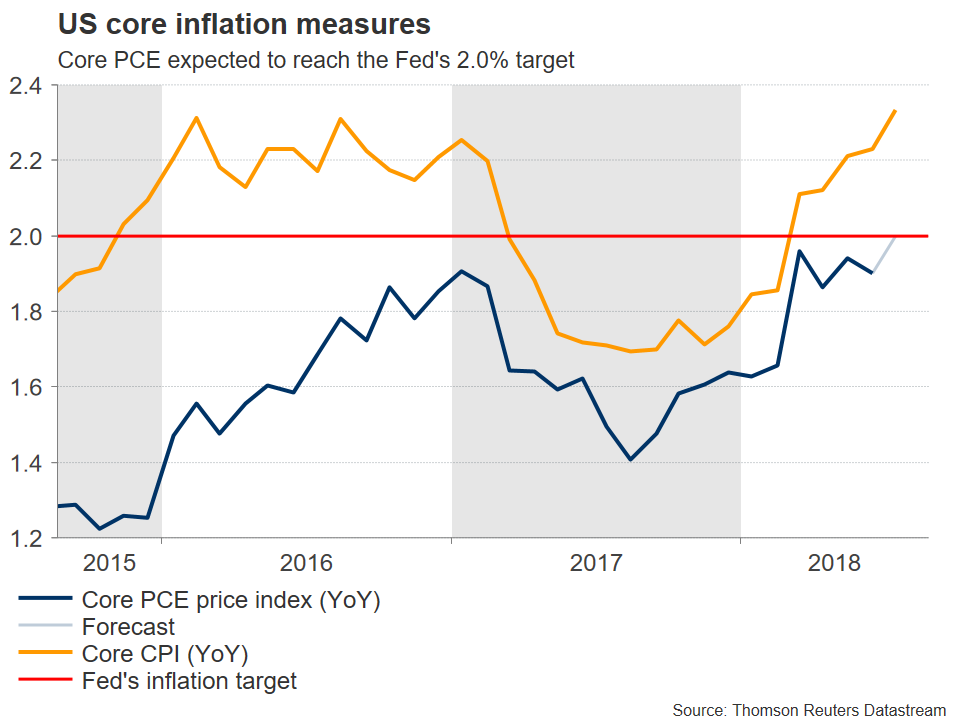
Then on Thursday, personal income and spending for July are due, alongside key data on consumer prices. Incomes are forecast to have risen again, albeit at a slightly weaker pace of 0.3% month-on-month compared to the 0.4% seen in June. Meanwhile, spending is anticipated to have risen by 0.4%, unchanged from previously. Last but not least, the Fed’s preferred inflation measure – the core PCE price index – is projected to have ticked higher in yearly terms to reach the Fed’s 2.0% objective, following a 1.9% reading in June.
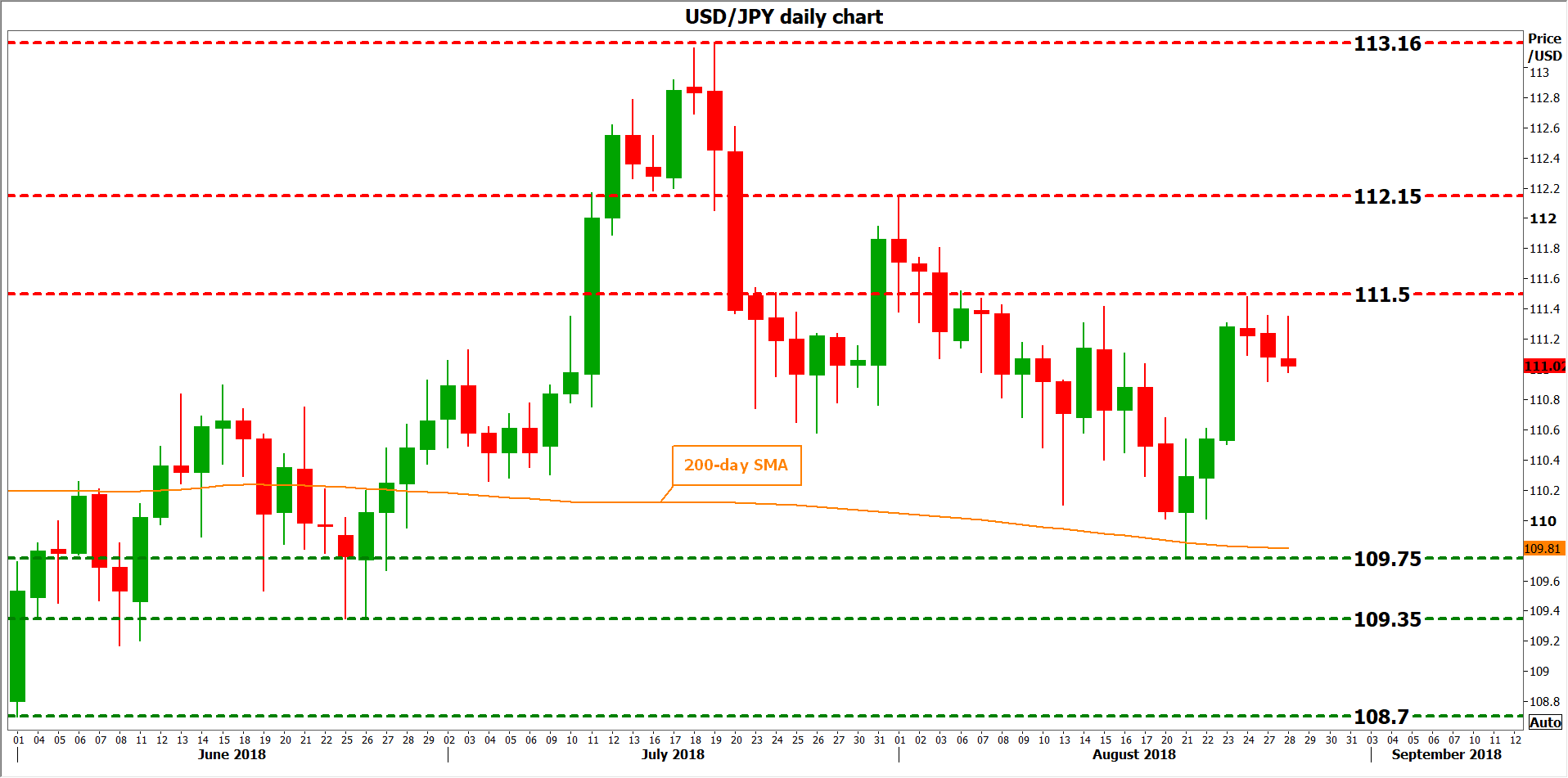
Should these figures mostly come in better-than-projected, and particularly the core PCE print, then investors may price in a greater likelihood for two more Fed hikes this year and consequently boost the dollar. Looking at dollar/yen technically, immediate resistance to advances may be found near the 111.50 zone, marked by the August 24 peaks. An upside break could open the way for the August 1 high of 112.15, before the attention starts shifting towards the 8-month high of 113.16.
On the contrary, in case of a data disappointment that dials back Fed-hike expectations, support to declines may come around the two-month low of 109.75 reached last week. Note that the 200-day moving average lies marginally above, at 109.81. A downside break of that area could open the way for the 109.35 hurdle, defined by the June 25 lows, before the June 1 trough of 108.70 comes into view.
Finally, besides economic data, the other major factor that may influence the dollar are how trade tensions play out. The greenback has been acting like a haven asset in the midst of trade worries, benefiting when tensions intensified under the view that the US economy is better prepared than others to weather any trade storms, and retreating on signs of de-escalation. Following the recent trade agreement between the US and Mexico, all eyes are now on Canada to see whether the three nations can reach a new trilateral accord. If a new NAFTA deal is confirmed soon, that could divert funds away from the dollar as investors scale back their safe-haven bets on the currency. Besides NAFTA, any developments in the US-China standoff could also impact the dollar in a similar manner.
EURUSD Outlook: Weak US Data Help Euro Bulls
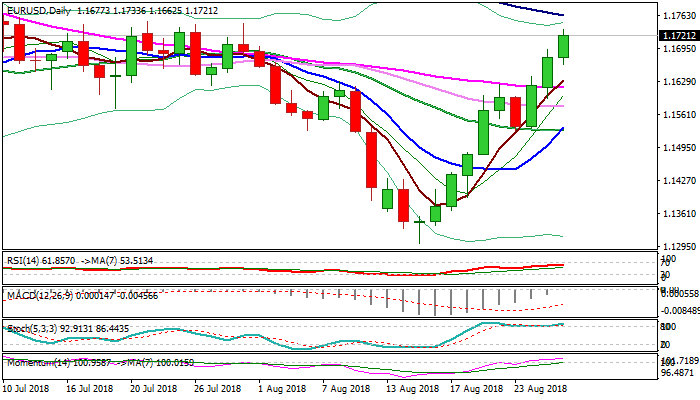
The Euro maintains bullish in early American trading tone and eventually broke 1.1700 barrier which temporarily capped the advance this morning. Strong advance from 1.1530 (23 Aug trough) holds in red for the third consecutive day and eyes key near-term barrier at 1.1750 zone (daily cloud top/Fibo 38.2% of 1.2476/1.1300). Fresh advance was helped by weaker than expected US data released today, which put the greenback under fresh pressure. Trade gap widened in July to $72.2 billion vs forecasted -$68.6 billion and $67.9 billion gap in June. Also, US HPI dipped to 6.3% in June, against forecast/previous month figure at 6.5%. Bulls came closer to 1.1750 pivot, break of which would generate bullish signal for stronger correctio of larger 1.2476/1.1300 Mar-Aug descend. Firmly bullish tech on daily chart continue to underpin the action, as momentum continues to trend higher in positive territory, daily Tenkan-sen/Kijun-sen formed bullish cross and MA's remain in bullish setup. Lift and close above daily cloud would open way towards barriers at 1.1790 (09 July high) and 1.1848 (14 June high) in extension. Overbought slow stochastic suggests that corrective action could be expected in coming sessions, but so far without firmer signals.
Res: 1.1750; 1.1761; 1.1790; 1.1848
Sup: 1.1700; 1.1658; 1.1631; 1.1615
Sunset Market Commentary
Markets
Core bonds stabilized during this morning’s European session, but faced new selling pressure as US trading gets going. US Treasuries underperform Bunds. The move is partly driven by continued equity strength and partly technically inspired (yesterday’s engulfing pattern in German yields and failed test of key support in the US). The continuation of the Treasury’s supply operation and comments by ECB Praet might have been of minor importance as well. The ECB’s chief economist, one of the founding fathers of the ECB’s extremely accommodating monetary policy, now says that risks associated to this policy need to be “closely monitored” after years of economic expansion. Early US eco data printed mixed and didn’t leave a trace on markets. The US yield curve bear steepens with yields up to 3.1 bps (30-yr) higher. The German yield curve shifts in similar fashion with yields increasing by 0.3 bps (2-yr) to 1.6 bps (30-yr). Peripheral yield spreads vs Germany narrowed up to 3 bps (Italy). There were some conflicting messages on Italy possibly breaching the 3% of GDP budget criterion with FM Tria promising to stay below it and keep the debt-to-GDP ratio on a declining path while 5SM leader Di Maio didn’t rule out a bigger deficit.
Dollar softness persisted today. Yesterday, investors sold the dollar as global risk sentiment improved. The US and Mexico reaching a new trade agreement supported investors hope that global trade tensions might ease, reducing safe haven demand for the dollar. Asian and European investors were less excited about the US/Mexican deal compared to US markets yesterday evening. Interest rate differentials between the US and Germany also widened slightly in favour of the dollar. Even so, the US currency remained in the defensive. At the same time, the euro ignored comments from Italy’s Di Maio that the country could breach the EU deficit rules. EUR/USD returned to the 1.17 area and even extended gains during the US trading session. US eco data were mixed. Inventory build-up was stronger than expected but the July trade deficit was much worse than expected (-$72.2 bln from -67.9 bln). The reaction of the dollar was negligible. Even so, in a context of lingering trade tensions, the negative US international trade data are evidently no help for the dollar. EUR/USD trades currently 1.1725 area.
Sterling traders returned from a long weekend today. There were no UK eco data. The debate on the likelihood/the potential consequences of a ‘no-deal brexit’ remained the main driver for sterling trading. Over the previous days, headlines of several parties involved in the brexit process preparing contingency plans unnerved investors and weighed on sterling. EUR/GBP yesterday surpassed the 0.9033/45 resistance. Sterling still had to fight an uphill battle today. UK PM May in an interview said that no deal is better than a bad deal and that a no-deal scenario wouldn’t be the end of the world. The comments didn’t help sterling. EUR/GBP maintained an upward bias and touched an intraday peak in the 0.9075 area. Cable avoided further losses on global USD softness. The pair trades near 1.29.
News Headlines
US trade deficit increased to a 5-month high in July (-$72.2 bn). Wholesale (0.7%) and retail Inventories (0.4%) grew strongly, which could have a positive impact on GDP. Richmond Fed’s manufacturing ‘confidence’ index increased in August to 24 from 20. Consumer confidence printed much stronger than expected at 133.4 in August (127.4 in July).
Swedish retail sales unexpectedly declined 1.0% M/M in July (+0.4% expected) bringing the Y/Y measure to -1.2%. This plunge is linked to unusually high temperatures but still raises doubts over economic momentum as the Riksbank prepares to raise interest rates later this year. EUR/SEK is testing the April peak near 10.70.
As Turkey remains in crisis, Germany is considering to provide emergency financial assistance. Fear grows that an economic meltdown could spill-over to Europe, cause further destabilization in the Middle East and unleash a new immigration wave to the bloc. French Finance Minister Le Maire already expressed similar concerns.
US consumer confidence rose to 133.4, highest since October 2000
US conference board consumer confidence jumped to 133.4 in August, up from 127.9 and beat expectation of 127.0. That's also the highest reading since October 2000.
Lynn Franco, Director of Economic Indicators at The Conference Board said "Consumers' assessment of current business and labor market conditions improved further. Expectations, which had declined in June and July, bounced back in August and continue to suggest solid economic growth for the remainder of 2018. Overall, these historically high confidence levels should continue to support healthy consumer spending in the near-term."
EUR/USD Mid-Day Outlook
Daily Pivots: (S1) 1.1618; (P) 1.1657; (R1) 1.1718; More.....
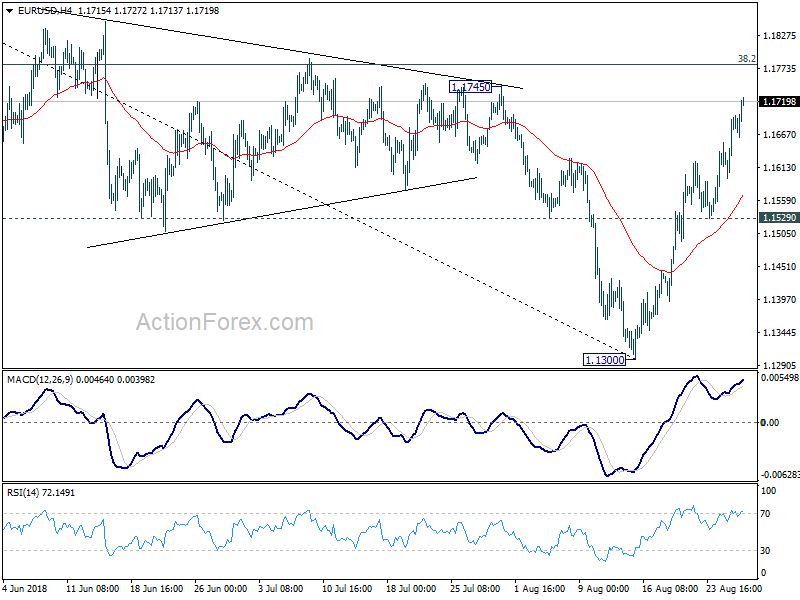
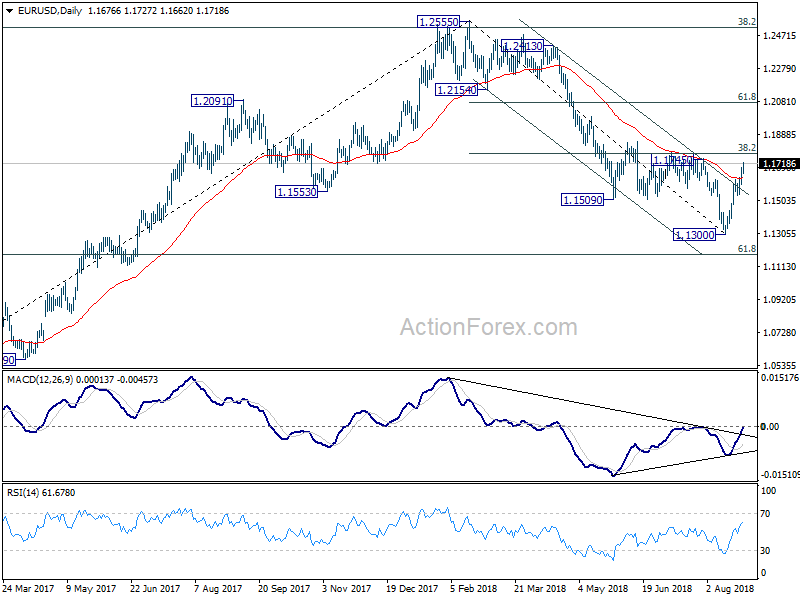
EUR/USD's rally is still in progress and reaches as high as 1.1727 so far. Intraday bias remains on the upside for 38.2% retracement of 1.2555 to 1.1300 at 1.1779. We'd expect upside to be limited there, at least on initial attempt, to bring near term reversal. However, break of 1.1529 minor support is needed to signal completion of the rebound first. Otherwise, further rise will remain in favor even in case of retreat. Break of 1.1529 will bring retest of 1.1300 low. After all, consolidation from 1.1300 will extend for a while before completion.
In the bigger picture, a medium term bottom should be in place at 1.1300, on bullish convergence condition in daily MACD and some consolidations would be seen. But still, note that EUR/USD was rejected by 38.2% retracement of 1.6039 (2008 high) to 1.0339 (2017 low) at 1.2516. That carries some long term bearish implications. Thus, we'd expect fall from 1.2555 high to resume after consolidation completes. Below 1.1300 should send EUR/USD through 61.8% retracement of 1.0339 to 1.2555 at 1.1186. And, in that case, EUR/USD would head to retest 1.0339 (2017 low).
USD/CHF Mid-Day Outlook
Daily Pivots: (S1) 0.9773; (P) 0.9810; (R1) 0.9832; More.....
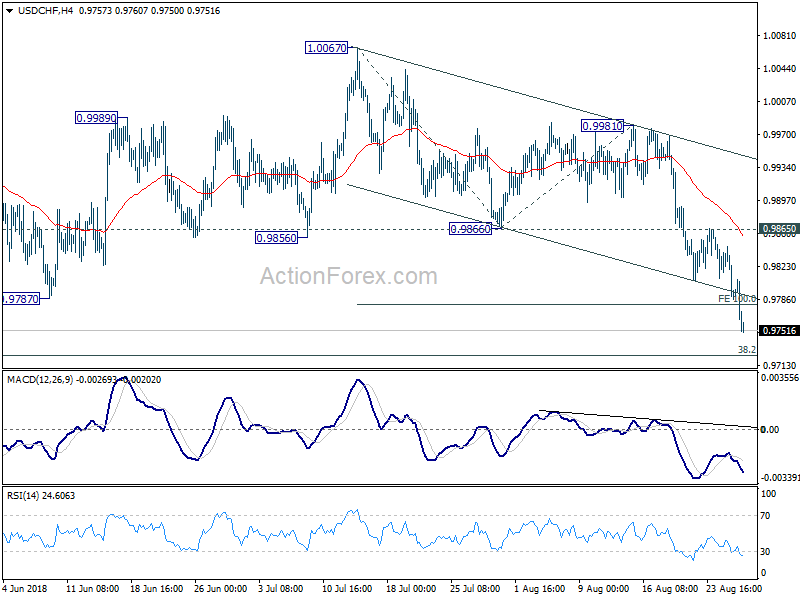
USD/CHF's decline accelerates to as low as 0.9751 so far today and breaks 100% projection of 1.0067 to 0.9866 from 0.9981 at 0.9780 decisively. There is no sign of bottoming yet. Intraday bias stays on the downside for 38.2% retracement of 0.9186 to 1.0056 at 0.9724. For now, we'd expect strong support from 0.9724 to contain downside and bring rebound. But, break of 0.9865 resistance is needed to indicate short term bottoming. Otherwise, further decline will remain in favor even in case of recovery. Meanwhile, sustained break of 0.9724 will carry larger bearish implications.
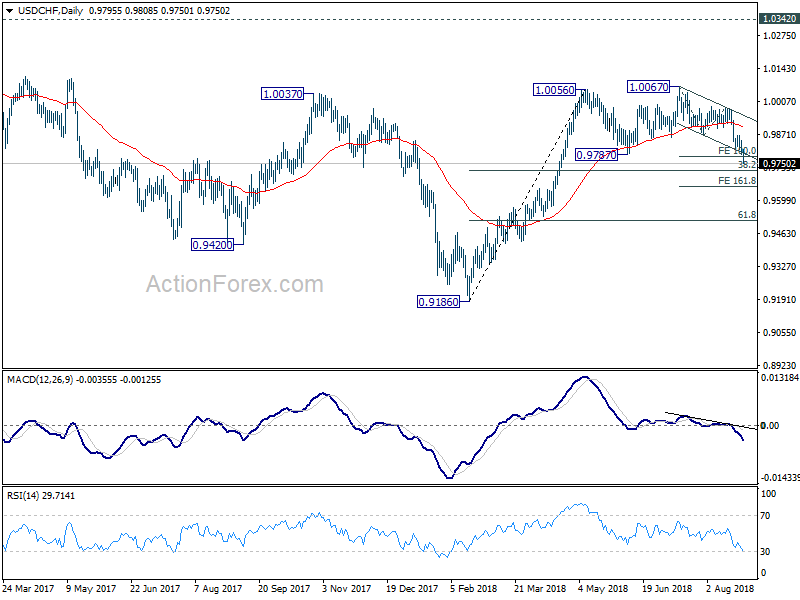
In the bigger picture, current development suggests that the consolidation pattern from 1.0056 is extending. As long as 38.2% retracement of 0.9186 to 1.0056 at 0.9724 holds, we'd expect rise from 0.9186 to resume at a later stage to retest 1.0342 key resistance (2016 high). However, sustained break of 38.2% retracement of 0.9186 to 1.0056 at 0.9724 will at least bring deeper fall to 61.8% retracement at 0.9518 before completion.
GBP/USD Mid-Day Outlook
Daily Pivots: (S1) 1.2847; (P) 1.2875; (R1) 1.2920; More...
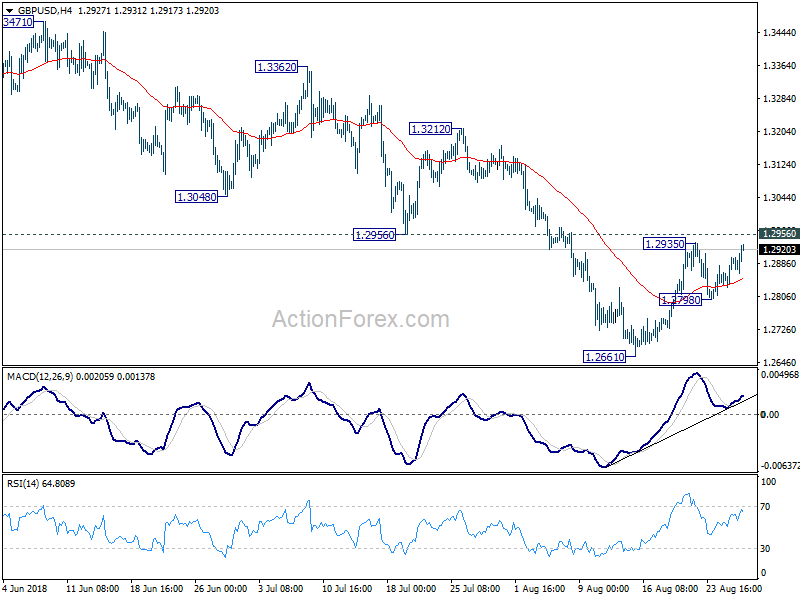
Intraday bias in GBP/USD remains neutral at this point. As long as 1.2956 support turned resistance stays intact, near term outlook remains bearish for further decline. On the downside, below 1.1798 minor support will target 1.2661 low first. Break will resume larger fall from 1.4376. However, considering bullish convergence condition in daily MACD, break of 1.2956 will indicate medium term bottoming. And stronger rebound would be seen back to 55 day EMA (now at 1.3060) and above.
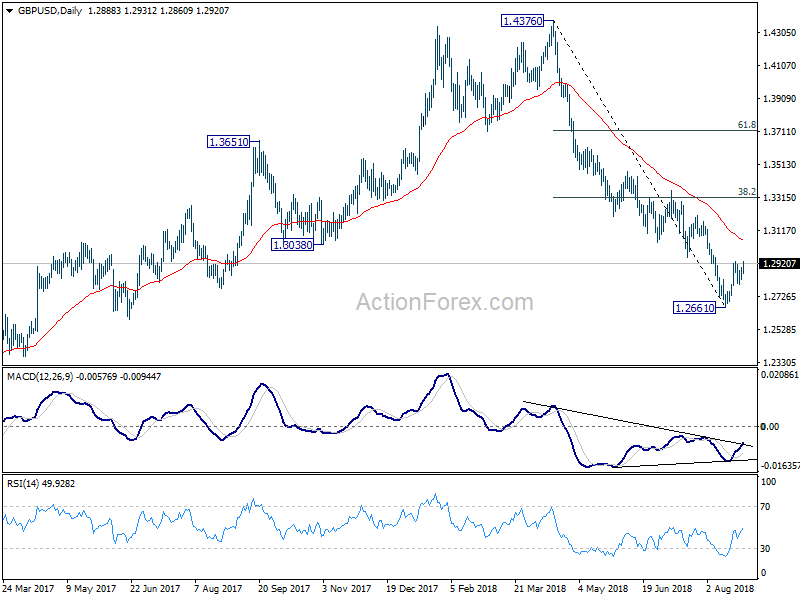
In the bigger picture, whole medium term rebound from 1.1946 (2016 low) should have completed at 1.4376 already, after rejection from 55 month EMA (now at 1.4091). Current downside acceleration argues that it's possibly resuming long term down trend. In any case, outlook will stay bearish as long as 38.2% retracement of 1.4376 to 1.2661 at 1.3316 holds. Retest of 1.1946 should be seen next.
USD/JPY Mid-Day Outlook
Daily Pivots: (S1) 110.88; (P) 111.12; (R1) 111.30; More...
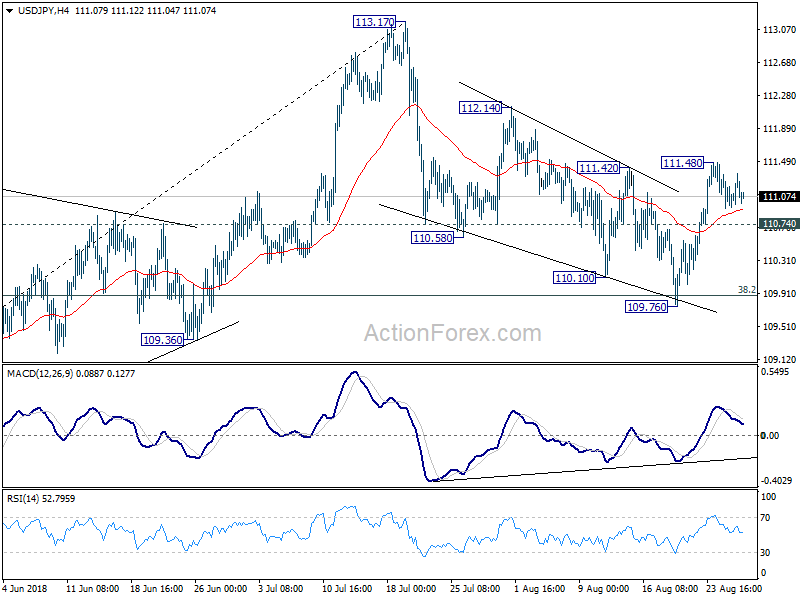
Intraday bias in USD/JPY remains neutral at this point. Outlook is unchanged that correction from 113.17 should have completed at 109.76 already. With 110.74 minor support intact, further rally is expected in the pair. Above 111.48 will turn bias to the upside for 112.14. Break will pave the way to retest 113.17 high. Meanwhile, below 110.74 minor support will dampen the bullish case and turn focus back to 109.76 instead.
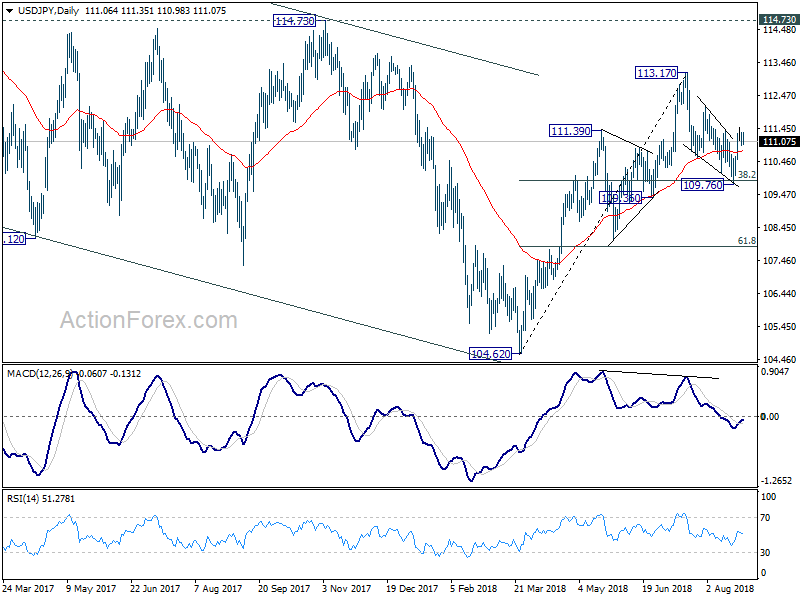
In the bigger picture, corrective fall from 118.65 (2016 high) should have completed with three waves down to 104.62. Decisive break of 114.73 resistance will likely resume whole rally from 98.97 (2016 low) to 100% projection of 98.97 to 118.65 from 104.62 at 124.30, which is reasonably close to 125.85 (2015 high). This will stay as the preferred case as long as 109.36 support holds. However, decisive break of 109.36 will mix up the outlook again. And deeper fall should be seen back to 61.8% retracement of 104.62 to 113.17 at 107.88 and below.
Canadian Dollar Accelerates Higher as Signs are Good for Trade Deal, Euro Stays Strong
Dollar selloff continues today as full-blown trade war fear receded. Yen follows as the second weakest on return of global risk appetite. Euro's strongest pace was overtaken by Swiss Franc and Canadian Dollar. The Loonie is awaiting the Canadian Foreign Minister Chrystia Freeland's visit to Washington. But so far, overall signs are positive. In other markets, FTSE is trading up 0.46% while DAX is up 0.30% at the time of writing. But both are kept well below day high made earlier in the session. On the other hand, CAC picks up solid momentum as the session goes and is up 0.42%. Gold is firm above 1210 thanks to Dollar's weakness.
Whether it's still named NAFTA or now US-Mexico Trade Agreement, the deal showed that Trump backed down from his demand of sunset clause. And it's a signal that he's ready for more concessions in negotiation with Canada as well as the EU. The threat of auto-tariffs on the closest allies of the US is materially reduced. Also, no matter how hard he sounds, Trump is facing tremendous domestic political and business pressures to include Canada into the deal eventually. We'll see how it goes.
Talking about trade, US trade deficit widened to USD -72.2B in July, up from USD -67.9B and larger than expectation of USD -68.6B. US Wholesale inventories rose 0.7% mom in July. Released earlier today, Eurozone M3 money supply rose 4.0% yoy in July.
US Mnuchin: We'll try to get Canada on board quickly
US Treasury Secretary Steven Mnuchin said in an interview that the US-Mexico Trade Agreement is a "great move forward for trade". Meanwhile, he, as perceived as a trade dove, added that "our objective is to try to get Canada on board quickly". Mnuchin also acknowledged that "this is a great deal for American workers. If you remember one thing, this deal is about more trade for U.S. companies and goods and services, and that's what we're focused on."
Regarding China, Mnuchin said that "We've been very clear. We need better market access to China we need reciprocal trade". And, "these are issues that our allies in the G-7 agree with us on."
San Francisco Fed: It's 10-yr 3-mth spread that predicts most accurately, not 10-yr 2yr spread
The San Francisco Fed released an interesting economic letter titled "Information in the Yield Curve about Future Recessions" yesterday. There is noted that yield curve inversion has been a "reliable predictor of recessions". However, the difference between ten-year and three-month Treasury rates is the most useful term spread for forecasting recessions. That is, not the ten-year and two-year yield spread that's most referred to.
Also, the letter noted that currently, the ten-year and three-month spread is still at a "comfortable distance from a yield curve inversion." If the paper reflects the norm of FOMC member's thoughts, the yield curve flattening shouldn't be much of a curve for keeping rate hikes continue.
ECB Praet: Patient, prudent and persistent monetary policy is still needed
In a speech titled Monetary and Macroprudential Policy Interactions, ECB chief economist Peter Praet said that the central bank's monetary policy has been "effective in stabilising the euro area economy and creating conditions for a sustained adjustment of inflation towards below, but close to, 2% over the medium term." But for now, "patient, prudent and persistent monetary policy is still needed" for the Eurozone right now." And, at the same time and in particular at this stage of the monetary policy cycle, "the risk channel of our policy has to be closely monitored".
Praet also explained that monetary policy enhances financial stability by "smoothing business cycles and keeping inflation expectations anchored". Also, it provides "liquidity to solvent institutions in stressful situations." However, as monetary policy operates amid uncertainty, "miscalibration is a possibility". And Financial stability risks "mostly arise when the chosen policy interacts with distorted incentives in the financial sector" that "that lead to excessive leverage and maturity transformation, and funding fragilities".
UK PM May: No-deal Brexit is not the end of the world
UK Prime Minister Theresa May cited endorsed remarks by Roberto Azevêdo, the director general of the World Trade Organization regarding no-deal Brexit. May said, a no-deal situation "will not be a walk in the park, but it wouldn't be the end of the world". May added that "what the government is doing is putting in place the preparation such that if we are in that situation, we can make a success of it, just as we can make a success of a good deal."
Chancellor of Exchequer Philip Hammond warned last week that a no-deal Brexit would costs UK GBP 80B in extra borrowing and inhibit long term growth. But May tried to talk that down and said the figures dated back to January and "they were a work in progress at that particular time." Regarding the time frame of Brexit negotiation, May said "we are all working to the October deadline" because "from our point of view there is some legislation we have to get through parliament".
Separately, German Foreign Minister Heiko Maas said "Regrettably, a hard Brexit is not off the table." French Prime Minister Edouard Philippe also "tasked ministers to prepare contingency measures that would be necessary … to mitigate the difficulties linked with this unprecedented challenge".
USD/CAD Mid-Day Outlook
Daily Pivots: (S1) 1.2924; (P) 1.2996; (R1) 1.3039; More...
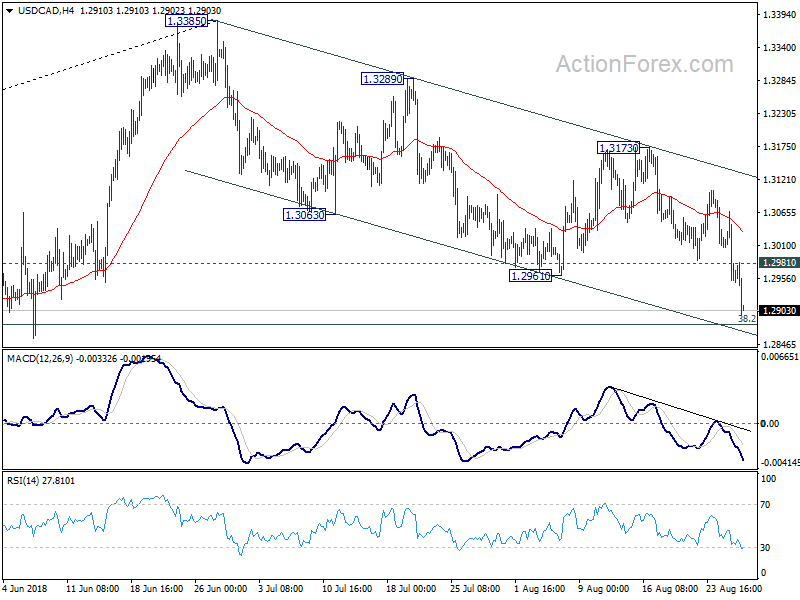
USD/CAD's decline accelerates to as low as 1.2894 so far today. Intraday bias remain son the downside for 1.2879 fibonacci level first. Sustained break there will add to the case of medium term reversal and target next fibonacci level at 1.2567. On the upside, above 1.2981 minor resistance will turn intraday bias neutral first. But for now, near term outlook will stay cautiously bearish as long as 1.3173 resistance holds.
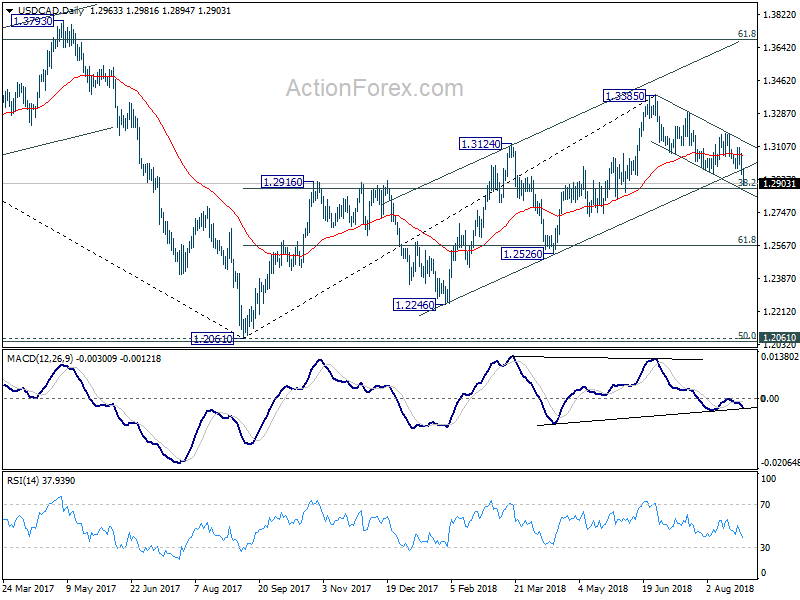
In the bigger picture, the break of channel support (now at 1.2988), argues that rise from 1.2246, as well as that from 1.2061, has completed at 1.3385. Focus is back on 38.2% retracement of 1.2061 to 1.3385 at 1.2879. Decisive break there will affirm the case of medium term reversal and target 61.8% retracement at 1.2567 and below. That will also put key long term support at 50% retracement of 0.9406 (2011 low) to 1.4689 (2015 high) at 1.2048 into focus. On the upside, break of 1.3173 resistance will revive the bullish case and target 61.8% retracement of 1.4689 to 1.2061 at 1.3685 and above.
Economic Indicators Update
| GMT | Ccy | Events | Actual | Forecast | Previous | Revised |
|---|---|---|---|---|---|---|
| 08:00 | EUR | Eurozone M3 Money Supply Y/Y Jul | 4.00% | 4.40% | 4.40% | |
| 12:30 | USD | Advance Goods Trade Balance (USD) Jul | -72.2B | -68.6B | -67.9B | |
| 12:30 | USD | Wholesale Inventories M/M Jul P | 0.70% | 0.10% | 0.10% | |
| 13:00 | USD | S&P/Case-Shiller Composite-20 Y/Y Jun | 6.40% | 6.50% | ||
| 14:00 | USD | Consumer Confidence Index Aug | 127 | 127.4 |