

Sample Category Title
PBOC Prevents Renminbi from Testing 7 Per US Dollar
China is on pins and needles as it sees renminbi (Chinese yuan) fall. The government dares not risk massive capital flight for uncertain benefit in exports by depreciating its currency. The apparent increases in FX reserve over the past months could hardly conceal concerns over renminbi weakness, which has been driven by rapid slowdown in China’s growth and exacerbated by the Trump-induced trade conflict which appears to be an endless game.
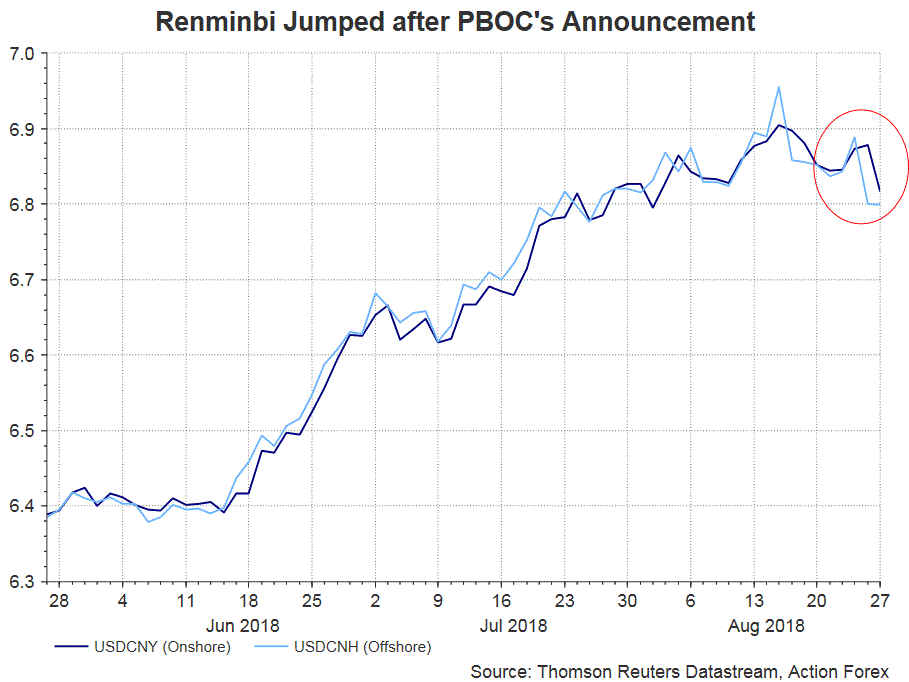
Last Friday, PBOC announced that the “counter-cyclical factor” has once again been used in exchange rate fixing, after abandoning it since the beginning of the year. Despite disguising the intervention as stabilization, the move evidenced that the government is really uncomfortable with further weakness in renminbi. The timing of the “re-introduction” is no coincidence. It is intentionally adopted in early- to mid- August, when US dollar is off from its peak and amidst strong criticism by US’ Trump over renminbi weakness.
What is “Counter-Cyclical Factor”?
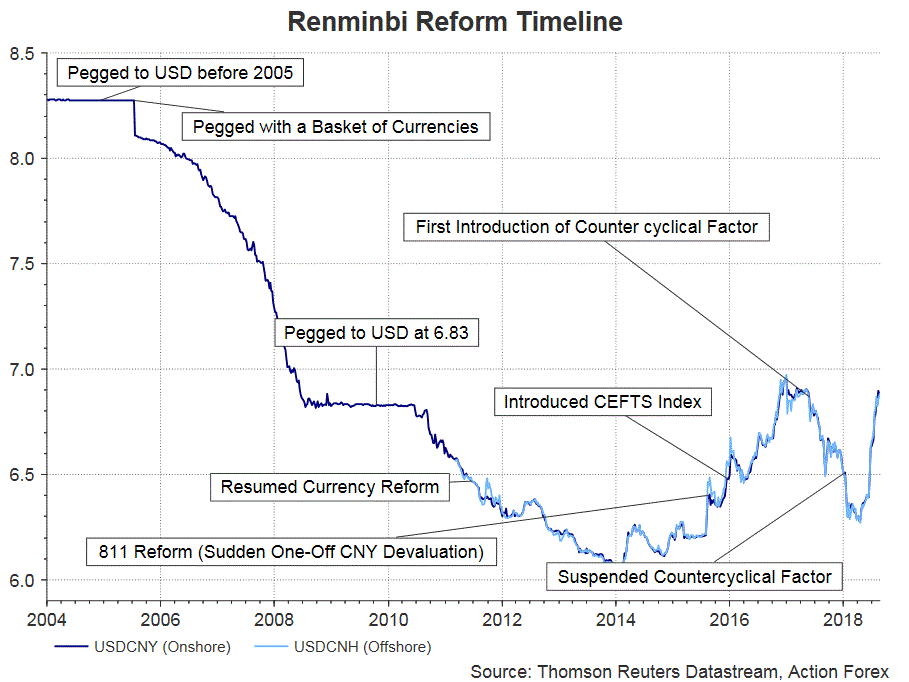
It is one of tools the PBOC uses to maintain renminbi in stable levels. First announced on May 26, 2017, the government explained that it would help prevent renminbi from being excessively affected by external volatility. Yet, it revealed no details about how the countercyclical factor would be computed or its weight in the new fixing mechanism. The tool only ran for about half a year and was suspended on January 9, 2018. Its comeback indicates that the daily renminbi fixing mechanism now contains three components:
- Previous day’s USDCNY closing price
- Exchange rate movements of a basket of currencies
- Counter-cyclical factor
Timing for Using the Tool
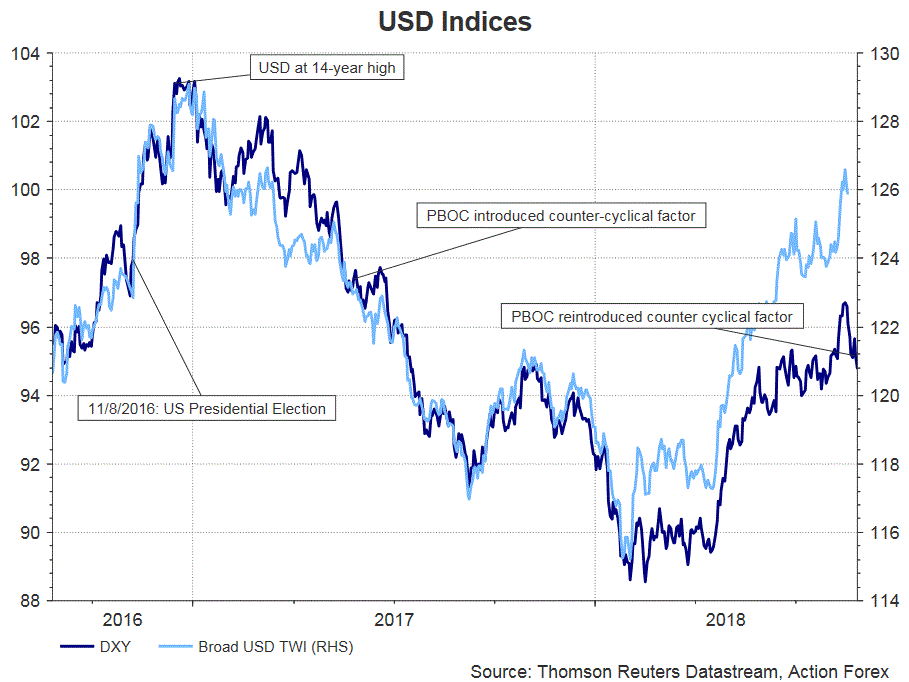
China first introduced the counter-cyclical factor when the US dollar was falling and shortly after US-China trade negotiation. Recall that the greenback rallied shortly after Trump won the Presidential election in November 2016 before reaching a 14-year high in December. The reflation rally of the greenback was fully erased in mid-May 2017, following by further weakness thereafter. China has been responsive to US’ call for strong renminbi. Somehow forgotten, US and China did agreed at the Mar-a-Largo meeting in May last year to “advance US-China economic cooperation with a 100-day action plan under the framework of the US-China Comprehensive Economic Dialogue”. It was believed that US had urged China to allow its currency to rise, resulting in the announcement of the counter-cyclical factor weeks later.
Now, with USD in correction after reaching a 2018-high in the middle of this month and shortly after a US-China trade talk by low-level officials, China probably finds it appropriate to signal that it is defending the renminbi. Notwithstanding the rhetoric that the counter-cyclical factor is to stabilize the currency, the intervention is more on prevention the currency from weakening, rather than strengthening. Since the beginning of this month, USDCNY fixing has dropped -0.37%, compared with a -0.22% fall in USD index (DXY). During the period, onshore renminbi has gained slightly more than +0.1% against the greenback while the CEFT renminbi index has rising +0.39%. Obviously, the counter-cyclical factor is functioning to send renminbi higher.
US Mnuchin: We’ll try to get Canada on board quickly
US Treasury Secretary Steven Mnuchin said in an interview that the US-Mexico Trade Agreement is a "great move forward for trade". Meanwhile, he, as perceived as a trade dove, added that "our objective is to try to get Canada on board quickly".
Mnuchin also acknowledged that "this is a great deal for American workers. If you remember one thing, this deal is about more trade for U.S. companies and goods and services, and that's what we're focused on."
Regarding China, Mnuchin said that "We've been very clear. We need better market access to China we need reciprocal trade". And, "these are issues that our allies in the G-7 agree with us on."
Canadian Dollar Jumps to 10-Week High as US-Mexico Reach Trade Deal
The Canadian dollar has gained ground on Tuesday, after posting strong gains on Monday. Currently, USD/CAD is trading at 1.2919, down 0.37% on the day. On the release front, the U.S releases CB Consumer Confidence, which is expected to drop to 126.6 points. There are no Canadian events on the schedule. On Wednesday, the US releases Preliminary GDP and Pending Home Sales, while Canada publishes current account.
The Canadian currency continues to rally, in response to the dramatic announcement that the U.S and Mexico have reached a new trade deal. USD/CAD has dropped 1.2% since Friday, and the pair is at its lowest level since mid-June. Under the new agreement, Mexican car plants will continue to manufacture their cars and send them on to the U.S and Canadian markets without the imposition of heavy tariffs. This agreement comes after months of escalating trade tensions, which have shaken global equity markets. The next likely step is for Canada to join the U.S and Mexico as part of NAFTA 2.0. However, President Trump doesn’t appear in a rush to extend the deal to Canada, and there will be intensive negotiations before Canada can rejoin the club. Still, Mexico has formally asked the U.S to include Canada in the agreement, and the rise in the Canadian dollar indicates that the markets expect Canada to reach an agreement with the U.S and Mexico.
Federal Chair Jerome Powell was the keynote speaker at the Jackson Hole Economic Symposium. Powell’s dovish remarks on Friday sent the U.S dollar broadly lower and the Canadian dollar jumped on the bandwagon and ended the week with gains. Powell reiterated that the Fed would continue its policy of gradual interest rate hikes, saying that a cautious approach was prudent. The Fed has faced criticism about its current policy from all sides – some analysts have argued that the Fed has been too aggressive, given weak inflation, while others say the Fed should tighten more quickly, due to the extremely tight labor market. Powell appeared to take a middle approach of raising rates, but slowly. The Fed has already raised rates twice this year, and a September hike is practically a given, with the CME Group estimating the odds of a hike at 96%. The odds of a December hike currently stand at 66%.
ECB Praet: Patient, prudent and persistent monetary policy is still needed
In a speech titled Monetary and Macroprudential Policy Interactions, ECB chief economist Peter Praet said that the central bank's monetary policy has been "effective in stabilising the euro area economy and creating conditions for a sustained adjustment of inflation towards below, but close to, 2% over the medium term." But for now, "patient, prudent and persistent monetary policy is still needed" for the Eurozone right now." And, at the same time and in particular at this stage of the monetary policy cycle, "the risk channel of our policy has to be closely monitored".
Praet also explained that monetary policy enhances financial stability by "smoothing business cycles and keeping inflation expectations anchored". Also, it provides "liquidity to solvent institutions in stressful situations." However, as monetary policy operates amid uncertainty, "miscalibration is a possibility". And Financial stability risks "mostly arise when the chosen policy interacts with distorted incentives in the financial sector" that "that lead to excessive leverage and maturity transformation, and funding fragilities".
US100 Stock Index Rallies to Fresh Record Highs, Near Overbought Territory
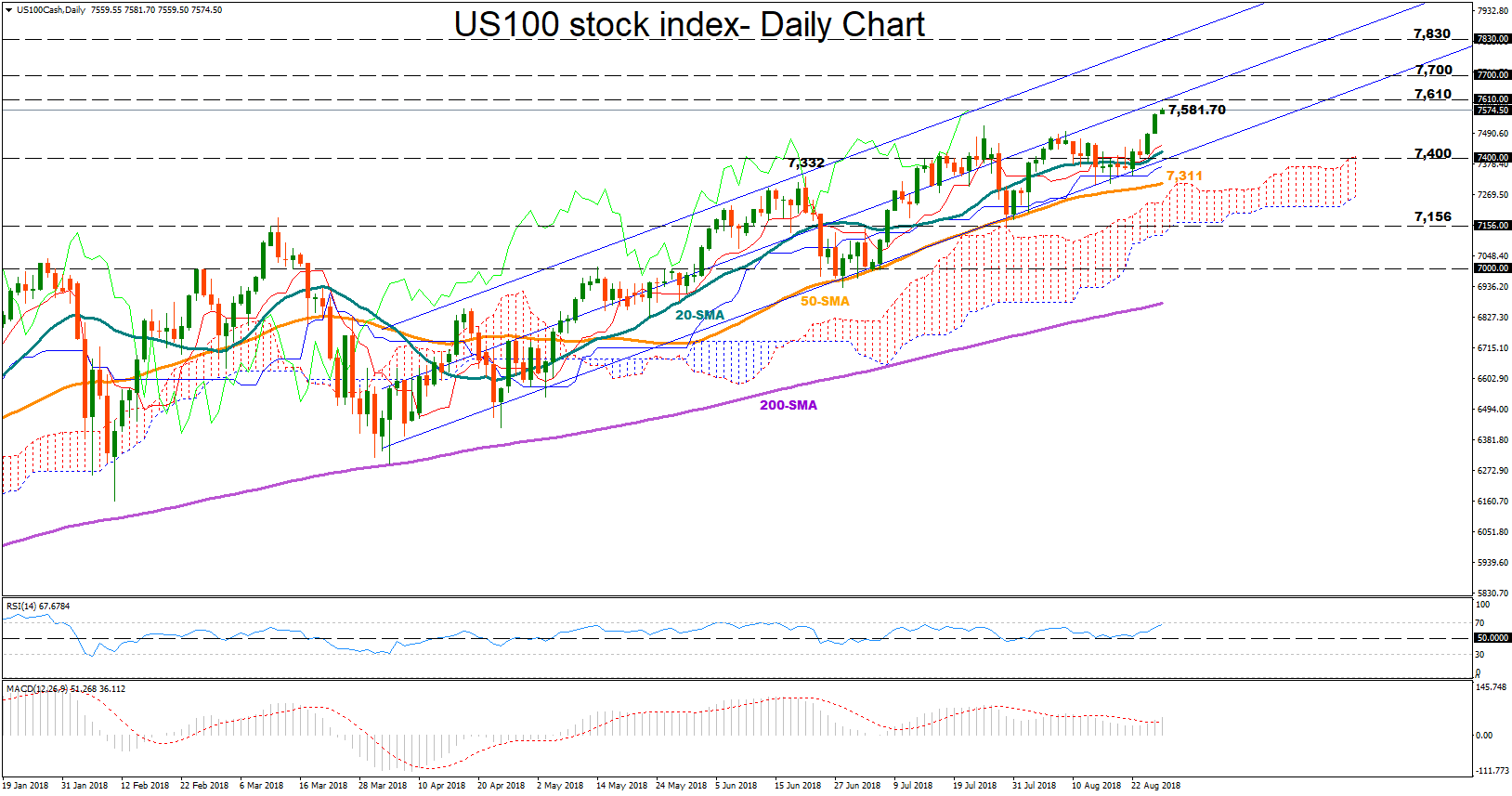
The US100 stock index (NASDAQ 100) continues to rise above the Ichimoku cloud, remaining inside a bullish channel over the past four months, stretching its upward pattern to a fresh record high of 7,581.70 on Tuesday. According to the MACD, positive momentum could push for further gains in the short-term as the indicator picks up steam above its red signal line. The RSI is also advancing, though, it is relatively close to the 70 overbought threshold; negative corrections cannot be excluded should it move above 70.
In the positive scenario, where the price continues to expand above today’s high of 7,581.70, a new top could be formed around 7,610, where the middle bound of the ascending channel is currently located. If the market manages to overcome that area, traders could look for resistance at the 7,700 round level before steeper bullish actions take the price up to the upper bound of the channel, currently near 7,830.
A reversal to the downside could stall at the bottom of the channel and the 20-day simple moving average – they both lie around 7,400 at the moment. Further below, the 50-day SMA at 7,311 could also provide support, as the index was unable to fall significantly under that line in the last two months and any violation at this point could potentially trigger further sell-off in the market, probably leading the price down to 7,156, a previous support and resistance area.
Regarding the medium-term picture, the bullish outlook has built up as the index continues to record all-time highs; a dive below 7,000 could shift the sentiment into a bearish one.
To sum up, the short-term bias is bullish though the index could be close to overbought levels, with the medium-term outlook also being positive.
Dollar Inches Lower; All Eyes on US-Canada Talks
Here are the latest developments in global markets:
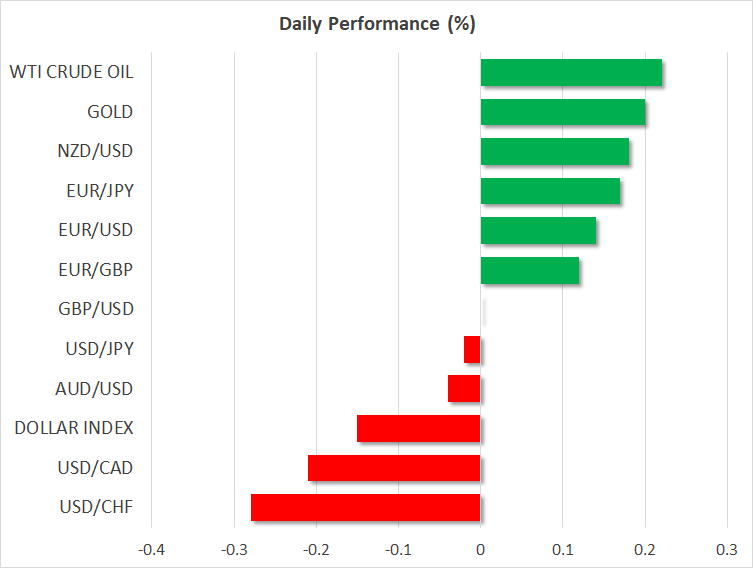
FOREX: The dollar traded 0.16% lower against a basket of six major currencies on Tuesday, erasing the modest gains it posted earlier in the session and looking set to post the third day of declines in a row. The world’s reserve currency has been under pressure lately as trade tensions appear to have eased somewhat and investors unwound some of their safe-haven bets, with some less-than-hawkish remarks from Fed chief Powell also weighing. Reflecting the greenback’s underperformance, euro/dollar was up by 0.14%, trading within breathing distance of the 1.1700 mark. Meanwhile, dollar/yen was near its opening levels, as the safe-haven Japanese currency was on the back foot amid the risk-on tones in markets. Sterling/dollar was flat as well. That said, the British currency was down by 0.12% against the euro, with euro/pound having touched a fresh one-year high of 0.9076 earlier today, after UK PM Theresa May was quoted as saying a no-deal Brexit “wouldn’t be the end of the world”. Elsewhere, dollar/loonie was down by 0.21%, hovering near a 10-week low amid hopes that the NAFTA negotiations may bear fruit before long, following the US-Mexico agreement yesterday.
STOCKS: European indices were mostly in the green on Tuesday, taking their cue from their US and Asian counterparts, with risk appetite being supported by optimism that trade tensions are set to deescalate somewhat. The UK’s FTSE 100 led the pack higher after remaining closed for a holiday yesterday, gaining 0.34%. The French CAC 40 climbed by 0.25%, while the German DAX 30 edged up by 0.18%. The blue-chip STOXX 50 was practically flat, while the pan-European STOXX 600 inched higher by 0.08%. The only underperformers were the Italian FTSE MIB (-0.44%) and the Spanish IBEX 35 (-0.35%). Turning to the US, futures suggest the S&P 500, Dow Jones, and Nasdaq 100 are all set to open higher today.
COMMODITIES: Oil prices turned higher, aided by the pullback in the dollar, which renders the dollar-denominated precious liquid more attractive for investors using foreign currencies. WTI is up by 0.22% at $69.03 per barrel, while Brent crude edged higher by 0.41% at $76.52/barrel. In precious metals, gold was up by 0.2%, trading near the $1214 per ounce mark.
Day ahead: Trade developments set to drive markets amid light calendar
With only second-tier economic indicators out of the US being released on Tuesday, market participants will likely keep their gaze locked on trade issues and specifically, how the US-Canada NAFTA negotiations will play out.
After the US and Mexico struck a trade accord on Monday, attention has turned firmly back to Canada, which was until now absent from the negotiating table. While the two sides said they prefer to have Canada on board too – making this a trilateral deal like NAFTA – they also hinted they could proceed regardless, if an arrangement with Canada is not achievable. Hence, pressure on Canadian officials is extremely high at a time when their negotiating capital has been depleted, having little leverage left with which to push for more favorable terms. Canada’s foreign minister will meet US officials today to try and reach common ground. Any positive remarks pointing to a trilateral deal being finalized soon may support the loonie and perhaps also benefit risky assets like stocks, whereas anything suggesting Canada may be “left out” could generate the opposite reactions.
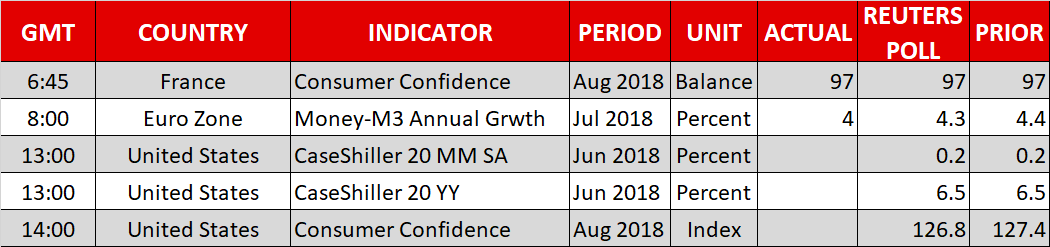
Turning to economic data, the US Conference Board consumer confidence index for August is due out at 1400 GMT. It is expected to decline somewhat but to still remain at an elevated level, consistent with healthy consumer optimism. An hour earlier, at 1300 GMT, the Case-Shiller figures tracking US housing prices for June will be made public.
In energy markets, the weekly private API crude inventory data are slated for release at 2030 GMT.
DAX – Auto Shares Continue to Rally on US-Mexico Trade Pact
The DAX is steady in the Tuesday session, after starting the week with strong gains. Currently, the index is at 12,556, up 0.14% on the day. In economic news, there are no major eurozone indicators. On Wednesday, Germany releases GfK Consumer Climate.
German automaker shares continue to climb this week, in response to news that the U.S and Mexico have reached a new trade deal. The news has pushed BMW up 2.00%, Daimler 1.19% and Volkswagen 1.87%. Under the agreement, 75% of automobile content must be manufactured in North America, up from NAFTA’s current level of 62.5%. European car makers can breathe a sigh of relief, as Mexican plants will continue to manufacture their cars and send them on to the U.S and Canadian markets without the imposition of heavy tariffs. This agreement comes after months of escalating trade tensions, which have shaken global equity markets. The announcement of the US-Mexico deal, which likely will be extended to Canada, has improved risk appetite for equities this week.
There was good news out of Germany on Tuesday, following a strong business confidence report in Germany. The Ifo Business Climate report improved to 103.8, easily beating the estimate of 101.9 points. This marked the first time this year that business confidence has improved, thanks to a strong German economy and a pause in the global trade war. Germany releases inflation and consumer spending data later in the week, and the strength of these readings could determine which direction the DAX takes later this week.
Market Sentiment Boosted By Nafta Breakthrough, Dollar Slips
A renewed sense of positivity and optimism continues to be felt across financial markets after the United States and Mexico reached a breakthrough deal over the NAFTA trade agreement.
This highly encouraging development may ease trade war fears, elevate global sentiment and stimulate appetite for riskier assets. Although it remains uncertain whether Canada will join the agreement, there is an expectation that the nation agrees to the new terms in an effort to conserve the three-nation pact.
Speaking of risk, Asian stocks closed mostly positive this morning while European markets edged higher as optimism over a trade deal between the US and Mexico boosted investor confidence. With Wall Street powering to record highs yesterday, US equity bulls could make another appearance this afternoon amid the risk-on sentiment.
Is the party coming to an end for Dollar bulls?
Dollar bulls were missing in action yet again today as investors digested Jerome Powell’s dovish speech at the Jackson Hole Symposium last Friday.
The Greenback’s continued depreciation in recent weeks has raised questions on whether the impressive bull run could be coming to an end. Buying sentiment towards the Dollar was dealt the first blow following Donald Trump’s latest criticism of the Federal Reserve. Bears were offered another opportunity to attack after the minutes from August’s Fed policy meeting raised concerns over escalating trade tensions negatively impacting growth. With reports of the United States and Mexico securing a trade deal dimming the Dollar’s safe-haven appeal, further losses could be witnessed in the near term. Although market expectations remain elevated over the Federal Reserve raising interest rates next month and possibly December, the Dollar may need fresh inspiration to rebound higher
As regards the technical picture on the daily charts, the Dollar Index has been relentlessly pounded by sellers in recent weeks with prices trading around 96.65 as of writing. A solid breakdown below the 96.50 level could encourage a decline towards 94.20 and 94.00, respectively.
Commodity spotlight – Gold
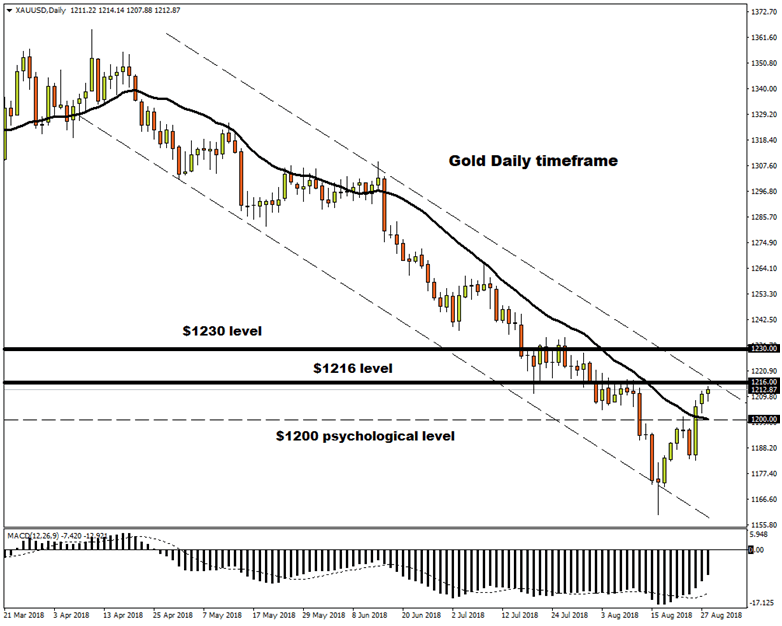
Gold prices edged to a fresh two week high on Tuesday thanks mostly to a depreciating US Dollar.
The fact that the yellow metal continues to appreciate despite global risk sentiment boosted by the US-Mexico trade breakthrough just further highlights how Gold remains heavily influenced by the Dollar. With the Greenback likely to experience further weakness following Powell’s dovish speech at the Jackson Hole Symposium, Gold has scope to appreciate further.
Technical traders will continue to closely observe how prices behave above the $1200 psychological level. Repeated Dollar weakness could send prices towards $1216 and $1230, respectively. For bears to jump back into the game, prices need to break back below the $1200 level.
Investors Buoyed By US-Mexico Agreement
US futures have edged into the green ahead of the open on Tuesday, a continuing sign of investor approval at the progress made in trade negotiations between the US and Mexico.
While I’m sure investors would rather the deal include Canada and preserve NAFTA, this is at least a step in the right direction and could be an important first step towards it. US President Donald Trump may have rebranded the agreement as the United States – Mexico Trade Agreement due to the apparent negative connotations associated with NAFTA but I think this may be yet another attempt to drag Canada to the negotiating table and align themselves with his idea of how it should look.
Trump has made renegotiating trade deals a key feature of his presidency and is willing to do whatever it takes in order to get what he wants. So far, he has had limited success with China, the EU and his NAFTA partners but coming ahead of the midterm elections, this could be viewed as an important success. While the US consumer may be the primary loser in his approach and the outcome of it due to the impact it has on prices, he is receiving credit for fighting to preserve skilled US jobs.
Whether such perception will be enough to secure him a second term will be determined in a couple of years but it does appear to be working in his favour so far. From an investor perspective, the economy is still booming and in coming to an agreement with Mexico, one trade risk has been effectively removed and for now, that is good news.
While there are some notable data pieces out later in the week, politics is likely to continue to be a driving force in the markets. The threat of a US-initiated trade war has dragged on markets for most of the year, with tax reform helping to offset this and prevent too significant a drop in the US. With progress being made, the S&P 500 hitting new record highs and stocks now in their longest ever bull run, the environment seems perfect for Trump to continue to pressure the countries trade partners and force concessions so I don’t expect any change in strategy any time soon
USD Loses Ground Amid Easing Trade Tensions
USD tumbles amid improving risk sentiment
After losing ground against most of its peers yesterday, the US dollar paused on Tuesday as market participants re-evaluate whether there is further dollar weakness ahead. The dollar index fell more than 2.4% in the past two weeks amid easing trade tensions with China and positive developments with Mexico. The initial move was triggered by President Trump’s intervention a couple of weeks ago, when he expressed his dissatisfaction with the Federal Reserve’s current hiking cycle, saying he was “not thrilled” with the Fed raising rates and that the central bank should help him boost the economy. As the Mexico deal has neared closing, Trump said it was “not the right time to talk” to China, but now he says China wants to talk.
Investors started to load risk again, which send the greenback to monthly lows. EUR/USD climbed to 1.17 this morning, the highest level since 1 August. The pair is testing the 1.1709 resistance level (Fibonacci 38.2% on January 2017 – February 2018). A break out of the latter would open the road towards the next resistance at 1.1851 (high from 14 June), then 1.1960 (200-day moving average).
Will US–Mexico deal derail the Canadian dollar?
US President Donald Trump is saying that the North American Free Trade Agreement (NAFTA) should be renamed the United States-Mexico trade agreement. American-Mexican bilateral talks initiated last month are coming to an end, putting pressure on Canada to sign or resign from the 24-year-old treaty. Canada must return to the negotiation table, and this will not be a loonie-positive.
Mexico finally agreed to US terms: 75% (62.50% in NAFTA terms) of auto content should be built on US soil, while being exempt from tariffs along with a minimum wage of $16/hour insured for 40%-45% of total US auto parts workforce. Canada is expected to counter-offer on this, paving the way for further talks. Since July, USD/CAD remained above 1.2950, but a strong bounce above 1.32 cannot be ruled out in coming days. Currently trading at 1.2955, USD/CAD is expected to strengthen slightly, as hope grows that Canada will accept current terms – we think this is unlikely.