Sample Category Title
Loonie Rallies Hard on Nafta Hopes
The CAD (C$1.2975) dollar has rallied aggressively this morning against the USD. It’s been pushed higher on Nafta optimism, but on the crosses there is little change (EUR/CAD €1.5129, GBP/CAD £1.6719).
President Trump is to make a trade announcement at 11 am EDT.
The ‘proof will be in the pudding,’ but ahead of the announcement U.S markets have rallied from the session’s outset on news of a potential NAFTA deal reached between the U.S and Mexico.
Material and automotive names are trading higher on the day amid the boost in risk-on sentiment, though gold ($1,206) and oil are roughly flat ($68.71).
U.S Treasury yields (10’s 2.815%) are up modestly with the curve shifting higher. USD/MXN – Mexico peso is +0.6% higher at $18.6711.
It’s believed that the Mexican President has spoken to PM Trudeau and has encouraged him to re-join Nafta talks to seek a trilateral accord this week.
Update:
- US and Mexico reach trade deal to replace NAFTA
- To see +40-45% of auto content made by workers earning avg. base wage of $16/hr
- Would boost U.S and regional content in autos to +75% (prior +62.5%)
Canada Fin Min Freeland expected in DC shortly for talks; discussions with Canada to accelerate Monday and wrap up by end of the week.
GBP/USD. Popular Currency Pair Features
The British pound is one of the most important currencies in the world. The pound takes the 4th place in terms of turnover, as well as the third place as a reserve currency.
British pound on Forex
The pound is one of the most popular currencies in the Forex market. It is traded with the currency code GBP.
The British pound is considered to be the most aggressive currency on Forex. It may create an increased volatility in the pair. Therefore, traders can observe sharp impulsive movements.
The most common currencies traded with GBP are the US dollar (GBP/USD), the Japanese yen (GBP/JPY), the euro (EUR/GBP). Currency pairs with the British pound are the most volatile in the market, price fluctuations can exceed 150 points during the trading session. So, take into account its volatility, if you decide to trade these pair. The main trading activity of currency pairs with GBP falls on the European and American sessions.
Trading the GBP/USD currency pair
This currency pair refers to the currency majors on Forex. The United Kingdom and the United States represent the world's largest banking and financial systems. This trading instrument is quite popular due to the high volatility and liquidity. So, it is one of the favorites among all types of traders: scalpers, day traders, swing traders. Different factors have an impact on the price change. One of the currencies can rise, while another fall, that creates excellent opportunities for earning.
GBP/USD takes the fourth position in terms of trading volume on Forex and is one of the most liquid instruments. More than 13% of all orders opened on Forex account for GBP. In the GBP/USD currency pair, the base currency is GBP and the quoted one is USD. The GBP/USD quotes show how many dollars it takes to buy one pound.
Traders call the pair "cable". It is called in such way because the first quotes were sent to America through the transatlantic cable in the middle of the 19th century.
GBP/USD has a strong potential of quotes movement. Intraday trading is usually characterized by strong trends and pullbacks. The currency pair may easily overcome the key resistance and support levels, as well as can quickly get corrected back. When important news is published on the Forex market, this currency pair can easily pass more than 100 points per day. The movement of the GBP/USD quotes is influenced by fundamental factors such as:
- the difference in interest rates between the British pound and the US dollar
- reports on inflation
- GDP and other indicators of economic activity
- retail sales
- changes in the unemployment rate
- speeches by the Governor of the Bank of England.
As a rule, all these news is published during the European trading session. Follow data from the US because they can significantly affect the GBP/USD rate.
Traders also note the correlation with EUR/USD. On short-term timeframes, one can easily see that the charts of both pairs move almost synchronously.
This currency pair is popular among traders and provides good opportunities for profit. If you are a beginner on Forex, you can read the daily analysis of the currency majors, which is published on JustForex website. Analytics from JustForex with competent money-management will allow you to receive a stable profit with minimal risk for your funds. Remember that the analytics reflects a personal opinion and should not be perceived as a guide to action.
GBPJPY Trades around 3-Week High; Remains Bearish in Medium-Term
GBPJPY is trading more than 300 pips above 139.88, its lowest in a year hit on August 15. Current price action is also not far below 143.23, the pair’s highest in nearly three weeks touched on Friday.
The RSI is on the rise in support of positive short-term momentum. Notice, though, that the indicator does not maintain a steep positive slope, the implication being that the bullish bias may be easing. Turning to the stochastics, the %K line has just moved below the slow %D one, which is a bearish signal in the very short-term.
Further advances may meet resistance around the 23.6% Fibonacci retracement level of the donwleg from 156.60 to 139.88 at 143.80, including the 144 round figure; given of course that price action successfully breaks above the zone around Friday’s peak of 143.23 first. Stronger bullish movement would turn the attention to the current level of the 50-day moving average at 144.93.
On the downside, support could occur around the 142 and 141 handles, before the area around the one-year nadir of 139.88 from mid-August comes into scope.
Turning to the medium-term picture, it remains bearish: GBPJPY is in a downtrend, recording lower highs and lower lows, with trading activity taking place below the 50- and 100-day MA lines.
Overall, the near-term bias appears mostly bullish, with a negative signal being in place in the very short-term. The medium-term outlook continues to be negative at the moment.
Yen Edges Higher as Investors Search for Cues
The Japanese yen has posted slight gains in the Monday session. In North American trade, the pair is trading at 111.00, down 0.22% on the day. It’s a quiet start to the week, with no Japanese or U.S events. On Tuesday, the U.S releases CB Consumer Confidence.
Japanese inflation numbers in July were slightly softer than expected. National Core CPI remained pegged at 0.8%, shy of the estimate of 0.9%. The Services Services Producer Price Index edged lower to 1.1%, missing the estimate of 1.2%. Despite an ultra-accommodative monetary policy, inflation remains well below the BoJ target of just below 2 percent. Rather than reduce the inflation target, the Bank will likely postpone yet again the timeline for its 2% target to fiscal year 2020 or beyond. Massive quantitative and qualitative easing have failed to coax inflation higher, so policymakers may have to consider other means of fiscal easing in order to encourage more spending and push inflation higher.
The Federal Reserve monetary policy has been one of gradual rate increases, as the U.S economy continues to expand. The Fed stance can be summed up as “proceed with caution”. Fed Chair Jerome Powell reiterated this position, with a dovish speech at the Jackson Hole Economic Symposium on Friday. However, the Fed has faced criticism about its current policy from both sides. Some analysts have argued that the Fed has been too aggressive, given weak inflation, while others say the Fed should tighten more quickly, due to the extremely tight labor market. Powell appeared to take a middle approach of raising rates, but slowly. The Fed has already raised rates twice this year, and a September hike is practically a given, with the CME Group estimating the odds of a hike at 96%. The odds of a December hike currently stand at 66%.
Sunset Market Commentary
Markets
Global core bonds lost ground today in a low volume trading session with UK markets closed for Summer Bank Holiday. The German Bund underperformed the US Note future following stronger-than-expected German IFO business sentiment which confirmed developments in last week’s national PMI’s. The Juncker/Trump trade truce is probably at play. Positive risk sentiment on stock markets and tonight’s start of the US end-of-month refinancing operation weighed on the market, too. Both the US S&P 500 and Nasdaq opened at new all-time highs. The German yield curve bear steepens with yields 0.8 bps (2-yr) to 2.3 bps (30-yr) higher. The German 10-yr yield shows a potential engulfing pattern, signaling more upward potential within the 0.3%-0.5% trading range. The US yield curve shifts in similar fashion with yields increasing by 1.3 bps (2-yr) to 2.2 bps (30-yr). Peripheral 10-yr yield spreads narrow up to 3 bps.
On Friday, the dollar ceded ground as Fed’s Powell indicated that the Fed can maintain its gradual approach on its road to policy normalization. Today, the US currency mostly consolidated Friday’s loss. The PBOC conforming recent indications that it didn’t intend any further weakening of the yuan was a potential USD negative. However, this trend wasn’t confirmed early in European trading. EUR/USD even dropped temporarily below 1.16, but the euro found a floor after a stronger than expected German IFO business confidence. Interest rates also move slightly in favour of the single currency. US eco data were second tier and had no noticeable impact on USD trading. EUR/USD is changing hands in the 1.1635, little changed from Friday’s close. USD/JPY struggles not to fall back below the 111 area. USD trading remains in holiday modus, awaiting more significant news. If anything, USD softness prevails.
Today, sterling trading developed in thin market conditions as UK markets were closed for the Summer bank Holiday. EUR/GBP drifted basically sideways in the mid 0.90 area as the pair rebounded to the 0.9033 resistance area last week. Lingering press headlines on (the consequences of) a no-deal brexit are keeping sterling in the defensive. All parties involved reiterate they want to avoid such a scenario. At the same time, the debate on all kinds of contingency plans suggests that the ‘unthinkable’ might be less unrealistic than all parties assumed at the start of the Brexit process. EUR/GBP trades in the 0.9040 area. Cable is changing hands in the 1.2875 area, partly due to some post-Jackson Hole USD softness.
News Headlines
French Finance Minister Le Maire said that France’s 2018 public sector budget deficit is expected to be larger than previously thought. It might reach 2.6% of GDP, while a 2.3% deficit was expected. The government’s decision to take over debt from the SNCF is the main reason for the upward revision.
German business confidence for August came in strong today ,with the ‘IFO expectations index’ rising for the first time in nine months. The index for August increased from 98.2 in July to 101.2 this month. The rise in confidence came after the Trump-Juncker agreement that eased trade tensions between the EU and US.
As Turkish markets were closed last week due to a public holiday, the Turkish lira slided almost 5% today against the dollar. The ongoing concerns about President Erdogan’s power concentration and the political deadlock between the US and Turkey is still pushing the Lira down, with USD/TRY currently trading at 6.125.
The US sanctions on Russia, that were announced last month after a nerve attack in the UK, come into effect today. A second round of penalties will be imposed in 90 days unless Russia assures it would no longer use chemical weapons. The Kremlin said it needed time to assess the impact, but confirmed it will react in line.
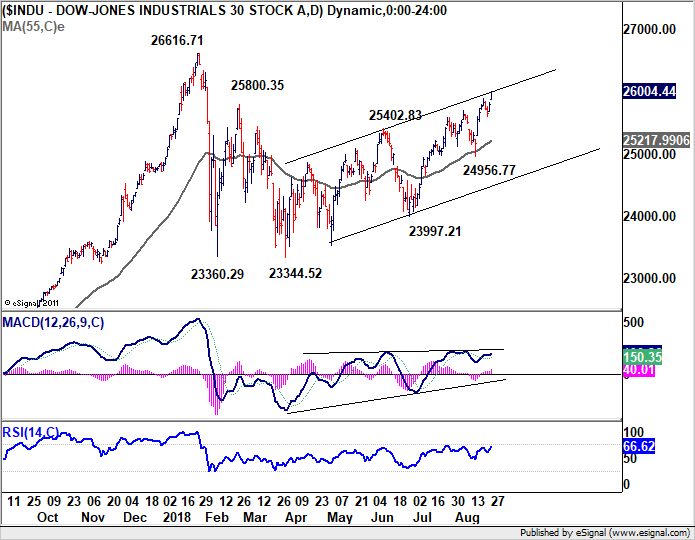
DOW breaks 26000 as NAFTA announcement is almost certain
Strong risk appetites carries on in early US session. DOW surges over 200 pts, or 0.8% and is back breaks 26000 handle. NASDAQ and S&P 500 extends he record run. Adding to the global trend, US equities are lifted by optimism that NAFTA negotiation is finally having a concrete breakthrough. It's widely reported that Mexico and the US are hammering out the final details for a bilateral agreement. And an announcement is "also certain" for today.
DOW is now pressing a key near term channel resistance. Decisive break there will indicate upside acceleration. In that case, the index could finally catch up with the other two in making new records.
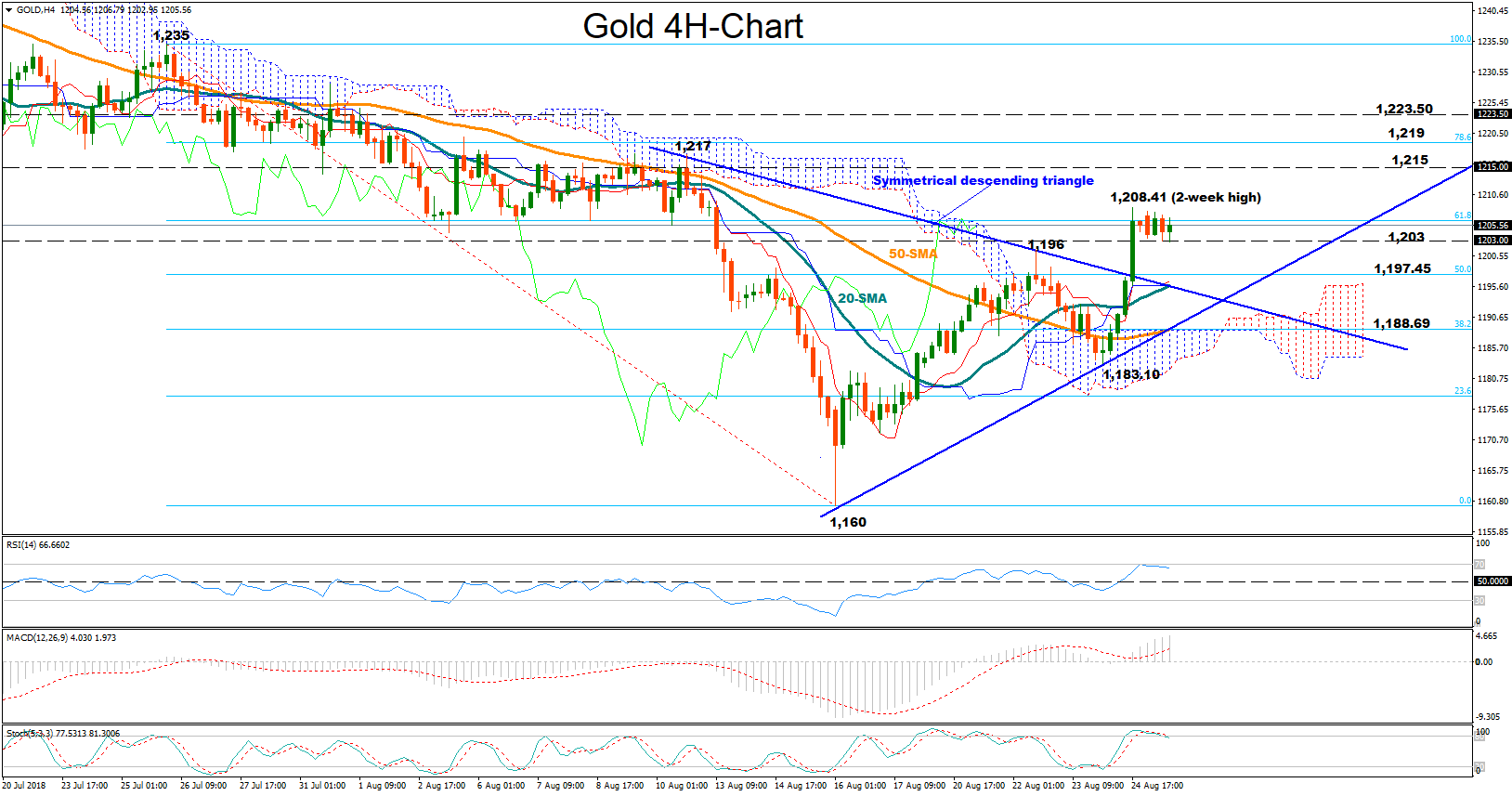
Gold Closes above 1,200; Breaks Descending Triangle to the Upside
Gold’s impressive rally on Friday paused around a two-week high of 1,208.41 after the RSI and the Stochastic oscillators touched overbought levels above 70 and 80 respectively in the 4-hour chart. While both indicators have already turned lower, suggesting that downside pressures could dominate in the short-term, the MACD continues to move higher in positive territory above its red signal line, giving some bullish signals for the market. Besides, with prices having already run significantly above the Ichimoku cloud for the first time in a long while, breaking the descending symmetrical triangle as well, the trend is more likely to hold up.
An extension to the upside could retest the 1,208.41 peak which is marginally above the 61.8% Fibonacci of the downleg from 1,235 to 1,160 before traders look for resistance between 1,215 and the 78.6% Fibonacci of 1,219. Any move above the latter could trigger further bullish actions, opening the way towards 1,223.50, a previous support and resistance level.
On the downside, bearish corrections could stop near the 1,203 mark which acted as a support the past couple of days, whilst any close below that could see the price falling until the 50% Fibonacci of 1,197.45 in which case the short-term outlook would shift from bullish to neutral. Below from here, if the market continues to weaken, the 38.2% Fibonacci and the 50-period (simple) moving average (SMA) both at 1,188.69 could be the next targets.
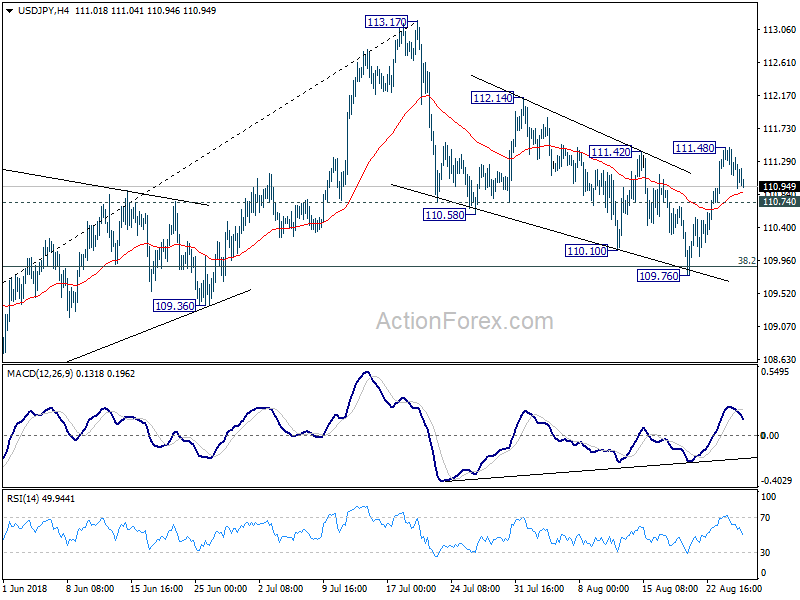
USD/JPY Mid-Day Outlook
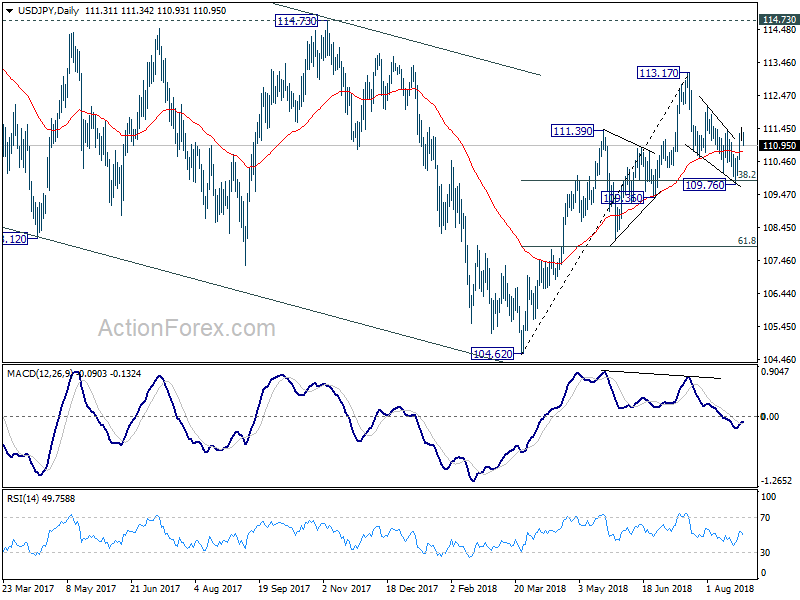
Daily Pivots: (S1) 111.09; (P) 111.29; (R1) 111.47; More...
Intraday bias in USD/JPY remains neutral at this point. Outlook is unchanged that we're still favoring the case that correction from 113.17 has completed at 109.76 already. On the upside, above 111.48 will extend the rebound from 109.76 to 112.14 first. Break will target a test on 113.17 high. Meanwhile, below 110.74 minor support will dampen the bullish case and turn focus back to 109.76 instead.
In the bigger picture, corrective fall from 118.65 (2016 high) should have completed with three waves down to 104.62. Decisive break of 114.73 resistance will likely resume whole rally from 98.97 (2016 low) to 100% projection of 98.97 to 118.65 from 104.62 at 124.30, which is reasonably close to 125.85 (2015 high). This will stay as the preferred case as long as 109.36 support holds. However, decisive break of 109.36 will mix up the outlook again. And deeper fall should be seen back to 61.8% retracement of 104.62 to 113.17 at 107.88 and below.
USD/CHF Mid-Day Outlook
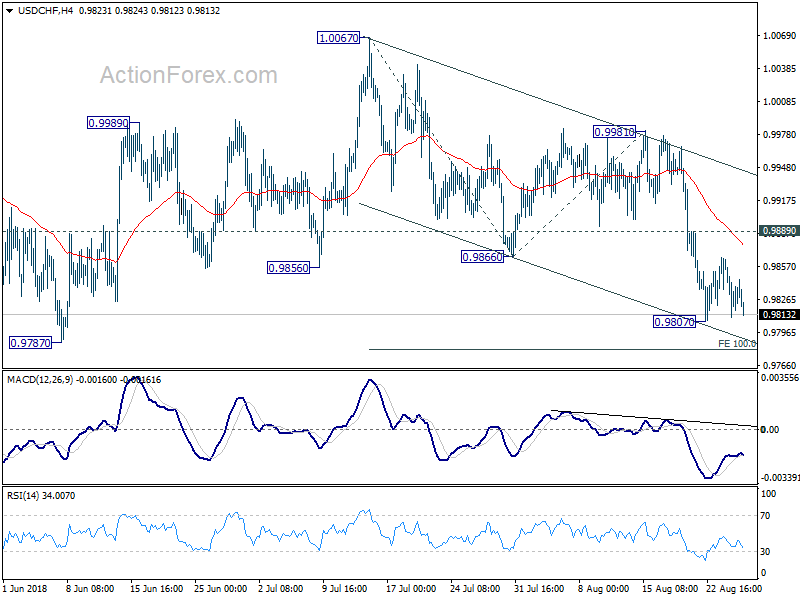
Daily Pivots: (S1) 0.9808; (P) 0.9837; (R1) 0.9863; More....
USD/CHF is still bounded in tight range above 0.9807 temporary low and intraday bias remains neutral. With 0.9889 minor resistance intact, near term outlook stays mildly bearish for deeper fall. On the downside, below 0.9807 will target 100% projection of 1.0067 to 0.9866 from 0.9981 at 0.9780 and possibly below. As current decline is seen as the third leg of consolidation from 1.0056, we'd expect strong support from 38.2% retracement of 0.9186 to 1.0056 at 0.9724 to bring rebound. On the upside, above 0.9889 will turn bias to the upside for 0.9981 resistance first. Break will bring retest of 1.0067 high.
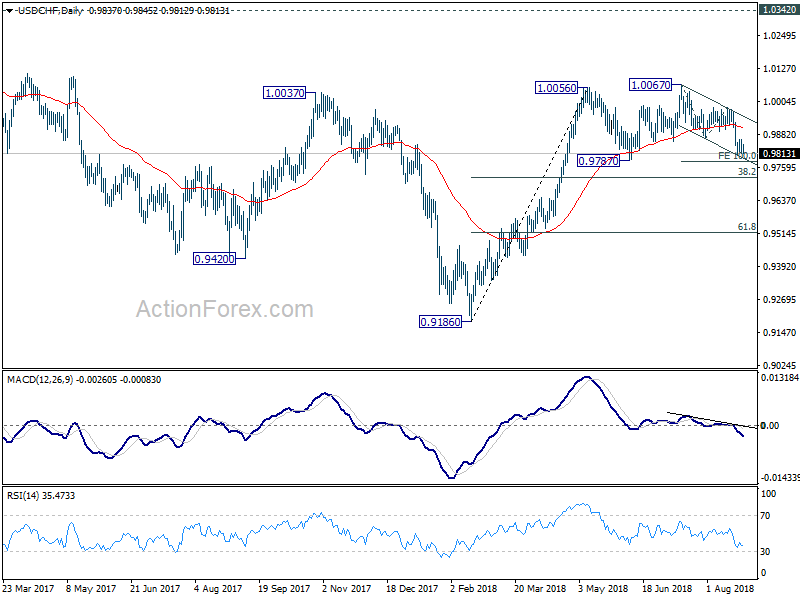
In the bigger picture, current development suggests that the consolidation pattern from 1.0056 is extending. As long as 38.2% retracement of 0.9186 to 1.0056 at 0.9724 holds, we'd expect rise from 0.9186 to resume at a later stage to retest 1.0342 key resistance (2016 high). However, sustained break of 0.9724 fibonacci level will bring deeper fall, as another declining leg in the long term range pattern.
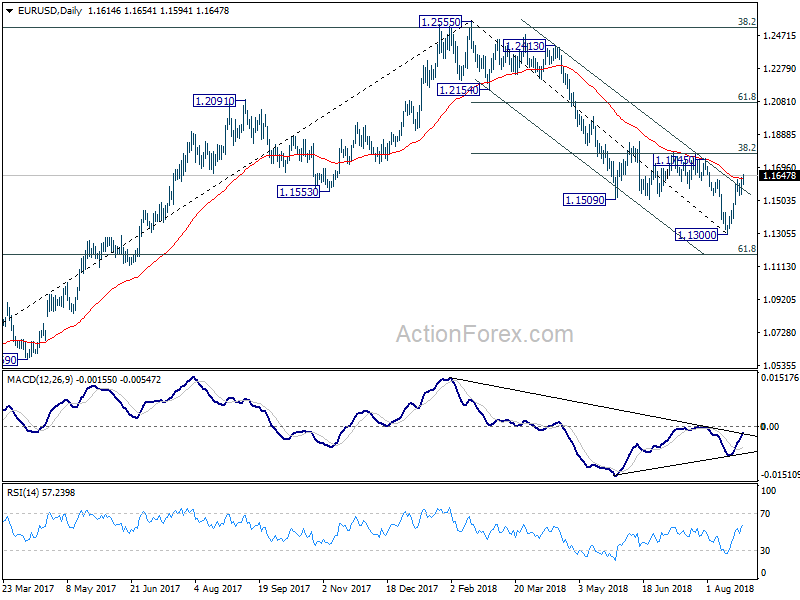
EUR/USD Mid-Day Outlook
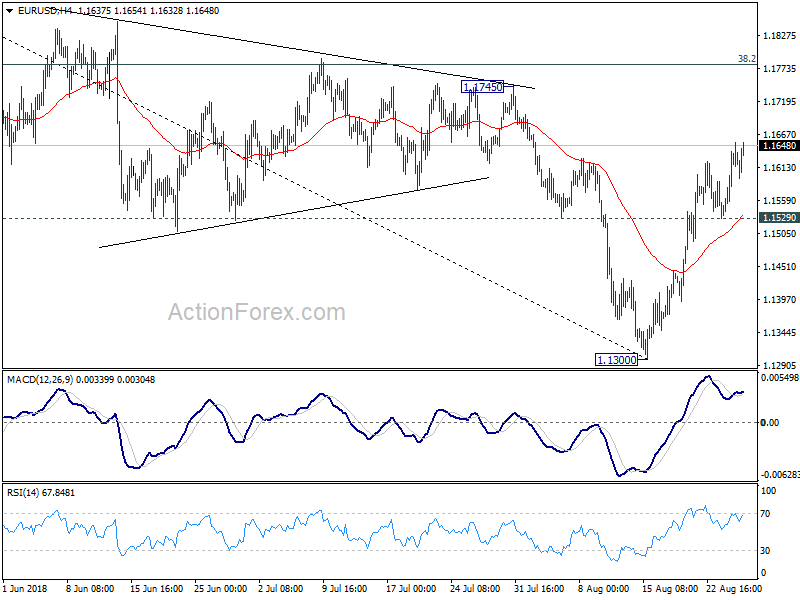
Daily Pivots: (S1) 1.1560; (P) 1.1599; (R1) 1.1664; More.....
EUR/USD's rally is still in progress and intraday bias stays on the upside. Rebound from 1.1300 is expected to target 38.2% retracement of 1.2555 to 1.1300 at 1.1779. We'd expect upside to be limited there, at least on initial attempt, to bring near term reversal. On the downside, below 1.1529 minor support will turn bias back to the downside for retesting 1.1300 low. But after all, consolidation from 1.1300 will extend for a while before completion.
In the bigger picture, a medium term bottom should be in place at 1.1300, on bullish convergence condition in daily MACD and some consolidations would be seen. But still, note that EUR/USD was rejected by 38.2% retracement of 1.6039 (2008 high) to 1.0339 (2017 low) at 1.2516. That carries some long term bearish implications. Thus, we'd expect fall from 1.2555 high to resume after consolidation completes. Below 1.1300 should send EUR/USD through 61.8% retracement of 1.0339 to 1.2555 at 1.1186. And, in that case, EUR/USD would head to retest 1.0339 (2017 low).