Sample Category Title
Gold: Yellow Metal Reverses Its Gains In The Morning Session
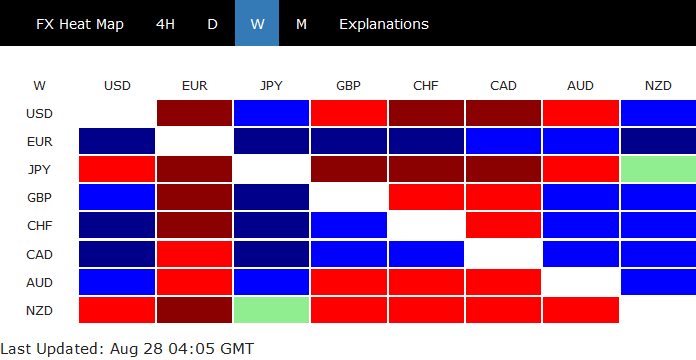
For the 24 hours to 23:00 GMT, Gold rose 0.57% against the USD and closed at USD1217.20 per ounce, as the US Dollar weakened, following the news of a trade deal between the US and Mexico.
In the Asian session, at GMT0300, the pair is trading at 1215.20, with gold trading 0.16% lower against the USD from yesterday’s close.
The pair is expected to find support at 1210.03, and a fall through could take it to the next support level of 1204.87. The pair is expected to find its first resistance at 1219.63, and a rise through could take it to the next resistance level of 1224.07.
The yellow metal is showing convergence with its 20 Hr moving average and trading above its 50 Hr moving average
Silver: White Metal Trading On A Negative Footing In The Asian Session
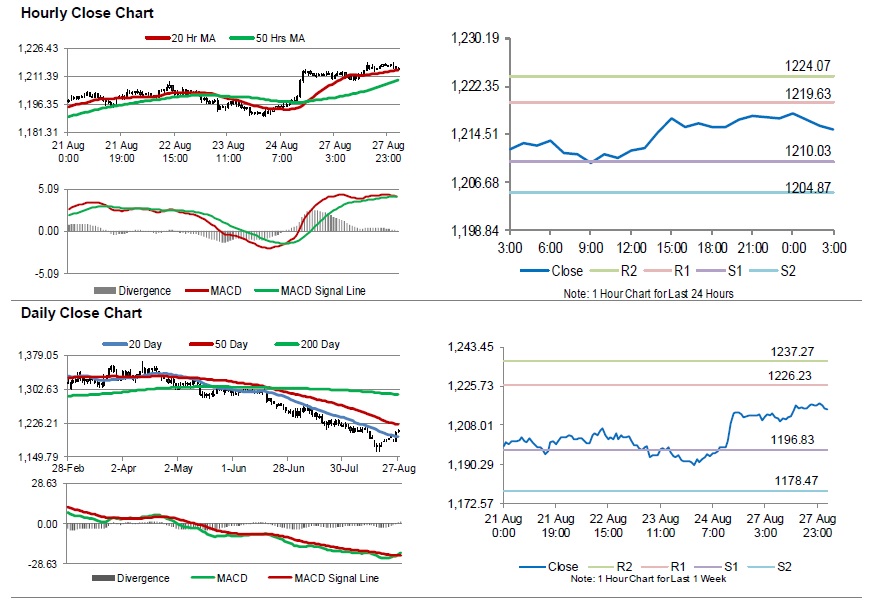
For the 24 hours to 23:00 GMT, Silver rose 0.57% against the USD and closed at USD14.97 per ounce, tracking rise in gold prices
In the Asian session, at GMT0300, the pair is trading at 14.94, with silver trading 0.23% lower against the USD from yesterday’s close.
The pair is expected to find support at 14.84, and a fall through could take it to the next support level of 14.74. The pair is expected to find its first resistance at 15.02, and a rise through could take it to the next resistance level of 15.09.
The white metal is showing convergence with its 20 Hr moving average and trading above its 50 Hr moving average.
Death of NAFTA? Or Just Trump’s Lip Service
The US and Mexico announced that they have reached a bilateral trade deal. Notwithstanding the facts that the preliminary agreement does not involve Canada and lacks details, and the US Congress would not vote on it until next year, President Trump has declared victory in ending NAFTA- a trilateral agreement among the US, Canada and Mexico. Trump, using his usual threatening tactic, obviously hopes to convert the bilateral deal with Mexico into a trilateral one that includes Canada. Meanwhile, Mexican President Enrique Pena Nieto is trying to finalize a deal before he is replaced by leftist Andrés Manuel López Obrado (a.k.a. AMLO) from December 1.
We doubt the feasibility of such wishful thinking. Not only does it depend on Canada’s calculus (protection of the dairy industry and unresolved issues on government procurement, etc), US’ midterm election also has a chance of shuffling the control of the Congress which might affect the vote on the trade deal. We notice the positive market reaction (S&P and Nasdaq jumped to record highs, while Mexican peso and Canadian dollar soared) after the announcement but expect the thrill would be short-lived.
What is the US-Mexico Preliminary Bilateral Trade Agreement About?
The focus is on automobile. The new deal requires 75% of the value of a vehicle to be produced in the partner countries, up from 62.5% required under NATFTA. The deal also requires 40- 45% of auto content made by workers earning at least $16 an hour, as well as greater use of US and Mexican steel, aluminum, glass and plastics.
Meanwhile, the deal will be reviewed every 6 years and will be eligible for expiration after 16 years. It can be extended for another16 years if there are no irreconcilable issues in the review process. If a key issue is identified after the 6-year review, the deal would be reviewed every year until that key issue was resolved. This marks a back down of Trump’s initial insistence on a 5-year sunset clause.
Mexico agrees to double the de minimus duty-free shipment values to US$100 and to improve working condition by practicing labour rights recognized by International Labor Organization. Duty-free access for farm products will be maintained and there will be no restriction on market access for US named “cheeses”. Both parties have also agreed on areas on intellectual property and environment protection.
There are still a number of areas remained unresolved. For instance, whether NAFTA’s Chapter 11 (investor-state) and Chapter 19 (anti-dumping and countervailing duty) dispute settlement mechanisms. under which bi-national panels make binding decisions on complaints about illegal subsidies and dumping, would be modified is uncertain. The White house has been calling to remove both clauses while the Mexican and Canadian governments are eager to keep. The US has also pushed for more stringent measure on government procurement, one of the issues that Canada has strongly objected. The US-Mexico deal has made no mention on this area.
Canada’s Calculus
Canadian Foreign Minister Chrystia Freeland has cut short her European trip to Europe and will be meeting with the US today. Trump has made the US-Mexico bilateral agreement a done deal and a “take it or leave it” offer for Canada. As he noted, “I think with Canada, frankly, the easiest we can do is to tariff their cars coming in. It’s a tremendous amount of money and it’s a very simple negotiation. It could end in one day and we take in a lot of money the following day”.
Although Trump believes that this would force Canada to make concessions, Canadian Prime Minister Justin Trudeau, facing national election by October 2019, has often affirmed that “no deal is better than a bad deal”. The thorniest areas between the US and Canada are dairy and the dispute settlement mechanism (the abovementioned Chapter 19). The latter is even viewed as uncompromisable for the Canada government.
Back in August last year, Freeland cited that Canada had withdrawn its chief negotiator from 1987 talks on a bilateral trade treaty with the US over the same issue, stressing that “Canada will uphold and preserve the elements in NAFTA that Canadians deem key to our national interest – including a process to ensure anti-dumping and countervailing duties are only applied fairly when truly warranted”.
Finalised by Friday?
Trump has planned to seek Congressional approval by the end of this week, noting that Canada might opt to join later if it cannot make up its mind by Friday. The urgency of the approval is two-folded. First, Trump would like to get it done before the mid-term election of which the result might eliminate Republican’s majority. Second, it is to accommodate the 90-day window for a deal to be signed by outgoing Mexican President.
However, there are mixed expectations on whether the Congress would accommodate. Congressional approval of NAFTA renegotiation back then was based on the assumption that the new agreement would be a trilateral one. As such, the White House would need to seek Congress’s approval to change it to a bilateral deal (if Canada refuses to join). This process could take at least 180 days. Yet, some believe that they might skip this process.
While Trump's lip service has again succeeded in stimulating the financial markets, the effect is short-lived. While the US and Mexico attempt to end NAFTA hastily and forcefully, Canada’s own interests and US Congressional procedures remain the key hurdles to overcome.
Crude Oil: Oil Trading Lower, Ahead Of API’s Weekly Crude Oil Inventories Data
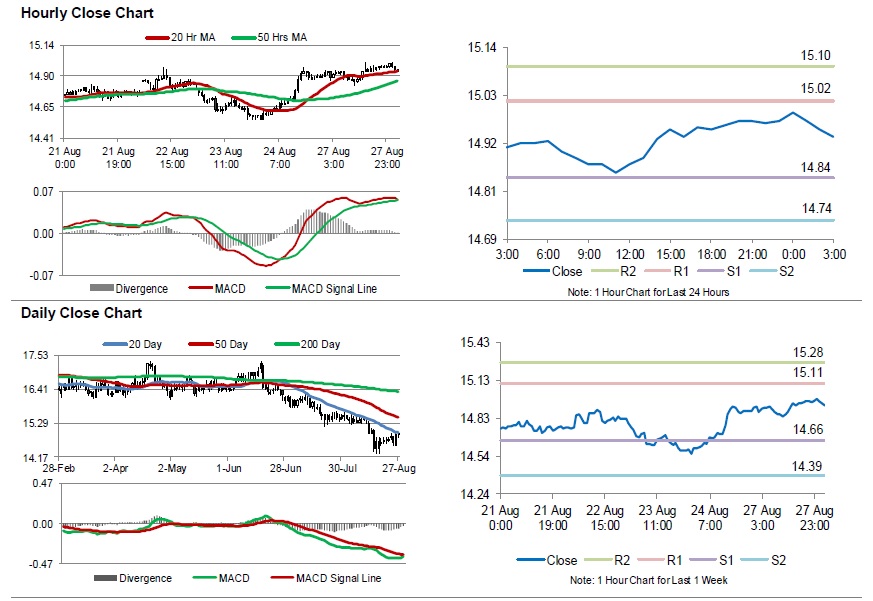
For the 24 hours to 23:00 GMT, Crude Oil rose 0.51% against the USD and closed at USD68.99 per barrel, after a committee of OPEC and non-OPEC producers announced that oil producers participating in a supply-reduction agreement have cut output in July by 9.0%.
On Friday, fresh figures from Baker Hughes disclosed that the number of active oil rigs fell by 9 to 860 in the week ended 24 August, marking its fastest pace since May 2016.
In the Asian session, at GMT0300, the pair is trading at 68.89, with oil trading 0.14% lower against the USD from yesterday's close.
The pair is expected to find support at 68.44, and a fall through could take it to the next support level of 67.99. The pair is expected to find its first resistance at 69.24, and a rise through could take it to the next resistance level of 69.59.
Crude oil is showing convergence with its 20 Hr moving average and trading above its 50 Hr moving average.
EUR/USD Daily Outlook
Daily Pivots: (S1) 1.1618; (P) 1.1657; (R1) 1.1718; More.....
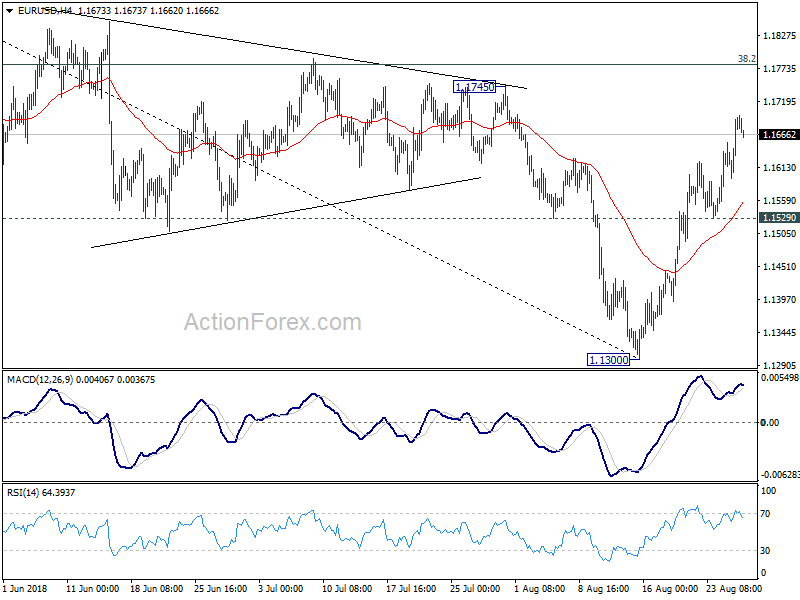
EUR/USD surges to as high as 1.1696 so far today as rebound from 1.1300 extends. Intraday bias remains on the upside for 38.2% retracement of 1.2555 to 1.1300 at 1.1779. We'd expect upside to be limited there, at least on initial attempt, to bring near term reversal. However, break of 1.1529 minor support is needed to signal completion of the rebound first. Otherwise, further rise will remain in favor even in case of retreat. Break of 1.1529 will bring retest of 1.1300 low. After all, consolidation from 1.1300 will extend for a while before completion.
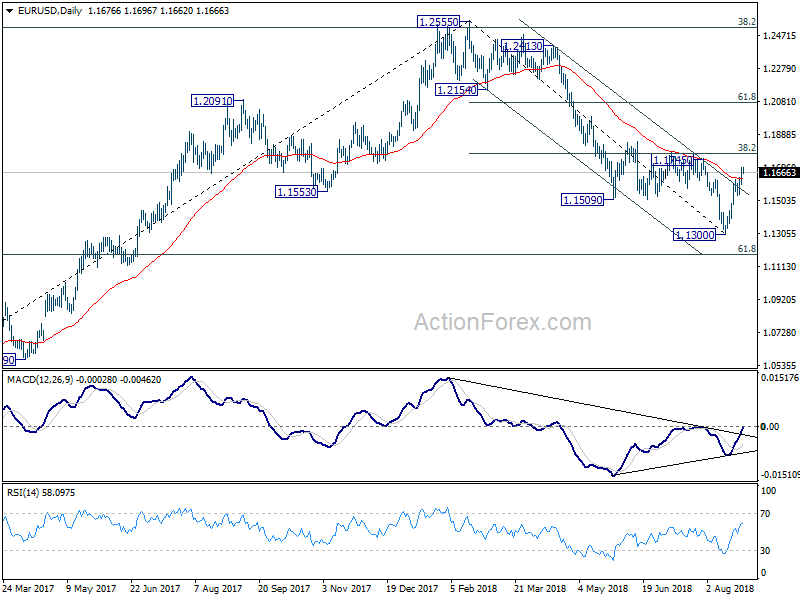
In the bigger picture, a medium term bottom should be in place at 1.1300, on bullish convergence condition in daily MACD and some consolidations would be seen. But still, note that EUR/USD was rejected by 38.2% retracement of 1.6039 (2008 high) to 1.0339 (2017 low) at 1.2516. That carries some long term bearish implications. Thus, we'd expect fall from 1.2555 high to resume after consolidation completes. Below 1.1300 should send EUR/USD through 61.8% retracement of 1.0339 to 1.2555 at 1.1186. And, in that case, EUR/USD would head to retest 1.0339 (2017 low).
Stocks, Euro and Canadian Dollar Jump on Trump’s Concession in Mexican Trade Deal
Be it NAFTA or United States-Mexico Trade Agreement, the markets global markets cheer the conclusion of the bilateral deal. DOW ended up 1.01% at 26049.54. S&P 500 and NASDAQ extended record runs, gained 0.77% to 2896.74 and 0.91% to 8017.909 respectively. Asian markets are also generally higher. At the time of writing, Nikkei is up 0.40%, Singapore Strait Times is up 0.96%, Hong Kong HSI is up 0.24%. But China Shanghai SSE is flat only. Gold is pressing 1210 as recent rebound is in progress.
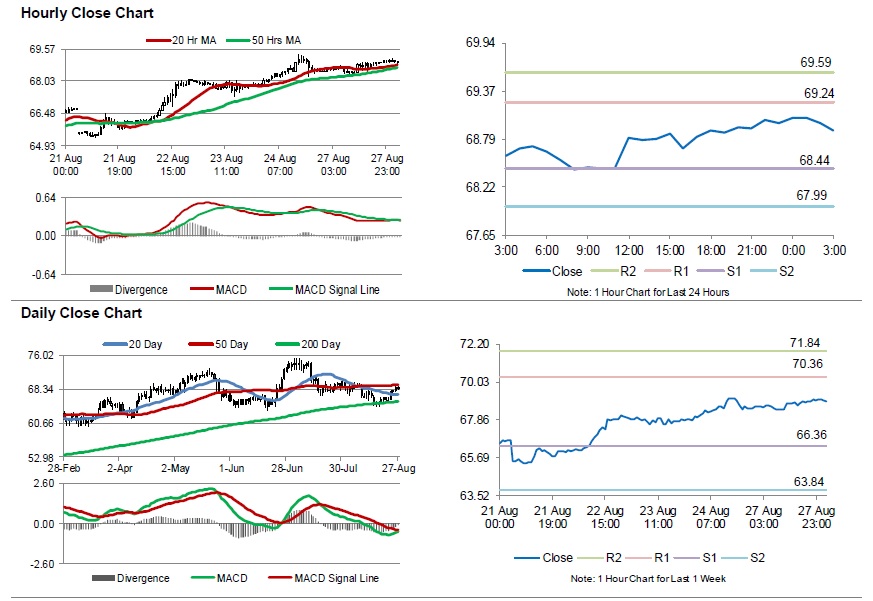
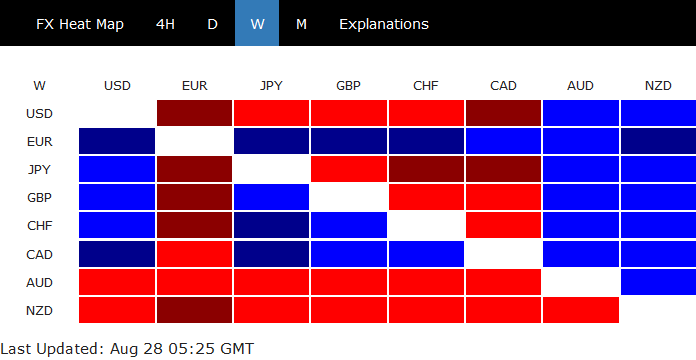
In the currency markets, Dollar recovers some ground today after yesterday's selloff. Euro follows as the second strongest for today, and then Canadian Dollar. Australian Dollar and New Zealand Dollar are the first and second weakest for today. For the week as a whole, Euro is overwhelmingly the strongest one followed by Canadian Dollar. Both are boosted by hope of trade deal with the US and material decrease in auto-tariffs threat. Aussie and Kiwi are also the weakest ones as they're passer-by in the current trade development. Yen also turns weaker following risk appetite finally.
Technically, USD/CAD's break of medium term channel support carries some bearish implications And focus will be turned to 1.2879 fibonacci level. EUR/USD is on track to 1.1745 resistance as rebound from 1.1300 is still in good shape. Euro is indeed having solid upside momentum against Sterling and Yen too. GBP/USD and AUD/USD, however, are staying in familiar range. A recovery in Dollar could put 1.1798 in GBP/USD and 0.7237 in AUD/USD in to focus.
Trump's concession on sunset clause shows willingness to deal with key allies
The most notable breakthrough in the US-Mexico negotiation is Trump's concession on the so called "sunset clause". In the original NAFTA re-negotiation, the US demanded that the agreement would automatically terminate every five years unless all the countries agreed to continue. This has been one of the show stoppers all the way . But now, US Trade Representative Robert Lighthizer, said both countries agreed to review the trade deal every six years. If problems cannot be resolved, the agreement can be terminated 10 a decade after the review. If one of the parties refuses to renew, a yearly review would take effect to address the issues.
The move showed that the Trump is backing down from his hard line stance, for business pressures ahead of election, or whatever reason. Such softening in stance could give way to more concessions to major allies of the US, like Canada, and more importantly the EU. Now, the threat of auto tariffs have materially diminished after the US-Mexico breakthrough. The White House also said that German Chancellor Angel Merkel talked to Trump on phone yesterday. And the two leaders "strongly supported ongoing discussions between Washington and Brussels to remove barriers to a deeper trading relationship."
The movements in the forex markets clearly reflect the implications of the development. Euro is trading as the strongest one for the week, followed by Canadian Dollar.
Canada in tricky but positive spot in trade negotiation with US
Canadian Foreign Minister Chrystia Freeland is expected to travel to Washington to "reset" the trade talks today. And the situation is tricky for the country. Trump appeared to want to play an upper hand by saying that "we'll give them a chance to have a separate deal, or we could put it into this deal." On the other hand, Freeland's office sounded firm and said Canada "will only sign a new NAFTA that is good for Canada and good for the middle class."
And what's more confusing is that Trump made himself clear again he is ditching NAFTA, which is a "ripoff". But Mexican president Enrique Peña Nieto constantly refer to the name of NAFTA, sounding like this is the agreement in negotiation. And, Republicans are also clear that a final agreement should include Canada. Sen. John Cornyn also indicated that a final agreement with Canada has "bipartisan support".
Technically, in the US-Mexico agreed deal, percentage of auto-parts must be produced in North America increases from 62% to 75%. And, at least 40% of vehicles must come from suppliers paying at least USD 16 an hour on workers. Mexico's Economy Minister Ildefonso Guajardo said that "the whole issue of rules of origin is considered trilaterally, so if we go forward with a bilateral model it would need to be rethought." And he added that "it's not the same having integration between three countries as two."
So, Trump's verbal threats to Canada are more likely bluffs than substance. Good news is more likely than bad when Freeland comes out of Washington.
Trump: Not the right time for trade talk with China
There is breakthrough in US-Mexico trade talk, which will likely pave the way for Canada. There is progress in US-EU trade talks too. But how about China? Trump is clear with his priority as he said yesterday that "it's just not the right time to talk right now, to be honest with China." He went further and added that "it's too one-sided for too many years and too many decades, and so it's not the right time to talk." Though, he said "eventually I'm sure that we'll be able to work out a deal with China." US Trade Representative Robert Lighthizer said that "we have to change the way we work with China", without giving any detail.
This could explain why all Asian stocks surge today but China SSE is left behind. Yuan was lifted since the PBoC reintroduced measures last Friday that acts counter-cyclical to market forces to keep Yuan from falling too quickly. But the Yuan is quickly losing some momentum already.
On the data front
Eurozone will release M3 money supply in European session. US will release trade balance, wholesale inventories, S&P Case-Shiller house price and consumer confidence later in the day.
EUR/USD Daily Outlook
Daily Pivots: (S1) 1.1618; (P) 1.1657; (R1) 1.1718; More.....
EUR/USD surges to as high as 1.1696 so far today as rebound from 1.1300 extends. Intraday bias remains on the upside for 38.2% retracement of 1.2555 to 1.1300 at 1.1779. We'd expect upside to be limited there, at least on initial attempt, to bring near term reversal. However, break of 1.1529 minor support is needed to signal completion of the rebound first. Otherwise, further rise will remain in favor even in case of retreat. Break of 1.1529 will bring retest of 1.1300 low. After all, consolidation from 1.1300 will extend for a while before completion.
In the bigger picture, a medium term bottom should be in place at 1.1300, on bullish convergence condition in daily MACD and some consolidations would be seen. But still, note that EUR/USD was rejected by 38.2% retracement of 1.6039 (2008 high) to 1.0339 (2017 low) at 1.2516. That carries some long term bearish implications. Thus, we'd expect fall from 1.2555 high to resume after consolidation completes. Below 1.1300 should send EUR/USD through 61.8% retracement of 1.0339 to 1.2555 at 1.1186. And, in that case, EUR/USD would head to retest 1.0339 (2017 low).
Economic Indicators Update
| GMT | Ccy | Events | Actual | Forecast | Previous | Revised |
|---|---|---|---|---|---|---|
| 08:00 | EUR | Eurozone M3 Money Supply Y/Y Jul | 4.40% | 4.40% | ||
| 12:30 | USD | Advance Goods Trade Balance (USD) Jul | -68.6B | -67.9B | ||
| 12:30 | USD | Wholesale Inventories M/M Jul P | 0.10% | 0.10% | ||
| 13:00 | USD | S&P/Case-Shiller Composite-20 Y/Y Jun | 6.40% | 6.50% | ||
| 14:00 | USD | Consumer Confidence Index Aug | 127 | 127.4 |
Elliott Wave Analysis: NASDAQ Nesting Higher As Impulse
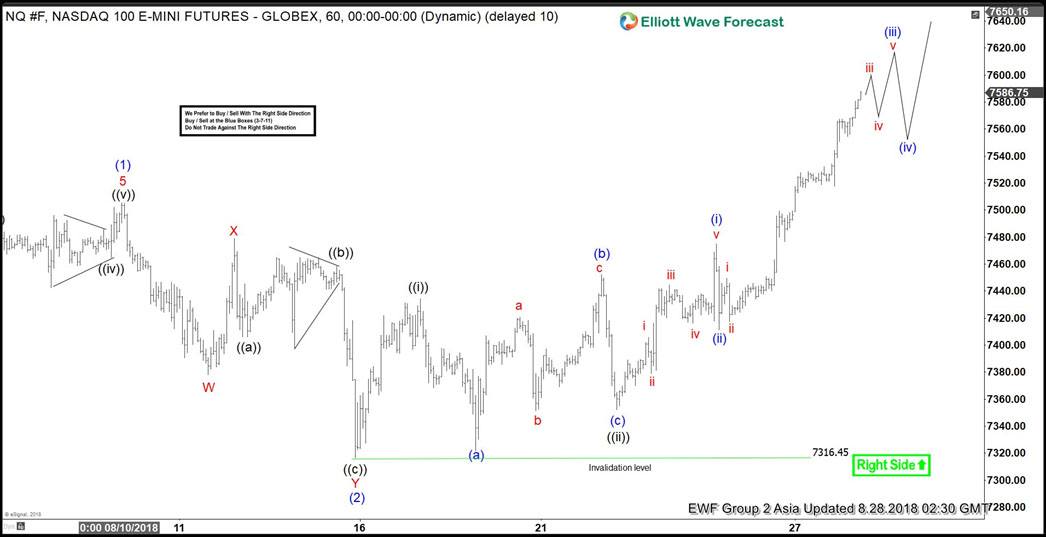
NASDAQ ticker symbol: $NQ_F short-term Elliott wave analysis suggests that the rally from 7/30 low ($7167.75) to $7505.25 high ended Intermediate wave (1). The internals of lesser degree cycles within Intermediate wave (1) unfolded as 5 waves impulse structure. Down from there, the correction against that cycle in Intermediate wave (2) pullback is proposed complete at $7316.5 low. The subdivision of Intermediate wave (2) unfolded as double three structure. Where Minor wave W ended at $7378.25. The rally to $7479 high ended Minor wave X. And the decline to $7316.45 low ended Minor wave Y of (2).
Above from there, the NASDAQ has already made a new all-time high confirming the next extension higher in Intermediate wave (3) higher has started. The internals of the rally higher is unfolding as 5 waves impulse structure. Where Minute wave ((i)) ended in 5 waves at $7433.5 high. Then the pullback to $7352 low ended Minute wave ((ii)) pullback as a Flat structure. Up from there, the index is nesting higher in Minute wave ((iii)) with lesser degree cycles showing 5 wave advance. Near-term, as far as a pivot from $7316.45 low remains intact index is expected to see more upside. We don’t like selling it and expect buyers to appear in 3, 7 or 11 swings against $7316.45 low in the first degree.
NASDAQ 1 Hour Elliott Wave Chart
Trump: Not the right time for trade talk with China
There is breakthrough in US-Mexico trade talk, which will likely pave the way for Canada. There is progress in US-EU trade talks too. But how about China? Trump is clear with his priority as he said yesterday that "it's just not the right time to talk right now, to be honest with China." He went further and added that "it's too one-sided for too many years and too many decades, and so it's not the right time to talk." Though, he said "eventually I'm sure that we'll be able to work out a deal with China." US Trade Representative Robert Lighthizer said that "we have to change the way we work with China", without giving any detail.
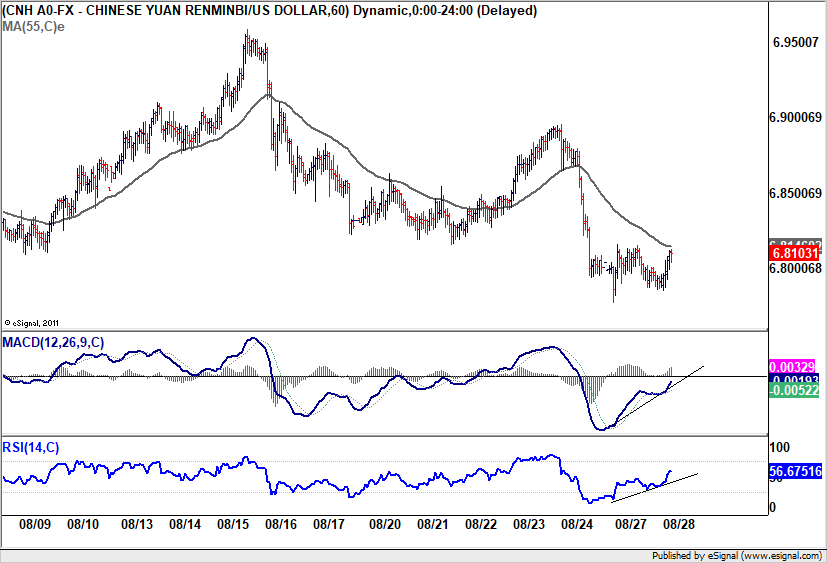
This could explain why all Asian stocks surge today but China SSE is left behind. Yuan was lifted since the PBoC reintroduced measures last Friday that acts counter-cyclical to market forces to keep Yuan from falling too quickly. But the Yuan is quickly losing some momentum already.
Canada in tricky but positive spot in trade negotiation with US
Canadian Foreign Minister Chrystia Freeland is expected to travel to Washington to "reset" the trade talks today. And the situation is tricky for the country. Trump appeared to want to play an upper hand by saying that "we'll give them a chance to have a separate deal, or we could put it into this deal." On the other hand, Freeland's office sounded firm and said Canada "will only sign a new NAFTA that is good for Canada and good for the middle class."
And what's more confusing is that Trump made himself clear again he is ditching NAFTA, which is a "ripoff". But Mexican president Enrique Peña Nieto constantly refer to the name of NAFTA, sounding like this is the agreement in negotiation. And, Republicans are also clear that a final agreement should include Canada. Sen. John Cornyn also indicated that a final agreement with Canada has "bipartisan support".
Technically, in the US-Mexico agreed deal, percentage of auto-parts must be produced in North America increases from 62% to 75%. And, at least 40% of vehicles must come from suppliers paying at least USD 16 an hour on workers. Mexico's Economy Minister Ildefonso Guajardo said that "the whole issue of rules of origin is considered trilaterally, so if we go forward with a bilateral model it would need to be rethought." And he added that "it's not the same having integration between three countries as two."
So, Trump's verbal threats to Canada are more likely bluffs than substance. Good news is more likely than bad when Freeland comes out of Washington
Euro and stocks cheer US-Mexico deal, as threats of trade war diminished
Be it NAFTA or United States-Mexico Trade Agreement, the markets global markets cheer the conclusion of the bilateral deal. DOW ended up 1.01% at 26049.54. S&P 500 and NASDAQ extended record runs, gained 0.77% to 2896.74 and 0.91% to 8017.909 respectively. Asian markets are also generally higher. At the time of writing, Nikkei is up 0.38%, Singapore Strait Times is up 1.06%, Hong Kong HSI is up 0.22%. But China Shanghai SSE is flat only.
The most notable breakthrough in the US-Mexico negotiation is Trump's concession on the so called "sunset clause". In the original NAFTA re-negotiation, the US demanded that the agreement would automatically terminate every five years unless all the countries agreed to continue. This has been one of the show stoppers all the way . But now, US Trade Representative Robert Lighthizer, said both countries agreed to review the trade deal every six years. If problems cannot be resolved, the agreement can be terminated 10 a decade after the review. If one of the parties refuses to renew, a yearly review would take effect to address the issues.
The move showed that the Trump is backing down from his hard line stance, for business pressures ahead of election, or whatever reason. Such softening in stance could give way to more concessions to major allies of the US, like Canada, and more importantly the EU. Now, the threat of auto tariffs have materially diminished after the US-Mexico breakthrough. The White House also said that German Chancellor Angel Merkel talked to Trump on phone yesterday. And the two leaders "strongly supported ongoing discussions between Washington and Brussels to remove barriers to a deeper trading relationship." Canadian Foreign Minister Chrystia Freeland is expected to travel to Washington to "reset" the talks today.
The movements in the forex markets clearly reflect the implications of the development. Euro is trading as the strongest one for the week, followed by Canadian Dollar. Yen is trading as the weakest, finally aligning itself with strong risk appetite. Dollar is soft on the pattern that lower trader war threat, lower the exchange rate.