Sample Category Title
US-Mexico Trade Deal Fuels Risk Appetite, Dollar Extends Retreat
Here are the latest developments in global markets:
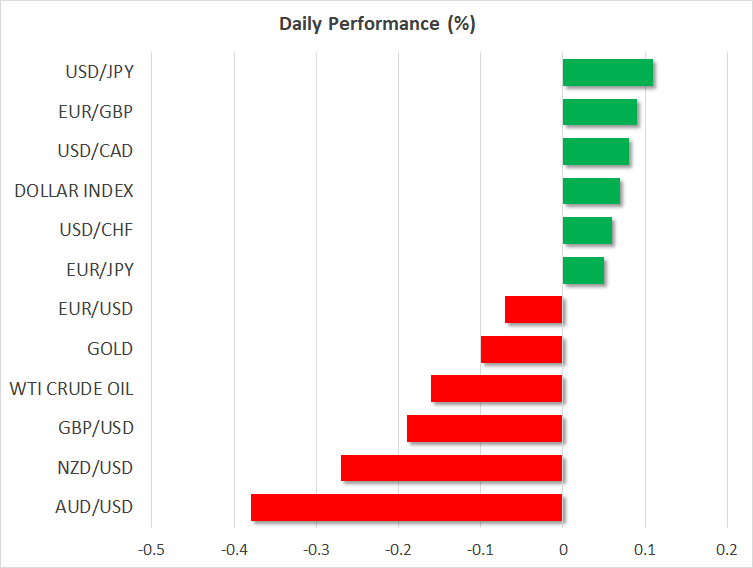
FOREX: The dollar index was up on Tuesday, albeit by less than 0.1%, attempting to recover some of the losses it recorded yesterday as investors scaled back safe-haven bets on the currency, following headlines of a US-Mexico trade agreement. The euro capitalized on the dollar’s softness, advancing across the board on Monday, and reaching a fresh one-year high against the battered British pound. Meanwhile, the loonie climbed somewhat on the optimistic NAFTA headlines, touching a ten-week high against the dollar.
STOCKS: US markets enjoyed another day of robust gains, with the S&P 500 (+0.77%) and the Nasdaq Composite (+0.91%) both closing at new record highs for a second session in a row, propelled higher by news the US and Mexico reached a trade deal. The Dow Jones surged by 1.01% as well, edging closer to its own all-time peak. Meanwhile, futures tracking the S&P, Dow, and Nasdaq 100 are all flashing green, pointing to a marginally higher open today as well. Asian markets took their cue from their US counterparts on Tuesday, though the magnitude of the gains was modest. Japan’s Nikkei 225 (+0.06%) and Topix (+0.16%) barely advanced, as did the Hang Seng in Hong Kong (+0.09%). In Europe, all the major indices were set to open higher today, according to futures.
COMMODITIES: Oil prices are marginally lower on Tuesday, giving back some of the gains they posted in the previous session. WTI was down by 0.17% at $68.77 per barrel, while Brent was practically flat at $76.25 a barrel. Although the precious liquid benefited somewhat yesterday on signals trade tensions are subsiding, news that OPEC compliance with its output-cut deal is slipping kept a lid on any major gains. While OPEC compliance was at 109%, meaning members cut production by 9% more than agreed, that still represents a decline from last month’s 120% – implying production is rising. In precious metals, gold was down by 0.10% at $1,211 per troy ounce on Tuesday. The dollar-denominated yellow metal inched higher yesterday despite the risk-on sentiment, buoyed by a weaker greenback.
Major movers: US-Mexico trade deal boosts risk appetite, weighs on dollar
The US and Mexico reached an agreement on trade yesterday that is expected to replace NAFTA, though crucially, this deal does not include Canada yet; the Mexican peso advanced considerably on the news though it later gave back some of those gains. Both sides said they would welcome Canada joining in as well, but hinted that if the nation does not, then they may proceed regardless – raising pressure even further on Canadian officials. As for the details of the new accord, it requires 75% of auto content to be made in NAFTA countries, from 62.5% previously. Moreover, it calls for 40-45% of auto content to be produced by workers earning a minimum of $16 an hour, which is likely to bode well with workers in manufacturing-heavy US states ahead of the midterm elections.
The headlines likely sent the message that a full-blown “trade war” may indeed be avoided, and that the endgame is still the US striking new deals with its partners, thereby boosting risk appetite across markets. Stocks got a lift, with the S&P 500 and the Nasdaq Composite breaking new all-time highs, while safe-havens like the Japanese yen retreated. The dollar – which had also been acting as a haven asset in recent months – tumbled as well.
Meanwhile, although the loonie surged, the magnitude of its gains was relatively modest – smaller than one would have expected on concrete signs that NAFTA may be resolved soon. This suggests investors likely took the news with a grain of salt, as there is still some uncertainty involved with whether Canada will join the deal immediately, or perhaps opt to negotiate better terms beforehand. In this respect, Canada’s foreign minister Chrystia Freeland will head to Washington today for talks, and any remarks hinting at her country’s intentions could provide short-term direction to the loonie.
Apart from NAFTA, news flow was relatively light on Monday and during the Asian session Tuesday. The euro was once again the main beneficiary of the dollar’s underperformance, with euro/dollar currently trading just a few pips below the 1.1700 zone. The euro’s gains were more pronounced versus the battered British pound, though. Euro/sterling touched a fresh one year high earlier today, currently hovering near the 0.9070 territory and looking set to post the fifth day of advances in a row.
Day ahead: US consumer confidence and housing data due
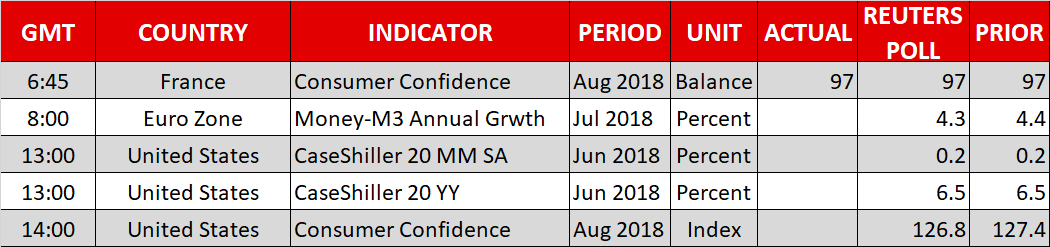
The economic calendar is relatively light on Tuesday, featuring consumer confidence and housing data out of the US.
Data on lending and money supply for July will be released out of the European Central Bank at 0800 GMT.
The Conference Board’s consumer confidence index for August will be made public at 1400 GMT. The gauge is anticipated to weaken a bit after rising in July on the back of consumers’ optimism about the jobs market. One hour earlier, June’s CaseShiller indices, gauging US house prices, will be hitting the markets.
After yesterday’s NAFTA deal between Mexico and the US, the attention now perhaps turns to Canada: will it consent to new terms to preserve the trilateral trade agreement or will it enter into long discussions, pushing to keep the terms that it deems are instrumental for its interests?
In terms of policymakers’ appearances, ECB chief economist Peter Praet will be participating in a panel discussion on “monetary and macroprudential interactions” at 1100 GMT.
In energy markets, weekly API data on US crude stocks are due at 2030 GMT.
Technical Analysis: USDCAD bearish bias as it touches 2½-month low though stochastics give positive signal in very short-term
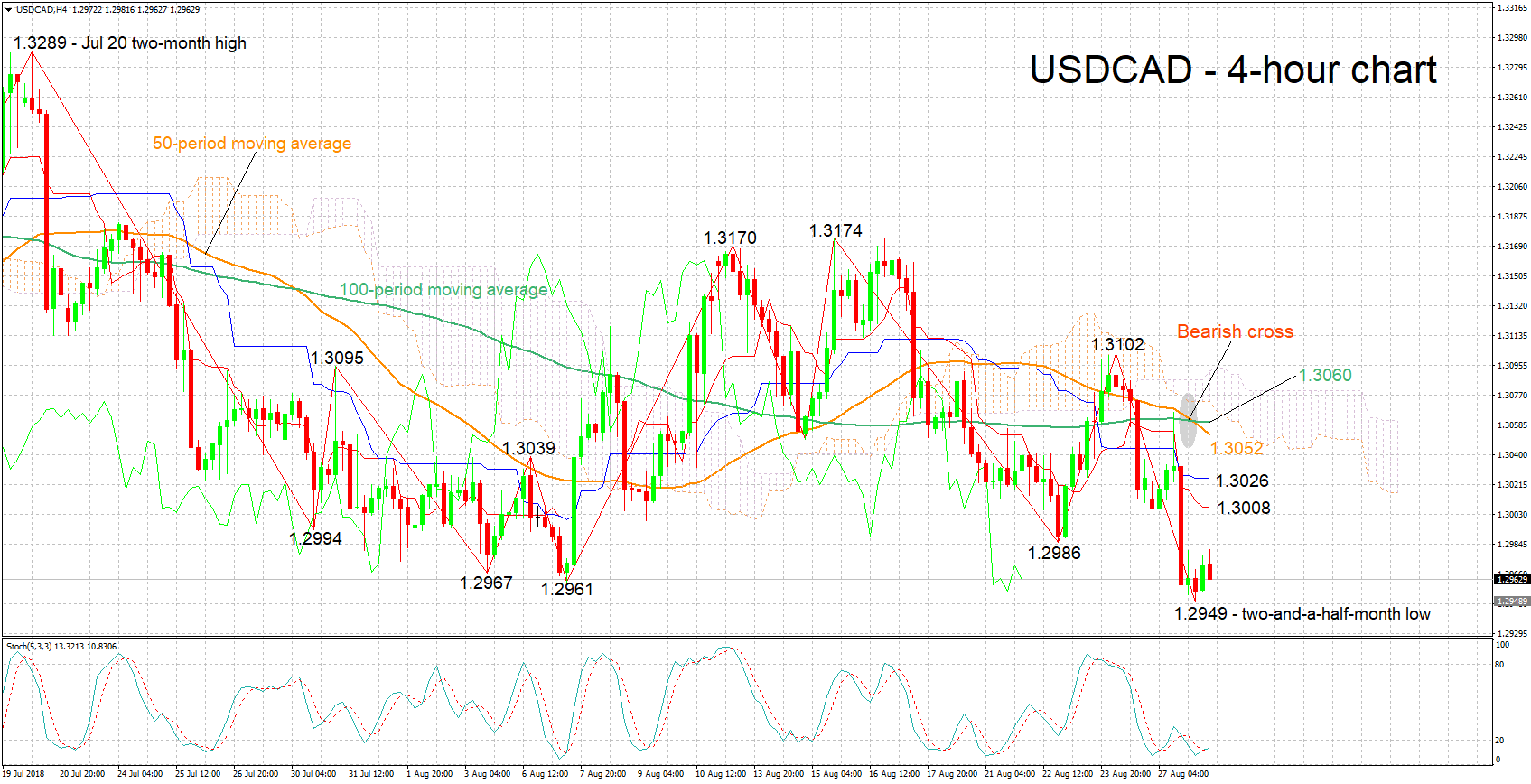
USDCAD hit a two-and-a-half-month low of 1.2949 earlier on Tuesday. The short-term bias is titled to the downside as indicated by the negatively-aligned Tenkan- and Kijun-sen lines. Still, the stochastics are giving a bullish signal in the very short-term as the %K line has moved above the slow %D one.
If Canada is seen as getting closer to a NAFTA deal then the loonie may come under buying interest, pushing USDCAD lower. Support to a declining pair may occur around today’s low of 1.2949, with steeper losses bringing into scope the 1.29 round figure.
On the other hand, if the US and Canada are seen as drifting away on the NAFTA front, then USDCAD is likely to head higher. Resistance to a rising pair may come around the current levels of the Tenkan- and Kijun-sen lines at 1.3008 and 1.3026, including the 1.30 handle. Further above, the region around the current level of the 50-period moving average at 1.3052 would be eyed.
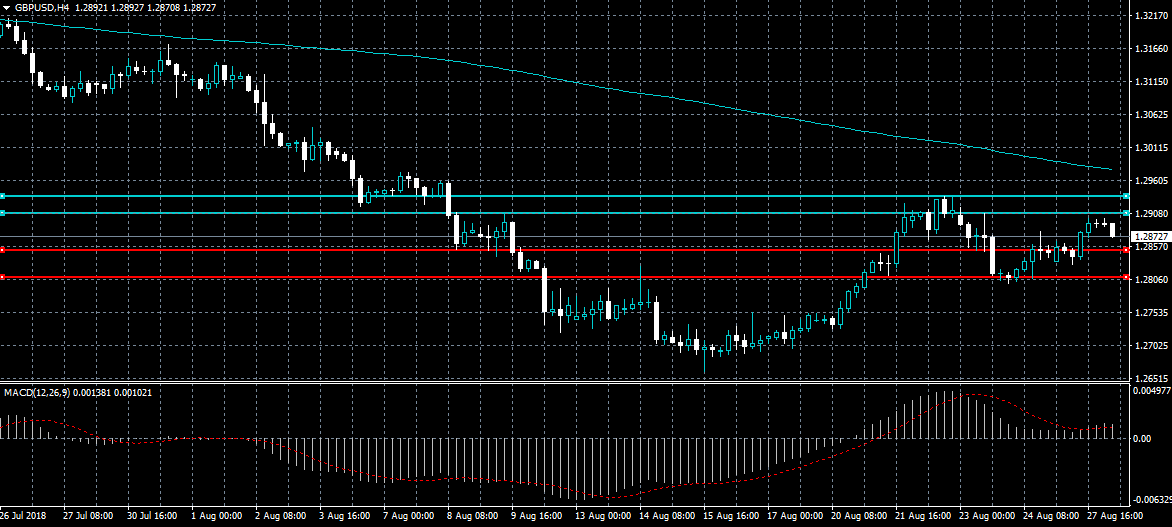
GBPUSD Awaits UK Inflation Report
The British pound has reversed direction and moved higher against the greenback, due to improving market sentiment and overall US dollar weakness. GBPUSD traders now await the Bank of England this morning, who are set to release the UK Inflation Report. A bullish cup and handle pattern may be forming if price stabilizes above the 1.2900 level.
The GBPUSD pair is bullish while trading below the 1.2850 level, key resistance is now found at the 1.2910 and 1.2958 levels.
If the GBPUSD pair fails around the 1.2900 level, sellers may test towards the 1.2850 and 1.2828 levels.
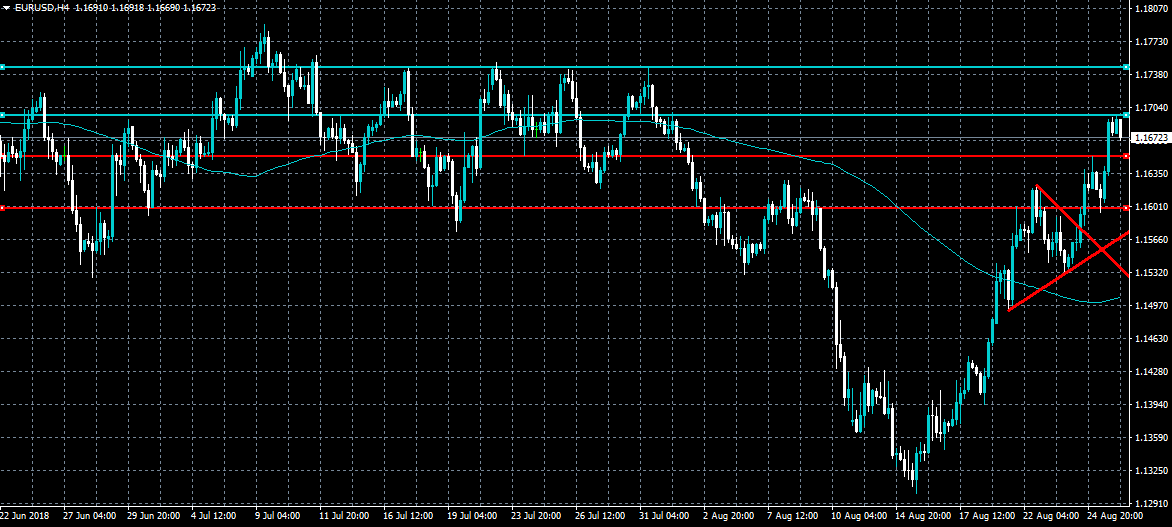
EURUSD Tests Key Resistance
The euro currency continues to advance against the greenback, due to improving market sentiment and broad-based weakness in the US dollar. The EURUSD pair is only intraday bullish while trading above the key 1.1681 level, it also worth noting that the pair may be creating a bullish inverted head and shoulders pattern across various time frames.
The EURUSD pair is strongly bullish while trading above the 1.1681 level, key resistance is found at the 1.1700 and 1.1740 levels.
If the EURUSD pair trades below the 1.1650 level, sellers will likely target the 1.1630 and 1.1600 support levels.
Bitcoin Rises As Hopes Of Etf Approval Rises
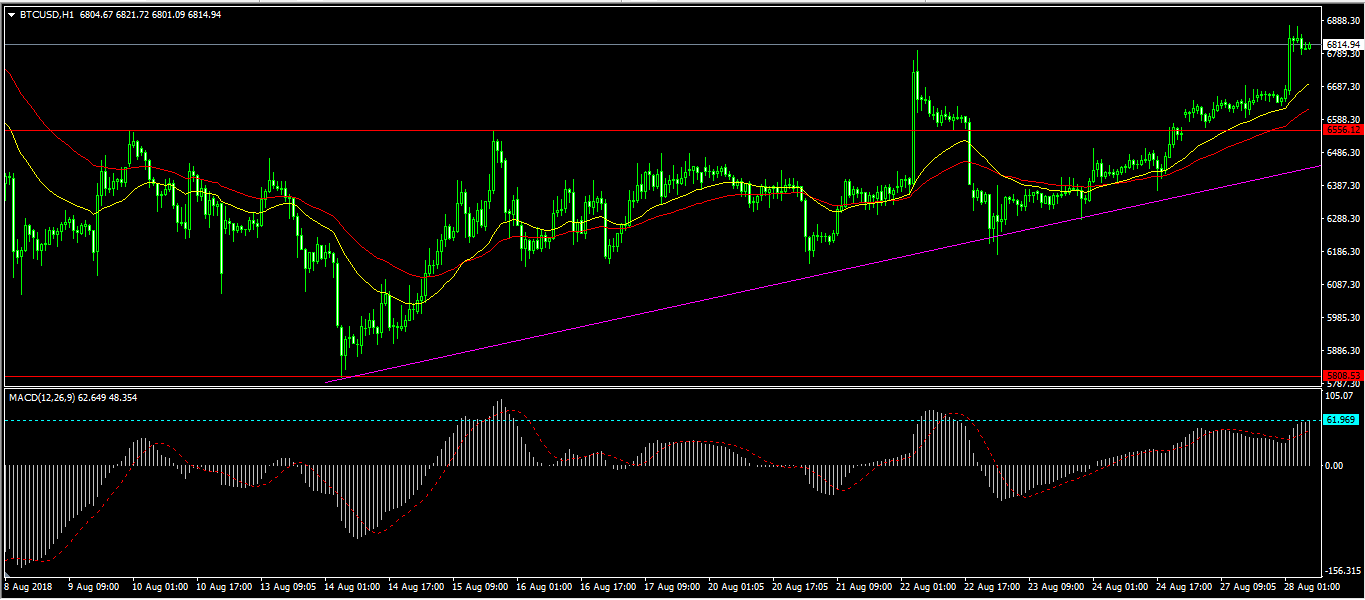
Two weeks ago, the price of Bitcoin fell to a monthly low of $5797 after the SEC ended its review of nine Exchange Traded Funds (ETFs). Since then, the BTC/USD pair has made slight gains and today, it reached a weekly high of $6877. These gains are attributed to the decision by the SEC senior management to review the decision to reject the ETFs.
The rise came as PricewaterhouseCoopers (PwC) released a new report on Bitcoin. The report found that lack of user trust and regulatory uncertainty were hindering the success of Bitcoin – and other cryptocurrencies. In the report, PwC officials surveyed 600 executives in more than 15 countries. These concerns have been around for a while. Regulators from across the globe are struggling with how to regulate cryptocurrencies and traders are worried about how the regulations will impact transactions.
Such issues have led to poor cryptocurrency adoption of late. Very few companies worldwide accept them. In addition, most people who own cryptocurrencies do so for speculation purposes.
The regulatory issues have also moved to the private sector. Early this year, Google, Facebook, and Twitter announced that they would ban blockchain ads from their platforms. Yesterday, Baidu – the Google of China – announced that it would halt all cryptocurrency-related ads and crypto chat groups. These services have been blamed for helping to manipulate crypto prices.
Crypto uncertainties have not prevented mining companies from being successful, however. The three biggest mining equipment manufacturers – Canaan, Bitmain, and Ebang – have announced plans to become public companies in Hong Kong. Bitmain, Canaan, and Ebang are expected to raise $3 billion, $1 billion, and $400 million respectively.
The BTC/USD pair is now trading at the $6820 level, which is above the 50 and 25 Exponential Moving Average (EMA) level. The price is also above key support levels as shown below. The MACD is at the highest level since Wednesday last week. The pair could continue to move higher to test the $7,000 level. The alternative scenario is where it declines to test the $6500 support.
US Data In The Spotlight On Tuesday
Economic data is back in the spotlight on Tuesday, with the United States scheduled to deliver most of the market-moving headlines.
Action begins at 06:45 GMT with a report on Fresh consumer confidence. The August reading of the index is forecast to come in at 97, unchanged from the previous month.
Switzerland is scheduled to report on second-quarter employment at 07:15 GMT. Overall employment in the Swiss economy likely rose to 4.985 million in the April-June quarter compared with 4.961 million in the first three months of the year.
Reports on Italian business confidence and consumer confidence are scheduled for release at 08:00 GMT. Italy's business confidence index likely fell to 106.2 from 106.9 the previous month. The consumer confidence indicator is projected to fall to 115.9 in August compared with 116.3 the month before.
One hour later, the Italian government will report on producer inflation for the month of July. The producer price index (PPI) is a key indicator of factory-gate inflation, which impacts price trends across the economy.
Shifting gears to North America, the US Department of Commerce will release its preliminary estimate of wholesale inventories at 12:30 GMT. Inventories are forecast to rise 0.1% in July compared with a similar increase the month before.
In a separate report that is also scheduled at 12:30 GMT, the Commerce Department will report on Washington's goods trade balance with the rest of the world. The deficit likely rose to $68.6 billion in July compared with $67.9 billion the month before.
At 13:00 GMT, traders can expect the latest home-price indices courtesy of S&P/Case-Shiller. The headline indicator is forecast to show price growth of 6.5% annually in June.
Finally, the Federal Reserve Bank of Richmond will release its manufacturing index at 14:00 GMT. The August reading is forecast to come in at 18, down two points from the previous month.
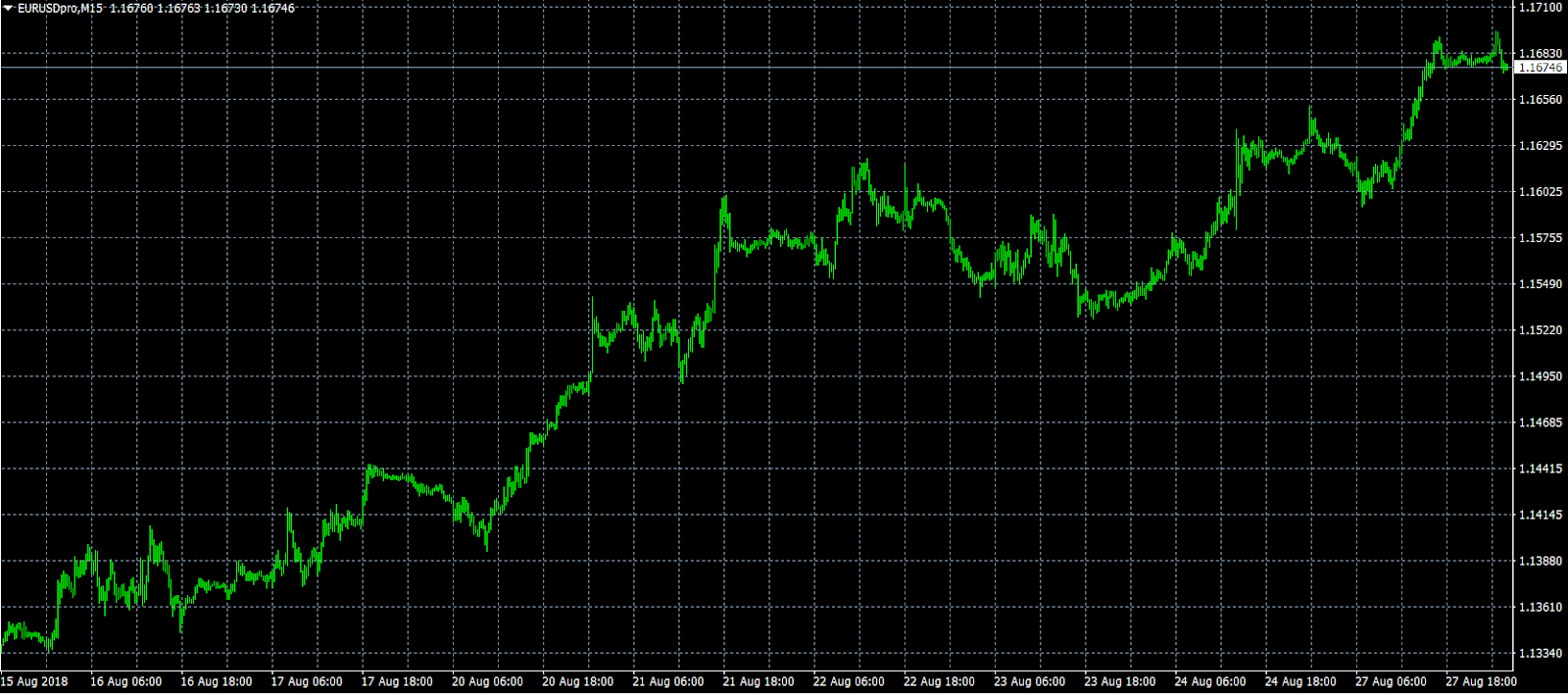
EUR/USD
Europe's common currency traded higher on Monday, as the dollar continued to backtrack against a basket of its rivals. The EUR/USD exchange rate has held most of its gains and now trades at 1.1675. At this level, the bulls are eyeing a test of the psychological 1.1700 region.
AUD/USD
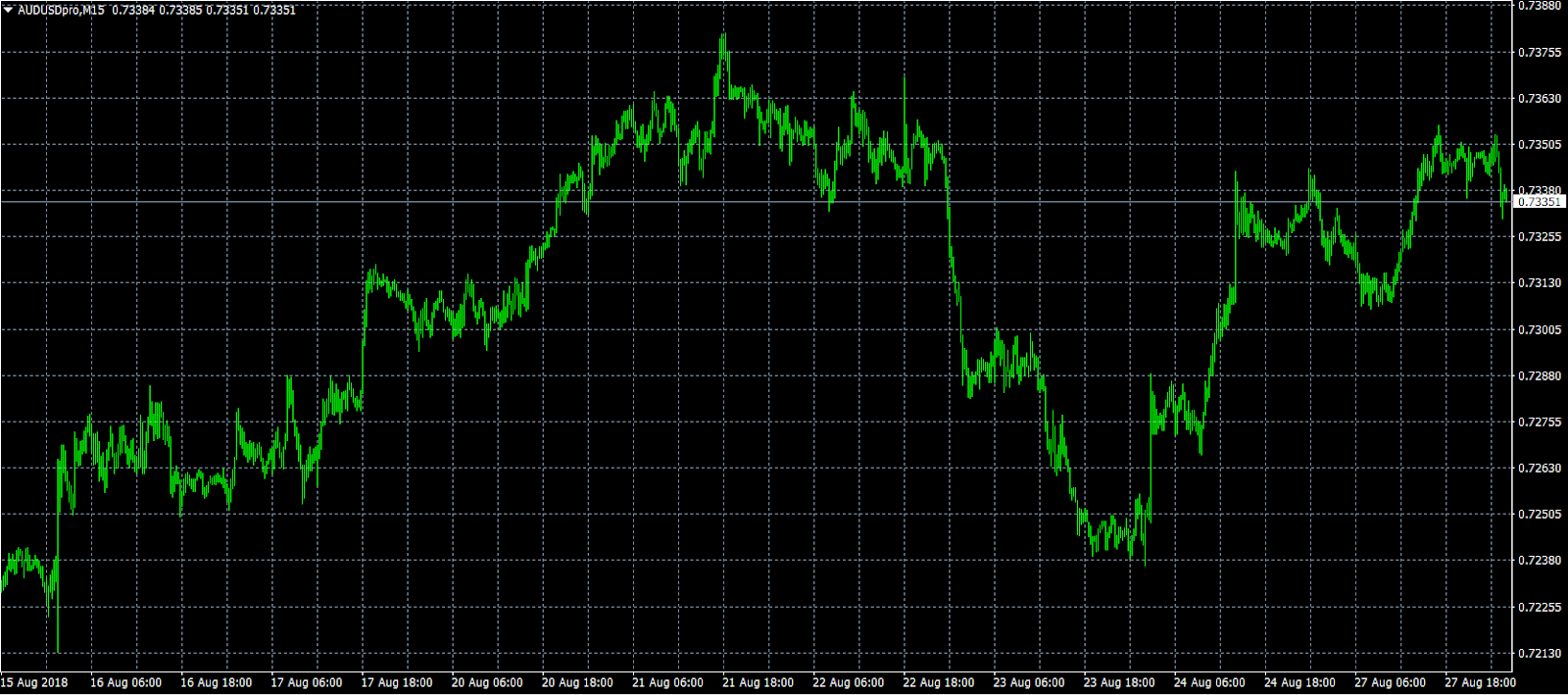
The Australian dollar regained momentum at the start of the week, as investors digested the latest political developments out of Canberra. The AUD/USD exchange rate currently resides at 0.7337 after multiple failed attempts to climb above 0.7350.
GBP/USD
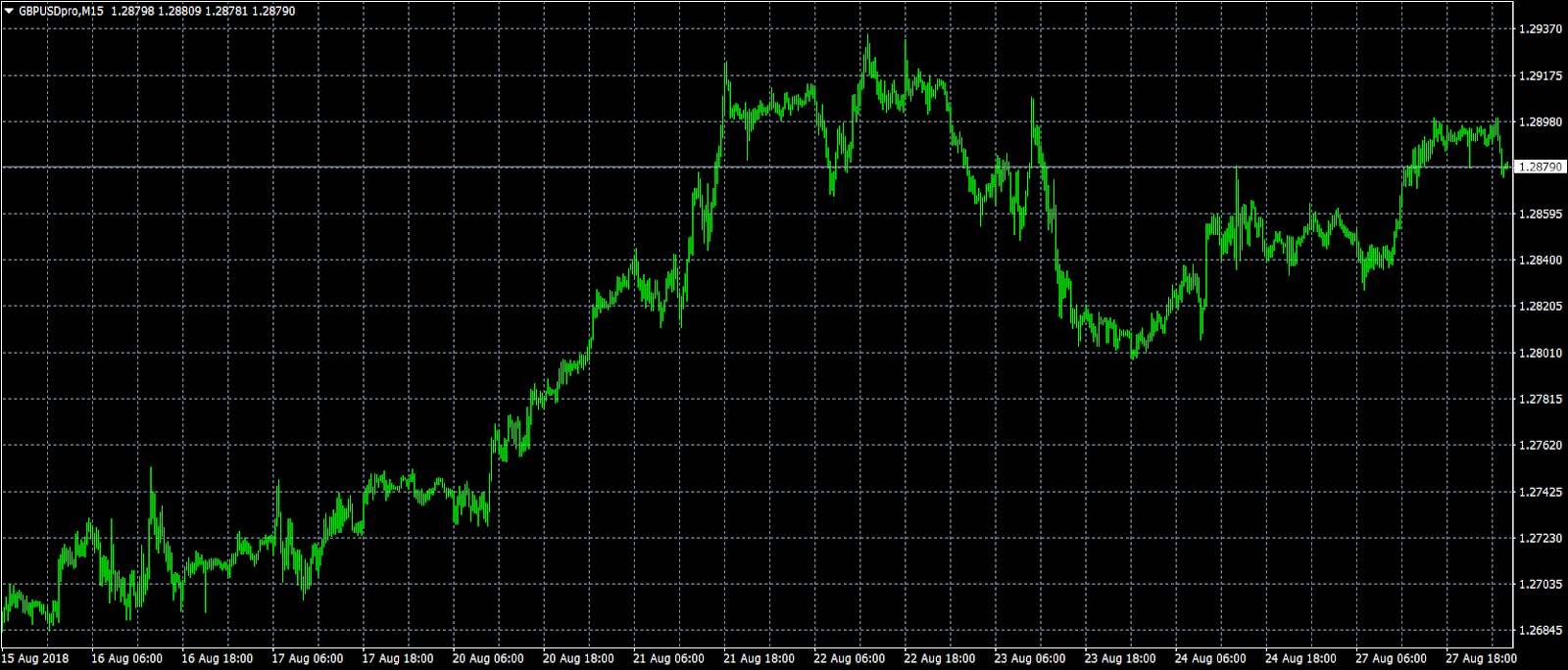
Cable's upward march continued Monday, as the pair edged closer to the all-important 1.2900 handle. At the time of writing, GBP/USD is currently trading at 1.2888 with the upside firmly intact. At current price levels, the bulls are eyeing a test of the 1.2950 region, which would expose higher highs near 1.3000.
GBP/JPY Daily Outlook
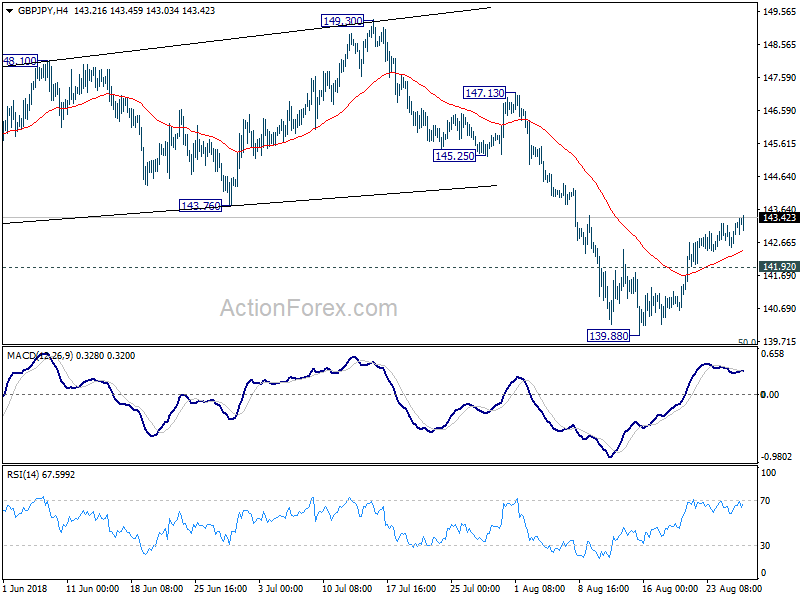
Daily Pivots: (S1) 142.74; (P) 143.01; (R1) 143.50; More...
GBP/JPY's rebound from 139.88 is still in progress for 55 day EMA (now at 144.68) even though upside momentum is diminishing. On the downside, however, below 141.92 minor support will indicate completion of the rebound. And larger down trend will likely resume for 139.29/47 key support zone instead.
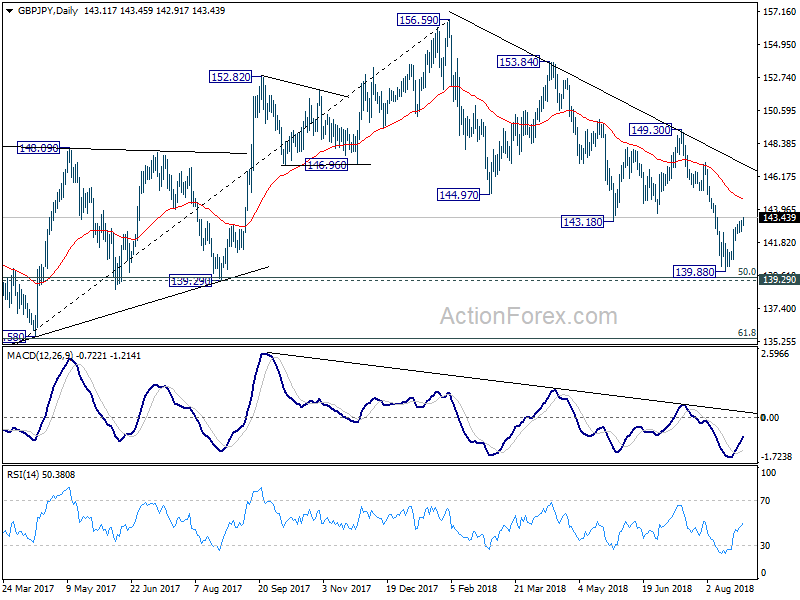
In the bigger picture, at this point decline from 156.59 is still seen as a corrective move. But the downside acceleration makes this view shaky. Focus will be on 139.29 cluster support (50% retracement of 122.36 to 156.59 at 139.47). Strong rebound from there will re-affirm the bullish case that rise from 122.36 is still to extend through 156.59 high. However, sustained break of 139.29/47 should confirm medium term reversal. GBP/JPY would then target a retest on 122.26 (2016 low).
EUR/JPY Daily Outlook
Daily Pivots: (S1) 129.06; (P) 129.45; (R1) 130.11; More....
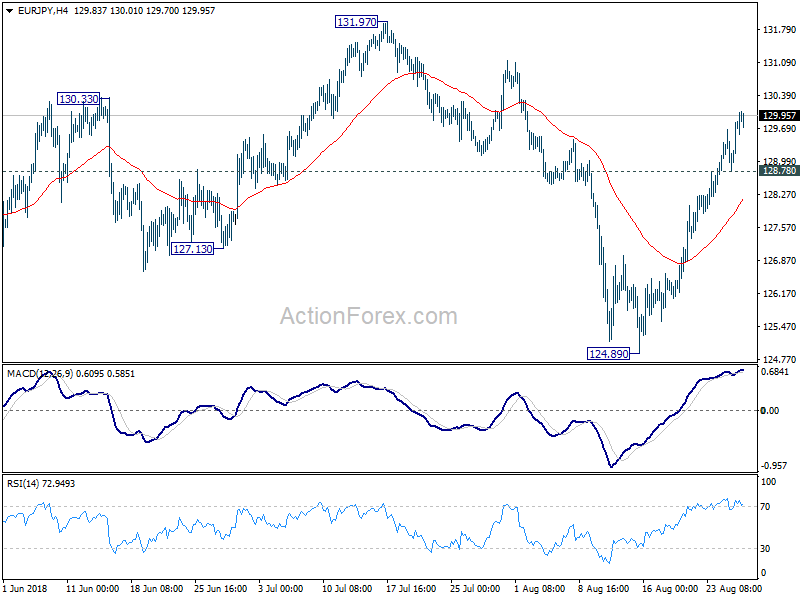
EUR/JPY's rally extends to as high as 130.04 so far and intraday bias stays on the upside. Current rally from 124.89 should target resistance zone between 131.97 and 61.8% retracement of 137.49 to 124.61 at 132.56. On the downside, below 128.78 minor support will turn intraday bias neutral and bring consolidations first.
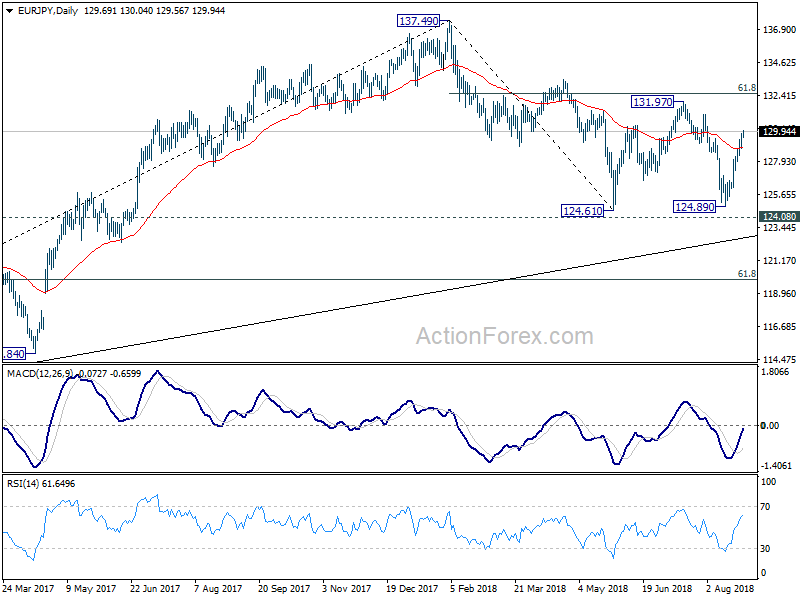
In the bigger picture, EUR/JPY once again rebounded ahead of 124.08 key resistance turned support. It's also held above long term trend line from 109.03 (2016 low). The development argues that such rise from 109.03 might now be over yet. Decisive break of 61.8% retracement of 137.49 to 124.61 at 132.56 will pave the way to retest 137.49 high. But, firm break of 124.08 will argue that whole rise from 109.03 (2016 low) has completed at 137.49. Deeper decline would be seen to 61.8% retracement of 109.03 to 137.49 at 119.90 next.
EUR/AUD Daily Outlook
Daily Pivots: (S1) 1.5854; (P) 1.5881; (R1) 1.5923; More....
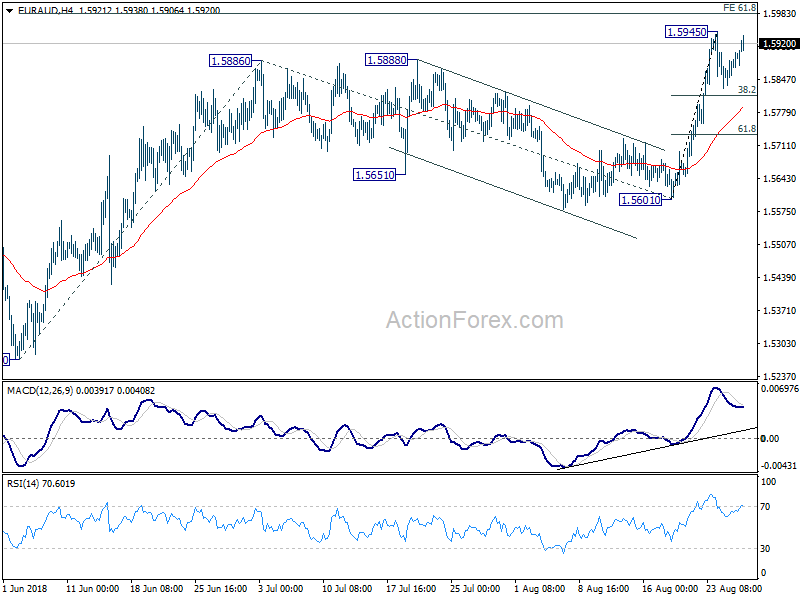
Intraday bias in EUR/AUD remains neutral as consolidation from 1.5945 temporary top is in progress. Another retreat could be seen but downside should be contained by 4 hour 55 EMA (now at 1.5791) to bring rise resumption. Above 1.5945 will target 61.8% projection of 1.5271 to 1.5886 from 1.5601 at 1.5981 first. Break will target 100% projection at 1.6216, which is close to 1.6189 high.
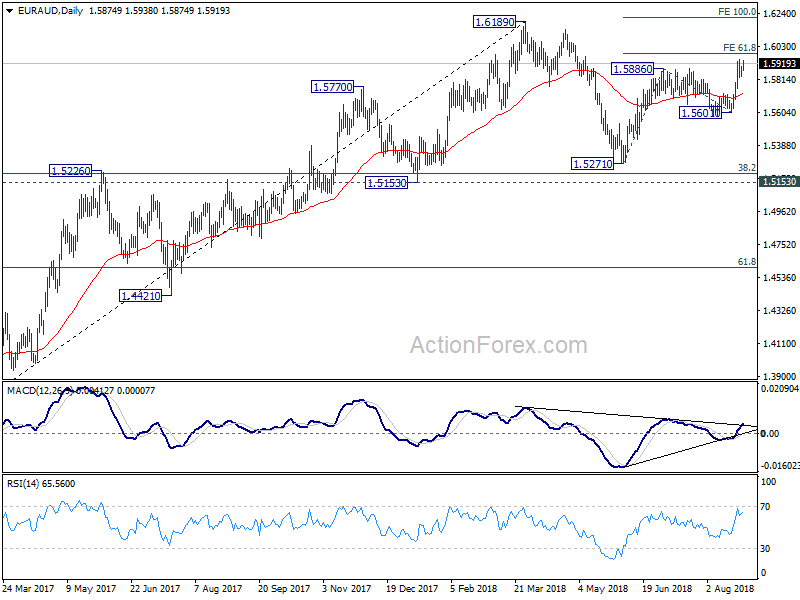
In the bigger picture, EUR/AUD drew strong support from 55 week EMA and rebounded. And the development argues that medium term rally from 1.3624 (2017 low) is still in progress. Firm break of 1.6189 will target a test on 1.6587 (2015 high). On the downside, break of 1.5601 support will now be the first sign of medium term reversal, and will bring a test on 1.5271 key support for confirmation.
EUR/GBP Daily Outlook
Daily Pivots: (S1) 0.9035; (P) 0.9051; (R1) 0.9074; More...
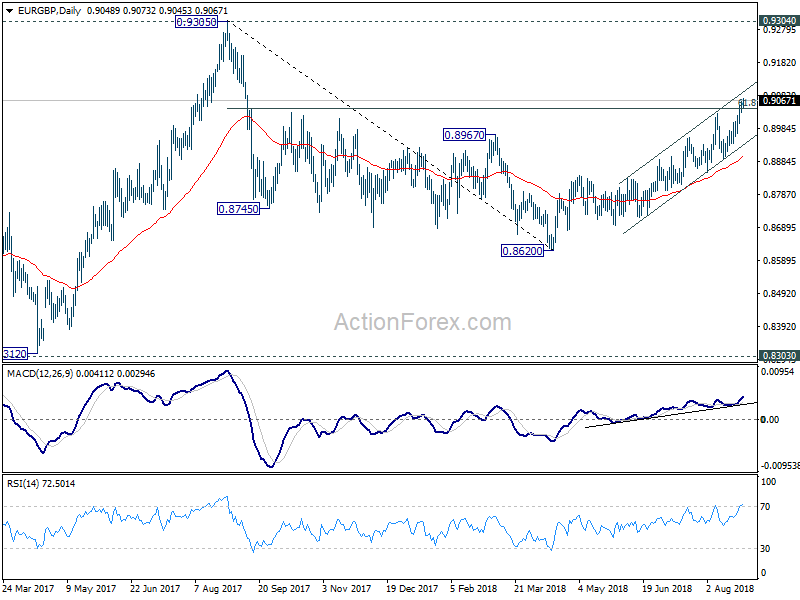
EUR/GBP's rally extends to as high as 0.9073 so far today. Intraday bias remains on the upside for the moment. Sustained trading above 61.8% retracement of 0.9305 to 0.8620 at 0.9043 will pave the way to retest 0.9305 key resistance. On the downside, below 0.9033 minor support will turn bias neutral and bring consolidations. But near term outlook will stay bullish as long as 0.8895 support holds.
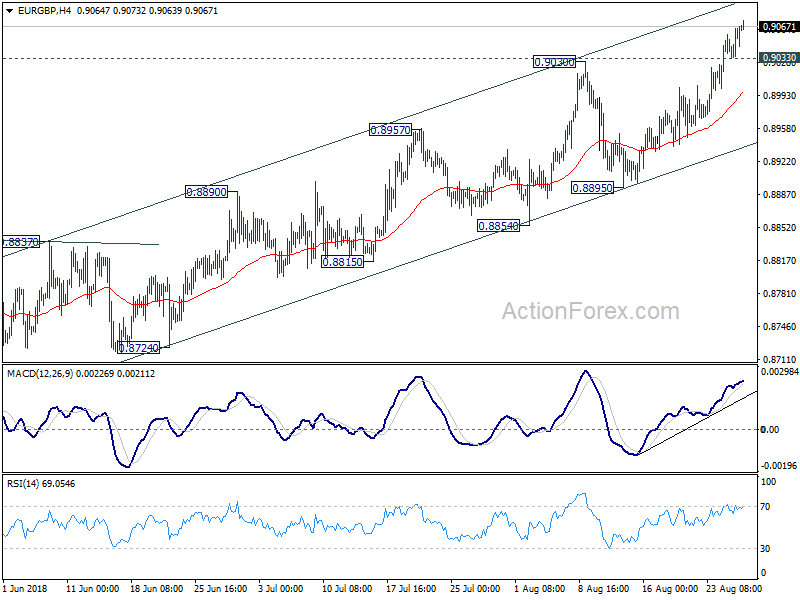
In the bigger picture, EUR/GBP is staying in long term range pattern from 0.9304 (2016 high). The corrective structure of the fall from 0.9305 to 0.8620 is raising the chance that rise from 0.8312 to 0.9305 is an impulsive move. But we're not too confident on it yet. In any case, we'd stay cautious on strong resistance from 0.9304/5 to limit upside in case of further rally. Meanwhile, if there is another medium term decline, strong support will likely be seen from 0.8303 to contain downside.
EUR/CHF Daily Outlook
Daily Pivots: (S1) 1.1417; (P) 1.1433; (R1) 1.1456; More...
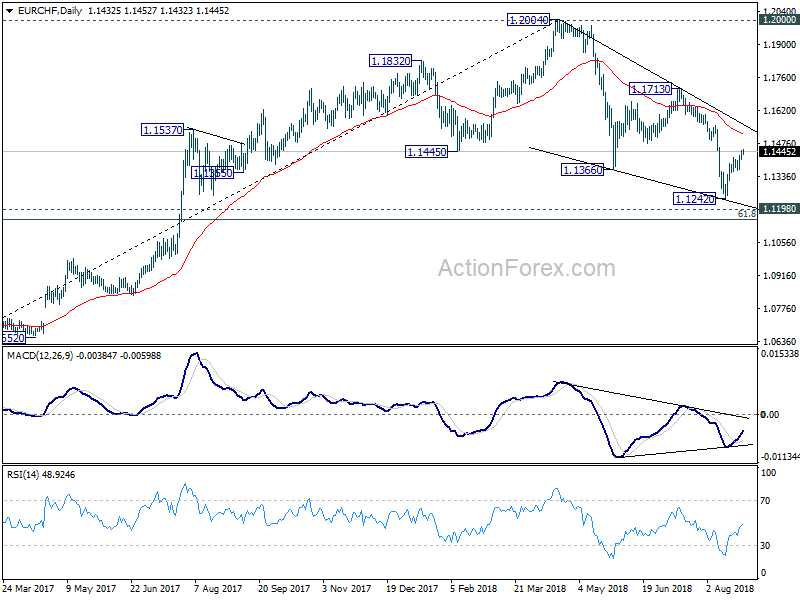
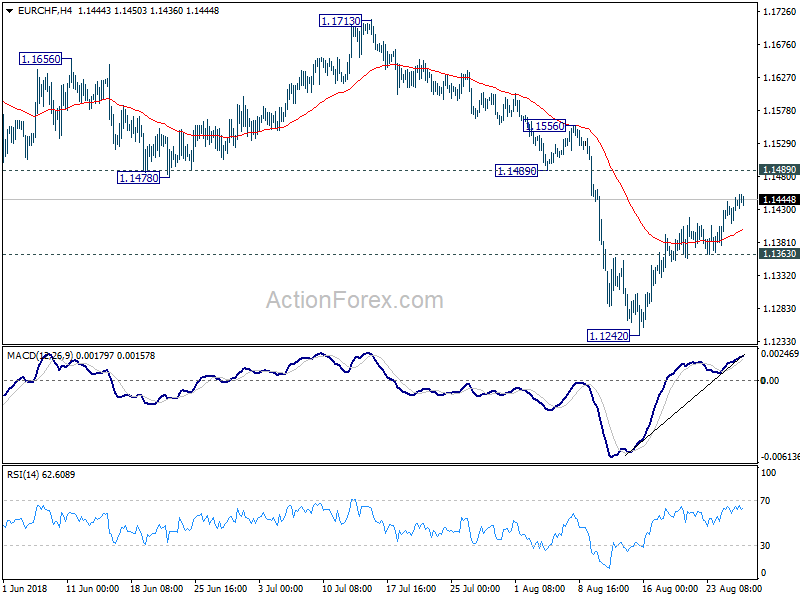
Intraday bias in EUR/CHF stays on the upside. Current rise from 1.1242 short term bottom is target 1.1489 support turned resistance first. Decisive break there will add to the case of trend reversal ahead of key support zone between 1.1154/98. Further rise should then be seen to 1.1713 resistance. On the downside, below 1.1329 minor support will turn bias to the downside for retesting 1.1242 low instead.
In the bigger picture, for now, the price actions from 1.2004 medium term top is seen as a correction only. Downside should be contained by 1.1198 (2016 high), 61.8% retracement of 1.0629 to 1.2004 at 1.1154 to complete it and bring rebound. This cluster level is in proximity to long term channel support (now at 1.1189) too. A break of 1.2 key resistance is still expected in the medium term long term. However, sustained break of the mentioned support zone will mark reversal of the long term trend.