

Sample Category Title
EU considering unscheduled summit in November to handle Brexit
UK Brexit Minister Dominic Raab is meeting with EU chief Brexit negotiator Michel Barnier in Brussels today. Reuters reported that the EU is definitely having a real push for concluding the negotiation by October 18-19 EU summit. But it's not optimistic base on current progress. In particular, there is no concrete proposal, from EU's point of view, that would work on the Irish border issue.
The next scheduled summit on December 13-14 is seen as too late by EU. That would leave too little time for ratification of an agreement before formal Brexit in March 2019. Also, that's too hard for businesses to start implementing contingency plans. Hence, an idea of a interim, unscheduled summit in November to handle the issue is floating around. It's seen as the last moment for the negotiations.
Into US session: Yen and Dollar Weak, Euro strong as German-Italian spread narrows
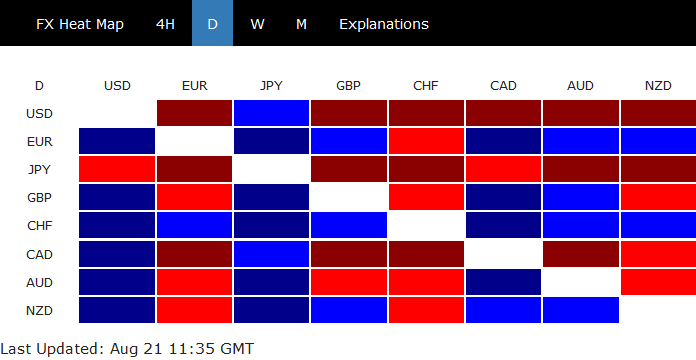
Entering into US session, Yen and Dollar remain the weakest ones in the currency markets. Selloff in the Dollar slows a little bit but there is no sign of bottoming yet. Swiss Franc is currently trading as the strongest one, followed by Euro. It seems Euro is rather troubled by Trump's wide of the mark accusation that it's manipulated. Though, it's also helped by narrowing German-Italian yield spread. Chinese delegation will arrive in Washington today to resume trade talks with the US tomorrow. But expectation on that is rather low.
 Instead, Dollar could look into Jackson Hole symposium for some inspirations to regain strengthened We find two areas where "expansive money" Fed chair Jerome Powell's comments might trigger volatility. That is, will there be early end of balance sheet reduction. And, will Fed return to pre-crisis channel system monetary policy? More in this report. Jackson Hole Symposium Preview: Two Questions on Fed's Monetary Policy.
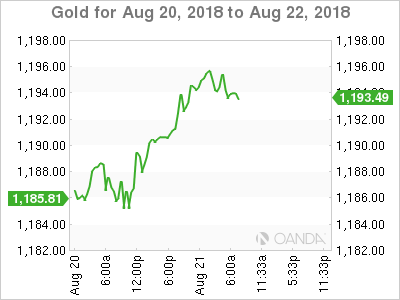
In other markets, Gold rides on Dollar selloff to as high as 1196.37 so far today. But as selling slows, there is not enough momentum to put it through 1200 yet. European stocks are mixed today, with FTSE trading down -0.12% at the time of writing. But CAC is up 0.74% and DAX is up 0.63%. Italian 10 year yield drops -0.097 to 2.939. German 10 year bund yield rose 0.020 to 0.326. German-Italian yield spread is narrowing back, which is a positive sign. Asian markets were generally positive today. Nikkei ended up 0.09%, Hong Kong HSI rose 0.56%, China Shanghai SSE gained 1.31%, Singapore Strait Times dropped -0.15%.
The economic calendar continues to be light today with Canada wholesale sales as the only feature in US session.
Dollar Index Under Pressure After Trump’s Fed Criticism
Here are the latest developments in global markets:
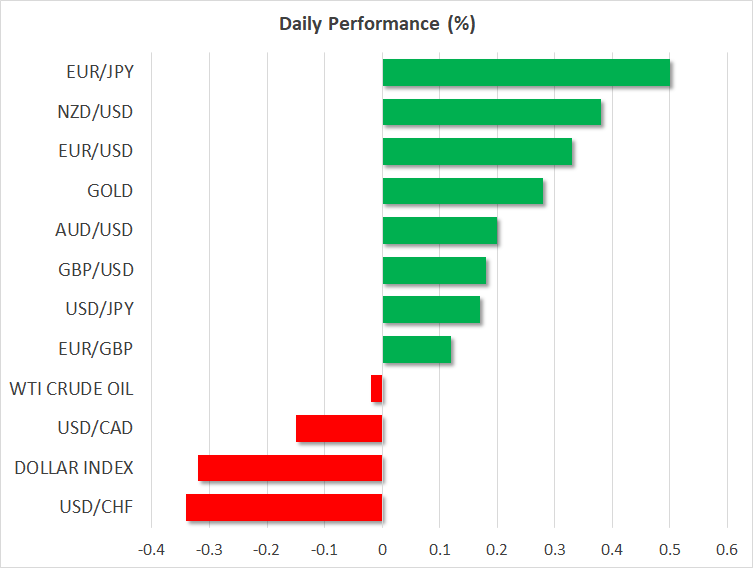
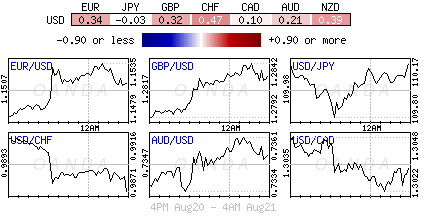
FOREX: The dollar index continued to trade lower early in the European session, weighed by comments made by the US President late on Tuesday who said that he is “not thrilled” about the central bank's decision to raise interest rates this year as his administration is making efforts to reduce trade deficit and higher interest rates combined with a stronger dollar would limit export growth. He also accused China and the Eurozone of manipulating their currencies; the response from the Chinese side was mild, with the PBOC expressing hopes the US and China could communicate on the issue and that the yuan will not be used as a weapon to mitigate the impact from import tariffs. German officials, though, supported that the bloc is not manipulating its currency. The dollar index hovered around 95.50 (-0.41%), near the two-week low of 95.44 it reached earlier today, whereas dollar/yen managed to remain in the green, inching up to 110.24 (+0.16%). Euro/dollar held onto gains, changing hands at 1.1515, slightly below today's two-week high of 1.1543 (+0.40%). Pound/dollar was also in bullish mode at 1.2815 (+0.15%) ahead of the resumption of Brexit talks today. Euro/pound stood at 0.8982 (+0.13%). In Switzerland, the Swiss National Bank was said to deliver its first rate hike in Q3 2019 according to a Bloomberg survey compared to Q4 2019 estimated previously, sending dollar/franc down to a one-month low of 0.9864. In the antipodean space, aussie/dollar remained on the upside at 0.7352 (+0.20%), shrugging off Prime Minister's narrower than anticipated leadership win and the relatively dovish RBA meeting minutes released earlier in the day. Kiwi/dollar was also stronger at 0.6663 (+0.38%) before the release of global dairy prices. Dollar/loonie was down at 1.3028 (-0.15%), while dollar/lira strengthened further to 6.12 (+0.85%).
STOCKS: Excluding the UK's FTSE 100 which was weaker by 0.17%, European stocks were rising at 1040 GMT. The pan-European STOXX 600 and the blue-chip Euro STOXX 50 were up by 0.34% and 0.31% respectively, with technology stocks leading the gains and basic materials underperforming. The German DAX 30 climbed by 0.72%, the French CAC 40 rose by 0.79%, while the Italian FTSE MIB continued to recover on Tuesday, surging by 1.47%; on Friday, the index dropped to the lowest since April 2017. US futures tracking the S&P 500, Dow Jones and Nasdaq 100 were all in positive territory, pointing to a higher open today.
COMMODITIES: Oil prices were on the rise early in the European session, with WTI crude crawling up to $66.98/barrel (+0.83%) and Brent moving up to $72.36/barrel (+0.21%), as reports stated that US supplies of heating oil and diesel are expected to tighten in the coming months. In other news, while renewed US sanctions against Iran (the third largest OPEC producer) and demands from Washington for Iranian oil buyers to cut their imports have already slashed operations in the region, China (Iran's biggest oil customer) insists on maintaining its Iranian oil purchases. In precious metals, gold was looking set to close the day in positive territory for the third consecutive day, last seen at $1,1193.80/ounce (+0.31%).
Day Ahead: US-China talks and Brexit negotiations eyed
Tuesday is relatively quiet in terms of economic releases, leaving potential trade headlines to move the markets as trade discussions between the US and China are expected to take place in Washington on Wednesday and Thursday.
The Turkish-related turmoil will remain in focus as Trump mentioned that the US will not make any concessions to Turkey in order to secure the freedom of the detained pastor, which suggests that an immediate resolution of the stand-off between the two nations may be distant.
As for Brexit, the UK's negotiator Dominic Raab will be meeting with his EU counterpart Michel Barnier in Brussels. Meanwhile, UK ministers are unveiling their plans for a no-deal Brexit to show Britain is prepared in case talks collapse with no agreement. It is worth mentioning that the deadline for an agreement is in October and a lack of positive developments could be perceived as negative for the currency.
Looking at the calendar, Canadian wholesale trade data for the month of June are scheduled for release at 1230 GMT. Also, in New Zealand, global dairy prices published at a tentative time today after the conclusion of the bi-weekly milk auction will be of most importance before retail sales figures come into view at 2245 GMT. Quarter-on-quarter, retail sales are forecasted to expand by 0.4% for the second quarter, above the 0.1% growth recorded previously.
In energy markets, investors will look forward to the API weekly report due

USD/CAD – Canadian Dollar Gains Continue, Wholesales Sales Next
The Canadian dollar has posted small gains in the Tuesday session, continuing the trend seen on Monday. Currently, USD/CAD is trading at 1.3023, down 0.16% on the day. In economic news, Canada releases Wholesale Sales. There are no U.S events on the schedule. On Wednesday, Canada releases retail sales reports, while the U.S will publish Existing Home Sales. As well, the U.S releases Existing Homes and the Federal Reserve will publish the minutes of the July policy meeting.
Will USD/CAD drop below the symbolic 1.30 level? The Canadian dollar has been moving higher since Friday and could drop below 1.30 this week, for the first time since August 7. It’s been a rough August for the Canadian dollar, as the escalating trade war has dampened risk appetite and hurt the Canadian dollar, which is a minor currency. However, the announcement that the U.S and China will hold trade talks in Washington later this week have raised investor confidence and boosted the Canadian currency. If the talks show signs of progress, such as the suspension of a $16 billion tariff scheduled to take effect on August 23, then the Canadian dollar rally could continue.
The Canadian dollar ended the week with strong gains, climbing 0.7 percent. The boost to the currency came from a strong CPI report, which showed a gain of 0.5%. This easily beat the estimate of 0.1% and marked a 5-month high. On an annualized basis, CPI jumped 3.0%, its highest level since 2011. The strong inflation report has raised expectations that the Bank of Canada will raise rates at the September meeting. The likelihood of a quarter-rate hike next month is only 33%, but this rises to 75% for an October hike, if the BoC stays on the sideline next month.
GBPUSD Supported By Bullish Macd
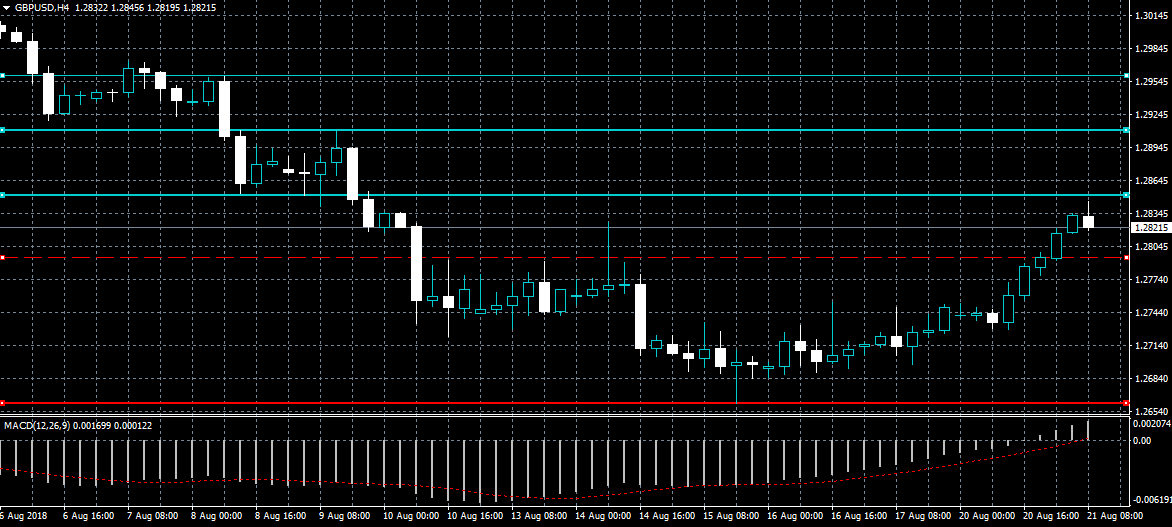
The British pound trades above the 1.2800 level against the US dollar on Tuesday, after the greenback weakened following dovish comments from US President Donald Trump. The GBPUSD pair retains a bullish intraday bias while trading above the 1.2775 level. It is also worth noting that the MACD indicator has now turned bullish across the four-hour time frame, supporting further upside in the GBPUSD pair.
The GBPUSD pair is intraday bullish while trading above the 1.2775 level, key resistance is now found at the 1.2850 and 1.2910 levels.
If the GBPUSD pair trades below the 1.2775 level, key support is found at the 1.2744 and 1.2722 levels.
EURUSD Holds Key Intraday Support
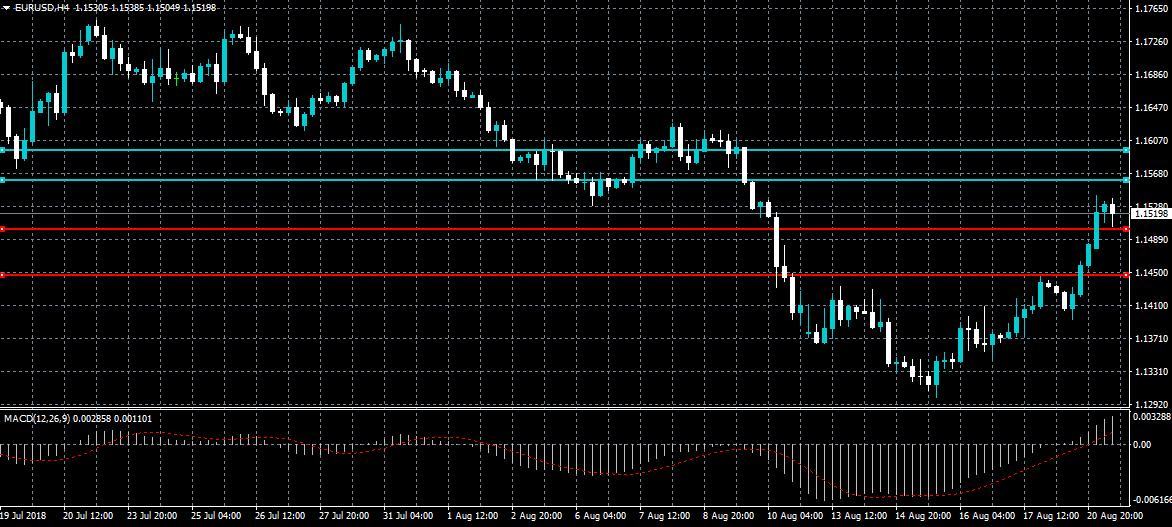
The euro retains its strong intraday bullish bias against the US dollar after buyers earlier defended the key 1.1507 support level. Dip-buying has been prevalent in the EURUSD pair since Friday, and we are now seeing price-action starting to support short-term euro buying. Traders will now look towards the 1.1553 resistance level, with daily time frame price closes above this key technical area critical for further bullish advancement.
The EURUSD pair is strongly bullish while trading above the 1.1507 level, key resistance remains at the 1.1553 and 1.1600 levels.
If we see the EURUSD pair fall below the 1.1507 support level, a strong corrective move towards the 1.1480 and 1.1445 support levels seems the most likely scenario.
RBA Too Early to be Confident over Consumer Spending
The RBA minutes of the August meeting contained little news, in particular after release of the quarterly Statement of Monetary Policy two weeks ago and Governor Philip Lowe’s parliamentary testimony last week. The minutes reiterated confidence over domestic economic development, hinging on the robust employment market. We also notice that the minutes revealed the members optimism over the consumer market. We wonder if the surprising decline in consumer sentiment would affect the members’ view at the upcoming meeting. Echoing the policy statement, the members acknowledged soft wage growth but remained hopeful that it has been troughed. RBA expected that household consumption should improve as wage growth gathered momentum.
As suggested in the minutes, the second quarter retail sales affirmed “steady growth” in consumption, as supported by “growth in labour income”. Policymakers indicated that the data released between the July and August meetings, together with the more recent increase in minimum wages, the announcement of future tax cuts and expectations of a further tightening in labour market conditions, had “reduced some of the uncertainty around the outlook for consumption”.
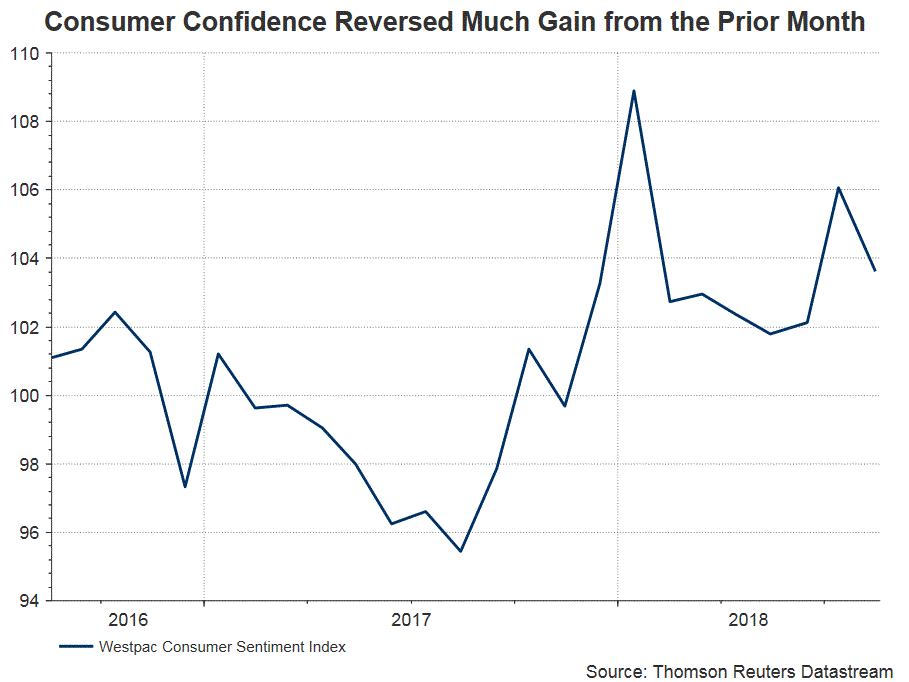
The latest surveys on consumer confidence have shown some worries, though. Last week’s consumer sentiment, by Australia Westpac Melbourne Institute, fell -2.3% to 103.6 in August, reversing half of the “surprisingly strong gains in June to July” as the impact of government’s tax cuts faded. The decline also came against the backdrop of rising global trade tension and housing markets correction in Sydney and Melbourne.
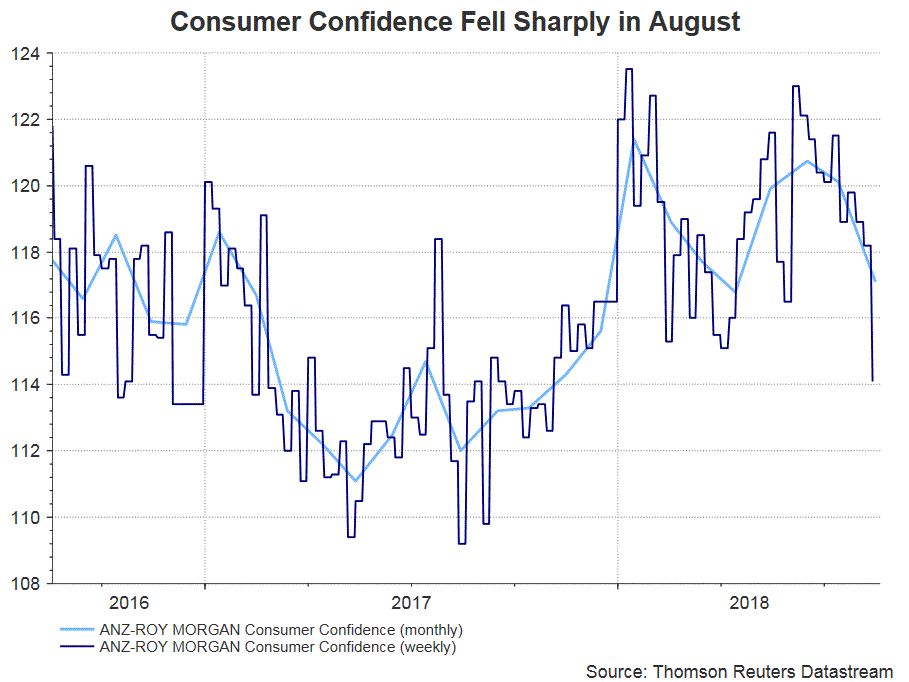
Meanwhile, the ANZ-Roy Morgan weekly consumer confidence plunged to 114.1, lowest reading recorded so far for the year, in the week ended August18/19, from 118.2 a month ago. Looking into details, consumer’s lost confidence in all aspects surveyed, with sharp decline in particular in future financial and economic conditions.
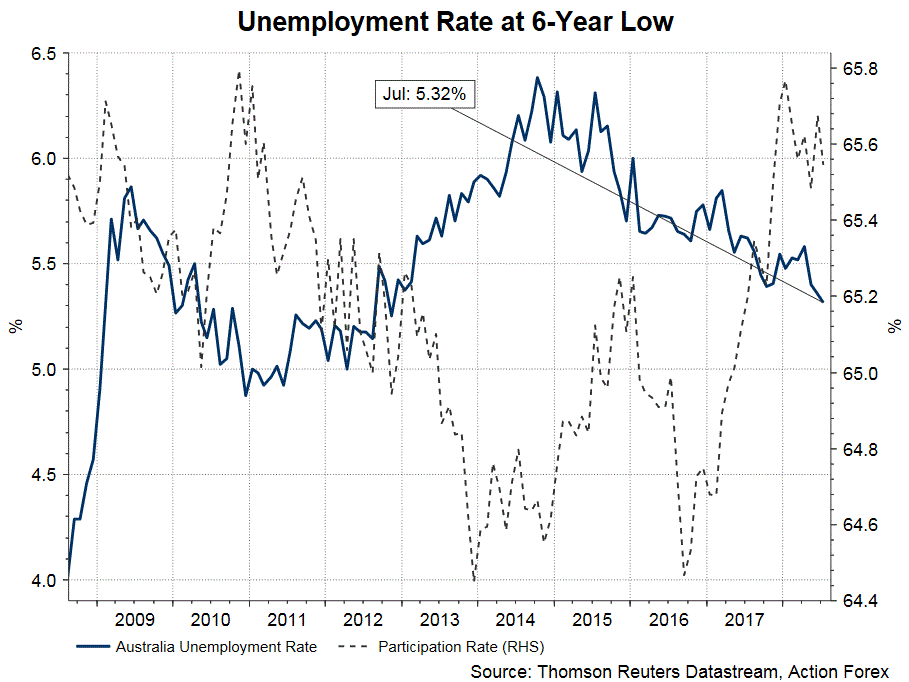
The July employment report released last week generally confirmed the strong job market. Unemployment rate slipped -0.1 percentage point to 5.3% in July as participation rate edged lower to 65.5%.
However, the number of employment surprisingly contracted -3.9K last month, compared with consensus of a +15K increase and June’s 50.9K addition. Full time jobs rose +19.3K, more than halved July’s increase of +41.2K.
Wage growth remained low, climbing +0.6% q/q, and +2.1% y/y, in 2Q18. The third quarter data might be boosted by an increase in minimum wage which took effect on July 1.
Aussie’s reaction was rather muted after the minutes. The minutes should not change market expectations that the next rate hike would come in 2H19 the earliest.
Market Spooked On Trump’s U.S Dollar Comments
Tuesday August 21: Five things the markets are talking about
The 'big' dollar has dropped for a fourth consecutive session, along with U.S Treasuries after President Trump criticized his own appointed Fed Chairman's interest-rate hikes.
Trump said he is not “thrilled” with the Fed raising interest rates, suggesting that U.S policy makers take a break from policy normalization while he carries out his protectionist policies.
The unconventional President has taken a swipe at U.S dollar bulls that have built up 'long' rate differential and risk aversion summer positions. Would his administration even go down the route of outright currency intervention? Or is Trump just limited to verbal comments?
Market focus now shifts to tomorrow's Fed meeting minutes and this week's Jackson Hole symposium for clues on U.S monetary policy, and for any response from Powell to Trump's comments.
1. Global stocks find support
Most stocks in Asia gained after U.S equities flirted with record highs yesterday, though European shares are little changed ahead of the U.S open.
In Japan, the Nikkei edged a tad higher overnight (+0.1%) after a weakening of the yen (¥110.24) prompted futures purchases, but mobile phone stocks plummeted on reports that a Japanese official said that the industry needs reform. However, the broader Topix lost -0.4%.
Down-under, Aussie shares slid overnight, as investors took note of failed attempts to topple PM Turnbull and top miner BHP missing annual earnings expectations. The benchmark S&P/ASX 200 index lost -1% after rallying +0.1% on Monday. In S. Korea, the Kospi (+0.99%) stock index closed higher on hopes that Sino/U.S talks would thaw a potential trade war.
In Hong Kong, stocks found support as the yuan stabilized and as investors expect Beijing to further relax its policies to counter the impact of trade frictions. The Hang Seng index rallied +0.6%, while the China Enterprises Index gained +1.0%.
In China, equities have extended their gains, led by technology, consumer and financial stocks, as risk appetite improved on signs the government will relax monetary and fiscal policies. The blue-chip CSI300 index ended +1.8% higher, while the Shanghai Composite Index closed up +1.3%.
In Europe, regional bourses are trading higher, following their Asian counterparts.
U.S stocks are set to open in the ”black' (+0.1%).
Indices: Stoxx600 +0.2% at 383.9, FTSE 0.0% at 7590, DAX +0.6% at 12388, CAC-40 +0.5% at 5406, IBEX-35 +0.6% at 9526, FTSE MIB +1.0% at 20687, SMI +0.2% at 9074 S&P 500 Futures +0.1%
2. Oil firm on tighter U.S outlook, gold higher
Oil prices trade firm stateside, with U.S fuel markets seen to be tightening, although the release of crude from the American strategic reserves is offsetting an expected supply cut due to upcoming sanctions against Iran.
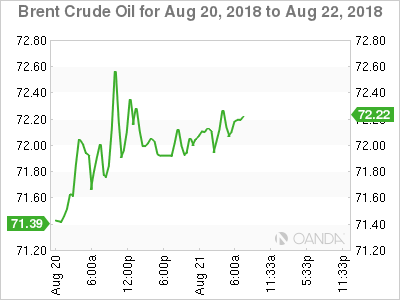
Brent crude oil futures are down -9c, at +$72.12 a barrel, while U.S West Texas Intermediate (WTI) crude futures are up +30c, or +0.45%, at +$66.73 per barrel.
Note: Inventories in U.S for refined products – diesel and heating oil – are at their lowest in four-years.
Washington yesterday offered +11M barrels of crude from its Strategic Petroleum Reserve (SPR) for delivery from Oct. 1 to Nov. 30. The market expects the released oil may offset expected supply shortfalls from U.S sanctions against Iran.
However, on the flip side, the overall market sentiment remains cautious because of concerns over the demand outlook amid the Sino-U.S trade dispute.
Ahead of the U.S open, gold prices have climbed to a one-week high on the back of a weaker dollar. Spot gold has rallied +0.4% to +$1,194.81 an ounce, the highest level since Aug. 14. U.S gold futures have climbed +0.5% to +$1,200.60 an ounce.
3. Yields – impact of Trump's comments remain unclear
Given that the Fed is an independent institution, explicit comments about interest rates from a sitting President could just as easily have the opposite effect.
Trump wants lower rates and a weaker U.S dollar, however, Fed Chair Powell maybe more inclined to 'normalize' rate policy to defend their credibility – the Fed has raised interest rates twice this year and has penciled in two-more +25 bps increases in 2018 and three-more in 2019.
Note: The market will be watching for tomorrow's FOMC minutes and as well as the annual Jackson Hole symposium of global central banks for 'yield' guidance.
The yield on 10-year Treasuries have rallied +1 bps to +2.83%, the biggest advance in a week, while the yield on two-year notes has gained +2 bps to +2.60%, also the largest advance in a week. In Germany, the 10-year Bund yield has backed up +1 bps to +0.31%, while in the U.K the 10-year Gilt yield has increased +1 bps to +1.223%.

4. Dollar under pressure from Trump remarks
The 'mighty' U.S dollar remains on soft ground after President Trump again complained about the job Fed Chair Powell was doing and believed that the Fed should be more accommodating to his policies. In an interview yesterday, Trump also reiterated his view that both China and Europe were manipulating their 'respective' currencies.
EUR/USD (€1.1519) is holding above the key €1.15 level – the techies will monitor today's daily close level to gauge whether a reversal is possible for the 'bearish' EUR trend since the break occurred last week.
GBP/USD (£1.2820) is higher by +0.2% as Brexit negotiations resumed. U.K officials continue to remain optimistic that an agreement with the E.U can be achieved. An opinium poll for the Observer newspaper has found that +40% now believe it is most likely that the U.K will leave in next March without a deal – up sharply from +31% last month. One in five (+22%) think Britain will leave with a deal, while +16% thinks Britain will not leave the E.U in March.
USD/JPY (¥110.26) traded below ¥110 for the first time since late June amid broad USD weakness, but has since moved off its worst levels as the European session progressed.
The Chinese yuan has rallied +0.25% to ¥6.839, pulling further away from ¥6.934, its weakest since January 2017 marked last week.

5. RBA has greater confidence in Aussie consumers
The Reserve Bank of Australia (RBA) agreed the next move in the cash rate would more likely be an increase in yesterday's minutes from the Aug. 7 policy meeting.
Aussie policy makers stressed that keeping rates at +1.50% would “help reduce the jobless rate and lift wage growth over time.”
Members assessed it would be appropriate to hold the cash rate steady and for the Bank to be a source of “stability and confidence” while this progress unfolds.
Note: Political instability remains an issue, despite Aussie PM Turnbull winning a leadership vote for the ruling Liberal Party by a vote of 48 to 35.
The RBA generally sounded more upbeat about the economy, citing recent strength in the labor market and strong business confidence.
EUR/USD – Euro Gains Ground, Investors Eye Fed Minutes
EUR/USD has posted gains in the Tuesday session. Currently, the pair is trading at 1.1515, up 0.29% on the day. There are no eurozone or U.S events on the schedule. On Wednesday, the U.S releases Existing Homes and the Federal Reserve will publish the minutes of the July policy meeting.
The euro has declined more than 2% in August, but is enjoying a mini-rally. EUR/USD has posted gains over four straight days, as the strong U.S dollar has given up some ground to its major rivals. The euro has pushed above the 1.15 line on Tuesday, for the first time since August 10. Investor risk appetite is higher, on the news that the U.S and China are holding trade talks later in the week. The U.S is unhappy with the Chinese protection of local markets and technology transfers required in order for U.S businesses to operate in China, but it’s questionable if the Chinese will show much flexibility. Both sides have slapped tariffs of $34 billion on each other’s products, with another $16 billion in tariffs scheduled for August 23. If the negotiations lead to the suspension of the upcoming tariffs, risk appetite would rise and the euro could gain ground. However, the talks involve low-level officials, so the meetings are unlikely to result in a breakthrough in the US-China trade spat.
US Futures Trading Higher – Thanks Trump | Gold Above 1,200K, Will It last?
- Trump isn't happy about the interest rate in the US
- Fed may be controlled by the US goverment
- Gold moved higher on the back of weaker dollar
US futures are trading mostly higher and investors ready to build on the gains. The reason behind that is the optimism around the US and China trade deal. However, before we get into that, it is important to talk about the key issue which many traders are paying close attention to. The Fed has increased interest rate a few times this year already and this has fuelled the dollar rally. The president of the United States isn't too happy about it, he has said that he will continue to show his discomfort as long as the Fed will continue to increase the interest rate. This means that investors are going to remain more on the edge because Trump's discomfort mean that anything can happen.
His track record shows that he will do anything to get things done his way and that could possibly mean changing the chairman of the Fed. Yes, for now, this looks very stretched idea and doesn't seem like that this will happen because Mr Trump was the one who appointed the Fed chairman. A change at this level would mean change in the Fed monetary policy and this is something which the market isn't prepared for at all.
Back on Wall street, risk appetite is back with vengeance and investors pushed the stock market to a new record. Investors over in Asia would likely to build on this momentum. Investors are confident that trade war, an issue which has jolted the markets several time, will not derail the rally.
Trump's comment on the fed policy has done a big favour for the gold bulls. Traders are uncertain about the dollar rally and this has restored the gold rally- for now. Central banks are suppose to be free and should be allowed to tackle the handle policy according to the economic data. Turkey's currency was battered because there were serious concerns that the central bank will not have any independence. And now, over in America, we have Trump who is unleased with the higher interest rate. But overall, we still think that there is nothing to be really excited about the gold move because the upward move is still not powerful. Having said if we close and remain above the 1200, then we have assurance that the current pull back in the price is over.