

Sample Category Title
Understanding Risk:Reward For Real Success
Learn From The Best
First entry into any new endeavour is fraught with challenges and in the pursuit of excellence, the experience is a priceless asset. New traders can, however, expedite their learning process by avoiding the typical mistakes that rookies make and instead listening to and learning from the wisdom of those who have already achieved success. Among the key tenets set out by the trading elders, one particular aspect stands out as being a vital element in trading success, one which if understood and utilised early on, really can help traders advance far quicker than their peers.
So, which “golden rule” are we talking about here?
Risk vs. Reward
To any traders who have been in the game for a while, they will, of course, understand immediately what this refers to but for new traders, this can often be a notion that needs a proper introduction.
The essential thinking behind this premise is that to achieve real and sustainable success in trading; a trader must always stand to make more on a winning trade than they risk. The golden numbers here are 2 x risk and 3 x risk. Meaning that if a trader generally makes at least 2 – 3 x more than they risk, they stand a high chance of being successful.
The reason for this might be quite clear, but many new traders still struggle with this notion and end up getting involved in the sub-par trade, from a risk: reward perspective, which sees them merely spinning their wheels by going through winning streaks only to give it all back during the drawdown.
If a trader’s profit target is only ever equal to the amount they risk, then in order to be successful that trader must always trade with a hit rate of more than 50%. If this hit rate isn’t sustained, the trader will fail.
(most successful pro traders have a hit rate of between 30% – 50%)
Conversely, if a trader trades with a profit target of at least three times his risk then in order to be successful, then that trader needs only achieve a 30% win rate. This dramatically lowers the barrier to achieving success in trading and means that during winning streaks of up to 70% win rate the trader will experience outsized gains but most importantly, will limit his losses during drawdown and be able to quickly recoup them with winning trades.
R:R Cheat Sheet
Here is a quick summary to give you an idea of the way your R:R affects your need to maintain a certain win rate.
| R:R | Minimum Win Rate for Profitability |
| 3:1 | 30% |
| 2:1 | 40% |
| 1:1 | 51% |
| 1:2 | 70% |
Understanding the true function of risk vs. reward protects against falling into the trap which so many traders fall foul of which is focusing on win rate instead of risk reward. Many new traders feel that to make money and be successful in trading they need to be winning all the time even if it means banking only 1 x risk and in even worse cases banking less than they risk.
It is not uncommon for traders at some point to try out what is referred to as inverted risk reward whereby, for example, a trader risks 100 pips to make 25. The premise behind this domed method is that such a small profit target greatly increases the chances of hitting it, and a stop so wide lessens the chances of being stopped before the target is hit. However, the issue here is that for every four winning trades, 1 loser will erase those gains meaning that the trader needs to trade with a minimum 90% hit rate to remain profitable.
So, when trading makes sure that you always win more than you risk and look to achieved a solid multiple such as 2 x risk or 3 x risk.
Sounds simple?
The problem, however, is that simply attaching an arbitrary risk:reward ratio to your trading means nothing. If you get into a trade and say that you won’t exit until you’ve hit 3 x risk you might be damaging yourself because perhaps your trades never make it that far and always come back on. However, what if analysis of your trading showed that at least 40% of your trades reached 2 s risk? Then you could look to make that your profit target, knowing that you stand a decent chance of reaching that level and again ensuring that your trading is profitable.
To properly identify a correct risk reward ratio means studying your strategy and your results to properly understand your trade expectancy. This requires either studying a strategy backtest and identifying these parameters or analysing live data to determine these results.
Each Trade Is Not Equal
It also means being conscientious with your trading and learning to “sit on your hands” and avoid trades which don’t have favourable conditions to offer you the necessary risk reward.
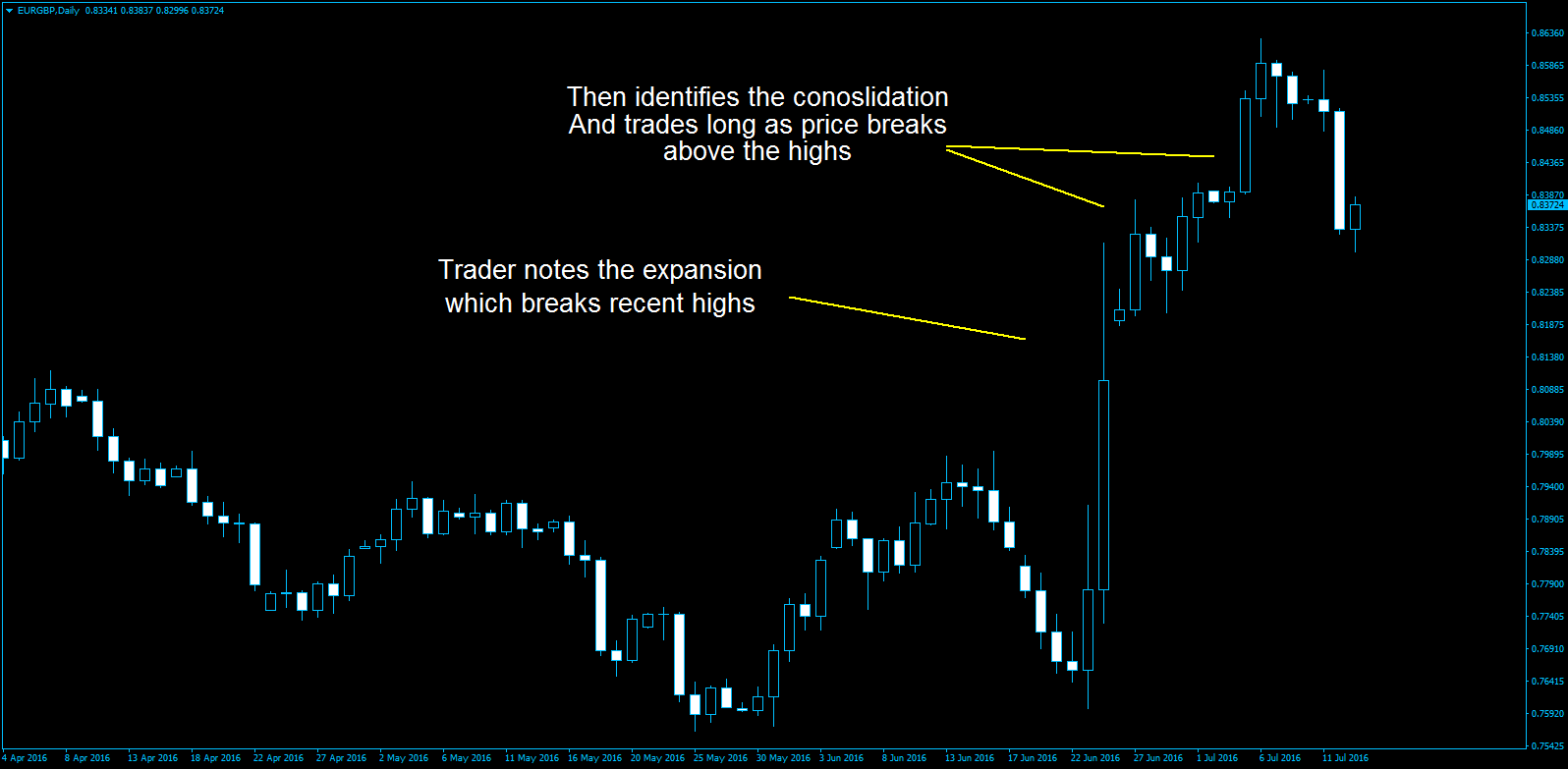
For example, in the above chart, the trade would have identified the breakout move above recent highs, then waited for a brief period of consolidation before trading long on the break above new highs. With this trade, they would have been aiming for a minimum 2 x risk.
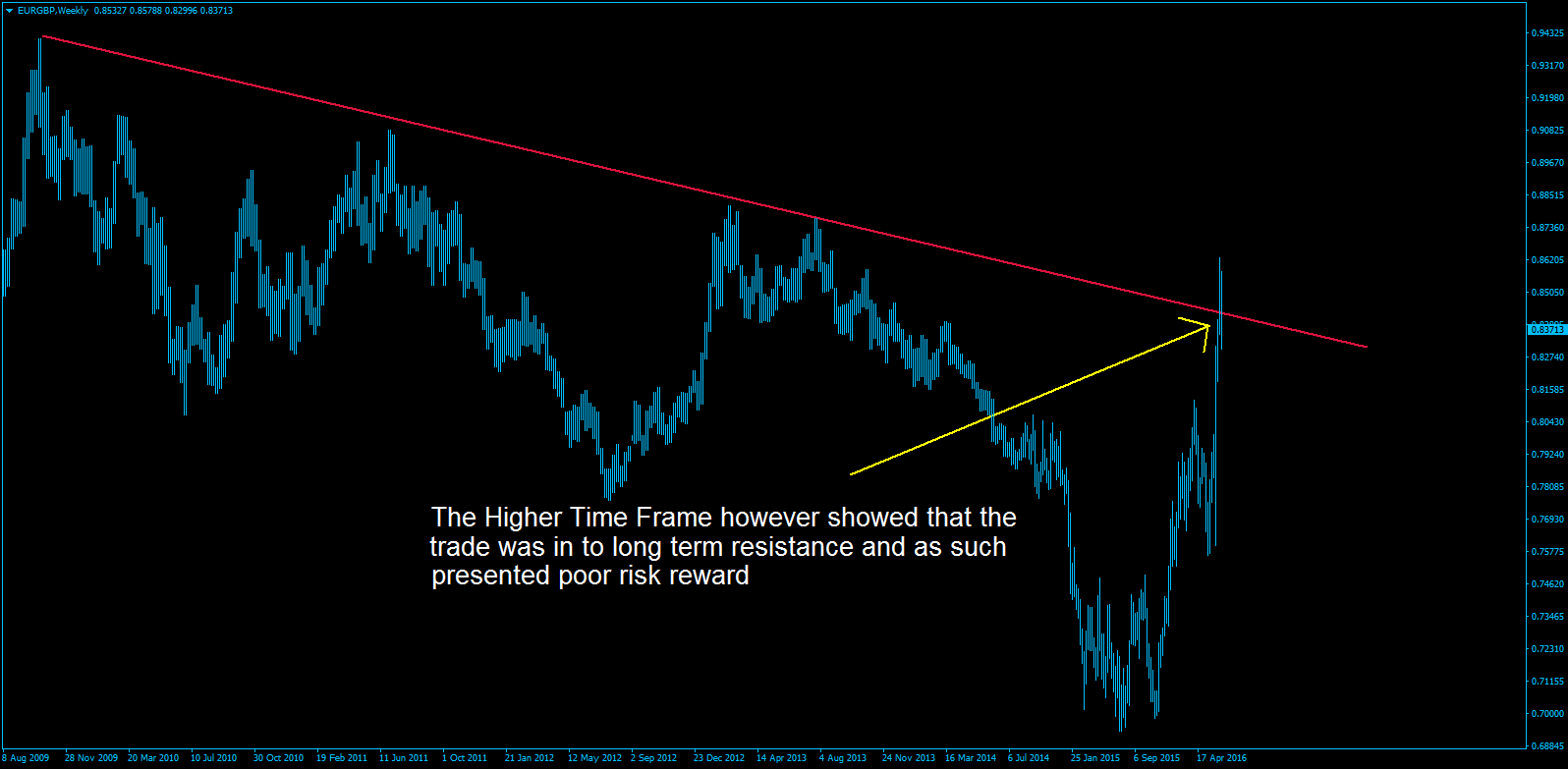
However, looking at the higher time frame shows that the trade was directly into major long term resistance and as such presented poor risk-reward because the chances of the trade reaching the target were extremely poor given the proximity of such strong overhead resistance.
You can see here that risk:reward is about far more than simply picking an attractive profit target and hoping price makes it that far. It requires an understanding of your strategy and ability to read the charts and identify the times when conditions are favourable for you to employ your strategy and the times when you should stand aside.
Sunset Market Commentary
Markets:
Global core bonds lost some ground in a risk-on environment, reversing part of yesterday’s gain. US President Trump’s criticism on the EU, China and Fed didn’t really resonate in today’s action. The eco/event calendar was empty, resulting in another low volume August trading session. The agenda heats up later this week with FOMC Minutes, EMU PMI’s and a speech by Fed Chair Powell on the economy and monetary policy in Jackson Hole. US yields add 1 bp (2-yr) to 1.5 bps (5-yr) at the time of writing. German yields gain up to 1.9 bps (5-yr). The 2-yr’s performance (+3.9 bps) is due to a Bloomberg benchmark change. Peripheral yield spreads vs Germany narrow by 11 bps for Greece and 4 to 6 bps for Portugal, Spain and Italy. General risk sentiment is at play. Moody’s announcement to delay its decision on the Italian review for possible downgrade (currently Baa2) until after the 2019 budget discussions (October?) had no impact.
Dollar trading was sentiment driven and in any case confined to rather narrow ranges given today’s empty economic calendar. After closing higher yesterday following Trump’s dollar negative remarks, EUR/USD jumped further north, enjoying a short squeeze in the early trading hours. The pair temporary reclaimed the important 1.1510-resistance level. However, only a sustained break (i.e. a weekly close above 1.1510) would alter the picture for EUR/USD, at least for the short run. Throughout the day, EUR/USD fought valiantly to hold territory, hovering sideways in a 1.1510-1.1540 trade channel. The battle is still raging as the couple temporarily dipped below 1.15 again before trading back at around 1.1512 at the time of writing. Today’s risk-on environment propelled USD/JPY from its intraday low back above the 110-mark (110.37 currently).
UK’s CBI data came in close to expectations and had little to no impact on sterling, nor did diplomats in Brussels’ warning that the October deadline for Brexit will probably have to be delayed. The brexit discussions between UK Brexit Minister Raab and EU chief negotiator Barnier restarted today around noon. For now, meaningful news headlines are scant. The currency pair followed EUR/USD in lockstep and is currently changing hands at 0.8963.
News Headlines:
In a rare news conference, China’s central bank said it will not deploy strong stimulus measures to support the slowing economy. It will however provide more than sufficient liquidity and offer more help to companies in obtaining financing. It further reiterated that the yuan won’t be used as a weapon in the trade conflict.
UK CBI August data showed more manufacturing companies expect higher selling prices in the coming quarter (on balance 15%) while fewer reported total order books to be above normal (7%). However, the CBI said the manufacturing sector is in a “robust shape” while warning that a no-deal Brexit would be “immensely damaging”.
The Hungarian central bank (NBH) left its main interest rates unchanged at 0.9% for the 3-month deposit rate and -0.15% for the overnight deposit rate.
Diplomats in Brussels warned the informal October deadline for Brexit is in jeopardy as negotiations drag on. They said EU leaders probably will have to hold an emergency meeting in November to consider any agreement. Some even mentioned December, which would leave little time for ratification before the UK leaves in March 2019.
DAX Gains Continue as Trade Tensions Ease
The DAX index continues to point higher and has recorded considerable gains in the Tuesday session. Currently, the pair is trading at 12,420, up 0.73% on the day. There are no German or eurozone events on the schedule. On Wednesday, the Federal Reserve will publish the minutes of the July policy meeting.
Central banks will be in focus during the week. On Wednesday, the Fed releases the minutes of the July meeting, while the ECB publishes its July minutes on Thursday. This will be followed by the Jackson Hole Symposium, a gathering of the heads of the major central banks. Investors will be keenly following these events, looking for hints regarding future monetary policy on the part of the ECB and the Federal Reserve. The U.S economy continues to show strong growth but inflation and wage growth continue to lag, and Fed chair Jerome Powell will be expected to address these issues.
The DAX has started the week with gains and is currently at a 1-week high. Although the index is in the red in the month of August, investor risk appetite has improved, following the announcement that the U.S and China had agreed to hold trade talks later this week in Washington. This follows months of escalating trade tensions, which have dampened risk appetite. The U.S is unhappy with the Chinese protection of local markets and technology transfers required in order for U.S businesses to operate in China, but it’s questionable if the Chinese will show much flexibility. If the talks show signs of progress, such as the suspension of a $16 billion tariff scheduled to take effect on August 23, German stock markets could continue to gain ground.
XAUUSD Outlook: Bulls Face Strong Headwinds at Falling 10SMA
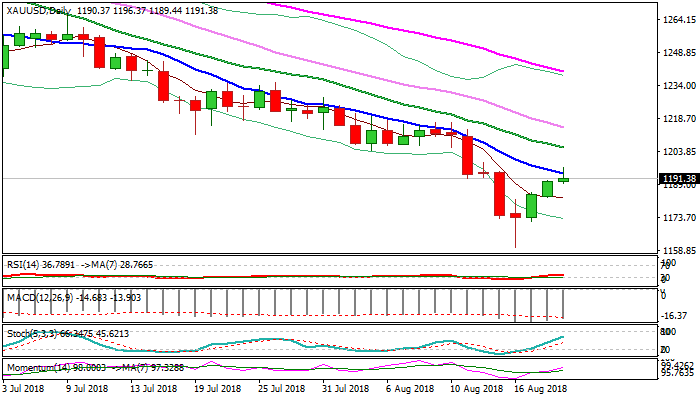
Bulls are taking a breather on Tuesday, following two days of strong rally on softer dollar, after failing to take out barriers at $1194/95 (falling 10SMA / Fibo 61.8% of $1217/$1160 bear-leg). North-heading momentum and slow stochastic are supportive, but strong bearish setup of daily MA’s offsets positive signals.
Failure at 10SMA and close below daily low at $1189 would generate initial signal that recovery rally is running out of steam, while extension and close below 5SMA $1182) would signal reversal.
Bullish scenario requires close above 10SMA as initial bullish signal for recovery extension towards psychological $1200 barrier at falling 20SMA at $1205.
Res: 1194; 1200; 1205; 1214
Sup: 1189; 1182; 1171; 1160
EUR/USD Mid-Day Outlook
Daily Pivots: (S1) 1.1425; (P) 1.1455 (R1) 1.1516; More.....
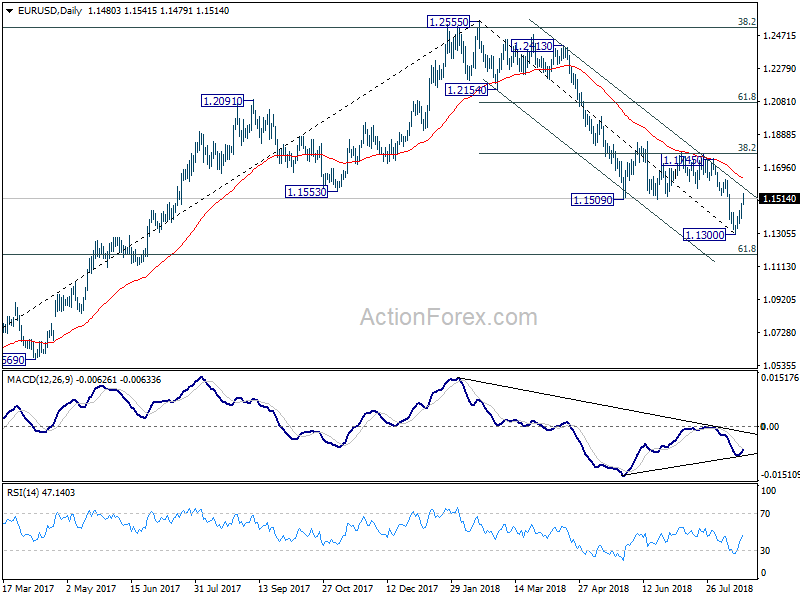
Intraday bias in EUR/USD remains on the upside for the moment. Rebound from 1.1300 short term bottom is still in progress. While further rally would be seen, upside should be limited by 1.1745 resistance to bring larger down trend resumption. On the downside, break of 1.1444 minor support will suggest that the rebound is completed. Intraday bias would be turned back to the downside for retesting 1.1300 low.
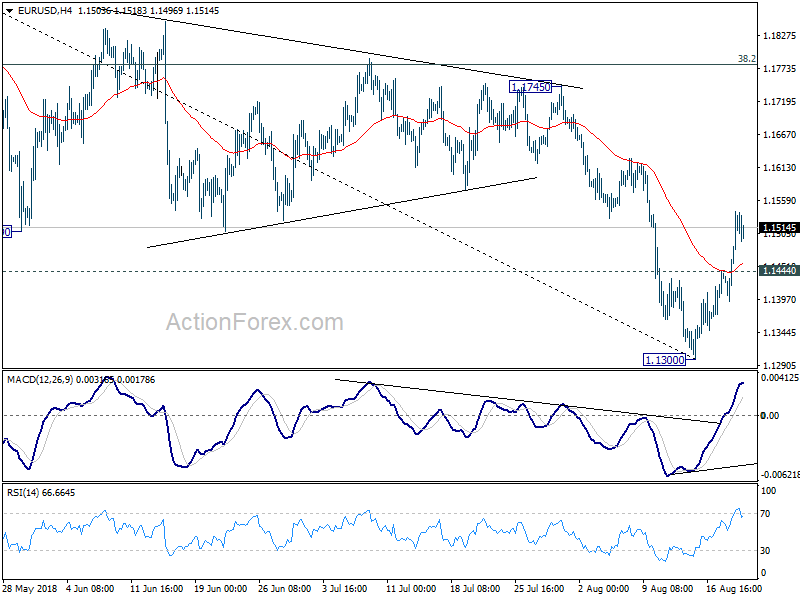
In the bigger picture, the down trend from 1.2555 medium term is in progress for 61.8% retracement of 1.0339 to 1.2555 at 1.1186. Note again that EUR/USD was rejected by 38.2% retracement of 1.6039 (2008 high) to 1.0339 (2017 low) at 1.2516. That carries some long term bearish implications. Sustained break of 1.1186 could pave the way back to retest 1.0339 low. For now, outlook will remain bearish as long as 38.2% retracement of 1.2555 to 1.1300 at 1.1779 holds, even in case of strong rebound.
GBP/USD Mid-Day Outlook
Daily Pivots: (S1) 1.2750; (P) 1.2775; (R1) 1.2821; More...
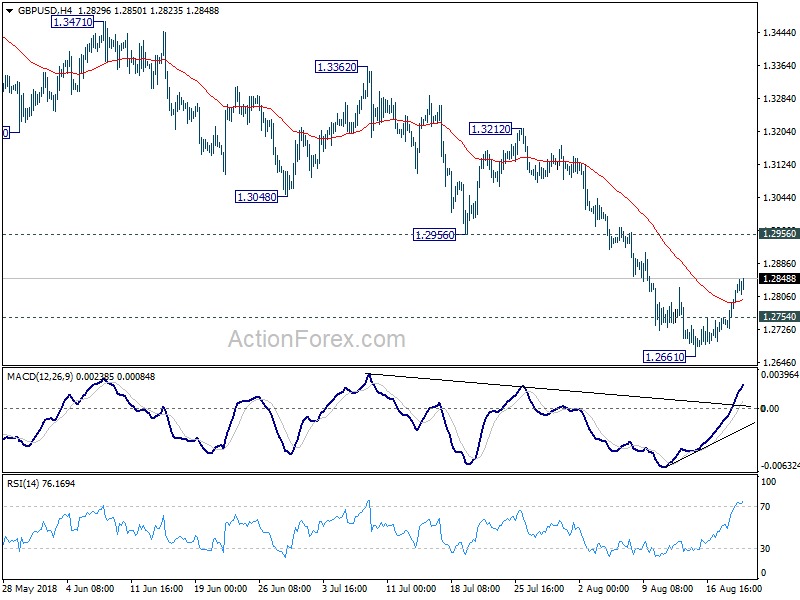
GBP/USD's rebound form 1.2661 short term bottom is still in progress and intraday bias stays on the upside for further rally. But upside should be limited by 1.2956 support turned resistance to bring fall resumption. On the downside, below 1.2754 minor support will bring retest of 1.2661 low first.
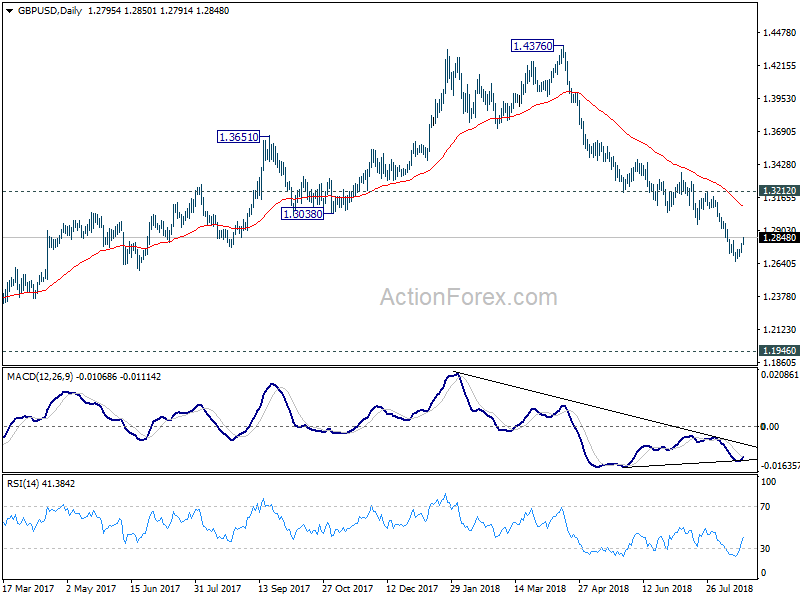
In the bigger picture, whole medium term rebound from 1.1946 (2016 low) should have completed at 1.4376 already, after rejection from 55 month EMA (now at 1.4091). Current downside acceleration argues that it's possibly resuming long term down trend. In any case, outlook will stay bearish as long as 1.3212 resistance holds. Retest of 1.1946 should be seen next.
USD/CHF Mid-Day Outlook
Daily Pivots: (S1) 0.9892; (P) 0.9930; (R1) 0.9952; More....
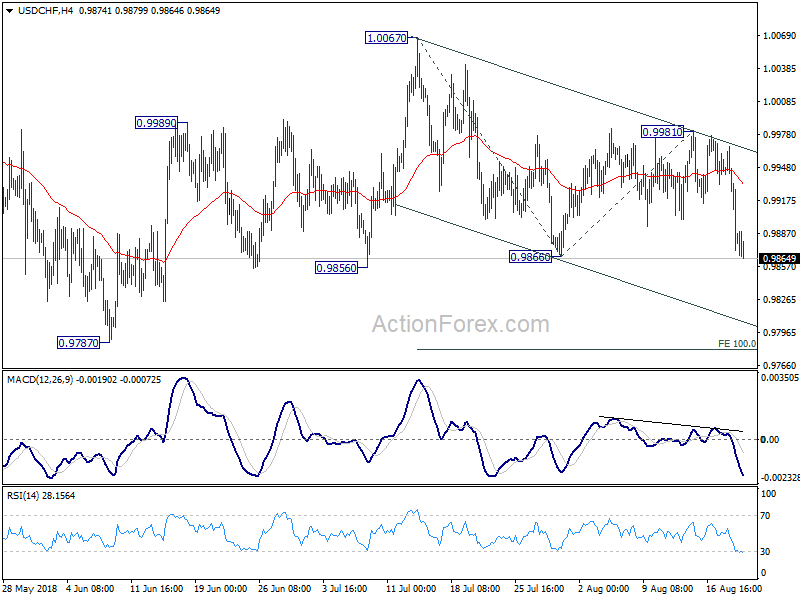
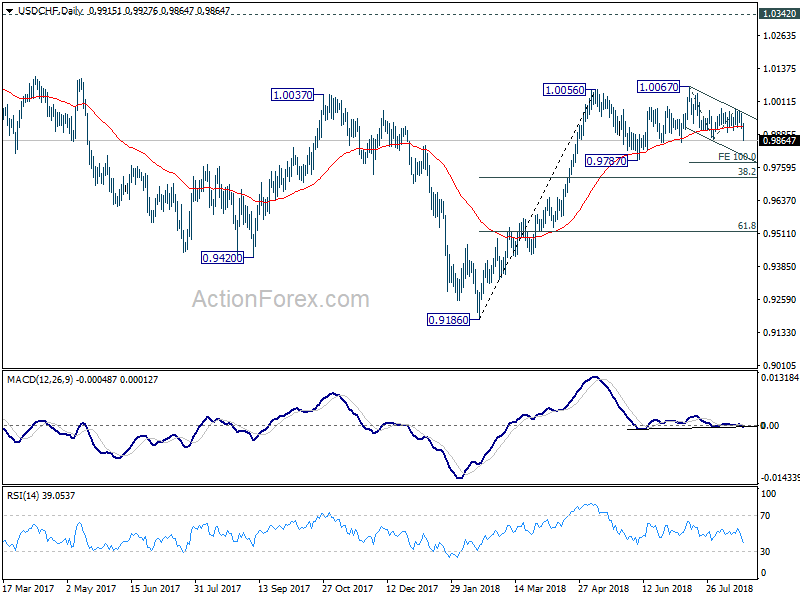
Intraday bias in USD/CHF remains on the downside at this point. Deeper fall should be seen to 100% projection of 1.0067 to 0.9866 from 0.9981 at 0.9780 and possibly below. But fall from 1.0067 is see as the third leg of the consolidation pattern from 1.0056. Hence, we'd expect strong support from 38.2% retracement of 0.9186 to 1.0056 at 0.9724 to bring rebound. On the upside, break of 0.9981 will bring retest of 1.0067 resistance.
In the bigger picture, current development suggests that the consolidation pattern from 1.0056 is extending. As long as 38.2% retracement of 0.9186 to 1.0056 at 0.9724 holds, we'd expect rise from 0.9186 to resume at a later stage to retest 1.0342 key resistance (2016 high). However, sustained break of 0.9724 fibonacci level will bring deeper fall, as another declining leg in the long term range pattern.
US Dollar Index Heads Lower But Remains in Upward Pattern
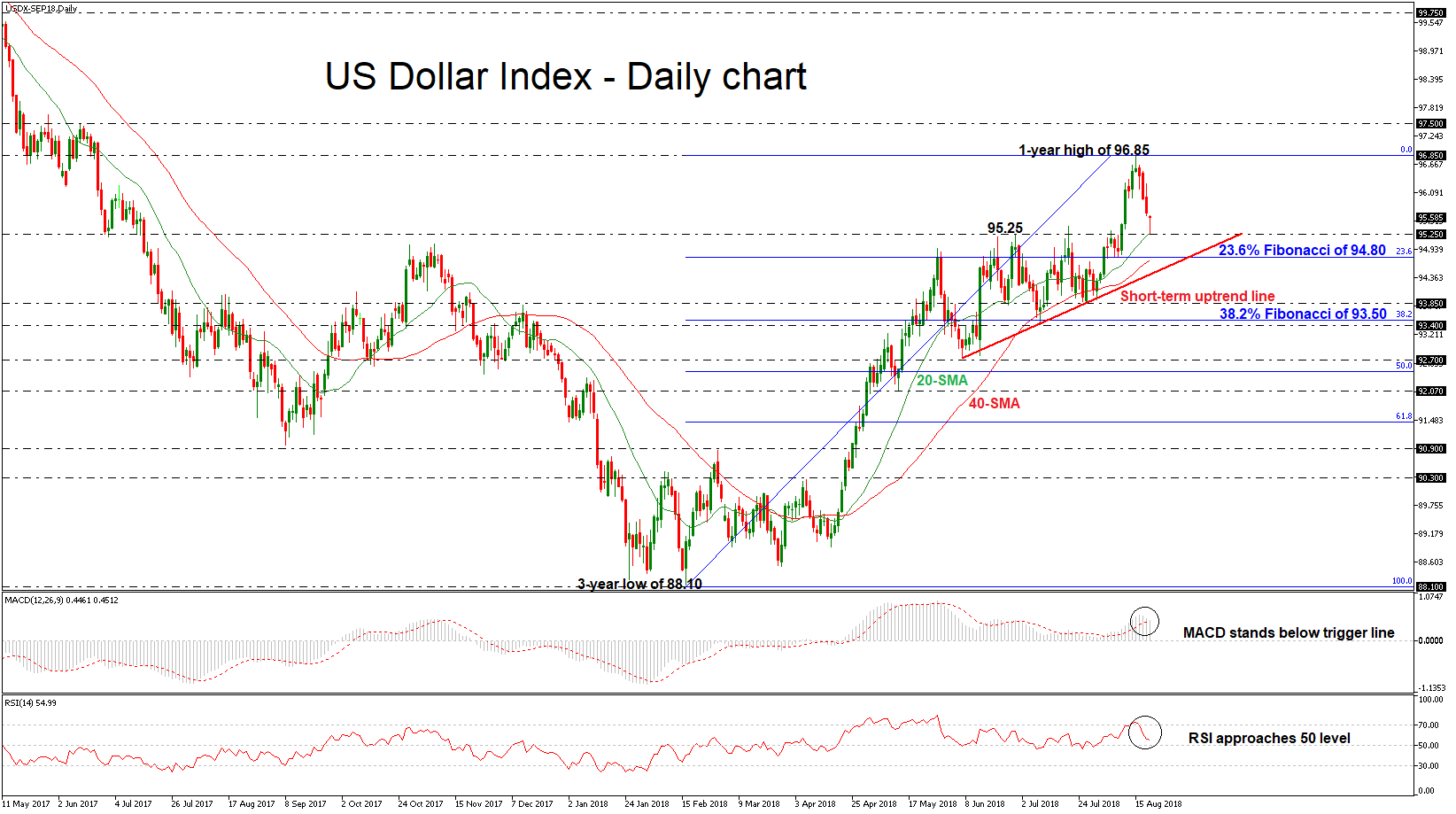
The US Dollar Index has declined considerably over the last three days following the bounce off the more than one-year high of 96.85, reached on August 15. The sharp sell-off, especially in the past sessions, has shifted the near-term bias from positive to negative. However, the price moved up after challenging the 20-day simple moving average (SMA) today, recovering on a significant part of its intraday losses.
The momentum indicators are supportive of the bearish picture, with the RSI falling to approach the 50 level, while the MACD oscillator slipped below the red-trigger line.
On the downside, the area between 95.25 and 94.80, outlined by the 23.6% Fibonacci retracement of the February 16 to August 15 upleg and the 20-day SMA, could provide immediate support. A penetration of this area would bring the short-term ascending trend line at 93.85, which has acted as a strong obstacle in July, in focus. Moreover, notice that the 38.2% Fibonacci of 93.50 lies not far below.
Should the price head north again, it would be interesting to see whether the one-year high (96.85) can stop the bullish movement. If this is not the case, the market could jump until the next high of 97.50, where it topped on June 2017.
Regarding the medium-term picture, the index has been remaining in an upward move since February after it hit a more than three-year low and currently, the price is holding above the 20- and 40-day SMAs, indicating a positive outlook.
USD/JPY Mid-Day Outlook
Daily Pivots: (S1) 109.80; (P) 110.24; (R1) 110.52; More...
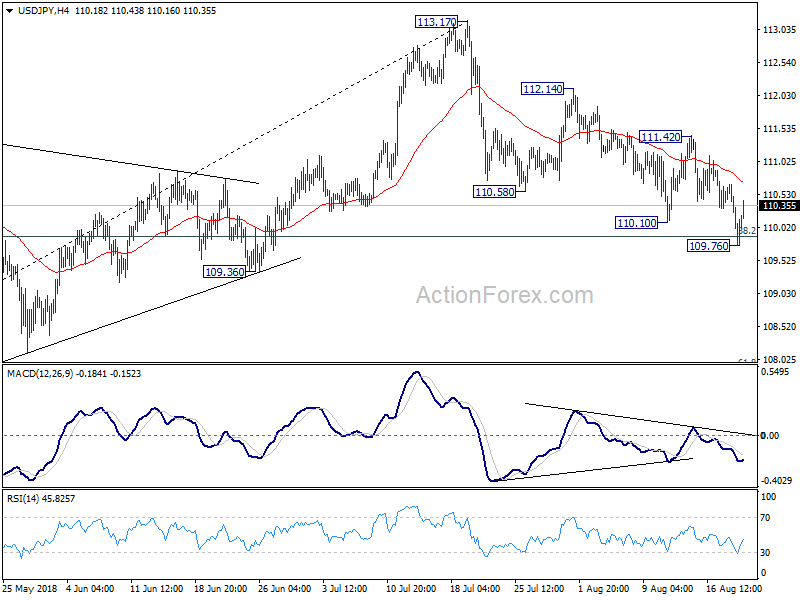
USD/JPY recovers strongly after breaching 38.2% retracement of 104.62 to 113.17 at 109.90 briefly to 109.76. Intraday bias is turned neutral again. At this point, we'd still expect strong support around 109.90 to bring rebound. On the upside, above 111.42 will turn bias back to the the upside for retesting 113.17 first. However, sustained break of 109.90 will put 109.36 key support level in focus. Break of 109.36 will carry larger bearish implications.
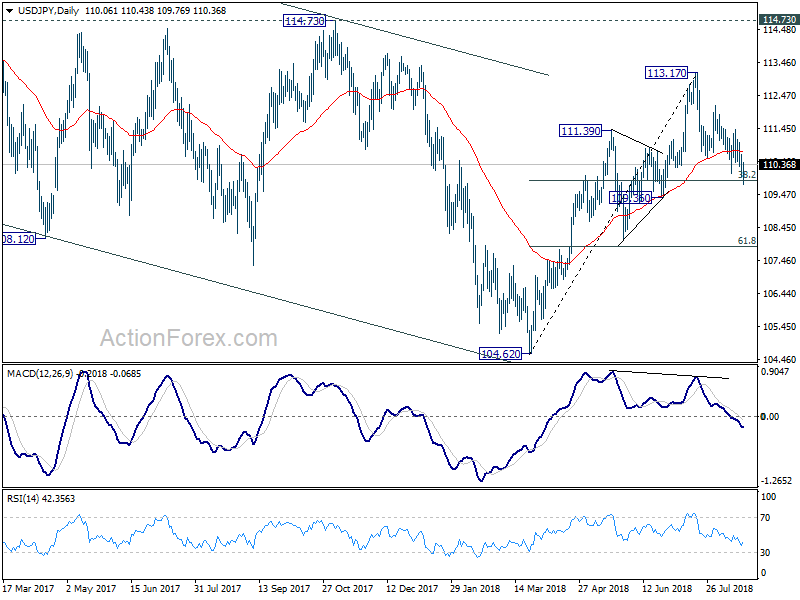
In the bigger picture, corrective fall from 118.65 (2016 high) should have completed with three waves down to 104.62. Decisive break of 114.73 resistance will likely resume whole rally from 98.97 (2016 low) to 100% projection of 98.97 to 118.65 from 104.62 at 124.30, which is reasonably close to 125.85 (2015 high). This will stay as the preferred case as long as 109.36 support holds. However, decisive break of 109.36 will mix up the outlook again. And deeper fall should be seen back to 61.8% retracement of 104.62 to 113.17 at 107.88 and below.
Dollar Stabilizes Mildly as Selling Focus Turns to Yen
Dollar and Yen are pressured by all other major currencies throughout the day. The greenback continues to be weighed down by Trump's attack on Fed, and Jerome Powell personally, regarding rate hikes. Nonetheless, the greenback is showing a little sign of stabilization and sell focus turns to Yen. At the time of writing, Swiss Franc is trading as the strongest one, followed by New Zealand Dollar and then Sterling. Euro pares back some of earlier gains and trades mixed,
But for now, there is little sign for Dollar to start a real come back yet. Dollar could look into Jackson Hole symposium for some inspirations to regain strengthened We find two areas where "expansive money" Fed chair Jerome Powell's comments might trigger volatility. That is, will there be early end of balance sheet reduction. And, will Fed return to pre-crisis channel system monetary policy? More in this report. Jackson Hole Symposium Preview: Two Questions on Fed's Monetary Policy.
The stock markets are relatively steady. At the time of writing, CAC is up 0.79% and DAX is up 0.69%. FTSE reversed earlier loss and is trading flat. 10 year Italian yield is down -0.072 at 2.965. 10 year German bund yield is up 0.020 at 0.326. Narrowing German-Italian yield spread is an indication of easing concerns over Italy. Earlier in the day, Nikkei ended up 0.09%, Hong Kong HSI rose 0.56%, China Shanghai SSE gained 1.31%, Singapore Strait Times dropped -0.15%.
Technically, whether S&P 500 will have a take on 2827.87 record high is a focus today. Gold's seems to have lost some momentum in its recovery. It hit 1196.37 earlier today but lacks follow through buying to push through 1200 handle. It's now back pressing 1190. USD/JPY recovers after a brief breach of 109.90 fibonacci level. We'll see if it can build on the rebound to reverse the near term corrective fall.
EU considering unscheduled summit in November to handle Brexit
UK Brexit Minister Dominic Raab is meeting with EU chief Brexit negotiator Michel Barnier in Brussels today. Reuters reported that the EU is definitely having a real push for concluding the negotiation by October 18-19 EU summit. But it's not optimistic base on current progress. In particular, there is no concrete proposal, from EU's point of view, that would work on the Irish border issue.
The next scheduled summit on December 13-14 is seen as too late by EU. That would leave too little time for ratification of an agreement before formal Brexit in March 2019. Also, that's too hard for businesses to start implementing contingency plans. Hence, an idea of a interim, unscheduled summit in November to handle the issue is floating around. It's seen as the last moment for the negotiations.
UK launches ambitious strategy to boost exports from 30% to 35% of GDP
UK Department for International Trade launches an "ambitious" strategy to boosts exports to 35% of GDP. In a statement released today, it's noted that the country exported GBP 620B in goods and services last year. That accounted for 30% of UK GDP. The department noted estimated that 400,000 businesses believe they could export by don't. And from overseas is "only growing".
The key elements of the strategy are:
- encourage and inspire more businesses to export
- inform businesses by providing information, advice and practical assistance on exporting
- connect UK businesses to overseas buyers, markets and each other
- put finance at the heart of our offer
International Trade Secretary is expected to tell business audience in a speech that "UK has the potential to be a 21st century exporting superpower". And, "as we leave the EU, we must set our sights high and that is just what this Export Strategy will help us achieve."
The strategy draws strong support from the business sectors. CBI Diretor-General Carolyn Fairbain said in the statement that "The CBI strongly supports the ambition to make exports 35% of GDP, which will put the UK out in front of many of our international competitors." And, "firms will work with the strong team in place at the Department for International Trade to ensure these plans are now rigorously carried out."
Director General of the British Chambers of Commerce Adam Marshall also said that "we welcome the government's pledge in the new Export Strategy to work hand-in-hand with business to unlock opportunities for UK firms all across the globe."
Director General of the Institute of Directors Stephen Martin also said "we will be encouraging our members to engage with government to make sure this strategy really takes off and enables British firms to realize their full trading potential."
Former top treasury official blasts Trump as woefully wide of the mark on Yuan manipulation
Mark Sobel, a former top US Treasury Official criticized Trump's remark regarding Chinese currency manipulation as "woefully wide of the mark". And, Trump's focus on bilateral balances as "silly". And, to suspect a country of currency manipulation, there are criteria of "material 'excessive' current account surplus, an undervalued currency, and ample and rising reserves".
In an article titled "Trump wide of mark on 'manipulation'", Sobel point to facts that "China's current account surplus is falling to under 1% of GDP. The renminbi, hit by capital outflows between early 2015 and the end of 2016, rose sharply against the dollar up to April 2018. The renminbi trade-weighted index rose too. Since then, the renminbi has fallen on both measures, but the depreciation reflects the dollar's strength across the board. There is little evidence of more than scant Chinese foreign exchange market intervention."
He noted "a currency manipulating country should have a significant current account surplus". And, "the US Treasury in its foreign exchange reports uses a 3% of GDP threshold." While a currency manipulating country might also have an "undervalued currency" one should "look at a country's real effective exchange rate, not its bilateral dollar rate." Additionally, the country may intervene heavily in the markets, "buying dollars to hold its currency down, resulting in an increase in its foreign reserve holdings." But there might be "good reasons" to do so such as building up of reserves. There are many useful gauges of reserve adequacy to examine - reserves/GDP; reserves/short-term maturing debt; reserves/imports.
Sobel also completed that "a focus on bilateral balances is silly, even if the US Treasury is required to do so by statute and the president seems obsessed with them. Such an emphasis neglects to consider that certain countries specialize in certain goods and hold comparative advantage in such spheres."
Mark Sobel is US Chairman of OMFIF. He is a former Deputy Assistant Secretary for International Monetary and Financial Policy at the US Treasury and until earlier this year US representative at the International Monetary Fund.
RBA minutes indicated optimism over consumer markets
The RBA minutes of the August meeting contained little news, in particular after release of the quarterly Statement of Monetary Policy two weeks ago and Governor Philip Lowe's parliamentary testimony last week. The minutes reiterated, on interest rates, the next move "would more likely be an increase than a decrease". But there was "no strong case for a near-term adjustment".
Meanwhile, the minutes revealed the members optimism over the consumer market. As suggested in the minutes, the second quarter retail sales affirmed "steady growth" in consumption, as supported by "growth in labour income". Policymakers indicated that the data released between the July and August meetings, together with the more recent increase in minimum wages, the announcement of future tax cuts and expectations of a further tightening in labour market conditions, had "reduced some of the uncertainty around the outlook for consumption".
But we wonder if the surprising decline in consumer sentiment would affect the members' view at the upcoming meeting.
More in RBA Too Early to be Confident over Consumer Spending
USD/JPY Mid-Day Outlook
Daily Pivots: (S1) 109.80; (P) 110.24; (R1) 110.52; More...
USD/JPY recovers strongly after breaching 38.2% retracement of 104.62 to 113.17 at 109.90 briefly to 109.76. Intraday bias is turned neutral again. At this point, we'd still expect strong support around 109.90 to bring rebound. On the upside, above 111.42 will turn bias back to the the upside for retesting 113.17 first. However, sustained break of 109.90 will put 109.36 key support level in focus. Break of 109.36 will carry larger bearish implications.
In the bigger picture, corrective fall from 118.65 (2016 high) should have completed with three waves down to 104.62. Decisive break of 114.73 resistance will likely resume whole rally from 98.97 (2016 low) to 100% projection of 98.97 to 118.65 from 104.62 at 124.30, which is reasonably close to 125.85 (2015 high). This will stay as the preferred case as long as 109.36 support holds. However, decisive break of 109.36 will mix up the outlook again. And deeper fall should be seen back to 61.8% retracement of 104.62 to 113.17 at 107.88 and below.
Economic Indicators Update
| GMT | Ccy | Events | Actual | Forecast | Previous | Revised |
|---|---|---|---|---|---|---|
| 22:45 | NZD | Net Migration M/M Jul | 0.60% | -3.50% | -3.60% | |
| 01:30 | AUD | RBA Meeting Minutes Aug | ||||
| 06:00 | CHF | Trade Balance (CHF) Jul | 2.26B | 2.85B | 2.59B | |
| 08:30 | GBP | Public Sector Net Borrowing (GBP) Jul | -2.90B | -2.1B | 4.5B | 3.3B |
| 10:00 | GBP | CBI Industrial Order Expectations | 7 | 10 | 11 | |
| 12:30 | CAD | Wholesale Trade Sales M/M Jun | -0.80% | 0.80% | 1.20% | 0.90% |