

Sample Category Title
Eco Data 8/22/18
[php_everywhere instance="1"]
Japanese Yen Dips, Investors Await Fed Minutes, Jackson Hole
The Japanese yen has posted gains in the Tuesday session, erasing the losses seen on Monday. In the North American session, USD/JPY is trading at 110.41, up 0.32% on the day. In economic news, Japanese All Industries Activities is expected to decline 0.7%, which would mark the first decline in five months. There are no U.S events on the schedule. On Wednesday, the U.S releases Existing Homes and the Federal Reserve will publish the minutes of the July policy meeting.
With little data for the markets to digest, the Federal Reserve will be in focus. On Wednesday, the Fed releases the minutes of the July meeting. This will be followed on Thursday by the Jackson Hole Symposium, a gathering of the heads of the major central banks. Investors will be keenly following these events, looking for hints regarding future monetary policy on the part of the Federal Reserve. The U.S economy continues to show strong growth but inflation and wage growth continue to lag, and Fed chair Jerome Powell will be expected to address these issues, and his speech could be a market-mover.
The yen continues to hover around the 110 line this week, and USD/JPY briefly broke into 109 territory earlier on Tuesday. The Japanese currency has posted gains of 1.2% in August, with the currency benefitting from the risk apprehension due to the rash of tariffs that the U.S has slapped on its major trading partners, including Japan. However, there is some hope that things are on the mend, as the U.S and China have agreed to hold low-level trade talks this week in Washington. Traders shouldn’t expect a dramatic breakthrough, but the fact that the two sides are talking has investors cheering. The U.S is unhappy with the Chinese protection of local markets and technology transfers required in order for U.S businesses to operate in China, but it’s questionable if the Chinese will show much flexibility. Both sides have slapped tariffs of $34 billion on each other’s products, with another $16 billion in tariffs scheduled for August 23. If the talks show some progress, such as the cancellation of the upcoming tariffs, we could see some volatility from the currency markets.
Mid-US update: Yen selloff accelerates as S&P 500 hits record high
** S&P 500 hits all time high already.
Yen's selloff accelerates in US session on the back on strong risk appetite. S&P 500, currently at 2871, up 0.49%, is closing in on record high at 2872.87. DOW is up 0.44% and NASDAP is up 0.83% at the time of writing. Dollar recovers some ground against Canadian Dollar, but remains pressured against all others.
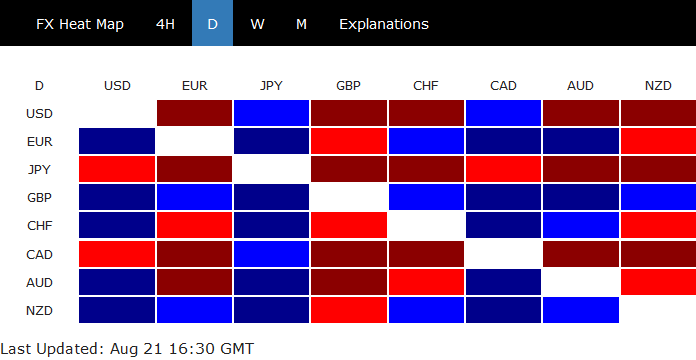
On the other hand, Sterling seems to have responded well to the post meeting press conference of Raab and Barnier. They're adding intensity on Brexit negotiation and are still targeting to complete a deal by October EU summit. Kiwi follows as the second strongest, and then Euro.
In other markets, FTSE closed down -0.34% at 7565.70. DAX gained 0.43% to 12385.49. CAC rose 0.54% to 5408.60. Gold is back below 1190 as Dollar stabilized a bit from Trump triggered selloff.
UK Brexit Minister Raab still targeting to reach agreement with EU by October, Sterling hold on to gains
Sterling seems to be responding well enough to the post meeting press conference of UK Brexit Secretary Dominic Raab and EU chief Brexit negotiator Michel Barnier. The pound is holding on to gains against both Dollar and Yen.
Raab said they had "positive" discussions and UK reaffirmed the commitment regarding Irish border. Raab said there are still "some significant issues to overcome". Both agreed the need to "step up the intensity" during the final phase of the negotiations. Raab also emphasized that "if we have that ambition, that pragmatism and that energy on both sides, I'm confident we can reach that agreement by October." Regarding no-deal Brexit, Raab said "some of these hair-raising scare stories are far from true""
Barnier said the negotiation has now entered the final stage. And both the EU and UK agreed to continually negotiation from now on. He added that the EU and UK can find common grounds, and both are now more advanced in defining the common ground, for foreign policy, security and economic relationship.
Both sides will meet again in Brussels next week.
https://www.youtube.com/watch?v=wQmsN4N9_Qs
Elliott Wave Analysis: Gold Update
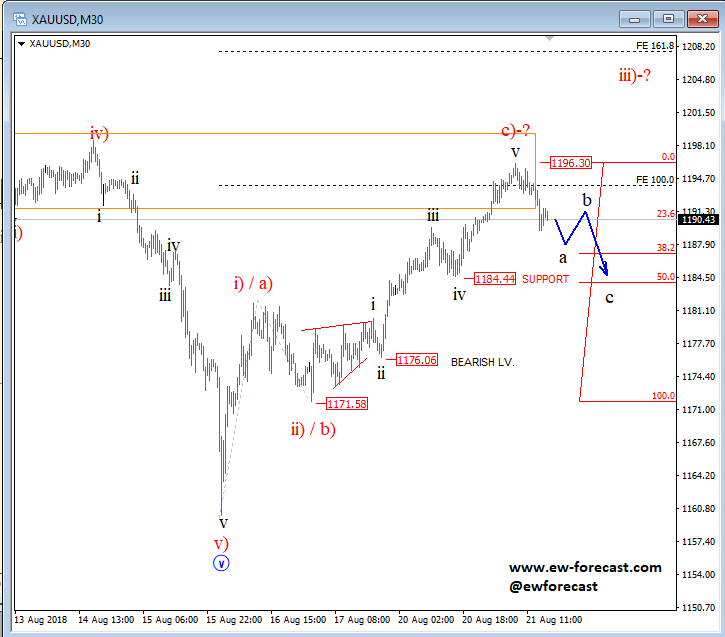
Gold is currently reversing from the 1196 level, which is the first evidence of a minor three-wave turn in play. Ideally some support will be seen at the 1184 level, where a new bounce may follow. That said, a break below the 1176 level would favor the bears.
Gold, 1h
FOMC Meeting Minutes Eyed for Trade Concerns
The US Federal Reserve is scheduled to release the minutes from its latest policy meeting on Wednesday at 1800 GMT and while the central bank opened the path for further rate increases this year, giving a strong assessment on the US economy, investors will be closely reading the detailed record to confirm that policymakers are indeed comfortable to raise borrowing costs even under a worsening outlook on global trade.
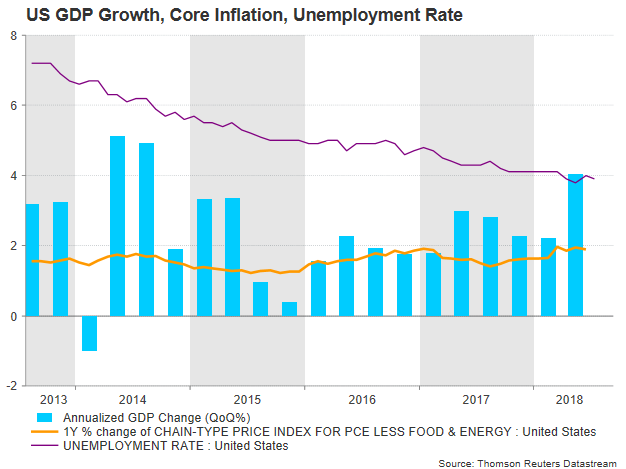
Having already delivered seven rate hikes since the financial crisis, the Federal Open Market Committee (FOMC) announced on August 1 that the federal funds rate will remain steady between 1.75-2.0% as was widely expected. At the same time, it expressed that the Fed plans to raise rates further this year as economic activity has been growing at a “strong rate” thanks to rising household spending and business investment, which led GDP growth to 4.1% on an annualized basis in the second quarter, the fastest expansion since Q4 2014. Policymakers assessed that the labor market is in good shape as well and with inflation near the Fed’s 2.0% target, markets turned increasingly confident that two more rate hikes could be possible this year with the first one being almost fully priced in during the late September meeting according to Fed’s fund futures. The probability for a second 25bps move currently stand at around 60%.
Regarding trade, the Fed chief, Jerome Powell, acknowledged during his testimony before Congress that US import tariffs, as well as retaliatory actions from other nations, are a risk to the US economy rather than a negative impact at the moment. He later said though, that economic growth could weaken if trade frictions fail to lead to negotiations. Still, him appearing to not worry much on the issue increased speculation that the Fed is more likely to stay on course with rate increases even if trade tensions threaten to boil over.
It is of note that the US President, Donald Trump, is among those opposing higher interest rates. Despite picking Powell as the Fed’s new chief, Trump criticized his hiking plans, saying he is “not thrilled” with higher interest rates given that the combination of higher borrowing costs and a stronger dollar would weigh on the country’s export growth and hence disrupt his efforts to limit the trade deficit. This was not the first time Trump complained about monetary policy as back in July he had also expressed his displeasure with rate rises, creating question marks on whether the President could affect the central bank’s independence. Continued attacks on the Fed by the US president will probably bring fresh downside to the dollar.
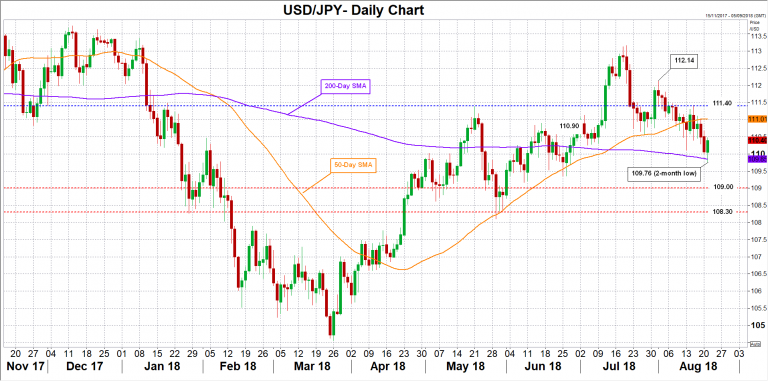
In forex markets, USDJPY spiked slightly below the 200-day simple moving average today to touch two-month lows at 109.76. However, the downfall proved to be short-lived and the pair is now looking set to finish the day in the green and above the 110 key-level. Should the FOMC minutes use a surprisingly stronger hawkish tone, probably easing concerns related to the trade story, the pair could gain ground towards the 50-day SMA, currently at 111.01. If the area fails to restrict upside movements, resistance could take place around 111.40, taken from the highs on August 15 and May 21. The peak at 112.14 reached on August 1 could be also approached in case of steeper bullish corrections.
In the alternative scenario, if the minutes highlight that trade protectionism is harmful to US businesses, the market could give up today’s gains to retest the 109.76 trough. Below that, further losses could reach the 109 round level before the 108.30 support comes into view.
EUR/USD – Has Trump Ended the Decline?
Central Bank Pressure and Intervention Speculation Weigh on USD
Donald Trump’s recent comments on the dollar, in which he openly criticized the central banks of the US and the eurozone, may have provided some temporary reprieve for the pair but is that all they’ve done?
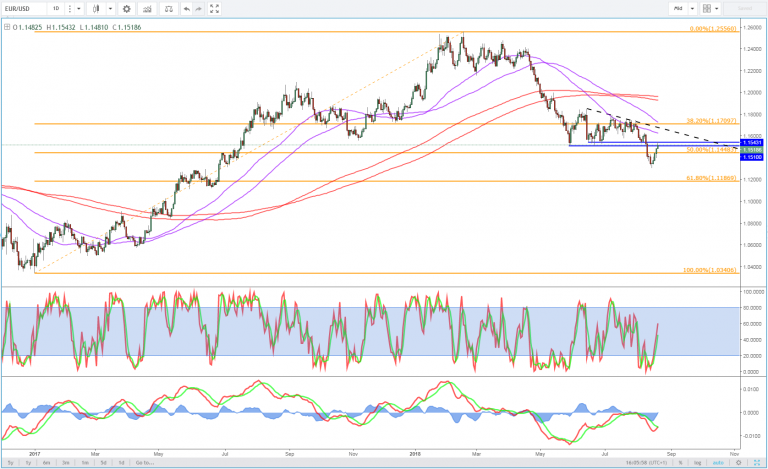
The euro hit a near-14 month low against the greenback last week, having broken below 1.15 support which had held since the end of May, with the US currency benefiting once again from safe haven flows. These declines have been pared in recent days, following Trump’s comments, but it’s not yet clear whether it will be enough to prevent further selling.
There has been plenty of speculation that Trump could be tempted to intervene and weaken the dollar, which has aided the recent move, but in the absence of any more than that, I wouldn’t expect this to have much legs. Of course, I wouldn’t be surprised if Trump capitalized on such fears to his advantage.
From a technical perspective, while the latest decline was not accompanied by a similar drop in the stochastic or MACD indicators, which could indicate a weakening of the recent downtrend, they don’t on their own suggest it’s bottomed either.
We’re now seeing the previous 1.15 support being tested from below and a rebound off this level could be viewed as confirmation of the original break, a bearish signal, which would put the focus back on 1.13 where we ran into support last week. We would also learn, in this scenario, just how serious traders are taking the prospect of intervention.
Should the pair break above 1.15, 1.1650 would be another area of interest, with price then testing the descending trend line from 14 June highs, and 55 and 89-day simple moving average combination.
German FM Maas: Europe needs payment channels that are independent of US
German Foreign Minister Heiko Maas urged that an Europe has to set up payment channels that are independent of the US. That is crucial to save the Iran nuclear deal as US sanctions take effect.
He said, "it is indispensable that we strengthen European autonomy by creating payment channels that are independent of the United States, a European Monetary Fund and an independent SWIFT system."
Regarding the Iran nuclear deal, Maas said "every day the deal is alive is better than the highly explosive crisis that would otherwise threaten the Middle East".
How To Trade Rate Decisions: The Key Factors Affecting Market Reaction
Among the endless stream of economic events hitting wires each month there are a few key events that tend to dominate the action and among those central bank rate decisions are arguably the most important. However, trading these events can be tricky for new traders who don’t yet properly understand the nuances that distinguish highly volatile, market moving events from the vanilla non-events.
Furthermore, the actual market response to central bank rate decisions can sometimes be confusing with rate cuts resulting in stronger currencies and unchanged decisions resulting in aggressive rallies.
To help improve your trading of these key events it is vital to establish a proper understanding of the key factors that determine market response. Let’s, first of all, consider what these events entail and the traditional impact they are perceived to have.
Central Bank Rate Decisions
Each month, the central banks of the world hold their rate setting meetings where they decide whether to keep rates unchanged, lower them or raise them. These meetings are crucial in determining investor sentiment for a given currency and affecting fundamental flows. The conventional wisdom around these events suggests that:
- If a central bank raises rates, typically the currency of that economy will rise as the higher rates attract foreign investment.
- Conversely, a decreases in rates tends to lead to a depreciation in the currency of that economy as foreign investors seek yield elsewhere.
- Rates kept on hold can either be bullish or bearish depending on the tone of the accompanying statement and whether or not the central bank was expected to move rates.
The Role Of Market Expectations In The Impact of Rate Decisions
This brings us on to an important point: the role of investor expectations in market volatility around rate decisions.
- If markets are expecting a central bank to lower rates and the central bank decides to keep rates on hold, this is seen as a bullish driver and the currency tends to rise.
- However, if the central bank was expected to raise rates and they instead keep rates on hold, then this is seen as a bearish driver, and typically rates will fall.
However, the rate decision alone is not always the most important aspect of these meetings and the accompanying monetary policy statement and/or press conference following the events are keenly scrutinised by traders as they provide further colour on how the central bank views the current economic climate and their outlook for the future, e.g., how they might act in the future based on their forecasts.
- If A central bank keeps rates on hold but strikes a very Dovish tone in the meeting highlighting a bleak economic outlook and outlining their intentions to ease in future, then a currency might still trade lower even if rates are kept unchanged.
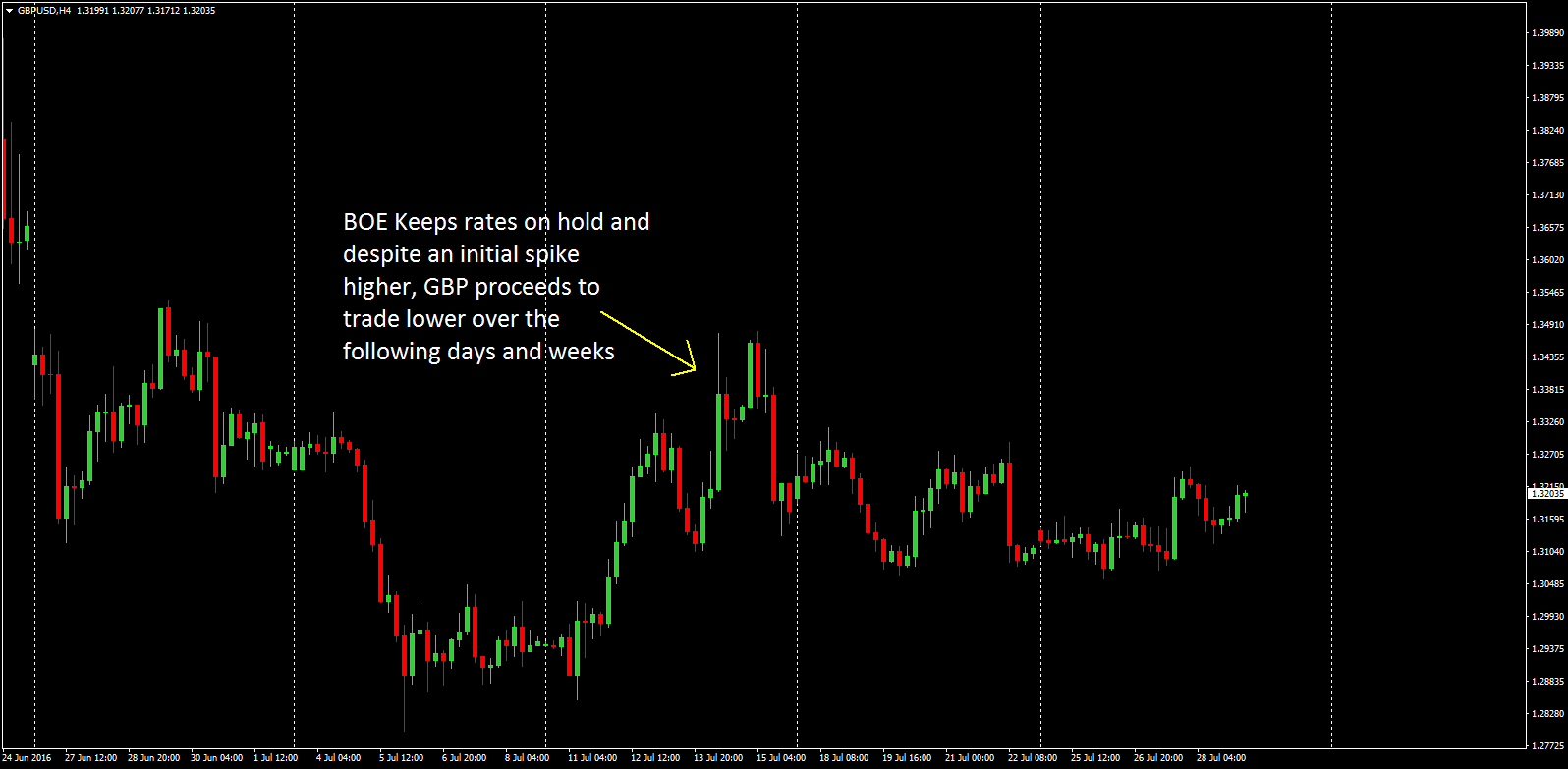
The above example shows GBPUSD around the July BOE meeting which markets expected was going to see the bank announce a rate cut at their July in response to Britain’s decision to leave the EU. However, the BOE opted not to cut rates at that meeting though did strike a very Dovish tone and gave a clearly signal of their intention and likely need to cut rates at the August meeting. In light of the Dovish statement accompanying the meeting, GBP traded lower over the following days.
- However, if a central bank keeps rates on hold but strikes a very Hawkish tone in the meeting, sounding very upbeat about the economy and offering guidance on the likely need to raise rates in the near term, then despite the unchanged decision, the currency could still rise.
Again, rate decisions are not the only measures that can be employed at these meeting and the central bank in recent years have used these events to announce monetary stimulus programs known as quantitative easing either alongside rate moves or in lieu of. Expectations around QE announcements are just as important as expectations around rate decisions.
- QE announced by surprise or QE of a larger amount than expected can have a significant impact on markets.
- Similarly, if markets are expecting a certain level of QE to be announced and are disappointed, the reaction can be severe.
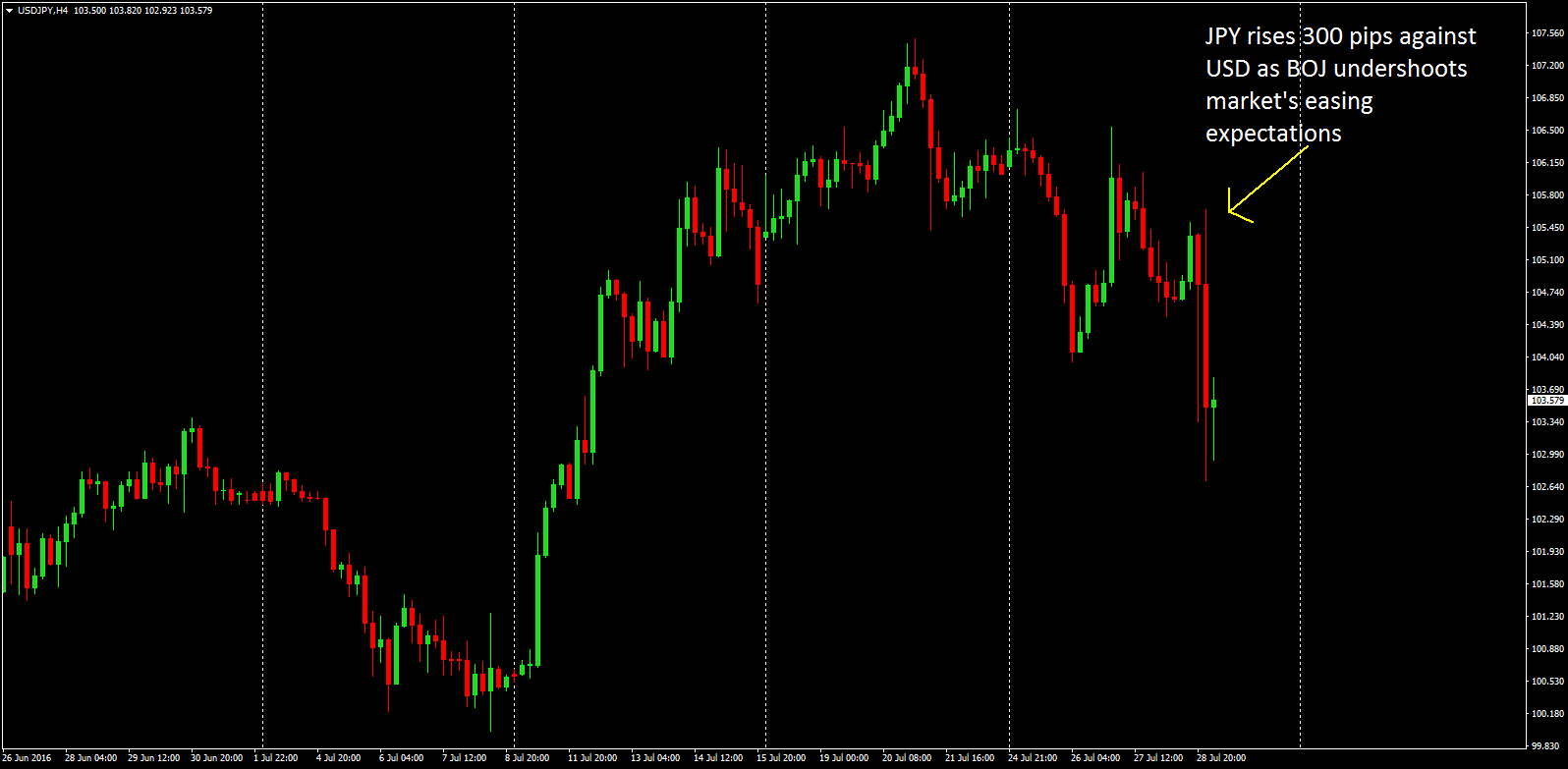
A good example is the July BOJ. A huge amount of speculation had been built up ahead of the meeting with traders expecting the bank to adopt unconventional methods in a bid to stimulate the economy and combat deflation but at the very least to announce a further rate cut and an increase in QE from Y3.3trln to Y7trln. However, the BOJ refrained from adopting any unconventional methods and even fell short of market consensus by keeping rates on hold and instead raising QE to just Y6trln. Markets responded aggressively by buying JPY.
Impact of Central Bank Credibility on Market Expectations
Central bank credibility is a driving force behind market expectations. If a central bank is seen to consistent in following up their words with actions, then verbal intervention can be an effective tool whereby the central bank is able to war against higher currency rates lest they should need to intervened. However, if a central bank loses their credibility and appears to be making “empty threats” then verbal intervention ceases to be a tool they can use.
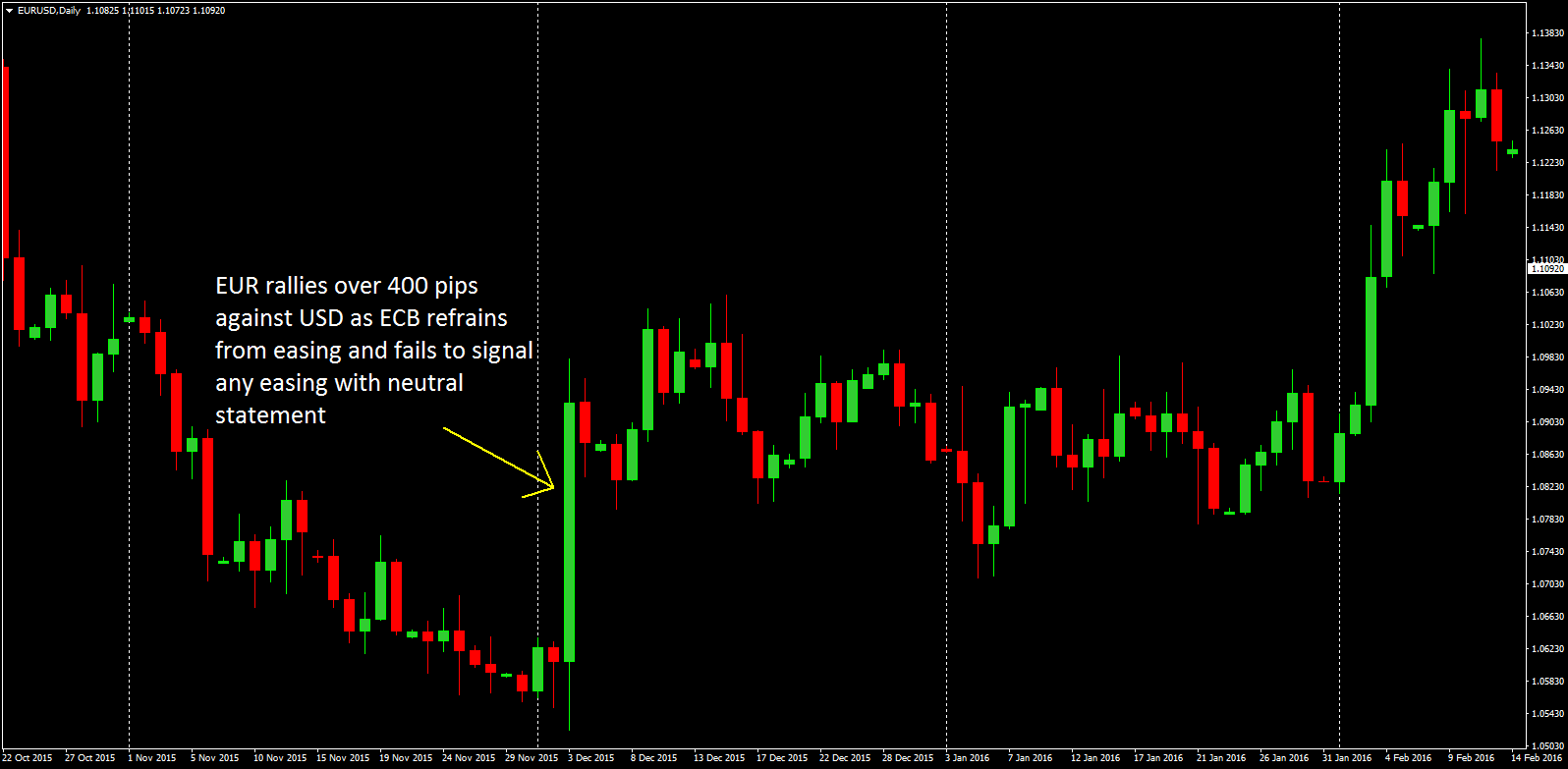
In December 2015 the ECB were widely expected to announce further easing measures or at the very least give a clear signal of their intent to ease further as well as a nod to the sort of policy adjustments markets could expect. However, despite a lot of pre-emptive rhetoric on behalf of the ECB and highly elevated market expectations, the ECB decided to keep rates on hold and struck a very neutral tone in their meeting downplaying the likelihood of easing in the near term. The market responded to this with a 400+ pip rally in EURUSD.
Initial Reaction Versus Sustained Reaction
Another key aspect of market volatility around rate decisions is that we need to distinguish between an initial “reaction” move and then the sustained fundamental impact on the market. Very often positioning adjustment in response to these events, such as profit taking, can lead to a short-term spike in currency but once these initial flows are absorbed the currency will then revert into a fundamental trading pattern.
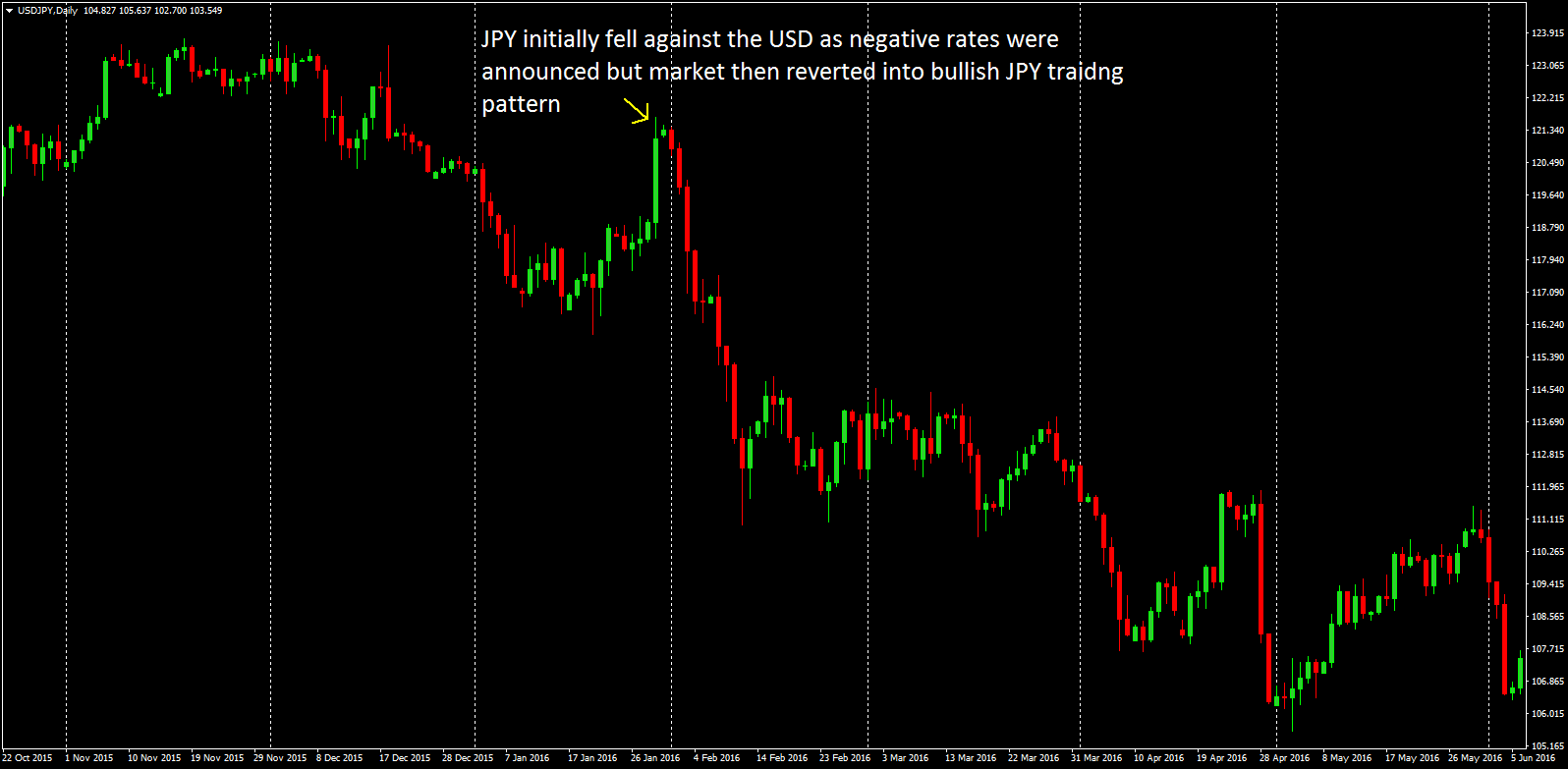
A great example of this is the Bank of Japan’s historic announcement in January this year that for the first time in Japanese history they were adopting negative rates. Whilst this unprecedented move initially yielded a near 3% selloff in JPY against the US Dollar., the move was immediately reversed the next day, and the Japanese Yen proceeded to rally against the US Dollar by more than 18% five months later.
Textbook economic theory suggests that negative rates should translate into a lower currency value as foreign investors seek yield elsewhere. However, the Yen’s status as a traditional safe-haven currency means that during times of economic uncertainty investors sell foreign assets and repatriate their capital into Yen. This dynamic alongside a growing skepticism as to the effectiveness of traditional easing measures in Japan led to a stronger JPY. Indeed, referencing the CFTC positioning data shows that shortly after the Japanese Govt introduced negative rates JPY positioning flipped to net long (more buyers than sellers) for the first time in four years.
Summary
It is quite clear that market expectations are an extremely important factor in whether or not a rate decision has a market-moving impact or not. The actual rate decision itself is only relevant within the context of market expectations and hence, a rate increase might not always translate into a higher currency, and a rate decrease might not always translate into a lower currency. Similarly, a decision to keep policy on hold might actually result in bigger moves depending on the level of expectation in the market.
Hopefully, by now you can see that central bank rate decisions are complex, important events that offer a lot of opportunities if properly understood. To get an idea of the key expectations ahead of each central bank meeting Orbex prepares central bank previews which can help you to understand what industry analysts are looking for and the sort of outcomes to expect.
Guide to Trading with Divergence: the Background
Divergence-based trading strategies are quite common and often used in tandem with trend following strategies. Perhaps one of the most commonly used technical indicator that comes to mind when using the concept of divergence in forex is the MACD, also known as the moving average convergence divergence. There are many other indicators that can be used as well securities for a relative comparison.
Trading with divergence offers traders many benefits, some of them are:
- Timing the dips and rallies in an uptrend and a downtrend respectively
- Divergences can be used to spot support and resistance levels with a greater accuracy
- Trading strategies can be developed using divergences, to build a long term as well as scalping opportunities
- An essential element that determines your success in divergence is in understanding the indicator or the security being used to spot the divergence set ups
- Trading with divergence can be applied to any market and any time frame
Here are some examples of divergence setups.
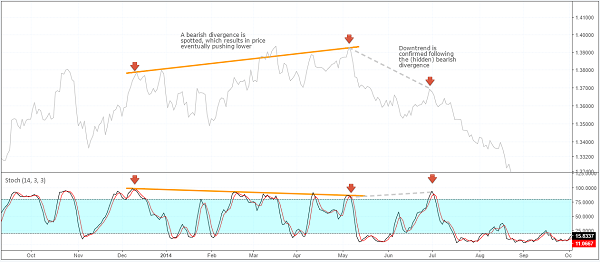
In this first article, we take a look at the background of divergence trading and understanding what causes divergence in the first place and what does it say about the markets. It is important to understand the basics of divergence before delving further into the fascinating world of divergence based trading.
Divergence based trading can be applied in a number of ways, from timing entries into a trend or as short term scalping strategies as well
Understanding divergence in the markets
Divergence is a synonym for the difference, dissimilarity or separation. Divergence was conceptualized by Charles Dow in his famous ‘Dow Theory.’ Speaking on divergence, he said, “Stock market averages must confirm each other” (not to be confused with moving averages). When Dow referred to stock market averages, he was referring to the stock indexes, namely the industrial average and railroad average. According to Dow, there was a strong relationship between the industrial and the railroad averages.
The concept of divergence was put forth by Charles Dow in his famous ‘Dow Theory’
If manufacturer’s profits were rising, it means that they are producing more goods, which translates to increasing shipping or transportation of the goods to the consumers, and thus a rising industrial average leads to a rising railroad or a transportation average.
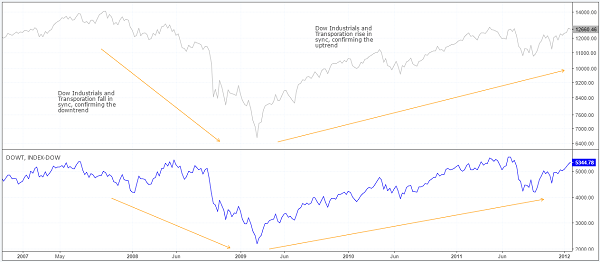
Therefore, in an uptrend, a rising industrial average is confirmed by a rising transportation average and in a downtrend, both the stock market averages tend to fall. Dow said that when one of the two averages fails to confirm one another, it was a warning sign that change was in the air.
When two securities or an indicator fails to confirm the other, it signals a divergence and a potential change in the prevailing trends.
Charles Dow went to explain in detail why this (divergence) happens.
Imagine that the industrial goods index was falling but the transportation index started to rise. This signifies that production was slowing down while the transportation index was merely clearing up the stockpiles or the available inventory. Sooner or later, once the stockpiles are shipped, the transportation index would also start to fall.
Another example would be a rising industrial goods index, which signals increased production, but a falling transportation index which is falling, signaling slower movement of inventory. If the divergence continued, industrial goods production would have to be slowed down in order for the transportation sector to keep up with the backlog of inventory or stockpiles.
As one can understand by now, Dow’s take on divergence was merely to establish a relationship between two securities that are closely related to each other and to confirm trends as long as both the securities were moving in tandem. A disconnect between the two, known as divergence is what is understood to be a caution for traders, which something was amiss.
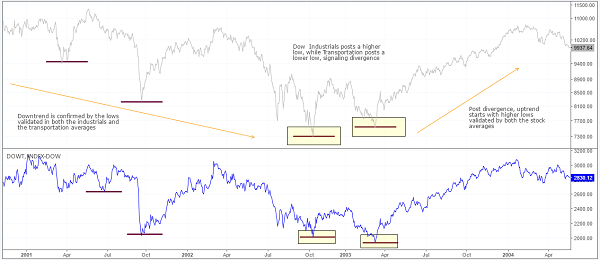
Divergences can be applied to any markets and securities. It works best when the securities being compared are dependent. For example, in Figure 4, a comparison between the Intel stock (INTC) and the Semiconductor sector (PHLX) shows two instances of divergences where the lows in price were not confirmed. Following the divergence, you can see how prices started to correct higher and embarked on a bullish rally after that.
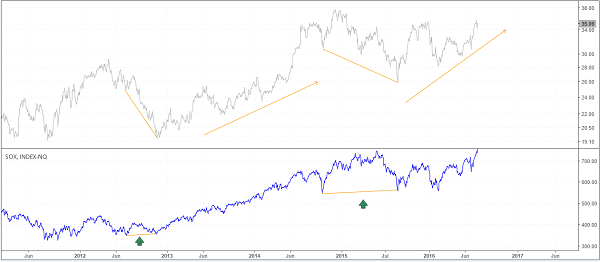
Divergence Trading: Key takeaways
- Divergence occurs when there is a disconnect between two securities or a security and an indicator
- Trends are confirmed when both the securities, or the security and the indicator move in tandem, making lows and highs
- When divergence occurs, it signals a possible change in trend or a correction
- Divergence is a phenomenon that occurs and is a leading indicator
- With divergence, traders will be able to determine the trade entry as well as potential exit points in their trend setups
- Divergence-based trading is best suited for trend following strategies, but it can be equally used in short term scalping strategies as well
In the next article in this series, we will take a look at how divergence is applied in the forex markets and the four types of divergences that are widely used.