

Sample Category Title
Loonie Trading Reverses Its Losses In The Morning Session
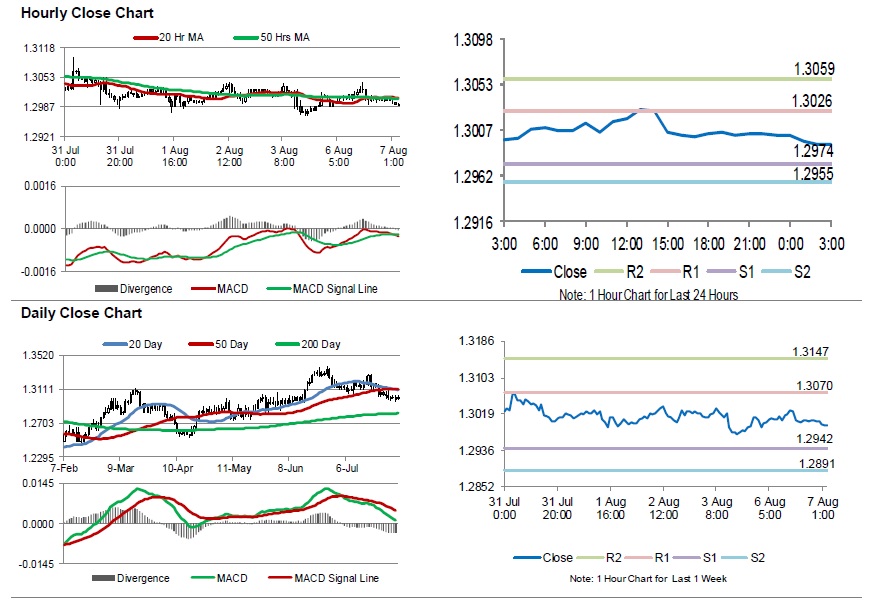
For the 24 hours to 23:00 GMT, the USD rose 0.11% against the CAD and closed at 1.3003.
In the Asian session, at GMT0300, the pair is trading at 1.2993, with the USD trading 0.08% lower against the CAD from yesterday’s close.
The pair is expected to find support at 1.2974, and a fall through could take it to the next support level of 1.2955. The pair is expected to find its first resistance at 1.3026, and a rise through could take it to the next resistance level of 1.3059.
Going forward, investors will await Canada’s Ivey purchasing managers index for July, slated to release, later in the day.
The currency pair is trading below its 20 Hr and 50 Hr moving averages.
RBA Keeps Policy Rate Unchanged
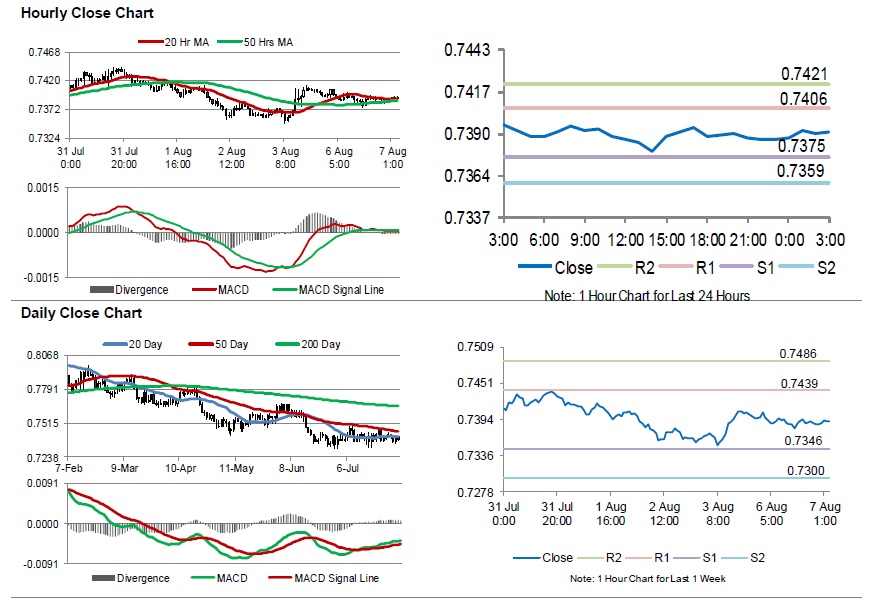
For the 24 hours to 23:00 GMT, the AUD declined 0.24% against the USD and closed at 0.7386.
LME Copper prices declined 0.7% or $15.5/MT to $6040.0/MT. Aluminium prices rose/declined 2.1% or $127.0/MT to $2000.5/MT.
In the Asian session, at GMT0300, the pair is trading at 0.7391, with the AUD trading 0.07% higher against the USD from yesterday’s close.
Overnight data showed that, Australia’s AIG performance of construction index advanced to a level of 52.0 in July, following a reading of 50.6 in the prior month.
Separately, the Reserve Bank of Australia (RBA), in its August monetary policy meeting, kept its interest rate steady at 1.50%, as widely expected.
The pair is expected to find support at 0.7375, and a fall through could take it to the next support level of 0.7359. The pair is expected to find its first resistance at 0.7406, and a rise through could take it to the next resistance level of 0.7421.
Trading trends in the Aussie today is expected to be determined by the Reserve Bank of Australia’s Governor, Philip Lowe’s speech, due overnight.
The currency pair is showing convergence with its 20 Hr and 50 Hr moving averages.
Gold: Yellow Metal Trading On A Stronger Footing In The Asian Session
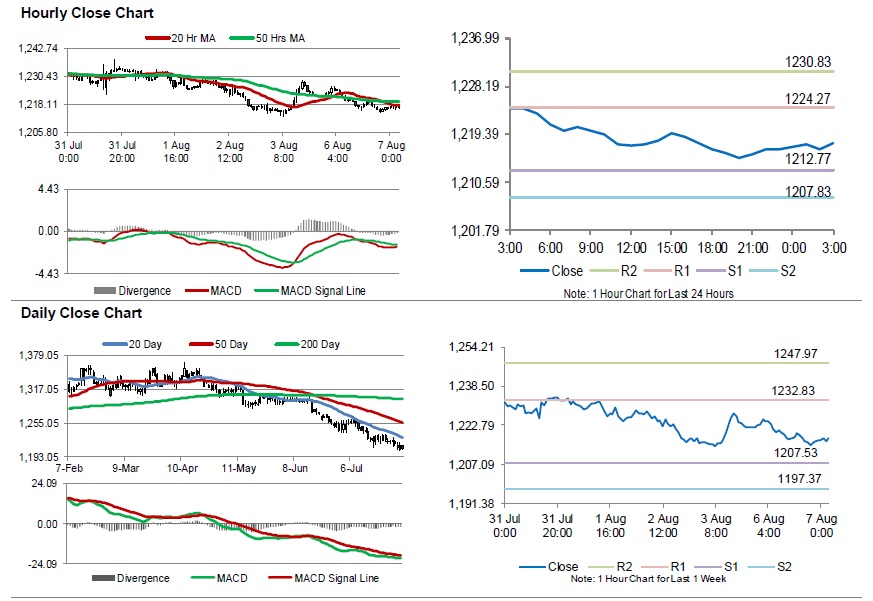
For the 24 hours to 23:00 GMT, Gold declined 0.71% against the USD and closed at USD1216.60 per ounce, amid broad strength in greenback and US equities.
In the Asian session, at GMT0300, the pair is trading at 1217.70, with gold trading 0.09% higher against the USD from yesterday’s close.
The pair is expected to find support at 1212.77, and a fall through could take it to the next support level of 1207.83. The pair is expected to find its first resistance at 1224.27, and a rise through could take it to the next resistance level of 1230.83.
The yellow metal is showing convergence with its 20 Hr moving average and trading below its 50 Hr moving average.
Silver: White Metal Reverses Its Losses In The Morning Session
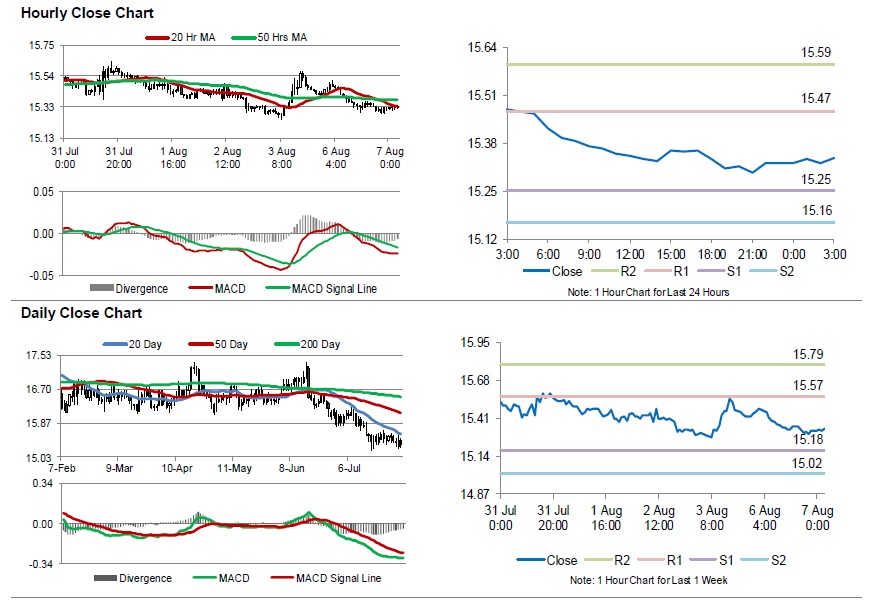
For the 24 hours to 23:00 GMT, Silver declined 1.03% against the USD and closed at USD15.33 per ounce, tracking losses in gold prices.
In the Asian session, at GMT0300, the pair is trading at 15.34, with silver trading 0.10% higher against the USD from yesterday’s close.
The pair is expected to find support at 15.25, and a fall through could take it to the next support level of 15.16. The pair is expected to find its first resistance at 15.47, and a rise through could take it to the next resistance level of 15.59.
The white metal is showing convergence with its 20 Hr moving average and trading below its 50 Hr moving average.
Crude Oil: Oil Trading Higher, Ahead Of API’s Weekly Crude Oil Inventories Data
For the 24 hours to 23:00 GMT, Crude Oil rose 0.06% against the USD and closed at USD68.90 per barrel, amid reports of a fall in Saudi Arabia's crude output and following renewed US sanctions against Iran.
In the Asian session, at GMT0300, the pair is trading at 69.09, with oil trading 0.28% higher against the USD from yesterday's close.
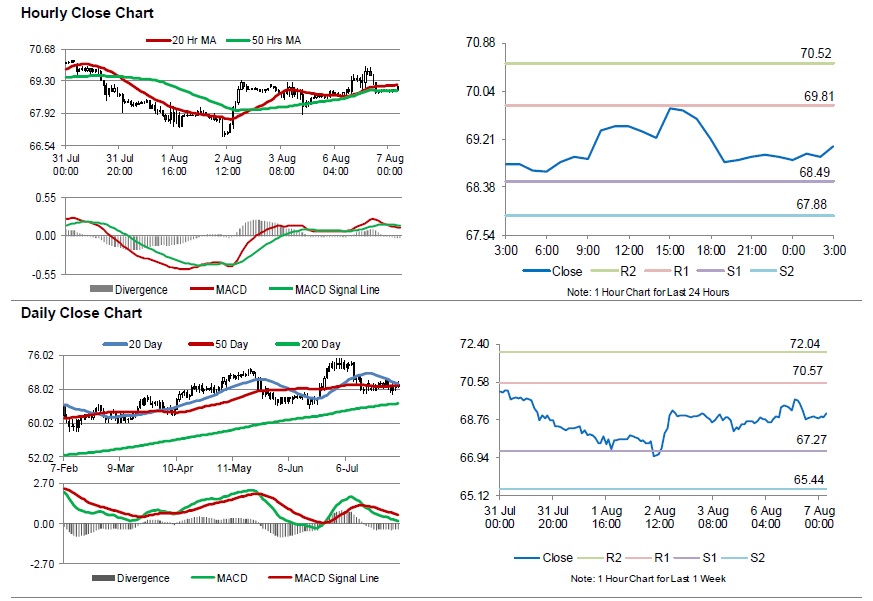
The pair is expected to find support at 68.49, and a fall through could take it to the next support level of 67.88. The pair is expected to find its first resistance at 69.81, and a rise through could take it to the next resistance level of 70.52.
Crude oil is showing convergence with its 20 Hr and 50 Hr moving averages.
AUD/USD Daily Outlook
Daily Pivots: (S1) 0.7373; (P) 0.7390; (R1) 0.7405; More...
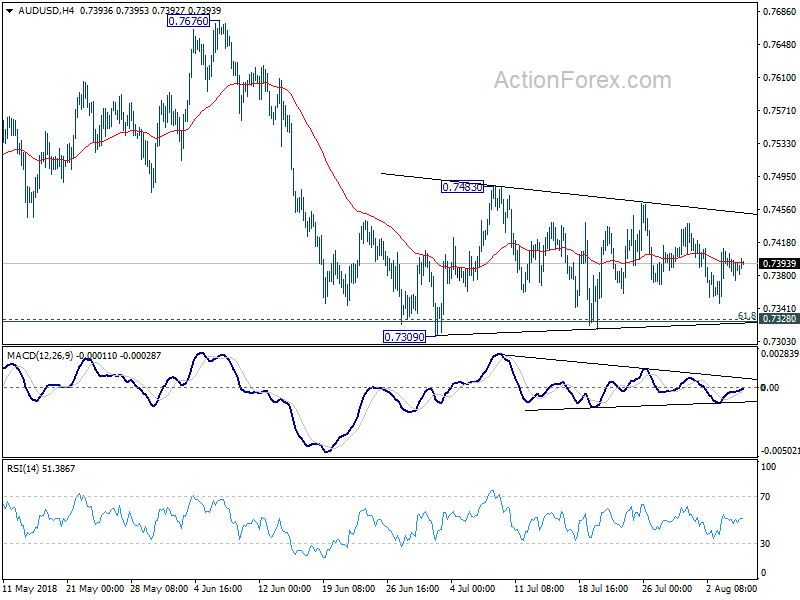
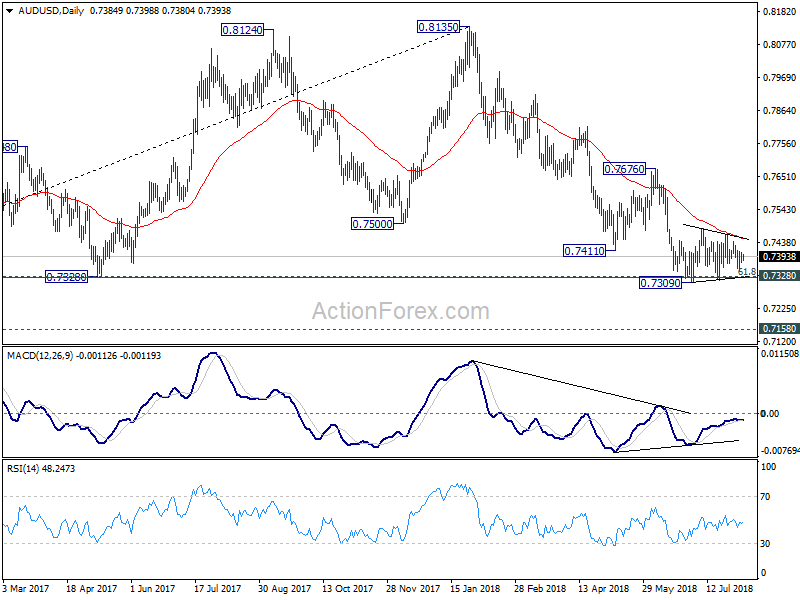
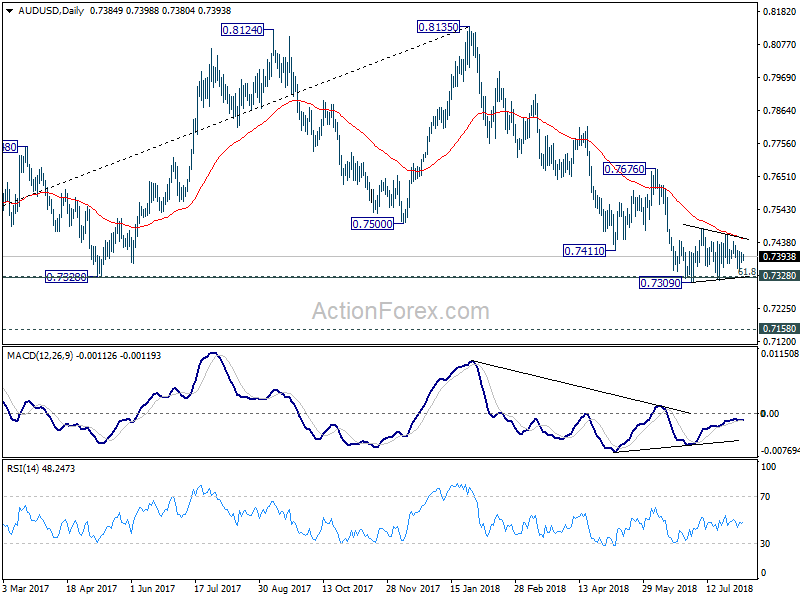
AUD/USD is still bounded in consolidation from 0.7309. Intraday bias remains neutral and more sideway trading could be seen. On the downside, break of 0.7309 and sustained trading below 0.7328 cluster support (61.8% retracement of 0.6826 to 0.8135 at 0.7326) will extend the fall from 0.8135 to 0.7158 support next. On the upside, above 0.7483 resistance will bring stronger rebound. But upside should be limited below 0.7676 resistance to bring larger fall resumption eventually.
In the bigger picture, medium term rebound from 0.6826 is seen as a corrective move that should be completed at 0.8135. Deeper decline would be seen back to retest 0.6826 low. This will now remain the favored case as long as 0.7676 resistance holds.
Australian Dollar Steady after RBA Stands Pat, Dollar Pare Gains But Stays Firm
The forex markets are rather steady in Asian session today. Dollar is paring some gains and trades slightly lower. But it remains the strongest one for the week together with Canadian Dollar. New Zealand Dollar, however, trades broadly lower as markets expect that RBNZ could be slightly dovish in the upcoming rate decision. Taking about central banks, RBA left cash rate unchanged at 1.50% as widely expected. The announcement is shrugged off by the Australian Dollar as it provides nothing new.
In other markets, US equities ended higher overnight with DOW up 0.16% to 25502.18, S&P 500 up 0.35% to 2850.40. NASDAQ's rebound was very impressive as it gained 0.61% to 7859.68. Despite the sharp pull back in late July, NASDAQ is now heading back to 7933.31 record high. US treasury yields extended decline with 10 year yield closed down -0.015 at 2.938.
In Asia, China's Shanghai SSE is trading up 1.56% at the time of writing, at 2747.38. It looks like there is a chance for SSE to defend 2700 handle again. Hong Kong HSI follows and is up 1.0%. Nikkei is up 0.61% while Singapore Strait Times is up 1.55%. Gold is back at 1210 as yesterday's sell-off slowed, but outlook stays bearish for a take on 1200 handle. WTI crude oil stays in range below 70, and there is no committed buying to push it above this 70 handle.
Technically, outlook in Dollar is mixed. EUR/USD is on course for testing 1.1507 key support even though intraday downside momentum is diminishing. GBP/USD is also staying bearish after yesterday's break of 1.2956 low. But elsewhere, there is no apparent strength in the greenback yet. AUD/USD is bounded in consolidation. USD/JPY and USD/CAD are mixed and could head lower before bottoming. Meanwhile, EUR/JPY and GBP/JPY declines slowed. But the lack of any notable strengthen in recovery affirms near term bearish outlook in both crosses.
Aussie steady after RBA kept cash rate unchanged at 1.50%
RBA kept cash rate unchanged at 1.50%. The accompanying statement is largely unchanged from the prior one. Central forecasts for the Australian economy "remains unchanged". GDP growth is expected to be "a bit above 3%" in both 2018 and 209. Household consumption remains an uncertainty for the outlook. That's primarily due to slow growth in income while debt levels are high. Also, RBA noted that drought has led to "difficult conditions in parts of the farm sector".
Latest inflation data were in line with RBA's expectations. Inflation is projected to be higher the than current 2.1% in 2019 and 2020. Nonetheless, there could be an interim dip to 1.75% in September quarter this year due to "once-off declines in some administered prices". Labor market outlook "remains positive" and further decline in unemployment rate is expected over the next few years to around 5%. But wage growth remains slow even though the pace has troughed.
Australian Dollar is steady after the release and focus will turn to Friday's Monetary Policy Statement.
Kiwi soft ahead of RBNZ rate decision
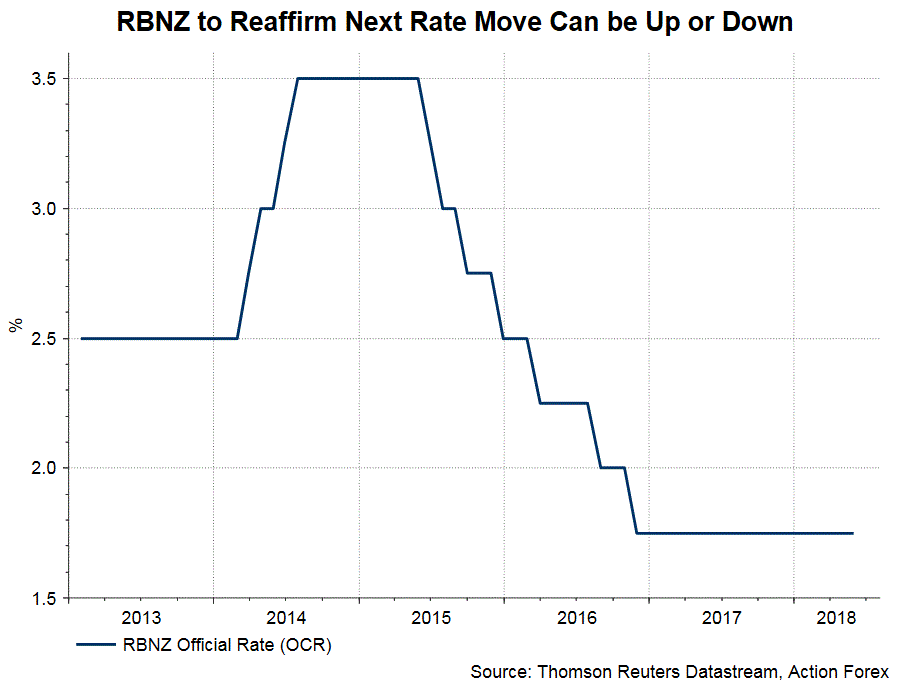
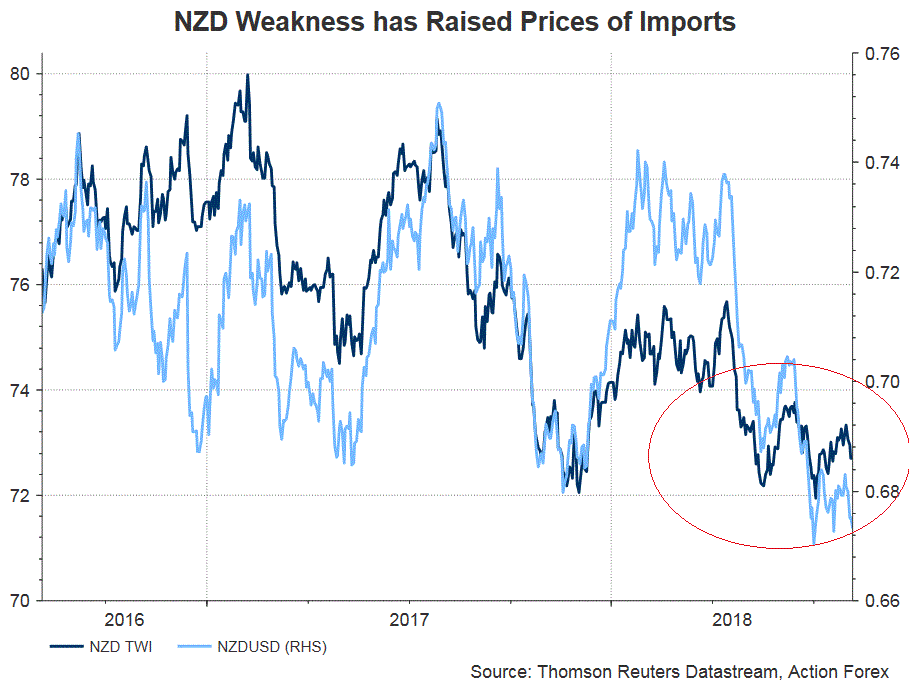
New Zealand Dollar trades generally lower ahead of RBNZ rate decision on Thursday. The central bank is widely expected to leave the OCR unchanged at 1.75% and deliver a neutral to slightly dovish policy statement. Since the June meeting, data showed that economic growth moderated while inflation picked up. In the job market, the unemployment rate climbed higher to 4.5% in 2Q18.
We expect policymakers to look through the improvement in inflation data and maintain accommodative monetary policy at least until late 2019. The central bank will likely reiterate that the next move in the OCR could be "up or down". On the updated economic forecasts, we expect the central bank to downgrade the GDP growth projection in light of recent slowdown.
More in RBNZ Preview – Policy Rate On Hold, Overall Tone Neutral or Slightly Dovish.
Confidence on UK PM May's Brexit negotiation plunged to new low
According to the latest monthly Brexit Confidence Tracker by ORB International, confidence on Prime Minister Theresa May regarding Brexit negotiation plunged again to new low in August. There was clear deterioration after the high profile Chequers meeting, which resulted in one white paper and two resignations of key cabinet ministers in Boris Johnson and David Davis.
Only 24% of respondents said they approve of the way May's government is handling Brexit negotiation. That compares to 40% back in April On the other hand, disapproval surged to 76%.
Meanwhile, only 22% are confidence that May will get the right Brexit deal. 60% believed that May won't. And the percentage of "don't know" also dropped 2% to 17%.
Japan real wages grew at fastest pace since 1997
Japan nominal labor cash earnings rose strongly by 3.6% yoy in June versus expectation of 1.7% yoy. Real wages grew 2.8% yoy, the fastest pace in 21 years since January 1997. Looking at the details, regular pay grew 1.5% yoy. One-off payment including bonuses jumped an impressive 7.0% yoy. Overtime pay also rose 3.5% yoy, a notable acceleration of 2.0% yoy in May. The set of data should be welcomed by BoJ. Nonetheless, persistent strength is needed to eventually change the "social mode" of deflation mind set, which suppresses inflation pressures. Also from Japan, overall household spending dropped -1.2% yoy in June, matched expectations.
Elsewhere, UK BRC retail sales monitor rose 0.5% yoy in July, below expectation of 1.3% yoy. Australia AiG performance of construction index rose to 52.0 in July, up from 50.6.
Looking ahead
German trade balance and industrial production will be featured in European session. Swiss will release foreign currency reserves. UK will release Halifax house price. Later in the day Canada will release Ivey PMI.
AUD/USD Daily Outlook
Daily Pivots: (S1) 0.7373; (P) 0.7390; (R1) 0.7405; More...
AUD/USD is still bounded in consolidation from 0.7309. Intraday bias remains neutral and more sideway trading could be seen. On the downside, break of 0.7309 and sustained trading below 0.7328 cluster support (61.8% retracement of 0.6826 to 0.8135 at 0.7326) will extend the fall from 0.8135 to 0.7158 support next. On the upside, above 0.7483 resistance will bring stronger rebound. But upside should be limited below 0.7676 resistance to bring larger fall resumption eventually.
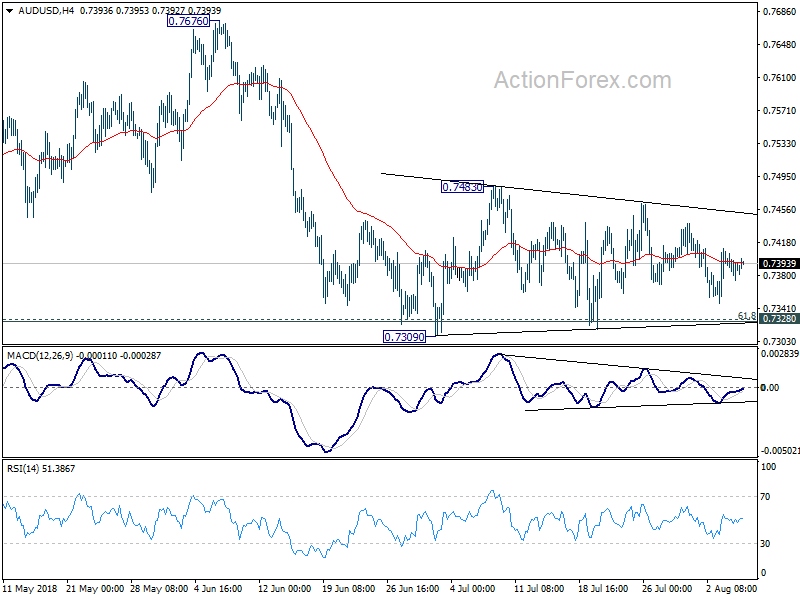
In the bigger picture, medium term rebound from 0.6826 is seen as a corrective move that should be completed at 0.8135. Deeper decline would be seen back to retest 0.6826 low. This will now remain the favored case as long as 0.7676 resistance holds.
Economic Indicators Update
| GMT | Ccy | Events | Actual | Forecast | Previous | Revised |
|---|---|---|---|---|---|---|
| 22:30 | AUD | AiG Performance of Construction Index Jul | 52 | 50.6 | ||
| 23:01 | GBP | BRC Retail Sales Monitor Y/Y Jul | 0.50% | 1.30% | 1.10% | |
| 23:30 | JPY | Overall Household Spending Y/Y Jun | -1.20% | -1.20% | -3.90% | |
| 0:00 | JPY | Labor Cash Earnings Y/Y Jun | 3.60% | 1.70% | 2.10% | |
| 4:30 | AUD | RBA Rate Decision | 1.50% | 1.50% | 1.50% | |
| 5:00 | JPY | Leading Index Jun P | 105.2 | 105.4 | 106.9 | |
| 6:00 | EUR | German Trade Balance Jun | 21.4B | 20.3B | ||
| 6:00 | EUR | German Industrial Production M/M Jun | -0.50% | 2.60% | ||
| 7:00 | CHF | Foreign Currency Reserves (CHF) Jul | 749B | |||
| 7:30 | GBP | Halifax House Prices M/M Jul | 0.20% | 0.30% | ||
| 14:00 | CAD | Ivey PMI Jul | 64.2 | 63.1 |
RBNZ Preview – Policy Rate On Hold, Overall Tone Neutral or Slightly Dovish
At the August 9 meeting (this Thursday), we expect RBNZ to leave the OCR unchanged at 1.75% and deliver a neutral to slightly dovish policy statement. Since the June meeting, data showed that economic growth moderated while inflation picked up. In the job market, the unemployment rate climbed higher to 4.5% in 2Q18.
We expect policymakers to look through the improvement in inflation data and maintain accommodative monetary policy at least until late 2019. The central bank will likely reiterate that the next move in the OCR could be “up or down”. On the updated economic forecasts, we expect the central bank to downgrade the GDP growth projection in light of recent slowdown.
RBNZ to lower GDP growth forecasts
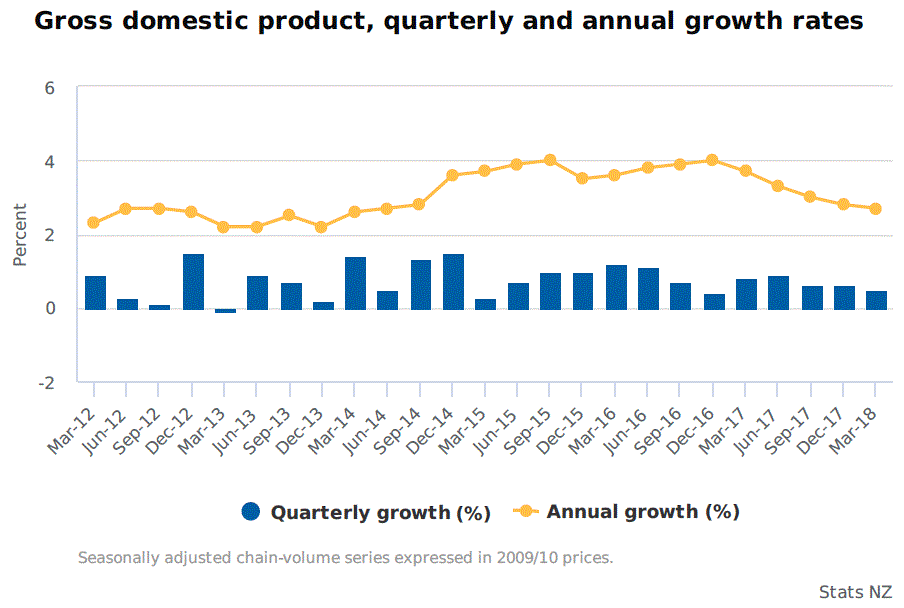
GDP growth slowed to +0.5% q/q in 1Q18 from +0.6% in the prior quarter. The annual growth, at +2.7%, also marked the weakest in almost 4 years. Meanwhile, business confidence weakened further.
According to NZIER’s Quarterly Survey of Business Opinion (QSBO), a net 19% of businesses expect deterioration in economic conditions in 2Q18, compared with 10% in the previous quarter. As suggested in the accompanying statement, firms’ expectations of future demand eased, “with fewer businesses expecting improved demand over the next quarter”. This signals “softer economic growth in the second half of 2018”.
As such, we expect RBNZ to revise lower its GDP growth forecasts. In May, the central bank projected GDP growth to reach +3% this year, before peaking at +3.3% in 2019, and then slowing to + 3.1% in 2020.
 RBNZ to gauge inflation data cautiously despite uptick
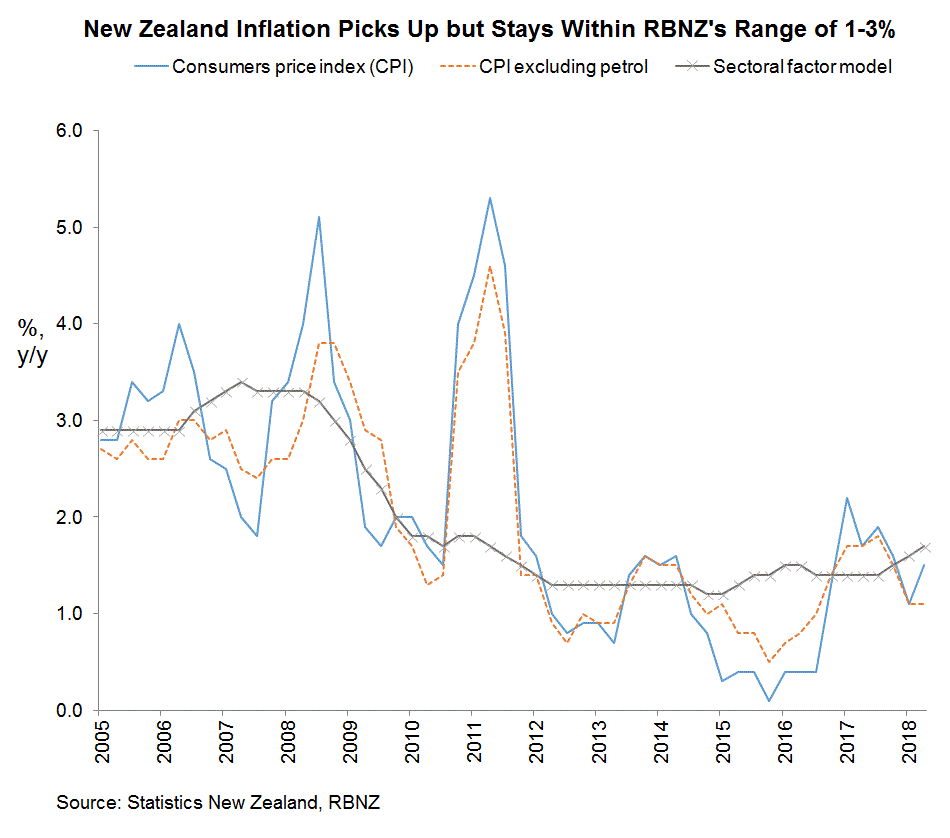
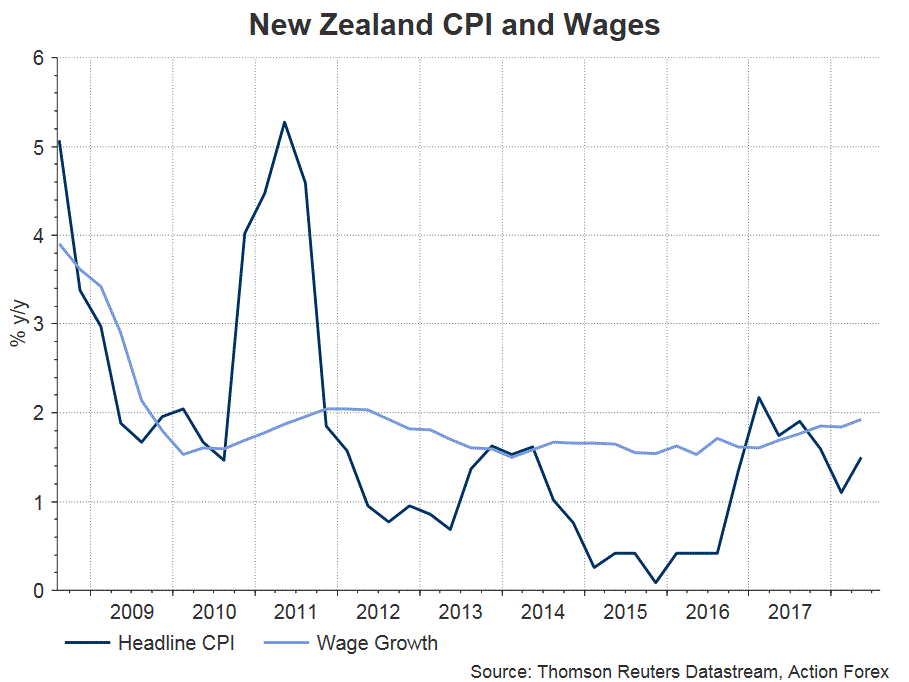
On inflation, headline CPI rose +0.4% q/q, and 1.5% y/y, in 2Q18, accelerated from +0.5% q/q and 1.1% y/y from the prior quarter. The strong growth was driven by house rents and the rise in global fuel prices. Notably, the sectoral factor model CPI rose to a 7-year high of +1.7% y/y for the quarter. Meanwhile, there have been continuous improvements since last year from +1.4% in 3Q17 to +1.5% in 4Q17 to +1.6% in 1Q18.
The sectoral factor model CPI, one of RBNZ’s preferred core inflation gauge, estimates the common component of inflation in the CPI basket, the tradable basket, and the non-tradable basket, based upon separate factors for the tradable and non-tradable sectors. The data excludes GST. While the second quarter data suggests that inflation is moving towards RBNZ’s +2% target, the board members would likely prefer to gauge the data more cautiously.
Job market resilient despite slight rise in unemployment rate
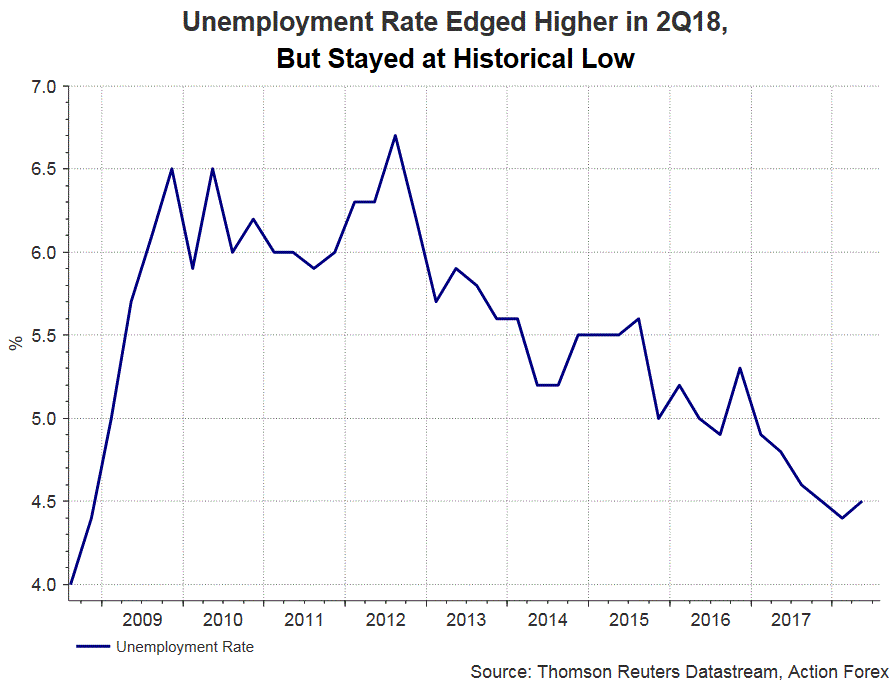
Although unemployment rate rose marginally to 4.5% in 2Q18, from the 9-year low of 4.4% in the prior quarter, the job market has remained resilient. First, the rise in the unemployment rate was a result of the increase in the participation rate to 70.9%, from 70.8% in 1Q18. The number of people employed actually increased by +0.5%. Second, wage growth rose to +0.6%, up from +0.3% in the first quarter, reflecting a tighter job market and the rise in minimum wages, by +NZ$ 0.75, to NZ$ 16.5/hour from April.
RBNZ to keep interest low for some time
Recent economic developments have been mixed. Rising inflation has stayed at comfortable levels. Meanwhile, moderating economic growth and softness in business confidence might ease the pace of improvement in the general price levels in coming months. This should help reinforce the central bank’s stance to leave the policy rate at low level for some time.
RBA kept cash rate unchanged at 1.50%, full statement
RBA kept cash rate unchanged at 1.50%.
The RBA statement is largely unchanged from the prior one. Central forecasts for the Australian economy "remains unchanged". GDP growth is expected to be "a bit above 3%" in both 2018 and 209. Household consumption remains an uncertainty for the outlook. That's primarily due to slow growth in income while debt levels are high. Also, RBA noted that drought has led to "difficult conditions in parts of the farm sector".
Latest inflation data were in line with RBA's expectations. Inflation is projected to be higher the than current 2.1% in 2019 and 2020. Nonetheless, there could be an interim dip to 1.75% in September quarter this year due to "once-off declines in some administered prices". Labor market outlook "remains positive" and further decline in unemployment rate is expected over the next few years to around 5%. But wage growth remains slow even though the pace has troughed.
Full statement below.
Statement by Philip Lowe, Governor: Monetary Policy Decision
At its meeting today, the Board decided to leave the cash rate unchanged at 1.50 per cent.
The global economic expansion is continuing. A number of advanced economies are growing at an above-trend rate and unemployment rates are low. Growth in China has slowed a little, with the authorities easing policy while continuing to pay close attention to the risks in the financial sector. Globally, inflation remains low, although it has increased in some economies and further increases are expected given the tight labour markets. One uncertainty regarding the global outlook stems from the direction of international trade policy in the United States.
Financial conditions remain expansionary, although they are gradually becoming less so in some countries. There has been a broad-based appreciation of the US dollar over recent months. In Australia, money-market interest rates are higher than they were at the start of the year, although they have declined somewhat since the end of June. These higher money-market rates have not fed through into higher interest rates on retail deposits. Some lenders have increased mortgage rates by small amounts, although the average mortgage rate paid is lower than a year ago.
The Bank's central forecast for the Australian economy remains unchanged. GDP growth is expected to average a bit above 3 per cent in 2018 and 2019. This should see some further reduction in spare capacity. Business conditions are positive and non-mining business investment is continuing to increase. Higher levels of public infrastructure investment are also supporting the economy, as is growth in resource exports. One continuing source of uncertainty is the outlook for household consumption. Household income has been growing slowly and debt levels are high. The drought has led to difficult conditions in parts of the farm sector.
Australia's terms of trade have increased over the past couple of years due to rises in some commodity prices. While the terms of trade are expected to decline over time, they are likely to stay at a relatively high level. The Australian dollar remains within the range that it has been in over the past two years.
The outlook for the labour market remains positive. The vacancy rate is high and other forward-looking indicators continue to point to solid growth in employment. Employment growth continues to be faster than growth in the working-age population. A further gradual decline in the unemployment rate is expected over the next couple of years to around 5 per cent. Wages growth remains low. This is likely to continue for a while yet, although the improvement in the economy should see some lift in wages growth over time. Consistent with this, the rate of wages growth appears to have troughed and there are increased reports of skills shortages in some areas.
The latest inflation data were in line with the Bank's expectations. Over the past year, the CPI increased by 2.1 per cent, and in underlying terms, inflation was close to 2 per cent. The central forecast is for inflation to be higher in 2019 and 2020 than it is currently. In the interim, once-off declines in some administered prices in the September quarter are expected to result in headline inflation in 2018 being a little lower than earlier expected, at 1¾ per cent.
Conditions in the Sydney and Melbourne housing markets have continued to ease and nationwide measures of rent inflation remain low. Housing credit growth has declined to an annual rate of 5½ per cent. This is largely due to reduced demand by investors as the dynamics of the housing market have changed. Lending standards are also tighter than they were a few years ago, partly reflecting APRA's earlier supervisory measures to help contain the build-up of risk in household balance sheets. There is competition for borrowers of high credit quality.
The low level of interest rates is continuing to support the Australian economy. Further progress in reducing unemployment and having inflation return to target is expected, although this progress is likely to be gradual. Taking account of the available information, the Board judged that holding the stance of monetary policy unchanged at this meeting would be consistent with sustainable growth in the economy and achieving the inflation target over time.
(RBA) Statement by Philip Lowe, Governor: Monetary Policy Decision
At its meeting today, the Board decided to leave the cash rate unchanged at 1.50 per cent.
The global economic expansion is continuing. A number of advanced economies are growing at an above-trend rate and unemployment rates are low. Growth in China has slowed a little, with the authorities easing policy while continuing to pay close attention to the risks in the financial sector. Globally, inflation remains low, although it has increased in some economies and further increases are expected given the tight labour markets. One uncertainty regarding the global outlook stems from the direction of international trade policy in the United States.
Financial conditions remain expansionary, although they are gradually becoming less so in some countries. There has been a broad-based appreciation of the US dollar over recent months. In Australia, money-market interest rates are higher than they were at the start of the year, although they have declined somewhat since the end of June. These higher money-market rates have not fed through into higher interest rates on retail deposits. Some lenders have increased mortgage rates by small amounts, although the average mortgage rate paid is lower than a year ago.
The Bank's central forecast for the Australian economy remains unchanged. GDP growth is expected to average a bit above 3 per cent in 2018 and 2019. This should see some further reduction in spare capacity. Business conditions are positive and non-mining business investment is continuing to increase. Higher levels of public infrastructure investment are also supporting the economy, as is growth in resource exports. One continuing source of uncertainty is the outlook for household consumption. Household income has been growing slowly and debt levels are high. The drought has led to difficult conditions in parts of the farm sector.
Australia's terms of trade have increased over the past couple of years due to rises in some commodity prices. While the terms of trade are expected to decline over time, they are likely to stay at a relatively high level. The Australian dollar remains within the range that it has been in over the past two years.
The outlook for the labour market remains positive. The vacancy rate is high and other forward-looking indicators continue to point to solid growth in employment. Employment growth continues to be faster than growth in the working-age population. A further gradual decline in the unemployment rate is expected over the next couple of years to around 5 per cent. Wages growth remains low. This is likely to continue for a while yet, although the improvement in the economy should see some lift in wages growth over time. Consistent with this, the rate of wages growth appears to have troughed and there are increased reports of skills shortages in some areas.
The latest inflation data were in line with the Bank's expectations. Over the past year, the CPI increased by 2.1 per cent, and in underlying terms, inflation was close to 2 per cent. The central forecast is for inflation to be higher in 2019 and 2020 than it is currently. In the interim, once-off declines in some administered prices in the September quarter are expected to result in headline inflation in 2018 being a little lower than earlier expected, at 1¾ per cent.
Conditions in the Sydney and Melbourne housing markets have continued to ease and nationwide measures of rent inflation remain low. Housing credit growth has declined to an annual rate of 5½ per cent. This is largely due to reduced demand by investors as the dynamics of the housing market have changed. Lending standards are also tighter than they were a few years ago, partly reflecting APRA's earlier supervisory measures to help contain the build-up of risk in household balance sheets. There is competition for borrowers of high credit quality.
The low level of interest rates is continuing to support the Australian economy. Further progress in reducing unemployment and having inflation return to target is expected, although this progress is likely to be gradual. Taking account of the available information, the Board judged that holding the stance of monetary policy unchanged at this meeting would be consistent with sustainable growth in the economy and achieving the inflation target over time.