Sample Category Title
USDCAD Turns To Bearish Correction But Maintains In Upward Trend
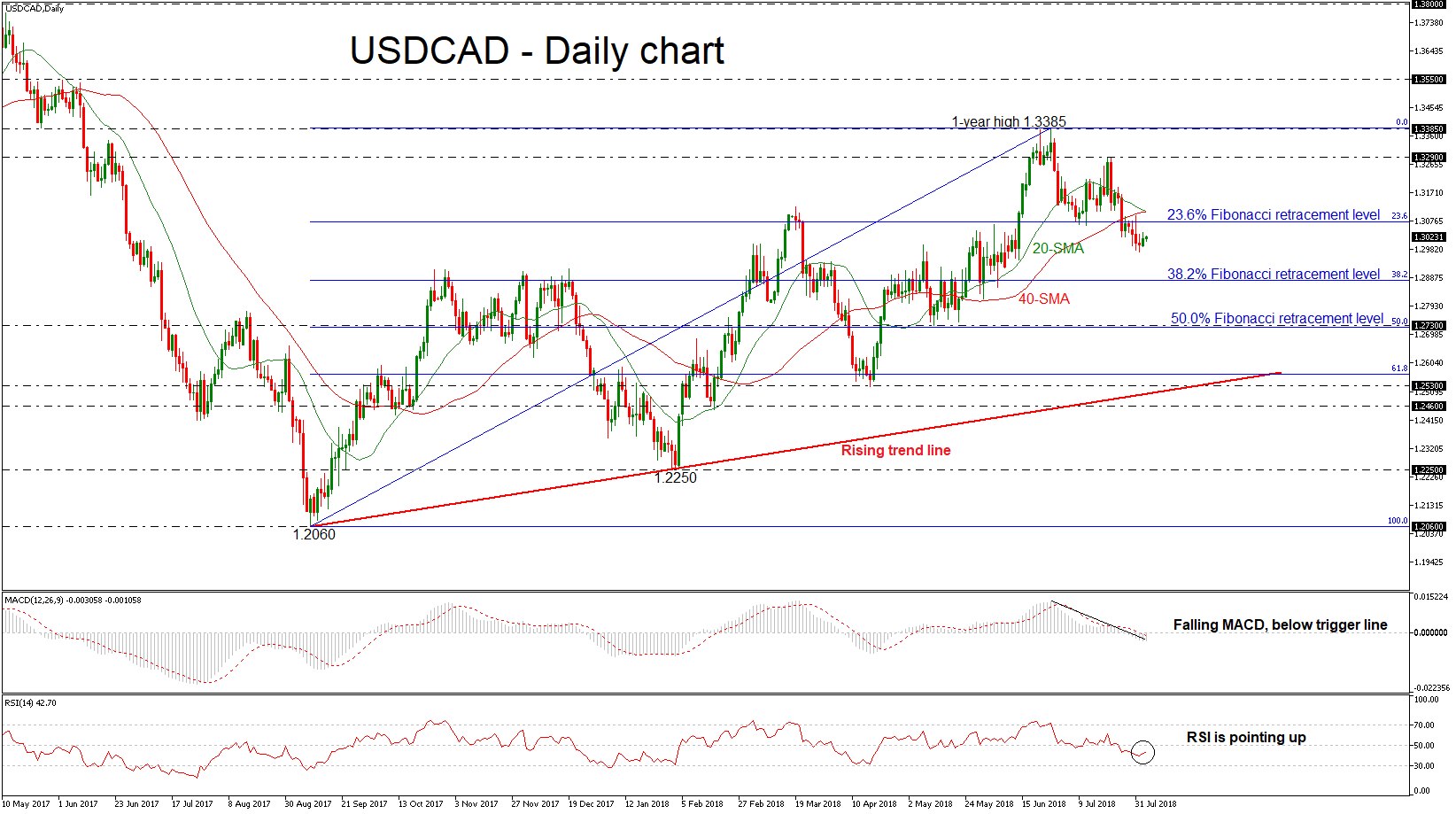
USDCAD formed a fresh seven-week bottom at 1.2974 on August 1 in the daily timeframe after the downfall below the strong obstacle of the 23.6% Fibonacci retracement level of the upleg from 1.2060 to 1.3385, around 1.3074. The pair seems to be in a bearish correction mode as the technical indicators are confirming the scenario for a possible downside pressure.
The RSI and the MACD have both weakened, with the former sloping slightly up below the 50 level and the latter easing below its red trigger and zero lines. Also, the 20- and 40- simple moving averages (SMAs) are ready to record a bearish crossover in the short-term.
Should the price decline further, traders could look for support at the 38.2% Fibonacci region near 1.2880. A fail attempt to hold above this level could open the door for the 50.0% Fibonacci, which stands near the 1.2730 barrier. Even lower, the area near the 61.8% Fibonacci and the medium-term ascending trend line could be another target for the bears.
On the upside, the zone within the 1.3074 and 1.3110, outlined by the 23.6% Fibonacci and the moving averages, could provide immediate resistance. Beyond this area, resistance could then run towards the 1.3290 price level, taken from the peak on July 19. A bullish rally above this hurdle could open the way for the one-year high of 1.3385.
Having a look at the bigger picture, dollar/loonie has been trading within an ascending movement since September 2017, but in the short-term, the price seems to be in a retracement mode over the last five weeks.
Dollar Stands At 2-Week Highs Ahead Of US Jobs Report
Here are the latest developments in global markets:
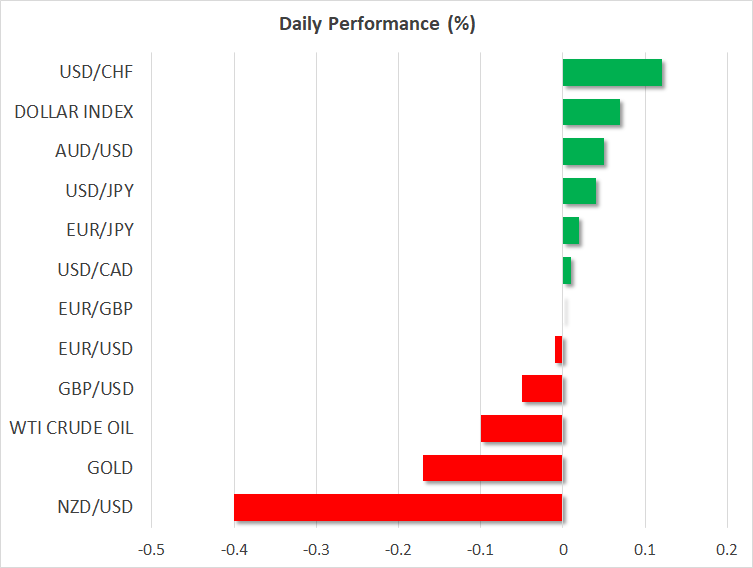
FOREX: The dollar was up on the margin versus a basket of currencies on Friday and at a two-week high after rising considerably on Thursday. The outcome of the US jobs report due later today, as well as any developments on global trade may constitute the next catalysts to steer the currency in either direction.
STOCKS: The Dow Jones finished Thursday’s trading marginally lower, with the S&P 500 and Nasdaq Composite edging higher by 0.5% and 1.2%. Of note yesterday was that Apple reached the $1 trillion valuation milestone, with its shares closing at an all-time high, up 2.9%. In Asian markets, the Japanese Nikkei 225 moved marginally higher and the Topix lost 0.5%. Hong Kong’s Hang Seng was down, though by less than 0.1% after declining notably yesterday. Meanwhile, worries over global trade remain front and center, weighing on equity market sentiment. At 0650 GMT, futures markets were pointing to a higher open for major European indices, with market participants perhaps viewing yesterday’s losses as an opportunity to buy the dip. Contracts on the Dow, S&P and Nasdaq 100 were little changed.
COMMODITIES: WTI posted some gains yesterday after earlier falling to its lowest since June 22 of $66.92 per barrel. The rise came on the back of signs that the drain from a key US supply hub will continue. Today, both WTI and Brent crude were not much changed at $68.89 and $73.36 per barrel respectively. In precious metals, gold was down by 0.1%, trading not far above the near 13-month low of $1,204.91 hit earlier in the day. The dollar-denominated metal is suffering on the back of the greenback’s strength and also looks unable to attract safe-haven flows stemming from trade uncertainty.
Major movers: Dollar elevated ahead of employment report; yuan hits fresh low on trade concerns
The dollar’s index against a basket of six major currencies was last trading in proximity to its highest since July 20 of 95.231 hit earlier on Friday. The greenback was posting some moderate gains that allowed it to build on yesterday’s strong rise.
China’s offshore yuan recorded its lowest level versus the greenback since May 2017, with USDCNH – up 0.25% – touching 6.8992 and last challenging that peak to extend even higher. Traders are apparently viewing China as having much more to lose from entering into a trade dispute with the US, given that the trade imbalance between the two parties heavily favors the world’s second largest economy. Perhaps, though, markets are not acknowledging that China has other ways of responding to US tariff actions beyond just retaliating with counter tariffs. In the meantime, China yesterday pledged to not stay put if the US went ahead with its threat to further raise tariffs on its exports.
Dollar/yen was up by less than 0.05% at 111.70, with the US and Japan anticipated to hold their first bilateral trade talks in Washington next week. The meetings might be used to forge an alliance of some sorts against China.
The euro and sterling were mostly unchanged against the US currency, trading not far above their two-week low levels posted earlier on Friday of $1.1574 and $1.3000 correspondingly; both lost significant ground against the USD on Thursday. Sterling initially gained yesterday on the unexpected 9-0 vote in favor of a rate increase by Bank of England policymakers, though it later plunged, more than giving up on earlier advances. The pound’s losses were induced by Governor Carney who dampened the rate-normalization outlook and expressed worries about the risks of a cliff-edged Brexit.
Elsewhere, aussie/dollar was up, though not by much, unable to gain from upbeat retail sales figures released earlier on Friday as a deteriorating trade outlook continues to act as a drag on the currency. Kiwi/dollar was down by a notable 0.4%.
Lastly, the Turkish lira recorded a fresh all-time low relative to the dollar as worsening relationships between the US and Turkey over the imprisonment of an American pastor, as well as an ever-poorer economic outlook in Turkey, are hurting the currency.
Day ahead: US NFP report takes center stage; trade story remains in focus
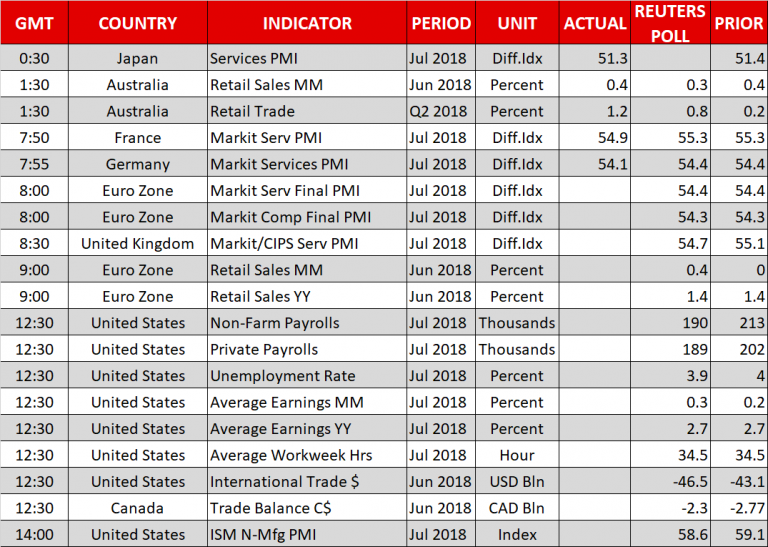
The US nonfarm payrolls report due at 1230 GMT will be the big release of the day, with traders once again eyeing wage growth data which can affect inflationary pressures and thus the Federal Reserve’s rate outlook.
According to economic forecasters, the US economy added 190k positions during July, which compares to June’s 213k; despite the decline this still constitutes a robust number. Meanwhile, the unemployment rate is projected to tick down to 3.9%, after climbing to 4.0% in June. Turning to average earnings, which are again expected to be in the spotlight, they are projected to expand by 0.3% m/m – above June’s 0.2% –, something which would maintain the year-over-year pace of growth at 2.7% for the third straight month.
Firmer wage growth figures as reflected by the reading on average earnings have the capacity to spur price pressures and thus lead to a more aggressive Fed tightening cycle, consequently boosting the greenback. At the moment, Fed funds futures show that market participants have fully priced in an additional 25bps interest rate increase by the US central bank in 2018, while they assign a 63% chance for a second one, which would put the total number of quarter percentage point rate hikes during the year at four. Relatively strong wage growth on Friday can push those odds further up, with the opposite holding true as well.
Staying in the US, June trade stats will be gathering attention at 1230 GMT amid the latest threats from the US to increase its import tariffs on Chinese goods; the relevant deficit is predicted to widen to $46.5 billion, from May’s $43.1bn. In May, rising exports drove the US international trade deficit to the lowest in 19 months, though, the trade gap with China widened further. Another deterioration in June could potentially add fuel to Trump’s protectionist mindset. Meanwhile, Canada is scheduled to deliver its respective trade report at the same time.
Later in the day (at 1400 GMT), the US’ ISM non-manufacturing PMI for the month of July is projected to decline by 0.5 points to 58.6.
Earlier in the eurozone, the economic calendar will be featuring final July PMI and June retail sales figures at 0800 GMT and 0900 GMT respectively, with the latter being of greater importance to the euro. Markit’s composite and services PMIs are expected at 54.3 and 54.4 in July, in line with previous estimates. As regards retail sales, which are somewhat of a proxy for household spending, they’re expected to have expanded at May’s annual pace of 1.4%, while month-on-month, the print is forecast to rise by 0.4% after posting no growth in the previous month.
In the UK, the Markit/CIPS services PMI is due at 0800 GMT; unlike the eurozone, the UK sees only one and final release, which might render the pound more sensitive to the data. Expectations are for the gauge to fall by 0.4 points to 54.7 in July.
In energy markets, the Baker Hughes count of active US oil rigs is due at 1700 GMT.
A meeting between UK PM Theresa May and French President Emmanuel Macron that is expected to touch on Brexit issues is of interest, with any headlines having the potential to prove sterling-sensitive.
Technical Analysis – USDJPY trades flat ahead of nonfarm payrolls
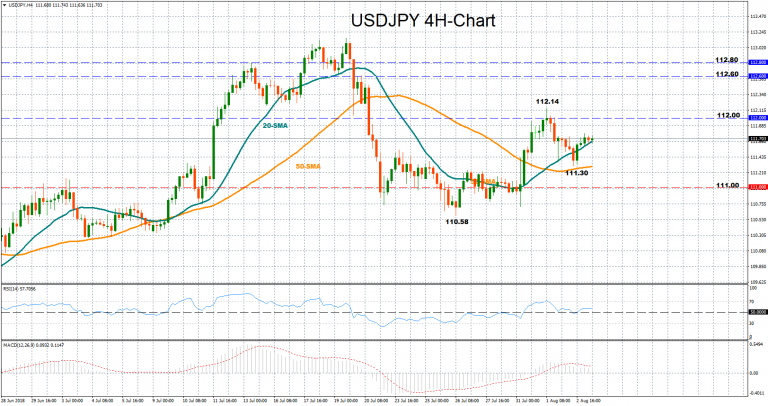
USDJPY managed to rebound after it found support at 111.30 on Thursday, but on Friday the pair paused positive momentum, moving sideways around 111.70. The RSI returned to bullish territory above 50, however it seems to be losing steam at the moment, largely moving sideways. The MACD supports this view as well, moving close to its red signal line.
In case of an upbeat NFP employment report however, the dollar could decisively return to bullish mode, stretching towards the 112 round-level before it tests the August 1 high of 112.14. Steeper increases could also target the area between 112.60 and 112.80 which was somewhat congested earlier in July.
On the other hand, disappointing numbers could pressure the dollar and send the pair down to the recent low of 111.30. If this level fails to hold, bears could try to break below the 111-round level, with scope to reach the 110.58 bottom touched on July 26. Further declines below that area could bring the bearish outlook back into play.
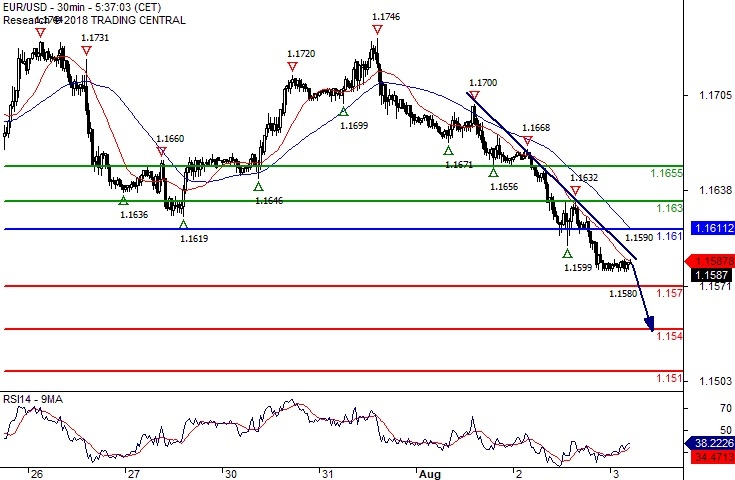
EUR/USD 1.1570 Expected
Pivot (invalidation): 1.1610
Our preference Short positions below 1.1610 with targets at 1.1570 & 1.1540 in extension.
Alternative scenario Above 1.1610 look for further upside with 1.1630 & 1.1655 as targets.
Comment A break below 1.1570 would trigger a drop towards 1.1540.
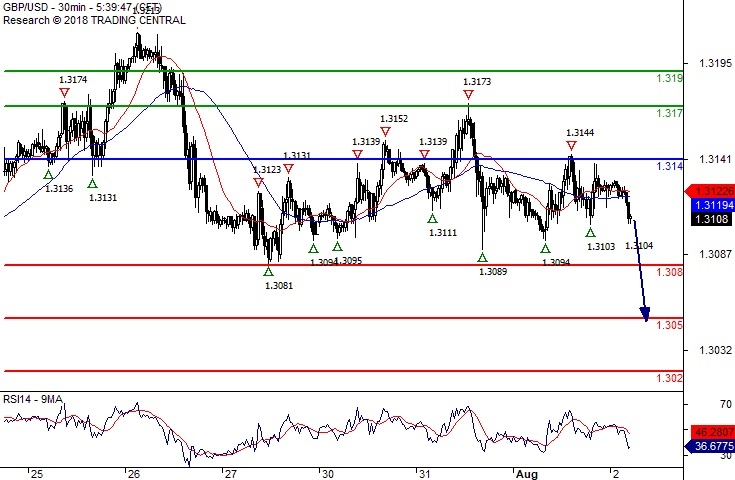
GBP/USD The Downside Prevails
Pivot (invalidation): 1.3050
Our preference Short positions below 1.3050 with targets at 1.3000 & 1.2965 in extension.
Alternative scenario Above 1.3050 look for further upside with 1.3095 & 1.3140 as targets.
Comment A break below 1.3000 would trigger a drop towards 1.2965.
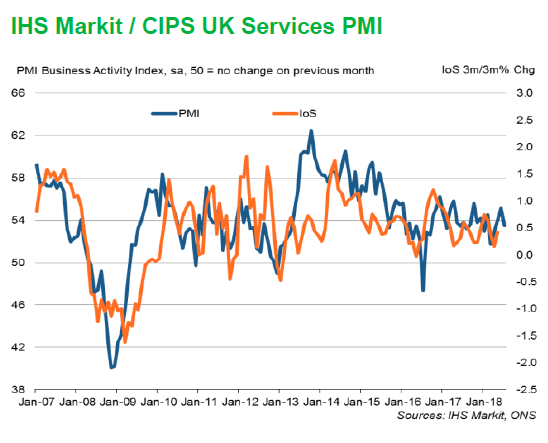
UK PMI services dropped to 53.5, back into slow lane
UK PMI services dropped to 53.5 in July, down from 55.1 and missed expectation of 54.7.
Tim Moore, Associate Director at IHS Markit, which compiles the survey:
"The service sector moved back into the slow lane in July as business activity growth lost momentum for the first time since the start of spring. While it's difficult to quantify the precise impact of the recent heat wave on overall business performance, some survey respondents reported that a combination of hot weather and the World Cup had weighed on consumer footfall. These short-term disruptions and a general slowdown in new business growth appear to have offset the boost to tourism-related activity from the extended dry period in July.
"Looking at demand fundamentals, service providers commented that Brexit uncertainty had held back new project wins, reflecting risk aversion and a wait-and-see approach to investment spending among international clients.
"Tight labour market conditions and rising wage pressures are also a key challenge for service sector companies, which contributed to the slowest pace of job creation since August 2016. Survey respondents are increasingly citing worries about the availability of suitably skilled candidates to fill vacancies, although this is also helping drive efforts to boost productivity across the service sector.
"Meanwhile, input cost inflation eased back from June's nine-month high, which helped to moderate the rate at which service sector firms increased their own charges. The combination of slower output growth and softer price pressures during July will reinforce expectations that any further Bank of England rate rises will be both gradual and limited."
USD/JPY The Bias Remains Bullish
Pivot (invalidation): 111.50
Our preference Long positions above 111.50 with targets at 111.80 & 112.00 in extension.
Alternative scenario Below 111.50 look for further downside with 111.30 & 111.15 as targets.
Comment Even though a continuation of the consolidation cannot be ruled out, its extent should be limited.
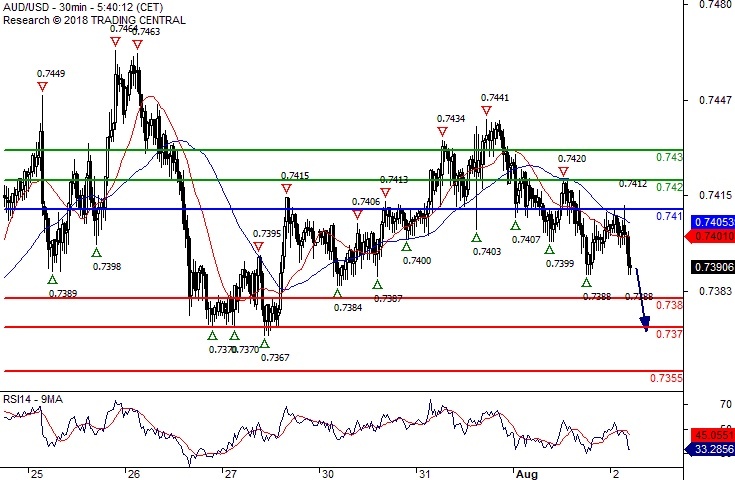
AUD/USD Key Resistance At 0.7385
Pivot (invalidation): 0.7385
Our preference Short positions below 0.7385 with targets at 0.7350 & 0.7330 in extension.
Alternative scenario Above 0.7385 look for further upside with 0.7400 & 0.7420 as targets.
Comment As Long as the resistance at 0.7385 is not surpassed, the risk of the break below 0.7350 remains high.
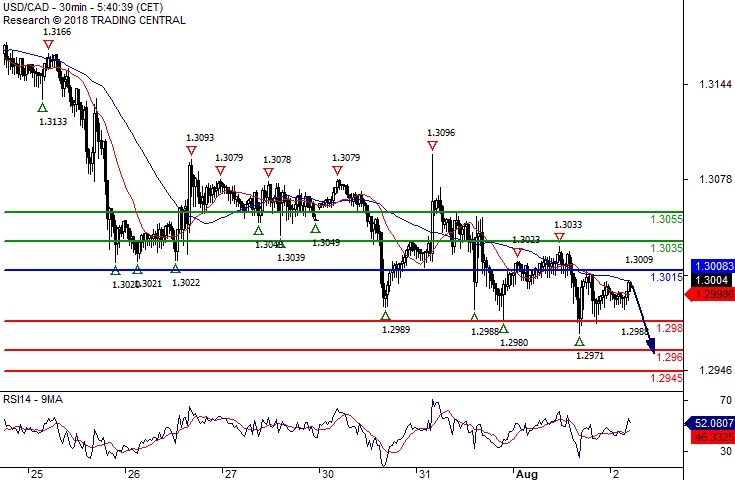
USD/CAD Limited Upside
Pivot (invalidation): 1.3000
Our preference Long positions above 1.3000 with targets at 1.3040 & 1.3060 in extension.
Alternative scenario Below 1.3000 look for further downside with 1.2970 & 1.2945 as targets.
Comment Even though a continuation of the consolidation cannot be ruled out, its extent should be limited.
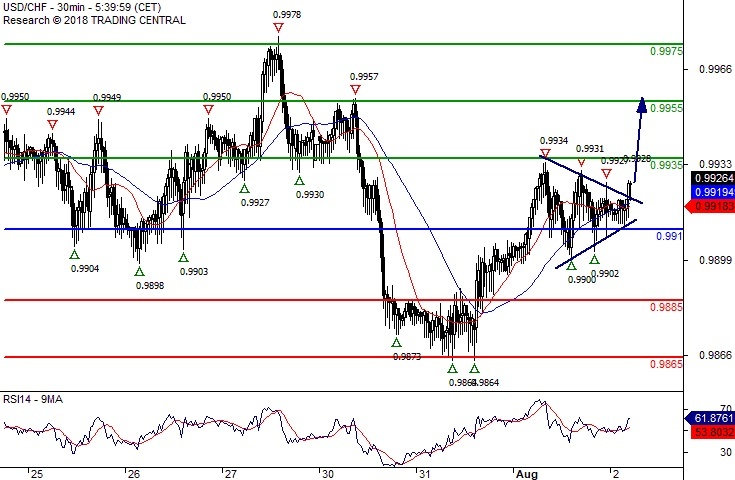
USD/CHF Target 0.9975
Pivot (invalidation): 0.9930
Our preference Long positions above 0.9930 with targets at 0.9975 & 1.0000 in extension.
Alternative scenario Below 0.9930 look for further downside with 0.9910 & 0.9885 as targets.
Comment Technically the RSI is above its neutrality area at 50.
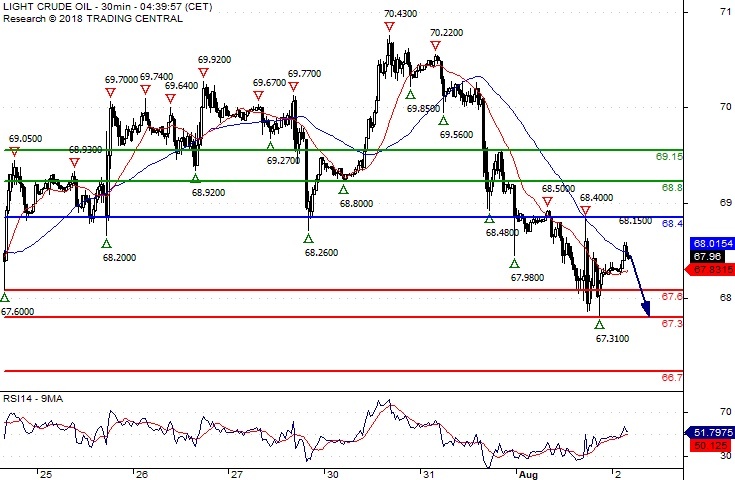
Crude Oil Further Advance
Pivot (invalidation): 68.40
Our preference Long positions above 68.40 with targets at 69.35 & 69.90 in extension.
Alternative scenario Below 68.40 look for further downside with 68.00 & 67.40 as targets.
Comment The RSI is mixed to bullish.