Sample Category Title
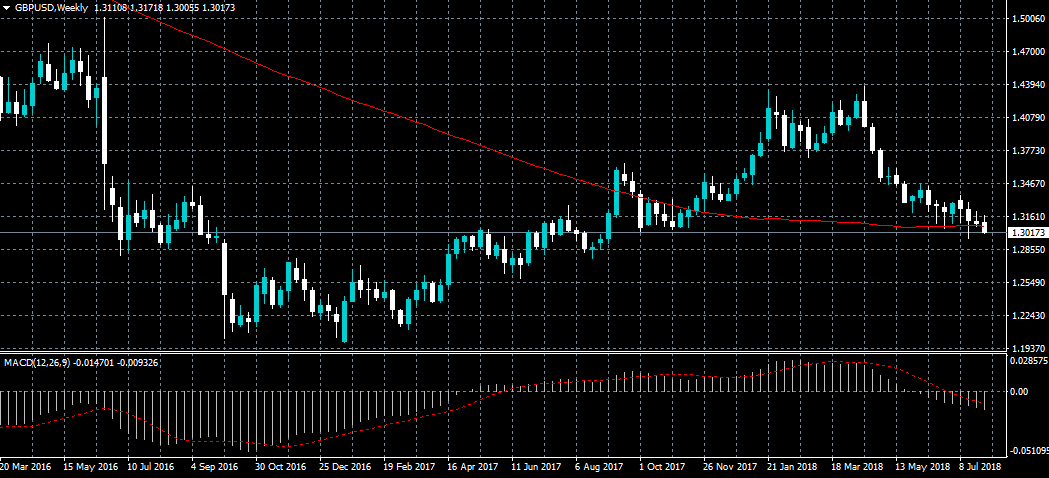
GBPUSD Strongly Bearish Below 1.3070
The British pound has come under heavy selling pressure against the US Dollar, after the Bank of England raised interest rates, but stated that any future rate hikes would be gradual and limited. The GBPUSD pair is now strongly bearish below the 1.3070 level, as represents the pairs 100-week moving average and the neckline of a bearish head and shoulders neckline break. Sellers will try to break the 1.3000 support level, while buyers attempt to stabilize price above the 1.3070 resistance level.
The GBPUSD pair is strongly bearish while trading below the 1.3070 level, key support remains at the 1.3000 and 1.2958 levels.
If the GBPUSD pair moves above the 1.3070 level, buyers will likely target the 1.3101 and 1.3150 resistance levels.
EURUSD Strongly Bearish Below 1.1620
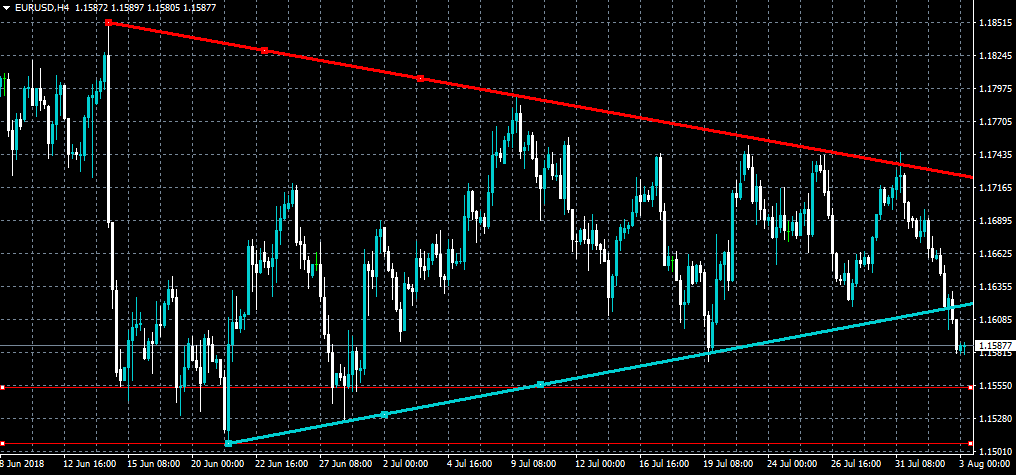
The euro currency has fallen below the 1.1600 support level against the US dollar, after a key technical break below the previously mentioned symmetrical triangle pattern. The EURUSD pair retains a strong intraday bearish bias while trading below the 1.1620 level. Sellers will now target the 1.1508 support level, while buyers need to hold price above 1.1620 resistance level.
The EURUSD pair is strongly bearish while trading below the 1.1620 level, key support is now found at the 1.1550 and 1.1508 levels.
If the EURUSD pair trades above the 1.1620 level, buyers may test toward the 1.1630 and 1.1650 resistance levels.
Nonfarm Payrolls Friday
US nonfarm payrolls, the most closely watched data release of the month, will be released today. Another solid month of jobs creation could be a boon to the US dollar as traders double down on multiple interest rate hikes by the Federal Reserve later this year.
Action begins at 07:15 GMT with a spate of European PMI reports covering Spain, Switzerland, Italy, France, Germany and the 19-member Eurozone. The Eurozone Composite PMI, which tracks business conditions in the manufacturing and services sectors, is forecast to come in at 54.4.
The European Commission's statistical agency will report on retail sales a 09:00 GMT. Receipts at retail stores are forecast to rise 0.4% in June after flatlining the month before. In annual terms, this translates into a gain of 1.4%.
The US Labor Department will report on nonfarm payrolls at 12:30 GMT. US employers likely added 190,000 workers to payrolls last month, following a net gain of 213,000 in June. The unemployment rate is projected to fall to 3.9% from 4% even as workforce participation increases.
Average hourly earnings – a key proxy for wage inflation – are projected to rise 0.3% on month and 2.7% year-over-year.
Earlier in the week, payrolls processor ADP Inc. said private-sector payrolls increased by 219,000 in July compared with 181,000 the month before.
Separately, the Department of Commerce will release the latest trade figures at 12:30 GMT. Washington's deficit with the rest of the world likely rose to $46.5 billion in June from $43.1 billion the month before.
Later in the session, the Institute for Supply Management (ISM) will release its monthly gauge of services activity. The ISM non-manufacturing PMI is projected to come in at 58.6 in July compared with 59.1 the month before.
EUR/USD
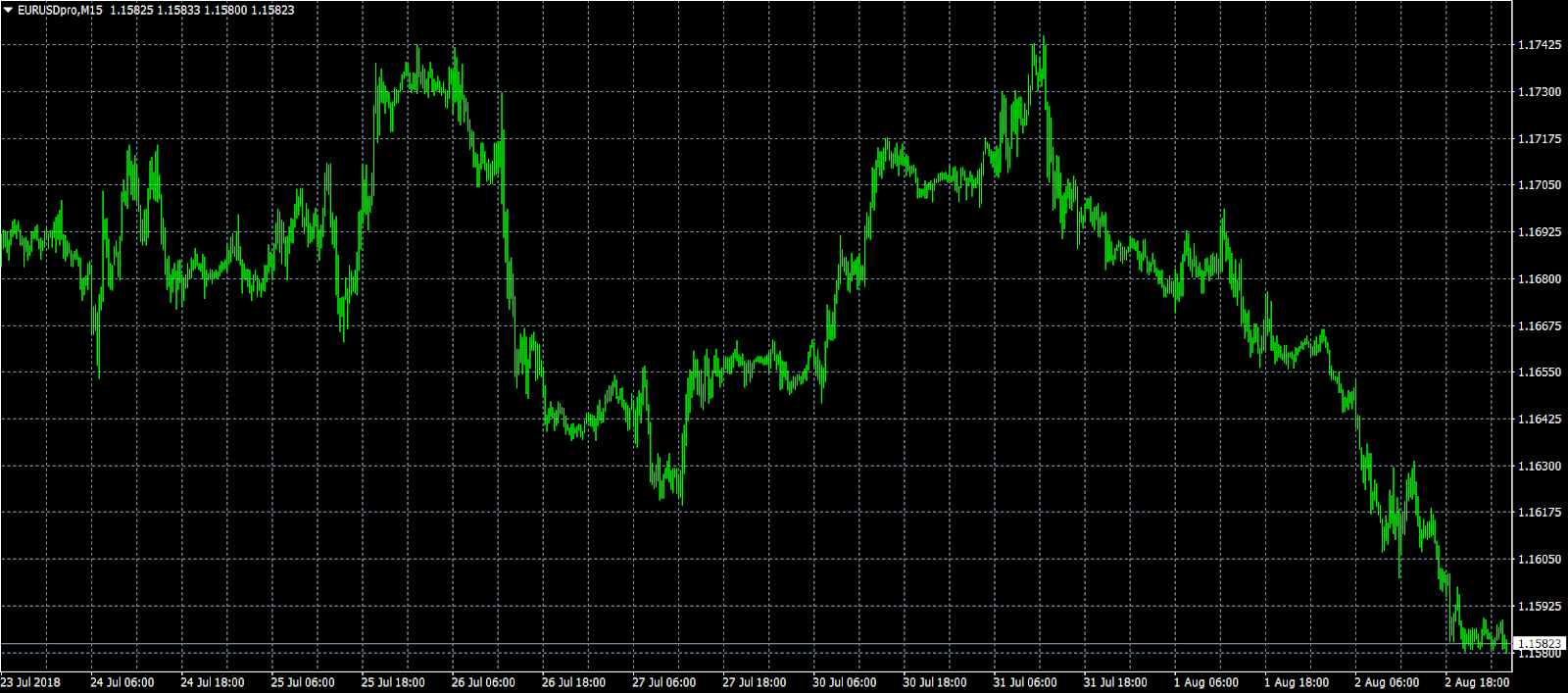
Europe's common currency has been on a downward spiral for most of the week, with prices falling back below 1.1600 US. At the time of writing, EUR/USD was trading at 1.1582, where it was little changed compared with the previous close. Immediate support is located at 1.1600. On the flipside, resistance is likely found at 1.1635.
AUD/USD
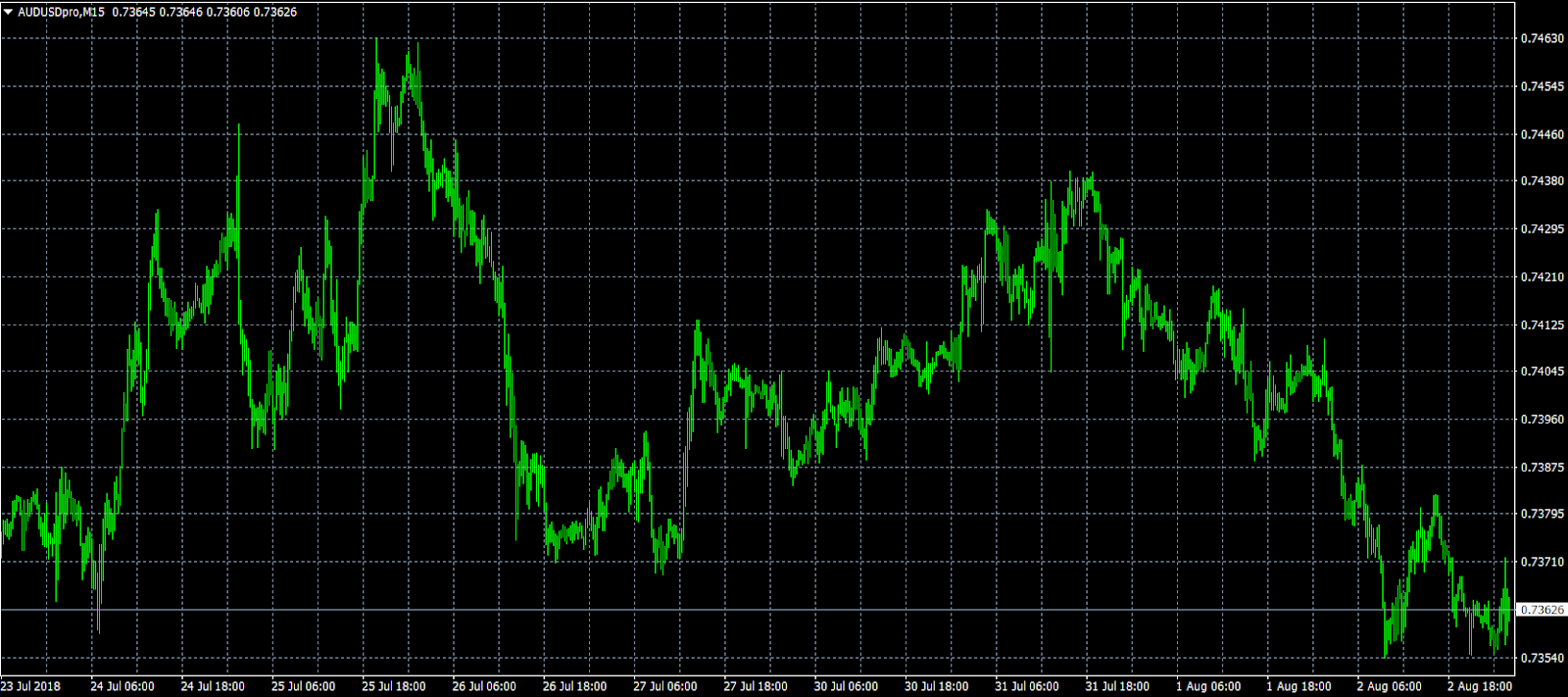
The Australian dollar was little changed on Friday after China, its largest trading partner, reported a slowdown in service-sector activity. AUD/USD is currently trading around 0.7363. The pair peaked near 0.7450 earlier in the week. In terms of technical levels, the pair faces immediate support near 0.7310, which corresponds with the year-to-date low.
USD/JPY
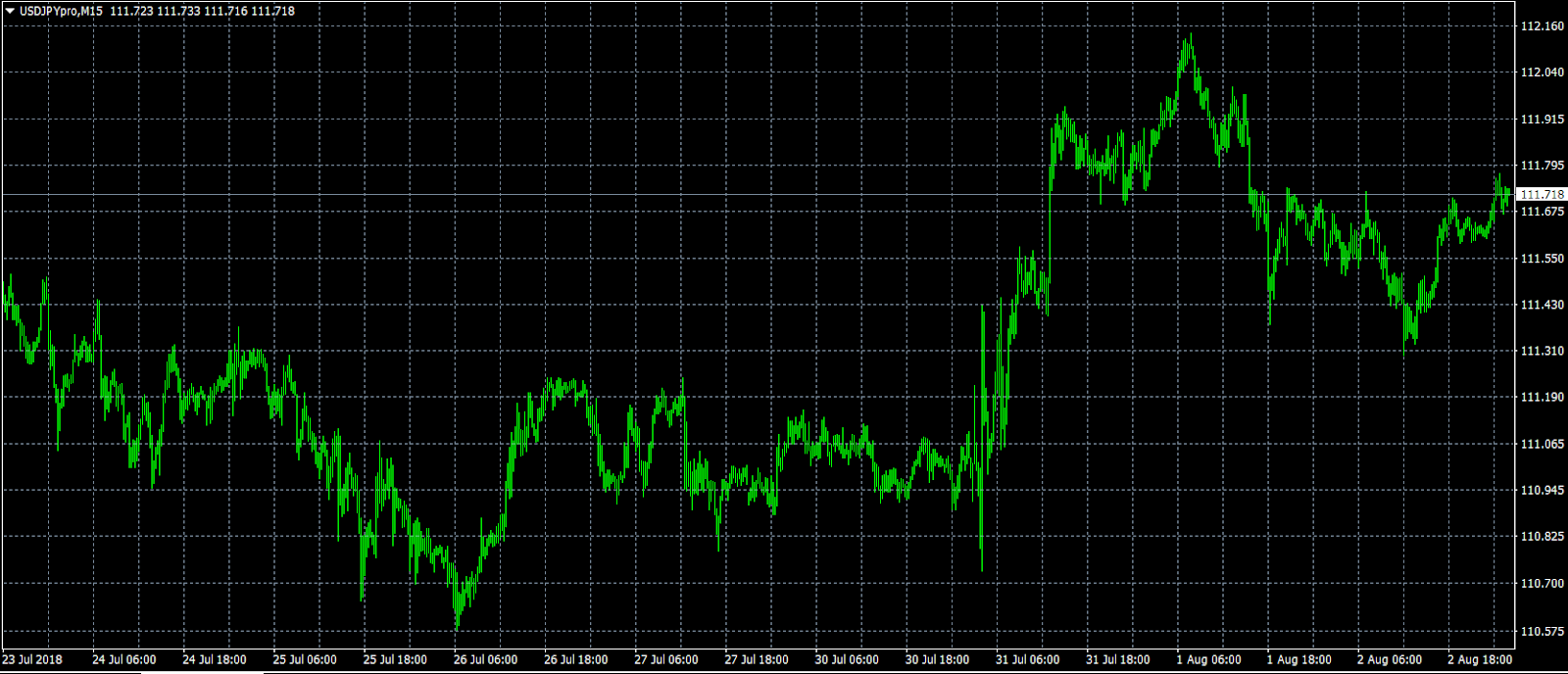
The USD/JPY exchange rate is showing signs of strength this week, as the bulls continue to target the 112.00 level. The pair peaked at 112.14 on Wednesday but has since fallen back down to around 111.74. Immediate support is located in the 111.25 region, followed by 111.00. On the opposite side of the spectrum, immediate resistance is located at 112.55.
USD/JPY Builds Bearish Wave 1-2 Within ABC Pattern
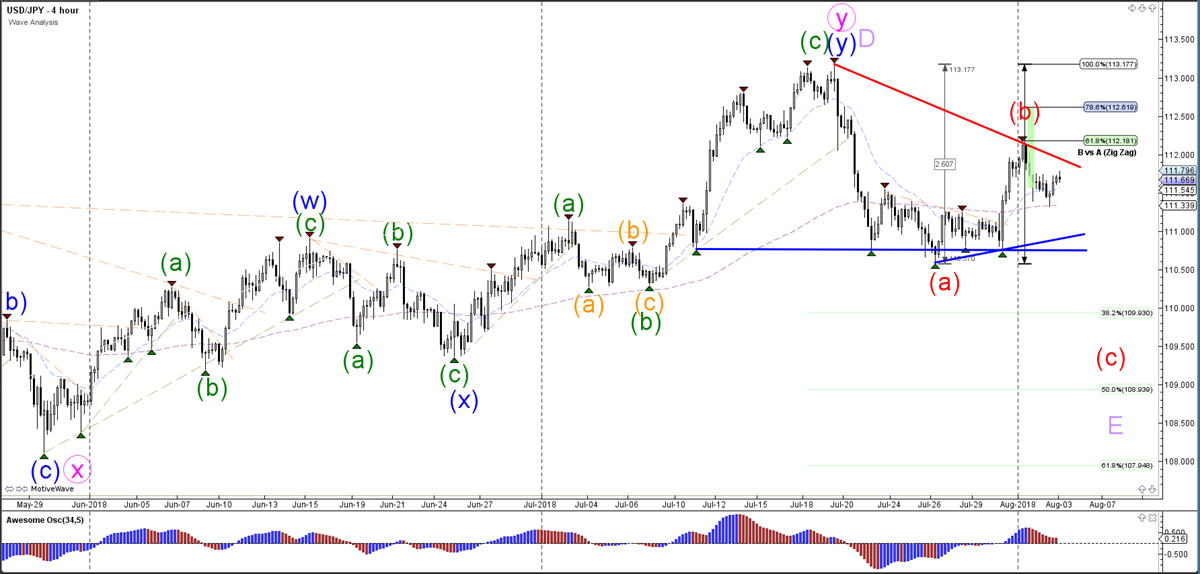
The USD/JPY is probably building a bearish ABC (red) pattern within wave E (purple). The support and resistance trend lines remain critical for any potential bullish or bearish breakout. Another key level is the previous top because a break above the 100% Fib level invalidates the ABC pattern (red). A bullish rebound is expected once price completes the wave E.
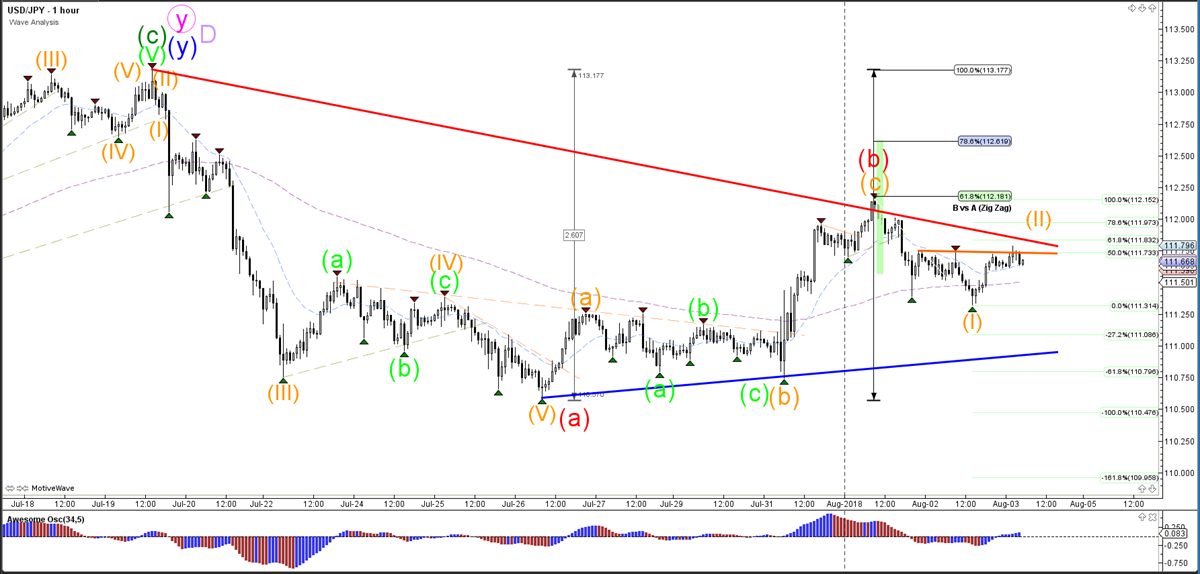
The USD/JPY seems to have completed bearish wave 1 (orange) and price is now building a retracement within wave 2 (orange). The wave 2 is invalidated if price breaks above the 100% Fibonacci level. Price could be starting a wave 3 if it manages to break below the support trend line (green).
EUR/USD: Bearish Momentum Challenges Support Zone Of Range Pattern
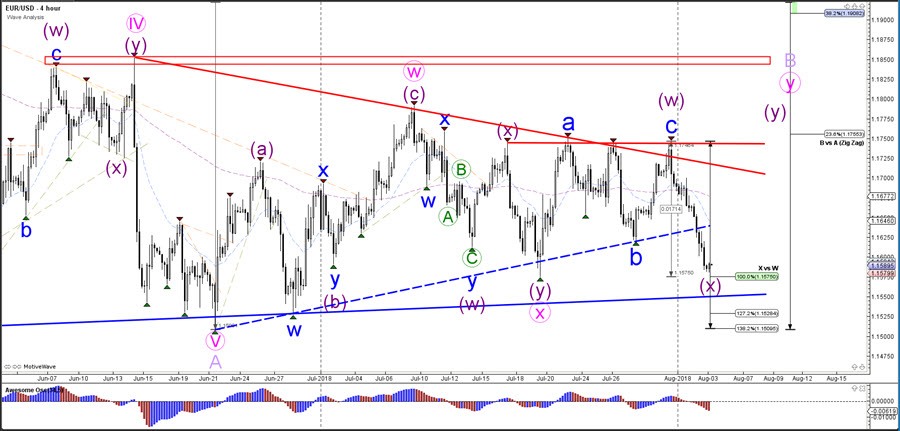
The EUR/USD fell down towards the bottom of the sideways range (blue line) and 100% Fibonacci level of wave X (purple), which is a new decision zone for a bullish bounce or bearish breakout.
The EUR/USDis building a large corrective pattern and consolidation zone. Price has again reached the bottom and potential support. A larger bullish correction is possible via a WXY (purple) pattern unless price breaks below the support trend line. A bearish breakout is certainly possible when considering the strong bearish momentum.
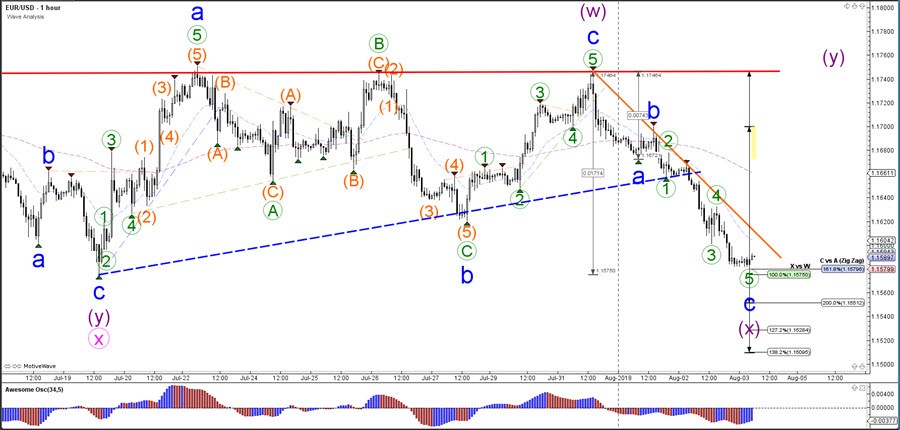
The EUR/USD could have completed an ABC (blue) zigzag pattern but it depends how the price patterns that develop at the Fibonacci targets. If price moves sideways and builds a bear flag pattern, then a wave 3 rather than a wave C (blue) becomes a more likely scenario. A strong bullish bounce and break above the resistance trend line (orange) however would confirm the development of an ABC within wave X.
Today’s Main Event Is The US Labour Market Report
Market movers today
Today's main event is the US labour market report. We expect the NFP number to be 190,000, slightly below the consensus estimate, and we expect the unemployment rate to decline back below the 4% mark to land at 3.9%. We expect unchanged 0.2% m/m average hourly earnings from last time, below the 0.3% consensus estimate. None of the data is likely to change our expectation of another two rate hikes by the FOMC this year.
In the US, we also get US non-manufacturing. We expect a slightly lower reading than last time but still at a very high level in an historical context.
We do not expect the final PMIs in euroland to move the market, as we expect the final estimates to be close to the flash readings. At 11:00 CEST, retail sales data are due out.
We expect UK services to fall to 54.9 from 55.1, not far from consensus of 54.7.
In the Scandi area, we expect the Norwegian unemployment rate to rebound to 2.4% due to seasonality. We also get Norwegian housing market data and our Swedish housing market indicator is also due out this morning.
Selected market news
Yesterday, the Bank of England increased the Bank Rate from 0.50% to 0.75% as expected but the unanimous vote (9-0) was slightly surprising. The BoE thinks very much like the Federal Reserve, as it believes the strong growth and tighter labour market will lead to higher wage growth and hence underlying inflation pressure (Philips curve thinking). We think the Bank of England will continue to hike around once a year and our base case is for the next hike to come in May. For our full take, see Bank of England Review 6 Tight labour market will cause BoE to keep hiking , 2 August.
As expected, FX reserves data released yesterday showed Danmarks Nationalbank made no intervention in the Danish FX market in July.
Depending on what happens today in the stock market, S&P 500 has increased five weeks in a row, which is the longest streak in 2018 , also driven by a strong earnings season, as 85% of the almost 400 companies in the S&P 500 that have reported earnings have exceeded expectations (Apple is the first US company with a market value above USD1,000bn). Still, stocks have become more volatile this year, due partly to the ongoing trade tension between US and China, where it is difficult to see a deal in the near-term. Yesterday, the Commerce Secretary Wilbur Ross said that the US should continue putting pressure on China. Asian stocks are mixed, ending the worst week since March. USD/CNY has risen sharply in a short period and is trading at the highest level since 2017, as China has eased economic policy.
Elliott Wave Analysis: NASDAQ Ready To Rally Higher?
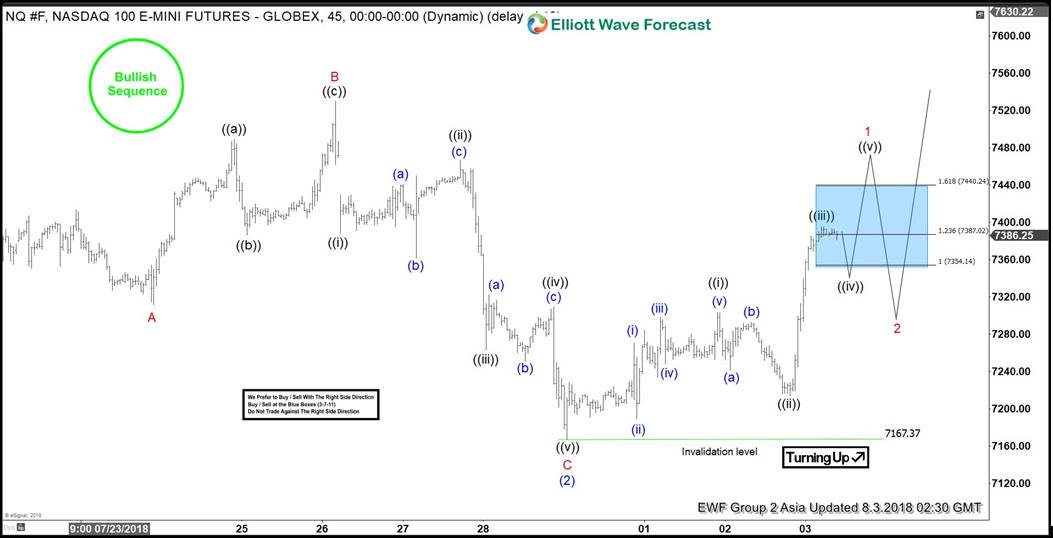
NASDAQ futures: ticker symbol NQ_F short-term Elliott wave analysis suggests that the decline to $7167.37 low ended intermediate wave (2) pullback. The internals of that pullback unfolded as Elliott Wave Flat correction where Minor wave A ended at $7311.50 low. Above from there, the bounce to $7530 high ended Minor wave B bounce as Elliott wave Zigzag where Minute wave ((a)) ended at $7489.75 high, Minute wave ((b)) pullback ended at $7386.75 low and Minute wave ((c)) of B ended at $7530 high.
Down from there, the index declined in 5 waves lower within Minor wave C. The first leg lower Minute wave ((i)) ended at $7388.5. Up from there, the bounce to $7467 high ended Minute wave ((ii)) and then the decline to $7263.50 low ended Minute wave ((iii)). Minute wave ((iv)) bounce ended at $7309.25 and the last leg Minute wave ((v)) of C ended at $7167.37 low. This last leg also completed Intermediate wave (2) pullback. Near-term, while dips remain above $7167.37 low, expect the Index to do a nesting to resume the the next leg higher. A break above $7530 (irregular wave B) however is needed for final confirmation to avoid a double correction lower. We don’t like selling the index.
NASDAQ 1 Hour Elliott Wave Chart
Euro-Zone’s Producer Prices Climbed More-Than-Anticipated In June
For the 24 hours to 23:00 GMT, the EUR declined 0.66% against the USD and closed at 1.1664.
In the economic news, Euro-zone's producer price index advanced to 3.6% on yearly basis in June, more than market consensus for a rise to 3.5%. In the preceding month, the index had recorded a gain of 3.0%.
The US dollar gained ground against a basket of currencies, amid mounting trade tensions between the US and China.
In the US, data showed that US factory orders climbed 0.7% on a monthly basis in June, rising for the second consecutive month and in line with market expectations. In the previous month, factory orders had increased 0.4%. Moreover, the nation's final durable goods orders rose 0.8% on a monthly basis in June, after a drop of 0.4% in the previous month. The preliminary figures had recorded an advance of 1.0%. Meanwhile, the US seasonally adjusted initial jobless claims jumped to a level of 218.0K in the week ended 28 July 2018, less than market consensus for a rise to 220.0K. In the prior week, initial jobless claims had registered a level of 217.0K.
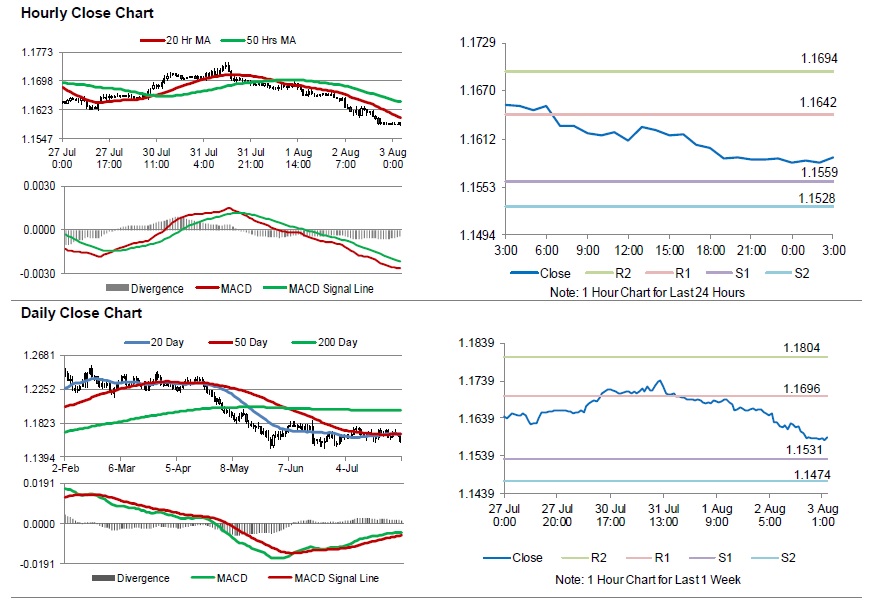
In the Asian session, at GMT0300, the pair is trading at 1.1589, with the EUR trading marginally higher against the USD from yesterday's close.
The pair is expected to find support at 1.1559, and a fall through could take it to the next support level of 1.1528. The pair is expected to find its first resistance at 1.1642, and a rise through could take it to the next resistance level of 1.1694.
Going forward, investors will closely monitor the Markit services PMI for July, set to release across the euro bloc in a while. Later in the day, the US trade balance data for June, followed by non-farm payrolls data, unemployment rate, average hourly earnings and the services PMI, all for July, will be on investors radar.
The currency pair is trading below its 20 Hr and 50 Hr moving averages.
BoE Raised Its Interest Rates To 0.75%
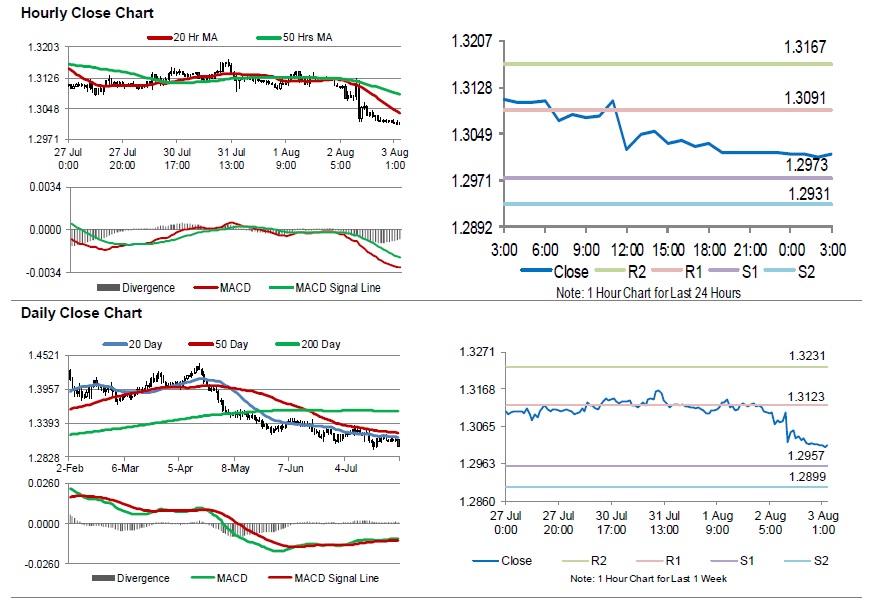
For the 24 hours to 23:00 GMT, the GBP declined 0.84% against the USD and closed at 1.3018, despite the Bank of England’s (BoE) rate hike decision.
Data indicated that, UK’s construction PMI unexpectedly rose to a level of 55.8 in July, notching its highest level since May 2017 and defying market expectations to ease to a level of 52.8. In the prior month, the PMI had recorded a reading of 53.1.
Separately, the BoE, at its August monetary policy meeting, raised its key interest to 0.75%, in an effort to bring back inflation to its targeted level of 2.0% and maintained the quantitative easing at £435.0 billion. The bank reiterated its view that any future interest rate hikes would be gradual and limited.
In the Asian session, at GMT0300, the pair is trading at 1.3015, with the GBP trading a tad lower against the USD from yesterday’s close.
The pair is expected to find support at 1.2973, and a fall through could take it to the next support level of 1.2931. The pair is expected to find its first resistance at 1.3091, and a rise through could take it to the next resistance level of 1.3167.
Trading trend in the pound will be determined by the release of UK’s Markit services PMI for July, scheduled to release in a few hours.
The currency pair is trading below its 20 Hr and 50 Hr moving averages.
Japanese Yen Trading Marginally Lower In The Asian Session
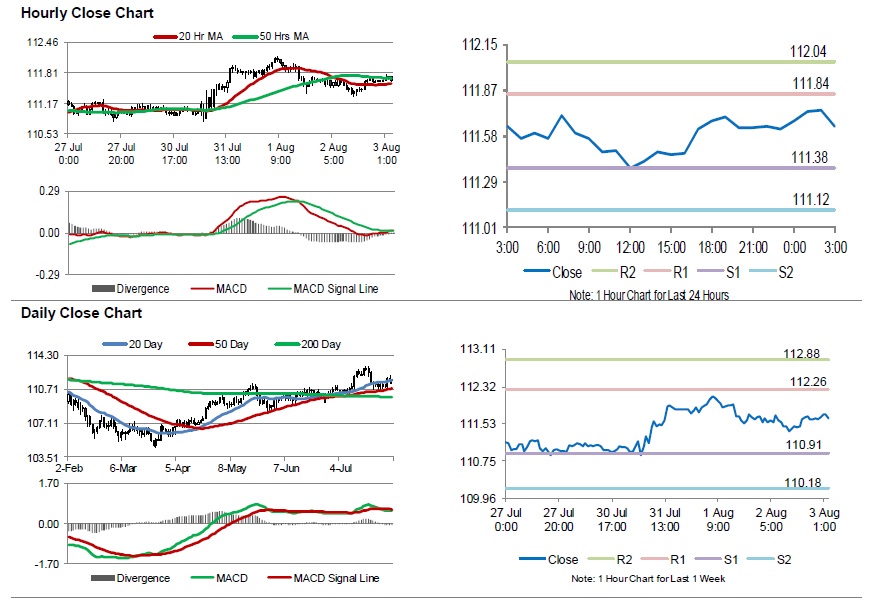
For the 24 hours to 23:00 GMT, the USD declined slightly against the JPY and closed at 111.62.
In the Asian session, at GMT0300, the pair is trading at 111.64, with the USD trading a tad higher against the JPY from yesterday’s close.
Overnight data showed that, Japan’s Nikkei services PMI declined slightly to a level of 51.3 in July, compared to a reading of 51.4 in the prior month.
According to BoJ Minutesthe Bank of Japan (BoJ) meeting minutes, financial conditions in the country remain “accommodative”. The minutes also noted the “sluggish growth” in inflation since the start of fiscal 2018. However, the policymakers failed to reach an agreement on how to address soft inflation and the rising cost of its stimulus program.
The pair is expected to find support at 111.38, and a fall through could take it to the next support level of 111.12. The pair is expected to find its first resistance at 111.84, and a rise through could take it to the next resistance level of 112.04.
With no macroeconomic releases in Japan today, traders will look forward global macroeconomic news for further direction.
The currency pair is trading above its 20 Hr moving average and showing convergence with its 50 Hr moving average.