

Sample Category Title
GBP/USD Daily Outlook
Daily Pivots: (S1) 1.2976; (P) 1.3054; (R1) 1.3093; More...
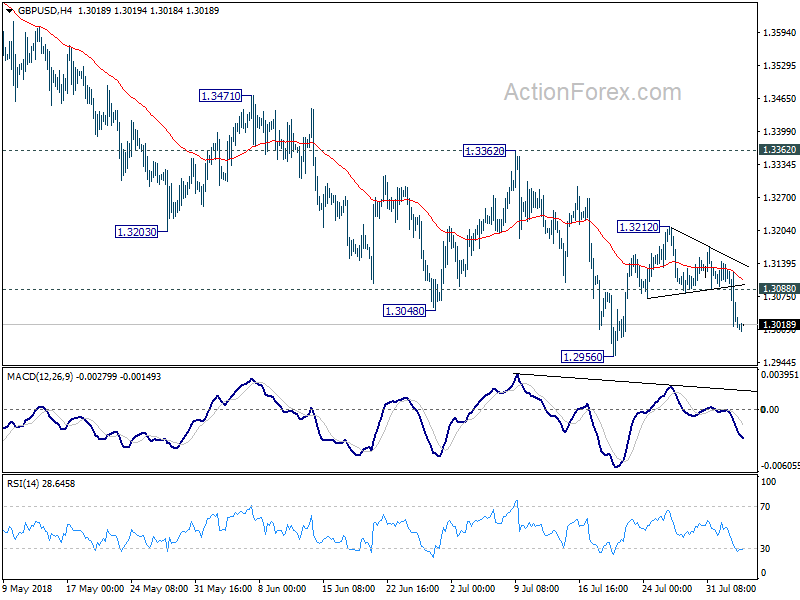
Intraday bias in GBP/USD remains on the downside for 1.2956 low. Decisive break there will resume larger decline from 1.4376 for 1.2874 fibonacci level next. On the upside, above 1.3088 minor resistance will possibly extend the correction from 1.2956 with another rebound through 1.3212. But even in that case, upside should be limited by 1.3362 resistance to bring larger decline resumption eventually.
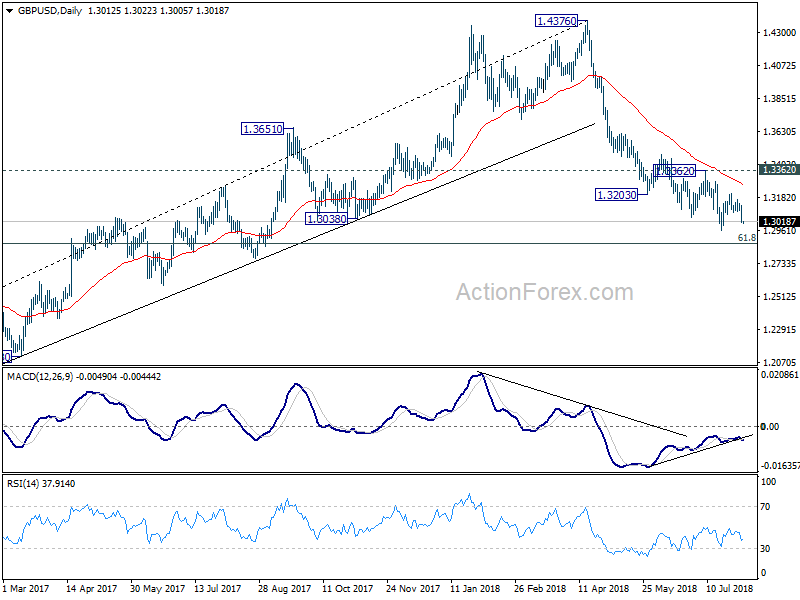
In the bigger picture, whole medium term rebound from 1.1946 (2016 low) should have completed at 1.4376 already, after rejection from 55 month EMA (now at 1.4179). Fall from 1.4376 should extend to 61.8% retracement of 1.1946 (2016 low) to 1.4376 at 1.2874 next. Decisive break of 1.2874 will raise the chance of long term down trend resumption through 1.1946 low. On the upside, break of 1.3362 resistance is needed to be the first indication of medium term bottoming. Otherwise, outlook will remain bearish even in case of strong rebound.
EUR/USD Daily Outlook
Daily Pivots: (S1) 1.1555; (P) 1.1612 (R1) 1.1641; More.....
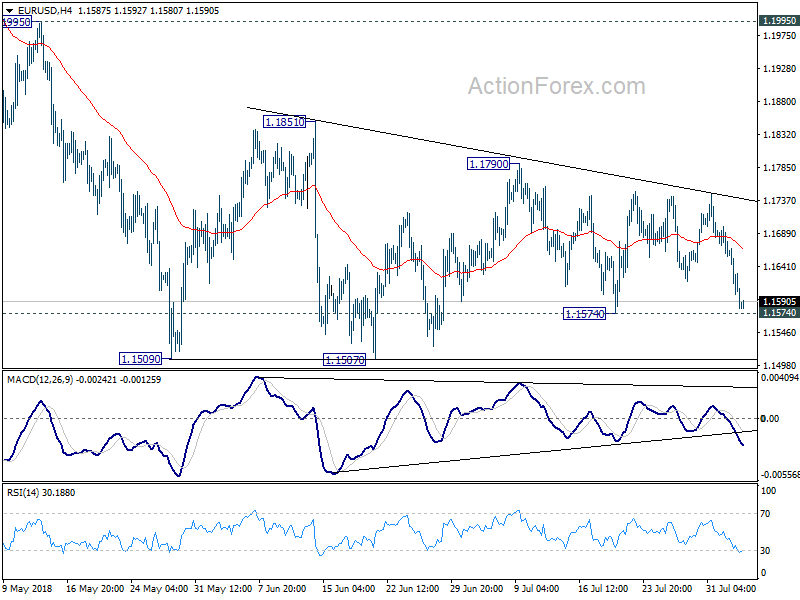
EUR/USD is still bounded in consolidation pattern from 1.1509 and intraday bias stays neutral. Nonetheless, break of 1.1574 minor support will be the first sign of downside breakout. That would bring retest of 1.1507/9 support zone first. Decisive break there will resume larger down trend from 1.2555 through 50% retracement of 1.0339 to 1.2555 at 1.1447. Again, in case of another recovery, upside should be limited by 1.1851 resistance to bring fall resumption eventually.
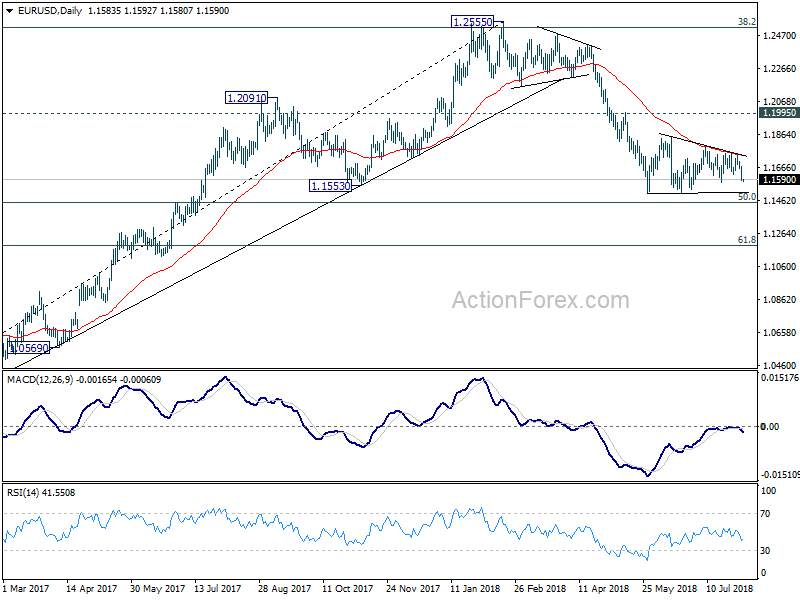
In the bigger picture, EUR/USD was rejected by 38.2% retracement of 1.6039 (2008 high) to 1.0339 (2017 low) at 1.2516. And, a medium term top was formed at 1.2555 already. Decline from there should extend further to 61.8% retracement of 1.0339 to 1.2555 at 1.1186 and below. For now, even in case of rebound, we won't consider the fall from 1.2555 as finished as long as 1.1995 resistance holds.
EUR/USD Eyes 1.1574 Minor Support ahead of Non-Farm Payrolls
Sterling stabilizes after yesterday's post BoE selloff. It's trying for a recovery in Asian session today but lacks committed buying so far. Nonetheless, renewed selloff in New Zealand Dollar makes it the worst performing one for the week. The Pound is just the second weakest for the week. Canadian Dollar is staying as the strongest one for the week, followed by Dollar. The Loonie is somewhat supported by positive developments in NAFTA negotiation as well as resilience in oil price.
In other markets, US equities were mixed overnight, with DOW dropped -0.03% to 25326.61. NASDAQ gained 1.24% to 7802.69, thanks to Apple hitting USD 1T market cap. Asian markets are mixed with Nikkei trading up 0.06% at the time of writing. China Shanghai SSE recovers mildly and is up 0.08%. Hong Kong HSI is down -0.13%. While WTI crude oil struggles to own 70 handle, rejection from there was mild and it's now hovering around 69. Gold, on the other hand, finally resume recent down trend and hits as low as 1206.61 so far today.
Technically, Dollar is now close to near term minor support again Euro and Swiss Franc. That is, 1.1574 in EUR/USD and 0.9977 in USD/CHF. Break of these two level will bring retest of 1.1507 low (EUR/USD) and 1.0067 high (USD/CHF). Such development will also raise the change of upside breakout in USD. Non-farm payroll report could be the event that prompts the move.
NFP to highlight today with focus on wage growth again
Non farm payroll is the major focus for today. NFP is expected to show 193k growth in jobs in July, slightly lower than prior month's 213k. Unemployment rate is expected to drop back to 3.9%. Expectation on wage growth is high again, as average hourly earnings are seen growing 0.3% mom. Looking at other related data, ADP report showed a solid 219k growth in private sector jobs, above expectation of 186k. ISM manufacturing employment rose 0.5 to 56.5. The four week average of initial jobless claims dropped slightly from 217.25k to 221.50k. Consumer confidence rose 0.3 to 127.4 in July. Overall, the key to Dollar will stay on wage growth.
Suggested readings on NFP:
- NFP Preview: Tired King Dollar Requires Big Beat
- US Jobs Data In Focus With Trade 'Noise' Making A Comeback
Very good advancement in bilateral US-Mexico NAFTA talk
Mexico's Economy Minister Ildefonso Guajardo met with US Trade Representative Robert Lighthizer in a bilateral NAFTA meeting yesterday. Guajardo said after the meeting that there is "very good advancement" in at least 20 items. But they have yet to discuss the stickier issues like the "sunset clause". The meeting will continue on in Washington today.
It's believed that the differences between the US and Mexico have somewhat narrowed after leftist Andres Manuel Lopez Obrador's victory in the presidential election on July 1. A large part of the convergence was in both sides' push to raise wages for auto workers. There's a change that both US and Mexico could agree on most of the items before letting Canada join in again to make it trilateral.
Near 50% of UK businesses not anticipating any Brexit contingency plan
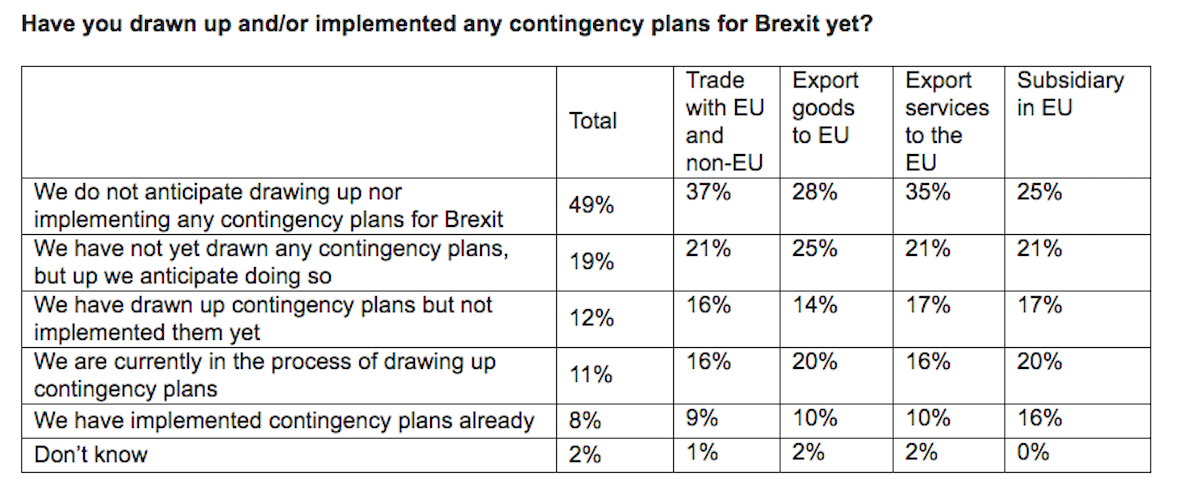
According to a survey by the Institute of Directors, only 31% of respondents are have carried out Brexit contingency plan. 8% have the plan implement already, 11% are drawing up the plans, and 12% have drawn up bot not implemented the plans yet. 19% of them haven't even drawn up any plans even though the anticipate doing so. And 49% have no intention to do any Brexit contingency plans.
From the figures, it looks like business are not to worried about the impact of Brexit and transitions on businesses. But Director-General of the IoD Stephen Martin has another interpretation. He said that firms have been "left in the dark" when it comes to the planning. And "the reality is that many companies feel they can only make changes once there is tangible information about what they are adjusting to." And he urged that "as long as no deal remains a possibility, it is essential that the government steps up to the plate and provides advice on preparing for such an outcome."
BoJ minutes: No pronounced signs on improvement in trade tensions
BoJ released minutes of the June 14/15 meeting today (not the one earlier this week). The discussions during this meeting were of much less important to the one on July 30/31, after which BoJ announced strengthening of the easing framework. Nonetheless, there were still some interesting points to note.
One member questioned that BoJ's credibility and commitment of achieving the 2% inflation target was undermined "because the description on the timing of reaching around 2 percent inflation had been deleted from the April 2018 Outlook Report." And there communication strategy was a deeply discussed topic. There was consensus on emphasizing the bank's commitment to achieving price stability.
The minutes also noted the "sluggish growth in the CPI since the start of fiscal 2018". Some members pointed to "short term factors" including Yen's appreciation. Theses members also pointed to "increasingly competitive environment surrounding the retail sector". Some members took a long-term perspective and attribute to " the fact that the mindset and behavior based on the assumption that wages and prices would not increase easily had been deeply entrenched among firms and households." One member said inflation was constrained by "social mode" which was brought about by "prolonged period of low growth and deflation".
On risks the minutes noted US economic policies, Brexit and geopolitical risks as the main ones. In particular, "a few members said that, although the U.S. protectionist trade policy had been criticized at international conferences such as the Group of Seven (G-7) meetings, there were no pronounced signs at the moment that the situation surrounding the policy would improve."
On the data front
Australia AiG performance of services dropped notably by -9.4 pts to 53.6 in July. Retail sales rose 0.4% mom in June, beat expectation of 0.3% mom. China Caixin PMI services dropped 1.1 to 52.8 in July. Looking ahead, UK PMI services is the main focus in European session. Eurozone will release PMI services final and retail sales. Swiss will release CPI. Later in the day, Canada will release trade balance. US will release NFP, trade balance and ISM services.
EUR/USD Daily Outlook
Daily Pivots: (S1) 1.1555; (P) 1.1612 (R1) 1.1641; More.....
EUR/USD is still bounded in consolidation pattern from 1.1509 and intraday bias stays neutral. Nonetheless, break of 1.1574 minor support will be the first sign of downside breakout. That would bring retest of 1.1507/9 support zone first. Decisive break there will resume larger down trend from 1.2555 through 50% retracement of 1.0339 to 1.2555 at 1.1447. Again, in case of another recovery, upside should be limited by 1.1851 resistance to bring fall resumption eventually.
In the bigger picture, EUR/USD was rejected by 38.2% retracement of 1.6039 (2008 high) to 1.0339 (2017 low) at 1.2516. And, a medium term top was formed at 1.2555 already. Decline from there should extend further to 61.8% retracement of 1.0339 to 1.2555 at 1.1186 and below. For now, even in case of rebound, we won't consider the fall from 1.2555 as finished as long as 1.1995 resistance holds..
Economic Indicators Update
| GMT | Ccy | Events | Actual | Forecast | Previous | Revised |
|---|---|---|---|---|---|---|
| 22:30 | AUD | AiG Performance of Service Index Jul | 53.6 | 63 | ||
| 23:50 | JPY | BOJ Minutes of Policy Meeting Jun | ||||
| 01:30 | AUD | Retail Sales M/M Jun | 0.40% | 0.30% | 0.40% | |
| 01:45 | CNY | Caixin China PMI Services Jul | 52.8 | 53.7 | 53.9 | |
| 07:15 | CHF | CPI M/M Jul | -0.30% | 0.00% | ||
| 07:15 | CHF | CPI Y/Y Jul | 1.20% | 1.10% | ||
| 07:45 | EUR | Italy Services PMI Jul | 53.7 | 54.3 | ||
| 07:50 | EUR | France Services PMI Jul F | 55.3 | 55.3 | ||
| 07:55 | EUR | Germany Services PMI Jul F | 54.4 | 54.4 | ||
| 08:00 | EUR | Eurozone Services PMI Jul F | 54.4 | 54.4 | ||
| 08:30 | GBP | Services PMI Jul | 54.7 | 55.1 | ||
| 09:00 | EUR | Eurozone Retail Sales M/M Jun | 0.40% | 0.00% | ||
| 12:30 | CAD | Trade Balance (CAD) Jun | -2.3B | -2.8B | ||
| 12:30 | USD | Trade Balance Jun | -46.1B | -43.1B | ||
| 12:30 | USD | Change in Non-farm Payrolls Jul | 193K | 213K | ||
| 12:30 | USD | Unemployment Rate Jul | 3.90% | 4.00% | ||
| 12:30 | USD | Average Hourly Earnings M/M Jul | 0.30% | 0.20% | ||
| 13:45 | USD | US Services PMI Jul F | 56.2 | 56.2 | ||
| 14:00 | USD | ISM Non-Manufacturing/Services Composite Jul | 58.6 | 59.1 |
BoJ minutes: No pronounced signs on improvement in trade tensions
BoJ released minutes of the June 14/15 meeting today (not the one earlier this week). The discussions during this meeting were of much less important to the one on July 30/31, after which BoJ announced strengthening of the easing framework. Nonetheless, there were still some interesting points to note.
One member questioned that BoJ's credibility and commitment of achieving the 2% inflation target was undermined "because the description on the timing of reaching around 2 percent inflation had been deleted from the April 2018 Outlook Report." And there communication strategy was a deeply discussed topic. There was consensus on emphasizing the bank's commitment to achieving price stability.
The minutes also noted the "sluggish growth in the CPI since the start of fiscal 2018". Some members pointed to "short term factors" including Yen's appreciation. Theses members also pointed to "increasingly competitive environment surrounding the retail sector". Some members took a long-term perspective and attribute to " the fact that the mindset and behavior based on the assumption that wages and prices would not increase easily had been deeply entrenched among firms and households." One member said inflation was constrained by "social mode" which was brought about by "prolonged period of low growth and deflation".
On risks the minutes noted US economic policies, Brexit and geopolitical risks as the main ones. In particular, "a few members said that, although the U.S. protectionist trade policy had been criticized at international conferences such as the Group of Seven (G-7) meetings, there were no pronounced signs at the moment that the situation surrounding the policy would improve."
USD/JPY Remains Supported Ahead Of US NFP
Key Highlights
- The US Dollar failed to move above the 112.00-112.10 resistance and declined against the Japanese Yen.
- There is a major bullish trend line formed with support at 111.00 on the 4-hours chart of USD/JPY.
- The US Initial Jobless Claims for the week ending July 28, 2018 increased from 217K to 218K.
- Today, the US NFP report will be released for July 2018, which is forecasted to register 190K.
USDJPY Technical Analysis
The US Dollar jumped higher recently from the 111.00 support against the Japanese Yen. However, the USD/JPY pair faced a solid barrier near the 112.00 zone, resulting in a fresh downside move.
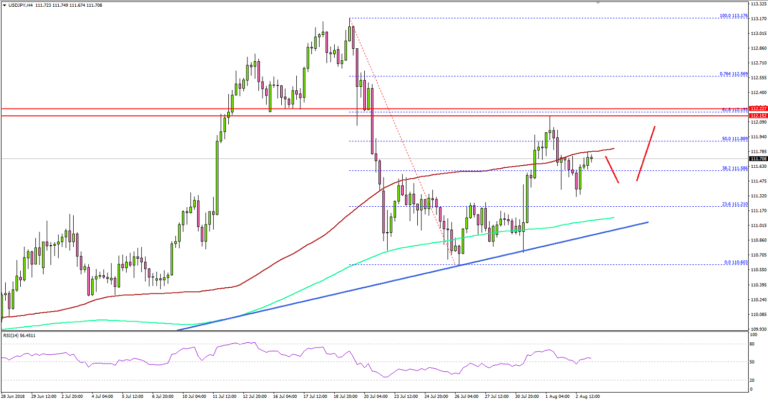
Looking at the 4-hours chart, the pair failed to hold gains above the 111.50 level and the 100 simple moving average (red, 4-hours). It was rejected from the 61.8% Fibonacci retracement level of the last decline from the 113.20 swing high to 110.60 low.
The pair is currently moving lower, but it remains well supported above the 111.00 level. There is also a major bullish trend line formed with support at 111.00 on the same chart.
Above the trend line, the 200 simple moving average (green, 4-hours) is positioned at 111.10. Therefore, if the pair continues to move down, it is likely to find support near 111.00. Below this, USD/JPY could move into a bearish zone towards 110.60.
On the upside, the 111.75 level and the 100 SMA are important hurdles followed by 112.00. A break and close above 112.00 may well open the doors for a push towards 112.80.
Recently in the US, the Initial Jobless Claims for the week ending July 28, 2018 was released by the US Department of Labor. The market was looking for a rise in claims from 217K to 220K.
However, the rise in claims was 1K to 218K, and the advanced seasonally adjusted insured unemployment rate remained at 1.2% for the week ending July 21, 2018. The report added that:
The 4-week moving average was 214,500, a decrease of 3,500 from the previous week's unrevised average of 218,000.
Overall, the US Dollar remains supported versus the Euro, British Pound and Japanese Yen ahead of today's NFP release.
Economic Releases to Watch Today
- Germany's Services PMI for July 2018 – Forecast 54.4, versus 54.4 previous.
- Euro Zone Services PMI for July 2018 – Forecast 54.4, versus 54.4 previous.
- UK Services PMI for July 2018 – Forecast 54.7, versus 55.1 previous.
- US Services PMI for July 2018 – Forecast 56.2, versus 56.2 previous.
- US nonfarm payrolls July 2018 – Forecast 190K, versus 213K previous.
- US Unemployment Rate July 2018 – Forecast 3.9%, versus 4.0% previous.
Market Morning Briefing: 25500 Is An Important Resistance Level For Dow
STOCKS
Crucial movement in the indices in the next few sessions. Shanghai and Nifty have already come off in the last 2-sessions, while Nikkei, Dax and Dow may still have some room for range-trade before facing rejection from the respective resistances.
25500 is an important resistance level for Dow (25326.16, -0.03%) and is likely to hold in the coming sessions, pushing the index down towards 25000 and lower. We could see 2-3 sessions of sideways trade in the 25100-25500 region before a strong rejection from 25500 is seen. A break above 25500 with at rise past 26000 could trigger sharp upmove in the longer run.
Dax (12546.33, -1.5%) saw a sharp gap down opening following the losses in the other equities. There is room for test of 12300 before it bounces back to move up eventually.
Nikkei (22541.81, +0.13%) is stuck in the narrow range of 22500-22800 and could move up slowly towards 22800 in the next 2-3 sessions. Looking at the 3-day and weekly charts, Nikkei may come off sharply towards 22000 or lower, given the medium term resistances hold.
Shanghai (2748.48, -0.71%) continued to fall sharply as 2900 resistance holds well for now. On the weekly there is scope of testing 2650 on the downside. Near to medium term looks bearish.
Nifty (11244.70, -0.89%) closed below our mentioned support near 11250. But if the index bounces back today, three could be chances of moving up in the early sessions next week. A break below 11200, if seen would make the index vulnerable to test lower levels of 11000 soon.
COMMODITIES
Brent (73.36) and Nymex WTI (68.95) bounced back from Supports on the 3-day candles. While the current rise sustains, they could start moving up in the medium term towards 78 and 72 respectively.
Gold (1216.20) has come off as expected and could test 1200 in the early sessions of next week. A short corrective bounce from 1200 is possible in the longer run.
Copper (2.7240) is headed towards 2.70. Support zone is visible in the 2.65-2.70 region which may hold in the coming week, pushing the Copper prices back to higher levels. A break below 2.65, if seen could make it vulnerable to a sharp fall in the long term. Watch price action near 2.65.
FOREX
Euro (1.1587): As per our expectation, Euro broke below support on daily candles near 1.1600-1.1625 and now looks headed downwards towards previous low near 1.1508 (could be tested anytime next week). Slightly lower down, there is also some support near 1.145 on 3 day line chart, whose break could make Euro quite bearish
Dollar Index (95.17): As expected, the Dollar Index has moved up and now looks like it could target resistance on daily line chart near 96 in the coming week – that could correspond with a test of 1.145 on the Euro. From the weekly line chart, a close above 95 today would be very bullish for the Dollar Index in the coming weeks.
Dollar Yen (111.63): Dollar Yen tested support on daily candles near 111.32 yesterday and has again moved back up. However, while below 112.15, there still remain some chances of a break below 111.30 to test lower support near 110.75. As we have been mentioning, the 112.5-115.0 region is a crucial long term resistance zone for Dollar Yen, which should cap the upside in the next 1-2 months.
Euro Yen (129.38): As per expectation, Euro Yen has broken below support on daily candles near 130 and could move lower towards 128 next week. If the Dollar Yen stays below 112, while Euro moves down towards 1.150-1.145, Euro Yen could test crucial horizontal support on weekly line chart near 127 next week. A break below 127 would be very bearish.
Pound (1.3016): The Bank of England raised rates by 25 bps as expected. As we had forecasted, the bearish trend has persisted inspite of the rate hike. Pound has broken below horizontal support on weekly candles near 1.3050. A downmove towards 1.29 (support on daily candles) in the next week now looks possible.
Dollar Rupee (68.7050): Dollar Rupee is likely to come off from 68.80 today. Next week looks bearish for Dollar Rupee towards 68.10. A close below 68.47-50 today would be important for bearishness next week.
INTEREST RATES
Day before yesterday, the US Fed’s re-assertion of the fact that the US economy’s growth is strong has made a rate hike in the September meet look almost certain. Moreover, a rate hike in Dec ’18 is also very likely. The big question that arises now is – will the Fed continue with as many rate hikes in 2019 as well? In the coming weeks, more clarity and certainty on this issue would start emerging, which might thereby be the primary determinant for whether the US 10 year yield breaks above 3.125% in 2018 or not. With Japanese and German yields looking bullish, the 2.95%-3.00% barrier is looking weaker for the 10 year yield as of now. A breach of the 3% level in the coming 2-3 sessions itself would be bullish.
US 10 year yield (2.99%), 30 Year (3.12%), 5 Year (2.85%), 2 Year (2.67%):
The US 10 – 5 yield spread (0.14%) is breaking above resistance on short term chart and could target higher resistance near 0.17% in the next 1-2 weeks. The 5 year yield also looks bullish. Consequently, this might be another signal that the 10 year yield might rise above 3% soon.
Earlier, the Bank of Japan had maintained status quo in its policy – keeping the target for Japanese 10 year yield at 0% and Japanese short term interest rates at -1.1% - but it also announced that its policy framework will be more flexible in future for the long term yield. This has opened up the possibility for Japanese 10 year yield to be more reactive to positive news about the Japanese economy.
This week, the Japanese 10 year yield (0.12%) has breached the crucial 0.11% level for the first time in over 2.5 years. This upmove could now continue till levels near 0.20%-0.25%.
As we mentioned yesterday, the German 10 year bond yield (0.46%) is breaking above resistance on short term and medium term chart and could target levels near 0.50%-0.55% in the coming 1-2 weeks.
Dollar Awaits Jobs Report Amid Trade Uncertainty
The US dollar is higher against major pairs on Thursday in anticipation of a strong U.S. non farm payrolls (NFP). The U.S. Federal Reserve kept rates unchanged on Wednesday and without a press conference there was little guidance for the markets who will have to wait until the minutes from the Federal Open Market Committee (FOMC) meeting are published in two weeks. Two more rate hikes are forecasted to the Fed funds rate in 2018, but the economic indicators will have to validate them. The U.S. non farm payrolls (NFP) will be published on Friday, August 3 at 8:30 am EDT. Investors will be quick to scan the report for the wage growth and unemployment rate components.
- US expected to add 190,000 jobs
- US wages could have gained 0.3 percent
- Unemployment rate in the US to drop to 3.9 percent
Dollar Rises on Safe Haven Flows
The EUR/USD lost 0.62 percent on Thursday. The single currency is trading at 1.1587 as the US dollar rose as investors sought a safe haven as trade tensions once again flared up between the United States and China.The Trump administration proposed a 25 percent tariff on $200 billion Chinese goods with China expected to retaliate.
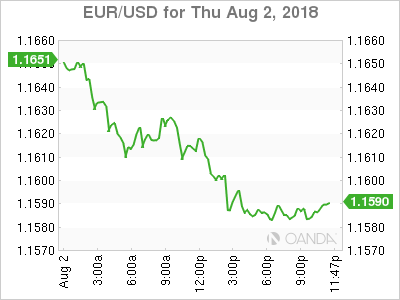
Friday’s economic data release will be highly focused on US indicators. The employment report by the Bureau of Labor Statistics will be the main attraction but geopolitics will continue to guide the market if trade war concerns do not subside.
The US stock market closed with gains across the board, with the exception of the DJI. Apple became the first company to break above the $1 trillion capitalization. Not unlike Brexit negotiations it is still too early to say what effect the looming trade war between the US and China will have on markets as there is still the possibility that both sides will reach an agreement.
US Commerce Secretary Wilbur Ross said on Thursday that the tariffs are thought through but a compromise is being worked on by the US President. NAFTA negotiations have advanced in recent weeks as the newly elected Mexican president has been optimistic a quick deal can be reached. Mexican Trade teams are in Washington to talk with the US Trade representative, but the US did not extend an invitation to Canada to join the meetings.
Pound Lower Despite BoE Rate Hike
The GBP/USD fell 0.84 percent on August 2. The pound is trading at 1.3015 after a Super Thursday that included a unanimous vote from the Monetary Policy Committee to raise the benchmark interest rate by 25 basis points. The decision to lift rates to 0.75 percent was heavily anticipated by the market. The currency rebounded temporarily on the announcement but quickly dropped as the press conference by BoE governor Mark Carney presented a gradual path in the future.
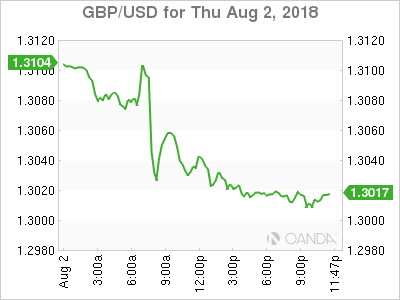
Governor Carney told the BBC that a rate hike a year was a good rule of thumb but questions remain on the timing of the decision. The EU divorce concerns continue to hang over the UK as Prime Minister Theresa May has not been able to find the perfect compromise between hard and soft Brexit.
The BoE elected to act now based on hard economic data than wait for the unclear outcome of the Brexit negotiations. The deadline is still 8 months away, but there is a lot of issues where not only are the UK and the EU apart, but there is no clear consensus between members of May’s cabinet.
Loonie Falls Ahead of NFP and Trade Disputes
The USD/CAD gained 0.13 percent in the last 24 hours. The currency pair is trading at 1.3026 after the US dollar rose and the loonie failed to get traction from a rebound in oil prices. West Texas Intermediate is trading at $69.54 ahead of US rig data due on Friday.
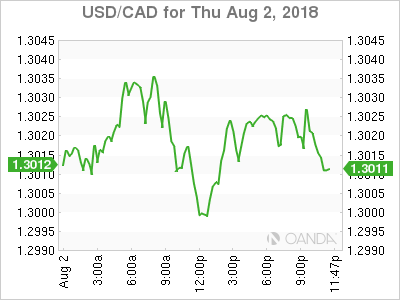
The Bank of Canada (BoC) lifted interest rates by 25 basis points on July 11 and after a stronger than expected monthly GDP report the probability of a follow up in 2018 has risen. Bank of Nova Scotia is forecasting 2 more rate hikes despite the uncertain outcome on NAFTA. The BoC will try to keep the gap between the Fed funds rate and the Canadian rate as much as the economy will allow. The U.S. Federal Reserve is expected to hike in September and again in December to deliver the promised four interest rate hikes in their path to normalization.
Market events to watch this week:
Friday, August3
4:30am GBP Services PMI
8:30am USD Average Hourly Earnings m/m
8:30am USD Non-Farm Employment Change
8:30am USD Unemployment Rate
10:00am USD ISM Non-Manufacturing PMI
GBPUSD – Continues To Look For More Correction
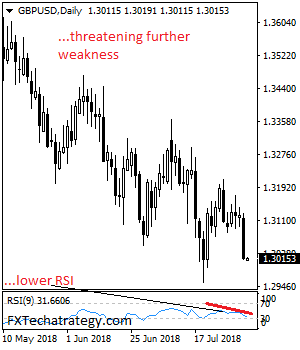
GBPUSD - The pair continues to retain its downside pressure leaving risk to the downside. Support lies at the 1.3000 level where a break will turn attention to the 1.2950 level. Further down, support lies at the 1.2900 level. Below here will set the stage for more weakness towards the 1.2850 level. Conversely, resistance stands at the 1.3050 levels with a turn above here allowing more strength to build up towards the 1.3100 level. Further out, resistance resides at the 1.3150 level followed by the 1.3200 level. On the whole, GBPUSD remains biased to the upside on correction.
Near 50% of UK businesses not anticipating any Brexit contingency plan
According to a survey by the Institute of Directors, only 31% of respondents are have carried out Brexit contingency plan. 8% have the plan implement already, 11% are drawing up the plans, and 12% have drawn up bot not implemented the plans yet. 19% of them haven't even drawn up any plans even though the anticipate doing so. And 49% have no intention to do any Brexit contingency plans.
From the figures, it looks like business are not to worried about the impact of Brexit and transitions on businesses. But Director-General of the IoD Stephen Martin has another interpretation. He said that firms have been "left in the dark" when it comes to the planning. And "the reality is that many companies feel they can only make changes once there is tangible information about what they are adjusting to." And he urged that "as long as no deal remains a possibility, it is essential that the government steps up to the plate and provides advice on preparing for such an outcome."
Very good advancement in bilateral US-Mexico NAFTA talk
Mexico's Economy Minister Ildefonso Guajardo met with US Trade Representative Robert Lighthizer in a bilateral NAFTA meeting yesterday. Guajardo said after the meeting that there is "very good advancement" in at least 20 items. But they have yet to discuss the stickier issues like the "sunset clause". The meeting will continue on in Washington today.
It's believed that the differences between the US and Mexico have somewhat narrowed after leftist Andres Manuel Lopez Obrador's victory in the presidential election on July 1. A large part of the convergence was in both sides' push to raise wages for auto workers. There's a change that both US and Mexico could agree on most of the items before letting Canada join in again to make it trilateral.