Sample Category Title
An update on GBP/CHF short
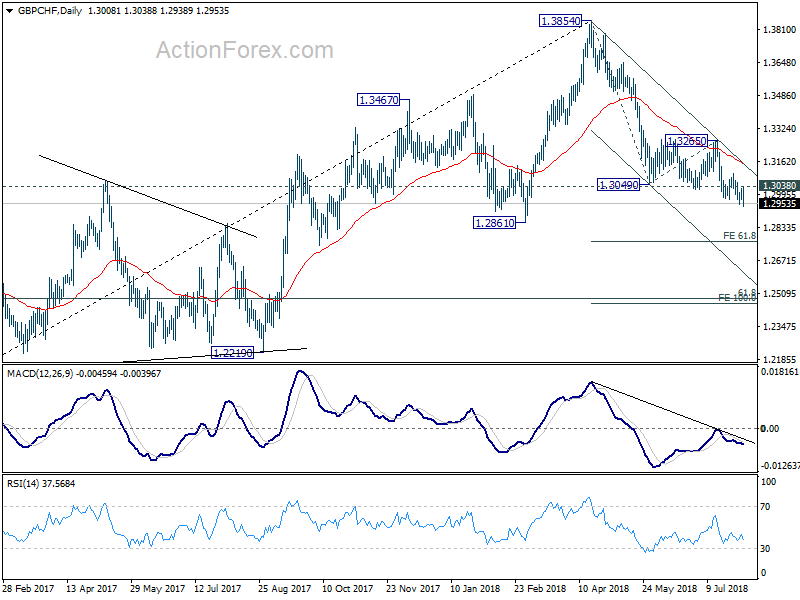
Based on the position trading strategy noted in the weekly report, we've sold GBP/CHF on break of 1.2971 this week.
Overall outlook is unchanged with the cross staying well below falling 55 day EMA. It's also held well inside medium term falling channel from 1.3854. This decline fall from 1.3854 is expected extend to 61.8% projection of 1.3854 to 1.3049 from 1.3265 at 1.2768 as first target.
There is prospect of further decline to 100% projection at 1.2460 before bottoming. But we'll monitor downside momentum in the current fall to gauge the chance.
Stop will be put slightly above today's high at 1.3040.
GBP/USD Mid-Day Outlook
Daily Pivots: (S1) 1.3098; (P) 1.3122; (R1) 1.3148; More...
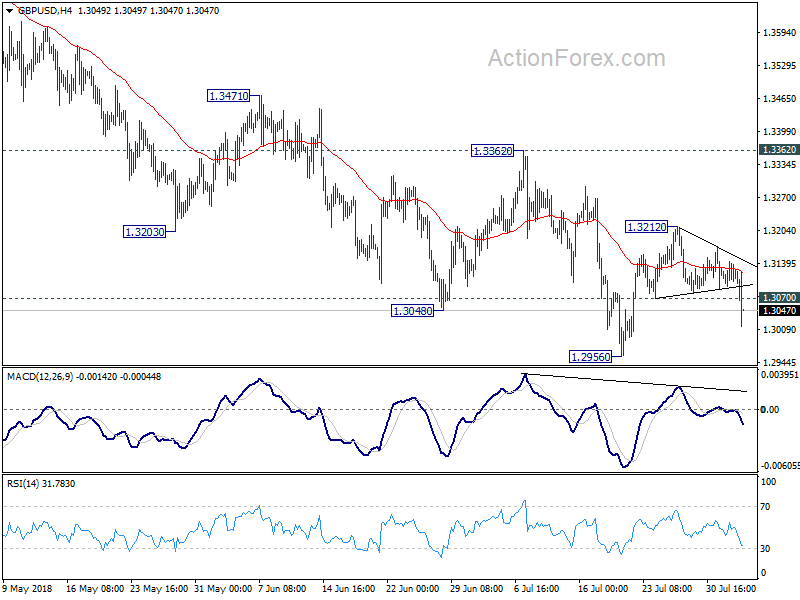
GBP/USD's strong break of 1.3070 minor support indicates that corrective rise from 1.2956 has completed at 1.3212 already. Intraday bias is back on the downside for 1.2956 short term bottom first. Decisive break there will resume larger decline from 1.4376 for 1.2874 fibonacci level next. For now, the consolidation pattern from 1.2956 could still extend with another rebound through 1.3212. But even in that case, upside should be limited by 1.3362 resistance to bring larger decline resumption eventually.
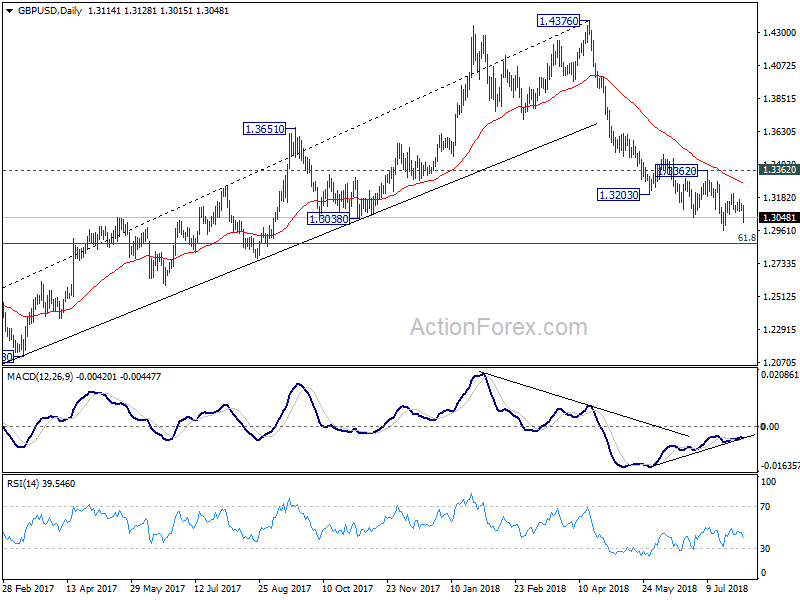
In the bigger picture, whole medium term rebound from 1.1946 (2016 low) should have completed at 1.4376 already, after rejection from 55 month EMA (now at 1.4179). Fall from 1.4376 should extend to 61.8% retracement of 1.1946 (2016 low) to 1.4376 at 1.2874 next. Decisive break of 1.2874 will raise the chance of long term down trend resumption through 1.1946 low. On the upside, break of 1.3362 resistance is needed to be the first indication of medium term bottoming. Otherwise, outlook will remain bearish even in case of strong rebound.
Australian Retail Sales Eyed ahead of RBA Meeting; Aussie Sensitive to Trade Tensions Too
Australian retail sales data for June will be hitting the markets on Friday at 0130 GMT, in what is perhaps the last important release before the Reserve Bank of Australia concludes a meeting on monetary policy next week. Meanwhile, Australia seems to be getting caught in the crosshairs of the trade dispute between the US and China, with its currency coming under pressure due to the country’s heavy export dependency, but also as a result of the nation’s close economic ties with China.
Retail sales are anticipated to grow by 0.3% m/m in June, reflecting an easing relative to the pace of expansion in the two previously tracked months of 0.5% and 0.4% in April and May correspondingly. Despite slowing sales being projected on a monthly basis, second-quarter data are forecast to show retail sales expanding by 0.8% q/q, this constituting a notable acceleration compared to the previously tracked quarter’s 0.2%.
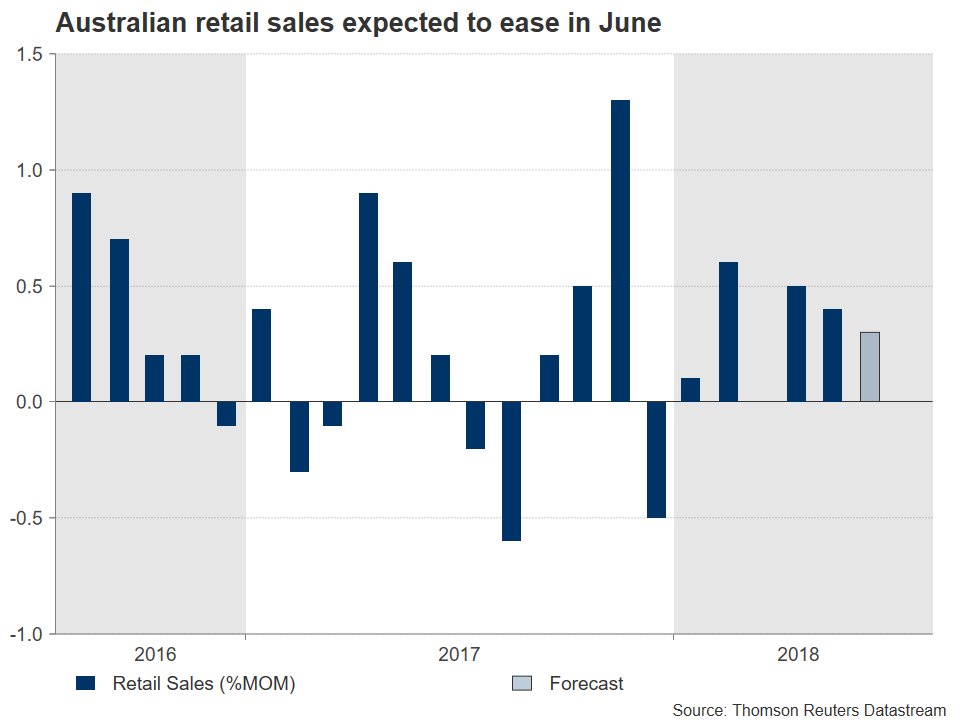
With wage growth – which can stoke inflationary pressures – persistently subdued despite a relatively low unemployment rate and troubling record-high levels of household debt, Friday’s readings are unlikely to materially alter RBA policymakers’ thinking when they conclude a meeting on monetary policy on August 7. Specifically, markets widely expect the central bank to keep its policy rate at the historic low of 1.50% for the 22nd consecutive meeting, the longest stretch without an interest-rate move in the country’s modern history.
Still, given that retail sales are used as somewhat of a gauge for household spending which constitutes more than 50% of the Australian economy’s annual GDP, the release holds some significance and might prove market moving; the data beats delivered in the two previous months did boost the local dollar versus its US counterpart.
Better-than-forecasted retail sales could push AUDUSD higher. Given a move above the 0.74 round figure, an additional barrier to the upside may come around the current level of the 50-day moving average line at 0.7453. More bullish movement would shift the attention to the region around the 23.6% Fibonacci retracement level of the January 26 to July 2 downleg at 0.7503, including the 0.75 handle. On the downside and in case of disappointing prints, support may come around the 19-month low of 0.7308 hit in early July, including the 0.73 mark. Steeper losses would increasingly bring into scope the 0.72 handle.
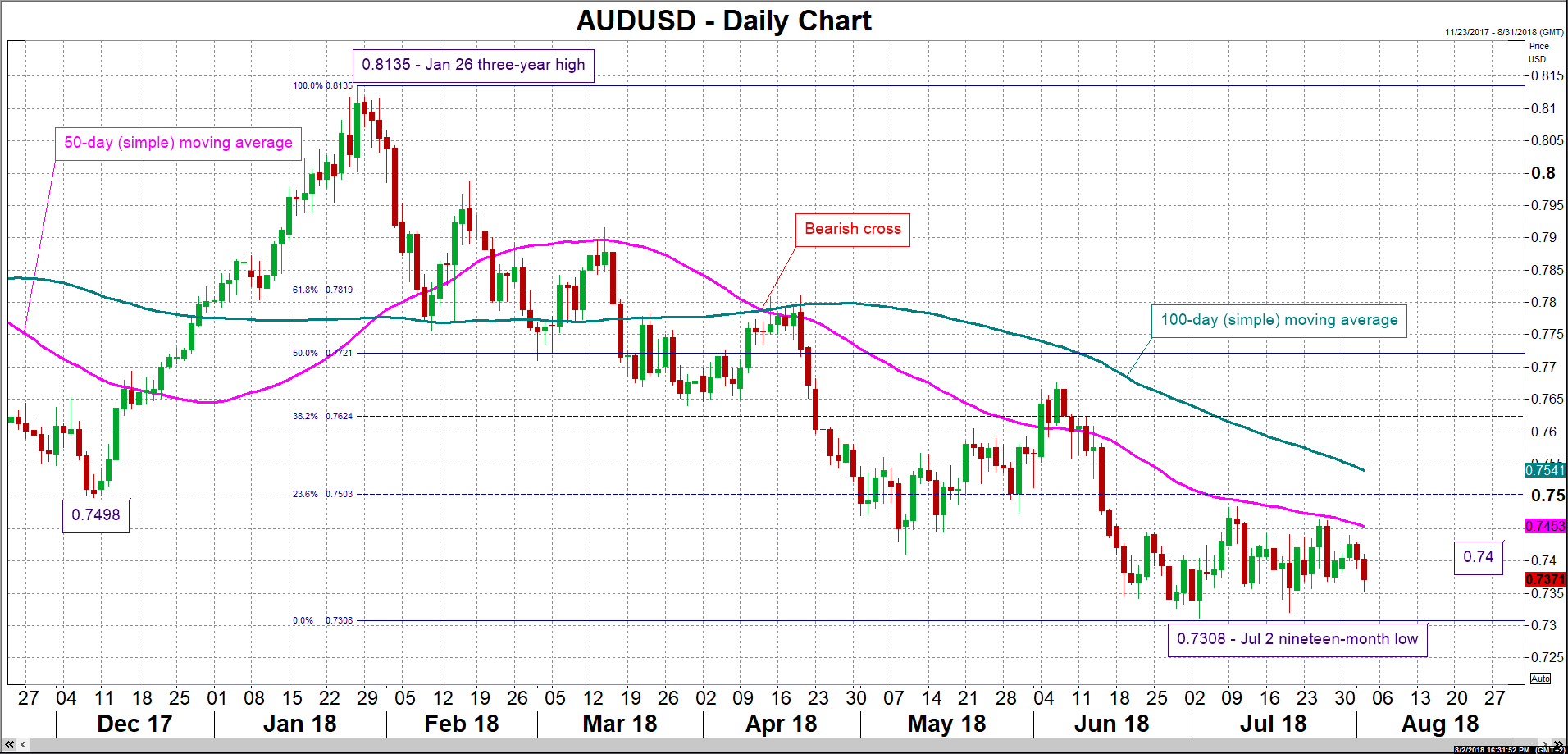
The aussie/dollar is on the decline on Thursday, suffering on the back of rising Sino-US trade tensions as the US seems to be ratcheting its China-directed tariff threats. In particular, the aussie fell to a two-week low of 0.7352 on Thursday despite the delivery of upbeat trade data out of Australia earlier in the day. Aussie-shorting by traders is related to the nation’s export reliant economy, with the greatest proportion of those exports heading to China. A deteriorating outlook on global trade or the Chinese economy is thus seen as aussie-negative and vice versa.
Lastly, in terms of positioning on AUDUSD, it should also be kept in mind that the US will see the release of its employment report for July on Friday at 1230 GMT.
UK Services PMI to Revert to Slower Gear in July; Unlikely to Prove a Big Driver for Pound
After the highly anticipated Bank of England decision on Thursday, the focus for sterling at the end of the week will turn to the services PMI out of the United Kingdom on Friday at 08:30 GMT. The IHS Markit/CIPS services PMI is expected to highlight the BoE’s dilemma, with activity in the sector expected to expand only moderately even as the Bank presses with a rate hike – its second since the global financial crisis.
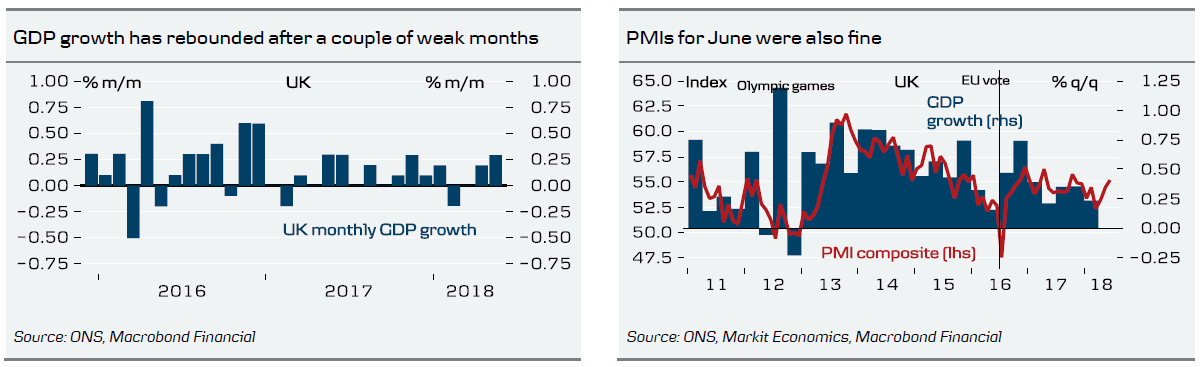
While a modest rebound in growth in the second quarter was enough to convince Monetary Policy Committee (MPC) members that the economy could withstand some removal of monetary stimulus, that may not be sufficient going forward to warrant subsequent rate hikes. Investors will therefore be watching closely how the largest sector of the UK economy performs over the coming months.
The services PMI is forecast to ease to 54.7 in July from 55.1 in June – an 8-month high, having bounced back strongly from a 20-month low in March. While being nothing phenomenal, this would still be comfortably above the 50-neutral level, where a reading above it represents expansion in activity and a figure below it points to a contraction.
Growth in the manufacturing sector has also lost steam since the beginning of the year. The manufacturing PMI fell sharply from a high of 58.2 in November to a 17-month low of 53.8 in April. It rebounded only gradually in May-June before slipping again in July to 54.0.
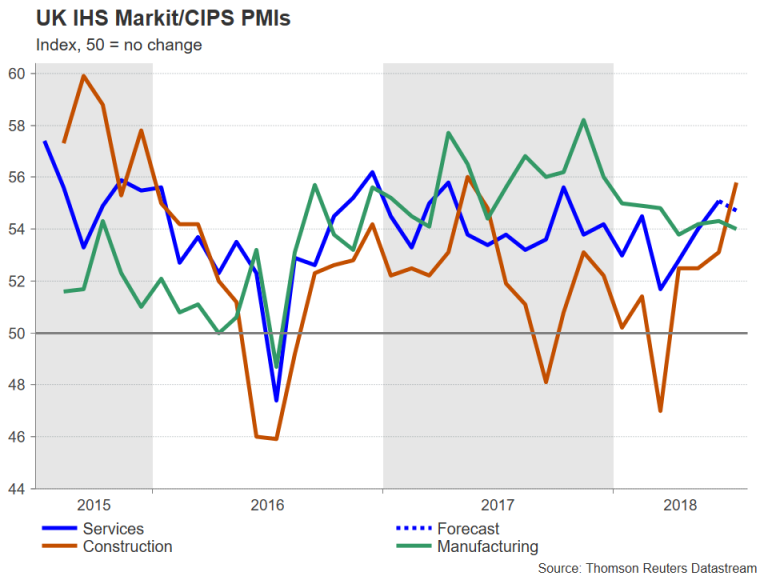
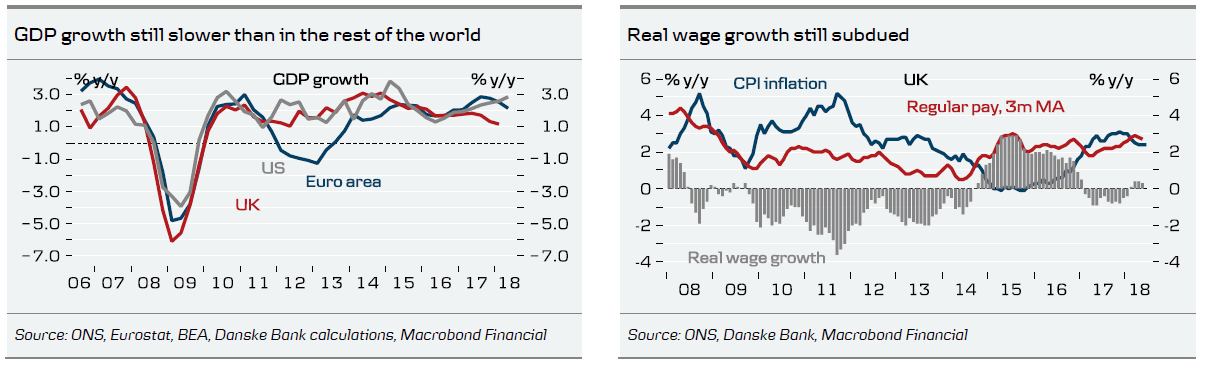
With growth in the rest of the world (bar the US) also losing some momentum during 2018, the UK’s relative performance isn’t that much worse in comparison. However, with uncertainty over a Brexit deal intensifying in recent weeks, businesses in the UK are understandably becoming increasingly gloomier about the outlook and this could weigh on growth in the coming quarters, giving the BoE little scope to raise rates further.
That probably explains why traders weren’t too impressed by the Bank of England’s rate increase on Thursday, with sterling slipping after the decision, having barely recovered from July’s 10-month low of $1.2955 in anticipation of the hike.
Brexit talks have stalled recently as the UK and the EU struggle to reach a compromise on a customs solution and over the tricky question of the Northern Irish border. The prime minister, Theresa May, will be meeting with the French president, Emmanuel Macron, on Friday to try and break the deadlock. Britain’s new Foreign Secretary, Jeremy Hunt, is travelling to European capitals this summer to win support for May’s Chequers plan on a “facilitated customs arrangement”. Hunt warned his French and German counterparts this week that the chances of a no-deal Brexit are “increasing by the day”.
However, despite the negative headlines, the European Commission has not completely rejected May’s customs plan and talks are ongoing, keeping hopes alive that a deal could be reached by October.
In the meantime, the pound is expected to see only limited upside from any positive data, including Friday’s services PMI. In the event of a data beat, cable would seek to reclaim the 1.31 level after dropping below it in response to the BoE decision. A convincing climb above the handle would open the way to the July 26 peak of 1.3213, while further up, the 1.33 mark would be the next key level to watch.
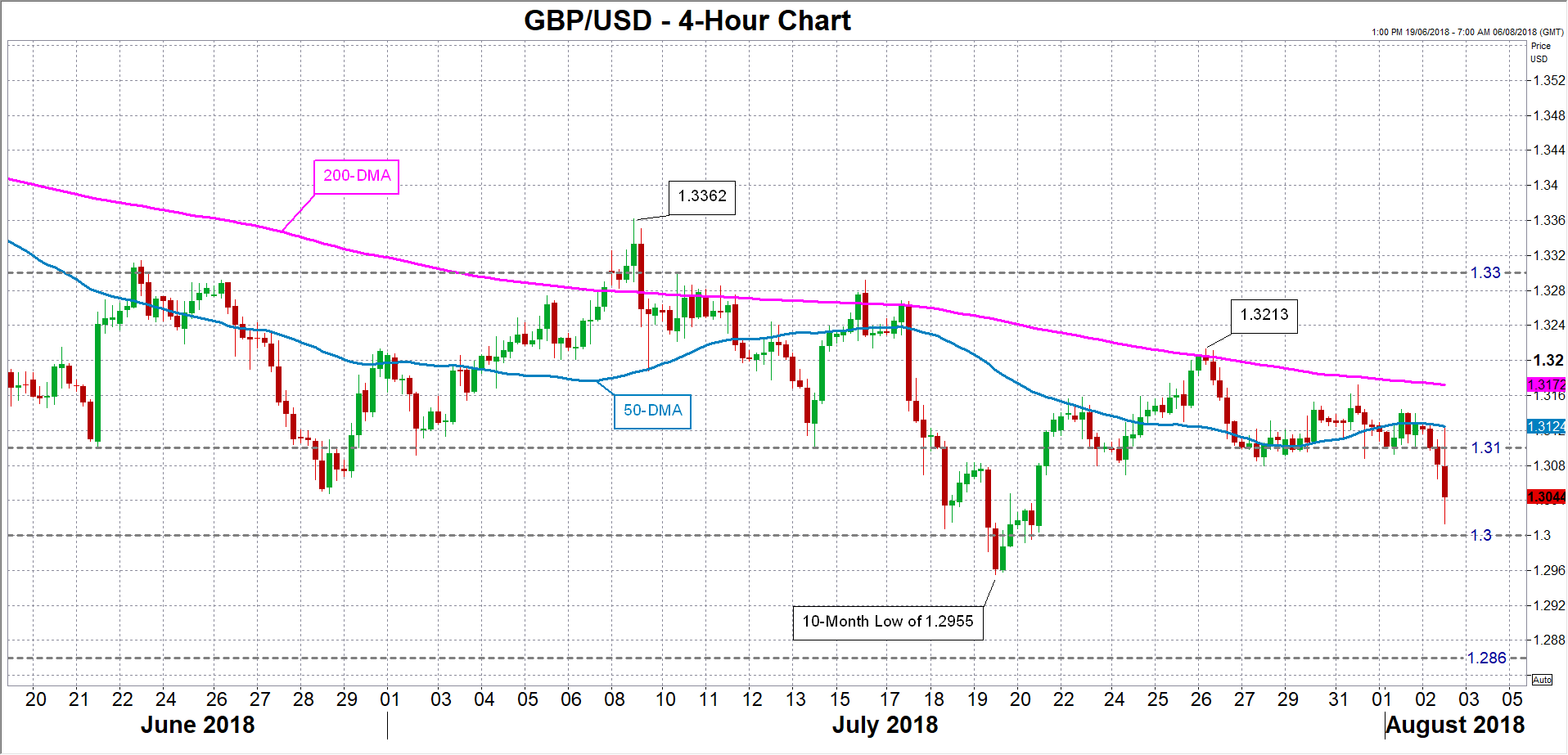
But should the services PMI disappoint, initial support for pound/dollar will likely come from the 1.30 level. Failure to hold above the handle would risk a retest of July’s 10-month low of 1.2955. Breaching this support would reinforce the bearish picture in the medium term and bring into view the 1.2860 level – a past support region.
Bank of England Review: Tight Labour Market Will Cause BoE to Keep Hiking
- Bank of England increased the Bank Rate to 0.75% from 0.50% as expected but the unanimous 9-0 vote was a hawkish surprise.
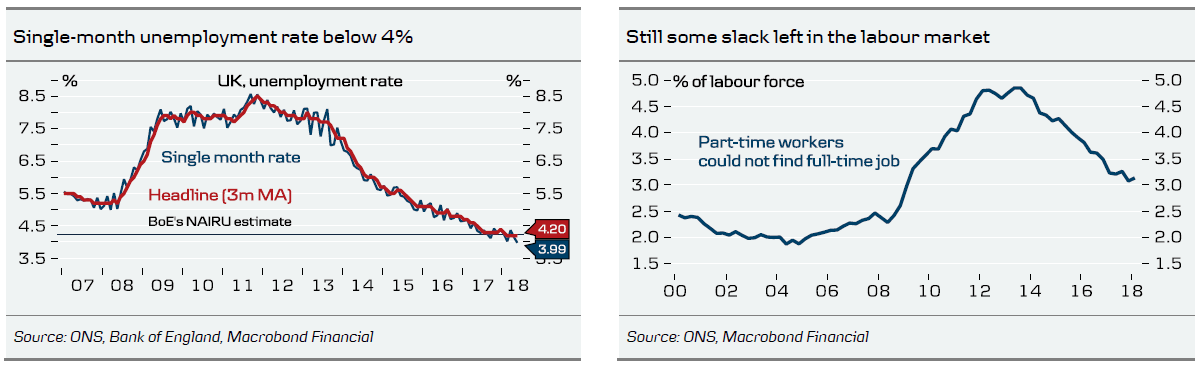
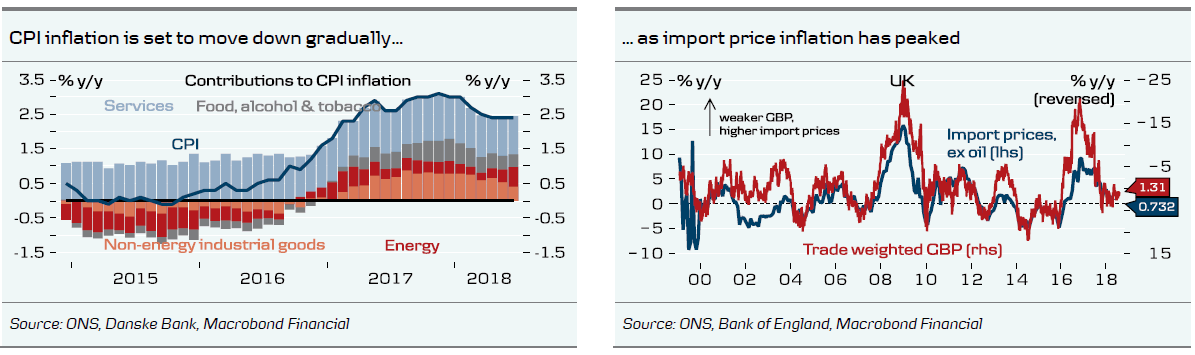
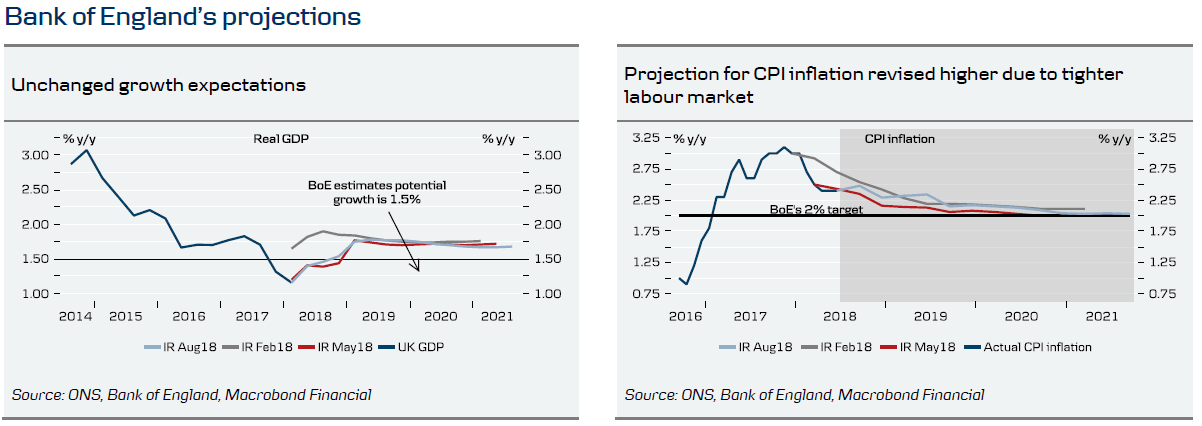
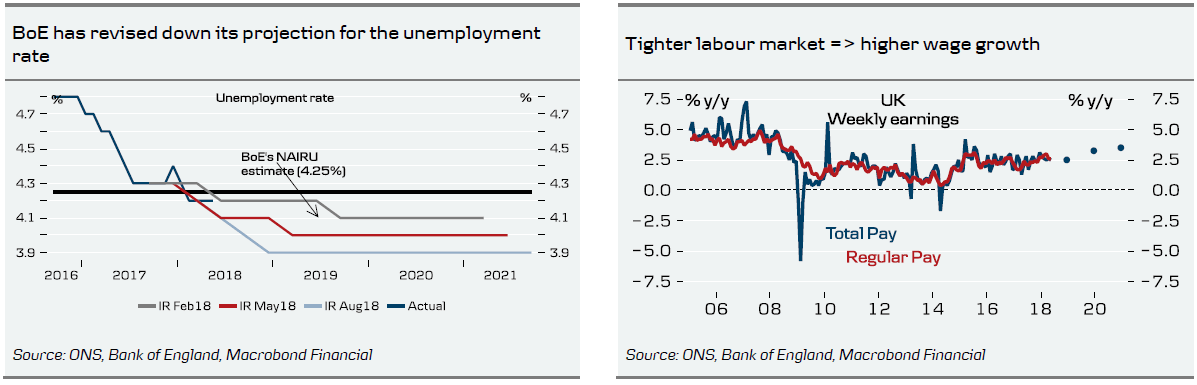
- The BoE seems to be thinking very much like the Federal Reserve in the sense that it believes the tighter labour market will lead to higher wage growth and hence underlying inflation.
- We expect the BoE to continue hiking once a year with the next hike in May.
- We look for EUR/GBP to remain range bound near term with Brexit uncertainty expected to remain a key source of volatility.
BoE outlook: once a year hiking cycle
The Bank of England (BoE) increased the Bank Rate to 0.75% from 0.50% as expected, but the unanimous vote (9-0) was slightly surprising. The main reason is that the BoE thinks very much like the Federal Reserve, as it believes the strong growth and tighter labour market will lead to higher wage growth and hence underlying inflation pressure (Phillips curve thinking). Besides that, the BoE repeated that 'ongoing tightening of monetary policy over the forecast period would be appropriate' and that rate hikes 'are likely to be at a gradual pace and to a limited extent'.
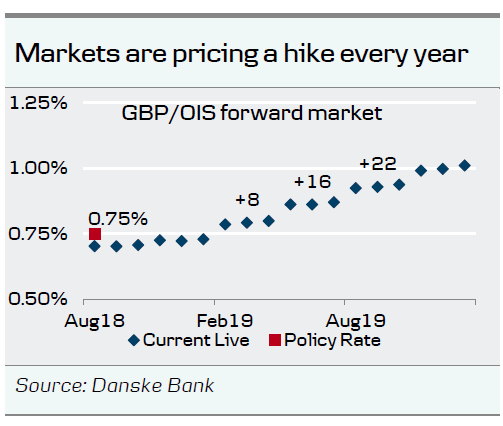
We had also looked forward to the BoE's estimate of the natural rate of interest (the rate where monetary policy is neither expansionary nor contractionary). Unfortunately, we did not get much useful information here. We now know that the Bank of England expects it to rise to between 2-3% (nominal) in the long term but that it is lower in the short term, without saying how much lower. As the BoE has stated it will not start shrinking its balance sheet before the Bank Rate hits 1.5%, we guess it is around that level. Hence the Bank of England can hike around three times from the current level of 0.75% before monetary policy becomes neutral. This fits well with our view that the Bank of England will continue to hike around once a year. This of course also depends on the Brexit outcome where our base case (and the Bank of England's) is still an orderly Brexit. Our base case is that the next hike will come in May. Also keep in mind that the Bank of England seems biased towards postponing a rate hike (as in May) if necessary, as it seems to think the costs of postponing a hike are smaller than hiking prematurely.
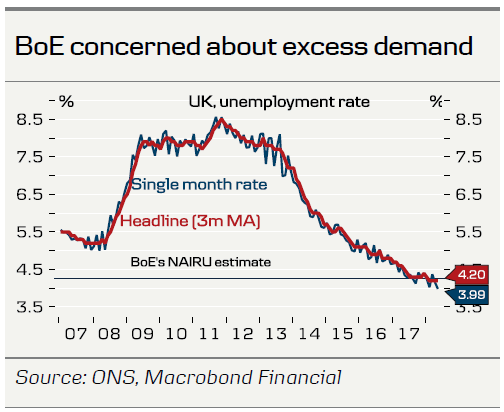
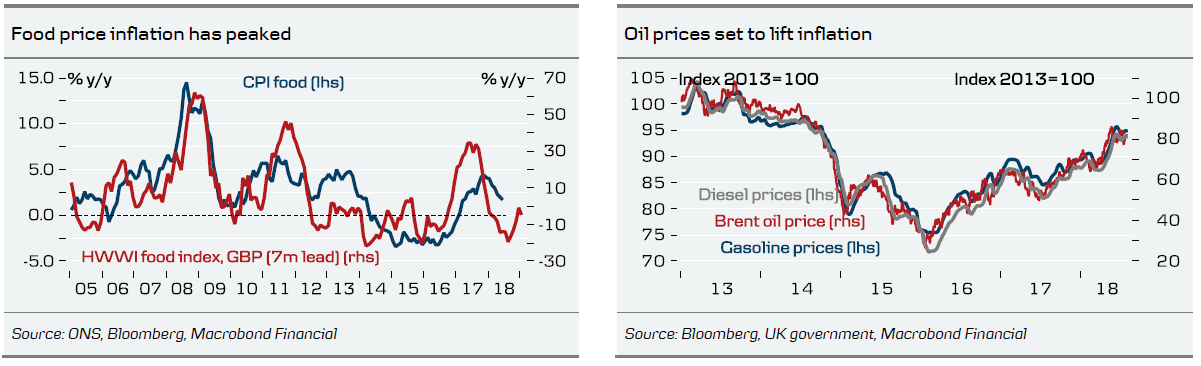
Looking at the projections, the Bank of England still thinks GDP growth will stay around 1.7%, slightly above potential GDP growth of 1.5%. As GDP growth exceeds potential, the BoE expects the unemployment rate to fall further and the projection has been revised down compared to the May report. This, in combination with the weaker GBP, has pushed up the inflation projection. We still think the BoE may be too optimistic on the inflation outlook, as we believe the impact of the GBP depreciation will fade faster than the BoE projects and that wage growth will not increase as much as BoE thinks either.
FX outlook: EUR/GBP range bound for now, but lower eventually
As we predicted, the rally in GBP in the wake of the highly anticipated BoE rate hike proved short-lived and EUR/GBP has bounced back above 0.89 again.
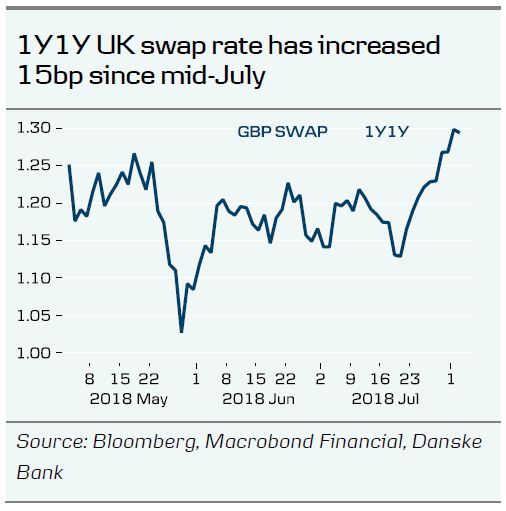
The UK yield curve has steepened substantially in recent weeks where e.g. the 1Y1Y UK swap yield has increased 15bp since mid-July. The market is now pricing that the Bank Rate will reach 1.25% in August 2021, which is fully consistent with our call of one hike per year. Given the uncertainty not least stemming from Brexit, we view the market's pricing as hawkish, and UK yields as not likely to be a positive for GBP near term.
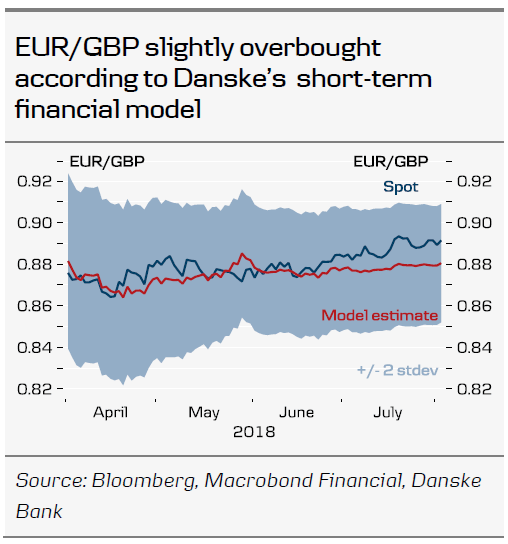
During the press conference, BoE Governor Marc Carney, said that the BoE sees signs that the risk premium on GBP and UK assets in general has increased somewhat recently. Our short-term financial model supports this view, with GBP having traded on the weak side vis-à-vis EUR and USD relative to the model's estimates (see charts below).
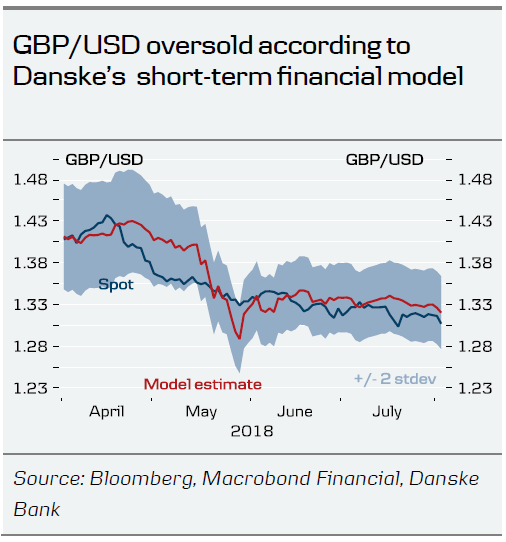
As such, the risk premium on GBP is likely to remain elevated in the near term as Brexit negotiations move into an important period during the Autumn, and we look for EUR/GBP to remain range bound (most likely within 0.875-0.895) near term with Brexit uncertainty expected to remain the key source of volatility.
Longer term, we still expect EUR/GBP eventually to trade lower driven by Brexit clarifications and fundamental valuations. We target EUR/GBP at 0.8650 in 3M, 0.84 in 6M and 0.83 in 12M.
Copper Outlook: Trade Tensions Keep Metal’s Price Firmly in Red
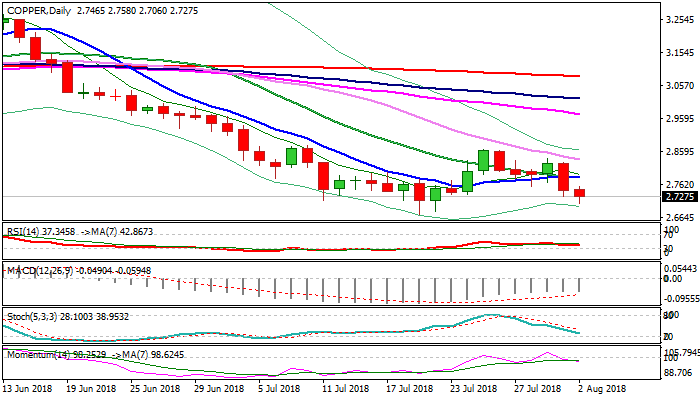
Copper extends strong fall of the previous day to new two-week low at $2.7060 on Thursday, as fears of escalation of trade tensions between the US and China, metal’s biggest consumer, keep the price firmly in red.
On the other side, news about a strike in the biggest copper mine in Chile, did little to support the metal’s price.
Fresh bearish extension approached psychological $2.70 support, the last obstacle en-route to key support at $2.6720 (19 July low, the lowest since July 2017), violation of which would signal extension towards $2.6280 (50% retracement of $1.9360/$3.3200, Jan 2016/Dec 2017 rally).
Bearish daily techs add to negative outlook, with converged 10/20SMA’s ($2.7839) marking solid barrier and expected to cap upticks.
Res: 2.7580; 2.7839; 2.8270; 2.8369
Sup: 2.7060; 2.7000; 2.6720; 2.6280
Sunset Market Commentary
Markets
Core bonds enjoyed a modest safe haven bid today as trade hostilities between the US and China flared-up overnight/today. The BoJ announcing a ¥400 bn offer this morning to contain the Japanese yield rise (10-y touched 0.14%) probably supported core bonds too. The current risk-off sentiment pushed US rates lower by 1.2bps (2-y) to 1.4bps (30-y) with the belly of the yield curve outperforming (US 10-y back below the 3%-mark, -2bps). After opening higher, the German Bund extended its rally as Spanish and French auction results were rather mixed. The German yield curve bull flattens with yields declining 1.7bps (2-y) to 2 bps (10-y). Intra EMU-spreads increased from 2 bps (France, Spain) to 4 bps (Portugal). Italy’s BTP underperforms (+13bps) ahead of a key budget meeting between the country’s leaders and Finance Minister Giovanni Tria.
Today, the dollar trended higher. The rise had little to do with yesterday’s Fed policy statement. The US currency mainly profited from an overall risk-off sentiment as investors were puzzled by the a new exchange of mutual threats in the US-China trade war rhetoric. Tensions between the US and Turkey and further selling of Turkish assets probably added to the safe haven bid for the dollar. In EMU, peripheral spreads with Germany also widened, a potential negative for the euro. The eco data were second tier end had no impact on USD trading. The risk off sentiment eased slightly early in US dealings. This capped the rise of the dollar. EUR/USD dropped to the low 1.16 area, but trades currently again in the 1.1625 area. In line with the risk-off sentiment, USD/JPY traded with a tentative downward bias, but the rise of the yen remained modest. USD/JPY trades currently at around 111.40.
Today, the focus for sterling traders was on the BOE policy decision. EUR/GBP lost a few ticks in the run-up to the announcement. However, this was probably mainly due to EUR/USD softening at that time. The BoE as expected raised its policy rate by 0.25bp. However, it vote was 9-0 (unanimous) and this was a bit of a surprise. Sterling gained temporarily ground on this unanimity. EUR/GBP spiked to the 0.8855/60 area. However, the sterling gain could not be sustained. The BoE assumes that no more than one rate hike each year over the 2019/21 horizon might be enough to bring inflation back to target. This rate hike path remains very modest. ‘The BOE will walk not run’. Evidently, Brexit still also contains a high degree of uncertainty with potential impact on monetary policy. In the end, the gain of sterling was temporary and short-lived. EUR/GBP trades again close to the 0.89 mark. Cable is changing hands in the 1.3050 area, mainly on USD strength.
News Headlines
The Czech National Bank has raised its policy rate with 25bp to 1.25%. One of the main reason is the growing of inflationary pressures. Strong wage growth and a tight labour market pushed inflation to 2.6%, while the bank aims 2%. The bank also aims to strengthen the Czech crown after depreciations in May/July.
The Bank of England has raised its policy rate with 25bp to 0.75%, after an (unexpected) unanimous vote. The raise was widely expected, after the bank unexpectedly did not raised the policy rate in May, due to slowing Q1 growth. Governor Carney signaled there is no rush for a next hike, to achieve its inflation target of 2%.
The trial of an American pastor accused of backing the coup in Turkey, is causing political tension between the two countries, with the US sanctioning two top officials, part of President Erdogan’s cabinet. The tensions have caused the Turkish lira to reach an all-time low against the dollar, with USD/TRY surpassing the 5.00-level.
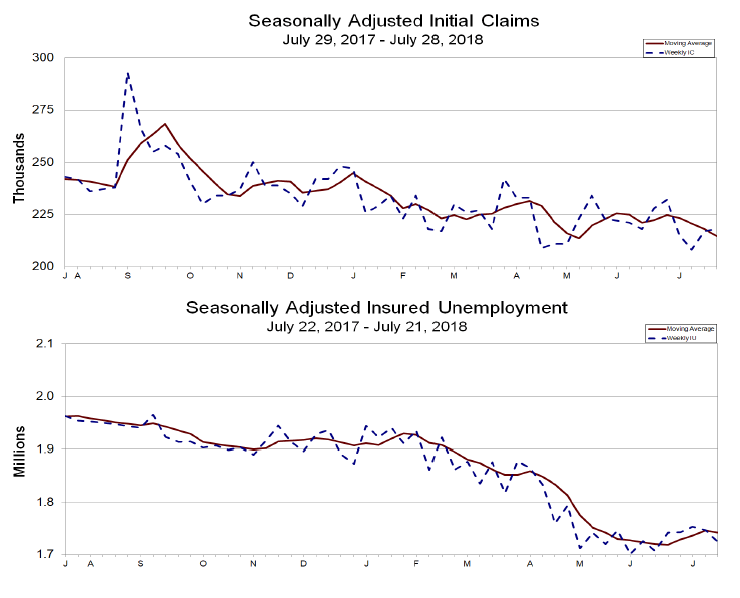
US factory orders rose 0.7%, initial jobless claims rose 1k to 218k
Released from US, factory orders rose 0.7% in June, in line with expectation.
US initial jobless claims rose 1k to 218k in the week ended July 28. Four-week moving average of initial claims dropped -3.5k to 214.5k.
Continuing claims dropped -23k to 1.724m in the week ended July 21. Four-week moving average of continuing claims dropped -4.5k to 1.74175m.
 U
U
GBP/JPY Mid-Day Outlook
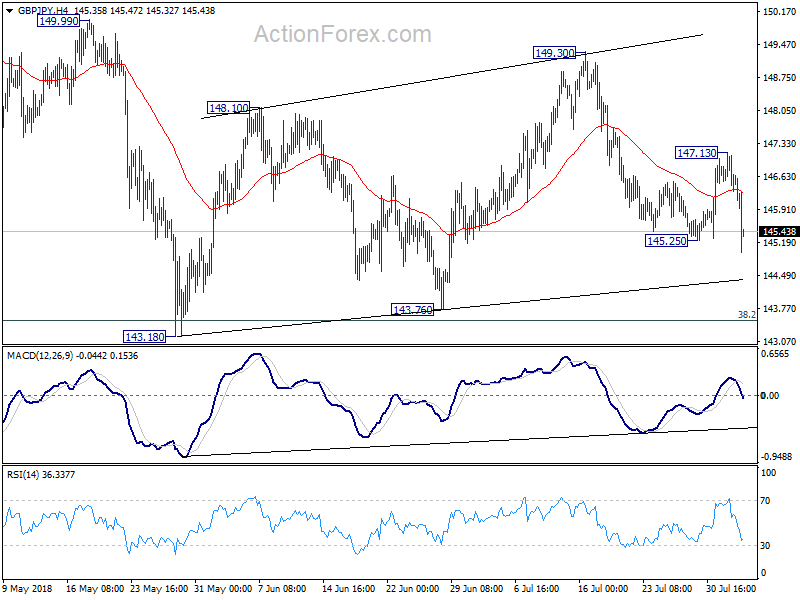
Daily Pivots: (S1) 146.25; (P) 146.70; (R1) 147.09; More...
GBP/JPY's break of 145.24 indicates resumption of fall from 149.30. It also revive the case that consolidation pattern from 143.18 has completed with three waves up to 149.30 already. Intraday bias is back on the downside for 143.18 support first. Break will extend larger fall from 156.69 to key support level at 139.29/47. This will be the preferred case as long as 147.13 minor resistance holds.
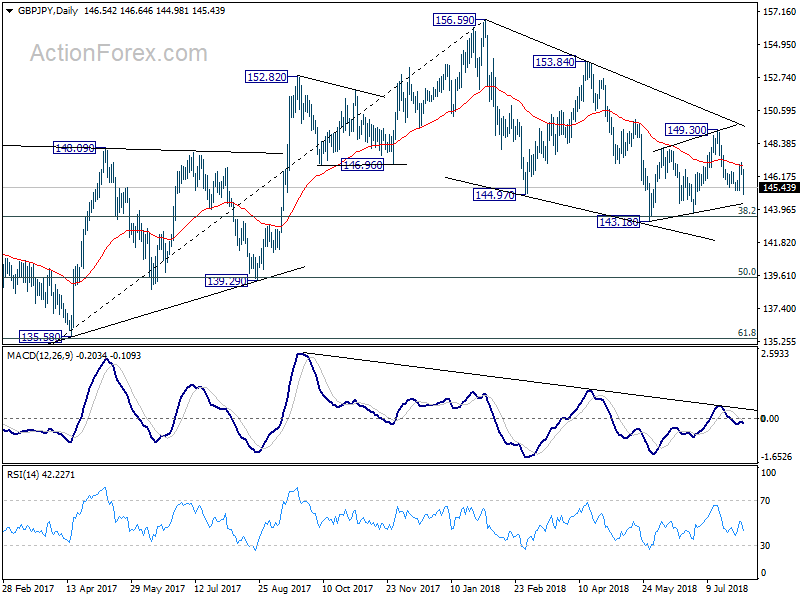
In the bigger picture, decline from 156.59 is seen as a corrective move. In case of another fall, strong support should be seen above 139.29 cluster support (50% retracement of 122.36 to 156.59 at 139.47) to contain downside and bring rebound. Meanwhile, break of 153.84 should confirm that the correction is completed and target 156.59 and above to resume the medium term up trend.
EUR/GBP Mid-Day Outlook
Daily Pivots: (S1) 0.8871; (P) 0.8895; (R1) 0.8908; More...
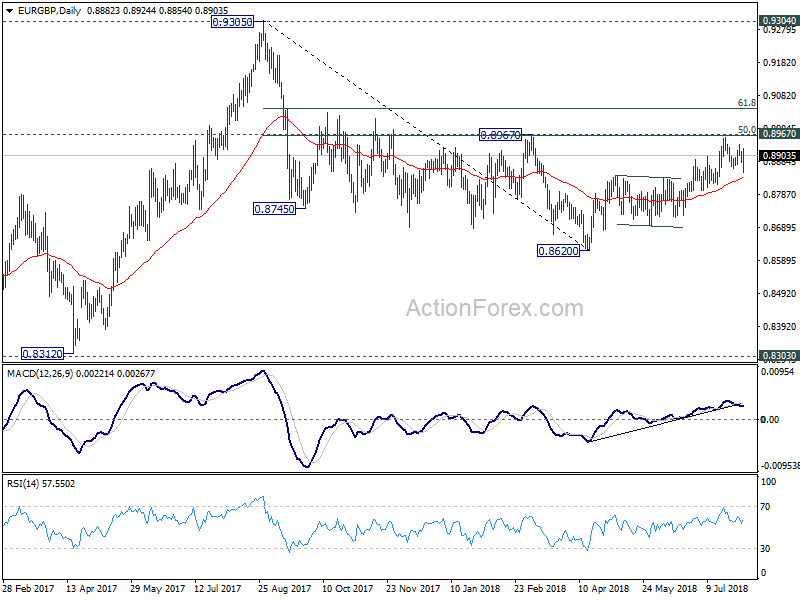
EUR/GBP dips to 0.8854 but quickly rebounds. As it's staying below 0.8957 resistance, intraday bias remains neutral first. As long as 0.8815 support holds, outlook remains bearish and further rise is expected in the cross. On the upside, decisive break of 0.8967 cluster resistance (50% retracement of 0.9305 to 0.8620 at 0.8963) should confirm completion of whole decline from 0.9305. EUR/GBP should then target 61.8% retracement at 0.9043 next.
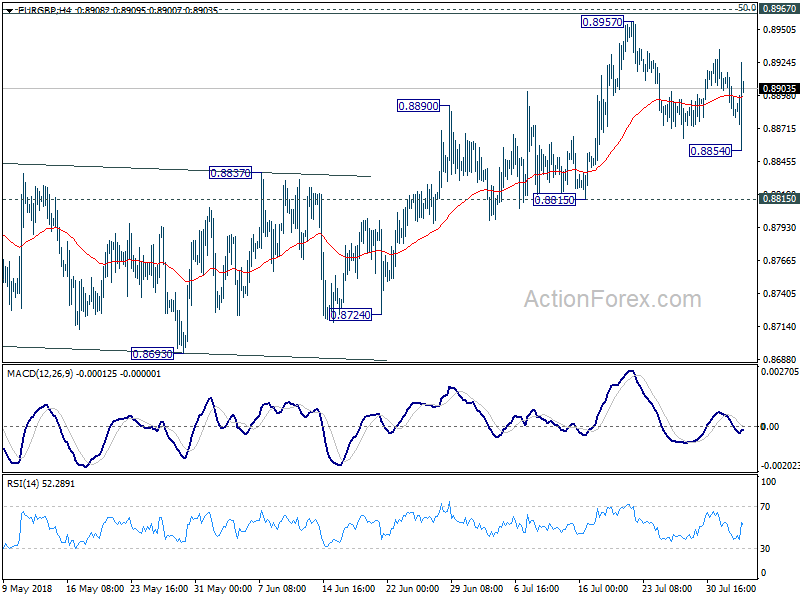
In the bigger picture, EUR/GBP is staying in long term range pattern from 0.9304 (2016 high). The corrective structure of the fall from 0.9305 to 0.8620 is raising the chance that rise from 0.8312 to 0.9305 is an impulsive move. But we're not too confident on it yet. In any case, we'd stay cautious on strong resistance from 0.9304/5 to limit upside in case of further rally. Meanwhile, if there is another medium term decline, strong support will likely be seen from 0.8303 to contain downside.