Sample Category Title
Eurozone PMI manufacturing finalized at 55.1, slowdown reflects worries on trade wars, tariffs and rising prices
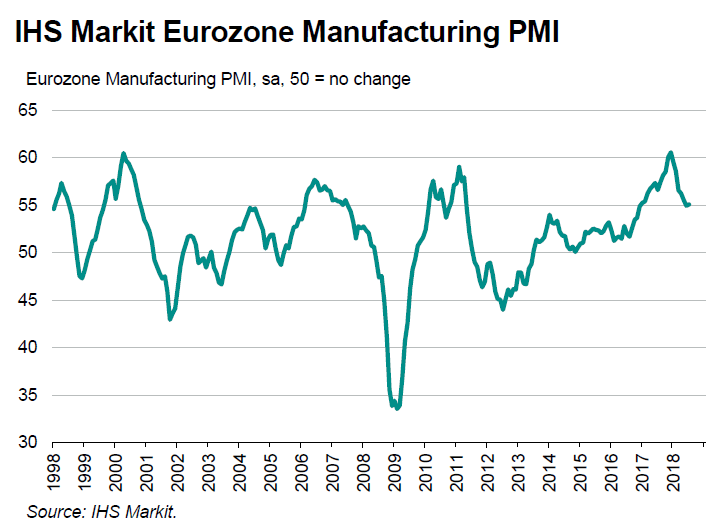
Eurozone manufacturing PMI is finalized at 55.1 in July, unrevised. That was a touch higher than June's final reading of 54.9. Market noted in the release that growth of both output and new orders remain
subdued compared to earlier in the year. Also, new export order growth at near-two year low amid concerns about tariffs and trade wars.
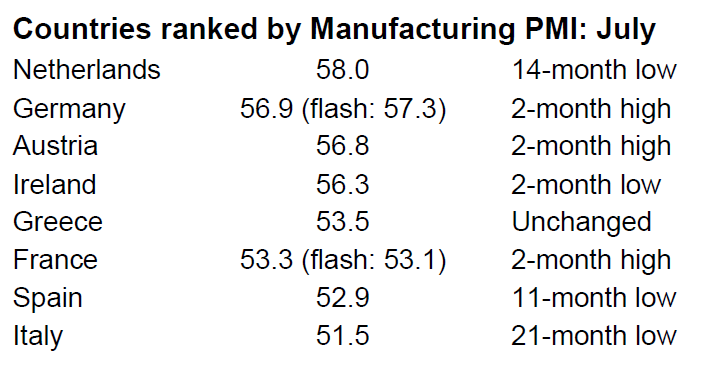
Among the countries, the Netherlands scored 58.0, but hit a 14 month low. Germany came second at 56.9 (revised down from 57.3). Italy hit a 21-month low at 51.5.
Commenting on the final Manufacturing PMI data, Chris Williamson, Chief Business Economist at IHS Markit said:
"A marginal uptick in the PMI provides little cause for cheer given it is the second weakest number for more than one-and-a-half years. The past two months have seen the most subdued spell of factory output growth since late-2016. Worse may be to come. Even this reduced rate of output growth continued to outpace order book growth, resulting in the smallest rise in order book backlogs for two years. The clear implication is that manufacturers may have to adjust production down in coming months unless demand revives.
"Clues to the current soft patch lie in the export growth trend, which has deteriorated dramatically since the start of the year across all member states to reach a near-two year low, with France and Austria seeing exports fall into decline in July.
"The survey responses indicate that the slowdown likely reflects worries about trade wars, tariffs and rising prices, as well as general uncertainty about the economic outlook. Optimism about the future remained at one of the lowest levels seen over the past two years."
Japan Nishimura: Meeting with USTR Lighthizer not prelude to bilateral FTA
Japanese Deputy Chief Cabinet Secretary Yasutoshi Nishimura emphasized today that the meeting between Economy Minister Toshimitsu Motegi and US Trade Representative Robert Lighthizer next week is not a prelude to a bilateral free trade agreement.
Nishimura reiterated the government's stance that "Japan does not desire an FTA and these talks are not at all preliminary discussions on an FTA." Though he noted that "We will be looking for the best path for both the United States and Japan."
In additional he also ruled out setting a quantitative limit on auto exports to the US. He said "whether it's exports or imports, we will not set numerical targets." And, "the fundamental thing is to maintain free and fair trade."
Regarding the threat of auto tariffs from Trump, Nishimura said "raising tariffs on autos would have a big impact on the world economy and would be a big minus for the American economy, so we want to talk firmly so that does not happen."
Japan has been very clear on their intention to bring the US back to the multilateral Trans-Pacific Partnership pact which Trump quitted as one of the first things he did after taking office.
AUDUSD Still Consolidating, Builds Base Around SMAs In Short Term
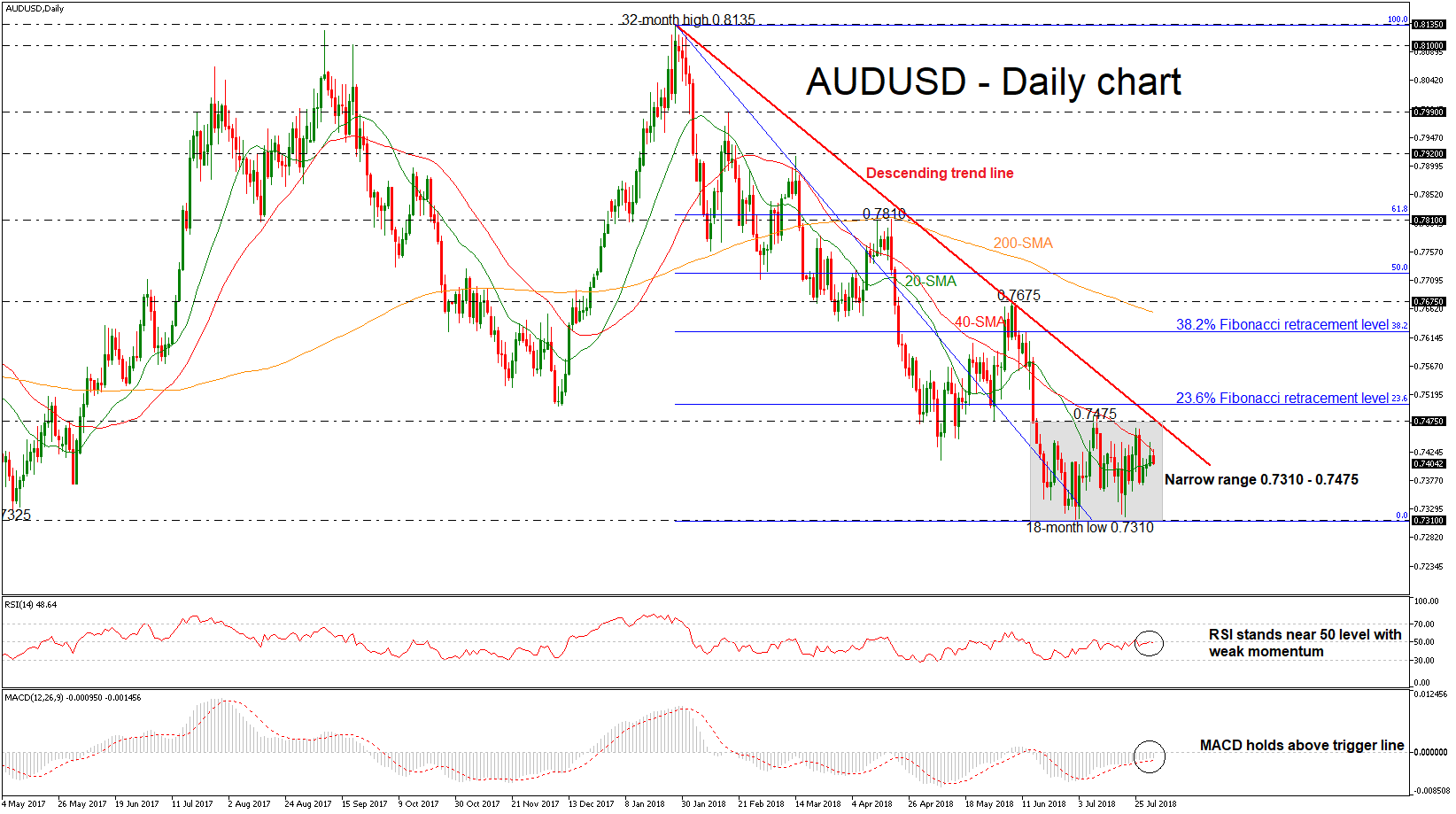
AUDUSD has been trading within a sideways channel over the last six weeks with upper boundary the 0.7475 resistance level and lower boundary the 18-month low of 0.7310. Moreover, the price holds within the 20- and 40-simple moving averages (SMAs) today and is ready to set a bearish session in the daily timeframe.
Technically, momentum indicators are endorsing the neutral to bearish weakness in the market. The RSI indicator is flattening and stands below the threshold of 50, however, the MACD oscillator is moving higher in the negative territory above its trigger line and is approaching the zero line with weak momentum,
Should prices drop further lower, this could open the way towards the 18-month low (0.7310). Further downside extensions could drive the pair until the 0.7160 hurdle, where it bottomed on December 2016.
To the upside, the first resistance for investors to have in mind is the 0.7475 barrier. If there is a jump above this region, the price could challenge the 23.6% Fibonacci retracement level of 0.7505 of the downleg from 0.8135 to 0.7310, increasing the chances for a bullish correction. Above this barrier, if there is an upside penetration of the falling trend line, the focus shifts to the upside until the 38.2% Fibonacci of 0.7625.
Finally, in the longer timeframe, AUDUSD has been trading within a descending move since January 26, however, in the short-term price action endorses the scenario for a sideways move.
XAUUSD Intraday Analysis
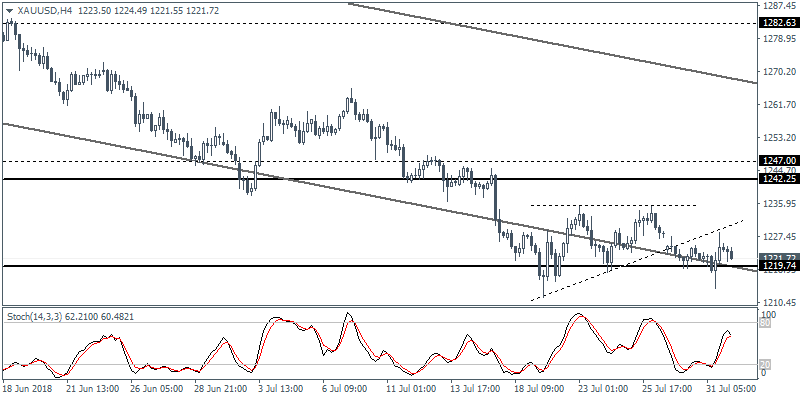
XAUUSD (1221.72): Gold prices formed an outside bar on Tuesday as price action held up near the support level of 1219.75 region. With multiple tests to the support level, gold prices could be potentially forming a bottom in the near term. A rebound off the support near 1219.75 is required to confirm the upside. In the near term, gold prices could maintain the sideways range within 1242.25 resistance and 1219.75 support. A breakout from either of these levels could trigger further gains or losses in the short term.
USDJPY Intraday Analysis
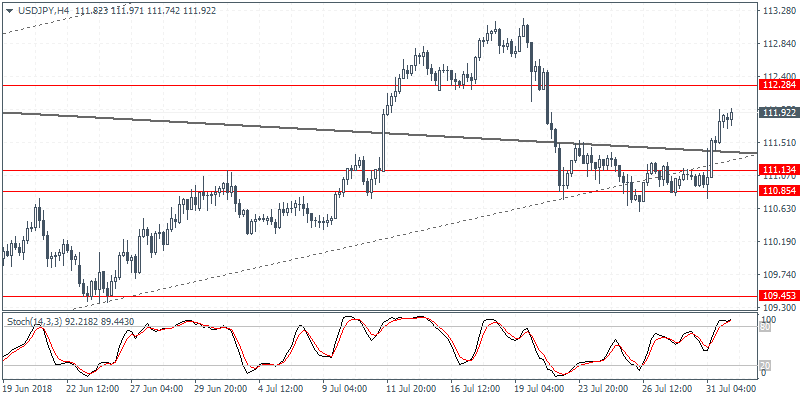
USDJPY (111.92): The USDJPY currency pair was seen bouncing off the support level near 111.13 - 110.85 to close higher on the day. As price action approaches the resistance level near 112.28, the currency pair could settle back into the range within the mentioned levels. USDJPY will need to clear the resistance level of 112.28 in order to confirm the upside with a potential break of the previous highs. To the downside, the declines could be limited to the support level.
EURUSD Intraday Analysis
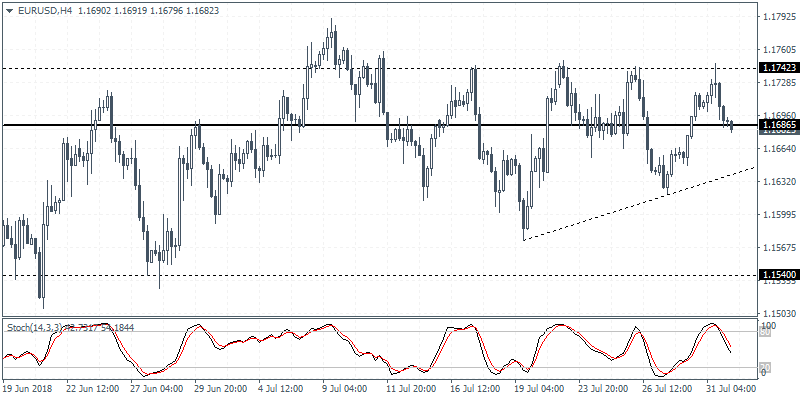
EURUSD (1.1682): The EURUSD currency pair once again failed to break past the resistance level as price action gave up the gains near 1.1730. With the consolidation likely to continue, we expect to see some downside momentum building up in the near term. On the 4-hour chart, price action is seen trading back at the short term support near 1.1686 level. There is a possibility that a break down below this level could see price finding dynamic support near the rising trend line. In the event of a break down below this level we expect further declines to push EURUSD lower to 1.1540.
FOMC, ADP Payrolls And ISM In Focus
The markets were busy with lots of economic data on the tap. In the Eurozone, the flash inflation estimates showed that headline consumer prices increased 2.1% on the year ending June. This was above expectations and even the core inflation rate was seen to have increased 1.1% on the year.
On the downside, the preliminary GDP reports for the second quarter suggested that growth in the Eurozone expanded just 0.3%. This was slower than the 0.4% estimates and the rate of expansion from the previous quarter.
Canada's monthly GDP figures showed a strong 0.5% increase on the month. The data beat estimates of a 0.3% increase.
In the U.S. trading session, the core PCE price index data showed a 0.1% increase on the month, matching estimates. Personal spending and income increased 0.4% respectively.
In the overnight trading session, the New Zealand employment data showed that the unemployment rate increased to 4.5% coming in above estimates of 4.4%. The quarterly employment change increased 0.5%.
Investors will be looking to a new trading month. The UK's manufacturing PMI is on the tap this week with forecasts expected to show a modest reading of 54.2.
The U.S. trading session will see the release of the ADP private payrolls followed by the ISM's manufacturing PMI. Manufacturing activity is expected to show a print of 59.2. Later in the afternoon, the FOMC will be releasing its monetary policy statement. No changes are expected at today's meeting.
The Dollar Regained Momentum Supported By Strong Data
Markets
Yesterday, price action on US and EMU bond markets was mainly driven by the BOJ policy decision. US and EMU bonds enjoyed a relief rally as the BOJ left its policy rate and the target for the 10-y yield unchanged. However, bonds soon reversed a big part of the rebound with Bunds underperforming. Eco data were mixed (EMU: CPI and GDP) to mostly stronger than expected (US: spending and income, Chicago PMI and consumer confidence) but had only a limited impact. At the end of the day, both the US and EMU curves showed a mild flattening, with a modest yield decline for longer maturities. Still, the move was limited given the pre-BoJ yield rise. This morning, the Japan10-y yield rises 5 bp testing the recent peak (0.11%). Markets are testing the limits of BOJ tolerance after the Bank indicated a wider (+/- 0.2%) trading band for 10-y bonds. For now, there is only a moderate negative spill-over on US Treasuries. Today, the final EMU manufacturing PMI will be published. The US calendar contains the ADP labour report and ISM manufacturing. Recently, US data came out fairly solid despite the trade tensions. We see no obvious trigger for this trend to change. Still, the market focus will be on the Fed policy statement. We expect the Fed to keep its (positive) assessment on the economy from the June meeting. Even so, late markets were reluctant to fully join the June Fed dot-plot indicating two additional rate hikes this year. This reluctance is also visible in the sideways pattern in LT US yields and in the flattening yield curve. We doubt that an unchanged Fed assessment will turn the markets' view. For that to happen, more strong data (e.g. Friday's payrolls) or positive trade headlines are probably needed. We also keep a close eye at the Bund contract after recent underperformance. A drop below the pre-BOJ low (161.33) might further hurt the technical picture.
Yesterday EUR/USD initially trended higher despite mixed EMU eco data. A (modest) narrowing in the US/German interest rate differential probably support the technical rebound. EUR/USD came close to the 1.1750 resistance, but a real test/break again didn't occur. The dollar regained momentum supported by strong data. EUR/USD closed at 1.1691 (from 1.1706). USD/JPY outperformed, partly due to a softer yen after the BOJ decision. Today, the question is whether good US data and a confirmed positive Fed assessment on the US eco will be able to trigger a USD rally beyond recent ranges. Of late, the USD ranges (EUR/USD-DXY) were very solid. Some further USD gains are possible, but a break of EUR/USD 1.15 or of DXY 95.50 is not evident. USD/JPY showed a nice rebound yesterday, but the rise might slow as Japanese yields are again rising. The US-China trade developments remain a wild card.
Yesterday, EUR/GBP temporary extended gains north of 0.89 in order-driven, technical trade. However in line with the EUR/USD price action the pair closed the session little changed at 0.8909. Today, the UK Manufacturing PMI is expected to ease slightly to 54.2 (from 54.4). The report is unlikely to derail market expectations for a BoE rate hike tomorrow. We expect more sideways trading for EUR/GBP near the 0.89 barrier.
News Headlines
China's July manufacturing PMI falls to 50.8 from 51.0 in June (50.9 expected), which is the slowest pace in eight months as export orders declined yet again. Despite rumors of talks between US Treasury Secretary Mnuchin and Chinese VP Liu He, others say the US will propose to raise its planned tariffs on $200bn from 10% to 25%. • The US has said to expect North Korea to continue its denuclearization process, despite satellite material detecting renewed activity at a North Korean nuclear facility. The US State Department said it would press other southeast Asian nations this week to maintain sanctions against North Korea.
The EU is willing to offer the UK a deliberately vague declaration on future EU-UK ties, if it helps UK Prime Minister Theresa May avoid a ‘no deal' outcome. The new development comes after May and Germany's Chancellor Merkel met last week. She also cuts her holiday short to meet French President Macron later this week.
EURUSD Traders Await Triangle Pattern Break
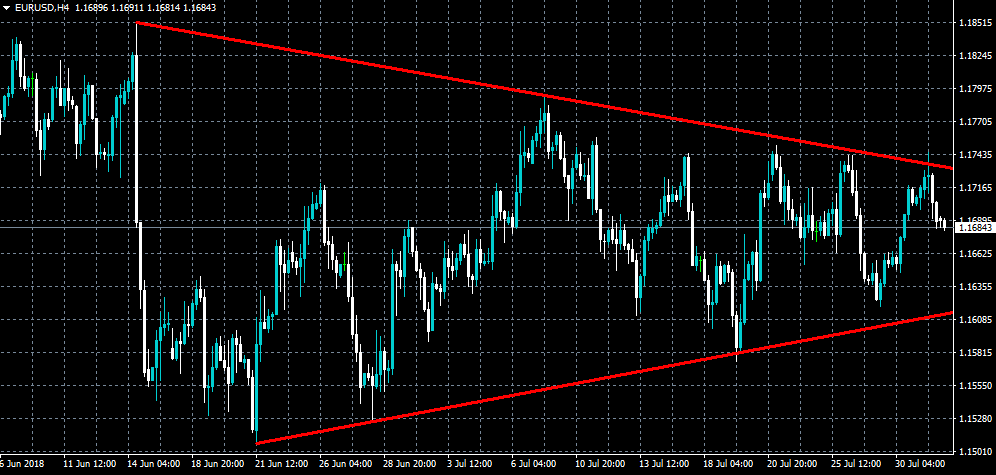
The euro currency is starting to weaken below the 1.1700 level against the US dollar, after a false technical breakout above the well-defined symmetrical triangle pattern on Tuesday. EURUSD traders need to see a clear break of the triangle pattern to encourage a much needed directional breakout in the pair. Buyers need to break the 1.1730 resistance level, while sellers need to force a break of the 1.1610 support level.
The EURUSD pair is only bullish while trading above the 1.1730 level, key resistance is found at the 1.1780 and 1.1850 levels.
If the EURUSD pair falls below the 1.1610 level, key technical support is found at the 1.1540 and 1.1480 levels.
GBPUSD Forming Potential Head And Shoulders
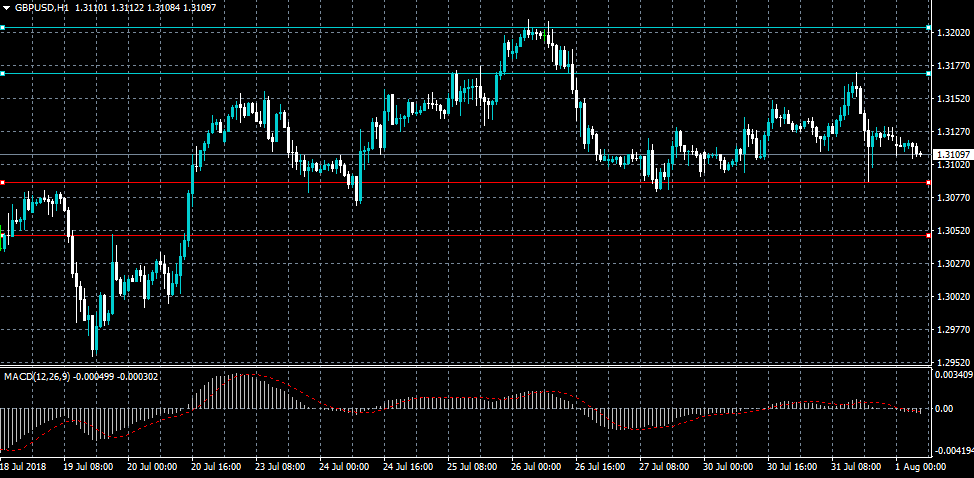
The British pound continues to trade towards the 1.3100 level against the US Dollar, after being sold aggressively from the 1.3170 region on Tuesday. The GBPUSD pair looks to be forming a bearish head and shoulder pattern, with a downside projection of around one-hundred and thirty pips. Sellers will target the head and shoulders neckline around the 1.3070 level, while buyers need to push the price above the 1.3200 level to negate the bearish pattern.
The GBPUSD pair is strongly bearish while trading below the 1.3080 level, key support is now found at the 1.3050 and 1.3030 levels.
If the GBPUSD pair trades above the 1.3170 level, buyers may be encouraged to target the 1.3205 and 1.3245 resistance levels.