

Sample Category Title
UK NIESR urges BoE to stand ready to move in either direction should circumstances change
The UK National Institute of Economic and Social Research release an article "Prospects for the UK Economy" yesterday. It warned that the economy is "facing an unusual level of uncertainty because of Brexit". Such "uncertainty primarily stems from the yet to be defined relationship between the UK and the EU", as well as "the economy's response to the new framework once it emerges." And it criticized Prime Minister Theresa May's Brexit white paper for failing to "unite the government or Parliament", thus " leaving open an entire spectrum of possible outcomes."
The NIESR conditioned its economic forecast with a 25bps BoE rate hike this month, that is, tomorrow. That's also under the assumption of a "soft Brexit". The economic is expected to grow at potential with GDP up 1.4% this year, and 1.7% next year. But "risks to our GDP growth forecast are wider than before and tilted to the downside."
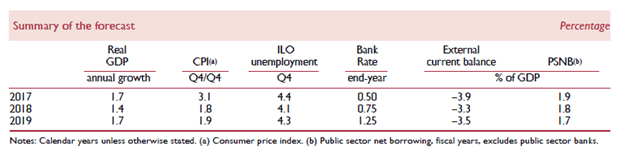
NIESR also urged BoE to take account of the uncertainty of Brexit when setting policy and "also weigh the consequences of 'getting it wrong'." That is, it urged BoE to "stand ready to move in either direction should circumstances change." BoE should "emphasise the uncertainty (rather than the certainty) of its future policy stance in its communications and its willingness to reverse its decisions."
Trump said to consider slapping 25% tariffs on USD 200B of Chinese imports
Just hours after report that US and China are seeking to re-engage in trade negotiations, there were reports that Trump is planning to slap 25% tariffs on USD 200B in Chinese imports, instead of 10%. The product list could include food, chemicals, steel and aluminum, consumer goods etc. The announcement could be made as soon as on Wednesday, that is today.
Trump defended his try policies in a rally speech in Tampa. And he put the blame on other countries again and said "China and others have targeted our farmers. Not good. Not nice. And you know what our farmers are saying? 'It's OK. We can take it." He also tried to equate the support to his policy to patriotism, in typical authoritarian government way, by hailing the farmers as "true patriots".
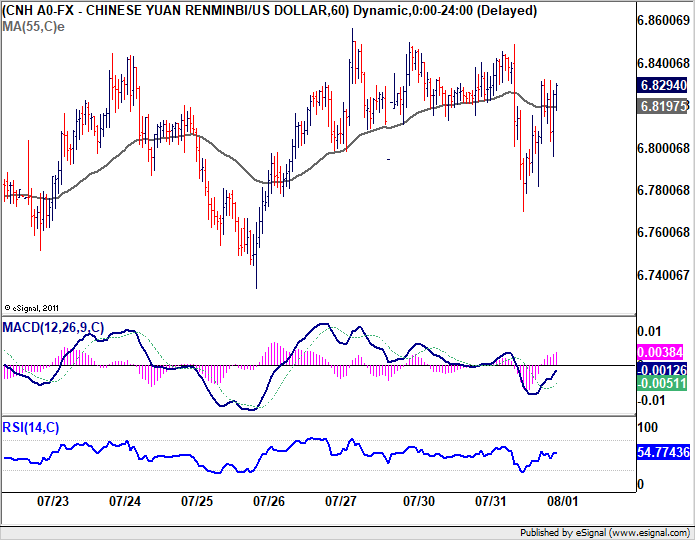
Market reactions to the news were relatively muted though. USD/CNH (offshore Yuan) dipped to as low as 6.770 on news of possible restart in trade talks. But that it's back above 6.8 on the news of the possible 25% tariffs. It's clear what is driving the Yuan exchange rate.
New Zealand employment grew 0.5%, unemployment rate edged higher to 4.5%, AUD/NZD stays in consolidation
New Zealand employment grew 0.5% qoq in Q2, down from prior quarter's 0.6% qoq, but beat expectation of 0.4% qoq. Unemployment rate rose 0.1% to 4.5%, above expectation of 4.4%. Participation rate rose 0.1% to 70.9%. All sector wage inflation rose 0.5%.
From Australia, AiG performance of manufacturing index dropped notable 52 in July, down from 57.4.
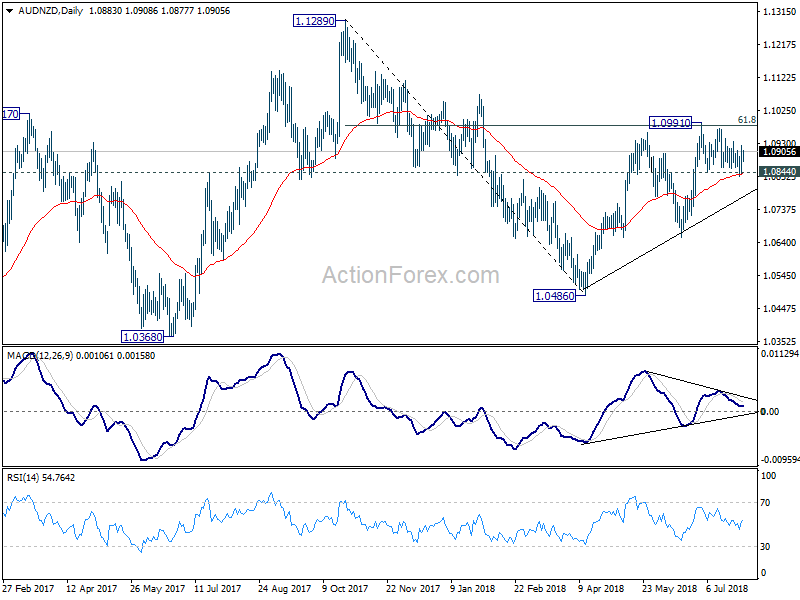
Despite breaching 1.0844 support briefly, AUD/NZD quickly recover, also drew support from 55 day EMA. For now, considering the corrective structure of price action from 1.0991, near term outlook in AUD/NZD stays bullish. We'd expect another rise ahead through 1.0991. And sustained trading above 61.8% retracement of 1.1289 to 1.0486 at 1.0982 could pave the way to retest 1.1289 high.
Japan PMI manufacturing finalized at 52.3, export sales stalled for second month
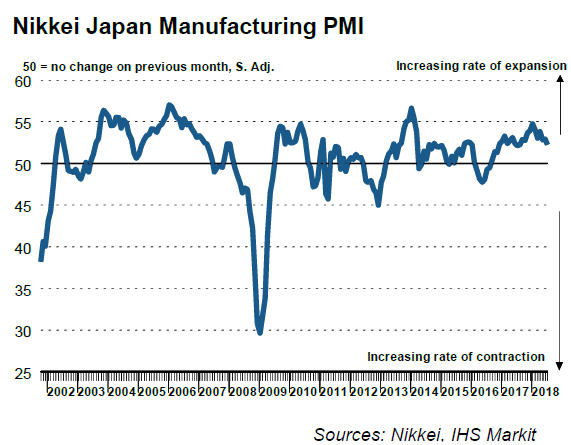
Japan PMI manufacturing was finalized at 52.3, revised up from 51.6. But the reading was still the lowest in 11 months.
Commenting on the Japanese Manufacturing PMI survey data, Joe Hayes, Economist at IHS Markit, which compiles the survey, said:
"Latest survey data signalled a slowdown to manufacturing sector growth at the beginning of Q3. Output growth eased and there was a noticeable softening of demand, while export sales failed to record any upswing for a second month running.
"There was also evidence that supply-side constraints were beginning to bite harder. Employment growth slipped and was weaker than rates seen earlier in the year, meanwhile delivery times for inputs lengthened to the greatest extent in over seven years.
"In turn, input price inflation accelerated to an 88-month high, resulting in the strongest rate of increase in selling charges for almost a decade. Although stronger output price inflationary pressures will be welcomed by policymakers, anecdotal evidence indicates the latest rise was primarily cost-push. Further weakness in total new business growth could skew the inflationary outlook to the downside."
China Caixin PMI manufacturing dropped to 50.8, export market continued to deteriorate
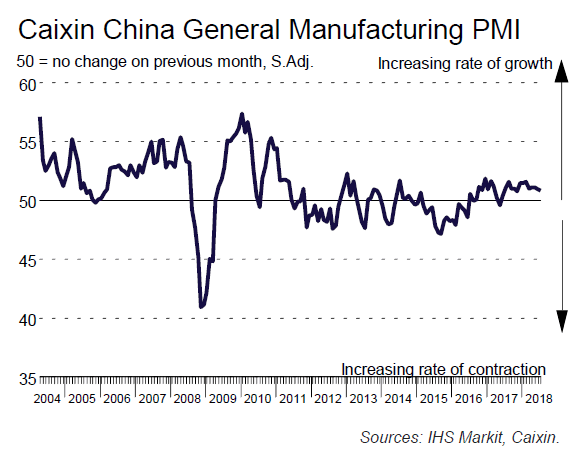
China Caixin PMI manufacturing dropped -0.2 to 50.8 in July, down from 51.0, slightly below expectation of 50.9. It's also the lowest since November 2017. The key points in the release are slower increase in output and new orders, fastest decline in new export sales for over two years and solid rise in input costs.
Commenting on the China General Manufacturing PMI™ data, Dr. Zhengsheng Zhong, Director of Macroeconomic Analysis at CEBM Group said:
"The Caixin China General Manufacturing PMI slipped to 50.8 in July from June. The reading has not been this low since November 2017.
"The sub-indexes for output and new orders both fell, but remained in expansionary territory, while the employment sub-index picked up despite remaining in contractionary territory. New export orders shrunk at the fastest pace since June 2016, indicating the export market continued to deteriorate.
"The sub-indexes for output charges and input prices both dropped, but remained in expansionary territory, pointing to easing pressure on prices. The sub-index for future output edged up, reflecting that goods producers were more optimistic that production would grow over the next 12 months.
"The sub-index for stocks of finished items contracted at a steeper rate in July, while the sub-index for stocks of purchased items started expanding again — a positive sign that companies had reduced their stocks of finished products and replenished stocks of purchases. The sub-index for suppliers' delivery times rose, even though it failed to make it into expansionary territory, which might imply an improved capital turnover among manufacturers.
"In general, the survey signaled a weakening manufacturing trend as a grim export market dragged on the sector's performance. The positive drivers were the increase in stocks of purchases and easing pressure on capital turnover."
AUD/USD Facing Uphill Task Ahead of Fed Decision
Key Highlights
- The Aussie Dollar declined heavily in June 2018 and traded towards 0.7300 against the US Dollar.
- There is a crucial bearish trend line in place with resistance at 0.7500 on the daily chart of AUD/USD.
- The US Personal Income in June 2018 increased 0.4% (MoM), in line with the market forecast.
- Today, the Fed Interest rate decision is scheduled, and the central bank is likely to keep rates at 2%.
AUDUSD Technical Analysis
The Aussie Dollar remained in a major downtrend from the 0.7670 swing high against the US Dollar. The AUD/USD pair recently formed support near 0.7310 and recovered, but upsides remained capped.
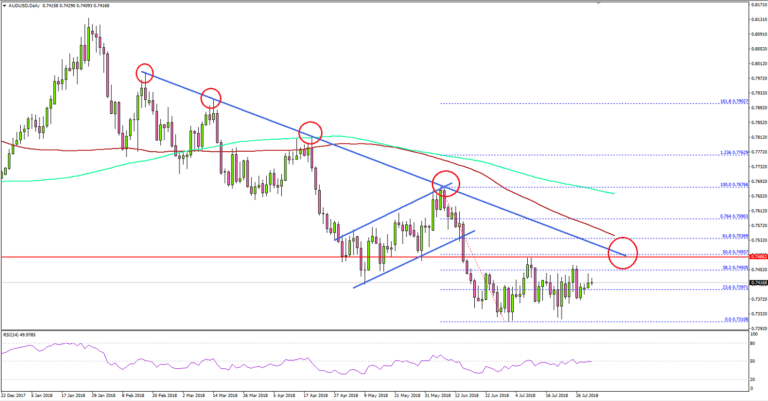
Looking at the daily chart, the pair recovered above the 23.6% Fibonacci retracement level of the last decline from the 0.7670 swing high to 0.7310 swing low. However, the previous support area near 0.7490-0.7500 acted as a resistance.
Additionally, the 50% Fibonacci retracement level of the last decline from the 0.7670 swing high to 0.7310 swing low also acted as a resistance. More importantly, there is a crucial bearish trend line in place with resistance at 0.7500 on the same chart.
Therefore, it won't be easy for the Aussie dollar to break the 0.7490 and 0.7500 resistance levels. Above 0.7500, the 100-day simple moving average (red) is positioned at 0.7540. As long as AUD/USD is below 0.7500 and the 100-day SMA, it may perhaps either consolidate or move down towards 0.7200.
On the flip side, a close above 0.7500 and the 100-day SMA could push the pair in a positive zone towards the 0.7600 and 0.7700 levels in the medium term.
Recently in the US, the Personal Income for June 2018 was released by the Bureau of Economic Analysis, Department of Commerce. The market was looking for a 0.4% rise the personal income compared with the previous month.
The actual result was in line with the forecast and similar to the last reading. Looking at the Core Personal Consumption Expenditure in June 2018, there was a rise of 1.9%, less than the forecast of 2%.
Overall, AUD/USD is facing an uphill task near 0.7500. However, today's fed rate decision could ignite swing moves in pairs like EUR/USD, GBP/USD, AUD/USD, USD/JPY and NZD/USD.
Economic Releases to Watch Today
- Germany's Manufacturing PMI for July 2018 – Forecast 57.3, versus 57.3 previous.
- Euro Zone Manufacturing PMI July 2018 – Forecast 55.1, versus 55.1 previous.
- UK Manufacturing PMI for July 2018 – Forecast 54.2, versus 54.4 previous.
- US Manufacturing PMI for July 2018 – Forecast 55.5, versus 55.5 previous.
- US ADP Employment Change July 2018 – Forecast 185K, versus 177K previous.
- US ISM Manufacturing Index for July 2018 – Forecast 59.8, versus 60.2 previous.
- Fed Interest Rate Decision – Forecast 2%, versus 2% previous.
Dollar Higher After Trump Administration Reopens Talks With China
The US dollar rose on Tuesday after American inflation data was in line with expectations and consumer confidence came out higher than forecasted. The U.S. Federal Reserve wraps up its two day Federal Open Market Committee (FOMC) meeting on Wednesday at 2:00 pm EDT. The market is not anticipating a major change from the language on the rate statement or the interest rate itself. The September Fed meeting has been priced in for another rate hike as the Fed continues its path toward monetary policy normalization. The private payrolls report from the ADP is expected to show a gain of more than 180,000 jobs and serve as the preamble to the biggest indicator release in the market the U.S. non farm payrolls (NFP) due on Friday.
- ADP forecasted to add 186,000 jobs
- Fed to hold interest rates unchanged
- Central bank week continues with the BoE on Thursday
Dollar Rebounds Ahead of FOMC
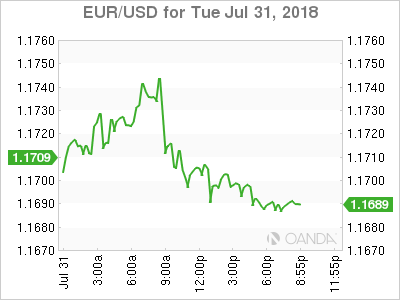
The EUR/USD fell on Tuesday. The single currency is trading at 1.1689 after breaking above the 1.17 price level on positive European indicator releases during the European session. The USD started gaining traction with the release of inflation data and higher consumer confidence numbers but it was the reports that the US and China are trying to meet to discuss trade that boosted the currency. Private conversation are said to be ongoing with a goal of having ministerial meetings that have been on hold since the trade war rhetoric escalated.
The U.S. Federal Reserve is not expected to modify its monetary policy on Wednesday and without a press conference the focus will be on the language changes in the statement. The Fed has already hiked twice in 2018 and policy members have talked about two more interest rates lift if the economy continues on its current growth path. President Trump has already commented that he is not a fan of the Fed’s decision to keep driving interest rates higher. Chair Powell has so far avoided commenting outside of the central bank’s mandate and this week there won’t be a chance for the financial press to seek his opinion on the matter of the Fed’s independence.
Bank of Japan (BOJ) Underwhelms Sends Yen Lower
The USD/JPY rose on Tuesday after the Bank of Japan (BOJ) kept most of its monetary policy intact, but will allow a wider band on its bond yields as well as the use of forward guidance. BOJ Governor Haruhiko Kuroda said that rates will remain low for an extended period of time. The central bank remains committed to a lofty 2 percent inflation target and has not reached it despite a massive QE program that has been going on for 5 years. Mr Kuroda closed the door to speculation that the BOJ would exit QE.
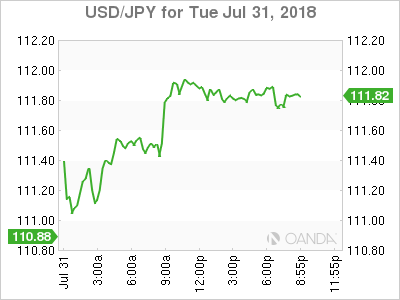
Investors were underwhelmed by the BOJ’s decision with the currency pair climbing to 111.87 on its way to break the 112 price level. All eyes will be on the U.S. Federal Reserve and its statement on Wednesday. The Fed will follow the BOJ in this busy week with little changes expected, but in current market conditions small tweaks could have big consequences for currencies.
Strong GDP Boosts Canadian Dollar
The Canadian dollar appreciated versus the US on Tuesday after the stronger than expected monthly GDP report. The Canadian economy expanded at a 0.5 percent rate in May versus the anticipated 0.3 percent. The higher annual pace of growth came in at 2.6 percent and has increased the possibility of another rate hike this year, appreciating the loonie versus the greenback on the North American trading session. Oil prices fell below $70 as the US dollar recovered with the announcement of new trade talks between the US and China.
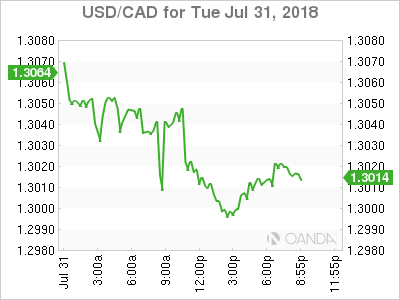
The US dollar staged a comeback after the announcement of lower trade tension between China and the United States. The currency pair touched a session low of 1.3010 at 8:30 am, but is now back at 1.3016 after sources indicated that US Treasury officials and China Vice Premier representatives intend to meet.
The NAFTA and EU-US trade conversations both had positive sound bites this week. Incoming Mexican President was eager for a quick NAFTA renegotiation and he was echoed by the Trump administration. Canada and Mexico made sure to be clear that a trilateral negotiation is needed as the US has been pushing for two bilateral sit downs.
Yesterday US Commerce Secretary Wilbur Ross said that NAFTA talks are close to a deal, specially with Mexico. The latest strategy by the US has been to move faster on talks with its southern neighbour with a new incoming government. Mexico and the US will hold ministerial talks on Thursday in Washington. Canadian officials tried to be part of the meeting but were rejected by the US.
Market events to watch this week:
Wednesday, August1
4:30am GBP Manufacturing PMI
8:15am USD ADP Non-Farm Employment Change
10:00am USD ISM Manufacturing PMI
10:30am USD Crude Oil Inventories
2:00pm USD FOMC Statement
2:00pmUSD Federal Funds Rate
Thursday, August2
4:30am GBP Construction PMI
7:00am GBP BOE Inflation Report
7:00am GBP MPC Official Bank Rate Votes
7:00am GBP Monetary Policy Summary
7:00am GBP Official Bank Rate
7:30am GBP BOE Gov Carney Speaks
Friday, August3
4:30am GBP Services PMI
8:30am USD Average Hourly Earnings m/m
8:30am USD Non-Farm Employment Change
8:30am USD Unemployment Rate
10:00am USD ISM Non-Manufacturing PMI
Trade War Breakthrough?
Trade war breakthrough?
US markets are off to a rousing start in the wake of a report that US and China are said to restart talks to avert the escalating tit for tat trade war but renewed selling in large-cap tech companies has tempered gains. But indeed any tempering of this confrontational issue ahead of the Presidents 200 billion trade threat will be viewed in a favourable light and provided parties remain at the table, where there’s a will there is a way.
Currency Markets
As expected there was no hawkish midsummer nightmare but rather \he BoJ did not change rates nor did they show any signs of shifting from ultra-loose monetary policy and predictably USDJPY has been grinding higher while taking the NKY is tow. The BoJ announced minuscule adjustments: Firstly, no surprise here that both GDP and CPI expectations were revised lower. Secondly, they increased the band around the 0.0% target for 10y JGBs from 10bps to 20bps, permitting more movement in rates. They changed the ETF program, maintaining purchases at JPY6.0tn but adjusting the allocation more to Topix rather than Nikkei. Finally, the BoJ adopted a forward guidance strategy as traders view incredibly subtle shift towards policy normalisation definitively dovish and topside USDJPY is now in play.
Chinese Manufacturing and non-manufacturing PMI’s were slightly below expectations but did not seem to have a notable market impact. If anything, base metals are trading mixed this morning after the data.
On the highly watched USDCNY post, the overnight the fix came out in line with expectations at 6.8165, +34 pips but on the positive trade headlines long USDCNH positions are buckling from 6.84+ to sub 6.80 as long dollar positions are running for the exits.
The AUD dollar was trading bid after residential building approvals came in better than expected overnight, But on the back of this morning move below 6.80 USDCNH has seen an exodus from arguably the market most crowded trade, short Aussie.
The National Post report overnight indicating US diffidence for Canada to join the current US/Mexico trade talks saw USDCAD spike back towards 1.31 but provided traders with an excellent opportunity to re-engage CAD longs as the outlook remains favourable for the Loonie,.And local dealers were rewarded after the positive GDP overwhelmed the negative NAFTA news.
With an apparent easing on Trade tensions, the Malaysian Ringgit should find some support on improving risk sentiment, but as we enter the two days Fed policy meeting, the USD is holding up its end of the bargain. But in addition to the Fed policy meeting, traders have payrolls on their mind which should continue to lend support to the Greenback and will limit MYR gains.
Oil Markets
Oil prices were back peddling out of the gates this morning ahead of today’s contract expirations in September Brent, after reports from Interfax pointed to increased supply, specifically from Russia, whose oil production was up to 11.22mm bpd this month. However, both Brent and WTI have reversed tack and are moving higher on the positive US-China trade headlines which are easing global growth concerns.
Gold Markets
Gold prices bounced off session lows with the Yuan rallying. However, with the Fed expected to stay the course with two interest rates rises in 2018 which should underpin near-term USD sentiment, speculators will continue to fade upticks in the absence of haven and sluggish physical demand.
Eco Data 8/1/18
[php_everywhere instance="1"]
Fed to Hold Rates But Will Trump Criticism Restrain a More hawkish Message?
The US Federal Reserve will announce its latest rate decision on Wednesday at 18:00 GMT when the Federal Open Market Committee (FOMC) concludes a two-day policy meeting. After the move in June when the Fed lifted rates to a range of 1.75-2.00%, no change in policy is expected this month. The absence of a press conference and new economic projections also make the July meeting a less eventful one. However, following President Trump’s recent remarks questioning the need to raise rates, investors will be watching to see whether political pressure has reined in some of the Fed’s hawkish language.
The Fed raised rates for a second time this year in June and set the ground for two more quarter point increases in 2018. But with other central banks moving much more slowly than anticipated in scaling back their stimulative policies, leaving the Fed as the only one on a decisive tightening path, the dollar has rallied sharply since the second quarter. The dollar index, which measures the greenback against a basket of six major currencies, hit a one-year high in July.
But the comparatively higher interest rates and an overvalued dollar appear to have drawn the attention of Donald Trump, with the US president taking to Twitter to attack the Fed for taking away America’s “big competitive edge”. Trump initially expressed his frustration with the Fed in an interview with the CNBC on July 19, before repeating his criticism in a tweet the following day. His remarks knocked the dollar off one-year highs and the currency has been struggling for direction since.
While Trump may have caught the markets off-guard, hence the strong reaction, it’s highly unlikely the Fed would bow to political pressure and ease back on raising rates. After all, the Fed has come under political interference on several occasions in the past, most recently in the 1980s and 1990s under presidents Ronald Reagan and George H. W. Bush, respectively. And although the Fed is certain to stick to its course of gradual rate increases, at least for the remainder of 2018, there is the risk that further criticism by Trump would start to damage the perceived independence of the Federal Reserve even if there is no real threat at present of Congress limiting the central bank’s powers.
The immediate focus though for the July meeting will be on any changes to the Fed’s views on growth and inflation. With GDP growth accelerating to an annualized 4.1% in the second quarter and core PCE inflation running close to the Fed’s 2% target, FOMC members might signal possible upward revisions to their projections for the forthcoming September meeting. In terms of risks to the downside, investors will be watching for any increased concerns by policymakers about the impact from heightened trade tensions. There has been some evidence lately, which has also been highlighted by Fed Chairman Jerome Powell, that higher tariffs are weighing on US business confidence.
While a bigger focal point this week will be Friday’s nonfarm payrolls report, the US dollar could nevertheless be in line for some gains should the Fed statement strike a slightly more upbeat tone in July. Dollar/yen, having surged towards the 112 level today, could attempt to break past that psychological mark. A successful climb above 112 would bring the pair back within reach of July’s 6-month high of 113.16, though there’s likely to be some resistance around 112.60 before then.
Alternatively, a less hawkish-than-anticipated statement could see dollar/yen retreating initially to around 111.20. Even steeper declines could lead prices towards the 110.80 and 110.55 levels.