

Sample Category Title
USD/JPY Mid-Day Outlook
Daily Pivots: (S1) 111.11; (P) 111.53; (R1) 112.30; More...
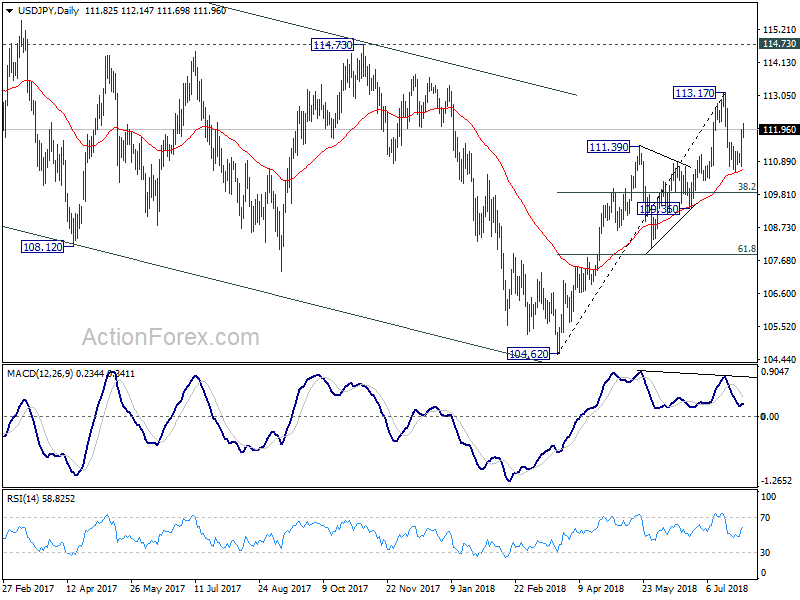
Intraday bias in USD/JPY remains on the upside for the moment. Current rebound from 110.58 should target a test on 113.18 resistance first. Firm break there will resume larger rally from 104.62 for 114.73 key resistance next. On the downside, below 111.24 minor support might extend the corrective fall from 113.17 with another decline. But downside should be contained by 38.2% retracement of 104.62 to 113.17 at 109.90 to bring rebound.
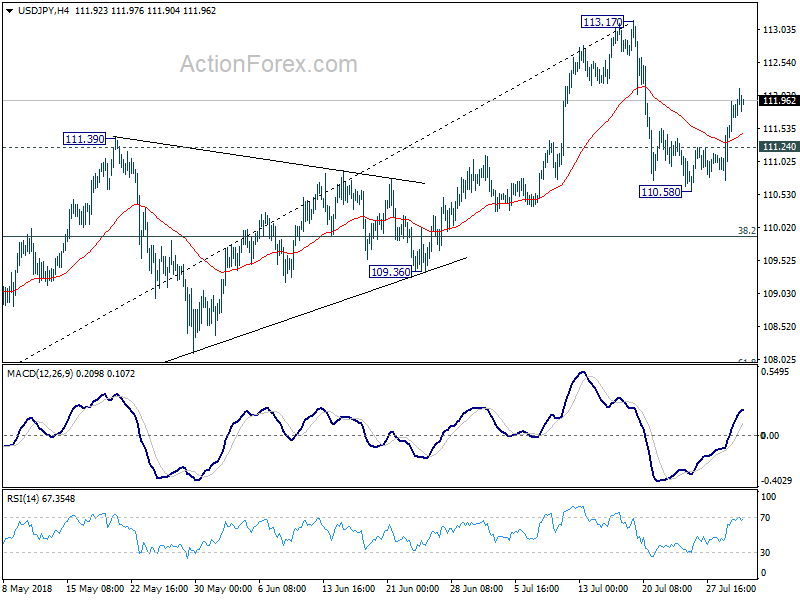
In the bigger picture, corrective fall from 118.65 (2016 high) should have completed with three waves down to 104.62. Decisive break of 114.73 resistance will likely resume whole rally from 98.97 (2016 low) to 100% projection of 98.97 to 118.65 from 104.62 at 124.30, which is reasonably close to 125.85 (2015 high). This will stay as the preferred case as long as 109.36 support holds.
USD/CHF Mid-Day Outlook
Daily Pivots: (S1) 0.9854; (P) 0.9906; (R1) 0.9934; More...
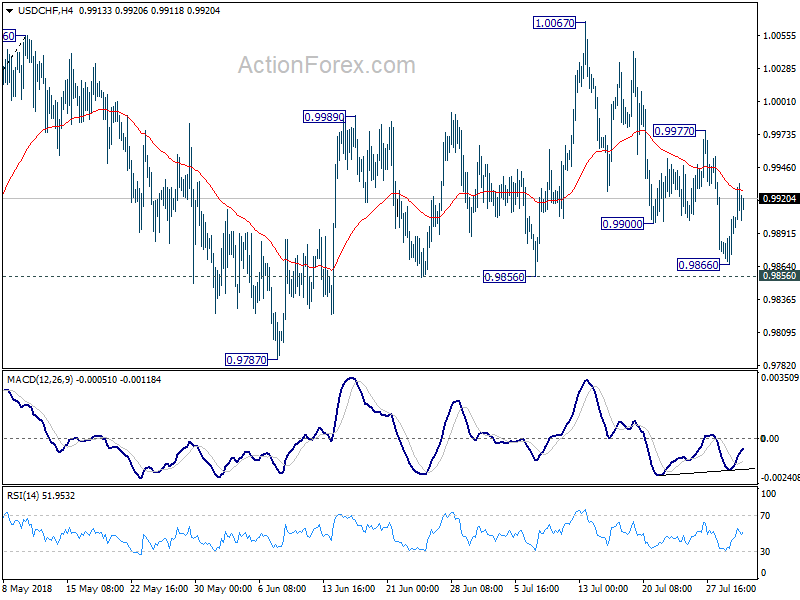
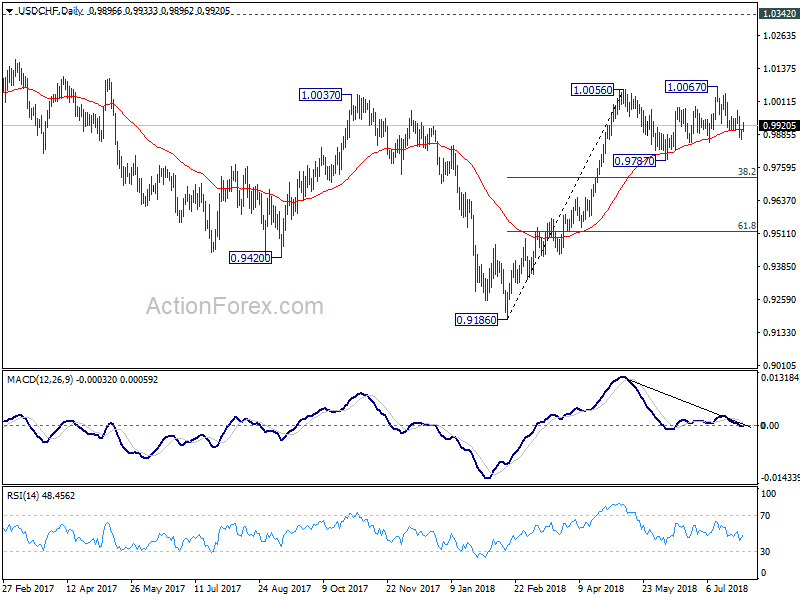
USD/CHF struggles to get through 4 hour 55 EMA and is held well below 0.9977 resistance so far. Intraday bias remains neutral first. On the upside, above 0.9977 will bring retest of 1.0067 first. Decisive break there will resume larger rally from 0.9186. On the downside, below 0.9866 will extend the fall from 1.0067 through 0.9856 to 0.9787 support. As price actions from 1.0056 are seen as a corrective pattern, downside should be contained by 38.2% retracement of 0.9186 to 1.0056 at 0.9724 to bring rebound.
In the bigger picture, current development suggests that the consolidation pattern from 1.0056 is extending with another leg. As long as 38.2% retracement of 0.9186 to 1.0056 at 0.9724 holds, we'd expect rise from 0.9186 to resume at a later stage to retest 1.0342 key resistance (2016 high). However, sustained break of 0.9724 will bring deeper fall, as another declining leg in the long term range pattern.
EUR/USD Mid-Day Outlook
Daily Pivots: (S1) 1.1669; (P) 1.1707 (R1) 1.1730; More.....
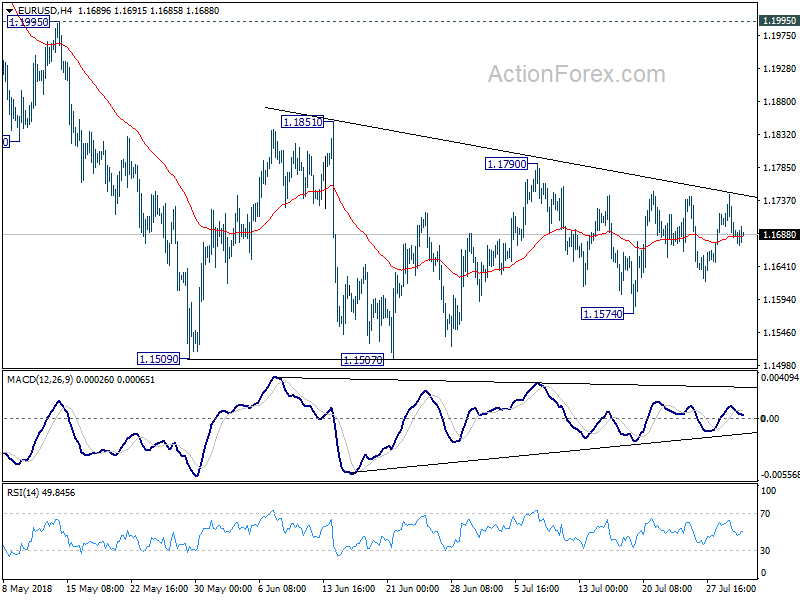
No change in EUR/USD's outlook as consolidation from 1.1509 is extending. Intraday bias stays neutral at this point. On the upside, in case of stronger recovery, upside should be limited by 1.1851 resistance to bring fall resumption eventually. On the downside, decisive break of 1.1507 low will resume larger down trend from 1.2555 through 50% retracement of 1.0339 to 1.2555 at 1.1447.
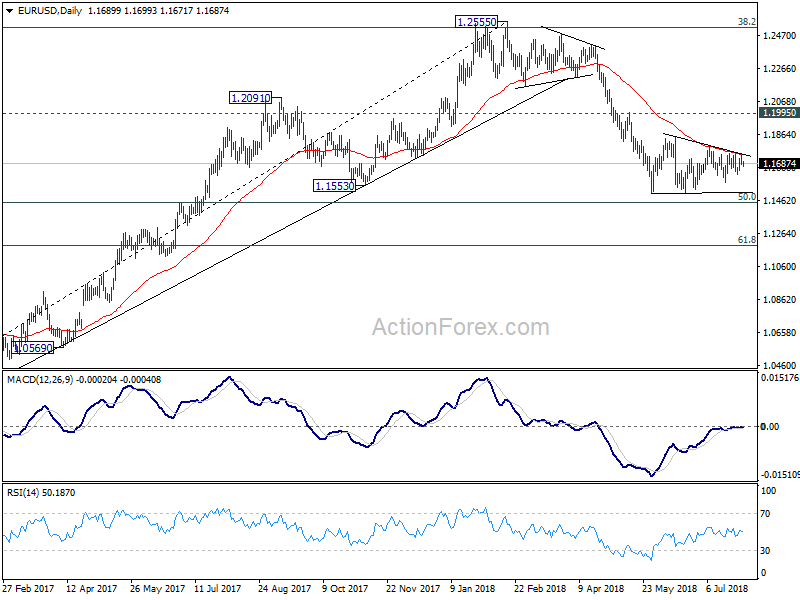
In the bigger picture, EUR/USD was rejected by 38.2% retracement of 1.6039 (2008 high) to 1.0339 (2017 low) at 1.2516. And, a medium term top was formed at 1.2555 already. Decline from there should extend further to 61.8% retracement of 1.0339 to 1.2555 at 1.1186 and below. For now, even in case of rebound, we won't consider the fall from 1.2555 as finished as long as 1.1995 resistance holds.
UK 100 Index Records Strong Bearish Session; Bullish Outlook in Medium Term
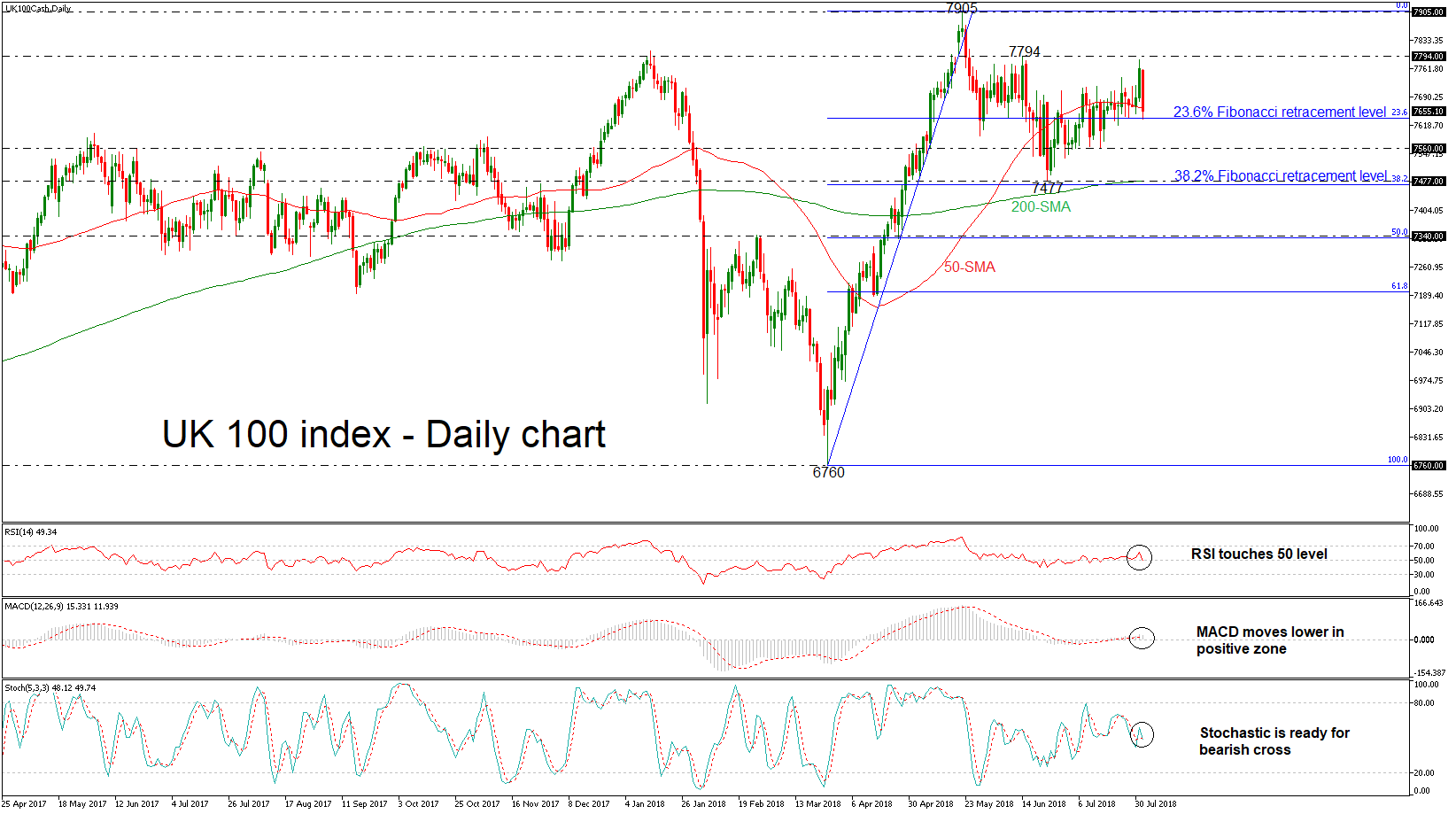
UK 100 index is on track to record a strong red day as it touched again the 23.6% Fibonacci retracement level of the upleg from 6760 to 7905, around 7635.57. This week, the price is on the backfoot and the technical indicators suggest that the market could ease a little bit in the short-term.
The RSI is currently increasing negative momentum towards its neutral threshold of 50, while the MACD is slowing down in positive territory, both hinting that the next move in prices could be on the downside rather than on the upside. Moreover, the stochastics indicate that further downside movement may be on cards as the % K line finally forms a bearish cross with the %D line.
Should the market extend losses and the index dives below the 23.6% Fibonacci, support could be met at the 7560 barrier, taken from the lows on mid-July. A significant leg below this area could send prices towards the 200-day simple moving average (SMA), which coincides with the 7477 support and stands near the 38.2% Fibonacci.
On the flip side, if the index bounces up, immediate resistance could be met at the 7794 level. A close above this level would endorse a bullish sentiment and push the price towards the 7905 hurdle, taken from the peak on May 22.
In the bigger picture, the pair is bullish as it still holds above the moving averages. In case it violates these lines, bears could take the upper hand.
GOLD: Continues To Face Recovery Threats
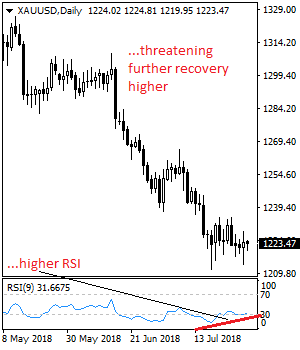
GOLD: The commodity looks to recover further higher on correction in the days ahead. On the downside, support comes in at the 1,210.00 level where a break will turn attention to the 1,200.00 level. Further down, a cut through here will open the door for a move lower towards the 1,190.00 level. Below here if seen could trigger further downside pressure targeting the 1,1800.00 level. Conversely, resistance resides at the 1,230.00 level where a break will aim at the 1,240.00 level. A turn above there will expose the 1,250.00 level. Further out, resistance stands at the 1,260.00 level. All in all, GOLD looks to strengthen further on correction.
GBP/USD Mid-Day Outlook
Daily Pivots: (S1) 1.3086; (P) 1.3129; (R1) 1.3168; More...
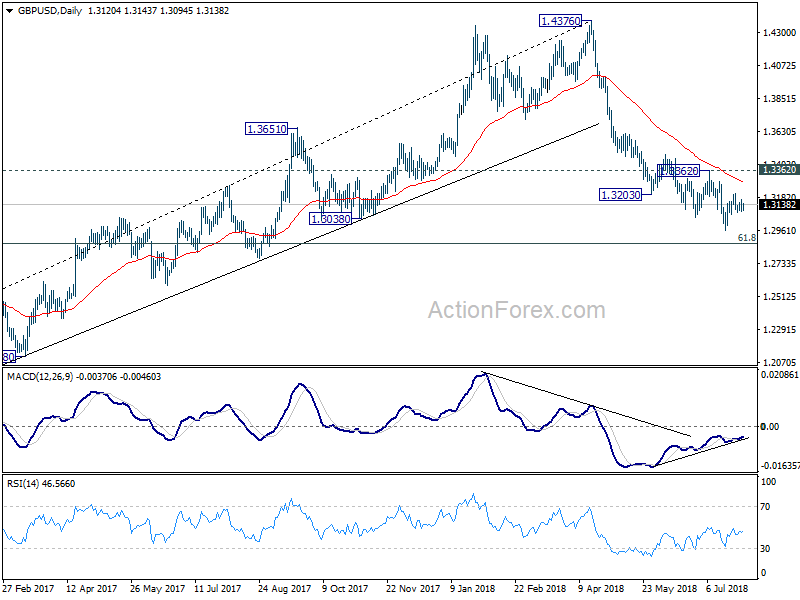
GBP/USD continues to stay in tight range between 1.3070/3212 and intraday bias stays neutral. Outlook is unchanged that price actions from 1.2956 are viewed as a corrective pattern. On the downside, break of 1.3070 minor support will indicate completion of rebound form 1.2956 and turns bias back to the downside for retesting this low. Firm break there will resume larger decline from 1.4376 for 1.2874 fibonacci level next. On the upside, above 1.3212 will bring further recovery. But upside should be limited by 1.3362 resistance to bring larger decline resumption eventually.
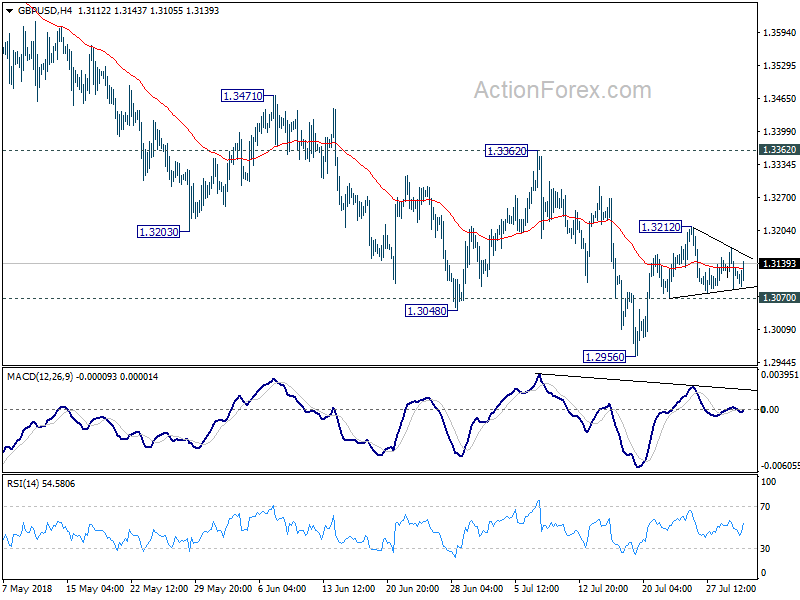
In the bigger picture, whole medium term rebound from 1.1946 (2016 low) should have completed at 1.4376 already, after rejection from 55 month EMA (now at 1.4179). Fall from 1.4376 should extend to 61.8% retracement of 1.1946 (2016 low) to 1.4376 at 1.2874 next. Decisive break of 1.2874 will raise the chance of long term down trend resumption through 1.1946 low. On the upside, break of 1.3362 resistance is needed to be the first indication of medium term bottoming. Otherwise, outlook will remain bearish even in case of strong rebound.
Dollar Pares Gain Despite Strong ADP Employment, FOMC Unlikely to Inspire
Dollar pares back some of today's gain in early US session. The better than expected ADP employment data provides no lift to the greenback. Focus will be turning to ISM manufacturing and FOMC rate decision. Nonetheless, as at the time of writing, Dollar is still the second strongest one for today, just next to Sterling. The Pound is apparently supported by not-too-bad UK PMI manufacturing data. Sterling's fate will depend on whether there will be a "dovish hike" by BoE tomorrow. Euro follows as the third strongest. On the other hand, commodity currencies are generally lower, with New Zealand, Australian Dollar and Canadian Dollar as the weakest three.
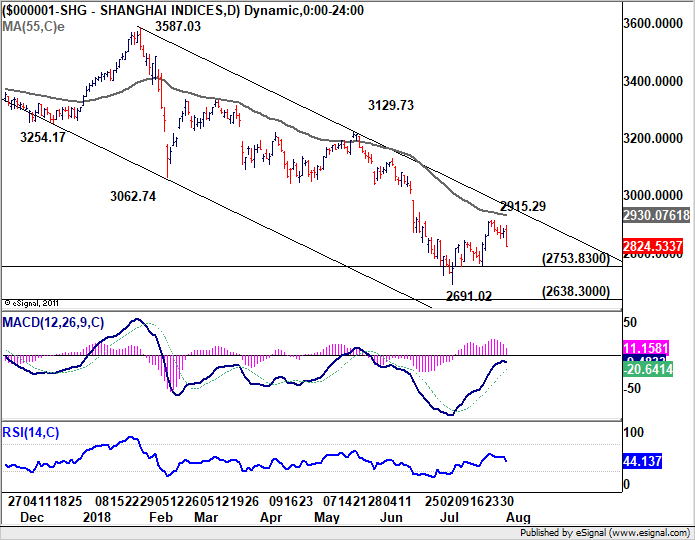
On development to note is the strong and immediate reaction in Chinese stocks to renewed threat of US-China trade war. It's reported that Trump is considering to impose 25% tariffs on USD 200B in Chinese imports, rather than 10%. The announcement could be made as soon as today. The China Shanghai SSE composite closed down -1.8% to 2824.53. The development argues that recent rebound is completed and the index might be ready to head south to retest 2016 low at 2638.30. This will be a key development to watch given that there is still no sign of either side backing down.
US ADP grew 216k, tariffs have yet to materially impact jobs
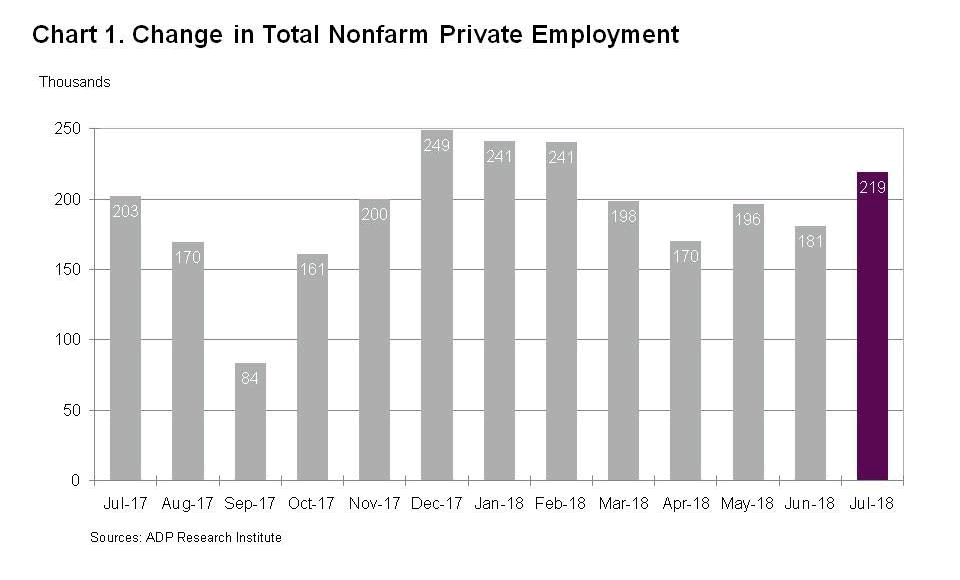
US ADP report showed private sector jobs grew 216k in July, above expectation of 186k. Prior month's figure was also revised up from 177k to 181k. Commenting in the release, Ahu Yildirmaz, vice president and co-head of the ADP Research Institute, said "the labor market is on a roll with no signs of a slowdown in sight." And, "nearly every industry posted strong gains and small business hiring picked up." Mark Zandi, chief economist of Moody's Analytics, said, "The job market is booming, impacted by the deficit-financed tax cuts and increases in government spending. Tariffs have yet to materially impact jobs, but the multinational companies shed jobs last month, signaling the threat."
FOMC rate decision is a major event ahead. But we're not expecting any surprise from Fed. The central bank is on course for two more rate hikes this year, one in September and another in December. There is no press conference today. Focus will be quickly turned to minutes to be released later on August 22.
More on FOMC:
- Fed to Hold Rates But Will Trump Criticism Restrain a More hawkish Message?
- Is the FOMC Overly-Optimistic?
- FOMC Preview: Fed on Holiday
- Fed Prepares for Rate Hike in September
UK PMI manufacturing dropped to 54.2, BoE could find some cause for pause
UK PMI manufacturing dropped to 54.0 in July, down from 54.3 and missed expectation of 54.2. Markit noted weaker increases in both output and new orders. Also, intermediate goods production falls for first time in two years. Rob Dobson, Director at IHS Markit, said in the release that UK manufacturing "started the third quarter on a softer footing, with rates of expansion in output and new orders losing steam", and " failed to provide any meaningful boost to headline GDP growth through the year-so-far."
Also he noted that "the financial markets still seem to have an interest rate increase nailed on for August." But, "if the combination of weaker growth and a softening of pipeline cost pressures at manufacturers is mirrored in the larger service sector, the Bank of England's decision will be far from unanimous and they may even yet find some cause for pause."
UK NIESR urges BoE to stand ready to move in either direction should circumstances change
The UK National Institute of Economic and Social Research release an article "Prospects for the UK Economy" yesterday. It warned that the economy is "facing an unusual level of uncertainty because of Brexit". Such "uncertainty primarily stems from the yet to be defined relationship between the UK and the EU", as well as "the economy's response to the new framework once it emerges." And it criticized Prime Minister Theresa May's Brexit white paper for failing to "unite the government or Parliament", thus "leaving open an entire spectrum of possible outcomes."
The NIESR conditioned its economic forecast with a 25bps BoE rate hike this month, that is, tomorrow. That's also under the assumption of a "soft Brexit". The economic is expected to grow at potential with GDP up 1.4% this year, and 1.7% next year. But "risks to our GDP growth forecast are wider than before and tilted to the downside."
NIESR also urged BoE to take account of the uncertainty of Brexit when setting policy and "also weigh the consequences of 'getting it wrong'." That is, It urged BoE to "stand ready to move in either direction should circumstances change." BoE should "emphasise the uncertainty (rather than the certainty) of its future policy stance in its communications and its willingness to reverse its decisions."
Eurozone PMI manufacturing finalized at 55.1, slowdown reflects worries on trade wars, tariffs and rising prices
Eurozone manufacturing PMI is finalized at 55.1 in July, unrevised. That was a touch higher than June's final reading of 54.9. Market noted in the release that growth of both output and new orders remain subdued compared to earlier in the year. Also, new export order growth at near-two year low amid concerns about tariffs and trade wars. Among the countries, the Netherlands scored 58.0, but hit a 14 month low. Germany came second at 56.9 (revised down from 57.3). Italy hit a 21-month low at 51.5.
Chris Williamson, Chief Business Economist at IHS Markit said "the survey responses indicate that the slowdown likely reflects worries about trade wars, tariffs and rising prices, as well as general uncertainty about the economic outlook. Optimism about the future remained at one of the lowest levels seen over the past two years."
Japan Nishimura: Meeting with USTR Lighthizer not prelude to bilateral FTA
Japanese Deputy Chief Cabinet Secretary Yasutoshi Nishimura emphasized today that the meeting between Economy Minister Toshimitsu Motegi and US Trade Representative Robert Lighthizer next week is not a prelude to a bilateral free trade agreement.
Nishimura reiterated the government's stance that "Japan does not desire an FTA and these talks are not at all preliminary discussions on an FTA." Though he noted that "We will be looking for the best path for both the United States and Japan."
In additional he also ruled out setting a quantitative limit on auto exports to the US. He said "whether it's exports or imports, we will not set numerical targets." And, "the fundamental thing is to maintain free and fair trade."
Regarding the threat of auto tariffs from Trump, Nishimura said "raising tariffs on autos would have a big impact on the world economy and would be a big minus for the American economy, so we want to talk firmly so that does not happen."
Japan has been very clear on their intention to bring the US back to the multilateral Trans-Pacific Partnership pact which Trump quitted as one of the first things he did after taking office.
Japan PMI manufacturing finalized at 52.3, export sales stalled for second month
Japan PMI manufacturing was finalized at 52.3, revised up from 51.6. But the reading was still the lowest in 11 months. Joe Hayes, Economist at IHS Markit noted in the release that "latest survey data signalled a slowdown to manufacturing sector growth at the beginning of Q3. Output growth eased and there was a noticeable softening of demand, while export sales failed to record any upswing for a second month running." "Input price inflation accelerated to an 88-month high, resulting in the strongest rate of increase in selling charges for almost a decade". But the rise was "primarily cost-pus". Hence, "further weakness in total new business growth could skew the inflationary outlook to the downside."
China Caixin PMI manufacturing dropped to 50.8, export market continued to deteriorate
China Caixin PMI manufacturing dropped -0.2 to 50.8 in July, down from 51.0, slightly below expectation of 50.9. It's also the lowest since November 2017. The key points in the release are slower increase in output and new orders, fastest decline in new export sales for over two years and solid rise in input costs. Looking at the details, new export orders shrunk at the fastest pace since June 2016, indicating the export market continued to deteriorate. Dr. Zhengsheng Zhong, Director of Macroeconomic Analysis at CEBM Group, said in the release that "in general, the survey signaled a weakening manufacturing trend as a grim export market dragged on the sector's performance. The positive drivers were the increase in stocks of purchases and easing pressure on capital turnover."
New Zealand employment grew 0.5%, unemployment rate edged higher to 4.5%
New Zealand employment grew 0.5% qoq in Q2, down from prior quarter's 0.6% qoq, but beat expectation of 0.4% qoq. Unemployment rate rose 0.1% to 4.5%, above expectation of 4.4%. Participation rate rose 0.1% to 70.9%. All sector wage inflation rose 0.5%. From Australia, AiG performance of manufacturing index dropped notable 52 in July, down from 57.4.
GBP/USD Mid-Day Outlook
Daily Pivots: (S1) 1.3086; (P) 1.3129; (R1) 1.3168; More...
GBP/USD continues to stay in tight range between 1.3070/3212 and intraday bias stays neutral. Outlook is unchanged that price actions from 1.2956 are viewed as a corrective pattern. On the downside, break of 1.3070 minor support will indicate completion of rebound form 1.2956 and turns bias back to the downside for retesting this low. Firm break there will resume larger decline from 1.4376 for 1.2874 fibonacci level next. On the upside, above 1.3212 will bring further recovery. But upside should be limited by 1.3362 resistance to bring larger decline resumption eventually.
In the bigger picture, whole medium term rebound from 1.1946 (2016 low) should have completed at 1.4376 already, after rejection from 55 month EMA (now at 1.4179). Fall from 1.4376 should extend to 61.8% retracement of 1.1946 (2016 low) to 1.4376 at 1.2874 next. Decisive break of 1.2874 will raise the chance of long term down trend resumption through 1.1946 low. On the upside, break of 1.3362 resistance is needed to be the first indication of medium term bottoming. Otherwise, outlook will remain bearish even in case of strong rebound.
Economic Indicators Update
| GMT | Ccy | Events | Actual | Forecast | Previous | Revised |
|---|---|---|---|---|---|---|
| 22:30 | AUD | AiG Performance of Manufacturing Index Jul | 52 | 57.4 | ||
| 22:45 | NZD | Unemployment Rate Q2 | 4.50% | 4.40% | 4.40% | |
| 22:45 | NZD | Employment Change Q/Q Q2 | 0.50% | 0.40% | 0.60% | |
| 23:01 | GBP | BRC Shop Price Index Y/Y Jul | -0.30% | -0.50% | ||
| 00:30 | JPY | PMI Manufacturing Jul F | 52.3 | 51.6 | 51.6 | |
| 01:45 | CNY | Caixin China PMI Mfg Jul | 50.8 | 50.9 | 51 | |
| 06:30 | AUD | RBA Commodity Index SDR Y/Y Jul | 7.60% | 6.60% | ||
| 07:45 | EUR | Italy Manufacturing PMI Jul | 51.5 | 53 | 53.3 | |
| 07:50 | EUR | France Manufacturing PMI Jul F | 53.3 | 53.1 | 53.1 | |
| 07:55 | EUR | Germany Manufacturing PMI Jul F | 56.9 | 57.3 | 57.3 | |
| 08:00 | EUR | Eurozone Manufacturing PMI Jul F | 55.1 | 55.1 | 55.1 | |
| 08:30 | GBP | PMI Manufacturing Jul | 54 | 54.2 | 54.4 | 54.3 |
| 12:15 | USD | ADP Employment Change Jul | 219K | 186K | 177K | 181K |
| 13:30 | CAD | Manufacturing PMI Jul | 57.1 | |||
| 13:45 | USD | US Manufacturing PMI Jul F | 55.5 | 55.5 | ||
| 14:00 | USD | Construction Spending M/M Jun | 0.30% | 0.40% | ||
| 14:00 | USD | ISM Manufacturing Jul | 59.3 | 60.2 | ||
| 14:00 | USD | ISM Employment Jul | 56 | |||
| 14:00 | USD | ISM Prices Paid Jul | 75.5 | 76.8 | ||
| 14:30 | USD | Crude Oil Inventories | -2.6M | -6.1M | ||
| 18:00 | USD | FOMC Rate Decision (Upper Bound) | 2.00% | 2.00% | ||
| 18:00 | USD | FOMC Rate Decision (Lower Bound) | 1.75% | 1.75% |
US ADP grew 216k, tariffs have yet to materially impact jobs
US ADP report showed private sector jobs grew 216k in July, above expectation of 186k. Prior month's figure was also revised up from 177k to 181k.
Commenting in the release, Ahu Yildirmaz, vice president and co-head of the ADP Research Institute, said "the labor market is on a roll with no signs of a slowdown in sight." And, "nearly every industry posted strong gains and small business hiring picked up."
Mark Zandi, chief economist of Moody's Analytics, said, "The job market is booming, impacted by the deficit-financed tax cuts and increases in government spending. Tariffs have yet to materially impact jobs, but the multinational companies shed jobs last month, signaling the threat."
Markets Gripped by Renewed Trade War Fears, FOMC in Focus
Contradicting reports surrounding the state of US - China trade relations are likely to create a sense of confusion across markets, while also possibly desensitising investors towards global trade developments.
Global sentiment was initially supported by reports that the United States and China would potentially be restarting trade talks in a bid to de-escalate tensions. However, this optimism was later squashed by news that US President Donald Trump is considering imposing tariffs of 25% on $200 billion of imported Chinese goods. These latest developments have yet again displayed how inherently unpredictable the Trump administration has been on trade. While there is a possibility that investor complacency kicks in as trade developments drag on, it must be kept in mind that a trade war presents a major threat to global stability.
Asian shares have closed mixed while European stocks drifted lower as uncertainty over US - China trade tensions weighed on risk appetite.
Sterling waits for BoE policy decision
The Pound’s response was fairly muted today despite activity in the UK manufacturing sector cooling to a three-month low at 54.0 in July.
It seems investors are more interested in Thursday’s BoE policy meeting and whether the central bank moves forward with an interest rate increase. Even if the BoE pulls the trigger in August, there is a suspicion that this could be a one-and-done hike. With inflationary pressures cooling and Brexit uncertainty grating on sentiment, the central bank is likely to hold off any further monetary policy normalization this year.
Dollar steady ahead of FOMC meeting
The Dollar has nudged higher against a basket of major currencies ahead of the Federal Reserve monetary policy announcement that is due to be made later today.
Investors will closely scrutinize the policy statement for fresh insight into the US’ economy and monetary policy. Market expectations over the Federal Reserve raising interest rates two more times this year could be reinforced if the Fed adopts a hawkish stance.
Prior to the Fed meeting, much attention will be directed towards the ADP Employment Report for July which could offer insight into the health of the labour markets. A figure that meets or exceeds market expectations of a 186k increase may provide some additional support for the Dollar.
Commodity spotlight – WTI Oil
Oil prices have extended losses today after an unexpected build in US Crude stockpiles encouraged sellers to attack the commodity.
With Crude Oil posting its biggest monthly loss since July 2016, could the party be coming to an end for bulls? The technical perspective is displaying signs of exhaustion from the bulls, with prices failing to keep above the stubborn $70 resistance level on repeated occasions. A solid breakdown below $67.70 could inspire a decline towards $67.00 and $66.60, respectively.
Bitcoin tumbles below $7800….
It is shaping up to be a horrible trading week for Bitcoin thus far, thanks to a string of negative news and developments eroding investor appetite for the cryptocurrency.
With prices crashing below the $8000 level and trading around $7570 as of writing, could this rebound transform into a dead cat bounce? Technical traders are likely to closely observe how prices behave above the $7500 level. Sustained weakness below this region could trigger a decline towards $7260. For bulls to jump back into the game, Bitcoin needs to secure a daily close above $8000.
Into US session: Dollar firm ahead of FOMC, Yen lifted as Chinese stocks tumble on trade war
Entering into US session, Sterling is trading as the strongest one for today, followed by Dollar then Yen. Both Australia Dollar and New Zealand Dollar are the weakest one.
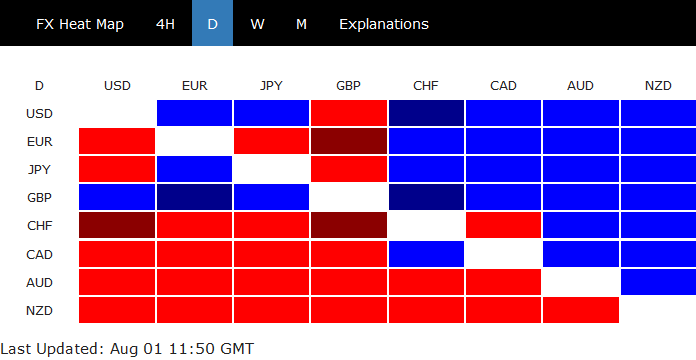
Dollar will be a major focus in US session with FOMC rate decision scheduled. But we're not expecting any surprise from Fed. The central bank is on course for two more rate hikes this year, one in September and another in December. There is no press conference today. Focus will be quickly turned to minutes to be released later on August 22. Instead, ADP employment and ISM manufacturing to be released earlier in the session could be more market moving.
More on FOMC:
- Fed to Hold Rates But Will Trump Criticism Restrain a More hawkish Message?
- Is the FOMC Overly-Optimistic?
- FOMC Preview: Fed on Holiday
- Fed Prepares for Rate Hike in September
Strength in 10 year JGB yield, which closed up 0.081 at 0.130, could be a factor for Yen's strength. But considering that Aussie and Kiwi are the weakest, we'd believe that risk aversion is a larger factor. Plus, Yen is also paring back some of the post BoJ selloff only. It's still the weakest one for the week.
Chinese stocks' reaction to the heat up in US-China trade war is immediate. The Shanghai SSE dropped -1.80% to close at 2824.53 today. The closed below 2844.19 resistance turned support suggests that recent rebound from 2691.02 has completed at 2915.29 already, ahead of 55 day EMA. Also, the index is kept well inside medium term falling channel. Focus is back on 2753.83 support. Break there will resume the medium term fall from 3857.03 for a take on 2638.30 key support (2016 low). Considering there is no sign of backing from on Trump's side, and EU has already agreed to join force against China's improper practices, this 2638.30 level is very vulnerable.
Sterling's strength could be explained by not-too-bad UK PMI manufacturing, which dropped -0.3 to 54.0. It's a respectable number. BoE is widely expected to raise Bank Rate by 25bps to 0.75% tomorrow. Sterling's fate will depend on whether that will be a "dovish hike".
Suggested reading on BoE and UK:
- BOE Expected to Deliver Dovish Rate Hike in August
- UK NIESR urges BoE to stand ready to move in either direction should circumstances change
- Bank Of England Preview: Once A Year Hiking Cycle