

Sample Category Title
US to impose 25% tariffs on $200B in Chinese goods, joined forces with like-minded partners
The US Trade Representative formally said in a statement that it's considering to raise the proposed tariffs on USD 200B in Chinese imports from 10% to 25%. In the statement, it said "the Trump Administration continues to urge China to stop its unfair practices, open its market, and engage in true market competition." And it emphasized that the US has been "very clear about the specific changes China should undertake" But China "regrettably" responded by " illegally retaliated against U.S. workers, farmers, ranchers and businesses."
Also, USTR Robert Lighthizer said "the increase in the possible rate of the additional duty is intended to provide the Administration with additional options to encourage China to change its harmful policies and behavior and adopt policies that will lead to fairer markets and prosperity for all of our citizens."
More importantly, the USTR specifically said that the US has "joined forces with like-minded partners around the world to address unfair trade practices such as forced technology transfer and intellectual property theft, and we remain ready to engage with China in negotiations that could resolve these and other problems detailed in our Section 301 report."
Crude Oil Price Could Revisit $66.50, Upsides Remain Capped
Key Highlights
- Crude oil price completed an upward recovery above the $70.50 level against the US dollar.
- There was a break below a crucial ascending channel support at $69.05 on the 4-hours chart of XTI/USD.
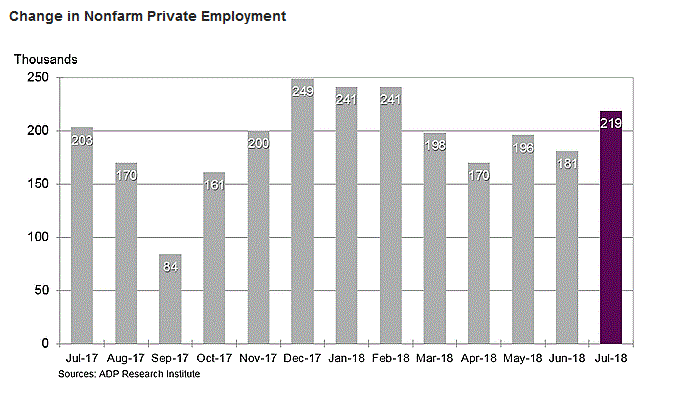
- The US ADP Employment change came in at 219K, more than the 185K forecast.
- The Federal Reserve kept the interest rates at 2%, in line with the market expectation.
Crude Oil Price Technical Analysis
After trading as low as $66.53, crude oil price recovered above $68.00 against the US Dollar. However, the price failed to break the $70.50 resistance and declined below $70.00.
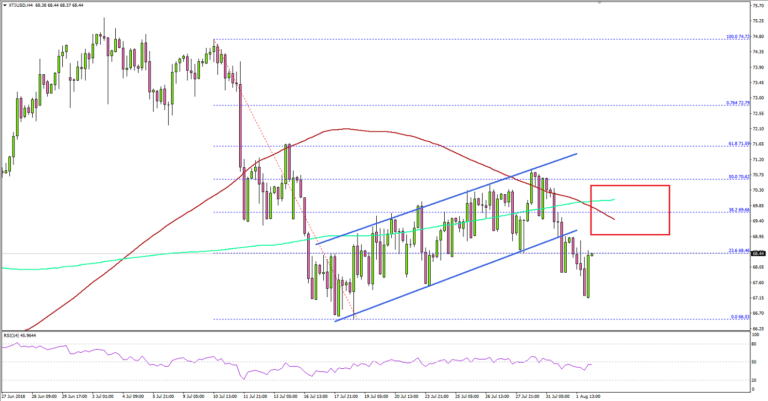
Looking at the 4-hours chart of XTI/USD, the price recovered nicely above the $68.00 and $69.00 resistance levels. It also moved above the 38.2% Fib retracement level of the last decline from the $74.42 high to $66.53 low.
The price was trading in an ascending channel until it faced a strong resistance near $70.50-60 and the 50% Fib retracement level of the last decline from the $74.42 high to $66.53 low.
As a result, there was a downward move and the price broke the $70.00 and $69.00 supports. It also settled below the channel support at $69.05 and the 100 (red) simple moving average (4-hours).
If the recent break gains traction, the price is likely to revisit the last swing low at $66.50. On the upside, the broken support at $69.00 and the 100 SMA are likely to act as resistances.
Recently in the US, the ADP Employment Change figure for July 2018 was released by the Automatic Data Processing, Inc. The market was looking for a change of 185K, compared with the last 177K.
The actual result was better than the forecast as private sector employment increased by 219K jobs in July 2018. Moreover, the last reading was revised up from 177K to 181K.
Commenting on the same, the vice president and co-head of the ADP Research Institute, Ahu Yildirmaz, stated:
The labor market is on a roll with no signs of a slowdown in sight. Nearly every industry posted strong gains and small business hiring picked up.
Overall, the outcome was positive and it could continue to weigh on oil price as long as it is below $70.00.
Economic Releases to Watch Today
- US Initial Jobless Claims – Forecast 220K, versus 217K previous.
- US Factory Orders June 2018 (MoM) – Forecast +0.7%, versus +0.4% previous.
- BoE Interest Rate Decision – Forecast 0.75%, versus 0.50% previous.
Dollar stays mixed after FOMC rate decision
Dollar is trading mixed in Asian session so far as market showed little reaction to FOMC.
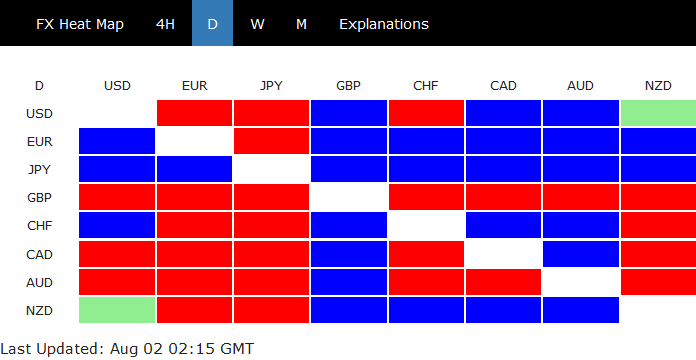
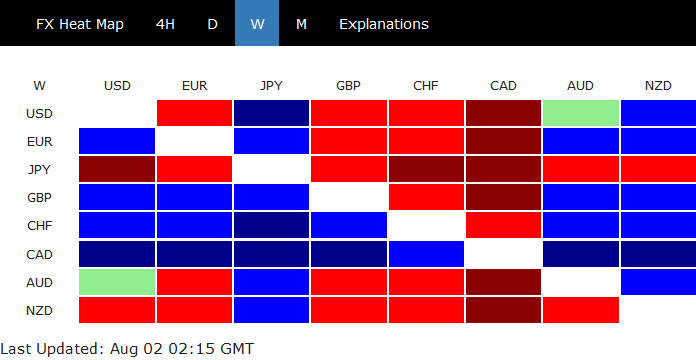
The greenback is also trading down for the week against all but Yen and New Zealand Dollar.
Fed kept federal funds rates unchanged at 1.75-2.00%. Assessment on economic activity was upgraded from "solid" to strong". Also, "household spending and business fixed investment spending have grown strongly."
As priced in by Fed fund futures, the chance of two more hikes by December to 2.25-2.50% has firmed up again this week to around 67.6%, from 65.5% a week ago.
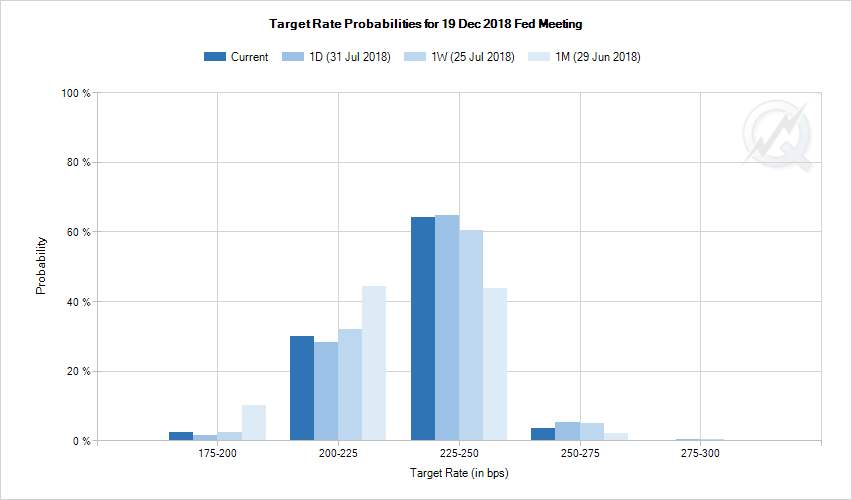
Some suggested readings on Fed:
FOMC : Pardon the Interruption
The FOMC interlude was even less of an event than expected but that belies some of the headline risk creeping back into play, as the market has been waiting for a Whitehouse press release on China tariffs which has left investors to speculate if this will confirm the overnight chatter the US is proceeding with USD 16 bln in tariffs.
US equities market have struggled all NY session despite a strong showing by Apple as US-China trade headlines started to sound alarms from the NY cash markets open.
On the other trade front, however, Canada and Mexican officials are “harnessing the power of trade agreements to promote higher wages” undoing some of the aggressive US rhetoric that was suggesting the US administration was on the cusp of freezing Canada out of NAFTA talks.
Oil Markets
Oil had been moving lower all session on the back of reports OPEC and Russian crude oil production rose during July, while a larger than expected DOE inventory build confirmed the API reports from Tuesday. While not quite as large as the API survey suggested it was still very bearish correlative to market expectations. US Crude oil exports have\ fallen right off the table from last week 2.7 million barrels per day to only 1.3 million barrels per day while clocking the slowest reading since April.
Oil traders were caught long and wrong by the surprising increase in OPEC production and more significant than expected US Crude inventory builds. The downward spiral halted when headlines surfaced the Iran Revolutionary Guard was planning a substantial exercise within 48 hours in the Persian Gulf in a show of force to bespeak its ability to close Strait of Hormuz, a primary oil artery.
Gold Prices
Gold prices have had another down day. Outside of some short covering into the FOMC, the yellow metal has been trading offered from the get-go with selling showing few signs of abating. US 10 year yields are trading above 3 % while the Feds are set to raise interest rates next time around which is lending support to the USD. Given that Gold is more or less trading at the dollar mercy and with USDCNH inching towards 6.84 in late NY trade gold is heading lower.
Currency Markets
JPY: The Yen has traded stronger today in part due to JGB yields moving higher. But with US stock markets trading with offered bias, a tinge of risk aversion is creeping in the USDJPY space.
BoE Super Thursday to Live Up to its Name
Surely they won’t bottle it again, right?
Super Thursday promises to live up to its name one way or another this week, as the Bank of England either raises interest rates to post-financial crisis highs or risks causing unnecessary and significant market volatility.
- Rate hike priced in but not guaranteed
- Possible scenarios on Thursday
- Key things to look out for
It’s been an unusual lead up to a central bank meeting, in that despite a lack of clear and specific warning signals, the likes of which we’ve become accustomed to, investors have become absolutely convinced it’s happening.
In fact, markets are now pricing in almost a 90% chance that the Monetary Policy Committee will vote to hike rates on Thursday. If the central bank doesn’t hike now, it will need a very good excuse and even then, this entire process of forward guidance will once again be heavily criticized.
BoE Interest Rate Probabilities
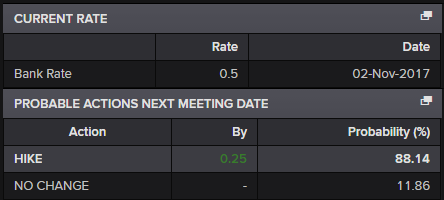
Source – Thomson Reuters Eikon
While it may not make much sense to blame the central bank when I’ve earlier stated that there’s been a lack of clear and specific warning signals, but policy makers are very aware of what market expectations are and when they deviate in such a significant way from reality, they do something about it. This time they have not.
This is where assumptions come into it. The lack of alternative guidance from policy makers has actually fuelled expectations that they must be planning a rate hike or they would have otherwise intervened to realign expectations.
Remember, investors are always looking for subtle hints in order to get ahead of the curve and in this case, the central bank’s silence has been deafening. Or so investors hope. Should the MPC not deviate much from last month’s vote and hold off again, there could be a sizeable response in the markets, particularly in the pound and short-term UK debt.
Whichever way the central bank goes – and just to be clear, I think they will raise rates – there could be a very interesting response in the markets. These are some of the possible outcomes.
Dovish hike
In this scenario, it would be natural to think that this would be bullish for the pound and, in the immediate aftermath it could be. But if markets are already largely pricing this in then what exactly is left?
A rate hike that is accompanied by dovish language and cautious approach on the economy, or even wait and see approach to Brexit negotiations, could quickly trigger some profit taking by those who have anticipated such a move prior to the meeting and be bearish for the pound not long after the announcement.
EURGBP Daily Chart
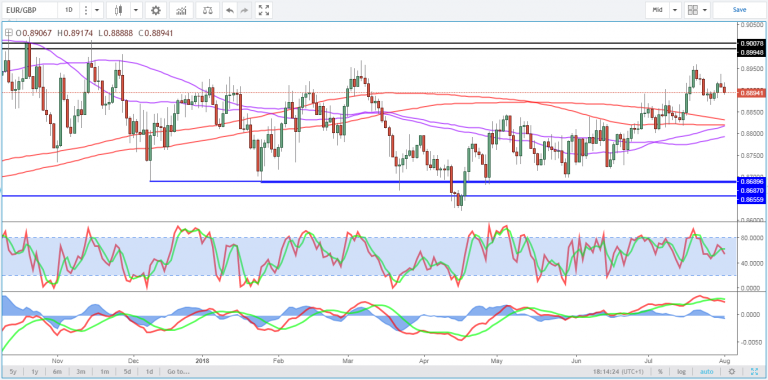
OANDA fxTrade Advanced Charting Platform
Hawkish hike
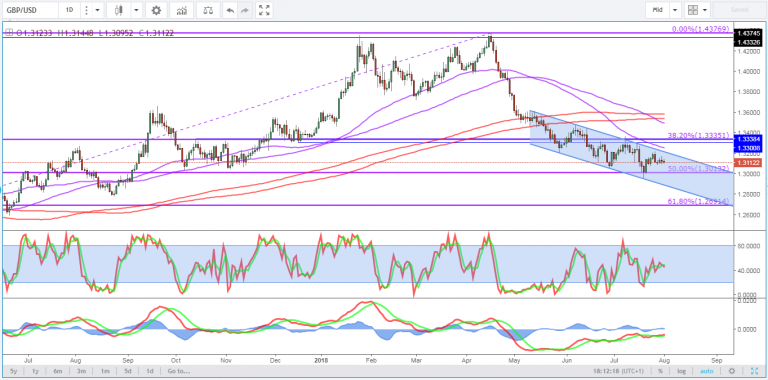
This is probably the most bullish feasible outcome for the pound. In this scenario, the BoE raises interest rates and warns that more will follow, maybe even a couple by the end of next year (more is of course possible but maybe not realistic given how the economy is right now and the uncertainty linked to Brexit).
In this case, the BoE is likely opting to look through Brexit or using base case assumptions on it – due to the sheer number of unknowns still – and base its views purely on the economic data, some of which is very good (unemployment, job openings, inflation) and some of which isn’t great (wages, investment, household debt).
GBPUSD Daily Chart
No hike
I don’t think this is likely (although it is arguably what the central bank should be doing) but it’s possible. Under this scenario, the central bank takes all of the recent data into consideration and takes the view that, given the uncertain outcome of Brexit negotiations and possibility of no deal, it makes more sense to wait until November to raise rates.
A few months is not a long time to wait but by then, they should be a lot better positioned to judge what the outcome of Brexit negotiations will be and whether it’s risky or not to be raising rates in such an environment, or what the chance is that it will be reversing course in the near-future, to its own embarrassment.
Of course, the argument against this is that there has been no noise coming from the central bank that market expectations are out of sync with their own which is usually a reliable sign that they are not.
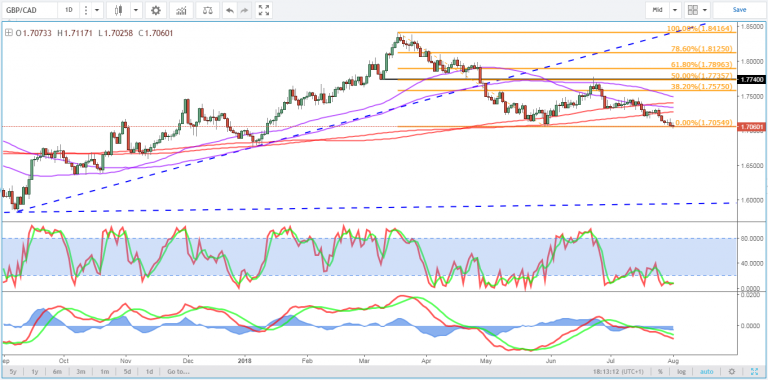
GBPCAD Daily Chart
What to look out for
All things considered, a rate hike looks likely but there is going to be a number of elements of tomorrow’s event that will influence how markets respond.
The interest rate decision is the most obvious (12pm UK time) but alongside the release, we’ll get the minutes from the meeting, voting and the inflation report which contains new growth and inflation forecasts for the coming years, which will effectively determine how many hikes we’ll see.
This will then be followed by a press conference with Carney and his colleagues 30 minutes later which is never a dull event and certainly won’t be if the central bank once again bottles it.
FOMC Remains on Hold, But More Rate Hikes Clearly on the Way
The FOMC remained on hold at its policy meeting today, but it made it very clear that further monetary tightening likely will occur in coming months.
FOMC Upgrades Its Assessment of the Economy
The Federal Open Market Committee (FOMC) decided at its meeting today to keep its target range for the fed funds rate unchanged at 1.75 percent to 2.00 percent. The eight voting members of the FOMC unanimously supported the decision, which was widely expected among market participants.
In our view, the FOMC upgraded its assessment of the economy compared to the statement that was released at the end of the last meeting on June 13. When describing growth, the FOMC upgraded its characterization of the pace of economic activity from "solid," which it used in the last policy statement, to "strong." The FOMC also said that "household spending and business fixed investment spending have grown strongly." (In June, the statement simply noted that "growth in household spending has picked up.") Indeed, the recently released GDP data for the second quarter showed that real personal consumption expenditures rose at an annualized rate of 4.0 percent in Q2 while business fixed investment spending shot up 7.3 percent.
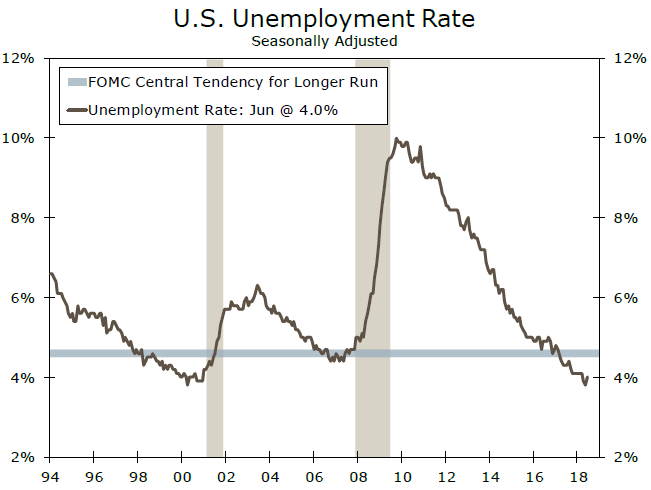
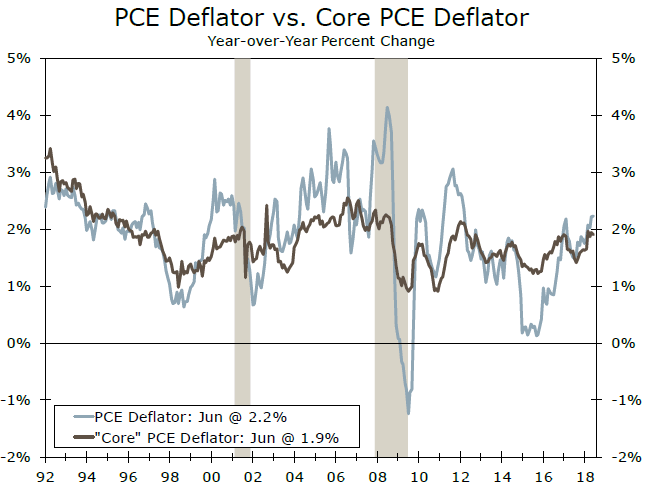
Congress has given the Fed two mandates. First, the Fed is charged with maintaining "full employment." With the unemployment rate currently at only 4 percent, "full employment" has essentially been achieved (top chart). In its policy statement today, the FOMC said that "job gains have been strong" and that "the unemployment rate has stayed low." Secondly, the Fed has a mandate to achieve "price stability," which it defines as an inflation rate of 2 percent. The statement noted that both the overall PCE inflation rate and the core PCE inflation rate are currently running near 2 percent (middle chart).
When describing the current stance of monetary policy, the statement said that policy "remains accommodative." To underscore the need for further tightening, the FOMC said that "further gradual increases in the target rate for the federal funds rate will be consistent" with its mandate to achieve its two policy objectives.
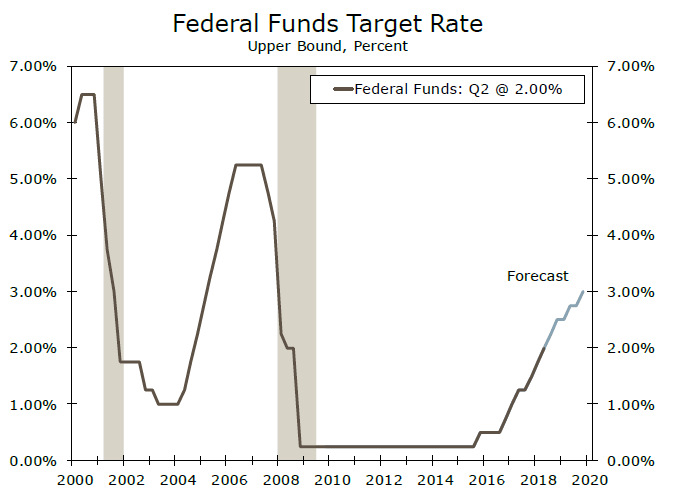
In sum, there was little in the statement that was released at the end of the meeting to disabuse market participants from the expectation that further rate hikes lie ahead. In the forecasts that the FOMC released in June, a majority of FOMC members expressed their expectation that the Fed will raise rates 50 bps by the end of the year. That is our expectation as well. We, and most other analysts, look for the FOMC to hike rates 25 bps at the September 26 meeting. We expect that the FOMC will remain on hold on November 8, but look for another rate hike on December 19 with two more to follow next year (bottom chart). Unless the wheels of the economy come off in coming months, which we do not expect, further Fed rate hikes seem to be more or less in the cards.
FOMC Takes a Summer Vacation from Rate Hikes, But Likely Back to it in September
As was widely expected, the Federal Open Market Committee (FOMC) kept its federal funds target rate unchanged at between 1¾ and 2 percent.
Overall, there were very few changes in the statement compared with the last one in June. The statement noted that economic activity has been rising at a "strong" rate, an upgrade from solid in June. In fact, if describing the economy in just one word, according to the Fed, it would be "strong". The statement used the descriptor five times.
The statement's forward looking language remained unchanged. The FOMC "expects that further gradual increases in the target range for the federal funds rate will be consistent with sustained expansion of economic activity, strong labor market conditions, and inflation near the Committee's symmetric 2 percent objective over the medium term". Risks remain balanced.
Key Implications
Go back to enjoying your summer vacations, there was little change in the FOMC's August statement. As expected, the FOMC took summer break from hiking rates. After the FOMC had made more significant changes to the statement back in June, the only changes in August reflected the incoming data, with the economy now described as "strong" five times, up from four in June. As for the qualifier "for now" that had crept into the Chair's testimony earlier this month with regards to "further gradual increases in the target range for the federal funds," it did not appear in the formal statement.
With no update in the FOMC's economic projections, and little change in the tone of the statement, the Fed likely expects to raise rates in two more 25 basis point steps this year as outlined in its June projections. Stronger economic data since then has likely increased its comfort with that view. The U.S. economy is booming, and the labor market is tight. Inflation is at target, but not yet showing signs of a more notable acceleration. Add it all up, and it makes sense for monetary policy accommodation to continue to be removed, but there is little urgency for the Fed to pick up the pace from what was outlined in June. We expect two more 25 basis point hikes this year, with the next one in September.
Fed Holds Rates Steady With Minor, Hawkish Changes to Policy Statement
Highlights:
- As expected, the target range for the fed funds rate was left unchanged at 1.75-2.00% in a unanimous decision.
- In a nod to Q2’s impressive GDP growth, the Committee noted economic activity is rising at a “strong rate,” compared with “solid” in June’s statement. Consumer spending and business investment were also characterized as strong.
- Job gains were also noted to be “strong” and the unemployment rate “stayed low,” despite ticking up to 4.0% in June from 3.8% in May. Both core and headline inflation “remain near” 2%.
- The Fed’s latest Beige Book report indicated manufacturers across the country are concerned about tariffs, with many reporting higher prices or supply disruptions. But trade tensions didn’t feature in today’s statement, with the Fed simply keeping an eye on “international developments.”
Our Take:
Today’s Fed meeting was fitting for the lazy days of summer—no rate change and only minor tweaks to the policy statement reflecting the latest data. Chair Powell will be conducting press conferences after all eight FOMC meetings starting next year, but for now these interim meetings continue to be non-events. The few changes in language today leaned hawkish, a sign the next rate increase isn’t far off. Looking ahead to September, the case for a hike is strong. GDP growth accelerated sharply in Q2, and while we doubt the add from exports will last, firmer domestic demand looks set to persist near term. Core PCE inflation is holding close to the Fed’s 2% objective and core CPI is running slightly firmer. The labour market remains strong, and while it would be a stretch to say wages are taking off, pay growth has picked up this year. Tariffs remain a risk to the outlook, though the Fed’s scant mention of trade issues today speaks to their limited impact thus far. Some caution might be warranted if tensions ratchet up significantly, but for now a strong domestic backdrop and sizeable fiscal boost argue for less accommodative monetary policy. We expect two more rate increases over the second half of the year, and look for 100 basis points of hikes in 2019 as well.
Eco Data 8/2/18
[php_everywhere instance="1"]
Fed left federal funds rate unchanged at 1.75-2.00%, full statement.
No surprise from Fed. Below is the full statement.
Federal Reserve issues FOMC statement
Information received since the Federal Open Market Committee met in June indicates that the labor market has continued to strengthen and that economic activity has been rising at a strong rate. Job gains have been strong, on average, in recent months, and the unemployment rate has stayed low. Household spending and business fixed investment have grown strongly. On a 12-month basis, both overall inflation and inflation for items other than food and energy remain near 2 percent. Indicators of longer-term inflation expectations are little changed, on balance.
Consistent with its statutory mandate, the Committee seeks to foster maximum employment and price stability. The Committee expects that further gradual increases in the target range for the federal funds rate will be consistent with sustained expansion of economic activity, strong labor market conditions, and inflation near the Committee's symmetric 2 percent objective over the medium term. Risks to the economic outlook appear roughly balanced.
In view of realized and expected labor market conditions and inflation, the Committee decided to maintain the target range for the federal funds rate at 1-3/4 to 2 percent. The stance of monetary policy remains accommodative, thereby supporting strong labor market conditions and a sustained return to 2 percent inflation.
In determining the timing and size of future adjustments to the target range for the federal funds rate, the Committee will assess realized and expected economic conditions relative to its maximum employment objective and its symmetric 2 percent inflation objective. This assessment will take into account a wide range of information, including measures of labor market conditions, indicators of inflation pressures and inflation expectations, and readings on financial and international developments.
Voting for the FOMC monetary policy action were: Jerome H. Powell, Chairman; John C. Williams, Vice Chairman; Thomas I. Barkin; Raphael W. Bostic; Lael Brainard; Esther L. George; Loretta J. Mester; and Randal K. Quarles.