

Sample Category Title
China shocked by US actions and opposes to US trade hegemonism
China MOFCOM responds to US move on tariffs on USD 200B in Chinese imports below.
Google translated, not perfect but you'll get the idea. Original in simplified Chinese here.
"It is totally unacceptable for the US to publish the tax collection list in an accelerated upgrade. We express our solemn protest. The behavior of the US is hurting China, hurting the world, and hurting itself. This irrational behavior is unpopular.
The Chinese side is shocked by the actions of the US. In order to safeguard the core interests of the country and the fundamental interests of the people, the Chinese government will, as always, have to make the necessary counter-measures. At the same time, we call on the international community to work together to safeguard the rules of free trade and the multilateral trading system and jointly oppose trade hegemonism. At the same time, we will immediately file an additional lawsuit against the US unilateralist behavior to the World Trade Organization."
Theresa May Walks Brexit Tightrope after Two Senior Officials Quitted, Key Dates ahead
While the optimists suggest that the latest political turmoil in the UK has increased the chance of a “soft" Brexit which is positive for UK’s economic outlook and the British pound, we see ongoing uncertainty in the negotiations with the EU. Pro-Brexit Dominic Raab has replaced the David Davis as Brexit Secretary, while Pro-Bremain Jeremy Hunt would assume the role of Foreign Secretary, replacing Boris Johnson. The new appointments exemplified the contining tug of war between the Brexit and Bremain camps. While British pound has stabilized after volatile trading in the aftermath of the resignations, we expect risk to skew to the downside.
In short, the “Chequers Plan” agreed upon last Friday would keep the UK effectively in the EU Customs Union and the Single Market for goods, but not services. Meanwhile, although PM May had pledged to end European Court of Justice's (ECJ) jurisdiction, the role of which would be assumed through a joint reference procedure and a joint Committee. The arrangements signal that the government has leaned towards a “soft” Brexit. While a similar approach has been revealed in PM May’s “facilitated customs arrangement” released ahead of the Chequers meeting, it is the first time that “soft” Brexit is adopted as a government stance.
BBC summarizes the plan as follows:
- The UK would accept continuing "harmonisation" with EU rules on the trade in goods, covering only those necessary to ensure frictionless trade
- Parliament would have the final say over how these rules are incorporated into UK law, retaining the right to refuse to do so
- There will be different arrangements for trade in services, including financial products, with greater "regulatory flexibility" and "strong reciprocal arrangements"
- Freedom of movement as it stands will come to an end but a "mobility framework" will ensure UK and EU citizens can continue to travel to each other's territories and apply for study and work
- A new customs arrangement will be phased in, with the goal of "a combined customs territory"
- The UK will be able to control its own tariffs and develop an independent trade policy
- The jurisdiction of the European Court of Justice will end but the UK will pay regard to its decisions in areas where common rules were in force
There is significance of the resignation of two top-level officials. This could mobilise pro‐Brexit Tories to act against PM May, leading to a leadership challenge. 48 Tory members of the parliament (MPs) are needed to trigger a vote of confidence in PM May. This is achievable as there are about 60 pro-Brexit hardliners in the parliament. However, it is not likely that PM May would lose as 159 votes are needed to actually remove her from power. Just as pro-Brexit Tory MP Jacob Rees Mogg has noted, it is unlikely to be a success to hold a confidence vote on the prime minister for now. Indeed, many MPs remain hesitant to kick PM May out for now. They could hardly find a viable alternative for the PM position to her. Moreover, the party rule that only allows Tories to hold the vote of confidence once every twelve months has suggested that they prefer to reserve this “right” for the most critical moment.
If PM May manages to survive the crisis, she could be in a better position to push her “soft” Brexit plan. The next challenge lies in the negotiations with the EU. We expect the UK would need more concession in order to reach a trade deal with the EU. For instance, we doubt if EU would accept the current proposal of adopting a common rulebook only for goods, but not services, with the option of diverging later. So the dilemma remains: if UK seeks to get a better trade deal, it has to make more concession to the EU. However, more compromises would trigger harder resistance from the pro-Brexit camp.
Important Dates for Brexit Negotiations:
- 18 October 2018: The key EU summit. Both sides hope to agree outline of future relations to allow time for UK parliament and EU members to ratify deal by Brexit day
- 13 December 2018: EU summit. If deal not done by October, this is the fall back option if the two sides still want to reach agreement
- Commons and Lords vote on withdrawal treaty - MPs could reject the deal but it's not clear what would happen if that is the case
- The UK Parliament also needs to pass an implementation bill before Brexit day
- 29 March 2019: As things stand, deal or no deal, Brexit is due to happen at 11pm UK time
- 31 December 2020: If all goes to plan a transition period will then last until midnight on this date
US retailers respond to new China tariffs: Trump cannot continue to move goal post
The US Retail Industry Leaders Association responded to Trump's latest move on tariffs on USD 200B in Chinese goods. The group condemned Trump for breaking his promise to bring 'maximum pain on China, minimum pain on consumers". And it warned Trump administration not to "move the goal post any more".
Separately, a spokesperson of the US Chamber of Commerce warned that "tariffs are taxes, plain and simple. Imposing taxes on another $200 billion worth of products will raise the costs of every day goods for American families, farmers, ranchers, workers, and job creators. It will also result in retaliatory tariffs, further hurting American workers."
Here is the full statement of RILA:
RETAILERS RESPOND TO ADMINISTRATION'S LATEST ANNOUNCEMENT ON TARIFFS
Today, Retail Industry Leaders Association vice president of international trade, Hun Quach, issued a statement following the Administration's announcement of new tariffs on an additional $200 billion worth of imported goods from China:
"American retailers and the families we serve barely had time to process the barrage of tariffs implemented last week. Now, we will need to grapple with new tariffs on an additional $200 billion worth of imports, which are bound to include even more consumer products and everyday essentials.
"The President has broken his promise to bring 'maximum pain on China, minimum pain on consumers,' and American families are the ones being punished. Consumers, businesses and the American jobs dependent on trade, are left in the crosshairs of an escalating global trade war.
"The Administration cannot continue to move the goal post. Unless the Administration finds meaningful solutions, American businesses, families, and jobs are on the losing end of this battle."
Market Morning Briefing: Euro Saw A Low Near 1.169
STOCKS
Almost all indices except Shanghai look bullish for the near term. Shanghai needs to sustain above 2800 to move up in the medium term, else chances of further fall remains on the cards.
Dow (24919.66, +0.58%) is moving up as expected and may test 25250 in the next couple of sessions. Thereafter, a rejection from resistance at 25250 could produce a short dip towards 24750 or lower.
Dax (12609.85, +0.53%) is also headed upwards and may test 12800-13000 over the coming sessions. Near term looks bullish.
Nikkei (21891.55, -1.38%) opened with a gap down and has come off to test 21800 from levels near 22400 tested yesterday. While 21600 supports, the index has some scope to move up again towards 22600-22800 levels. A break below 21600, if seen would be bearish towards 21000.
Shanghai (2784.02, -1.54%) is again down to levels below 2800. Scope of testing 2700-2650 is still on the cards. Near term is likely to be bearish. However, we do not expect a fall below 2650 in the longer run.
Nifty (10947.25, +0.87%) closed at 10947 in line with our expectation and as mentioned in yesterday's edition. If the rise sustains, the index could gather momentum and rally towards 11000-11200 in the coming sessions. Else the index could dip back to test 10850 over today and tomorrow before resuming the upmove. Overall the break of 10850 may trigger a medium term rally in Nifty.
COMMODITIES
Commodities may see some dip in the coming sessions. Copper, Gold and Silver are likely to come off in the medium term while Crude prices are also set to a short term corrective dip.
Brent (78.08) dipped from levels near 78.80 seen yesterday. Near term trade within 77-79 is possible. Downside could be limited to 76. On the other hand, Nymex WTI (73.56) looks bearish for the medium term with a possible chance of falling towards 72 in the coming sessions. A sharp fall in WTI, if seen could drag down Brent also to lower levels.
Gold (1251.70, -0.29%) has once again dipped from 1260 and could re-test 1240 in the coming session before resuming its rise towards 1280 in the medium term.
Silver (15.98, -0.73%) is now trying to break below 16 after trading in the broad sideways range of 17.40-16.00 since Jan'18. Watch price action near 3-day candle support at 15.80, which if breaks could indicate bearishness in the longer run.
Copper (2.7490, -3.19%) has fallen sharply along with fall in the Chinese Stock index. Copper looks weak just now but has a mild support near 2.70, which if holds could push the prices back to levels above 2.80/90. Else a break below 2.70 would open up chances of further fall towards 2.60-2.50 in the near to medium term.
FOREX
Euro (1.1731): Euro saw a low near 1.169, from where it has bounced back towards 1.174. If it moves above the 55 days MA near 1.176, it could turn reasonably bullish towards 1.185. This bullish move is more preferred currently.
Dollar Index (94.19): Dollar Index's upmove yesterday was stopped by the 21 days MA near 94.48. It could move towards support near 94 on daily candles in today's session. A break below 94 for the Dollar Index could correspond with a breach above 1.176 for the Euro. If that happens, the Dollar Index could become bearish towards the 13 weeks MA near 93.44.
Dollar Yen (111.09): As per expectation, Dollar Yen moved further up towards 111.50 but had its upmove restricted by the previous high near 111.4 (it saw a high yesterday at 111.35). It is now testing resistances on all charts and looks set for a downturn. The global flight towards safe haven assets (in wake of the developing trade war) could further trigger such a down turn in Dollar Yen.
Euro Yen (130.32): If Euro Yen ends the week below 130.25 (21 weeks MA) the chances of a downmove next week increases. Although it has broken resistance near 130 on short term charts, we would still wait for a week close above 130.25 to change our view from bearish to bullish.
Pound (1.3261): Pound could test resistance on daily candles near 1.33 in today's session. We prefer a downmove back towards 1.32 by Friday after that.
Dollar Rupee (68.83): An upmove beyond 68.95 in today's session could make USDINR bullish towards 69.10 and beyond. However, Euro's hold of support @ 1.169 could be slightly positive for the Rupee.
INTEREST RATES
US Treasury 3 year note auctions yesterday generated little demand from investors thereby decreasing prices and raising US bond yields. The US 2 Year tested highs near 2.59% while the 10 Year touched 2.87%. However, trade war worries were reignited by news that the US is planning to impose tariffs on $ 200 bn worth of Chinese goods in September. As this move gets more certain, the rush towards safe haven assets (like Govt bonds will only increase, helping yields fall).
US 10 year yield (2.844%), 30 Year (2.948%), 5 Year (2.743%), 2 Year (2.563%):
US 10 Year yield needs to break horizontal support zone of 2.84%-2.82% which has been restricting a decisive downmove towards 2.75% since May. Response in the next set of auctions today and tomorrow could further help in understanding the demand for US bonds –any increase in demand would take yields down.
The US 30 year yield also needs to break the 2.94%-2.92% zone to be able to go lower. However, support line on medium term chart (coming from June '16) could act as a strong support.
German 10 year bond yield (0.32%) seems to be forming a downward channel on short term chart, which could lead to a gradual fall towards 0.2%.
Defence spending and burden-sharing high on the agenda at NATO summit
"Defence spending and burden-sharing will be high on the agenda" as NATO said in a statement released ahead of the summit of the 29 Allies in Brussels today and tomorrow (July 11, 12). NATO Secretary General Jens Stoltenberg noted that "we expect 8 Allies to spend at least 2 percent of GDP on defence this year, compared to just 3 Allies in 2014." In additional, he estimated that European Allies and Canada will add an "extra 266 billion US dollar" to defence between now and 2024.
But a showdown is expected in the summit as US President Donald Trump continued to blasts his own allies ahead of the meeting.
He tweeted yesterday:
https://twitter.com/realDonaldTrump/status/1016616792926703616
That was followed by European Council President Donald Tusk's unusually blunt response:
https://twitter.com/eucopresident/status/1016627917915348993
Trump then followed up by:
https://twitter.com/realDonaldTrump/status/1016729137409486853
https://twitter.com/realDonaldTrump/status/1016757033071079424
Asian markets fall as US escalates trade war, but loss limited
Asian markets are generally trading in red on US announcement on the move to impose 10% tariffs on USD 200B in Chinese goods. But after initial weakness, stocks are starting to recover.
- Shanghai SSE hit as low as 2758.91 and is now at 2792, down -1.25%.
- Hong Kong HSI hit as low as 28013.72 and is now at 28270, down -1.44%.
- Nikkei hit as low as 21744.25 and is now at 21891, down -1.38%.
Let's see if the recovery could sustain. The key would be of whether SSE could regain 2800, or kisses it good bye.
In the currency markets. Dollar, as it happens recently, is benefiting from rising trade tension and is trading broadly higher. Yen also surges on risk version. But gains on both currencies are limited so far. Commodity currencies are the main casualties with Australian Dollar leading the way down.
US announces 10% tariffs on USD 200B Chinese imports, USTR statement
Trump administration announced the plan to impose tarrifs on additional USD 200B of Chinese imports. The list of targeted products is released. There will be 10% tariffs on the products after public consultations end on August 30.
Below is the full statement from US Trade Representative.
Statement By U.S. Trade Representative Robert Lighthizer on Section 301 Action
Washington, DC – U.S. Trade Representative Robert Lighthizer today released the following statement regarding action under Section 301 of the Trade Act of 1974:
"On Friday, in response to unfair Chinese practices, the United States began imposing tariffs of 25 percent on approximately $34 billion worth of Chinese imports. These tariffs will eventually cover up to $50 billion in Chinese imports as legal processes conclude. The products targeted by the tariffs are those that benefit from China's industrial policy and forced technology transfer practices.
"China has since retaliated against the United States by imposing tariffs on $34 billion in U.S. exports to China, and threatening tariffs on another $16 billion. It did this without any international legal basis or justification.
"As a result of China's retaliation and failure to change its practices, the President has ordered USTR to begin the process of imposing tariffs of 10 percent on an additional $200 billion of Chinese imports. This is an appropriate response under the authority of Section 301 to obtain the elimination of China's harmful industrial policies. USTR will proceed with a transparent and comprehensive public notice and comment process prior to the imposition of final tariffs, as we have for previous tariffs.
"On August 14, 2017, President Trump instructed USTR to begin the Section 301 process. For many years, China has pursued abusive trading practices with regard to intellectual property and innovation. USTR conducted a thorough investigation over an 8-month period, including public hearings and submissions. In a detailed 200-page report, USTR found that China has been engaging in industrial policy which has resulted in the transfer and theft of intellectual property and technology to the detriment of our economy and the future of our workers and businesses.
"USTR's Section 301 report found that Chinese policies and practices force U.S. innovators to hand over their technology and know-how as the price of doing business in China. China also uses non-economic means to obtain U.S. technology, such as using state-owned funds and companies to buy up American businesses and imposing burdensome intellectual property licensing requirements in China. USTR's report also found that the Chinese government sponsors the outright theft of U.S. technology for commercial benefit. These practices are an existential threat to America's most critical comparative advantage and the future of our economy: our intellectual property and technology.
"For over a year, the Trump Administration has patiently urged China to stop its unfair practices, open its market, and engage in true market competition. We have been very clear and detailed regarding the specific changes China should undertake. Unfortunately, China has not changed its behavior – behavior that puts the future of the U.S. economy at risk. Rather than address our legitimate concerns, China has begun to retaliate against U.S. products. There is no justification for such action.
"As in the past, the United States is willing to engage in efforts that could lead to a resolution of our concerns about China's unfair trade practices and to China opening its market to U.S. goods and services. In the meantime, we will remain vigilant in defending the ability of our workers and businesses to compete on a fair and reciprocal basis."
The proposed list and process for the public notice and comment period is set out in a Federal Register notice, which will be published within the next few days. To view the notice, including the list of proposed tariffs on $200 billion of Chinese imports, click here.
Can AUD/USD Recover Further Above 0.7500?
Key Highlights
- The Aussie Dollar recovered after forming a decent support near 0.7300-0.7310 against the US Dollar.
- There was a break above a major bearish trend line with resistance at 0.7395 on the 4-hours chart of AUD/USD.
- Australia’s Home Loans figure in May 2018 increased 1.1%, compared with the forecast of -1.9%.
- Today in the US, the PPI figure for June 2018 will be released, which is forecasted to increase 0.2% (MoM).
AUDUSD Technical Analysis
The Aussie Dollar formed a support base near 0.7300 and started an upside move against the US Dollar. The AUD/USD pair traded above the 0.7400 resistance, and is currently facing resistance near 0.7500.
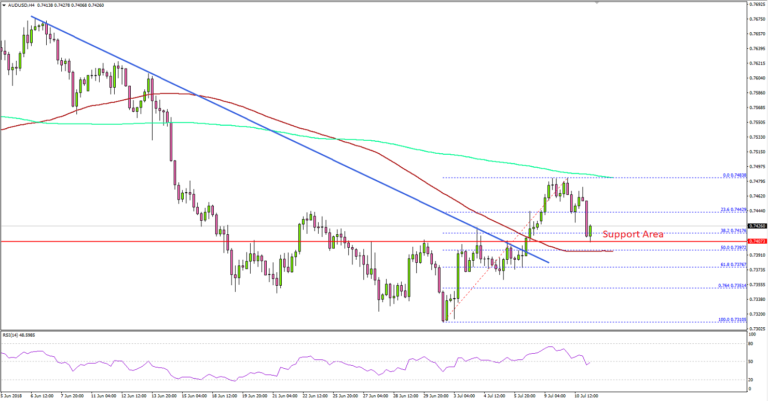
Looking at the 4-hours chart, the pair moved higher and cleared a few resistances such as 0.7350 and 0.7400. There was also a close above the 0.7400 pivot level and the 100 simple moving average (red, 4-hours).
More importantly, there was a break above a major bearish trend line with resistance at 0.7395 on the same chart. The pair traded above the 0.7450 level and it almost tested the 0.7500 resistance and the 200 simple moving average (green, 4-hours).
A high was formed at 0.7483 and the pair corrected lower. It corrected below the 23.6% Fib retracement level of the last wave from the 0.7310 low to 0.7483 high. However, there is a major support on the downside near 0.7400 and the 100 SMA.
Moreover, the 50% Fib retracement level of the last wave from the 0.7310 low to 0.7483 high is also around 0.7400 to act as support. As long as the pair stays above these supports, it could bounce back.
On the upside, a break above the 0.7480 resistance is needed for an acceleration above the 0.7500 barrier and the 200 SMA.
Economic Releases to Watch Today
- US Producer Price Index June 2018 (MoM) – Forecast +0.2%, versus +0.5% previous.
- US Producer Price Index June 2018 (YoY) – Forecast +3.2%, versus +3.1% previous.
- BoC Interest Rate Decision – Forecast 1.5%, versus 1.25% previous.
US CPI Preview: Onward and Upward
CPI likely rose a trend-like 0.2 percent in June amid steady gains in the core index. Consumers may have caught a little respite in travel costs last month, but solid demand and rising input costs point to inflation firming.
Carrying On
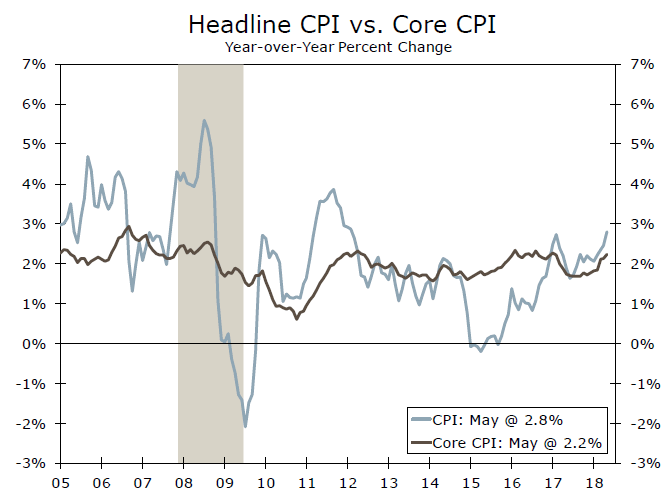
The upward climb in consumer price inflation that began in the middle of last year looks to have continued in June. We expect headline CPI to have risen 0.2 percent last month. By our estimates, that will likely be a "low" 0.2 percent (0.16 percent before rounding), leading to the risks being tilted to the downside. While our call for the monthly rise in headline CPI is in line with the consensus, our expectation for it to come in on the low side is driving our below-consensus call for a 2.8 percent year-over-year gain. Our model points to the non-seasonally adjusted index rising to 252.13.
Similar to the headline, we expect core inflation to come in at a soft 0.2 percent (0.17 percent before rounding). That rise should be just small enough to keep the year-ago rate unchanged at 2.2 percent.
What We'll Be Watching…
Gasoline: AAA gasoline prices trended lower in June, but the run-up in May, which peaked Memorial Day weekend, left the average monthly price little changed. Given that prices typically edge higher over the summer, gasoline will likely be a modest drag on the headline after seasonal adjustment.
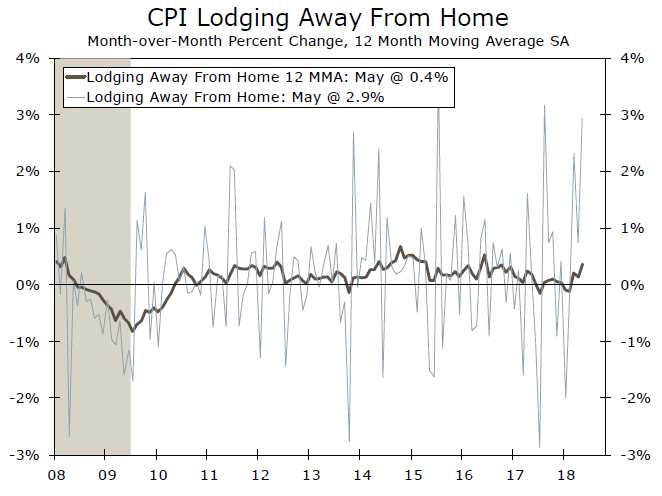
Lodging Away from Home: It has not just been at the pump where consumers have been shelling out more for travel. Hotel/motel prices have increased at a 30 percent annualized rate over the past three months. That puts recent gains in lodging away from home well above the trend (middle chart). Despite stronger discretionary spending from consumers that remains supportive of demand, we see some scope for lodging away from home prices to fall in June.
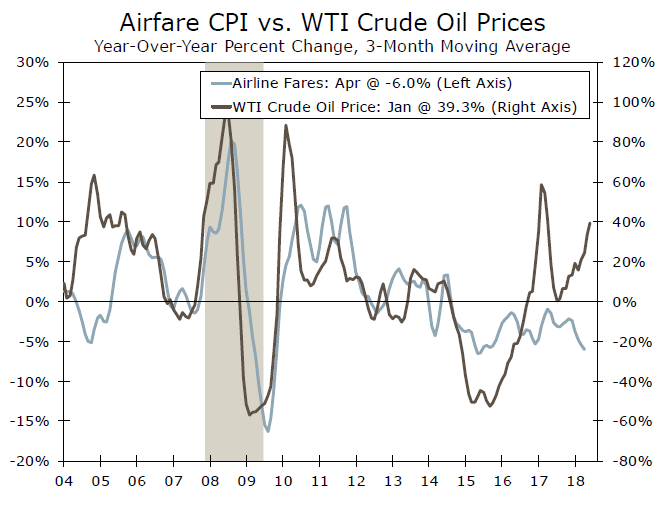
Airfare: Airline fares posted another sizeable decline in May, falling 1.9 percent on the heels of a 2.7 percent drop in April. The rollout of "basic economy" among all three major domestic carriers in the past year has contributed to airfares falling 6.6 percent from a year ago. About half of the CPI's airfare index consists of the lowest possible fare, but does not adjust for the value of picking seats or bringing a carry-on. The growing use of "basic economy" may be sufficient for another drop in airfare prices in June, but rising jet fuel prices and tougher base comparisons as the year goes on (United completed its rollout of domestic "basic economy" in May 2017) suggest airfare inflation will soon be flying high again.
Implications for the Fed
Inflation has become a much lower hurdle on the Fed's path to normalize policy over the past year. Although we expect fairly moderate gains in headline and core CPI in June, the trend remains higher amid solid consumer spending and businesses facing higher input costs for materials and labor. Core CPI at 2.2 percent year-over-year in June and trending higher is consistent with the Fed's more closely watched core PCE deflator running at 2 percent, which it finally hit in May.
When the Going Gets Tough, the Tough Get Going
US Poised to Publish $200 Billion Tariff List (Bloomberg)
Investors confidence was rocked after the latest US administrations trade salvo which reminded us that not all is quiet on the western trade war front after the Trump administration released a list of 10 per cent tariffs on $200 billion in Chinese goods. Of course, nothing is written in stone, and the tariffs are not set to take effect until September. Is Trump playing his strong hand or is he making good on his ultimatum to escalate trade war with Beijing, that is yet to be determined? But none the less, this is a very sobering reality check as to just how fragile sentiment around trade war rhetoric is and should keep markets trading defensively during Asia.
The markets have not yet turned onto full risk-off mode; US equity futures are indeed reducing earnings-inspired froth, but the S & P is tentatively finding support around the 2770 level but would seem a challenge to hold. USDJPY is holding above the key 110.75 levels but this is in serious threat of giving way as the Nikkei buckles.
Commodity prices have come under pressure led by Oil markets which are tapering some overbought positions knowing well that an all-out trade war will raise global growth concerns which could reduce Oil demand, especially China which could be the ultimate loser in this contentious game of trade war chicken.
The real action on currency markets remains centred on the RMB complex which has cratered on tariff headlines as market revisit both China economic downside risks and if mainland administrators will manipulate the Yuan weaker as a tool in trade war escalation. I expect the USDCNH trade 6.80-85 over time as China risk continues to wobble.
With the RMB under pressure we expect regional currencies to follow in tandem while local burses continue to de-risk for fear of trade war escalations. We remain on China watch for retaliation, but long USDCNH should be a go-to trade.
Gold will trade lower as investors seek shelter in US bonds and strengthening the USD on inbound flows
When the going gets tough, the tough get going
U.S. stocks are trading off their intraday highs late in the NY session weighed down by financials profit-taking ahead of the deluge of bank earnings reports on Friday, robust US economic data had temporarily overshadowed fears over global trade disputes. That was until a late NY session headline suggesting the US is reportedly preparing the release of a new $200B China tariff list according to two people familiar with the matter. But a list is a list and not an actual tariff, so lots to be ironed on this one. But regardless, it will put the markets back on the defensive for the time being
Until that point, the market was indeed embracing the raft of outstanding US economic data, and despite the apparent downside risks from an escalating trade war the fact investors continue to plough cash into equities, that was a central dictating market theme. And given the likelihood of a strong earnings season, and at one point investors were heard yelling down Wall Street “what trade war”?? Indeed, when the going gets tough, the tough get going. That was until the latest headline when much of the tough slogging was quickly unwound in minutes as the SPX shed 100 points in the flash of an eye reminding investors we are in tricky markets, and nothing can be taken for granted.
The currency markets, however, are a different kettle of fish where the market risk is relatively light with Forex traders doing little more than rotating from what currency pair is hot from what is not. In other words, chasing the fear of missing out seems to be a common theme among G-10 trades after a considerable volume of USD long positions have been culled over the past few weeks, especially against the EUR and AUD. There is a reason why risk is so low in currency land; it’s the real fear of getting sideswiped by trade war headline risk.
Oil Markets
Oil prices continue to gain on yet more production outages with Brent briefly breaching the $ 80 per barrel high water mark as strikes by workers in Norway and Gabon added to global production outages.
Without question, supply risk continues to dominate trader psyche and after the API reported another massive draw traders are now positioning for another sizeable drop in today’s EIA weekly report.
ON the bigger picture, the markets continue to access the intermediate-term supply impact as the Nov. 4 US-imposed deadline for allies to halt Iranian imports moves nearer. All the while the Libyan disruptions continue to run on.
At the end of the day, supply concerns and more disruptions continue to skew bullish for oil prices
Gold Markets
After a brief peak above 1265 Gold prices resumed its downward path as global stock markets trade well. However Gold prices pulled came off session lows on NATO concerns as the EU countries are worried about possible side agreement between Putin and Trump which could profoundly weaken the alliance. Also, the latest tariff headlines suggesting the US is reportedly preparing the release of a new $200B China tariff list according to two people familiar with the matter should keep a bid under the market. Gold dips remain attractive especially for investors knowing that gold should be an essential part of any diversified portfolio, especially in these highly charged political times.
Currency Markets
With this morning’s tariff headline risk, I need to remind myself that the trade war is good for the dollar, as the US has the upper hand in negotiations and whichever way this issue gets resolved it’s likely to be positive for the US current account.
GBP: Cable remains the land of the brave requiring a sharp eye and quick trigger given the plethora of Brexit headline risk. But indeed, in this muddied UK political landscape it does suggest the endgame will be the UK never leaves the EU, and in this scenario, the Pound is ” cheap as chips”. When the UK political malaise subsides, Sterling will be the shining star of the market
JPY: The USD did look poised to break out topside given the fading of trade rhetoric and a real risk-on environment developing. US equities have held up remarkably well as the bull market keeps marching her despite the reams of negative news thrown at the benchmarks. Long USDJPY is entirely under-owned as risk-off trades are still prevalent vs the JPY, and on a break of 111.50-75 levels, dealers will be forced into a risk on trade. But as usual, nothing ever works out as planned so we may have to re-explore this scenario later once we iron our fact from fiction over the latest US trade escalation headline.
MYR: It was an up and down day for the Ringgit which was in high demand and dare I say outperformed early on Bond related inflows as investors position for dovish pause for the BNM. The MGS curve was in firm demand particularly the attractive long end yields which are usually the domain for real money investors and pension funds. Indeed, last weeks Bond market awakening was the real deal!!
As for the BNM policy decision, we anticipate no actual shift in rates, Nor Shamsiah is a BNM veteran, and it would suggest policy continuity, but the markets will be more focused on forwarding guidance. Given the political and fiscal struggles ahead, I think it’s easy to assume this will not be a hawkish pause.
Oil prices continue to flourish and should push higher given the bullish supply skews which should go a long way in supporting the government coffers.