

Sample Category Title
Economic Projections Key As Fed Seen Raising Rates
- Will a Fourth Hike in 2018 Be Included in New Projections?
- GBP Lower as Inflation Data Does BoE No Favours.
US futures are trading relatively flat ahead of the open on Wednesday, as we await the latest interest rate decision from the Federal Reserve.
Markets have almost fully priced in a rate hike today which, assuming the central bank does as expected, should draw attention instead to the new economic projections. The central bank has previously indicated that three rate hikes this year is likely but with the inflation picking up, the economy performing well and tax reforms having added an additional stimulus this year, a fourth could be on the cards.
It will therefore be very interesting to see whether this is being factored into the economic projections yet or if policy makers still intend to take their time raising rates. There have already been suggestions that they will be willing to tolerate above target inflation but if prices are rising faster than anticipated – CPI inflation rose 2.8% in May, core CPI 2.2% - we should get an idea of just how much they will accept.
Should the Fed signal a fourth hike this year, it could trigger some near term strength for the dollar with markets only currently pricing a fourth hike at less than 40%. It could also lead to a further flattening of the yield curve which has caused some traders concern as it has been associated with recession warnings, although I remain sceptical that this is the case.
The morning saw the release of inflation data from the UK which was in line with expectations but will likely continue to cause a headache for the Bank of England, particularly in light of yesterday jobs data that showed wages growing slower than expected. The central bank was intent on raising interest rates back in May but held off after a difficult first quarter for the country.
With the data no longer looking quite so robust, we could see further back-peddling from the BoE, especially as we're now entering a crucial period in the Brexit negotiations. Theresa May is facing another potentially difficult day in parliament today as she tries to defeat another batch of Brexit bill amendments passed down by the House of Lords. May narrowly avoided an embarrassing defeat on Tuesday after offering concessions on the final deal.
US Retail Sales Expected To Accelerate In May, Dollar Sensitive To Other Events As Well
In an overall eventful week for the US, retail sales figures for May are due out of the country on Thursday at 1230 GMT and are anticipated to attract market participants’ attention.
Retail sales are expected to grow by 0.4% m/m in May, double April’s growth rate. Meanwhile, the measure of sales that excludes automobiles – core retail sales – is projected to expand by 0.5% on a monthly basis, after rising by 0.3% in April.
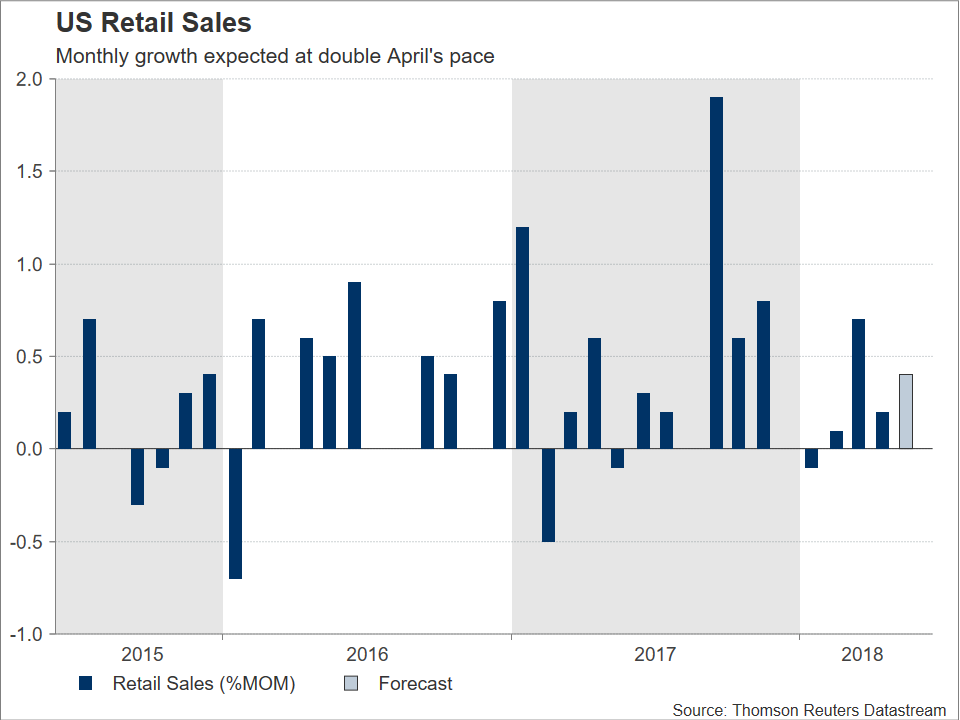
The US economy is largely driven by consumer spending which accounts for more than two-thirds of the economic pie. Retail sales are far from the best consumption indicator but are still viewed as a proxy of some sorts for consumer spending, something which perhaps increases their significance in investors’ minds. Robust retail sales numbers are also likely to add steam to views for the delivery of four quarter percentage point rate increases in total for 2018 by the US central bank. Three such hikes are fully priced in during 2018, while a more than 20% probability for a fourth move is discounted by market participants at the moment.
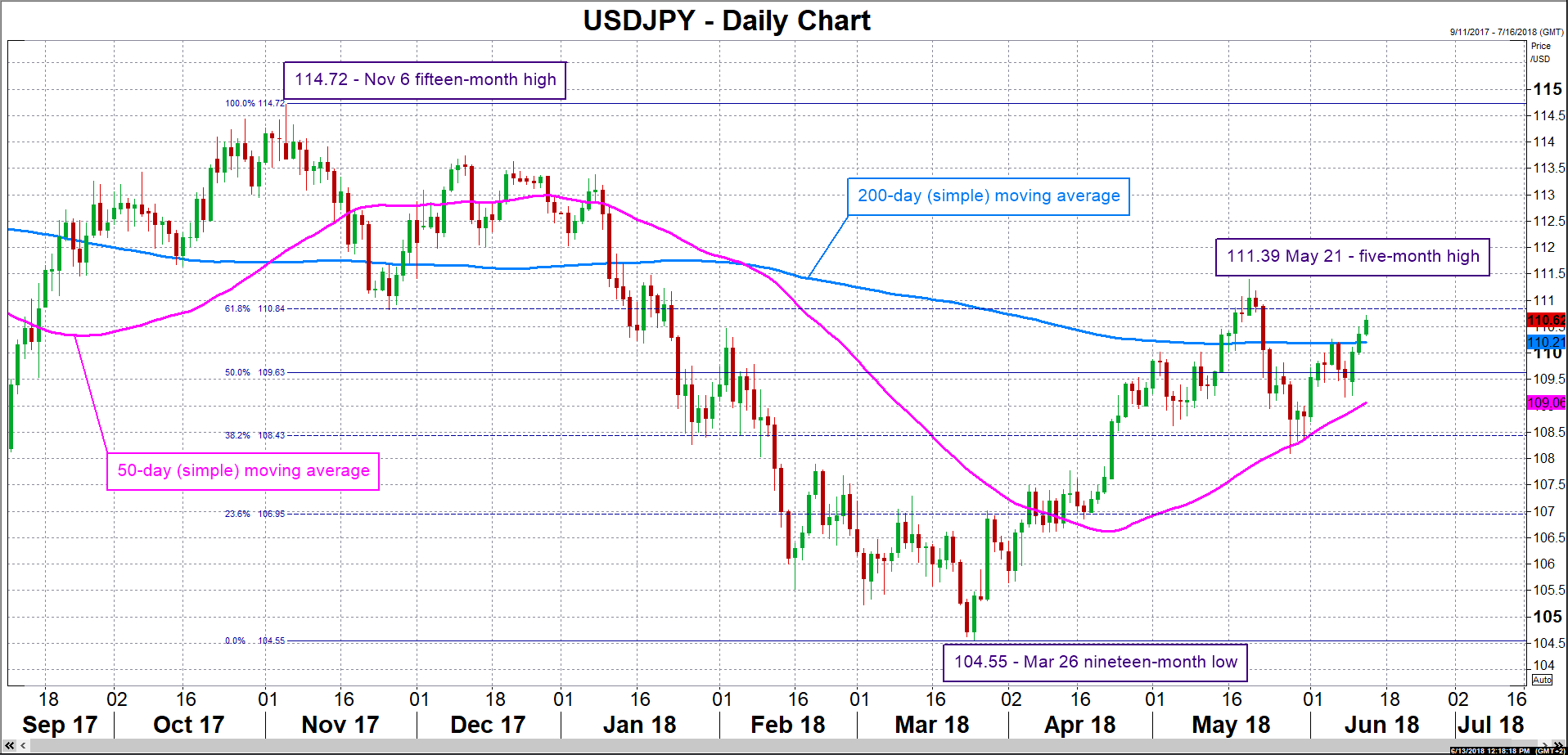
In FX markets, an upbeat release is likely to boost the dollar relative to other currencies. Focusing on USDJPY, a rising pair could meet resistance around the 61.8% Fibonacci retracement level of the November 6 to March 26 downleg at 110.84. The area round this mark encapsulates the 111 handle, while May 21’s five-month high of 111.39 lies not far above and may act as an additional barrier to stronger bullish movement. Conversely, weaker-than-projected numbers are expected to spur dollar selling, pushing dollar/yen lower. The region around the current level of the 200-day moving average at 110.21 that also includes the 110 round figure might provide support, with the areas to be eyed in case of steeper losses being those around the 50% Fibonacci mark (109.63) and the 50-day MA (109.06).
Other data that will be made public out of the US at the same time as retail sales numbers are weekly jobless claims data, as well as the figures on May’s import and export prices. The big event for the greenback though will be taking place later on Wednesday (1800 GMT) when the Federal Reserve concludes its meeting on monetary policy; market reaction is likely to challenge the aforementioned support/resistance levels. The central bank is widely anticipated to deliver its second 25bps rate increase of the year, with the focus turning on whether policymakers see four total increases in 2018 or whether they will stick to the three previously projected. Fed chair Jerome Powell’s news conference is due at 1830 GMT; his comments have the capacity to move markets significantly.
Wrapping up the week in terms of important US releases will be industrial (and manufacturing) production data for May, as well as the University of Michigan’s preliminary survey on consumer sentiment for the month of June; both data points are due on Friday. In the meantime, during Friday’s Asian session the Bank of Japan will be concluding its own meeting on monetary policy. Lastly, the US-China trade spat may receive a new chapter if the US goes ahead and releases a list of $50 billion of Chinese goods that will be subject to another 25% tariff for alleged intellectual property violations by June 15; the yen is likely to receive safe-haven flows in case of escalating tensions.
AUDUSD Outlook – Bearish Bias Below Daily Cloud
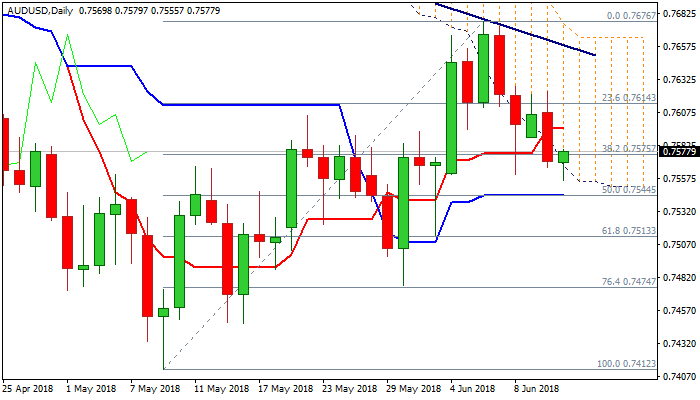
The Aussie dollar edged higher on Wednesday after extension of four-day descend found footstep at 0.7553 (30SMA) and profit-taking on Tuesday’s 0.5% fall pushed the price higher.
Near-term action holds in a downtrend from 0.7676/73 double-top and remains pressured by descending thick daily cloud.
Repeated closes below daily cloud maintain negative near-term tone off 0.7676, as pullback reversed over 38.2% of 0.7412/0.7676 rally so far.
Bearishly aligned daily techs support the notion, with eventual break below 30SMA expected to open next pivotal support at 0.7513 (Fibo 61.8%).
Fed’s rate decision announcement is due later today and may cause increased volatility.
Meanwhile, the pair is expected to hold within narrow range.
Sideways-moving daily Tenkan-sen marks solid resistance at 0.7595, which should keep the upside protected and maintain bearish bias0.7412 low last week.
Bearish scenario requires close below cloud to shift focus lower.
Res: 0.7579, 0.7595, 0.7623, 0.7657
Sup: 0.7555, 0.7544, 0.7513, 0.7474
Pound dips as UK CPI unchanged at 2.4% yoy, GBP/USD heads to 1.3203
Sterling dips notably as UK consumer inflation data missed expectation.
Headline CPI was unchanged at 2.4% yoy in May, below consensus of 2.5% yoy. Core CPI was also unchanged at 2.1% yoy, met expectations. RPI dropped to 3.3% yoy, down from 3.4% yoy and missed expectation of 3.4% yoy.
PPI input was at 2.8% mom, 9.2% yoy, versus expectation f of 1.7% mom, 7.0% yoy, and prior 0.6% mom, 5.6% yoy/
PPI output was at 0.4% mom, 2.9% yoy, versus expectation of 0.3% mom, 2.9% yoy, and prior 0.4% mom, 2.5% yoy.
PPI output core was at 0.2% mom, 2.1% yoy, versus expectation of 0.1% mom, 2.2% yoy, and prior 0.2% mom, 2.0% yoy.
UK House price index rose 3.9% yoy in April, below expectation of 4.4% yoy.
Also released in European session, Eurozone industrial production dropped -0.9% mom in April versus expectation of -0.5% mom. Eurozone employment rose 0.4% in Q1 versus expectation of 0.3% qoq.
Swiss PPI rose 0.2% mom, 3.2% yoy in May versus expectation of 0.2% mom, 3.2% yoy.
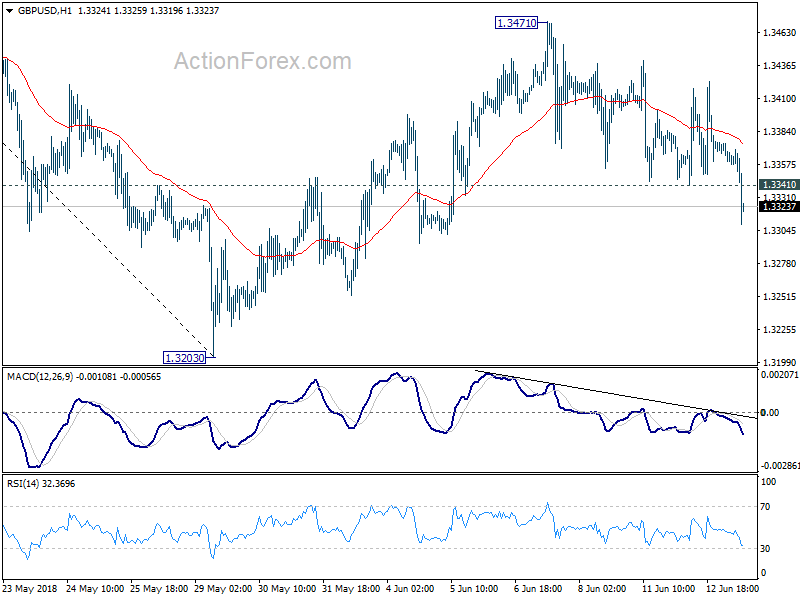
GBP/USD's break of 1.3341 minor support should now confirm the completion of rebound from 1.3203. Deeper fall is expected to retest 1.3203 soon.
EURJPY Remains Neutral Above 38.2% Fibonacci Level
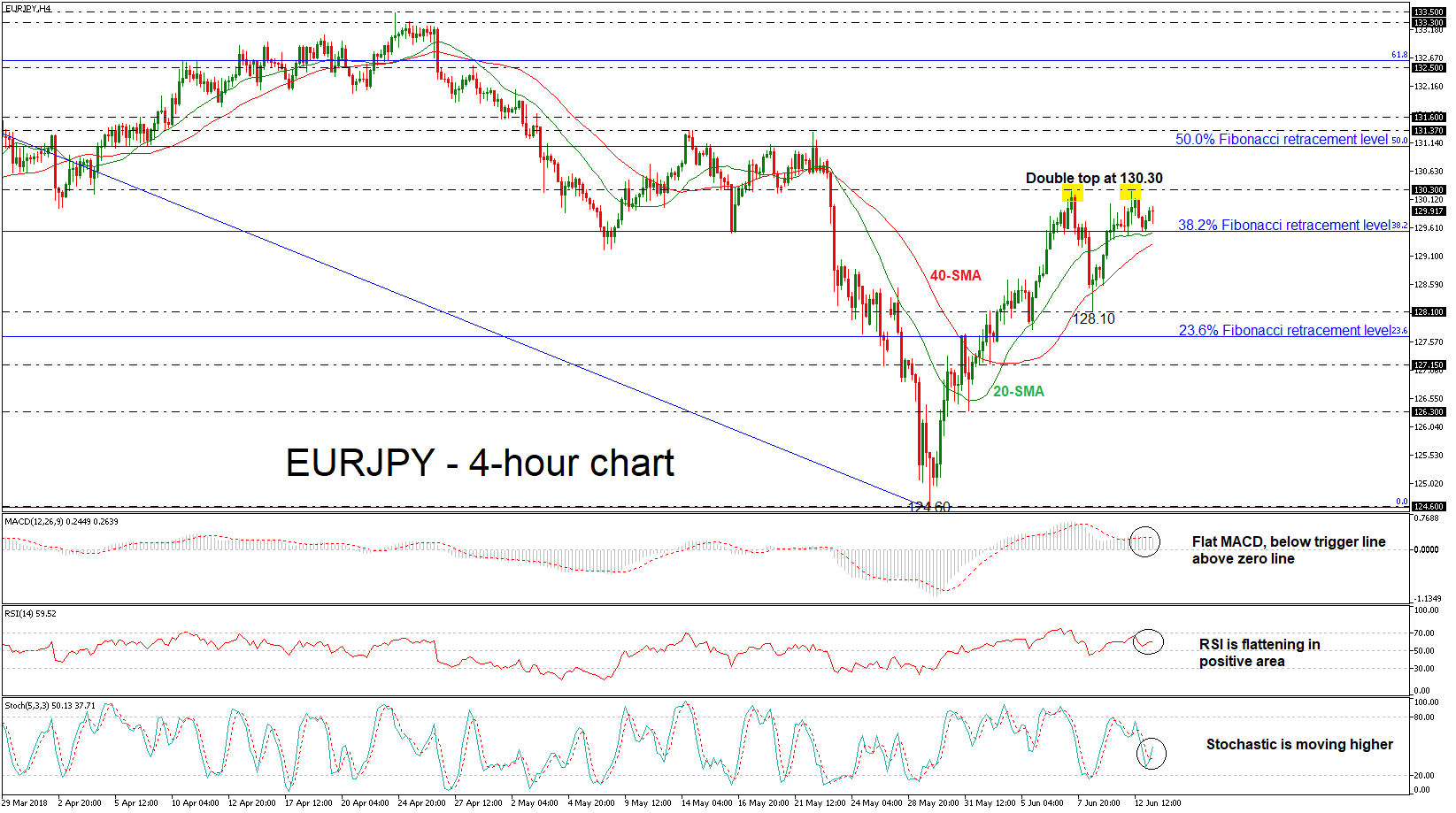
EURJPY has struggled above the 38.2% Fibonacci retracement level of the downleg from 137.50 to 124.60, around 129.50 and below the 130.30 resistance level since Tuesday’s trading session. The sharp buying interest, especially in the previous week, has shifted the near-term bias from negative to positive as the price is in the process for a bullish correction.
The RSI is currently moving above the threshold of 50, while the MACD is flattening in positive territory, both hinting that the next move in prices could be sideways rather than on the upside. However, the stochastics indicate that a rebound is not far off since the oscillators are moving upwards. Still, this is more likely to happen as the % K line formed a bullish cross with the %D line.
Should the market extend gains and successfully surpass the 130.30 double top, created on June 7 and June 12, resistance could be met at the 50.0% Fibonacci near 131.00. A significant leg above this area could send prices towards the 131.37 – 131.60 resistance zone.
Conversely, if the price drops below the aforementioned 38.2% Fibonacci of 129.50, it could shift the focus to the downside again until the 128.10 support. Then, if the market fails to hold above this level, the next stop could be at the 23.6% Fibonacci of 127.65.
In the bigger picture, the pair is bullish as long as it holds above the 20 and 40-simple moving averages (SMAs). In case it violates these lines, bears could take the upper hand.
USDJPY Outlook: Bulls Extend After Close Above 200SMA
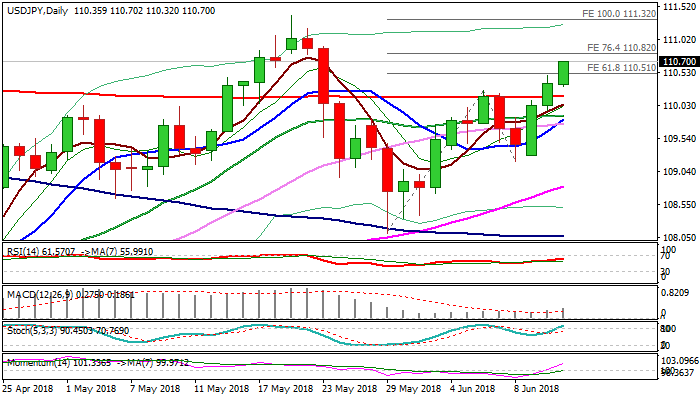
The pair continues to trend higher and holds firm bullish mode for the third straight day.
Tuesday's close above pivotal 200SMA barrier was strong bullish signal, as fresh extension higher cracked next targets at 110.62 (Fibo 76.4% of 111.39/108.11 pullback).
The pair is currently riding on the third wave (of five-wave cycle from 108.11) which pressures its 76.4% Fibo expansion at 110.85 and could extend to 111.36 (Fe 100%), to validate.
Daily techs in firm bullish configuration are supportive, with Fed in focus. Hawkish tone from the central bank would further boost the greenback. Hourly Tenkan-sen (110.52) and Kijun-sen (110.39) mark initial supports and guard 110.21 (top of thick hourly cloud) and key support at 110.16 (200SMA) which should keep the downside protected.
Res: 110.85; 111.00; 111.36; 111.88
Sup: 110.52; 110.39; 110.16, 109.88
GBPUSD Remains Offered Ahead Of UK CPI Data
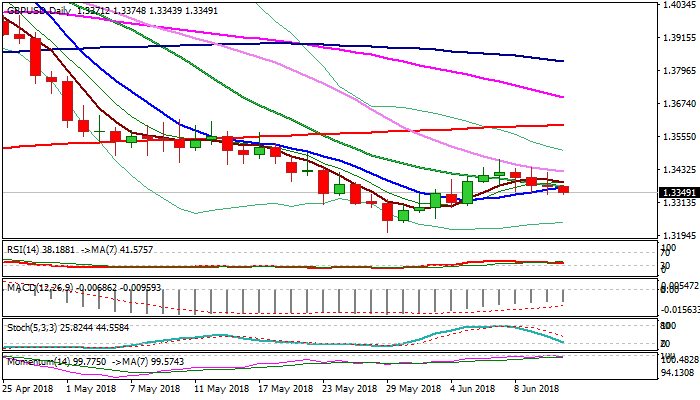
Cable holds in red for the fourth consecutive day and pressures lows of past two days at 1.3342, after eventual break below 10SMA (1.3368), also Fibo 38.2% of 1.3204/1.3472 upleg / 4-hr cloud top, which generated bearish signal.
Risk of break below 1.3342 pivots and extension of pullback from 1.3472 high is increasing, with the notion being supported by bearish configuration of daily MA’s and 14-d momentum entering negative territory.
Bears look for initial support at 1.3323 (4-hr cloud base), followed by 1.3306 pivot (Fibo 61.8% of 1.3204/1.3472 ascend, break of which would generate further strong bearish signal and risk extension towards the top of thinning weekly cloud (1.3237).
Falling 30SMA which limited recovery leg from 1.3204 and capped the action in past few sessions, marks key barrier at 1.3425, break of which is needed to shift near-term bias.
Key events for sterling today are UK CPI data and the second Brexit vote in parliament, while FOMC rate decision will be in focus in the US session.
Inflation in UK is expected to stay unchanged in May at 2.4% (annualized) and 0.4% (m/m).
Any surprise could generate strong signal for sterling, which could accelerate below 1.3300 on CPI miss.
Conversely, stronger than expected inflation data would further support expectations for Aug rate hike and boost pound.
Res: 1.3374, 1.3385, 1.3425, 1.3472
Sup: 1.3323, 1.3306, 1.3267, 1.3237
EURUSD Outlook: Increased Downside Risk Seen On Break Below 1.1720/13 Pivots While 30SMA Caps, Fed In Focus
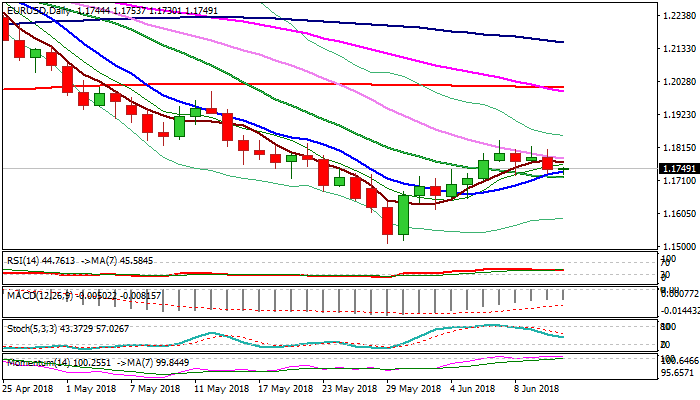
The Euro stands at the back foot in early Wednesday's trading, following previous day's close in red and fourth straight failure to close above falling 55SMA. Firmer dollar ahead of today's FOMC rate decision adds to rising pressure on the single currency.
The Fed is widely expected to increase interest rates on two-day meeting which ends today, but traders are looking for the tone of the central bank to get more clues about the next steps, regarding the third and possibly fourth rate hike this year.
Hawkish tone from Fed would further pressure Euro for attack at key near-term supports at 1.1720 (20SMA) and 1.1713 (Fibo 38.2% of 1.1509/1.1839 upleg), loss of which would be strong bearish signal.
Daily techs are weakening as momentum turned south and MA's turning to bearish setup and keeping negative near-term tone.
Falling 30SMA maintains pressure and marks key barrier (1.1780), break of which would ease downside pressure.
EU industrial production is the highlight of the European session and could put the Euro under fresh pressure if release comes in line or below the forecast (Apr f/c -0.5% vs Mar 0.5%).
Res: 1.1753, 1.1780, 1.1809, 1.1839
Sup: 1.1720, 1.1713, 1.1674, 1.1652
AUDUSD Bearish In Near Term But Stands Near Significant Obstacles Such As 23.6% Fibonacci And SMAs
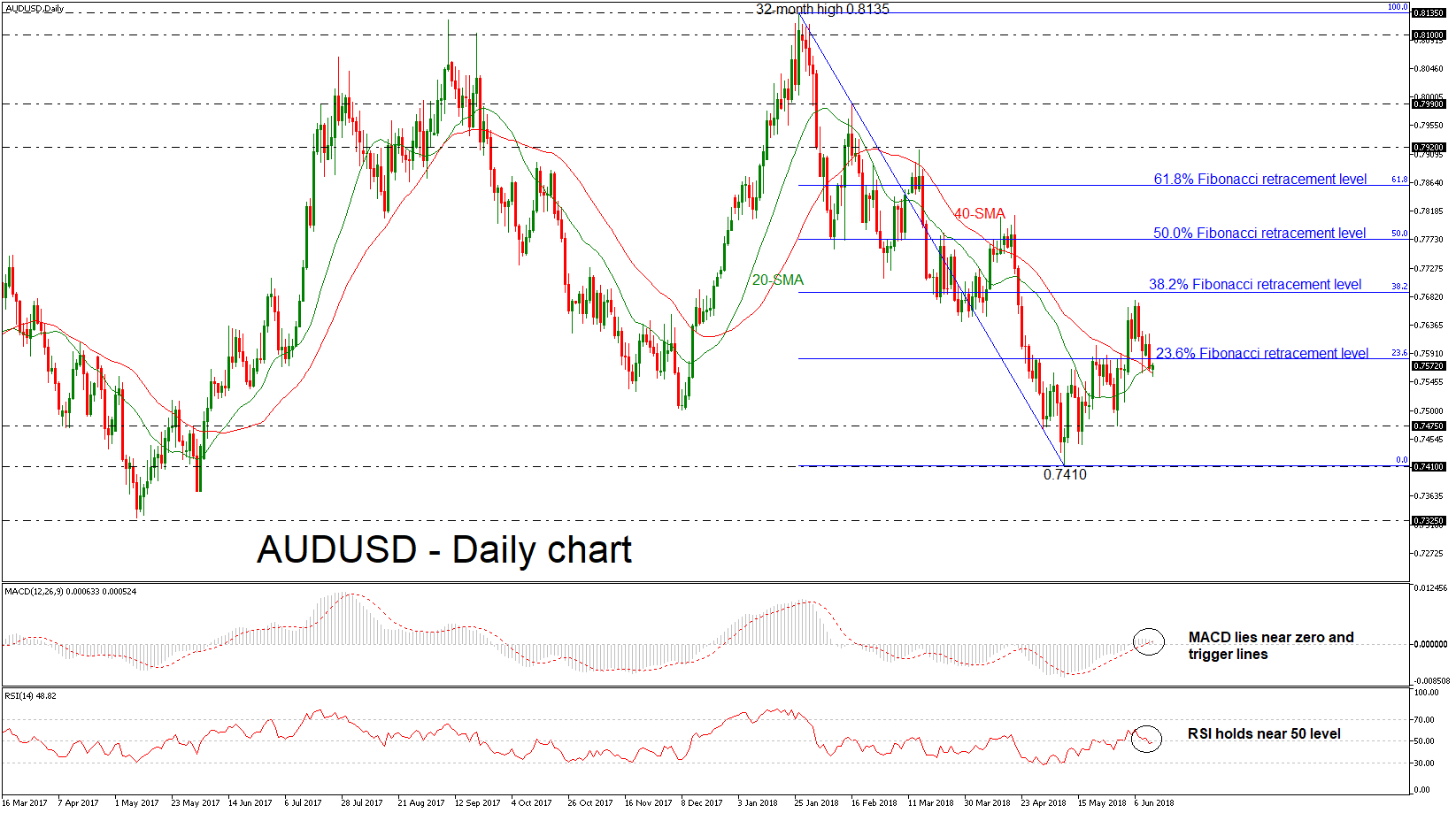
AUDUSD is looking more bearish again as it had a failed attempt to surpass the 38.2% Fibonacci retracement level of the downleg from 0.8135 to 0.7410, around 0.7690 in the prior week. Currently, the price is developing below the 23.6% Fibonacci of 0.7580 and within the 20- and 40-simple moving averages (SMAs) in the daily timeframe.
Looking at momentum oscillators in the short-term timeframe though, they suggest neutral to bearish momentum, suggesting further downside movement may be on the cards. The RSI indicator lies slightly below its neutral 50 line, detecting negative momentum. The MACD oscillator, already negative, holds below its trigger line and near its zero lines.
If the bears continue to control the market, price declines may stall initially near the latest lows of 0.7475. A potential downside violation of this region would send prices until the 0.7410 support barrier, raising the likelihood of more downside pressure. In such a case, the 0.7325 level could act as a barrier to the downside, identified by the May 9 low.
On the other side, in case of a bullish run above the 23.6% Fibonacci in the pair, immediate resistance may be found near the 38.2% Fibonacci of 0.7690. An upside break of that zone would open the way for the 50.0% Fibonacci of 0.7770. If buyers manage to push above that hurdle too, that would drive the price towards the 61.8% Fibonacci level near 0.7860.
In the medium-term, the outlook is also negative following the aggressive bearish rally after the bounce off the 32-month high of 0.8135 at the end of January.
Dollar Inches Up Ahead Of Fed Decision, UK CPI Coming Up
Here are the latest developments in global markets:
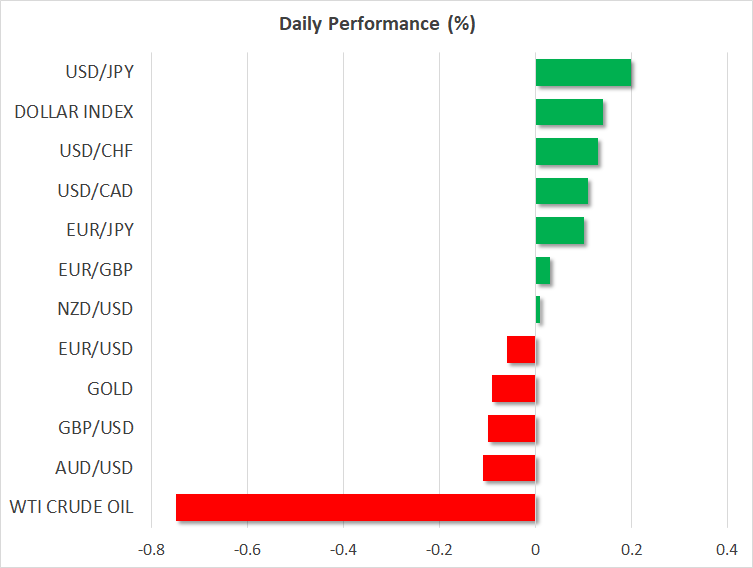
FOREX: The US dollar index is higher by a little more than 0.1% on Wednesday, ahead of the Fed policy decision at 1800 GMT, where the central bank is widely anticipated to raise interest rates. In the UK, sterling managed to rebound against the euro and the yen yesterday, following a vote in Parliament that was interpreted as making a “softer” Brexit more likely.
STOCKS: US markets closed mixed on Wednesday, with the Nasdaq Composite outperforming and rising by 0.57% to close at an all-time high, while the S&P 500 lagged, gaining 0.17%. Meanwhile, the Dow Jones closed fractionally lower, by 0.01%. As for today, futures tracking the Dow, S&P, and Nasdaq 100, are all pointing to a higher open. In Asia, markets were mixed as well, with Japan’s Nikkei 225 and Topix climbing by 0.38% and 0.42% respectively, but Hong Kong’s Hang Seng index declining by 1.01%. Europe looks set to take its cue from Asia, as futures tracking the major European indices are mixed. While the British FTSE 100, the German DAX 30, and the Spanish IBEX 35 are expected to open lower, the opposite holds true for the French CAC 40 and the Italian FTSE MIB.
COMMODITIES: In energy markets, oil prices are lower today, weighed on by a surprising build in the private API crude inventory data released yesterday, which were expected to show a drawdown in stockpiles. WTI and Brent are down by 0.7% and 0.6% respectively, with the theme that OPEC-led producers could agree to raise their output at next week’s OPEC meeting also lurking in the background. In precious metals, gold is down by 0.1%, extending losses from the previous session. Price action in gold remains lackluster, with the yellow metal still hovering in a very narrow range between $1,282 and $1,307 established lately. It will be interesting to see whether the Fed decision later today will be enough to break gold out of its lull.
Major movers: Pound rebounds after Brexit vote; dollar gains ahead of FOMC
Brexit came back under the market’s microscope yesterday, as PM Theresa May managed to avert a rebellion in Parliament. Several lawmakers wanted to include amendments to the Brexit withdrawal bill which would essentially force the government to go back to the negotiating table in a no-deal situation, something that would have likely undermined the PM’s negotiating power. For May to win the vote though, she reportedly had to agree to some concessions, including giving Parliament a greater role in the negotiations.
Markets interpreted the outcome as increasing the probability for a “softer” Brexit, evident by the recovery in the British pound following the vote. Interestingly enough, however, major media outlets like the BBC are reporting that no actual concessions have been agreed, and that the sole agreement was to continue talking. In another interesting twist, UK Justice minister Phillip Lee resigned yesterday in protest over the government’s handling of Brexit, adding another name to the list of departed figures from May’s administration and highlighting the fragility of the Tory cabinet.
Turning to the US, the dollar gained against almost all its major counterparts on Tuesday, and most notably versus the Japanese yen. It looks set to extend its gains today, with dollar/yen rising 0.2% and touching a fresh three-week high of 110.60 as market participants position for the Fed’s rate decision later today. A rate increase is seen as a done-deal, so focus will be on whether the Bank signals a faster pace of tightening for this year, or not (see below).
While the Fed decision today and the ECB one tomorrow will likely keep traders quite busy, it’s worth noting that as the week draws to a close, market focus will turn back to trade. On Friday, the US unveils which Chinese products it will impose tariffs on, something that could provoke a retaliatory response from China, and potentially bring the “trade war” theme back to the forefront. Importantly, President Trump said yesterday the commitment from China to buy $80bn more US agricultural goods was not enough. This implies he may seek more concessions, and judging by his method of operation so far, he may well choose to ramp up the pressure by imposing such tariffs before negotiating.
Day ahead: UK CPI & PPI, eurozone industrial production and US PPI due; Fed decides
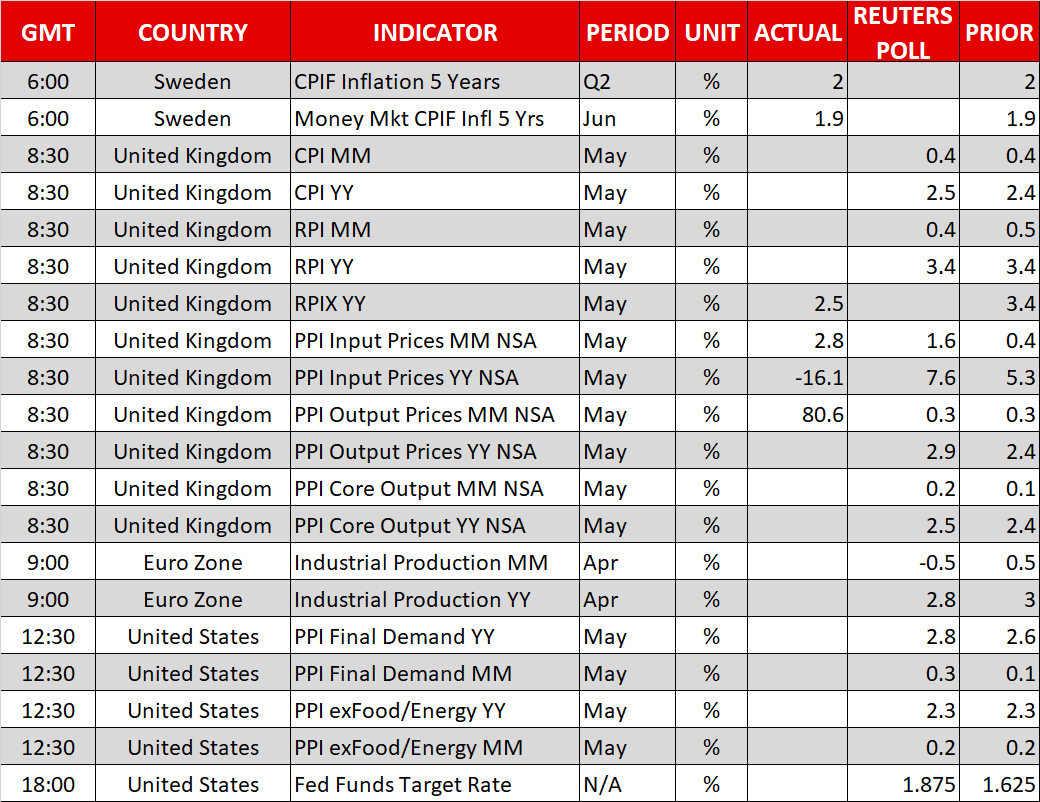
UK inflation figures, as well as the completion of the Federal Reserve’s meeting on monetary policy, constitute the highlights in Wednesday’s calendar.
May’s inflation numbers as gauged by the consumer price index (CPI) are due out of the UK at 0830 GMT. Headline CPI is projected to accelerate to 2.5% y/y, from April’s 2.4% which marked the third month in a row of slowing annual CPI; the BoE’s target for annual inflation stands at 2%. A CPI-beat is likely to stoke market expectations for a Bank of England rate hike sooner rather than later, consequently boosting sterling relative to other currencies. At the moment, market participants do not expect a move during next week’s BoE meeting, while they assign a 44% probability for a 25bps rate increase during the Bank’s August meeting.
Core CPI – forecast to remain constant at 2.1% y/y – and data on retail price inflation and producer prices will be made public out of the UK alongside headline CPI numbers (0830 GMT).
Eurozone industrial production figures for April are scheduled for release at 0900 GMT, with output expected to contract by 0.5% m/m, after rising by 0.5% in March. The contraction discredits, at least in part, those making reference to only a transitory slowdown in the euro area during Q1. Year-on-year, industrial production is projected to grow by 2.8%, below March’s 3.0%.
The US will be on the receiving end of May factory inflation data as measured by the producer price index (PPI) at 1230 GMT. However, the big event for the greenback will be the Federal Reserve’s rate decision, due at 1800 GMT alongside the accompanying statement. The central bank is widely anticipated to deliver its second 25bps rate increase of the year, with the focus turning on whether policymakers see four total increases in 2018 or whether they will stick to the three previously projected by the median dot in the Fed’s dot plot; a hawkish tilt is expected to boost the US currency. Fed chair Jerome Powell’s news conference will follow at 1830 GMT. His comments definitely have the capacity to move markets.
In energy markets, the EIA’s weekly report on crude oil inventories due at 1430 GMT might offer some short-term direction to oil prices. Crude stocks are forecast to have declined by 2.7 million barrels during the week ending June 8, after rising by around 2.1m in the previously tracked week.
Technical Analysis: EURUSD looking mostly neutral in the short-term
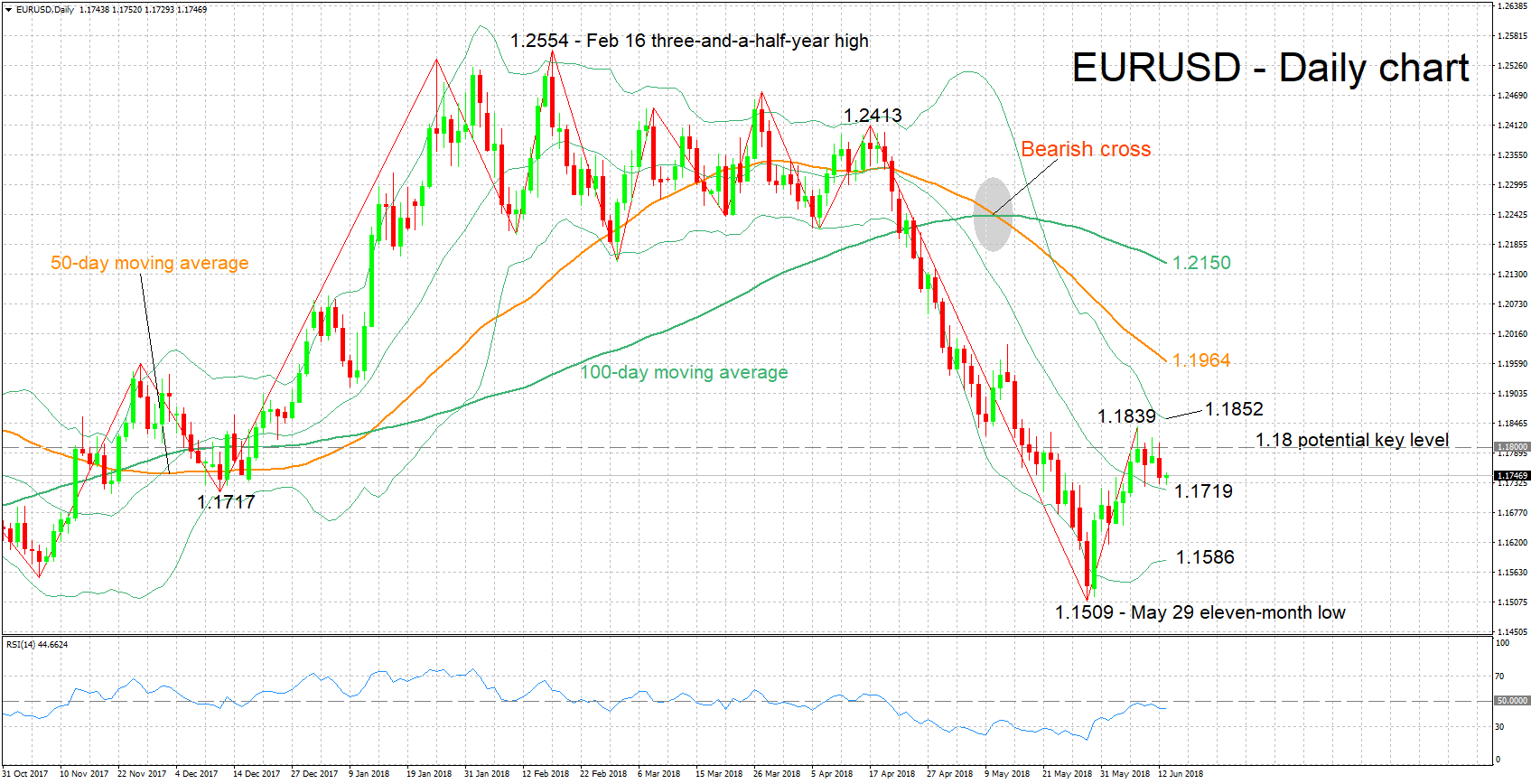
EURUSD has lost some ground after hitting a four-week high of 1.1839 last Thursday. The RSI has halted its previous advance and is largely moving sideways at the moment. This is pointing to a mostly neutral picture in the short-term.
A hawkish tilt by the Fed upon completion of its meeting later in the day is likely to boost the dollar, pushing EURUSD lower. Immediate support to declines could be taking place around the middle Bollinger line (a 20-day moving average line) at 1.1719, including the 1.17 round figure. The area around the lower Bollinger band at 1.1586, that also encapsulates the 1.16 handle, could provide additional support in case of steeper declines.
Conversely, a cautious Fed might weaken the greenback, lifting EURUSD. The 1.18 round figure resisted a successful close above it in previous days despite momentarily being violated. The region around it may act as resistance to advances. Last week’s four-week high of 1.1839 and the upper Bollinger band at 1.1852 might act as additional barriers to stronger gains in the pair.