Sample Category Title
China to end anti-dumping and anti-subsidy investigations of US sorghum
As the first day of US-China trade talk started, there are rumors flying around already. It's reported that, according to a US official, China is offering to slash its trade surplus with the US by up to USD 200B year. (Btw, is that considered a leak?) It's unclear for now how the total value was determined. But another source said the package could include Chinese tariffs on around USD 4B worth of US farm products.
Meanwhile, the Chinese Ministry of Commerce just announced to end the "anti-dumping and anti-subsidy investigations of imported sorghum originating in the United States" in a statement here. Looks like there was some real progress made.
It’s All About The Benjamins
It's all about the Benjamins
The USD continues to rally across the board as US yields continued to be the primary driver and threatening to break out above the fundamental 3.125 level, but the ease of the 50+pb steeping that got packed into the Two-Year vs Ten Year treasury curve is creating the unwelcoming tremors across global markets. The speed of the move is what's catching investors by surprise, and if 3.25 US Ten Year Yield is indeed the last line of defence, crossing that Rubicon will trigger a tsunami of dollar buying.
With 24 hours left in the trading week, it's all about closing levels particularly on EURUSD, USDJPY and of course 10-year yields. The Friday finish line will be a very key indicator of overall market sentiment which should confirm the USD is firmly in the driver's seat.
While US data didn't necessarily move the dial, it didn't thwart demand either with the Philly Fed soared to 34.4 in May vs 21.0 forecasts and 23.2 prior.
JPY: Not too unexpected, traders are expressing their USD stronger bias through the USDJPY as the widening 10-year differential is too attractive to ignore
EUR: A very quiet overnight session after the Wednesday tumult.
MYR: The surging USD and higher US yields continue to weigh on MYR sentiment Higher oil prices continue to make the MYR less vulnerable to external shocks, but it is hard to argue the current direction with US yields moving higher. But the political risk premium is currently offsetting the benefits from Oil as uncertainty continues to build over the Debt agency reaction to the Council removing the budget-balancing GST
Oil Markets
The dual supply shortcomings from Iran and Venezuela continue to provide substantial support. However topside buyer remorse set in after Saudi Arabia commented that there are ample oil supplies and of course after such a busy week a bit of expected trader fatigue set in which has likely contributed to the wave of profit-taking as oil prices veer off recent highs. As for next week, unless an unexpected meltdown, bullish sentiment should remain intact, and you know what they say “when in Rome.”
Gold Markets
Gold remains under pressure from the US dollar and utterly vulnerable to higher US bond yields which are showing signs of a significant topside breakout after the 10-year Treasury note yield hit 3.1 % overnight. The inflationary overtones from oil prices coupled with a strong US retail sales print have increased Fed rate hike expectations. As the trickle-down effects from US fiscal stimulus continue to show in the data, bond yields will move higher, but ultimately the positive data prints will leave a larger than life footprint on Fed members interest rate views and challenge the current dot plot scenario.
Gold Continues To Drift At $1290
Gold is trading sideways in the Thursday session. In North American trade, the spot price for one ounce of gold is $1290.46, down 0.03% on the day. On the release front, key U.S indicators were a mix. Unemployment claims climbed to 222 thousand, above the estimate of 216 thousand. This was the highest reading in 4 weeks. There was much better news on the manufacturing front, as Philly Fed Manufacturing Index jumped t0 34.4, crushing the estimate of 21.1 points. This was the strongest gain since February 2017.
In the U.S, retail sales and core retail sales posted gains in April, although both indicators fell short of the estimates. Still, consumer spending is improving after a sluggish first quarter. Investors liked what they saw, and the US dollar was broadly higher on Tuesday. At the same time, a new concern is higher gas prices, which could put a dent in consumers’ wallets and hurt spending. Oil prices have hit their highest levels in over 3 years, and with the US leaving the Iran nuclear deal and escalating tensions in the Middle East, gasoline prices could remain at high levels.
The U.S economy continues to perform well, but the Federal Reserve target of 2 percent remains elusive. CPI rebounded with a gain of 0.2%, but this fell short of the estimate of 0.3%. Core CPI edged lower to 0.1%, shy of the forecast of 0.2%. Inflation levels will be an important factor for the Fed in its monetary policy projection, which remains at two more hikes in 2018. The odds of a rate hike at the June hike stands close to 100%, and the US dollar could continue to make broad gains as we get closer to the June policy meeting.
British Pound Steady, US Posts Mixed Numbers
It continues to be an uneventful week for the British pound. In Thursday’s North American session, GBP/USD is trading at 1.3505, up 0.12% on the day. On the release front, there are no British indicators on the schedule. In the U.S, major indicators were a mix. Unemployment claims climbed to 222 thousand, above the estimate of 216 thousand. This was the highest reading in 4 weeks. There was much better news on the manufacturing front, as Philly Fed Manufacturing Index jumped t0 34.4, crushing the estimate of 21.1 points. This was the strongest gain since February 2017.
All eyes were on British job numbers on Tuesday, and the readings were lukewarm. Wage growth dropped from 2.8% t0 2.6% in March, missing the estimate of 2.7%. Unemployment claims increased by 34.4 thousand, much higher than the estimate of 21.1 thousand. This marked a 12-month high. At the same time, the labor participation rate rose to 75.6%, the highest rate ever recorded. Policymakers at the Bank of England will have to decide what to make of the mixed readings, as the employment market and wage growth will be important factors in the bank’s thought process regarding rate future rate hikes. Weak economic numbers dissuaded the BoE from raising rates last week, but if second-quarter data is stronger, the bank could press the rate trigger at its August meeting.
In the U.S, retail sales and core retail sales posted gains in April, although both indicators fell short of the estimates. Still, consumer spending is improving after a sluggish first quarter. Investors liked what they saw, and the US dollar was broadly higher on Tuesday. At the same time, a new concern is higher gas prices, which could put a dent in consumers’ wallets and hurt spending. Oil prices have hit their highest levels in over 3 years, and with the US leaving the Iran nuclear deal and escalating tensions in the Middle East, gasoline prices could remain at high levels.
EU to use Blocking Statute against extraterritorial effects of US sanctions of Iran
EU leaders showed unity in clashing with US President Donald Trump on preserving the Iran nuclear deal. European Council President Donald Tusk said after the summit in Sofia that "on Iran nuclear deal, we agreed unanimously that the EU will stay in the agreement as long as Iran remains fully committed to it. Additionally the Commission was given a green light to be ready to act whenever European interests are affected."
European Commission President Jean-Claude Juncker added that the "the effects of the US sanctions will be felt" And, "it is the duty of the EU therefore to protect European business and that applies particularly to smaller and medium-size businesses." He also said in strong words that "we will not negotiate with the sword of Damocles hanging over our heads" and "it's a matter of dignity, and it's a matter of principle".
Juncker will begin a legal process to prohibit EU companies to comply with US sanctions on Iran. The "blocking statue" process will begin, accord to Juncker, to "neutralise the extraterritorial effects of US sanctions in the EU". And "we will do it tomorrow [Friday] morning at 10.30." In addition, Juncker said EU "also decided to allow the European Investment Bank to facilitate European companies' investment in Iran"
German Chancellor Angel Merkel noted "All European Union member states are still backing this agreement, despite the fact the United States has decided not to, and we will continue talks with the United States". She added "we can see whether we can give small and medium-sized companies certain relief. That is being examined ... As for compensating all businesses in a comprehensive way for such measures by the United States of America, I think we cannot and must not create illusions."
USTR Lighthizer: Nowhere near close to a NAFTA deal
US Trade Representative Robert Lighthizer poured cold water after the May 17 deadline for NAFTA negotiation passed without breakthrough. He said "the NAFTA countries are nowhere near close to a deal." with "gaping differences" on a number of issues. He pledged to work towards the "best possible deal for American farmers, ranchers, workers, and businesses."
Just hours before Lighthizer's comments, Canadian Prime Minister Justin Trudeau said he was "positive" about NAFTA talks. He said "it's right down to the last conversations. ... I'm feeling positive about this, but it won't be done until it's done."
Mexico's economy minister Ildefonso Guajardo also said a deal could be reached by the end of May. But he didn't rule out extending the talks beyond July 1 Mexican presidential election.
May 17 was a deadline House Speaker Paul Ryan told the NAFTA countries for having the deal approved by the current Congress by the end of this year.
Eco Data 5/18/18
[php_everywhere instance="1"]
Japanese Yen Drops to 4-Month Low, Japan Inflation Report Next
The Japanese yen continues to lose ground this week. In Thursday’s North American session, USD/JPY is trading at 110.80, up 0.36% on the day. On the release front, Japanese Core Machinery Orders declined 3.9%, missing the estimate of -2.9%. This marked a 3-month high. Later in the day, Japan releases National Core CPI, which is expected to edge higher to 0.9%. In the U.S, key indicators were mixed. Unemployment claims climbed to 222 thousand, above the estimate of 216 thousand. This was the highest reading in 4 weeks. There was much better news on the manufacturing front, as Philly Fed Manufacturing Index jumped t0 34.4, crushing the estimate of 21.1 points. This was the strongest gain since February 2017.
Is the Bank of Japan looking to exit from its ultra-accommodative stimulus program? The cautious central bank will certainly move carefully. Any steps will be small and incremental in nature, in order not to rattle the markets or the yen exchange rate. The bank took one such step in April when it removed a deadline for hitting its inflation target of around 2 percent. Currently, BoJ policymakers are looking to raise bond yields from their near-zero levels as part of normalizing monetary policy. The stimulus program was introduced in 2013, when a confident BoJ Governor Kuroda claimed that he would reach the inflation target within two years. Fast forward to 2018, and the inflation target remains elusive, despite the bank spending trillions of yen in stimulus. The Japanese economy has shown some improvement, which will make it easier for the BoJ to exit from its radical easing policy. Still, traders should be prepared for small, incremental steps towards this end.
In the U.S, retail sales and core retail sales posted gains in April, although both indicators fell short of the estimates. Still, consumer spending is improving after a sluggish first quarter. Investors liked what they saw, and the US dollar was broadly higher on Tuesday. At the same time, a new concern is higher gas prices, which could put a dent in consumers’ wallets and hurt spending. Oil prices have hit their highest levels in over 3 years, and with the US leaving the Iran nuclear deal and escalating tensions in the Middle East, gasoline prices could remain at high levels.
Germany 30 Index Maintains Bullish Bias in Near-Term; Broader Trend is Neutral
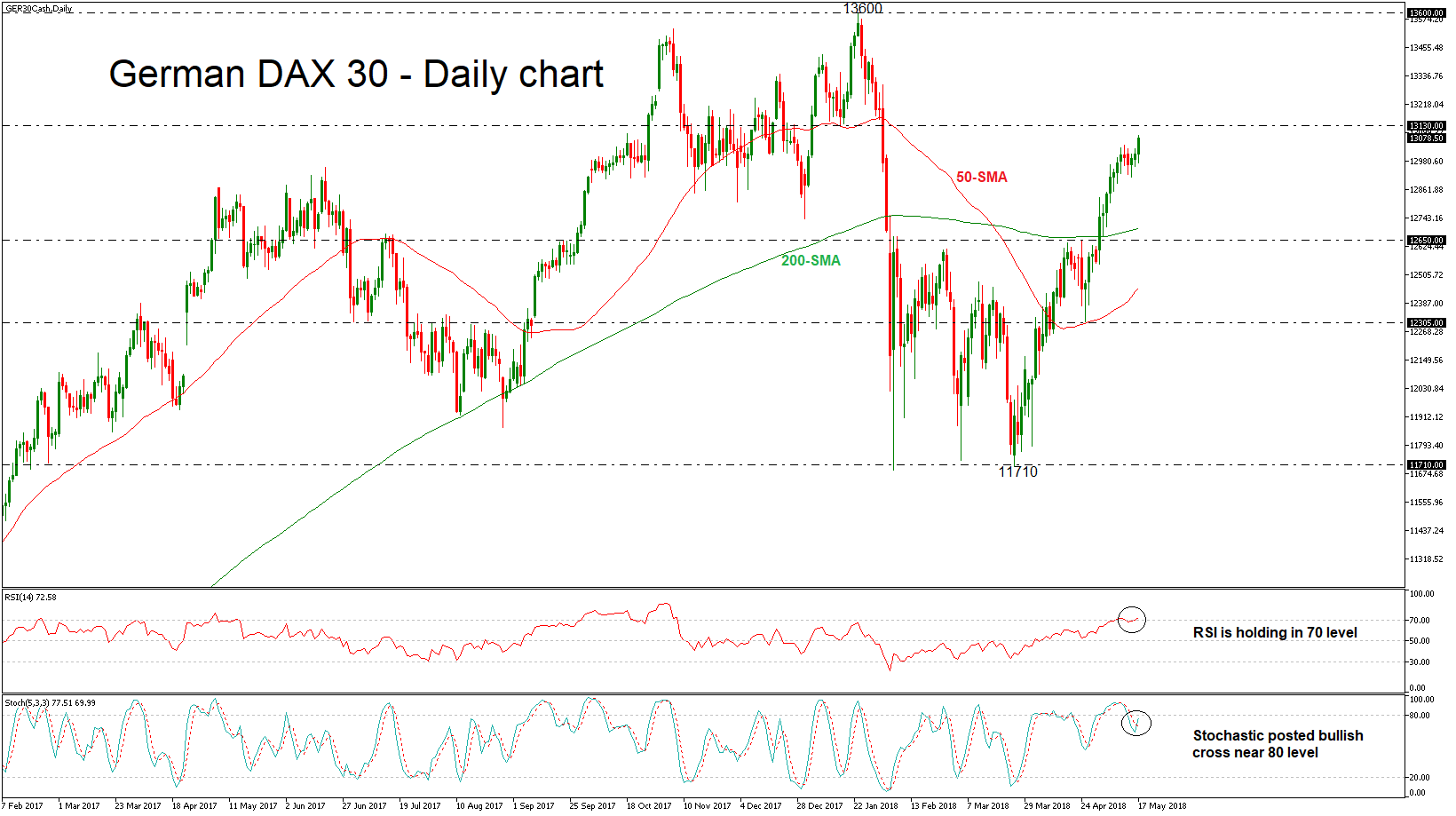
The Germany 30 index is looking set to record an eight straight week of gains, which have taken it above the 50-week SMA, following the rebound from the 11710 support. The sharp buying interest drove the price towards a new 15-month high of 13074.50, while the momentum indicators are supportive of the bullish picture.
Looking at the daily timeframe, the RSI indicator holds above the 70 level and is sloping up; some caution may be warranted given that the indicator is in overbought territory. Moreover, the stochastic oscillator posted an upward crossover – the %K line moved above the %Done – while it is approaching the 80 level. Additionally, the price is moving further above the 50- and 200-day simple moving averages (SMAs), supporting the view for a bullish bias.
Further gains should see the 13130 resistance level, taken from the trough of January 16. In case of an upside break, the index would likely meet resistance at 13600, this being its all-time high.
In the event of a downside reversal, the next support barrier to have in mind is the 200-SMA at 12698.53 before the 12650 hurdle comes into view. If there is break below this level, the price could meet the 50-SMA around 12450.
In the medium term, the bullish outlook remains intact, with the moving averages pointing upwards.
Falls in World Trade Outlook indicator could be linked to increased trade tensions
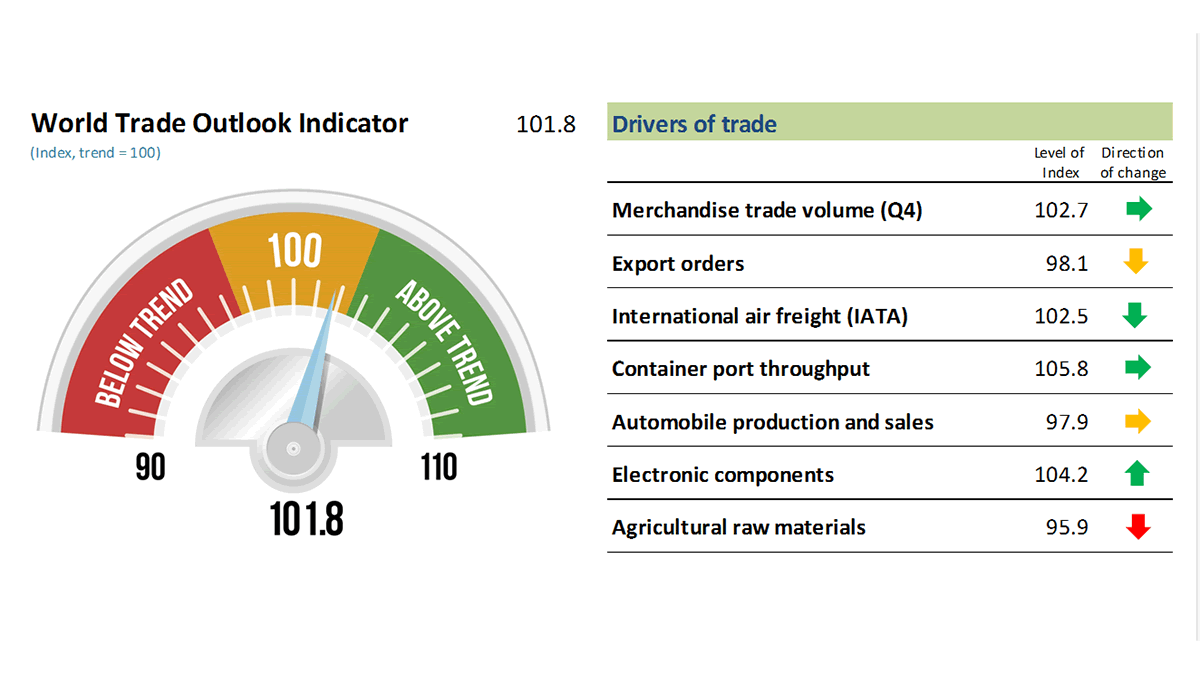
The World Trade Outlook Indicator of the WTO dropped to 101.8 as of May 17, down from 102.3 back in February.
WTO noted that the value remains "above the baseline value of 100" which suggests "continued solid trade growth in Q2. However, it's "probably at a somewhat slow pace" than Q1.
It also pointed out that the dip in WTOI reflects declines in export orders and air freight. And that "may be linked to rising economic uncertainty due to increased trade tensions."