

Sample Category Title
Markets respond positively to China Xi Jinping’s calm but uninspiring speech at Boao, AUD up, JPY down
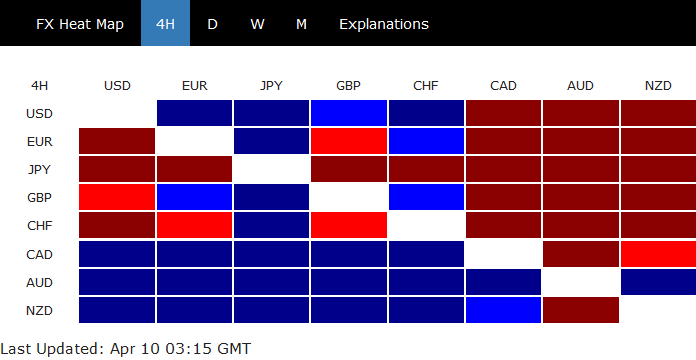
The financial markets are responding positively to China President Xi Jinping's calm but uninspiring speech at the Boao Forum for Asia today. At the time of writing, Nikkei is trading up 1%, Hong Kong HSI is up 0.9%. JPY is deeply lower at the current 4 hour bar while commodity currencies show much strength. This is a clear sign of risk appetite.
 Zero-sum game thinking is outdated
Xi urged the world not to return to "Cold War" mentality. He said that "human society is facing a major choice to open or close, to go forward or backward." And, "in today's world, the trend of peace and cooperation is moving forward and a Cold War mentality and zero-sum game thinking are outdated."
And, he added that "paying attention only to one's own community without thinking of others can only lead into a wall." XI urged that "we can only achieve win-win results by insisting on peaceful development and working together."
Stay committed to multilateral frameworks
Regarding trade, Xi said that "China does not seek trade surplus. We have a genuine desire to increase imports and achieve greater balance of international payments under the current account." And, "we hope developed countries will stop imposing restrictions on normal and reasonable trade of high-tech products and relax export controls on such trade with China."
Xi also emphasized the need to "stay committed to openness, connectivity and mutual benefits, build an open global economy, and reinforce cooperation within the G-20, APEC and other multilateral frameworks".
China to further open up
Xi also talked about the plans to further open up the massive Chinese markets to foreign investments. The measures would include "significantly" lowering import tariffs for autos, enforcing intellectual property protection, and improving investment protections for foreign companies.
Our views
Xi's speech is the kind that we expected. He is not a leader who thrives on populism and thus there wasn't any emotionally charged over the top words or phrases. Xi is a leader who survives on internal party politics in a politically closed country. The reiteration of commitment to multilateral relationship is consistent with the party line to accuse US of protectionism.
The pledges to open up the markets have been delivered by various Chinese leaders for two decades but actual delivery has been relatively small. And for now, these pledges remain words only. In addition, China still have the option of opening the markets to all but those who don't commit to multilateral frameworks.
So, does Xi's speech do something to ease the trade tension with the US? Certainly not. Does it worsen the relationship? No neither. It's like calling "check" playing poker. The ball is still on Trump's court.
Below is Xi's speech with English translation voice over.
https://www.youtube.com/watch?v=KgUcL4rdpI0
IMF Furusawa: Global economy continues to strengthen on the back of investment and trade
IMF Deputy Managing Director Mitsuhiro Furusawa delivered an opening remark to the 9th IMF-Japan High-Level Tax Conference for Asian Countries today.
There he noted:
- The global economy continues to strengthen on the back of investment and trade
- Capital flows to emerging markets remaining resilient
- U.S. tax reform expected to boost growth temporarily
- Current upswing provides an ideal opportunity for reforms to boost potential output
- This will require strategies to ensure fiscal sustainability and financial resilience
The speech otherwised touched on taxation and digitalization.
Australia NAB business condition dropped sharply from record high, confidence eased
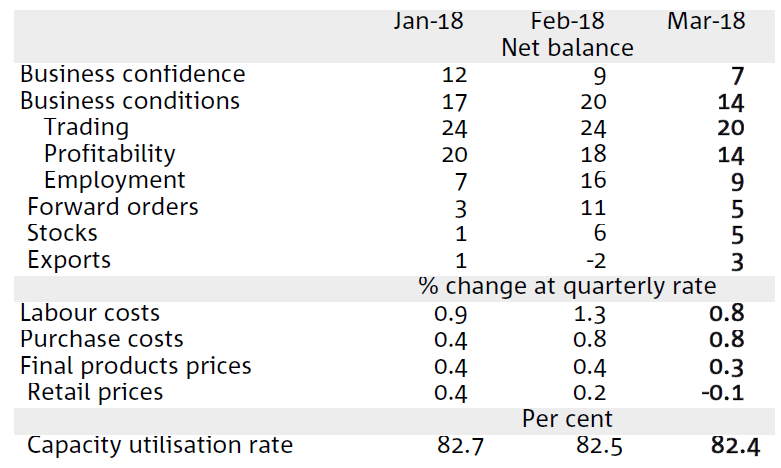
Australia NAB business confidence dropped another 2 pts to 7 in March, down from 9. Business conditions dropped 6 pts from February's record high at 20 to 14. That's 3 points lower than January's 17.
Nonetheless, NAB noted in the release that "conditions remain well above average, with reasonably broad based strength across industries although retail continues to lag." The historical average is at 5.5 and unchanged in trend terms.
"Business confidence eased again and is now only just above its long-term average, although leading indicators remain at solid levels, as is the employment index." "The survey was conducted shortly after US President Trump's announcement of tariffs on at least $50 billion of Chinese imports, which may have affected sentiment."
Regarding inflation, "final product price inflation remains muted and retail prices declined. However, purchase cost growth has been moving higher since late 2016 providing a tentative sign of inflationary pressure."
On wages, "labour cost (wage bill) growth moderated after rising the previous month."
GBP/USD: Cable Could Retest 1.4200?
Key Highlights
- The British Pound found a strong support at 1.3965 and recovered against the US Dollar.
- There was a break above a bearish trend line with resistance at 1.4080 on the 4-hours chart of GBP/USD.
- The UK Halifax House Price Index in March 2018 increased 1.5% (MoM), more than the forecast of 0.2%.
- The UK British Retail Consortium (BRC) Like-For-Like Retail Sales in March 2018 grew 1.4% (YoY), compared with the +0.7% forecast.
GBPUSD Technical Analysis
This past week, there was a sharp downside move in the British Pound below 1.4050 against the US Dollar. Later, the GBP/USD pair found a strong support at 1.3965 and recovered above 1.4050.
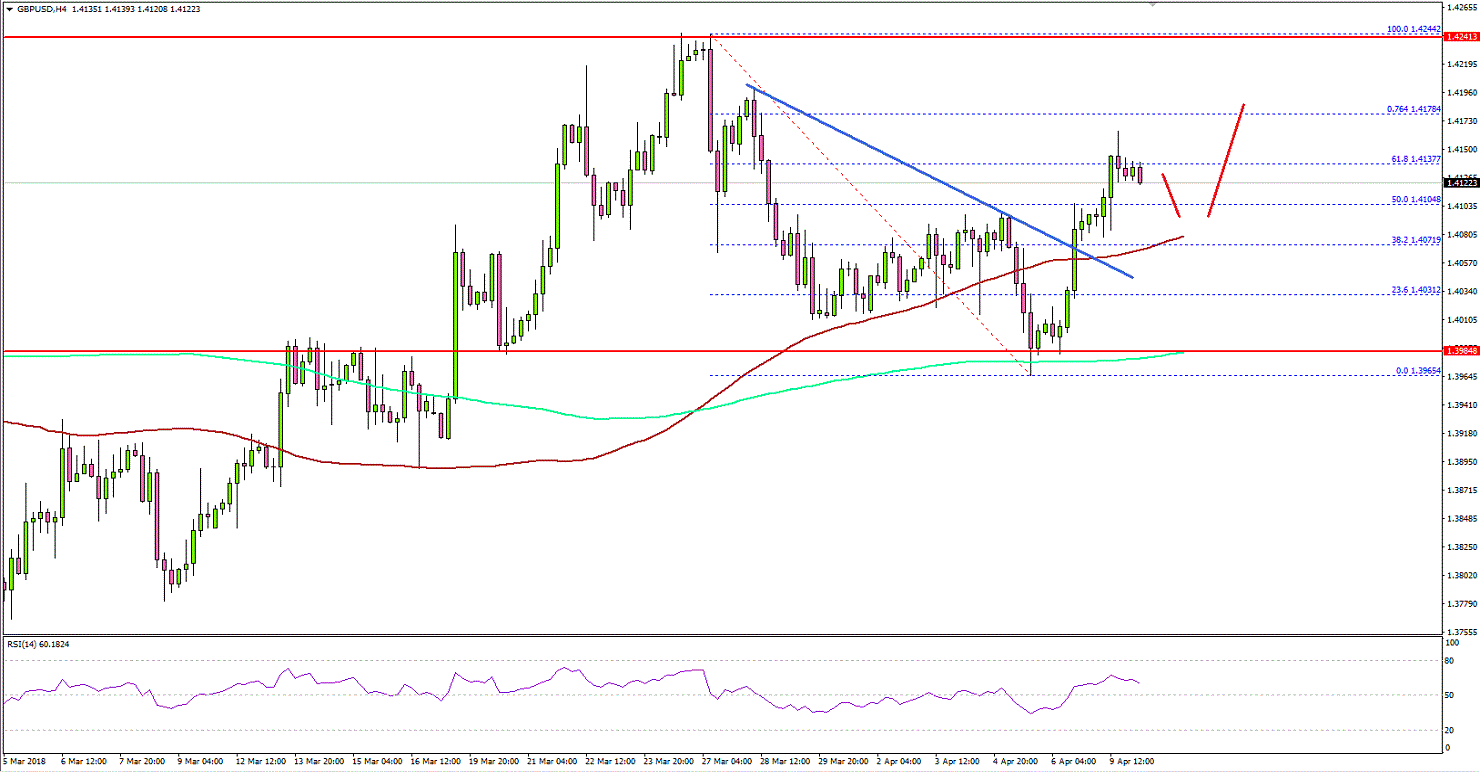
During the recent recovery, the pair broke the 50% Fib retracement level of the last decline from the 1.4244 high to 1.3965 low. Moreover, there was a break above a bearish trend line with resistance at 1.4080 on the 4-hours chart.
The pair is now trading well above 1.4050, and the 100 (red) and 200 (green) simple moving averages (4-hour). These are positive signs above the 1.4050 level. On the upside, a break above the 61.8% Fib retracement level of the last decline from the 1.4244 high to 1.3965 low at 1.4137 could open the doors more gains.
The next resistance on the upside could be near the 1.4180 and 1.4200 levels. On the downside, the 1.4070 support and the 100 SMA may act as a support if the pair corrects lower from the current levels.
Recently in the UK, the British Retail Consortium (BRC) Like-For-Like Retail Sales report was released for March 2018. The market was positioned for rise of 0.7% compared with the same month a year ago.
The actual result was positive as there was an increase of 1.4% in the BRC Like-For-Like Retail Sales. Overall, the GBP/USD pair may continue to rise as long as the 1.4050 support is intact.
Economic Releases to Watch Today
- US Producer Price Index March 2018 (MoM) – Forecast +0.1%, versus +0.2% previous.
- US Producer Price Index March 2018 (YoY) – Forecast +2.9%, versus +2.8% previous.
- US Wholesale Inventories for Feb 2018 – Forecast +0.9%, versus +1.1% previous.
- US NFIB Business Optimism Index March 2018 – Forecast 107.0, versus 107.6 previous.
Surge And Purge
Surge and Purge
The tale of the tape doesn't lie in this highly sensitive headline-driven markets. US stocks spent the better part of the New York session playing headline catch up as trade tensions between the U.S. and China apparently eased following last weeks dust-up. But there is no rest for the weary as the non-stop equity market surge and purge continues on the exhaustive list of negative narratives US-China trade relations remain uncertain, geopolitical risk is jumping higher, and the Muller investigation continues to wear on sentiment as investors continue to sell the news and worry about the details later
Currency markets were thrown a curve ball yesterday afternoon when a Bloomberg headline suggested that China is studying CNY devaluation as a potential tool in trade tensions. Investors need to be careful reading too much into all this nonsense as it's incredibly unlikely given China ambition to open up domestic markets, as any move to devalue the currency will bring back memories of 2015 and could cause irreparable damage to the Yuan as far as internationalisation is concerned.
Oil
Oil prices rose along with broader markets as trade war tension eased. But WTI is moving higher again as the Geopolitical risk premiums are surging. Some traders are pointing to the latest escalation in Syria, But I suspect this move is all about positioning ahead of a high probability the US will impose sanctions on Iran; Yesterday was new national security adviser John Bolton's official first day in office and with his hawkish view of the Iranian conflict, sanctions are more likely than not.,
Gold
Its been a strong start to the week for the precious metal despite the CoT reports suggesting that investors are paring back bullish bets on gold.But with geopolitical risk in the middle east bubbling and the never-ending trade war headline, risks Gold bid has remained exceptionally fir firm as the possibility of US military intervention in Syria has increased dramatically after an alleged chemical-weapons attack.There a very hawkish Whitehouse and with all option on the table, a US military strike cannot be ruled out.
The Malaysian Ringgit
With all the RMB devaluation rhetoric local investors remain very cautious despite such interventions very unlikely. But perhaps the coincidental timing of today's scheduled keynote speech by Chinese President Xi at the Boao Forum in Hainan is causing the jitters.
The Ringgit is struggling to make headway this week as trade war tension continue to boil under the surface and inflows have dropped to a trickle. Risk sentiment remains extraordinarily fragile, and investors are playing their cards very close to their chest. It seems that even with trade war tension easing $Asia remains a tough sell.
Gold Slightly Higher As Markets Cautious Over Trade War
Gold has posted slight gains in the Monday session. In North American trade, the spot price for an ounce of gold is $1335.86, up 0.19% on the day. In economic news, there are no US events on the schedule. On Tuesday, the US releases PPI, a key inflation indicator.
The tit-for tat tariff war between the US and China has roiled the stock markets in recent weeks, and gold has received a boost, as fears of a global trade war have seen investors flock to the base metal, which is a traditional safe-haven asset in during political and economic uncertainty. However, US policymakers made an effort to lower the flames on the weekend, and Treasury Secretary Steve Mnuchin said that he doesn’t “expect there will be a trade war.” The markets will be keeping a close eye on China’s Boao Forum, known as the ‘Asian Davos’, where Chinese President Xi Jinping will make a major address on Tuesday. If he echoes the tough and uncompromising stance which China has taken until now, market jitters could be revived and gold prices could move upwards.
US nonfarm payrolls, one of the most critical economic reports, was a major disappointment on Friday. The economy added just 103 thousand jobs, well off the forecast of 188 thousand. Still, the markets do not appear overly concerned, as payroll reports often sag in March. On a more positive note, wage growth improved to 0.3%, up from 0.1% a month earlier. This release matched the estimate. The improvement is likely to reinforce sentiment that the Fed could press the rate trigger four times in 2018, which could mean headwinds for gold later in the year.
Japanese Yen Edges Despite Dismal Current Account
USD/JPY has recorded small gains in the Monday session. In the North American session, USD/JPY is trading at 107.10, up 0.15% on the day. On the release front, Japan’s current account dropped sharply in February to JPY 1.02 trillion, down from 2.02 trillion in January. The reading fell short of the estimate of JPY 1.39 trillion. Japanese Consumer Confidence remains weak, and was unchanged at 44.3, missing the estimate of 44.6 points. Another consumer indicator, Economy Watchers Sentiment, rose to 48.9, above the forecast of 48.1 points. On Tuesday, the US releases PPI, a key inflation indicator.
US nonfarm payrolls, one of the most critical economic reports, was a major disappointment on Friday. The economy added just 103 thousand jobs, well off the forecast of 188 thousand. Still, the markets do not appear overly concerned, as payroll reports often sag in March. On a more positive note, wage growth improved to 0.3%, up from 0.1% a month earlier. This release matched the estimate. The improvement is likely to reinforce sentiment that the Fed could press the rate trigger four times in 2018, which could push the US dollar higher.
Japanese Prime Minister Shinzo Abe will meet with Prime Minister Trump later this month in Florida, and Japanese officials are bracing for what could be difficult trade talks. Trump signed a free-trade deal with South Korea in March, and the agreement included a side deal to prevent currency devaluation, and the US could demand similar provisions with the Abe government, which has adopted an ultra-accommodative monetary policy that has kept the yen at low levels. Trump may also demand a bilateral free-trade agreement between the two countries, rather than the multilateral approach favored by Tokyo.
Eco Data 4/10/18
[php_everywhere instance="1"]
Sentiment Remains Positive in Canada’s Q1/18 Business Outlook Survey
Highlights:
- The BOS indicator, which summarizes the main survey questions, ticked lower but to a still elevated level.
- The balance of opinion on future sales and employment improved while equipment investment plans remained at an above-average level
- Measures of capacity pressures edged lower but are still high historically
- · Inflation expectations ticked higher
- The survey was conducted Feb 12th to March 9th — before recent progress in NAFTA negotiations
Our Take:
The Bank of Canada’s Q1/18 Business Outlook Survey struck a positive tone once again. Future sales and employment intentions ticked higher. Measures of capacity pressures — businesses’ difficulty meeting demand and reports of labour shortages — edged lower but remained high. Machinery & equipment investment intentions ticked lower but to a still above-average level. The survey was collected before the emergence of greater optimism about NAFTA negotiations over the last couple of weeks but also before concerns about a global trade war became more prominent. Perhaps most importantly for near-term policy implications, the tone of the BoC’s commentary remained generally positive. Those comments often reflect underlying details collected but not published.
To be sure, the report was not without grey clouds. ‘Competitiveness’ issues — tied to US tax cuts and regulatory differences versus trading partners — were directly mentioned five times by our count. Although the investment intentions component was still relatively high, M&E investment only accounts for about a third of total business spending. Other surveys, as well as our own tracking of company plans, have not been so optimistic about overall business investment. Nonetheless, on balance, the data continues to point to an economy humming along at close if not somewhat beyond its long-run capacity limits. Growth has slowed but not enough to prevent further improvement in labour markets and firming in inflation trends. We continue to think that’s a backdrop that will ultimately warrant further gradual rate hikes from the Bank of Canada this year.
Bank of Canada Business Outlook Survey: Canadian Firms Remained Positive at the Start of 2018
Canadian firms reported generally positive sentiment during the first quarter of 2018, according to the results of the Bank of Canada's quarterly Business Outlook Survey (BOS) released this morning. Consistent with this, the summary "BOS indicator", was down just slightly, to 2.0 (from 2.5), still above its 2017 average.
Looking at the details, the balance of opinion on future sales rose slightly, with 16% of firms expected a sales acceleration on balance. Similarly, the future sales indicator, which takes order books, sales inquiries and similar information into account remained strong, rising slightly to 40% (was: 34%). The associated commentary suggested that "several" firms expect a moderation in sales growth to a more sustainable pace, while firms in the energy sector reported expectations of a slowing pace of recovery.
Investment intentions remain strong, with nearly 30% of firms on net reporting plans to increase the pace of spending in the coming year. This was a 12 percentage point increase from the prior quarter, as the share of firms reporting higher spending rose and the share planning to slow spending fell. The service sector appears to be leading the way, encouraged by strength in demand.
When it comes to labour, the balance of firms planning to expand employment remained in solid territory (40%; was 34%). Both the incidence and intensity reported of labour shortages remained high, with firms in B.C. and Central Canada reporting difficult hiring conditions, including in lower-paid/lower-skill occupations.
When it comes to prices, firms are expecting a rise in input price growth, citing commodity prices, taxes, and minimum wage increases. On the output side however, the balance of opinion was only slightly positive, with some firms reporting competition as limiting their ability to raise prices. Importantly for the Bank of Canada, the share of firms expecting inflation in the coming two years to fall in the 2% to 3% range rose to 53%, although no firms reported expectations of inflation above the 3% mark.
Senior Loan Officer Survey
The Senior Loan Officer Survey, released simultaneously with the BOS, indicated a slight easing of lending conditions, led by price conditions. Demand for credit was up again for a second quarter, with market access improving slightly across the risk spectrum.
This quarter marked the first report of household credit conditions, following a year of surveys. Household lending conditions tightened in the first quarter of 2018 on the back of tighter mortgage-lending standards. Demand reports were mixed, with some lenders reporting a pull-forward of applications, while others saw a decrease in demand. Survey respondents expect a decrease in demand both for mortgages and home equity lines of credit in the current quarter.
Key Implications
This was a surprisingly solid report. It is important to remember how the survey is designed: the questions are not in absolute terms, but in relation to the year that was. The strength of 2017 clearly makes a high hurdle to surpass, but firm optimism nevertheless remains solid, both on the outlook for sales and investment.
Indeed, the level of optimism is even more impressive considering the backdrop of NAFTA negotiations, and protectionist threats from south of the border. This may help explain why it was the typically more domestically-oriented services firms that reportedly led the way on investment intentions.
The Bank of Canada has its work cut out for it. It is clear that they will raise rates again, but the question is when and how rapidly. Arguing for quick action are an unemployment rate at a record low and measures of core inflation that have reached the Bank's inflation target. On the 'caution' side of the ledger are policy-led gyrations in housing markets, what looks likely to be a slow start to the year for economic growth, and ongoing NAFTA uncertainties – not to mention potential challenges disentangling minimum wage impacts from the overall inflation picture.
Clearly though, today's report likely falls on the 'quicker action' side of the ledger. Despite this, it is hard to imagine that next Wednesday's rate decision will see the next hike given still elevated uncertainty. Rather, the rate decision and Monetary Policy Report will be an opportunity for Governor Poloz to provide an update on how he sees the economic outlook evolving and a sense of the 'thresholds' to be surpassed before the next rate increase.