Sample Category Title
DAX Steady Ahead Of Fed Rate Announcement
The DAX index has posted slight gains in the Wednesday session. Currently, the DAX is trading at 12,327, up 0.16% on the day. It’s a quiet day on the economic front, with just one indicator, the German 10-year bond auction. In the US, the Federal Reserve is widely expected to raise the benchmark rate to a range of between 1.50% and 1.75%. On Thursday, Germany and the euorozone release manufacturing PMI, and Germany will also publish the Ifo Business Climate.
The markets are keeping a close eye on the Federal Reserve, which will release a rate statement later in the day. The Fed is expected to raise rates for the first time in 2018, and Fed Chair Jerome Powell will preside as chair of the FOMC for the first time, followed by Powell’s first post-FMOC press conference. The Fed has sounded marginally more hawkish recently – will this trend continue in the rate statement? The Fed rate projection remains at three rates for 2018, but with the US economy continuing to perform well, this forecast could be revised upwards to four rates. If the rate statement is unexpectedly hawkish, the US dollar could respond with gains.
Investors on both sides of the English Channel have been struggling with the ongoing uncertainty over the Brexit negotiations, as Britain and the European Union have clashed over a number of key issues. Earlier this week, there was some welcome positive news, as the two sides announced that there would be a transition period following the UK’s departure from the EU in March 2019. The transition deal will kick in at that time, lasting until December 2020. The deal covers the rights and status of EU citizens in the UK and British citizens in the EU, and allows the UK to pursue new trade agreements during that time. There are still some issues to iron out, such as the Northern Ireland border. The transition period is a major, positive development, in that it will enable Britain to enjoy the benefits of the common market, albeit without a seat at the table.
EUR/USD – Euro Moves Up, All Eyes On Federal Reserve
EUR/USD has rebounded with gains in the Wednesday session, after posting losses on Tuesday. Currently, the pair is trading at 1.2277, up 0.30% on the day. On the release front, there are no major eurozone or German indicators. In the US, the current account deficit is expected to widen to $125 billion. On the housing front, Existing Home Sales is forecast to rise to 5.41 million. All eyes are on the Federal Reserve, which is expected to raise the benchmark rate to a range of between 1.50% and 1.75%. On Thursday, Germany and the euorozone release manufacturing PMI, and Germany will also publish the Ifo Business Climate. In the US, the key indicator is unemployment claims.
The markets are keeping a close eye on the Federal Reserve, which will release a rate statement later in the day. The Fed is expected to raise rates for the first time in 2018, and Fed Chair Jerome Powell will preside as chair of the FOMC for the first time, followed by Powell’s first post-FMOC press conference. The Fed has sounded marginally more hawkish recently – will this trend continue in the rate statement? The Fed rate projection remains at three rates for 2018, but with the US economy continuing to perform well, this forecast could be revised upwards to four rates. If the rate statement is unexpectedly hawkish, the US dollar could respond with gains.
After months of rough rhetoric between Britain and the EU, the two sides announced that there would be a transition period following the UK’s departure from the EU in March 2019. The transition deal will kick in at that time, lasting until December 2020. The deal covers the rights and status of EU citizens in the UK and British citizens in the EU, and allows the UK to pursue new trade agreements during that time. There are still some issues to iron out, such as the Northern Ireland border. The transition period is a major, positive development, in that it will enable Britain to enjoy the benefits of the common market, albeit without a seat at the table.
Eurozone PMIs Expected To Point To Further Cooling Of Economic Activity
The eurozone will see the release of flash PMI figures for the month of March on Thursday at 0900 GMT. All three readings – for manufacturing, services, as well as the composite measure that blends the two sectors – are anticipated to slow down relative to recent releases, though still comfortably remain above the 50 threshold that separates sectoral expansion from contraction.
March’s flash manufacturing PMI is projected to stand at 58.1, recording its third straight monthly decline. In February, it came in at 58.6. The services and composite PMIs are expected at 56.0 and 56.7 respectively, down from the previous month’s corresponding numbers of 56.2 and 57.1, and posting their second consecutive monthly drop.
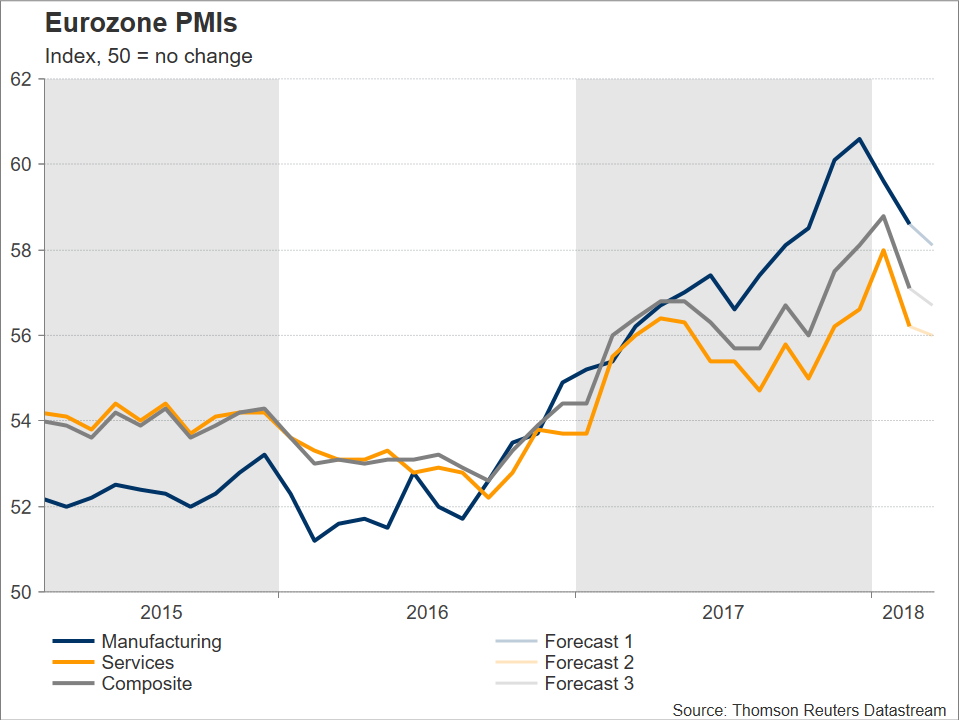
If the figures come in line with projections, they would point to rising economic activity in the euro area, though they would also leave a bit of a “bitter taste” in the sense that they would indicate further loss of growth momentum after a very encouraging start of the year, and lend credence to analysts supporting that growth in the eurozone has peaked.
The euro benefitted on Monday after a report on Reuters indicated that ECB policymakers’ views are moving further towards the direction of policy normalization, with the Bank’s asset purchase program potentially coming to a halt by the end of the year, and the delivery of an interest rate increase taking place around the middle of 2019. The health of the economy is instrumental for policy tightening and hence upbeat data on Thursday will back this “more hawkish” take by the ECB, likely boosting the common currency. Conversely, expectations of policy tightening could be scaled back if the data miss expectations, and the euro could suffer as a result.
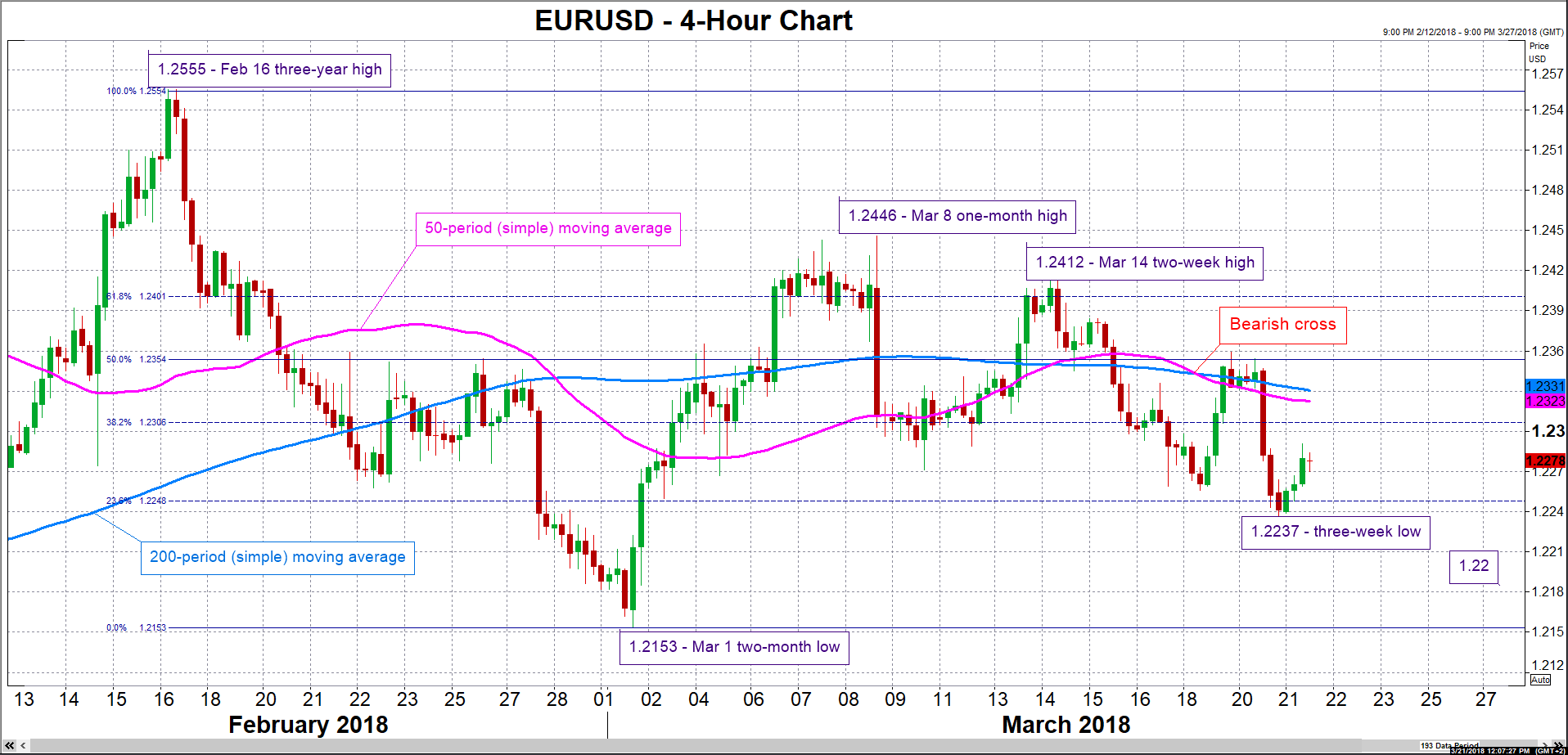
A data beat is expected to provide some support to the euro, with resistance to price advances potentially coming around the 38.2% Fibonacci retracement level of the February 16 to March 1 downleg at 1.2306. The range around this level was congested recently, while it also includes the 1.23 handle that may hold psychological importance. Not far above, the 50- and 200-period moving average lines at 1.2323 and 1.2331 might constitute another barrier to the upside. On the downside and in case of a data miss, the pair could find support around the 23.6% Fibonacci mark at 1.2248; the three-week low of 1.2237 recorded on Tuesday is also part of the area around this point. Steeper declines would increasingly turn the attention to March 1’s two-month low of 1.2153, while the 1.22 handle above – another potential psychological level – might also provide support.
Germany, the largest, and France, the second largest economy in the eurozone will see the release of their respective PMI figures for March on Thursday as well; the former at 0830 GMT and the latter at 0800 GMT. An easing of their corresponding numbers relative to February is anticipated, though again the readings are projected to stand well above the 50 expansion/contraction mark.
Elsewhere, Thursday’s calendar includes a survey gauging the business outlook in France which will be made public at 0745 GMT, while the Ifo Institute for Economic Research will release a similar survey for German business confidence at 0900 GMT; both would pertain to the month of March. In this respect, the ZEW institute’s economic sentiment index for Germany tumbled in March on the back of worries over an escalation of trade tensions, following the recent decision by the US to impose tariffs on steel and aluminum and the ongoing confrontational rhetoric by the country. As a result, the euro recorded losses versus other major currencies. It remains to be seen whether the aforementioned gauges of business confidence will mirror the ZEW’s reading.
Lastly, it should be mentioned that the FOMC monetary policy decision and accompanying statement due later on Wednesday (1800 GMT), as well as Jerome Powell’s maiden press conference as Fed Chief (18300 GMT) are likely to lead to volatility in euro/dollar, potentially bringing into scope the previously mentioned levels that may serve as support and resistance.
EURJPY Still Consolidating, 130.35 Acts As Strong Support Area
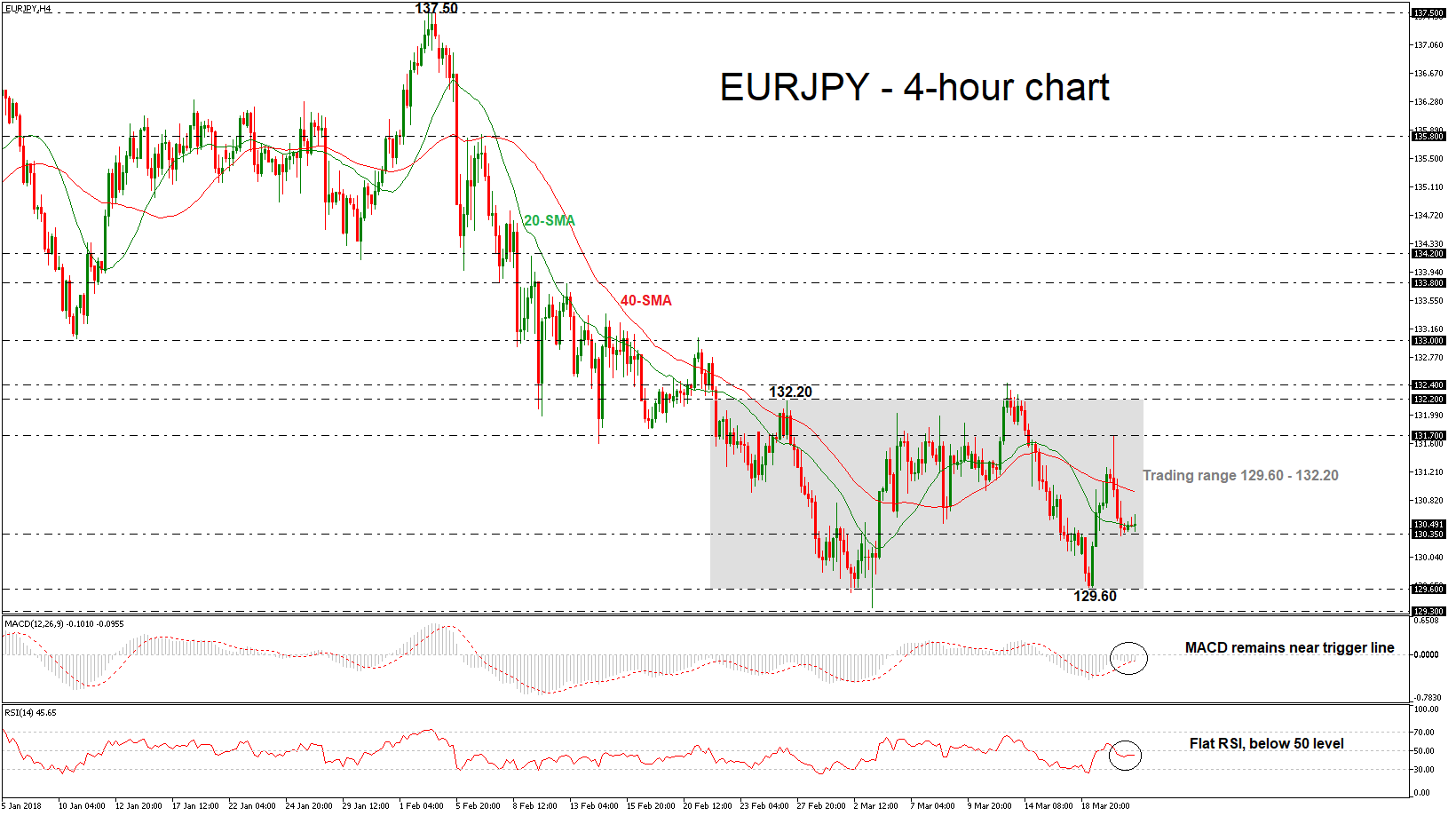
EURJPY has been moving within a consolidation area since February 22 with upper boundary the 132.20 resistance level and lower boundary the 129.60 support level. It is worth mentioning that the price came under strong pressure following the bounce off the 131.70 barrier on Tuesday’s session and hit the 135.35 support level.
Looking at momentum indicators, in the 4-hour chart, the Relative Strength Index (RSI) is lacking direction below the neutral threshold of 50, suggesting that the market could keep consolidating. The MACD oscillator supports this view in the negative territory and is currently embraced by its trigger line. Moreover, the price is trading near the 20-simple moving average (SMA) in the near-term.
If prices continue to head lower and drop below the 130.35 key level, support should come from the 129.60 low. A slip below this level would reinforce the short-term bearish view and open the way towards the 123.90 level, which has been a major support zone in the past.
However, should an upside reversal take form, immediate resistance will likely come from the 40-SMA around the 131.00 handle. A jump above it could drive the price until the 131.70 resistance barrier.
Forex Technical Analysis: EUR/USD, USD/JPY, GBP/USD
EUR/USD
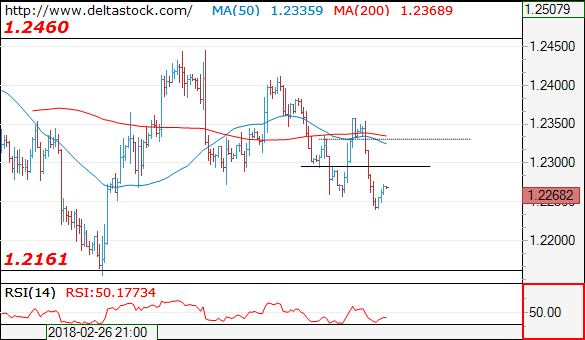
Current level - 1.2268
Yesterday's violation of 1.2300 key support has neutralized the positive bias and today's activity should be limited between 1.2230 and 1.2300 boundaries, as the market is awaiting FED's interest rate decision. On the senior frames my outlook is bullish, for a leg towards 1.2460.
| Resistance | Support | ||
| intraday | intraweek | intraday | intraweek |
| 1.2300 | 1.2460 | 1.2230 | 1.2160 |
| 1.2460 | 1.2560 | 1.2160 | 1.2090 |
 USD/JPY
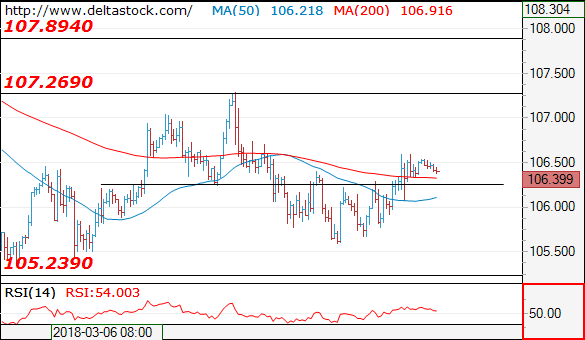
Current level - 106.39
My outlook here is positive, for a rise towards 107.30, en route to 107.90 zone.
| Resistance | Support | ||
| intraday | intraweek | intraday | intraweek |
| 107.30 | 108.30 | 105.20 | 105.20 |
| 108.00 | 110.40 | 105.20 | 102.40 |
 GBP/USD
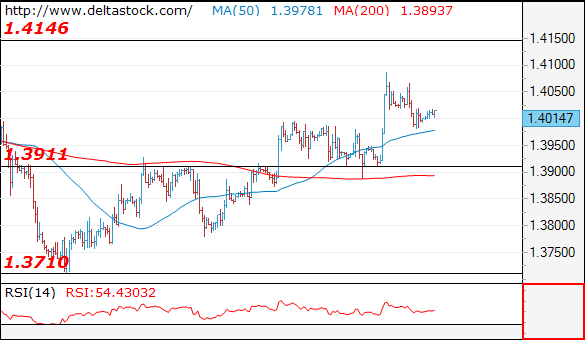
Current level - 1.4014
My outlook is counter-trend against 1.3930 resistance, for a break through 1.3840 crucial low, towards 1.3710.
| Resistance | Support | ||
| intraday | intraweek | intraday | intraweek |
| 1.3930 | 1.4060 | 1.3840 | 1.3710 |
| 1.3930 | 1.4280 | 1.3780 | 1.3620 |
CRUDE OIL Testing Resistance At 64.14
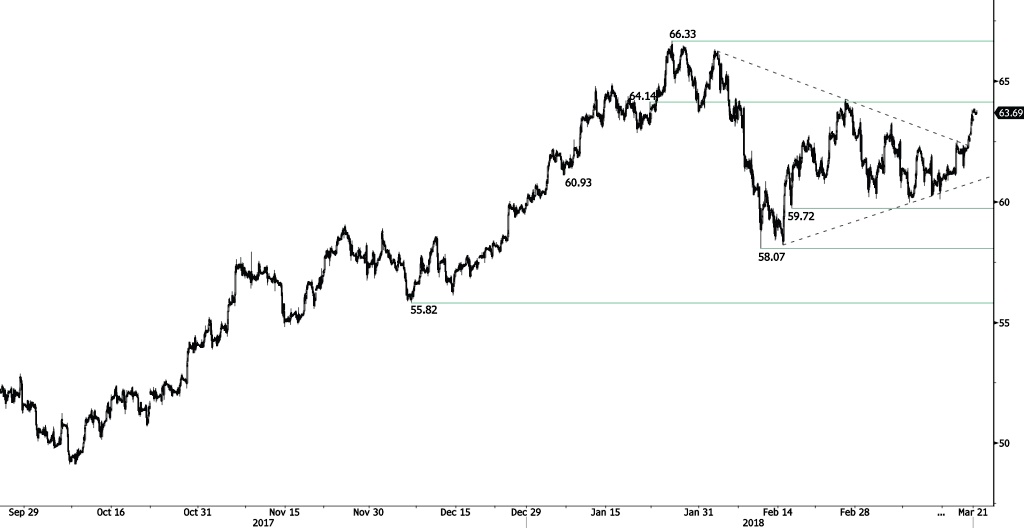
Crude oil continues its bounce, approaching hourly resistance at 64.14 (22/01/2018 high) and expected to rise further. Hourly support remains at 59.72 (15/02/2018 low). The technical structure suggests short-term increase.
In the long-term, crude oil has recovered after its sharp decline last year. However, we consider that further weakness is very likely. For the time being, the pair lies in an upside trend since June 2017. Support lies at 42.20 (16/11/2016) while resistance is located at 77.83 (20/11/2014). Crude oil is trading largely above its 200 DMA.
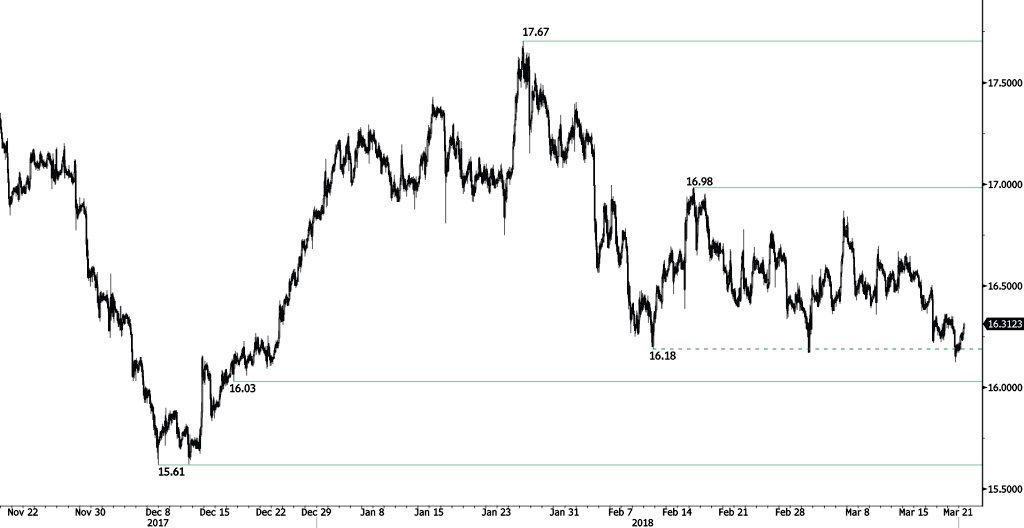
SILVER Recovery Phase
Silver is bouncing back after breaking hourly support at 16.18 (09/02/2018), approaching the 16.50 range. Hourly support and resistance are now given at 16.03 (18/12/2017 low) and 16.98 (15/02/2018 high). The short-term technical structure suggests further short-term rising moves.
In the long-term, the trend remains negative/ sideways. Further downside is very likely. The pair is trading below its 200 DMA. Resistance is located at 21.58 (10/07/2014 high). Strong support can be found at 11.75 (20/04/2009).
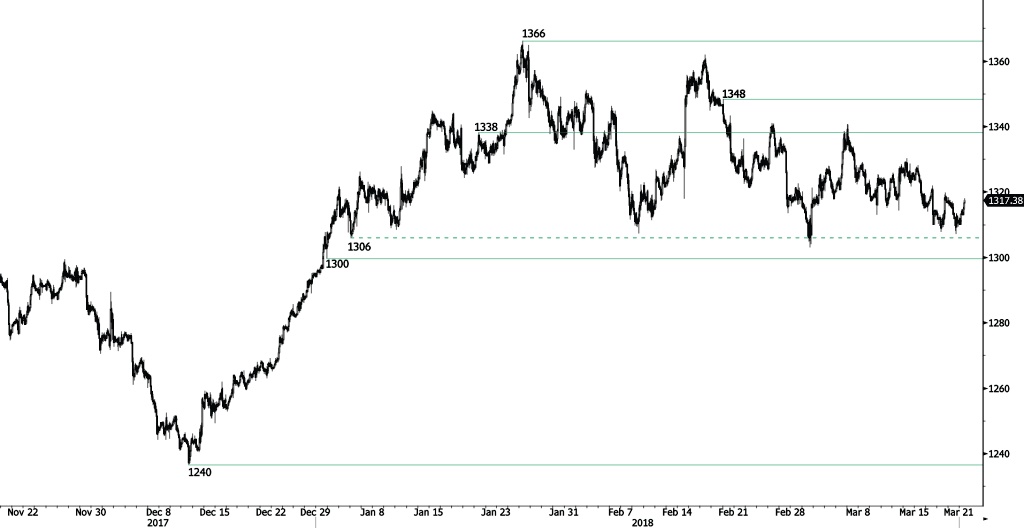
GOLD Bouncing Off
Gold is bouncing back from 1307 low, heading along the 1320 range. The pair remains contained between hourly support and resistance given at 1300 (29/12/2017 low) and 1338 (19/02/2018 high). The technical structure suggests further short-term increase.
In the long-term, the technical structure suggests that there is a growing upside momentum. A break of 1'392 (17/03/2014) is required to confirm it. A major support can be found at 1'045 (05/02/2010 low).
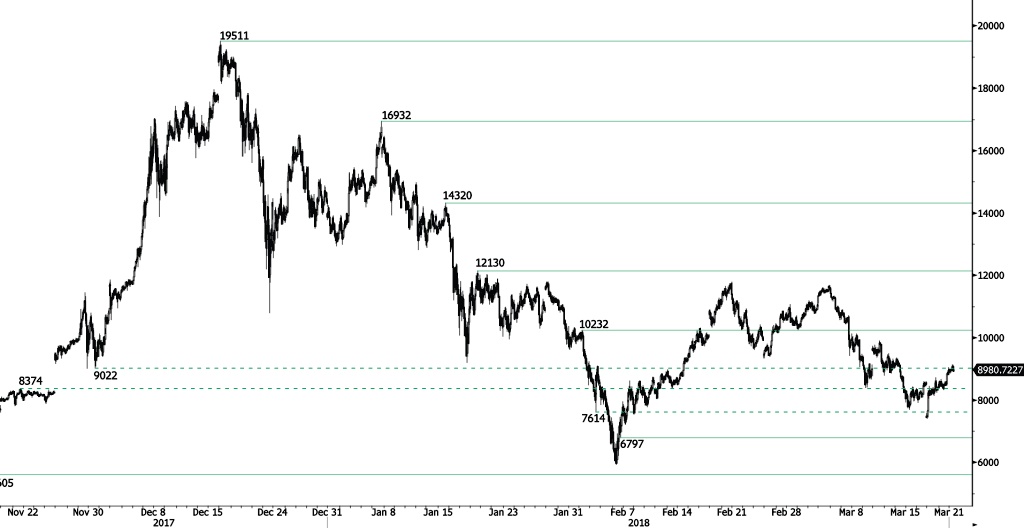
BITCOIN Bouncing Higher
Bitcoin is rising higher following recent bounce from 7387 low, approaching hourly resistance at 10232 (01/02/2018 high) and expected to head along the 10000 range. Hourly support at 6797 (06/02/2018 low) is distanced. The technical structure suggests further upward moves.
In the long-term, the digital currency has had an exponential growth but also presented important downturns. There is decent likelihood that the currency could stabilize between 7'000 - 12'000 in 2018. Bitcoin is approaching its 200 DMA (7000 range).
EUR/CHF Consolidation Maintained
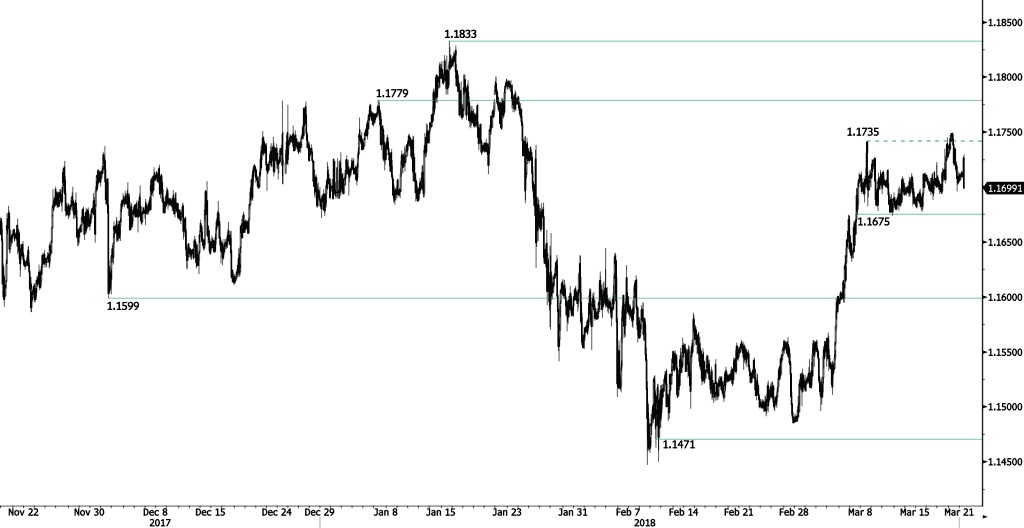
EUR/CHF consolidation phase continues following recent bounce at 1.1698. Hourly support and resistance are given at 1.1675 (07/03/2018 low) and 1.1779 (05/01/2018 high). The short-term technical structure suggests short-term sideways trading moves.
In the longer term, the technical structure has reversed. Strong resistance is given at 1.20 (level before the unpeg). Yet, the ECB's slowing QE program is likely to cause buying pressures on the euro, which should weigh in favour of the EUR/CHF. Support can be found at 1.0234 (20/04/2015 low).