Sample Category Title
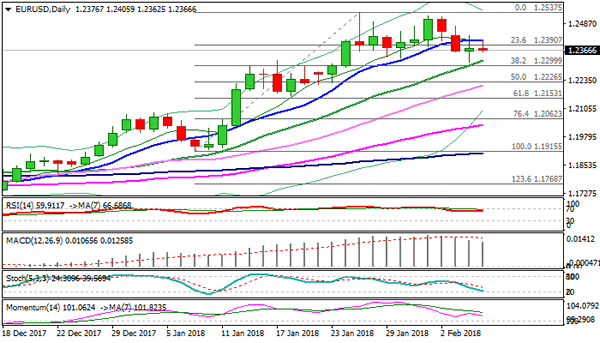
Technical Outlook: EURUSD – Directionless Mode Between 10 & 20SMA
Narrow range trading, shaped in tight Doji was seen in Asian / early European trading.
Long-legged Doji was left on Tuesday and signaling that two-day fall from double upside rejection at 1.2518/22 might be stalling.
No stronger signs of recovery while the upside remains capped by 10SMA (1.2408) and falling hourly cloud (1.2402/34) maintaining pressure.
On the other side, rising 20SMA (1.2322) continues to underpin and guarding pivotal support at 1.2300 (Fibo 38.2% of 1.1915/1.2537 upleg).
No clear near-term direction while the price holds between 10 and 20SMA’s.
Firm break below 1.2300 would signal extension of pullback from 1.2537/22 tops, while lift above 10SMA would signal higher low and shift near-term focus higher.
Res: 1.2408, 1.2434, 1.2474, 1.2522
Sup: 1.2362, 1.2322, 1.2300, 1.2226
EURUSD Only Intraday Bullish Above 1.2400 Level
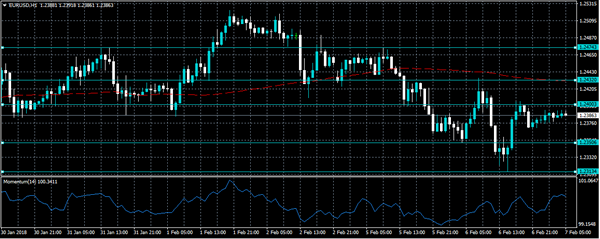
The euro has stabilized price-action towards the 1.2400 level against the U.S dollar in early Wednesday trading, following a reversal in broader stock markets and a decline in the greenback. The EURUSD pair is now recovering bullish trading momentum, after finding strong weekly technical support at the 1.2313 level. With a lack of macroeconomic data today, financial markets will likely be focused on the recent recovery in stock bourses, and the next directional move in the U.S dollar index.
The EURUSD pair may see if further upside if price-action can hold above the 1.2400 level. Key upside targets remain 1.2432, 1.2474 and 1.2500.
Should EURUSD price-action fail to hold above the 1.2400 level, we may see a decline towards the 1.2350 and 1.2313 support regions.
GBPUSD Still Bearish Below 1.4000 Level
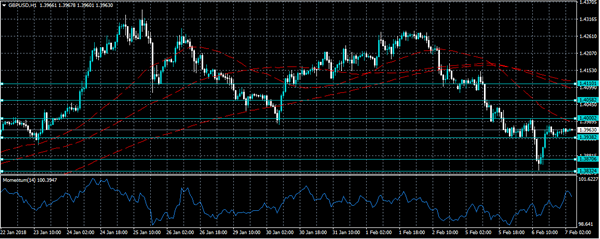
The British pound has recovered the 1.3900 handle against the U.S dollar, after finding support at the 1.3825 level on Tuesday, following a broad-recovery in global stock markets and a sell-off in the U.S dollar index. The GBPUSD pair is currently trading around the 1.3960 level, as price-action starts to consolidate in a tight range before its next directional move. Overall sentiment remains fragile for the British pound on Wednesday, as Brexit negotiations and UK political uncertainty continue to worry investors.
The GBPUSD pair is still intraday bearish while trading below the key 1.4000 level, further losses towards 1.3938 and 1.3870 remain a risk.
Should price-action on the GBPUSD pair start to move above the 1.4000 level, we may see a upward correction towards the 1.4058 and 1.4100 levels.
Data, Monetary Policy Drive Headlines On Wednesday
A steady stream of economic data will make its way through the financial markets on Wednesday, giving investors the latest glimpse of the Eurozone and US economies.
Action begins at 07:00 GMT with a report on German industrial production. Factory output in Europe’s largest economy is forecast to drop 0.5% in December after climbing 3.4% the month before. In annualized terms, this translates into growth of 6.8%.
French trade data will make the rounds later in the morning, with Paris set to report a smaller deficit. The French Republic likely saw its deficit shrink to €4.9 billion in December from €5.69 billion the month before.
Later in the morning, the Italian government will report on retail sales for the month of December.
In terms of monetary policy, European Central Bank (ECB) official Sabine Lautenschlager will deliver a speech at 09:00 GMT. The ECB is one of several central banks slowly unwinding record stimulus, a trend that could benefit the euro.
Shifting gears to North America, reports on US consumer credit change and Canadian building permits will make headlines. Meanwhile, Federal Reserve Bank of Chicago President Charles Williams will deliver a speech at 15:15 GMT.
Energy traders will also keep an eye on weekly crude inventory data courtesy of the US Energy Information Administration (EIA). The EIA is expected to show a weekly inventory build of 3.189 million barrels in the period ended 2 February, following an increase of 6.77 million barrels the week before.
Earlier in the session, New Zealand reported much better than expected employment data for the fourth quarter. Total employment rose by 0.5% in October-December, much higher than the 0.2% expansion predicted by economists. Meanwhile, the unemployment rate fell unexpectedly to 4.5% from 4.6%.
NZD/USD
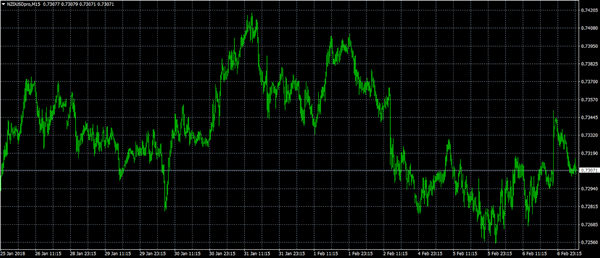
The New Zealand dollar failed to rally following the upbeat jobs numbers, as the NZD/USD fell 0.5% to 0.7309. The pair faces immediate support at the psychological 0.7300 handle. Below that level, the next support zone is clustered around 0.7255. On the flipside, resistance is likely seen all the way up near 0.7375. A breach of this level is needed to test the all-important 0.7400 region.
EUR/USD
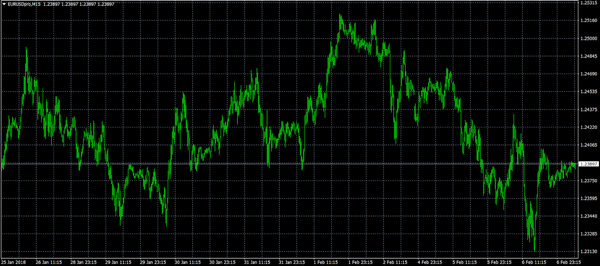
Europe’s common currency held its ground on Wednesday after a series of volatile moves the day before. The EUR/USD exchange rate was last seen trading at 1.2389 for a gain of 0.1%. The pair faces immediate resistance at the 1.2430 level, which corresponds to the previous day’s high. Support is located around the 1.2300 level.
GBP/USD
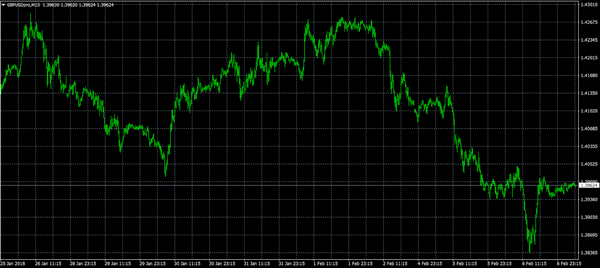
Cable traded slightly higher on Wednesday but held below the key 1.400 region. The GBP/USD has lost some of its luster after scoring multi-year highs at the end of January and early February. Despite the recent skid, the outlook remains generally favourable.
Technical Outlook: GBPUSD Remains In Sideways Mode After Tuesday’s Doji, BoE Eyed For Fresh Signals
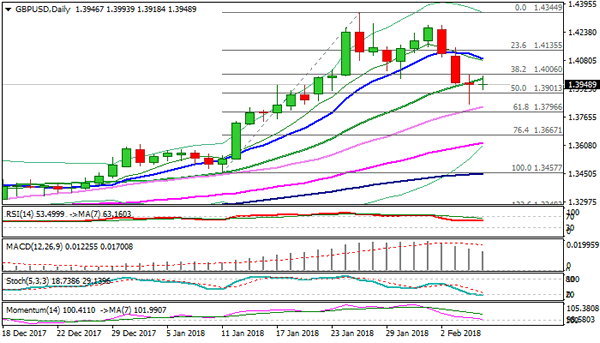
Cable holds within tight range in early Wednesday after strong downside rejection at 1.3835 on Tuesday and daily action ending in long-tailed Doji, signaling indecision.
Strong fall in previous two days shows initial signs of stall, but recovery attempts were so far limited and capped under 1.40 barrier (former strong support – Fibo 38.2% of 1.3457/1.4344 upleg) which marks the trigger for stronger recovery.
Near-term price action may hold in extended sideways mode, awaiting BoE rate decision and Inflation report on Thursday which could be a catalyst for fresh action.
Mixed daily studies support the notion, with RSI moving sideways in neutrality territory and momentum studies weakening, while daily MA's are I mixed mode.
Clear break below cracked 1.3900 support (50% retracement of 1.3457/1.4344 / daily Kijun-sen) would be initial bearish signal for renewed attack at 1.3796 (Fibo 61.8%).
Conversely, lift above 1.40 barrier would signal further recovery which needs to regain 10SMA (1.4092) to neutralize existing downside risk.
Res: 1.4000, 1.4056, 1.4092, 1.4109
Sup: 1.3918, 1.3901, 1.3835, 1.3796
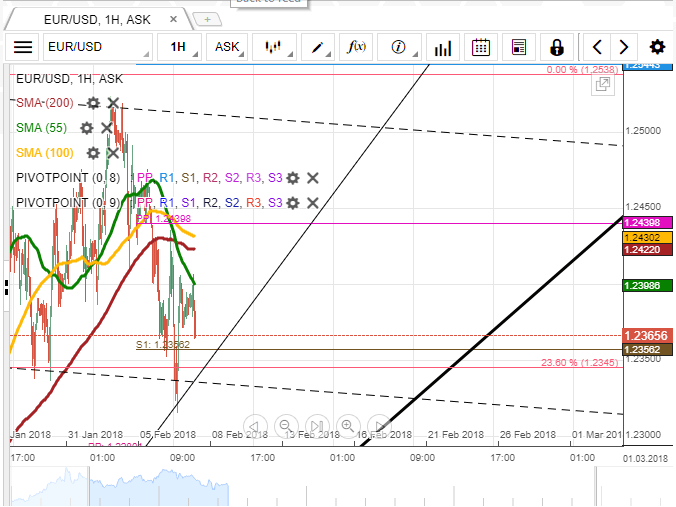
EUR/USD Analysis: Tests 55-Hour SMA
EUR/USD demonstrated high volatility in both directions during the previous session, as it was fluctuating within the bounds of 1.2335/1.2419. The upper barrier was provided by the 55-, 100– and 200-hour SMAs and the weekly PP, while the 23.60% Fibo retracement restricted the pair from below.
The slight upward movement during the Asian session suggests that the Euro might be tended north today. Gains, however, should be capped near the 1.2430 mark, as bulls are unlikely to surpass the massive resistance cluster located nearby.
If the previous volatility still persists in the market, traders could expect the pair to remain in the same range as yesterday or even fall down to the monthly PP at 1.2289. Technical indicators favour the bullish scenario.
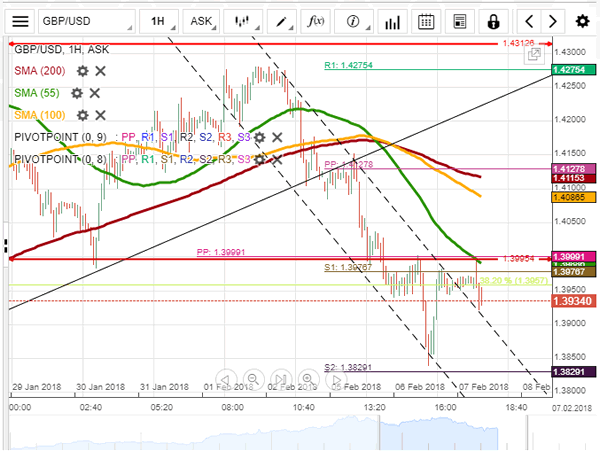
GP/USD Analysis: Returns Near 1.40 Mark
The Sterling was fluctuating in a narrow range between the monthly PP and the 38.20% Fibo retracement on Tuesday morning. It then made two notable leaps in both directions, but nevertheless returned within the aforementioned trading range.
As apparent from the pair's movement yesterday, the Pound tried to breach the 1.40 area for several hours; however, the combined resistance of the monthly PP, a two-week trend-line and the weekly S1 limited any movement above this psychological level. Thus, it is likely that this sessions does not bring any significant changes to the overall price level.
In case the 1.40 mark is breached, the 1.41 area should be the ultimate high for today, while the weekly S2 could limit losses below the 1.3829.
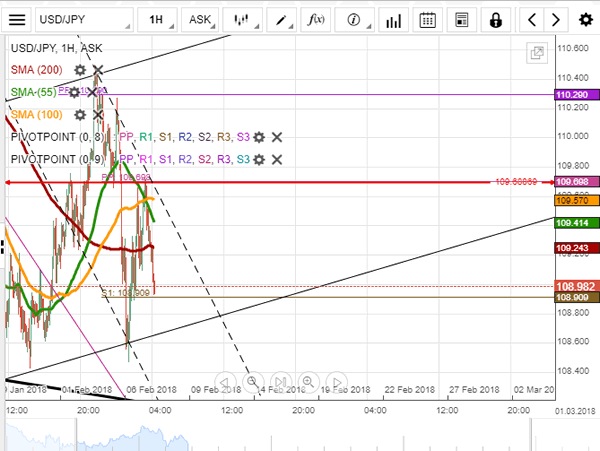
USD/JPY Analysis: Falls Down To 109.20
The US Dollar continued to trade in a short-term ascending channel against the Yen. The second bottom confirmation was provided early on Tuesday after which the pair accelerated towards the weekly PP at 109.70.
By Wednesday morning, it had returned for a re-test of the 200-hour SMA. Technical indicators suggest that this session might mark a further decline, possibly down to the nearest support of the weekly S1 at 108.91 or the bottom channel line located nearby.
Given that no significant fundamentals are to be released today, the Greenback might spend this session within the 108.80/109.70 range. Subsequently, this currency should gain strength and breach the most junior channel drawn on the chart with dashed lines.
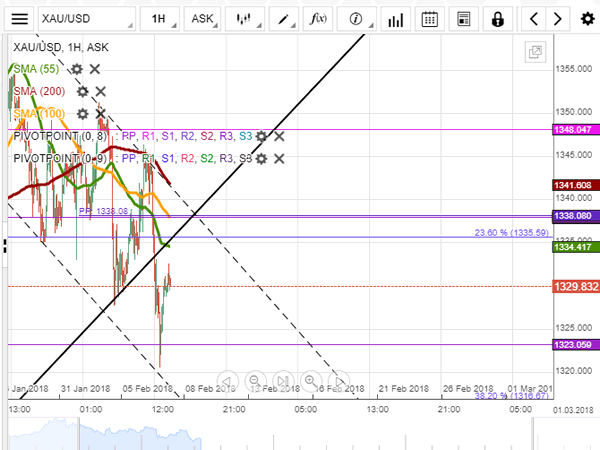
XAU/USD Analysis: Slightly Recovers
Gold began Tuesday's trading session in a calm manner, thus fluctuating between the 100– and 200-hour SMAs for several hours. However, the bearish sentiment eventually took over, and the pair dashed through the 100– and 55-hour moving averages, the weekly and monthly PPs, the 23.60% Fibo retracement, as well as breached the dominant two-month channel up. As a result, the yellow metal closed the session with a 1.19% decline.
The rate bounced off the weekly S1 on Wednesday morning and was moving towards a massive resistance cluster formed by the previously-breached levels. It is likely that this area is reached today for the pair to make a retracement from the bottom channel line; however, its subsequent fall is unlikely to change the overall price level within the following 24 hours.
USD/CAD: Canadian Trade Balance
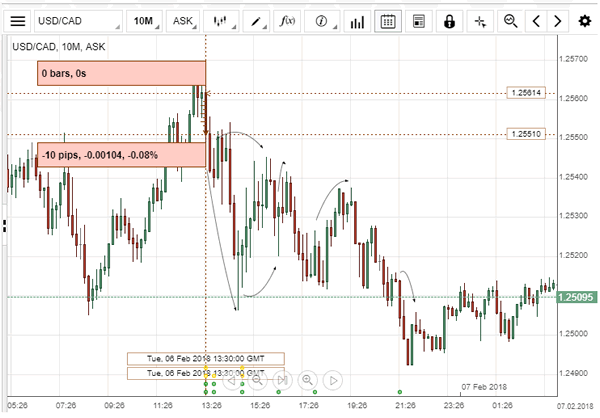
The Canadian Dollar rose slightly against the Greenback, following the report on the country's trade balance on Tuesday. The USD/CAD exchange rate declined 10 base points or 0.08% to 1.2250.
The Canadian trade deficit widened to C$3.2B over the month of December, as higher imports outpaced an increase in exports, missing expectations for a smaller deficit. Stephen Poloz, the Bank of Canada Governor, expressed concerns over the export sector, given the unclarity surrounding NAFTA. Trade is expected to subtract much more from the Q4 GDP, making the 2.5% growth target more difficult to reach. Poloz also noted that the Bank's policymakers remain not only data-dependent, but alert to progress in NAFTA negotiations as well.