Sample Category Title
USDJPY Testing Pivotal 108.98 Level
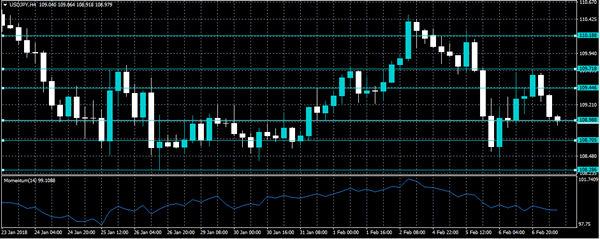
The U.S dollar has lost ground against the Japanese yen in early Wednesday trading, falling back towards the pivotal 108.98 technical level. After seeing a strong relief rally towards the 109.71 level following a recovery in global equity prices, USDJPY price-action is now testing demand around the 109.00 zone. Going forward, risk-sentiment remains the key driver of the pair, as the Japanese yen currency is considered a major safe-haven asset in times of extreme market volatility.
The USDJPY pair remains bullish while price-action trades above the key 108.98 pivot, further upside towards the 109.44 level is still possible.
If the USDJPY pair falls below the 108.98 level, we may see a deeper correction back towards the 108.70 and 108.27 support levels.
Chinese Trade & Inflation Numbers On The Horizon, Attention On Aussie As Well
China will see the release of trade data for the month of January on Thursday, with analysts projecting both exports and imports to grow at a solid pace; the release is tentative, lacking a fixed time of release. Figures on January producer and consumer prices out of the world’s second largest economy will also be attracting attention on Friday. Both PPI and CPI are expected to soften on an annual basis.
Before delving into the analysis, it is worthy of mention that the long Lunar New Year celebrations taking place in China have the capacity to distort the various readings, thus one might be justified not to read so much into the trade data before and after the holiday. The Chinese New Year will be celebrated on February 16.
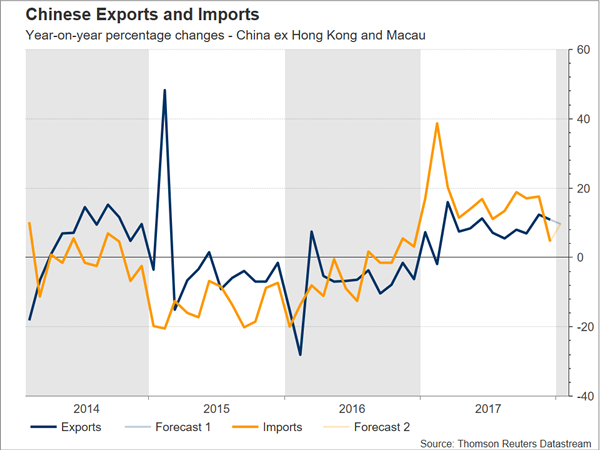
Exports and imports are anticipated to expand by 9.6% and 9.8% year-on-year in January respectively. These compare to a 10.9% export growth rate and a 4.5% import growth rate in December. The trade balance is forecast to narrow, reaching $54.10 billion from $54.69bn in December.
Despite the projected slowdown in export growth, a 9.6% pace of expansion – should it materialize – still translates into a strong reading and lends support to analysts making reference to improving global growth, which translates into rising demand for Chinese products. A factor potentially clouding the outlook for Chinese exports are rising trade disputes leading to the imposition of barriers to trade between the US and China. The Trump administration’s decision to impose tariffs on imported solar panels and washing machines in late January could be the prelude of what is to follow, while a tit-for-tat approach by China could see things escalating out of control. However, an escalating trade row between the world’s two largest economies doesn’t appear likely at the moment.
Turning to imports, those fell short of expectations in December by a relatively large margin, spurring concerns for a slowdown, something which would be troubling given the government’s efforts to rebalance the Chinese economy from the export-driven model of growth of the past to the one where domestically-driven consumption makes up a significant portion of the economic pie. If the actual reading comes as expected, January’s imports would grow at more than double December’s pace. This would be welcome news, though the increase is most likely to be attributed to inventory buildup ahead of New Year festivities, rather than reflect a rise in underlying demand. Moving forward, should the government’s attempts to curb risks in the financial system (in the form of excessive debt) intensify, this could pose downside risks on imports. However, such a move would likely contribute to the long-term sustainability of economic growth and subsequently imports by reducing the risk of a sharp slowdown due to a credit crisis getting out of hand.
The aussie is viewed as a liquid proxy for China’s economy due to the two nations’ close economic ties – China is Australia’s largest export and import partner – and thus will also be gathering attention as the figures hit the markets.
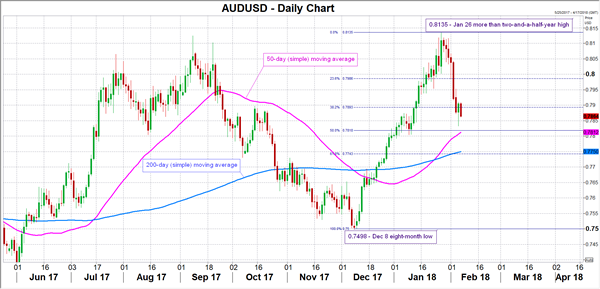
Upbeat data could incentivize forex market participants to place long aussie/dollar positions. In this scenario, the pair might meet resistance around 0.7893, this being the 38.2% Fibonacci retracement level of the December 8 to January 26 upleg (0.7893 failed to provide support on the way down during Wednesday’s trading and could instead act as a barrier to the upside). This area also includes the 0.79 handle, a level of potential psychological significance. Further above, the focus would shift to the range around the 23.6% Fibonacci mark at 0.7986.
In case of weaker-than-anticipated figures however, aussie/dollar might head lower. Support in this case might come around the 50% Fibonacci mark at 0.7818 (including the 0.78 handle and the current level of the 50-day moving average). Steeper declines would shift the focus to the 61.8% Fibonacci level at 0.7743. Notice that the current level of the 200-day MA roughly coincides with this point. It should be pointed out that there is negative momentum at the moment for AUDUSD, with the pair looking set to finish the day lower on Wednesday after declining in all but one of the preceding seven trading days.
January produce and consumer figures out of China will be made public on Friday at 0130 GMT. CPI growth is projected to moderate to 1.5% y/y (versus 1.8% in December) and PPI growth is forecast to ease to 4.4% y/y (versus 4.9% in December). A slowdown in PPI would constitute the third straight month of declines, with the measure growing at its lowest since late 2016 if the reading is released in line with projections. Should annual CPI come in as expected, then it would stand at its lowest since July. Beyond yuan pairs, aussie pairs would again be eyed ahead of and in the aftermath of Chinese inflation data.
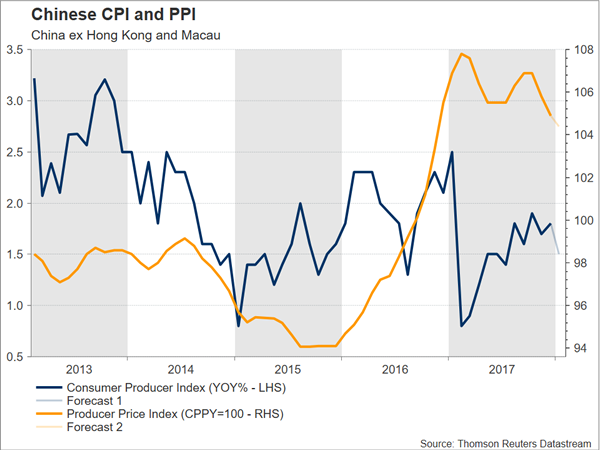
One hour before Chinese PPI and CPI numbers (at 0030 GMT), Australia will see the release of housing finance data for the month of December.
Forex Technical Analysis: EUR/USD, USD/JPY, GBP/USD
EUR/USD
Current level - 1.2396
The general bias is still bearish, for a dip to 1.2220 and 1.2160, but there is a minor risk of a break through 1.2435 crucial high, which will provoke another corrective leg to 1.2480 before drowning towards the mentioned projections.
| Resistance | Support | ||
| intraday | intraweek | intraday | intraweek |
| 1.2440 | 1.2540 | 1.2330 | 1.2330 |
| 1.2475 | 1.2870 | 1.2220 | 1.2220 |

USD/JPY
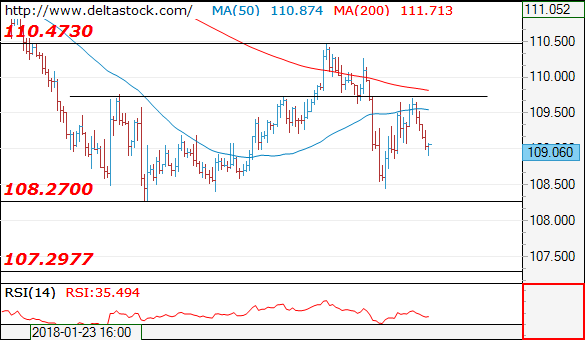
Current level - 109.06
The recent climb was capped at 109.70 and current slide should be considered corrective, preceding another leg upwards, to 110.50 zone. Crucial on the downside is 108.30 low.
| Resistance | Support | ||
| intraday | intraweek | intraday | intraweek |
| 109.70 | 111.90 | 108.30 | 108.30 |
| 111.50 | 113.40 | 108.30 | 107.30 |
GBP/USD
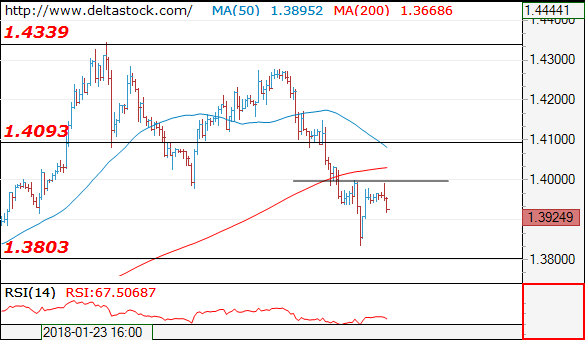
Current level - 1.3955
The overall bias remains bearish, for a slide towards 1.3730 and 1.3620 major static support. Key intraday resistance lies at 1.4000 and a violation of the latter will signal another corrective rebound to 1.4175 before drowning towards the mentioned targets.
| Resistance | Support | ||
| intraday | intraweek | intraday | intraweek |
| 1.4000 | 1.4090 | 1.3800 | 1.3730 |
| 1.4090 | 1.4174 | 1.3730 | 1.3620 |
Euro Edges Lower As German Industrial Production Contracts
The euro has edged downwards on Wednesday. Currently, the pair is trading at 1.2343, down 0.27% on the day. On the release front, German Industrial Production declined 0.6%, close to the estimate of -0.7%. This marked the third decline in four months. There are no key releases out of the US. On Thursday, Germany releases Trade Balance and the US publishes unemployment claims.
It’s been a volatile week on the stock markets, with the Dow Jones posting its biggest 0ne-day loss on Monday. The markets were back in green territory on Tuesday. A key factor in the stock market slide was strong employment numbers on Friday, as nonfarm payrolls and wage growth reports beat their estimates. Investors shied away from the stock markets, concerned that the sharp data could lead to higher inflation, which in turn would result in more rate hikes this year. Higher interest rates make the dollar more attractive for investors, at the expense of the stock markets.
The Janet Yellen era is over at the Federal Reserve. On the weekend, Jerome Powell took over as chair, replacing Yellen. On Friday, Yellen waxed optimistic about the economy, saying that strong growth, a red-hot labor market and increased wage growth would require the Fed to gradually raise interest rates. Powell is expected to continue to Yellen’s policies, so the markets are not expecting any dramatic shifts. However, the massive US tax cut will have a strong impact on the US economy, and the markets will be looking to the Fed for guidance. If the Fed sounds optimistic about the tax reform package, the US dollar could move higher.
Beware: FX Space Is Calm, But Appearances Can Be Deceiving
Wednesday February 7: Five things the markets are talking about
Risk-averse sentiment seems to have cooled for the time being as a number of the major indexes rebound in the overnight session.
Note: From a volatility standpoint, the forex market space appears tranquil when compared to other asset classes like equities or bonds.
The rebound in equity prices has spread to Europe, but capital markets remain on edge as Asian bourses pared their advance while U.S futures retreated.
Elsewhere, U.S Treasuries have rebounded after yesterday's slump along with gold and crude prices. The dollar has edged a tad lower as the FX market showed limited reaction to the sharp drop in equities earlier this week.
In Germany, the CDU/CSU, SPD political parties are said to have agreed on a grand coalition treaty.
Up next: Monetary policy decisions are due this week in New Zealand (Today 03:00 pm EDT) and tomorrow in the U.K (07:00 am EDT).
1. Some stocks record small gains
In Japan, equities pared early gains to end a tad higher overnight in a volatile trading session, as investors remained wary of further losses as U.S futures slipped from their highs. The Nikkei 225 share average ended +0.2% higher, while the broader Topix gained +0.4%.
Down-under, Aussie shares rebounded after Tuesday's biggest one-day drubbing in roughly 24-months. Broad-based buying helped the S&P/ASX 200 index end up +0.8%. The benchmark slumped -3.2% in the previous session. In S. Korea, the Kospi index dropped more than -2%.
In Hong Kong, equities reversed their earlier gains and closed at a five-week low overnight, led lower by material and real estate firms. At close of trade, the Hang Seng index was down -0.89%, while the Hang Seng China Enterprises index fell -2%.
In China, stocks slumped as developers and consumers fall. At the close, the Shanghai Composite index was down -1.81%, while the blue-chip CSI300 index was down -2.38%.
In Europe, regional bourses have rebounded from Monday's sharp sell off, mirroring Wall Streets moves. However, U.S stock futures (-0.8%) are pointing lower once again as volatility continues.
Indices: Stoxx600 +0.8% at 375.9, FTSE +0.6% at 7187, DAX +0.7% at 12474, CAC-40 +0.6% at 5191, IBEX-35 +0.6% at 9869, FTSE MIB +0.8% at 22518, SMI +1.0% at 8926, S&P 500 Futures -0.8
2. Oil steadies, as lower inventories offset by higher U.S output, gold higher
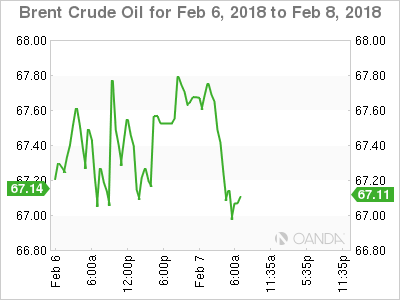
Oil prices are holding steady, as the boost from a report showing a drop in U.S crude inventories last week was offset by evidence of soaring U.S output.
Brent crude futures are down -11c to +$66.75 a barrel, while U.S West Texas Intermediate (WTI) crude futures have eased -12c to +$63.27 a barrel.
Data yesterday showed that U.S. crude inventories fell by -1.1m barrels in the week to Feb. 2 to +418.4m barrels, helping support the commodity.
However, rising U.S oil production continues to hang over the market. EIA data shows that U.S output has risen by +1m bpd in the last year to about +10m bpd.
Investors will take their cue from todays EIA crude stock report (10:30 am EDT).
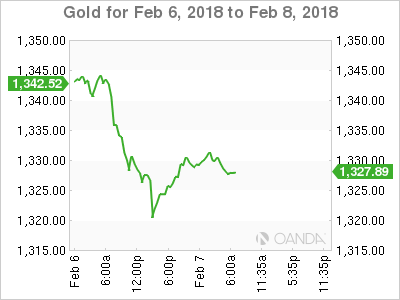
Ahead of the U.S open, gold prices have rallied from their three-week low on bargain hunting. Spot gold is up +0.5% to +$1,331.23 per ounce. Prices fell over -1% yesterday to hit its lowest since Jan. 11 at +$1,319.96.
3. Sovereign yields fall
In the Euro session, southern European government bond yields have fallen sharply and have extended their recent outperformance on news of a coalition agreement in Germany viewed as positive for Euro integration.
Germany's Chancellor Merkel's conservatives and the Social Democrats (SPD) have agreed “in principle” on a coalition deal. This will take Europe's economic powerhouse a step closer to a new government. Germany's 10-year Bund yield has climbed +1 bps to +0.70%.
Italian, Spanish and Portuguese 10-year government bond yields are -5 to -8 bps lower, and spreads over benchmark German Bunds have tightened.
Elsewhere, the yield on 10-year U.S Treasuries has dipped -4 bps to +2.76%, while in the U.K, the 10-year Gilt yield has advanced less than +1 bps to +1.523%.
Overnight, in India the Reserve Bank of India (RBI) statement noted that the decision to keep policy steady (+6%) was not unanimous (5-1) with a dissenter calling for +25 bps hike. It maintained its neutral monetary policy stance and reiterated to keep headline inflation close to +4% target on a durable basis.
4. Dollar has 'little traction'
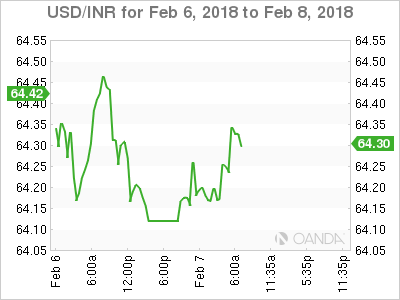
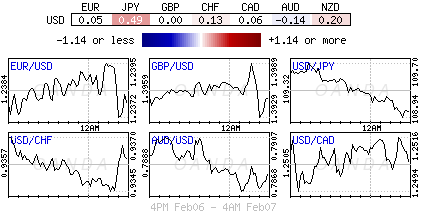
From a volatility standpoint, the forex market space appears tranquil when compared to other asset classes like equities or bonds. The U.S dollar continues to be confined to its recent ranges against G10 currency pairs.
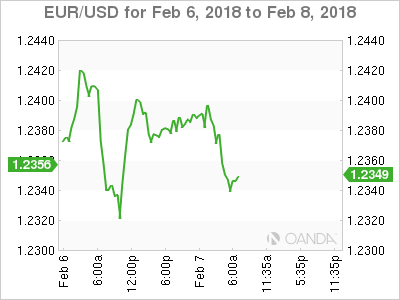
The EUR/USD (€1.2346) is a tad lower despite market reports of a grand coalition agreement in Germany. The pair continued to find headwinds above the psychological €1.24 level.
GBP/USD (£1.3884) continues to face headwinds as various press outlets noted that the E.U is prepared to harden its stance during the transition phase of negotiations.
USD/JPY (¥109.07) remains the liveliest of currency pairs, as risk-on and risk-off continues to find capital market leverage.
Note: The Nikkei 225 index did see its initial +2% gain disappear in the final hour of trading.
5. German industrial output slips
Data from Europe this morning revels that Germany's industrial output slipped at the end of 2017.
Industrial production in December fell -0.6% m/m, led by construction output. Market consensus was looking for a -0.5% decline.
Germany's economics ministry said manufacturers' order books signal vigorous production in the coming months. The trend is “clearly pointing up” after reporting a +3.8% monthly gain in manufacturing orders in December on Tuesday.
Global Equity Bulls Fight Back, Dollar Steady
Investors experienced a renewed sense of confidence on Wednesday morning following Wall Street's rebound overnight.
Asian stocks closed mostly mixed during early trading, while European shares ventured higher, as markets attempted to shake off the volatility and jitters witnessed in recent trading sessions. With the shocking levels of volatility limited to stock markets and not materially impacting currencies or commodities, the aggressive global equity sell-off could just be a steep correction. However, repeated weakness across stock markets may leave investors on high alert and on guard for something greater than a steep correction.
Dollar Index little changed
The Dollar remained steady against a basket of major currencies on Wednesday, as investors diverted most of their focus towards the development happening across stock markets. Sentiment towards the Dollar received a boost last week, after the stronger-than-expected growth in U.S. wages fueled speculations of higher U.S. interest rates. The Greenback has scope to appreciate further if economic data from the United States continues to beat market expectations. Taking a look at the technical picture, the Dollar Index has breached above the 89.50 lower high. The breakout above this level may encourage a further incline towards 90.00 and 90.55. Alternatively, a failure for prices to break above 90.00 could encourage a decline back to 89.50 and 89.00, respectively.
Commodity spotlight – WTI
WTI Crude found itself under noticeable selling pressure during Wednesday's trading session, amid ongoing concerns over soaring U.S. production weighing heavily on oil prices.
Although oil markets were initially supported on Tuesday after the American Petroleum Institute (API) reported an unexpected weekly decline in U.S. Crude stocks, gains were later relinquished by the oversupply fears. While price action continues to suggest that oil still has some upside momentum, gains could be capped by rising U.S. output. Focusing on the technical picture, WTI Crude is at risk of depreciating towards $62.20 if bears are able to conquer the $63.00 support level. In an alternative scenario, a breakout above $64.00 may re-open a path back towards $65 and $65.60.
Currency spotlight – EURUSD
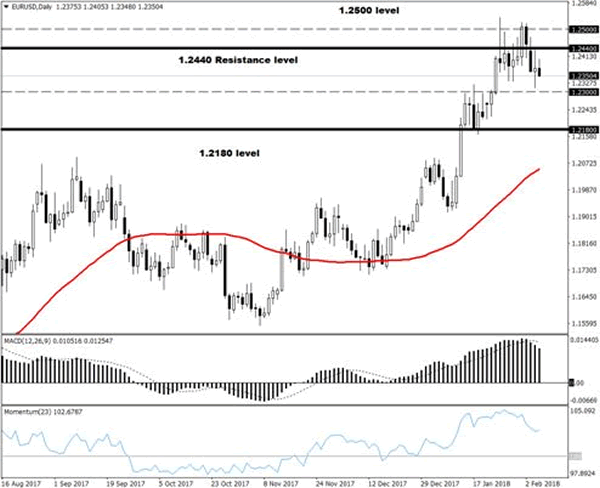
The EURUSD edged lower during Wednesday's trading session with prices sinking towards 1.2350 as of writing.
With the bullish sentiment towards the European economy stimulating appetite for the Euro, the EURUSD remains heavily supported. From a technical standpoint, the EURUSD is in the process of a technical correction on the daily charts with 1.2300 acting as a level of interest. Price remains above the 50 Simple Moving Average, while the MACD trades to the upside. A creation of a new higher low around the 1.2300 region could be in play,which may provide a foundation for bulls to elevate prices higher. A breakdown and daily close below the 1.2300 level may inspire a decline towards 1.2180. Alternatively, if 1.2300 defends then the EURUSD could venture back to 1.2440.
Technical Outlook: NZDUSD – Bids At 0.73 Hold Dips Ahead Of RBNZ
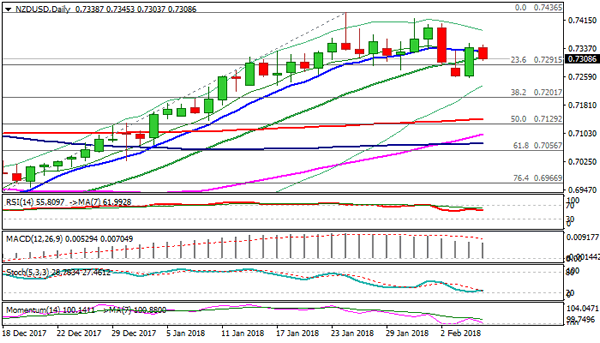
The Kiwi dollar eased from the session high at 0.7345, posted after solid NZ jobs report, released late Tuesday.
Renewed attempt at Tuesday’s 0.7350 high, hit after strong rally (the biggest one-day gains since 13 Dec) failed, with fresh easing testing bids at 0.7300 zone (rising 20SMA / psychological support).
Loss of 0.7300 handle would risk dip towards key near-term support at 0.7256 (06 Feb correction low, reinforced by rising daily Kijun-sen and broken weekly 200SMA).
Weakening daily momentum studies and south-heading daily RSI maintain pressure, as upside attempts repeatedly failed to clearly break above the top of thick falling hourly cloud.
Stronger correction of 0.6821/0.7436 (08 Dec / 24 Jan rally) could be expected on loss of 0.7256 pivot, which would expose next strong supports at 0.7201 (Fibo 38.2% of 0.6821/0.7436) and 0.7143 (200SMA) in extension.
Bullish scenario requires sustained break above daily Tenkan-sen at 0.7338 to turn near-term focus higher.
RBNZ rate decision is due later today, with central bank expected to keep interest rates unchanged at 1.75% (the RBNZ keeps overnight cash rate at the lowest levels since 1999 and maintains 1.75% rate since late 2016).
Res: 0.7338, 0.7350, 0.7370, 0.7405
Sup: 0.7291, 0.7256, 0.7201, 0.7143
CRUDE OIL Neutral
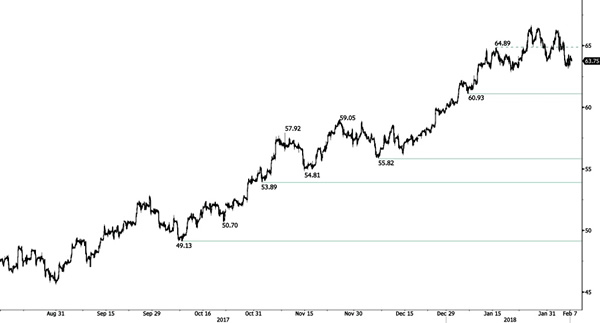
Crude oil gives signs of stability. Strong support is given at 60.93 (05/01/2018 low). Expected to keep increasing as demand remains strong.
In the long-term, crude oil has recovered after its sharp decline last year. However, we consider that further weakness is very likely. For the time being the pair lies in an upside trend since June 2017. Support lies at 42.20 (16/11/2016) while resistance is located at 77.83 (20/11/2014). Crude oil is trading largely above its 200 DMA.
SILVER Short-Term Selling Pressure
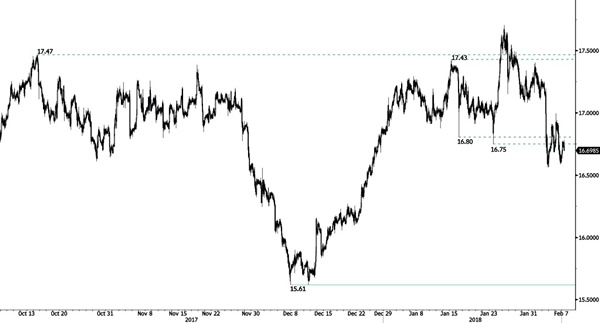
Silver is heading lower and trades below 17. The short-term technical structure is turning negative. Hourly resistance lies at 18.21 (08/09/2017 high). The technical structure suggests further short-term decrease.
In the long-term, the trend remains negative/ sideways. Further downside is very likely. The pair is trading slightly above its 200 DMA. Resistance is located at 21.58 (10/07/2014 high). Strong support can be found at 11.75 (20/04/2009).
GOLD Profit-Taking
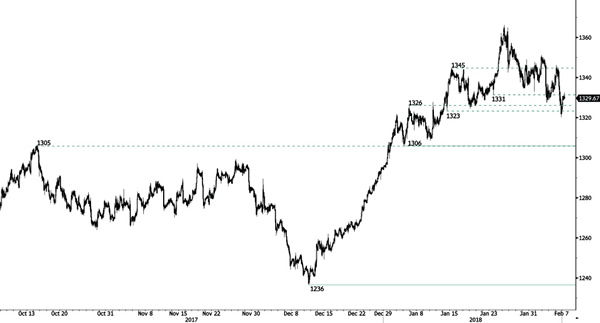
Gold is trading lower following yesterday's contraction. Hourly support at 1'323 (12/01/2018 low) is now broken while further support remains at 1'306 (12/01/2018 low). The technical structure suggests however further sideways moves.
In the long-term, the technical structure suggests that there is a growing upside momentum. A break of 1'392 (17/03/2014) is required to confirm it. A major support can be found at 1'045 (05/02/2010 low).