Sample Category Title
Technical Outlook: EURUSD – Downside To Remain At Risk While 10SMA Caps Recovery Attempts
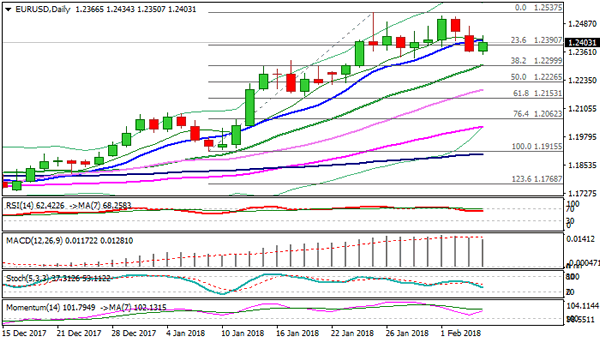
The Euro is holding within approx. 80-pips range on Tuesday and consolidating above new low at 1.2350, posted after two-day fall.
Upside attempts were heavy above 1.2400 and so fat limited by broken rising 10SMA which now reverted to resistance (currently at 1.2416).
Prevailing risk-off mode would keep the upside limited and keep in play risk of retesting key near-term supports at 1.2336/34 (29/30 Jan double-bottom) and 1.2300 (Fibo 38.2% of 1.1915/1.2537 upleg / rising 20SMA), loss of which will generate stronger bearish signal for deeper correction.
Conversely, break and close above 10SMA would sideline downside threats and shift near-term focus higher as overall structure is bullish.
Res: 1.2415, 1.2434, 1.2474, 1.2490
Sup: 1.2350, 1.2334, 1.2300, 1.2226
Forex Technical Analysis: EUR/USD, USD/JPY, GBP/USD
EUR/USD
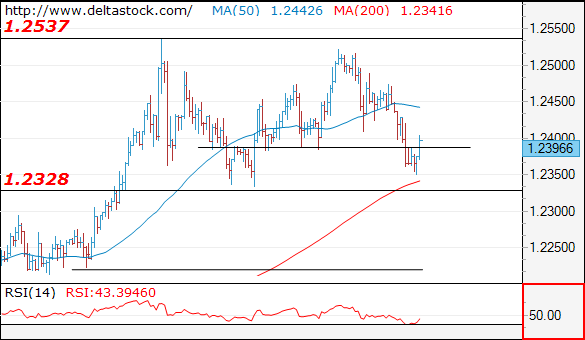
Current level - 1.2396
Current rebound above 1.2350 should be considered corrective and I expect 1.2440 minor resistance to cap the upside, for a continuation of the downtrend towards 1.2220 area. Crucial on the upside is 1.2475 high.
| Resistance | Support | ||
| intraday | intraweek | intraday | intraweek |
| 1.2440 | 1.2540 | 1.2330 | 1.2330 |
| 1.2475 | 1.2870 | 1.2220 | 1.2220 |
USD/JPY
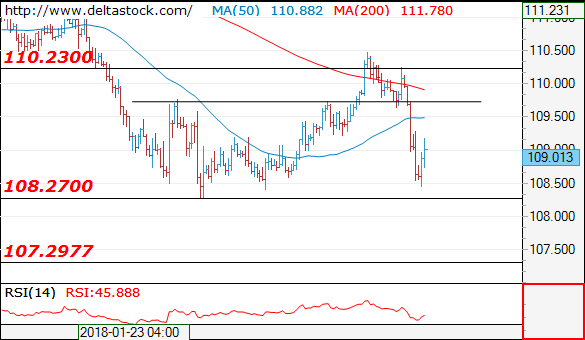
Current level - 109.01
The break through 109.70 led to a slide all the way down to 108.30 lows and my outlook is positive above the mentioned support, for a rise towards the upper boundary of the range at 110.20-50. Crucial on the downside is 108.30 and a violation of that low will challenge 107.30.
| Resistance | Support | ||
| intraday | intraweek | intraday | intraweek |
| 109.70 | 111.90 | 108.30 | 108.30 |
| 111.50 | 113.40 | 108.30 | 107.30 |
GBP/USD
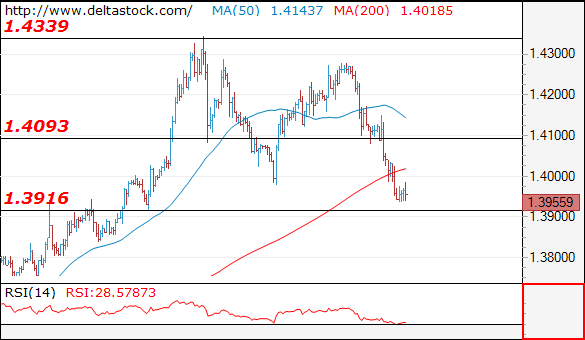
Current level - 1.3955
Yesterday's slide has reached the support area above 1.3910, but my outlook remains bearish below 1.4030, for another leg downwards, to 1.3800 zone. Crucial on the upside is 1.4090.
| Resistance | Support | ||
| intraday | intraweek | intraday | intraweek |
| 1.4030 | 1.4090 | 1.3910 | 1.3910 |
| 1.4090 | 1.4340 | 1.3800 | 1.3730 |
Sell-Off? Don’t Get Carried Away Fundamentals Are Strong | Bitcoin Selling At 69% Discount
It is a revenge trade, it's time for the Bears to take their revenge
The short squeeze happened when the VIX index exploded above the 30 mark
No panic buying for safe haven-gold
We all know one thing which is, that markets usually grind to the upside but fall like a rock. Recently the nature of the sell-off that we are experiencing in the market can simply be classified by using one term: revenge trade. Traders have been looking at the market for the past year moving in one direction which was skewed to the upside. Now, it's time for the Bears to take their revenge and the Dow Jones is set for it's worst monthly drop since 2008.
By looking at the Dow, the question's which comes to the mind is, what does this mean for all of the people who have been shorting volatility? Well, This is only a start. A trend which you don't see that often, but we have been witnessing it for the last two weeks; traders were taking long bets on the vix index and call options have been more popular for the last two days. The short squeeze happened when the index exploded above the 30 mark, you could tell that the bears are feeling the pain. If this rout continues, I would say we are likely to go above the 60 mark. The VIX index is having it's best month since 2008.
US futures and European markets are trading in a deep red territory and the S&P 500 suffered it's worst one-day loss since 2011, being ready to face more damage. This is what you call revenge.
The fear behind this sell-off is the economic data is improving in the US and this would stimulate the Fed to take more aggressive action towards their monetary policy stance. But, it would be foolish to think that the Fed is going to sit on it's hand and do nothing when the economic health of the country is improving. We would say that investors should not be worried about the fact that the improving health conditions of the country requires normal conditions.
The sell-off in the market is nothing more than just long overdue market correction. As there is no fundamental situation which has made matters worse. The earnings season has told us one story that corporate profits are strong and the consumer confidence shows that investors are comfortable with their spending. Under these conditions, the only thing which can be blamed for the kind of sell-off which we experienced yesterday is a machine- AKA high-frequency trading. Aglos triggered once again! The regulators need to address this issue because a drop like this is worse than anything on the street, we are talking about real companies with revenue streams.
Another reason why we think that this is a healthy correction is that we are not seeing any panic buying for safe haven-gold. Usually, investors would park their funds in gold and the price of gold would reflect that. But, under the current circumstances, we aren't seeing hot honey (yes I mean honey) isn't flowing into gold. Because under a real panic situation, we would have seen more than $40 move in a single day for the gold price.
Cryptocurrency
If there is anything which is selling at a massive discount, it has got to be your cryptocurrencies. Bitcoin is down nearly -69.29%, that is some discount- but that is if Bitcoin going to return to it's all-time high. We have broken the $6000 mark, the low of the day is 5992 and this indicates that we are very close to the bottom. It is certainly possible that we could drop still a little more, but we do think that the current sell-off is heavily oversold by any measure. One may want to pay less attention to adverse headlines and look at the price curve more closely. Why? You need to think who is abandoning the ship and who is coming on board or filling their tanks.
USDJPY Now Bearish Below 108.98 Level
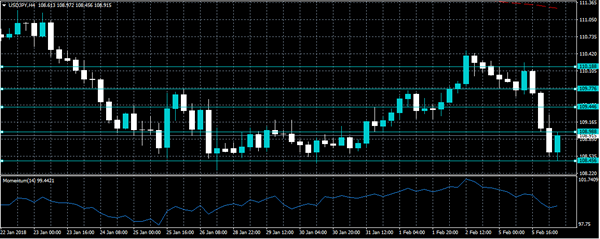
The U.S dollar has moved sharply lower against the Japanese yen, as global equities prices plummet lower, following a broad-based shift towards risk-off trading sentiment. The USDJPY pair has fallen to a new monthly-low, hitting 108.45 overnight, after the Nikkei225 index suffered its biggest one-day decline since November 1990. Price-action on the pair has now recovered slightly heading into the European trading session, with buyers and sellers testing overall demand around the pivotal 108.98 level.
The USDJPY pair still retains a strong bearish bias while trading below the 108.98 level, further losses towards 108.45 and 107.80 seem likely.
If USDJPY buyers can push the pair above the 108.98 level, we may see a correction back towards the 109.44 and 109.77 levels.
EURUSD Intraday Bearish Below 1.2400 Level
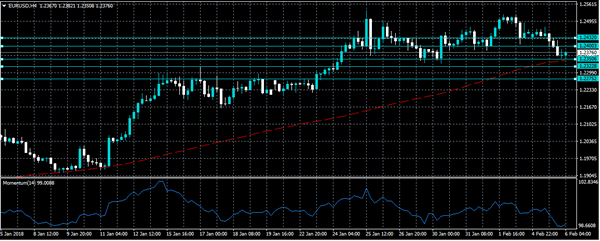
The euro has moved sharply lower against the U.S dollar overnight, hitting 1.2350, as risk-off trading sentiment prompted traders to move into the greenback. The EURUSD pair currently trades around the 1.2375 level, with downside pressure building on the single currency, with European stock markets set to open into heavy selling. Going forward, the 1.2400 level on the EURUSD pair remains the key daily pivot point intraday traders are watching.
The EURUSD pair is likely to suffer further intraday declines while trading below the 1.2400, downside support is currently located at the 1.2350, 1.2322 and 1.2275 levels.
If buyers can move price-action above the 1.2400 level, we may see an upside correction on the EURUSD pair towards the 1.2432 level.
German Factory Orders, US Trade Headline Slow Tuesday
Data watchers will be able to take a breather on Tuesday, as no major releases are expected. That being said, there are a few interesting tidbits that could impact the direction of currency pairs.
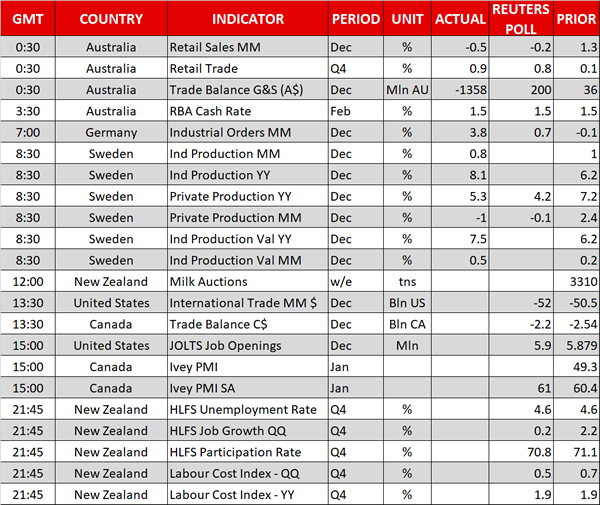
The first is a German report on factory orders, which is scheduled for release at 07:00 GMT. German factory orders are forecast to climb 0.6% in December, which translates into a year-over-year gain of 3.1%. That follows a 0.4% drop the previous month.
Shifting gears to North America, the US Department of Commerce will issue its latest trade balance covering the month of December. Washington’s deficit is forecast to rise to $52 billion from $50.5 billion in November.
North of the border, the Canadian government is expected to post a narrower trade deficit of $2.2 billion for December, down from $2.54 billion the month before.
In monetary policy, Federal Reserve Bank of St. Louis President James Bullard will deliver a speech at 13:50 GMT. As investors recall, the Federal Reserve held off on raising rates last week but is likely to pursue a rate adjustment at its next meeting.
Earlier in the day, the Reserve Bank of Australia (RBA) held its trend-setting interest rate at 1.5%, as was expected by virtually every analyst following the central bank. That being said, the outlook on the domestic economy remains robust.
“The Bank's central forecast for the Australian economy is for GDP growth to pick up, to average a bit above 3 per cent over the next couple of years,” the RBA said in its official statement. “The data over the summer have been consistent with this outlook. Business conditions are positive and the outlook for non-mining business investment has improved. Increased public infrastructure investment is also supporting the economy. One continuing source of uncertainty is the outlook for household consumption. Household incomes are growing slowly and debt levels are high.”
AUD/USD
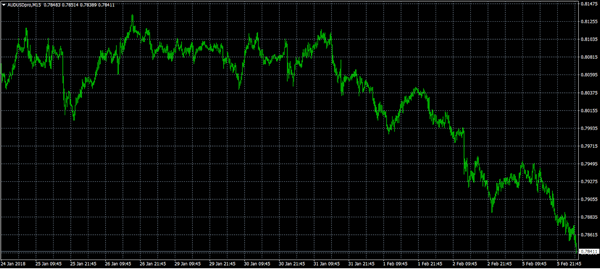
The Australian dollar declined sharply following the RBA rate statement, with the AUD/USD currently trading at session lows. The pair is down 0.5% at 0.7850 and faces continued downside as prices fail to extend beyond 0.7900. Overall, the market remains bearish below 0.8000. A future breakdown could expose the low from 10 January (0.709).
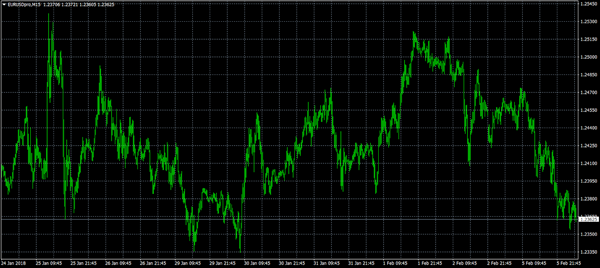
EUR/USD
Europe’s common currency drifted lower on Tuesday, as the US dollar continued its long recovery from multi-year lows. EUR/USD dipped 0.1% to 1.2364. From a technical perspective, the pair faces immediate support at the 30 January low of 1.2335.
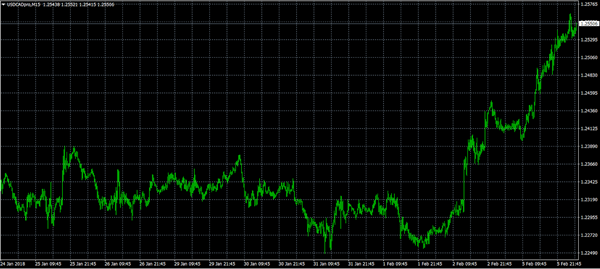
USD/CAD
The greenback strengthened against its northern rival on Tuesday, climbing 0.2% to 1.2550 CAD. The USD/CAD has bounced sharply from Friday’s low of 1.2260. However, the pair remains vulnerable to pullbacks driven by upbeat Canadian data.
Stock Bloodbath Continues In Full Swing, RBA Maintains Neutral Tone
Here are the latest developments in global markets:
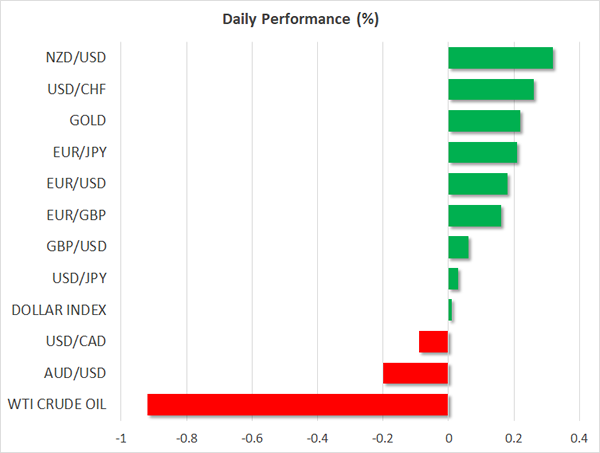
FOREX: The dollar index was practically unchanged on Tuesday, after posting some gains yesterday. The currency’s broader decline appears to have been halted, at least for now, as investors appear to be focused more on the collapse seen in stock markets.
STOCKS: US markets suffered one of their worst days on record yesterday. The Dow Jones led the collapse, falling by an astounding 4.6%. The S&P 500 was down 4.1%, its largest one-day decline since 2011, while the Nasdaq composite closed 3.9% down. According to futures, the Dow and the S&P could open lower today as well, though the same futures signal that the Nasdaq 100 may open slightly higher. The risk aversion rolled into the Asian trading session today as well. Japan’s Nikkei 225 and Topix indices fell by 4.7% and 4.3% respectively, while Hong Kong’s Hang Seng index is down 4.4%. European stocks are likely to feel the heat when they open today as well, with futures tracking the Euro Stoxx 50 currently down by 3.1%.
COMMODITIES: The energy market did not escape unscathed either. Both WTI and Brent crude are lower by 0.9% today, as the risk-off sentiment probably weighed on demand for the precious liquid. The safe-haven gold was one of the few winners today, up 0.2%, last trading near $1343 per ounce. Should risk aversion continue to prevail, the yellow metal could extend its gains. Immediate resistance may be found near $1350, with a potential upside break of that zone likely to open the way for gold’s recent highs at $1366.
Major movers: Equities suffer amid risk aversion; RBA stands pat
The collapse in major global equity markets accelerated yesterday. What is particularly interesting about the latest leg lower is that it appears to be driven primarily by risk aversion and a fear of loss, as opposed to rising US bond yields making bonds appear more attractive relative to equities. Whereas the last few days have been characterized by surging bond yields and falling equities, yesterday saw a simultaneous plunge in both stocks and Treasury yields. This implies that investors are becoming increasingly more concerned about the stock market and are seeking the safety of Treasuries, which is a typical market reaction in a risk-off environment.
Despite the big falls in major indices though, this still appears like a correction following an astonishing rally in equities, and not the beginning of a trend reversal. Indeed, it is not strange for stock markets to correct following such robust gains, especially as some investors may have taken the opportunity to take some profits off the table. The fact that it has been so long since a major correction occurred possibly plays into this as well.
The key question on everyone’s mind now should be: how low can equity markets go before willing buyers appear to halt the decline? It is important to note that with bond yields being on the rise overall, and equities falling, money is flowing out of both the bond and the stock markets. Thus, it appears some investors may be sitting on more and more cash, which will probably be looking to reenter the market at more favorable levels.
Overnight, the Reserve Bank of Australia (RBA) remained on hold, as was widely anticipated, and maintained a relatively neutral tone on policy. The Bank remains concerned with the high level of Australian household debts, particularly because incomes are growing very slowly. As for the AUD, the RBA did not appear worried, simply reiterating that an appreciating exchange rate would be expected to weigh on growth and inflation. Overall, the key message was that not much has changed, and that any potential rate hike later this year would be highly dependent on incoming data, particularly as they relate to wages. The reaction in aussie/dollar on the decision was somewhat limited, but the pair was already on the back foot beforehand, following disappointing Australian data.
Elsewhere, in Germany, headlines yesterday suggested that the two major parties are very close to finalizing a coalition deal. The talks are expected to conclude today, with a potential coalition likely to alleviate some of the uncertainty surrounding the European political scene.
Day ahead: Busy day for kiwi traders as milk auction & jobs data are due; trade data out of US and Canada, with US JOLTS job openings also on the agenda
Kiwi traders will be paying attention to the outcome of the bi-weekly milk auction – New Zealand is a major dairy exporter – that is set to take place on Tuesday around 1400 GMT; the release is tentative, lacking a fixed time of release. Kiwi pairs will again come in the spotlight at 2145 GMT when New Zealand releases its Q4 2017 Household Labour Force Survey. The jobless rate is forecast to remain at 4.6% – its lowest since Q4 2008 – while jobs growth is expected to stand at 0.2% on a quarterly basis – this compares to 2.2% in Q3 – and the participation rate is projected to tick down. Data on labour costs will also be in focus.
The US and Canada will see the release of international trade data and trade balance figures for the month of December respectively at 1330 GMT. December’s JOLTS job openings out of the US and January’s Ivey PMI out of Canada both due at 1500 GMT will also attract attention.
St. Louis Fed President James Bullard is scheduled to give a presentation on the US economy and monetary policy before the 29th Annual Gatton College of Business and Economics Economic Outlook Conference at 1350 GMT.
API weekly data on crude oil stocks are due at 2135 GMT.
In equity markets, the earnings season continues amid the broad equity selloff.
Technical Analysis: NZDUSD posts three-week low; stochastics give bullish signal in very short-term
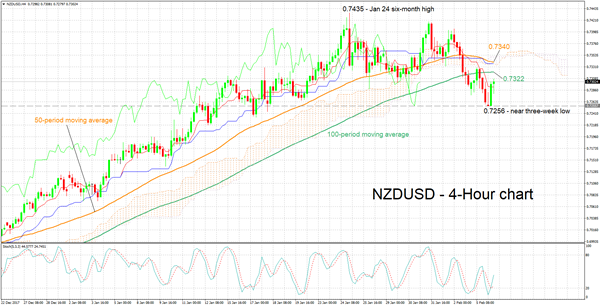
NZDUSD is trading roughly 50 pips above a near three-week low of 0.7256 hit earlier on Tuesday. The negatively aligned Tenkan- and Kijun-sen lines on the four-hour chart are projecting a negative picture in the short-term. However, notice that the two have flatlined, this potentially being a sign that negative momentum has come to a halt. Also, the stochastics are giving a bullish signal in the very-short term, as the %K line has moved above the slow %D one.
Strong jobs data out of New Zealand later on Tuesday are expected to lead to long positions, pushing the pair higher. In this case resistance could be met around the 100-period moving average at 0.7322. Not far above this level lie the 50-period MA, Kijun-sen line and the Ichimoku cloud.
On the downside and in case of weaker data out of New Zealand, some support could come around the Tenkan-sen which failed to provide resistance on the way up and could instead act as support. Further below, the focus would shift to the low of 0.7256 recorded earlier in the day.
The milk auction that is due before the labour market data also has the capacity to spur movements in the pair
Technical Outlook: AUDUSD Fell Further After Downbeat Data/RBA Staying Pat, But Bears Show Signs Of Hesitation
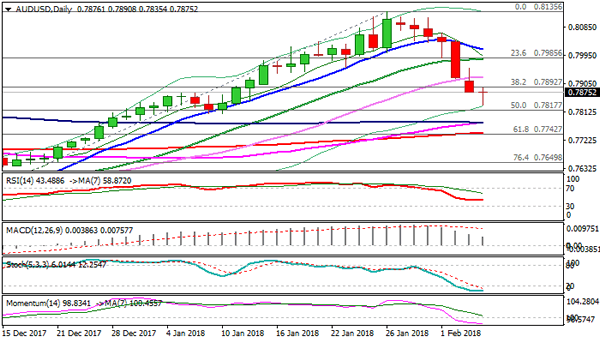
The Australian dollar dipped to new nearly one month low at 0.7835 on Tuesday, extending steep pullback from 0.8135 peak into seventh consecutive day. The Aussie remains under pressure which increased on Friday after solid US jobs data inflated the greenback, with fresh pressure coming from downbeat Australian data on Tuesday. Australian central bank left the benchmark interest rates unchanged at 1.5% in a widely expected action and showing more positive stance regarding global and domestic growth, but remains concerned about low inflation and signaled that they may stay on hold for some time. Australian retail sales fell below expectations in December (-0.5% vs -0.2% f/c and upwards-revised previous month’s release at 1.3%), while a separate report showed Australia’s trade balance hit deficit of A$1.36 billion in December, vs forecasted surplus of A$0.25 billion and previous month’s surplus of A$0.03 billion. However, the Aussie shows signs of hesitation above new low as daily slow stochastic is deeply oversold and suggesting correction, while RSI turned from descend to sideways mode and supporting the notion. Bull-cross of 55/100SMA is forming below and also underpins. On the other side, broken 10SMA turned south and heading towards 20SMA in sideways mode, maintaining pressure. Former pivotal support, now resistance, at 0.7892 (Fibo 38.2% of 0.7500/0.8135 rally) caps for now and firm break here is needed to sideline immediate downside risk and generate stronger correction signal. Broken 30 SMA marks next barrier at 0.7927, followed by 20SMA (0.7983) and 10SMA (0.8013) regain of which would confirm an end of corrective phase. Conversely, repeated failures at 0.7892 would keep in play risk of extension towards 0.7778 (converged 55/100SMA) and 0.7743 (200SMA / Fibo 61.8% of 0.7500/0.8135 rally).
Res: 0.7892, 0.7927, 0.7953, 0.7984
Sup: 0.7835, 0.7817, 0.7778, 0.7743
NZDUSD Intraday Analysis
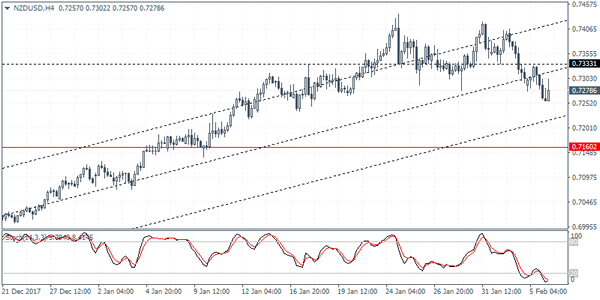
NZDUSD (0.7278): The NZDUSD currency pair gapped lower on the day. Intraday retracement saw prices retracing back to fill the gap but eventually price settled lower. This marks a second consecutive session of a bearish decline in price. On the 4-hour chart, with NZDUSD breaking below the 0.7333 level, we expect to see a short term consolidation at this level. If 0.7333 is retested for resistance then we can expect to see further declines for the Kiwi dollar. The NZDUSD will be seen falling towards the first support level at 0.7160. Alternately, in the event that price manages to reclaim the 0.7333 level, we could expect to see some upside momentum being built up.
USDJPY Intraday Analysis
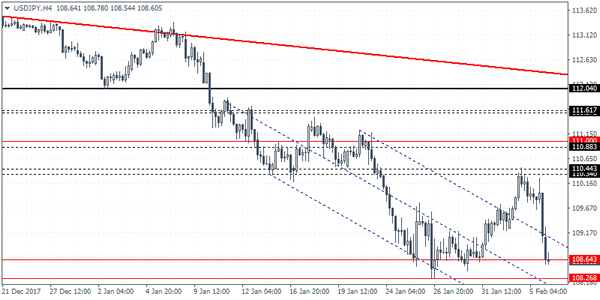
USDJPY (108.60): The USDJPY currency pair posted sharp declines late yesterday as price action was seen falling back to the 108.64 level of support. This marks a retest of the previously established support level. A rebound off this level is required in order to put the bias to the upside. However, the resistance level that has held up around 110.44 - 110.34 could be seen stalling the gains once again. To the downside, if the declines extend below 108.26 then USDJPY could be seen falling to the 108.00 level eventually.