Sample Category Title
Daily Wave Analysis: EUR/USD Bounces At Top And Shows Bearish Breakout And Momentum
Currency pair EUR/USD
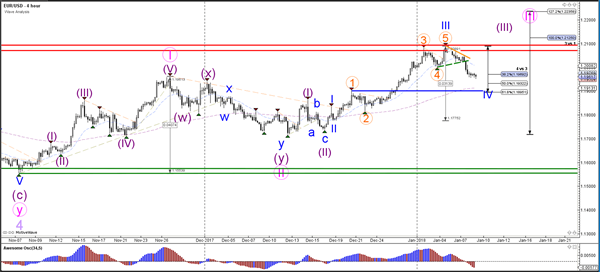
The EUR/USD made a bearish breakout below the support trend line (dotted green) after bouncing at the resistance (red). The bearish retracement could be part of a bearish correction within a larger uptrend continuation where waves 3 prevail. The alternative is that price is not completing a 123 (pink) but a larger ABC correction. A break below the support trend line (blue) and 61.8% Fib of wave 4 makes a bearish scenario more likely.
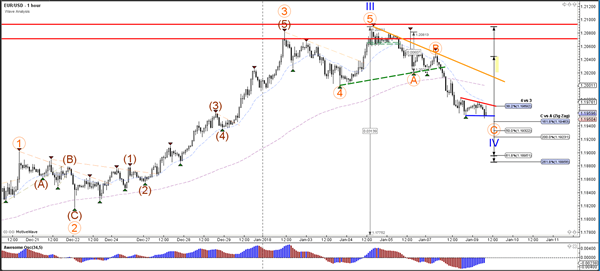
The EUR/USD broke the support trend line and could be building a wave C (orange) correction. A break above the resistance trend line (red) could be a first sign that wave C is over whereas a break below support could see price fall further. A push below the 61.8% Fib makes this wave 4 unlikely.
Currency pair GBP/USD
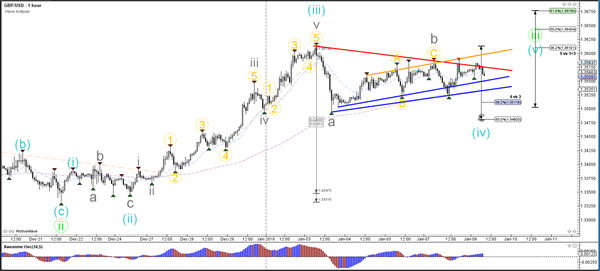
The GBP/USD is building a corrective pattern in the larger uptrend. A break above the resistance trend lines (orange/red) could see price move towards the Fibonacci targets whereas a break below support (blue) could see price make a larger bearish correction.
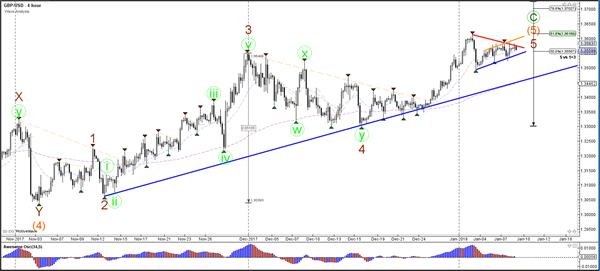
The GBP/USD is building an ABC corrective pattern. The breakout direction depends on the price's reaction versus the trend lines.
Currency pair USD/JPY
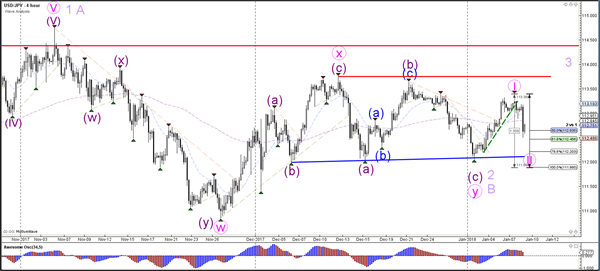
The USD/JPY broke below support (dotted green) and has made a larger bearish correction. This retracement could be a potential wave 1-2 (pink) although price remains in a larger range.
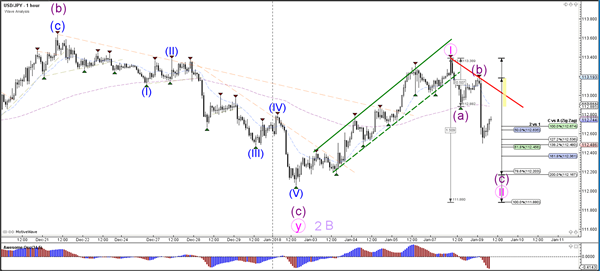
The USD//JPY broke the bullish trend channel (green) and could be building an ABC pattern if price stays above the 100% Fib level of wave 2 vs 1.
NZDUSD Intraday Analysis
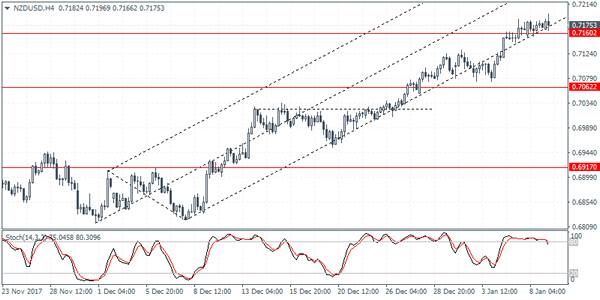
NZDUSD (0.7175): The New Zealand dollar was broadly muted yesterday as price action consolidates above the 0.7160 handle. The Stochastics oscillator shows price action losing its momentum. This could indicate a downside correction in NZDUSD if the support at 0.7160 fails. The next lower support at 0.7062 could be the next target on a downside breakout from the current levels. To the upside, further gains can be expected only on a rebound off the support level at 0.7160, but it looks unlikely at this point.
USDJPY Intraday Analysis
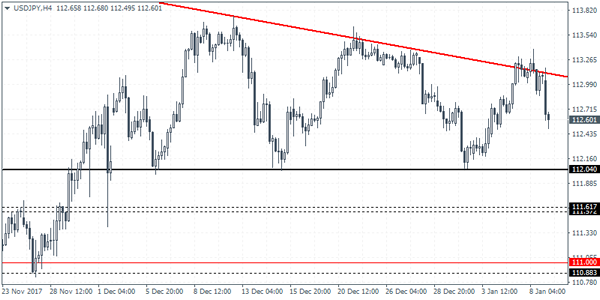
USDJPY (112.60): Despite the USD posting a rebound, the USDJPY closed with a doji with follow through price action showing a decline in early trading today. The reversal comes off the test of the major falling trend line as expected. We expect to see the downside correction in USDJPY pushing the currency pair lower. Support at 112.04 remains in focus to the downside. Overall, USDJPY is likely to maintain its sideways range but a break down below 112.04 could spell further declines in price.
EURUSD Intraday Analysis
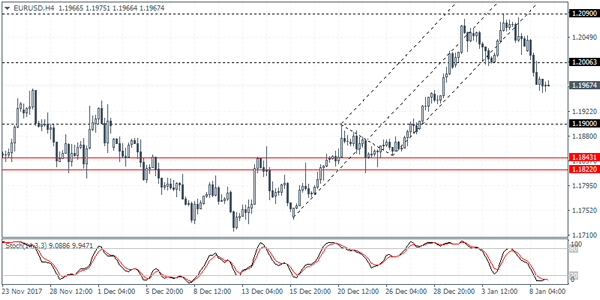
EURUSD (1.1967): The EURUSD posted sharp declines yesterday as price action was seen testing the support level at 1.1950 level, touching a 5-day low. The declines came on a stronger U.S. dollar and amid concerns that the strong appreciation in the common currency could spur ECB officials to talk down the currency ahead of this month's monetary policy meeting. Technically, EURUSD could be seen posting a rebound off 1.1950, however further declines cannot be ruled out to 1.1900. A retest of support at 1.1900 could potentially complete the correction. In the near term, any rebound will be limited to the 1.2000 handle which previously served as minor support.
USD Rebounds, But Trades Mixed
The U.S. dollar posted strong gains yesterday following the rebound at a major support level last week. This led to the euro losing steam as the currency pair was seen easing back from recent highs amid profit taking and fresh concerns on the surge in the exchange rate. Economic data was muted for the most part. Switzerland's inflation report showed a flat print on the month while the retail sales in the Eurozone showed a 1.5% increase which was more than expected.
The Bank of Canada released its business outlook survey which alongside recent jobs data has raised the odds of a rate hike from the central bank at next week's meeting.
Looking ahead, the economic data today is light. German industrial output data and the Eurozone unemployment report will be some of the major data points for the markets today.
Technical Outlook: EURUSD – Near-Term Bias To Remain Negative While 1.2000 Barrier Intact
The Euro traded within narrow range in Asia on Tuesday and bounced slightly in early European session, supported by upbeat German data (Nov IP 3.4% vs 1.9% f/c, Nov trade surplus widened to 22.3B from 19.9B in Oct and 20.9B f/c).
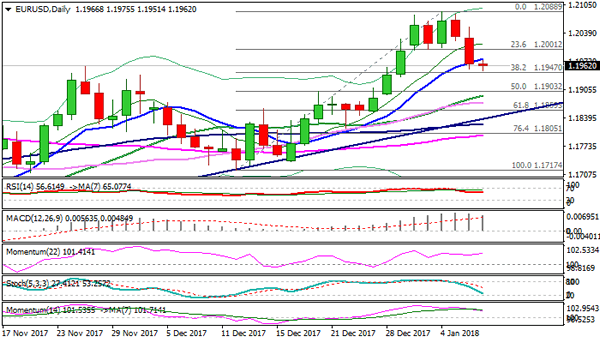
Fresh gains were so far limited by broken 10SMA (1.1978) which mrks initial resistance and guarding psychological 1.2000 barrier (former triple-low support). The pair remains at the back foot following two-day fall after repeated upside rejections under 1.2100 pivot.
Near-term bears pressure 1.1950 zone (Fibo 38.2% of 1.1717/1.2088 upleg) where strong bids lay and significant stops parked below.
Break here would open way for extension of pullback from 1.2090 zone towards 1.1900 (flat daily Kijun-sen/50% retracement) and 1.1860 (Fibo 61.8%/trendline support) in extension. Lift above 10SMA needs to regain and break above 1.2000 pivot to signal an end of correction and shift near-term focus higher.
Res: 1.1978, 1.2000, 1.2052, 1.2092
Sup: 1.1950, 1.1900, 1.1875, 1.1860
Forex Analysis: BOJ Tapers Bond Purchases
Earlier today the Bank of Japan announced that it would taper its Japanese Government Bond purchases. The ‘taper’ reduces the size of 10 to 25-year debt from ¥200 billion to ¥190 billion and +25 year bonds from ¥90 billion to ¥80 billion. It’s unclear if this will be carried through to the next purchase or if it is a one day only event. Inflation has yet to meet targets and there is no mention of a policy change from the BOJ. Today’s reductions are small but had a big impact on USDJPY which fell from 113.153 to a low of 112.493 overnight.
Swiss Consumer Prices Index (YoY) (Dec) was out as expected, unchanged from the previous value of 0.8%. Consumer Price Index (MoM) (Dec) was released at 0.0% v -0.1% expected, from a prior reading of -0.1%. USDCHF was higher from 0.97685 to 0.97831.
Eurozone Business Climate (Dec) was released at 1.66 v an expected 1.51, while the previous number was 1.49. Also at this time, Consumer Confidence (Dec) was as expected, unchanged at 0.5. Industrial Confidence (Dec) was 9.2 v 8.4 expected, while its prior was revised from 8.2 to 8.1. Services Sentiment (Dec) was 18.4 v 16.5 expected, while 16.3 previously was revised up to 16.4. Economic Sentiment Indicator (Dec) was 116.0 v an expected 114.8, from 114.6 previously. EURUSD rallied from 1.19892 to 1.20032 after this data release.
Bank of Canada Business Outlook Survey Indicator data was released at 15:30 GMT and came in at 2.49 v an expected 0.83. Future Sales were 8.0 v 19.0 prior. Data points were positive overall and USDCAD rose to a high of 1.24480 but then fell to a low of 1.24000.
US Consumer Credit Change (Nov) was $27.95B from an expected $19.75B and the prior of $20.52B was revised up to $20.53B. USDJPY moved higher to 113.122 upon release.
EURUSD is down -0.09% overnight, trading around 1.19568.
USDJPY is down -0.35% in the early session trading at around 112.690.
GBPUSD is up 0.04% to trade around 1.35681.
USDCAD is down -0.07%, trading around 1.24100.
Gold is down -0.15% in early morning trading at around $1,318.40.
WTI is up 0.34%, trading around $62.15.
Major data releases for today:
At 06.45 GMT, Swiss Consumer Prices Index (YoY) (Dec) is expected to come in unchanged at 0.8%. Consumer Price Index (MoM) (Dec) will also be released, with a prior reading of 1.5%. Swiss Franc pairs may see price movement if the data released varies from the consensus.
At 07:00 GMT, German Trade Balance s.a. (Nov) is expected to be 20.9B from a previous 19.9B. Exports (MoM) (Nov) are expected at 1.2% from -0.4% previously. Imports (MoM) (Nov) are expected at 0.8% from 1.8% prior. Current Account n.s.a. (Nov) is expected at 25.5B v a prior reading of 18.1B. EUR pairs may react to this data.
At 08:00 GMT, ECB Non-monetary policy’s meeting will take place. Any headlines from this meeting will be scrutinised for advance notice of policy decisions.
At 08:00 GMT, Swiss Real Retail Sales (YoY) (Nov) will come out. The consensus is -2.5% and the previous number was -3.0%.
At 10:00 GMT, Eurozone Unemployment Rate (Nov) is expected at 8.7% v a prior of 8.8%. Euro pairs could experience movement if the data differs from the consensus.
At 13:15 GMT, Canadian Housing Starts s.a (YoY) (Dec) is expected at 212.5K from a prior of 252.2K. CAD pairs will be exposed to this data release.
At 15:00 GMT, US FOMC Member Kashkari will be speaking, which may affect USD crosses, stocks, commodities and bonds.
How Long Will The Tired Bull Keep Running?
Led by Wall Street, global equity markets continued to enjoy one of their best starts in eight years. The Japan’s Nikkei 225 marched to a new 26-year high after the S&P 500 and Nasdaq Composite set record closes in the previous session. In Europe, the FTSE 100 made a new high on Monday before retreating slightly to close 0.36% lower, meanwhile the German Dax is only 1.2% shy of its all-time peak, reached in October last year.
There’s no reason not to be optimistic when global growth is expected to run above average; inflation remains muted, and U.S. tax reforms are driving up U.S. corporate profits forecasts at the fastest pace in more than a decade.
Many skeptical equity investors are not willing to call the end of the bull market, given that contrarians who challenged common market beliefs in 2017 missed the rally. However, this doesn’t necessarily mean there is no reason not to be worried.
From a valuation perspective, few can argue that stock valuations, particularly in the U.S.are overstretched, despite the upgraded earnings forecasts. When looking at the cyclically adjusted price-to-earnings multiple “CAPE”, it is currently above 33, a level last seen during the dot-com bubble. However, this indicator has been suggesting that stocks are expensive for the past two years, but there are still no signs of the bulls giving up. This is due to the low-interest rate environment, which wasn’t the case in 2000 or 1929.
The 45% rally in the S&P 500 during the past two years has driven down dividend yields to below 1.9% which is now lower than the returns on 2-year treasury notes. At the moment it appears that investorsare not too worried about rising short-term interest rates, but the outlook will likely change when yields in the longer term start to increase.
Today the Bank of Japan announced a reduction of buying JGBs by 20 billion yen. Although it’s considered a slight tweak in monetary policy, this may mean that further tightening is on the cards, despite BoJ’s Kuroda signaling at December’s meeting that no monetary policy tightening was imminent.
I expect to see further actions from major central banks to tighten policy through reducing stimulus and raising interest rates, as low inflation will not last forever. Such actions will likely lead to rapid appreciation in bond yields across Europe and the U.S. which could be the first signal of an equity market correction.
GBPUSD Intraday Bearish 1.3550 Level
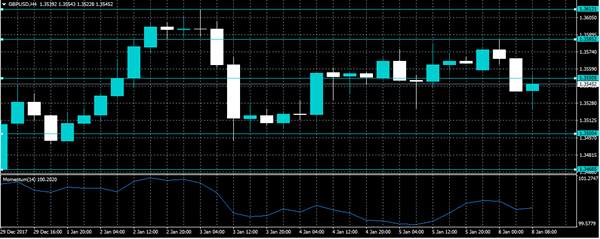
The British pound has started to trade below the key 1.3550 level against the U.S dollar, as the greenback starts to regain upside traction across the board. The GBPUSD pair earlier failed to make a new daily-high above the yearly trading high, found at 1.3613, encouraging traders to turn their attention towards the downside. Price-action currently sits around the 1.3540 level, after an earlier battle between buyers and sellers around the pivotal 1.3550 level. Headed into the U.S session, the directional bias of the U.S dollar index will likely dictate the pairs intraday price movements.
The GBPUSD pair is intraday bearish below the 1.3500 level, key downside targets remain 1.3500 and 1.3467.
Should price-action on the GBPUSD pair trade above the 1.3550 level, attention may shift back toward the 1.3567 and 1.3613 resistance levels.
EURUSD Beats Incharge Below 1.1958 Level
The euro continues to slip lower against the U.S dollar, with price-action continuing to test the key 1.1958 technical support level. After trading below the 1.1989 level on Monday, sellers took firm control of the EURUSD pair, with dip buyers now losing momentum on tepid upside rallies. The euro risks further losses below the 1.1958 support level, with sellers likely to target the 1.1910 region. Traders now look to the next directional move in the U.S dollar index, as dollar buyers look for further upside towards the 92.60 level.
The EURUSD pair is strongly bearish while trading below the 1.1989 level, further downside towards 1.1958 and 1.1910 seems increasingly likely.
Should the EURUSD pair start to recover above the 1.1989 level, buyers may start to target the 1.2030 and 1.2050 upside levels.