

Sample Category Title
European Data Releases Headline Today’s Market
The first releases of the European session take place at 07:00 GMT with reports on German industrial production and trade. Industrial output in Europe’s largest economy is expected to grow 1.8% in November, which translates into a year-over-year gain of 4%. That follows a 1.4% decline in October.
Berlin’s trade surplus is expected to widen to €21 billion in November from €19.9 billion. Exports are expected to grow 1.2% following a 0.4% decline the previous month. Imports, meanwhile, are projected to climb 0.6% month-on-month.
Shifting gears to France, MINEFA will report on the national trade balance for November. The deficit carried by Paris is expected to widen to €4.8 billion from €4.96 billion in October.
The European Commission’s statistical agency will report on unemployment at 10:00 GMT. The euro area jobless rate is expected to drop to 8.7% from 8.8%.
Investors will also be keeping an eye on the European Central Bank’s non-monetary policy meetings, which are scheduled to kick off at 08:00 GMT.
There are no major data releases scheduled in the North American session. The American Petroleum Institute (API) will supply the market with the weekly crude inventory report, which is a precursor to the official data on Wednesday.
On the policy front, Federal Reserve Bank of Minneapolis President and Federal Open Market Committee (FOMC) member Neel Kashkari will deliver a speech at 15:00 GMT. The FOMC will hold its final policy meeting under Janet Yellen at the end of the month.
Earlier in the session, Australia reported an unexpected surge in building permits for the month of November. Approvals spiked 11.7%, confounding expectations of a 1.3% decline, the Australian Bureau of Statistics said in a report. Compared to a year ago, building permits rose 17.1% following an 18.4% increase the month before.
AUD/USD
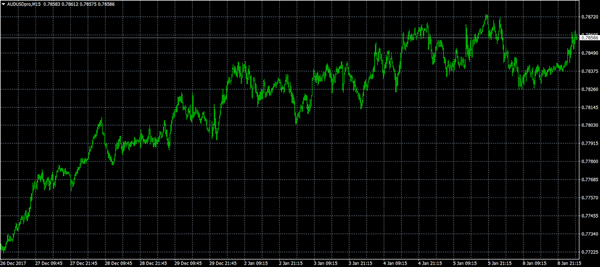
The Australian dollar rose on Tuesday, gaining the upper hand on a US currency that has struggled for momentum in recent weeks. The AUD/USD exchange rate climbed 0.3% to 0.7858, where it was trading near three-and-a-half month highs. The pair faces immediate support at 0.7800. On the opposite side of the ledger, the recent high of 0.7870 is the first resistance eyed by the bulls.
EUR/USD
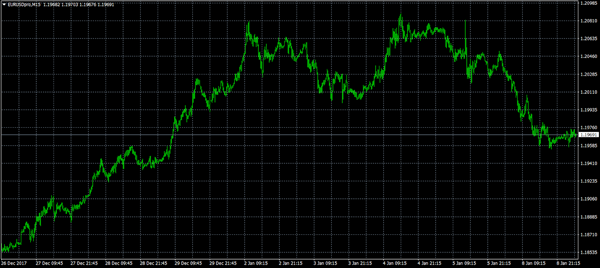
Europe’s common currency underwent a short-term bearish correction on Tuesday, as prices fell back from four-month highs near 1.2100. The EUR/USD exchange rate was last seen trading at 1.1971, where it was little changed compared to the previous close. The pair sees immediate support at 1.1955, followed by 1.1920. Resistance is located just above the psychological 1.2000 zone.
GBP/USD
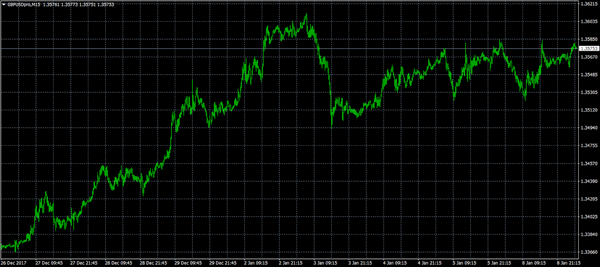
Cable was little changed in Asian trading after a choppy Monday session saw prices bottom out at 1.3529. The GBP/USD exchange rate was last seen hovering around 1.3580. The pair faces immediate support at the 1.3520 region.
GBPUSD Neutral In Short Term, Maintains Bullish Undertone After Break Above 1.35
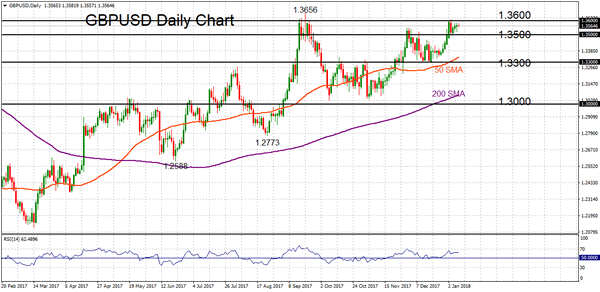
GBPUSD is neutral in the short term and is consolidating gains made after breaking above the key 1.3500 level last week. The pair maintains an overall bullish undertone. The short-term technicals are neutral to bullish.
The market is well-capped below the 1.3600 level which is now a strong resistance level. There is scope for a move higher out of the current consolidation range but prices need to see a sustained move above last week's high of 1.3612 (January 3). Only a clear break above this level would increase the odds for a move beyond last year's 1.3656 top.
Downside risks increase below immediate support at 1.3500. A dip lower from here would expect to find support at 1.3300 and then from here, 1.3000 comes into focus. Anything lower would fundamentally change the market structure.
For now, GBPUSD holds a neutral stance in the short term but a continuation of the bullish phase cannot be ruled out yet. In the bigger picture, the bullishly aligned 50-day and 200-day moving averages support the positive outlook.
Currencies: EUR/USD Drifting South. Yen Rebounds As Markets Ponder BOJ Action
Sunrise Market Commentary
- Rates: Calendar back loaded, range bound action today?
Atlanta Fed Bostic called for 2 or 3 rate hikes this year. He is a dovish leaning centrist and doesn't change our/the market's call of a March rate hike. Today's eco calendar is thin and probably won't impact trading. We expect range bound action, but heavy bond supply could be negative. Later this week, attentions turns to German wage negotiations and US inflation data. - Currencies: EUR/USD drifting south. Yen rebounds as markets ponder BOJ action
EUR/USD declined yesterday after Friday's rejected test of 1.2092 resistance. The yen rebounds overnight as investors try to assess the meaning of the BOJ reducing purchases of longer-dated JGB's. Is this a first step to gradual policy normalization. Eco data probably won't guide USD trading today. Swings in USD/JPY might set the tone for global USD trading
The Sunrise Headlines
- US stock markets gained slightly ground with Dow Jones underperforming (flat). Most Asian stock markets are positively oriented overnight with Korea underperforming as Samsung's profit guidance missed expectations.
- The Federal Reserve may only need to raise interest rates two times in 2018 given weak price pressures and possible loss of public confidence in the central bank's ability to hit a 2 percent inflation target, Atlanta Fed Bostic said.
- The yen climbed after the BoJ reduced its purchases of super-long bonds, adding to speculation that the central bank may be looking to wind back its ultra-loose monetary policy.
- Special counsel Mueller has informed lawyers for President Trump that he may seek an interview with the president early this year, prompting concerns within the Trump legal team over terms of the questioning, according to sources.
- May's Cabinet shuffle failed to consolidate her power. Health Secretary Hunt successfully resisted being given another post and Education Secretary Greening quit after the PM offered her the work and pensions portfolio. Johnson kept his foreign minister job, while Hammond and Davis also stayed on.
- Inflation-squeezed British shoppers cut back on almost everything other than food in the last three months of 2017, leading to the biggest fall in non-grocery spending since 2009, industry figures (BRC) showed.
- Today's eco calendar is rather thin with only EMU unemployment rate and US NFIB small business optimism. Supply heats up with Austria, the Netherlands, Germany and the US tapping the market
Currencies: EUR/USD Drifting South. Yen Rebounds As Markets Ponder BOJ Action
USD/JPY declines as BOJ amends JGB buying
The dollar gained against the euro yesterday, but struggled against the yen. EC economic confidence hit the highest level since end 2000, but didn't help the euro. Bunds even outperformed US Treasuries, slightly widening the USD-EUR interest rate differential. Friday's rejected test of EUR/USD 1.2092 caused a further repositioning out of EUR/USD longs. The pair dropped below 1.20 and finished at 1.1967. USD/JPY failed to keep up with the USD rebound. EUR/JPY profit taking after last week's rally and a slowing of the equity rally weighed on USD/JPY later in the session. The pair closed the day little changed at 113.09.
The yen jumped higher overnight as the BoJ reduced longer-dated JGB purchases. Investors ponder whether this could be a first small step to policy normalisation. USD/JPY dropped half a yen (currently 112.65). EUR/USD is little changed (1.1970). The Aussie dollar (AUD/USD 0.7860) profits slightly from strong building approvals. The eco calendar is thin today. EMU Unemployment is expected to decline from 8.8% to 8.7%. US NFIB small business confidence might near the historic top. Both series are no market movers. Technical factors will probably prevail. We keep a close eye on USD/JPY's decline. For now, it had few spill-over effects on other USD cross rates. The jury is still out, but a subsequent, further decline of EUR/JPY might also (temporary) weigh on EUR/USD, or at least prevent a rebound. In a broader perspective, slightly disappointing payrolls didn't cause USD damage. EUR/USD 1.2092 resistance survived. This week's US price data are a next reference for USD trading. Recently, the greenback suffered as the global recovery might force other major CB's (including ECB) to join policy normalisation. We keep the hypothesis that enough good news on the euro/'bad news' on the USD is discounted and that a sustained break beyond 1.2092 is not evident.
Sterling profited from the government reshuffle yesterday as it could be an indication that the UK PM is regaining some grip on UK politics. The decline of EUR/USD also weighed on EUR/GBP. The pair closed the session at 0.8821. Overnight, BRC like-for-like sales rose 0.6% Y/Y, but this was due to higher food prices. The underlying picture was less brilliant. It is also far from sure that the government reshuffle will make things easier for PM May. A further technical decline of EUR/USD might weigh on EUR/GBP ST. However, we don't see a strong case for a sustained sterling rebound. EUR/GBP 0.8700/60 support looks solid. We keep a EUR/GBP buy-on-dips in case of return action to 0.87.
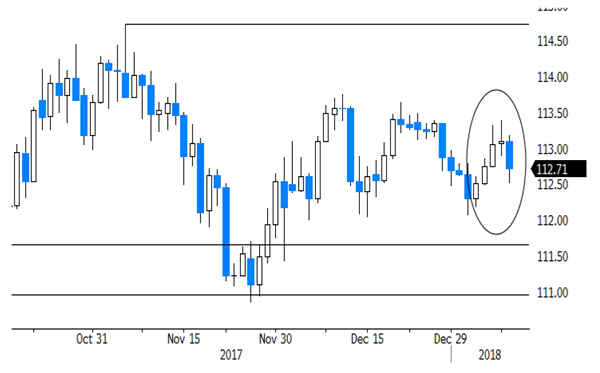
USD/JPY: yen rebounds as ‘BOJ action' sparks speculation on policy normalization. Break below 112 would hurt ST picture
BoJ Has Cut Back Its Bond Purchases In The Long End Of The Curve
Market movers today
Germany is due to release industrial production at 8:00 CET for November, which is expected to show a decent rebound of 1.8% m/m after the 1.4% m/m drop in October.
Euro unemployment for November is estimated to have declined to 8.7% from 8.8% in October. It would be the lowest level since 2009 and below the long-term average. However, i t is sti ll above the EUC ommission's e stimate for lon g-term unemployment at 8.4% for 2018.
The US is due to release NFIB small business optimism index around noon. It continues to beat very strong levels –boosted partly by the expectation of a US corporate tax cut.
Chinese inflation numbers will be released overnight. We expect an increase in the CPI inflation from 1.7% to 1.9% – still far below the 3% target. PPI inflation should drop back to 4.8% y/y from 5.8% y/y due to base effects from a very strong m/m November increase in 2016.
Selected market news
Overnight , USD/JPY dropped on news that the BoJ has cut back its bond purchases in the long end of the curve. The cut back is a consequence of the central bank's yield curve control target, but triggered concerns in the market that an exit from quantitative easing is drawing closer. Yesterday saw a couple of interesting dovish comments from members of the Fed. The At lanta Fed's Bostic (vot er in 2018) stated that his base case is two to three hikes in 2018 contrary to the median dot of three hikes, that low inflation expectations is a risk and that the Fed should be extremely cautious if the yield curve gets close to inverting. In addition, San Francisco's Williams was advocating for price level targeting and arguing that it is in fact a very modest change compared to the current inflation target .
There was also a string of interesting news from the White House. According to Reuters, US President Trump is said to be close to nominating a person for the position of Fed Vice Chair and apparently Richard Clarida is out of the race for that position. According to a Bloomberg story, US Treasury Secretary Steven Mnuchin has apparently asked congress to lift the debt ceiling before 28 February, which in turn would put a lid on any concerns in the market about a near-term US debt default . Finally, the White House is apparently considering a targeted strike in North Korea as a reaction to a missile test in order to illust rate that the high price the nation could pay for nuclear progress would be feasible according to WSJ. The market did not react to the news, but it serves as a reminder of the geopolitical risks looming in the background.
In the oil market , we have seen supply-related news out of Libya and Iraq. The former was said to ready a rise in output after a pipe blast two weeks ago, while the latter is confronting the Kurds about the crude production taking place in the northern part of Iraq. The oil market saw little reaction to the news.
EUR/JPY Carving Top Or Correcting Lower?
Key Highlights
- The Euro after a solid upside move formed a high at 136.63 against the Japanese Yen.
- The EUR/JPY pair moved down sharply and broke a crucial bullish trend line with support at 135.25 on the 4-hours chart.
- The pair must stay above 134.40 to avoid any further declines in the near term.
- Today’s German Trade Balance report for Nov 2017 could have a positive impact on EUR/JPY.
EURJPY Technical Analysis
The Euro opened 2018 with a positive bias not only against the US Dollar, but also versus the Japanese Yen. The EUR/JPY pair traded above 136.00 and is currently correcting lower.
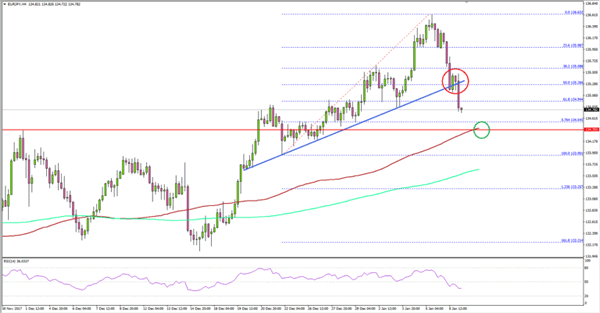
Looking at the 4-hours chart, it seems like there was a major rejection from the 136.63 high. The pair has moved below the 50% Fib retracement level of the last wave from the 133.90 low to 136.63 high.
The downside was strong since there was a break below a crucial bullish trend line with support at 135.25 on the same chart. It ignited further declines below the 61.8% Fib retracement level of the last wave from the 133.90 low to 136.63 high.
Below the trend line support, the 134.30-134.40 area is the next major support. EUR/JPY must stay above 134.40 with no 4-hour close to avoid any trend change. Should there be a close below 134.40, the pair could move back towards 133.25.
On the upside, an initial hurdle for a recovery is at 135.25. Above 135.25, the pair will most likely drift towards the 136.00 handle.
Fundamentally, the Euro Zone recently saw the release of the Economic Confidence indicator for Dec 2017 by the European Commission. The result was better than the forecast of 114.8, as there was a rise in the Economic Confidence indicator from 114.6 to 116.00.
However, the result failed to lift the market sentiment for the Euro. It traded lower versus the US Dollar as well. Both EUR/USD and EUR/JPY declined strongly and are heading towards key support levels. Thus, the next few sessions could be crucial. An increase in the current selling pressure may push both pairs further into the bearish zone.
Australia’s Building Approvals Jumped In November
For the 24 hours to 23:00 GMT, the AUD declined 0.1% against the USD and closed at 0.7841.
LME Copper prices declined 0.2% or $12.5/MT to $7084.5/MT. Aluminium prices declined 1.3% or $28.0/MT to $2177.5/MT.
In the Asian session, at GMT0400, the pair is trading at 0.7862, with the AUD trading 0.27% higher against the USD from yesterday's close, following better-than-expected housing sector data in Australia.
Data released overnight showed that Australia's seasonally adjusted building approvals unexpectedly rebounded 11.7% on a monthly basis in November, confounding market expectations for a drop of 1.3%, driven by a spike in apartment and townhouse building. In the previous month, building approvals had registered a revised fall of 0.1%.
The pair is expected to find support at 0.7838, and a fall through could take it to the next support level of 0.7813. The pair is expected to find its first resistance at 0.7876, and a rise through could take it to the next resistance level of 0.7889.
The currency pair is trading above its 20 Hr and 50 Hr moving averages.

Euro-Zone’s Retail Sales Surged In November, While Germany’s Factory Orders Eased For The First Time In 4 Months In...
For the 24 hours to 23:00 GMT, the EUR declined 0.54% against the USD and closed at 1.1968, after Germany's factory orders surprised with an unexpected drop in November.
On the macro front, Germany's seasonally adjusted factory orders unexpectedly fell 0.4% on a monthly basis in November, declining for the first time in 4 months and defying market expectations for a flat reading. In the prior month, factory orders had climbed by a revised 0.7%.
Separately, the Euro-zone's seasonally adjusted retail sales rebounded more-than-expected by 1.5% on a monthly basis in November, rising at its fastest pace in over a year, indicating that an upturn in the region's consumer spending may be on the horizon. In the previous month, retail sales had dropped 1.1%, while markets had expected for a rise of 1.3%. Moreover, the region's Sentix investor confidence index climbed to a level of 32.9 in January, topping market consensus for a rise to a level of 31.3, thus highlighting that optimism over the region's economic outlook continued at the start of the year. The index had registered a level of 31.1 in the previous month.
Other data showed that the region's final consumer confidence index was confirmed at a 17-year high level of 0.5 in December, compared to a revised flat reading in the previous month. Additionally, the region's economic sentiment indicator jumped to a level of 116.0 in December, reaching its highest level since October 2000, as strong economic performance across the common currency region continued to boost confidence amongst businesses and consumers. Markets had anticipated the index to advance to a level of 114.8, after recording a reading of 114.6 in the previous month.
The US Dollar advanced against its key currencies, after remarks from several top Federal Reserve (Fed) officials suggested that at least three interest rate hikes were on the table this year.
In economic news, data indicated that consumer credit in the US rose $27.95 billion in November, posting its largest increase in 16 years. Markets participants had expected consumer credit to rise by $18.0 billion, after recording a revised increase of $20.53 billion in the previous month.
In the Asian session, at GMT0400, the pair is trading at 1.1972, with the EUR trading a tad higher against the USD from yesterday's close.
The pair is expected to find support at 1.1940, and a fall through could take it to the next support level of 1.1908. The pair is expected to find its first resistance at 1.2020, and a rise through could take it to the next resistance level of 1.2068.
Trading trend in the Euro today is expected to be determined by the release of the Euro-zone's unemployment rate coupled with Germany's trade balance and industrial production data, all for November, set to release in a few hours. Also, the US NFIB small business optimism index for December and JOLTs job openings for November, both due to release later in the day, would be on investors' radar.
The currency pair is showing convergence with its 20 Hr moving average and trading below its 50 Hr moving average.

Britain’s Halifax House Prices Surprisingly Fell In December
For the 24 hours to 23:00 GMT, the GBP trade flat against the USD and closed at 1.3569.
Macroeconomic data showed that UK's Halifax house price index recorded an unexpected drop of 0.6% on a monthly basis in December, declining for the first time since June 2017 and pointing to a slowdown in the nation's housing sector. The index had registered a revised gain of 0.3% in the prior month, while investors had envisaged for a rise of 0.2%.
In the Asian session, at GMT0400, the pair is trading at 1.3579, with the GBP trading 0.07% higher against the USD from yesterday's close.
Overnight data indicated that the nation's BRC retail sales across all sectors grew more-than-expected by 0.6% YoY in December, compared to a similar rise in the previous month.
The pair is expected to find support at 1.3540, and a fall through could take it to the next support level of 1.3500. The pair is expected to find its first resistance at 1.3602, and a rise through could take it to the next resistance level of 1.3624.
The currency pair is trading above its 20 Hr and 50 Hr moving averages.

Japanese Yen Trading On A Stronger Footing This Morning
For the 24 hours to 23:00 GMT, the USD slightly declined against the JPY and closed at 113.15.
In the Asian session, at GMT0400, the pair is trading at 112.63, with the USD trading 0.46% lower against the JPY from yesterday’s close.
The Japanese Yen gained ground against the USD, after the Bank of Japan (BoJ) reduced the amount of its buying in Japanese government bonds, thus sparking speculation about a future exit from its massive stimulus policy.
Early morning data showed that Japan’s consumer confidence index unexpectedly eased to a level of 44.7 in December, compared to a reading of 44.9 in the prior month and defying market consensus for an increase to a level of 45.0.
The pair is expected to find support at 112.29, and a fall through could take it to the next support level of 111.95. The pair is expected to find its first resistance at 113.18, and a rise through could take it to the next resistance level of 113.73.
The currency pair is trading below its 20 Hr and 50 Hr moving averages.

Swiss Consumer Prices Unexpectedly Remained Flat In December
For the 24 hours to 23:00 GMT, the USD rose 0.18% against the CHF and closed at 0.9773.
Macroeconomic data showed that Switzerland’s consumer price index (CPI) surprisingly remained flat on a monthly basis in December, against market expectations for a fall of 0.1%. The index had dropped 0.1% in the prior month.
In the Asian session, at GMT0400, the pair is trading at 0.9769, with the USD trading slightly lower against the CHF from yesterday’s close.
The pair is expected to find support at 0.9753, and a fall through could take it to the next support level of 0.9736. The pair is expected to find its first resistance at 0.9785, and a rise through could take it to the next resistance level of 0.9800.
Moving ahead, traders would keep a close watch on Switzerland’s unemployment rate data for December, due to release in a while.
The currency pair is trading between its 20 Hr and 50 Hr moving averages.
