Sample Category Title
BoC’s Business Outlook Survey Firms Up Expectations for a Rate Hike Next Week
Highlights:
- The BOS indicator, which summarizes the main survey questions, rebounded close to the peak seen in the summer survey—which was a major factor in the BoC raising rates last July.
- The balance of opinion on future sales moderated following "unsustainable" strength in the first half of 2017. Still, firms expect an acceleration in export growth.
- Investment intentions rebounded as firming capacity pressures helped offset "tax and regulatory hurdles" as well as uncertainty over US trade policy.
- The share of firms that would have difficulties meeting an unexpected increase in demand hit its highest level in a decade. Labour shortages also became more common.
- Inflation expectations were little changed with a slight majority of respondents still expecting inflation to be in the lower half of the BoC's 1-3% target range.
Our Take:
We think last Friday's impressive employment report tipped the scales in favour of a January rate hike, and today's release of the Business Outlook Survey gives further weight to that view. This survey has become a key input in the Bank of Canada's policy deliberations, and signs that "positive business sentiment is widespread" give the central bank the all clear to raise interest rates next Wednesday. Importantly, capacity pressures continued to firm and businesses are responding by boosting investment and hiring, even amid concerns about US trade policy. Not all indicators point to an urgent need to raise rates—wage pressures increased but still aren't widespread and upward pressure on output prices is being offset somewhat by structural factors like e-commerce—but overall it is increasingly clear that Canada's economy doesn't need the amount of monetary policy stimulus currently being provided.
Global Economic Themes for 2018
Although 2017 started on a more upbeat note than 2016, few forecasters expected the positive surprises that the year had in store. Economic momentum proved to be stronger and persistent, particularly within G7 countries. A typically weak (residual-seasonality distorted) first quarter in the U.S. quickly gave way to sustained, above-trend growth thereafter. A virtuous global cycle finally kicked in, feeding into trade volumes and many emerging market economies.
More of the same is on the docket for 2018. We anticipate the global economy to grow by 3.8%, slightly firmer than the 3.7% pace from last year. Indeed, many of the same themes will act to support global economic activity. Advanced economies will remain fairly hot, with emerging markets gaining speed. Although monetary stimulus should continue to wane, there is no question that conditions will still be highly accommodative by historical standards. Labor markets will tighten further, but a rapid uptick in wage and price pressures is unlikely. In fact, this is a key pillar supporting the view of many analysts that monetary stimulus will be removed at a gradual pace. Any shift in this market perception or actual data can quickly become a game changer for central bankers and bond yields in 2018.
The year has barely started and an "everything-is-awesome" sentiment dominates the outlook. The global financial crisis, the euro debt crisis and the commodity price shock are all now largely in the rear view mirror. However, the true test of global health will be how economies adjust to less central bank stimulus after nearly a decade of priming the pump in favor of asset prices. And, this year will also give analysts a good look at how much politics will run interference with the international movement of goods and people.
We've identified six themes that we believe will shape the economic narrative for 2018:
Theme #1: Global Reflation
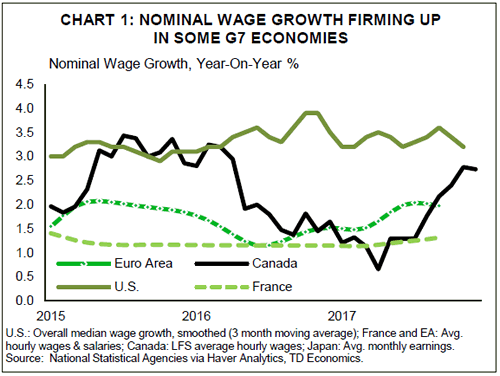
In a note last fall, we highlighted a number of factors that may explain why inflation in G7 economies has been subdued despite strong economic growth and the rapid absorption of slack. Our empirical analysis showed that the link between economic slack and inflation still holds, but has weakened during the current cycle. However, weakened does not correspond to dead. It's just a matter of time before wage and price pressures respond to ever-tightening capacity conditions. Some signs are already evident in Canada and Europe, and various reports within the U.S. are reinforcing increasing wage pressures within the higher skilled segments of the labor force (Chart 1). With unemployment rates in advanced economies set to continue to plummet below historical norms, the laws of supply and demand favor increased wage-competition as labor becomes scarcer.
As with all economic forecasts, nothing is written in stone. But, a virtuous growth-cycle on a global scale does tilt the balance of risks more in favor to the upside for inflation, rather than downside. Certainly adding to this risk (and current reality) is that elevated geopolitical risks drive energy prices higher, pushing headline inflation up.
However, some aspects cannot yet be fully reconciled within forecast models, such as what's referred to as the "Amazonization" of prices, as well as the inherent imprecision that surrounds the calculation of output gaps and equilibrium interest rates across countries. We may find that inflation-targeting central banks will be more inclined to run their economies a little hotter than necessary, rather than risk tightening financial conditions too fast and ending the expansion prematurely.
Theme #2: Rising global interest rates
G7 central banks are on track to continue along the path of gradually removing stimulus. The Federal Reserve will have good company in raising its main policy rate by at least another 50bps, with both the Bank of England and the Bank of Canada each expected to follow suit with 25 bps and 50 bps hikes, respectively (Chart 2). Not to be left out, the European Central Bank has reduced its monthly asset purchases to €30 billion, and will likely cease altogether by year-end. This will leave Japan as the only G7 central bank continuing with a monthly asset purchase program through the end of 2018, and likely into 2019 as well.
With central bank demand for bond-related purchases set to shrink, this may have knock-on effects to asset prices more broadly. There is the general sense that a decade of low interest rates has instilled a sense of complacency in investors, evidenced by ultra-low volatility in global stock and bond markets despite elevated policy uncertainty and geopolitical risks (Charts 3 and 4). It would not be unusual to see rising interest rates trigger bouts of financial market volatility in the coming months.
Historically, higher borrowing costs have triggered a selloff in asset markets. This suggests that the pace of wealth creation from asset price appreciation could slow or cease altogether as interest rates rise further and central banks withdraw from adding assets to their balance sheet. A surgical skill will be required of central banks to maintain credible communication, ensuring that balance sheet normalization be a boring process.
Of course, rising borrowing costs implies that servicing debt becomes more burdensome for borrowers. As such, higher rates should cool demand for housing, while also making highly speculative assets, such as high-yield debt and cryptocurrencies, less attractive to investors. Overall, we anticipate that the gradual pace of policy normalization is likely to do what policymakers intend: temper house price growth, slow asset price growth, and keep consumer spending and debt in check.
Theme #3: Elevated debt levels
Given the forthcoming rise in debt service costs, there are concerns regarding the elevated levels of debt in G7 and emerging market economies. Within a global context, all sectors of the economy - households, firms, and government - have added leverage over the past decade. In its November update, the OECD provided an in-depth analysis of this rapid uptake in global debt. For businesses, the rise in debt is largely a consequence of the low cost of capital that resulted from monetary policy actions. However, increased leverage in household and government sectors is a little more difficult to unwind. Corporations have the option to switch to equity issuance and pay off debt. This amounts to reversing course of what has been years of financial engineering to minimize financing costs. This action poses relatively little economic risk, barring a sustained, adverse reaction by investors.
In contrast, although governments have the option of extracting more revenue from their tax base or cutting back expenditures, these are all options that tend to exert a drag on economic activity now, or in the future.
Conversely, households are most likely to have a difficult time adjusting to higher interest rates. Those economies that have high household leverage relative to incomes - like Canada and the UK - are now more interest-rate sensitive. Chart 5: Most Households Have Tough Time Recovering From Wealth Stocks In contrast, American households were one of the few to experience a true deleveraging cycle in the past decade. But, these same households have only recently been able to taste the fruit of their labor with a recovery in wealth across income categories (Chart 5). What's more, most of the wealth-gains have been captured by higher income individuals, which still leaves many American households price-sensitive to movements in interest rates and income. Let's also not gloss over the fact that this economic cycle is long-in-the-tooth, particularly in North America. This does leave economies more susceptible to debt fatigue, policy errors, and asset re-pricing risks that can suddenly exacerbate debt conditions within the various segments of the economy.
Looking ahead, it's extremely difficult to forecast how each sector will respond to higher interest rates in G7 economies. But, in the absence of an unanticipated shock, 2018 is unlikely to be the year that a major deleveraging episode occurs in Canada, the U.S., Europe or Japan. Persistent above-trend income growth is a positive sign and the baseline view is that a gradual rise in interest rates shouldn't see debt service costs become too onerous. Instead, this is probably the year when the appetite for corporate debt finally slows after a decade long feast. The response of governments and households remains to be seen.
Theme #4: Productivity growth ticking up
Strong economic growth over the last six quarters in G7 economies has partly reflected firming productivity gains (Chart 6). That is, the economy grew more than the amount of extra output resulting from the increased usage of labor and capital. Moreover, this recent uptick in productivity growth raises questions about existing trend estimates of its past and future path.
Labor productivity growth can be decomposed into the contribution from capital deepening (change in the additional investment in capital per unit of labor), and from total factor productivity. The post-crisis slump in productivity has been blamed on slower growth in both components. Indeed, slower business investment growth was puzzling especially in a historically low interest rate climate. Together with weak demand, the uncertain business climate after the Great Recession drove firms to prefer to return cash to shareholders instead of investing in their business. Less certain is why total factor productivity growth slumped. The most popular theory comes from Professor Robert Gordon, who theorizes that past waves of innovation have fully passed-through to the economy, leaving smaller influences stemming from the recent pace of innovation.1
Although it's still early days, the recent uptick in productivity growth, if it persists, may be a sign of a turning tide. Business investment globally has been ticking up in response to persistence of highly accommodative financial conditions and stronger demand. Although more difficult to assess, firmer productivity growth may also reflect a rebound in total factor productivity growth.
What's more, one of the greatest economic experiments is about to get underway. Will the massive, sudden drop in the U.S. corporate tax rate, combined with temporary full-expensing of capital investment, unleash the investment-beast in America? Economists say "no" to the beast, but "yes" to the jackrabbit. However, with investment momentum already accelerating last year, it will be difficult to fully untangle the sources of influences. Country comparisons will be useful in gauging impacts as we go forward.
Why does this matter? Trend estimates of productivity growth and its components feed directly into estimates of potential output. The estimated gap between actual and potential economic output helps policymakers assess how much slack exists within the economy, ultimately determining the speed and level of interest rate adjustments. So, if productivity growth is indeed heating up in G7 economies, central banks will have to reassess how much economic slack remains, potentially altering the pace of policy normalization.
Theme #5: Election outcomes
Elections and referendum results at times have become detached from polls in recent years. Markets were surprised by the UK vote to leave the EU, and the election of Donald Trump as President of the United States. With U.S. mid-term elections and general elections in parts of Europe this year, politics may once again shape market knee-jerk responses and economic outcomes.
Indeed, the U.S. economy performed very well last year, averaging just under 3.0% growth over the past three quarters. Moreover, the unemployment rate has plunged to a seventeen year low, with job gains likely to remain reasonably strong through at least the first half of 2018. Now that tax changes are a done deal, political focus will shift to NAFTA negotiations, immigration reform, repairing or replacing the Affordable Care Act, and maybe even an infrastructure plan. With mid-term elections this November, the Republican majority House would like to see progress in at least one of these areas before voters head to the polls. But, with a paper-thin Republican majority Senate at stake, posturing for mid-term elections and any shift in composition thereafter could deal a blow to the ability for the U.S. administration to implement other long-lasting economic reforms over the remainder of its term.
Similarly, European economies outperformed expectations last year, as economic activity in the Euro Area expanded at a pace almost double trend estimates. Moreover, the outlook for Europe remains largely positive. There are good indications that momentum is carrying into the first half of this year and unemployment rates should continue to plummet, even in the periphery which is still in recovery mode.
Simply put, all signs point to a region that has moved beyond past economic crises. However, the outlook is not all roses. Anti-establishment political movements are likely to continue to cast a long shadow this year, threatening the stability of the euro and the European Union. Although the populist threat to core economies largely fizzled following electoral victories last year by more centrist candidates in the Netherlands and France, the election of the young, anti-migrant Austrian Prime Minister Sebastian Kurz and the entrance into parliament of the nationalist AfD party in Germany prove that anti-establishment policies remain attractive to voters.
Italians are first to head to the polls this year, with parliamentary elections scheduled for March. Although the anti-euro/EU M5S party is favored to win, currently polling at 27% of the popular vote, they are still far short of a majority. Moreover, recent electoral changes in Italy and M5S's refusal to negotiate a coalition reduce the chance that M5S will be able to form a government. However, an outcome that proves otherwise could be disruptive to market sentiment.
Flying somewhat below the radar are forthcoming elections in Eastern Europe. Hungary, Czech Republic, and Poland have all been vocal about EU immigration policies, or the lack thereof, and the current brand of soft Eurosceptic leadership is likely to remain after elections later this year. Although Poland isn't going to the polls, its dispute with European authorities regarding judicial changes that violate European laws resulted in a ruling last month which opens the door for the EU to impose sanctions on Poland until it returns independence to its judiciary. Initial sanctions are likely to include suspending Poland's ability to vote on EU articles. How the EU handles Poland could have implications for upcoming elections.
Theme #6: Brexit, NAFTA, and geopolitical risks
Lastly, there are several overarching themes carrying over from last year that will intensify this year. The timeframe for Brexit negotiation and resolution will be shortening with each passing month. Although Phase 1 negotiations that largely dealt with Brexit costs wrapped up last month, Phase 2 is really where the rubber hits the road. Critically, negotiations this year will entail compromises by both the UK and the EU-27 in order to establish the necessary framework to avoid a hard Brexit in March 2019.
Other trade negotiations will also garner critical market attention. NAFTA renegotiations will continue behind closed doors probably (at least) through the first quarter of this year. Material changes could have substantial negative implications for the economies of Mexico and Canada. For example, if the U.S. were to pull out of NAFTA entirely, we estimate that a return to WTO trading rules could shave about 0.7% off of the level of our baseline view for economic activity in Canada within the first year. Although macroeconomic estimates of the impact on U.S. activity are much smaller, the indirect impacts both to the U.S. economy and global supply chains will be largely unobservable until after a complete withdrawal from NAFTA occurs. In addition, the U.S. would not be able to skirt a negative financial market reaction on a NAFTA withdrawal or changes that are materially unfavorable to the states/industries that have high growth-reliance on Canada and Mexico.
As U.S. interest in trade liberalization has waned, the rest of the world will continue to work to build closer relationships this year. The Trans Pacific Partnership (TPP) will remain in the headlines, as more countries, including Canada, seek to join New Zealand and Japan by having the agreement ratified by their parliaments. China will also drive harder on building inroads on more new free trade agreements (FTAs), seeking to add an additional eleven to its current roster of seventeen over the next few years.2
Outside of trade packs, North Korea will likely remain as the most pertinent geopolitical risk. Thus far, North Korea's leadership has been reluctant to negotiate terms to abandon its nuclear weapons research and stockpile. Moreover, there is little comfort that the situation can deescalate while North Korea continues to fire ballistic missiles near its neighbors and conducts nuclear tests. Financial markets are betting that a large political misstep doesn't occur that causes a stumble into conventional or nuclear war.
The Case for Higher Interest Rates in 2018: The Fundamentals
Day-to-day, countless factors drive gyrations in the Treasury market. The key fundamentals, however, drive the underlying trend, and we believe these factors are poised to drive U.S. Treasury yields higher in 2018.
Fundamental #1: Economic Growth and Inflation
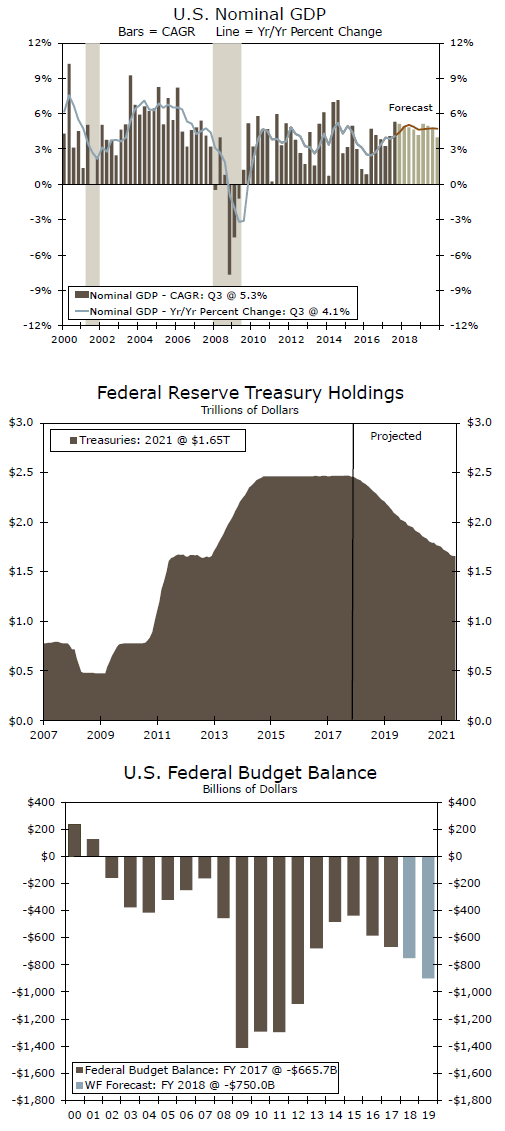
The case for higher U.S. Treasury yields in the United States in 2018 starts with the most basic of fundamentals: economic growth and inflation. When the 10-year U.S. Treasury yield reached a cycle low of 1.36 percent in the summer of 2016, it occurred at a time of global tumult related to the Brexit vote, but the underlying fundamentals of both U.S. economic growth and inflation were also very soft (top chart). Real GDP growth was a paltry 1.5 percent in 2016, and the PCE deflator rose just 1.2 percent over the same period. In 2017, real GDP accelerated to roughly a 2.3 percent pace, while inflation as measured by the PCE deflator strengthened to 1.7 percent.
Faster economic growth/inflation has pushed nominal GDP growth back to a 4 percent year-over-year pace, and we expect the upward trend to continue in 2018. We expect real GDP growth of 2.7 percent this year and for inflation to drift closer to the Fed's 2 percent target. A continued acceleration in GDP and prices suggests these two key fundamentals will be supportive of higher yields on U.S. Treasuries this year.
Fundamental #2: Monetary Policy
With faster growth/inflation and a falling unemployment rate, the FOMC is positioned to hike the fed funds rates multiple times for the second year in a row. We expect three rates hikes this year, occurring in March, June and September. If realized, this would put the fed funds target range at 2.00-2.25 percent by year end. The FOMC dot plot suggests a neutral rate of 2.50-2.75 percent, signaling that another year of three rate hikes would put the Fed within spitting distance of a "normal" stance of monetary policy, at least in regard to the fed funds rate.
With regards to the Fed's balance sheet, monetary policy remains more accommodative, but here too the fundamentals suggest upward pressure on Treasury yields. The balance sheet reduction program initiated last October will see the run-off caps rise to $50 billion/month in Q4-2018 for Treasuries and MBS. If the Fed follows its stated plan, approximately $230 billion in Treasury debt would mature and not be reinvested in 2018 (middle chart). Steady increases in the fed funds rate and snowballing balance sheet reductions suggest an upward shift for the yield curve in 2018.
Fundamental #3: Treasury Supply
After steadily failing through FY 2015, the federal budget deficit has begun to rise again (bottom chart). As a result, the supply side of the Treasury market will see a surge of new issuance due to several factors: secular pressures related to the aging Baby Boom generation, additional spending from an expected budget deal and for hurricane/wildfire related emergencies and lower tax collections as a result of the tax overhaul bill passed in December. A jump in net issuance represents an additional catalyst for higher Treasury yields in 2018.
Yen Subdued After Dollar Gains
USD/JPY is showing little movement in the Monday session. In North American trade, USD/JPY is trading at 113.00, down 0.06% on the day. On the release front, there are no major US or Japanese events. On Tuesday, the US releases JOLTS Jobs Openings.
On Friday, the US posted mixed employment numbers. Nonfarm Payrolls dropped to 148 thousand, down from 228 thousand in the previous release. This was well below the estimate of 190 thousand. There was better news from wage growth, which edged up to 0.3%, matching the forecast. This marked a 3-month high. The unemployment rate remained unchanged, at a sizzling 4.1%.
As we begin the New Year, what can investors expect from the Bank of Japan? BoJ Governor Haruhiko Kuroda has generally stuck to his script that the Bank will maintain its massive stimulus program until inflation rises, but there have been subtle hints form Kuroda that he could change course, if the economic rebound which marked 2017 continues. The stimulus program has failed to lift inflation above 1%, well below the BoJ inflation target of around 2%. Some analysts expect a 'stealth tapering', whereby the BoJ would reduce asset purchases and tighten policy, but in small, incremental steps. In this way, the BoJ could change its monetary stance, while minimizing market volatility.
Bank of Japan Governor Haruhiko Kuroda is slated to end his 5-year term in April, but will he be staying on? The Japanese government hasn't made up its mind, and Prime Minister Shinzo Abe said as much on Sunday. Abe said that Kuroda has met his expectations, but admitted that he had not made up his mind about the reappointment. With Japan posting seven straight quarters of growth and inflation moving higher, there's a strong likelihood that Kuroda will be given the green light for another term at the helm of the central bank.
Slew of Fed Speakers Have the Capacity to Affect Dollar Positioning
The dollar is in recovery mode on Monday after falling on Friday, recording its lowest since January 2 versus a basket of currencies and coming close to hitting a fresh 3½-month low. Dollar selling took place in the aftermath of December's jobs report which showed the US economy adding notably fewer positions than analysts had expected.
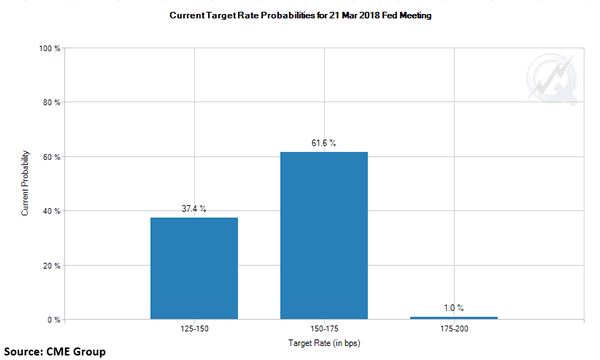
Despite earlier declines, the dollar managed to recover, finishing Friday's trading higher, albeit only slightly so. Dollar bulls eventually taking control was attributed to the fact that last week's NFP report doesn't seem to be changing perceptions among Fed policymakers, with markets continuing to in large part – more than 60% at the moment according to CME futures – pricing in a rate hike during the Federal Reserve's March meeting. Remarks by Fed policymakers late last week also played their role, with positive momentum for the US currency carrying through Monday's trading, as comments by FOMC policymakers were broadly tilted towards the hawkish side. The dollar index is trading in the green during Monday's trading and at a distance to Friday's low, touching 92.36 at its highest, a level last experienced on December 29.
In a Reuters interview over the weekend, San Francisco Fed President John Williams said that the US central bank should raise interest rates three times this year – as projected in December's dot plot – making reference to an already strong economy that will receive a boost from lower taxes and leaving the door open for more hikes (but less tightening as well) depending on economic conditions. John Williams is a hawkish-perceived FOMC member that is holding voting rights in 2018. Later on Monday – at 1835 GMT – he is scheduled to participate in a panel discussion titled "The Options: Keep it, Tweak it, or Replace It" with "It" referring to the Fed's 2% inflation target. Williams' comments will be attracting attention.
Cleveland Fed President Loretta Mester, also an FOMC voting member in 2018, was typically hawkish in her comments late last week, saying she expected four rate hikes in 2018; markets are currently roughly pricing in two 25 bps interest rate hikes in 2018.
Another hawkish-perceived FOMC member, Boston Fed President Eric Rosengren, will be participating in a discussion (2125 GMT) at the same event as John Williams, the topic of which is "Next Steps: Learning from the Bank of Canada". Unlike Williams, Rosengren doesn't hold voting rights in the FOMC in 2018; he will be a voting member next year.
Earlier on Monday – at 1740 GMT – Atlanta Fed President Raphael Bostic will be speaking on the economic outlook and monetary policy before the Rotary Club of Atlanta. Given that Bostic is holding a voting status in 2018 and being viewed as falling neither on the hawkish nor the dovish side of the spectrum, forex market participants will likely be paying attention to his comments.
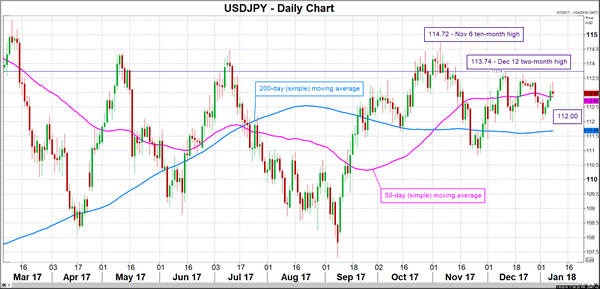
The dollar ended last week with a three-day advance versus the Japanese currency, its longest streak since the end of November. Should Fed-talk continue to be on the hawkish side, the pair is expected to head higher, especially if one takes into account that the Bank of Japan seems in no hurry to begin normalizing policy, even in light of stronger growth in the world's third largest economy. In such an event, a barrier to the upside is expected around December's 12's two-month high of 113.75. A successful break above it would shift focus to early November's ten-month high of 114.72, with the area around this level encapsulating a few other peaks from the relatively recent past.
On the downside and should the greenback fail to find support from comments by Fed officials, the range around the current level of the 50-day moving average at 112.86 might act as support. Price action is at the moment taking place close to this point, with a breach turning attention to the 112.00 handle, a potential psychological level and an area of congestion in recent weeks.
In a week packed with speeches by FOMC members, Minneapolis Fed President Neel Kashari is scheduled to participate in a Q&A session on Tuesday at 1500 GMT. Him and Chicago Fed President Charles Evans, with the latter participating in a discussion on current economic conditions and monetary policy on Wednesday at 1400 GMT, were the two FOMC members voting against an interest rate increase during the Fed's latest meeting in December. They're both thought of as chief doves by markets and they will importantly be losing their voting rights in 2018, a factor that renders some to speculate on a more hawkish-than-currently-priced-in direction by the Fed.
Other Fed speakers making talks this week are Dallas Fed President Robert Kaplan (centrist-viewed and non-FOMC voting member in 2018), St. Louis Fed President James Bullard (viewed as a dove and holding voting rights in 2019) and New York Fed President William Dudley (centrist-perceived with the New York Fed holding permanent voting rights within the FOMC). A few months ago, Dudley announced that he will be stepping down before his 10-year term at the NY Fed expires in January 2019. Speculation on who will replace him is well underway.
Beyond Fed officials, other catalysts could drive the US currency this week: perhaps most important in terms of releases are Friday's inflation and retail sales figures for the month of December, both due at 1330 GMT. Other data also have the capacity to drive positioning on the dollar, including tomorrow's JOLTS job openings report for the month of November to be made public at 1500 GMT.
Sunset Market Commentary
Markets
Global core bonds corrected higher today. The US Note futures tested the 123-12+ contract low early in the session, but a break didn't occur and attracted technically-inspired buying. A strong European equity market opening weighted as well in the early stages of dealings, but stocks couldn't build on that opening momentum. EMU EC confidence data went through the roof, but activity data aren't on investors' minds in this stage of the cycle. The US eco calendar is empty apart from Fed speeches. We particularly eye Atlanta Fed Bostic's view on the economy. Bostic votes on policy this year and today's speech is his first huge public address since being appointed mid last year. Any deviating view from the Fed's median forecast (3 rate hikes this year) has market moving potential. The US yield curve bull flattens at the time of writing with yields 0.4 bps (2-yr) to 1.8 bps (30-yr) lower. German yields drop between 1.3 bps (2-yr) and 2.2 bps (10-yr). On intra-EMU bond markets, 10-yr yield spread changes versus Germany narrow up to 4 bps (Portugal).
The dollar showed a mixed picture today. It gained ground against the euro but struggled against the yen. EMU eco data were strong. EC economic confidence hit the highest level since the autumn of 2000, but it didn't help the euro. German bunds even outperformed US Treasuries, slightly widening the EUR-USD interest rate differential. In combination with the rejected test of EUR/USD 1.2092 after Friday's payrolls, it was enough to trigger some further repositioning out of EUR/USD longs. The pair dropped below the 1.20 mark. USD/JPY initially tried to start a new up-leg, but the move lacked strong momentum. EUR/JPY profit taking after last week's rally and an easing of the equity rally weighed on USD/JPY later in the session. The pair struggles not to drop below the 113 mark.
Sterling trading was still dominated by technical considerations today. EUR/GBP drifted further sought in the 0.88 big figure, mirroring the decline of EUR/USD. The start of PM May's government reshuffle was slightly positive for sterling. EUR/GBP trades in the 0.8840 area. USD strength dominated the intraday price pattern of cable. The pair trades in the 1.3550 area.
European equities initially extended the positive momentum from Asia and from the US on Friday, opening with gains of up to 0.5%. However, there was no follow-through price action. The equity rally gradually ran into resistance. US equity futures indicated most losses. The major US indices opened with losses of about 0.1%/0.2%.
News Headlines
The economic confidence from the European Commission rose further in December to 116.0 from 114.6 in November, confirming a buoyant activity in EMU economy. The indicator touched the highest level since the autumn of 2000. The improvement was visible across all sectors including manufacturing, services, retail and construction. The Euro-zone business climate indicator showed a similar picture rising from 1.49 to 1.66.
November EMU retails sales printed at a strong 1.5% M/M and 2.8% Y/Y in November. The figure to some extent counterbalanced an unexpectedly large decline in October. Even so, the outcome was stronger than expected.
Romania's central bank delivered its first benchmark interest rate hike in a decade today, raising it by a quarter point to 2%, with inflation already above its 2017 forecast. A majority of analysts expected the bank to keep its policy rate unchanged.
AUDUSD Pauses its Bullish Rally; Momentum Indicators Signal Bearish Retracement
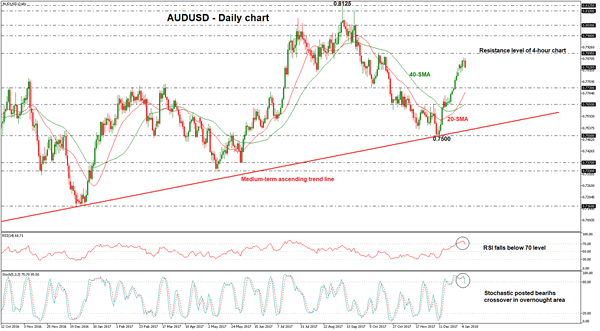
AUDUSD edged sharply higher in the near-term timeframe following the rebound on the 0.7500 significant support level that started on December 12, 2017. The price hit the ascending trend line on the medium-term chart, which has been holding since January 2016 before the upside movement.
However, given that the latest run appears overstretched and having a look at the momentum indicators in the daily chart, a correction setback may take place before buyers decide to push further. The Relative Strength Index (RSI) is pointing south in the overbought zone, which is a signal of a downward retracement, whilst the Stochastic oscillator recorded a bearish crossover with its moving averages as the %K line has moved below the slow %D line and both lines are heading lower.
The price started the day with sharp bearish move and if the bears take control, then the expectation is a pressure to the downside until the 0.7730 support level, which is near the 20-day simple moving average at 0.7710.
On the flip side, if traders manage to overcome the 0.7895 strong resistance level, this could strengthen the upside momentum and push the price perhaps towards the next obstacle of 0.8830. However, going in the 4-hour chart, there is a resistance before 0.8830 at 0.7980 where the price could pause its ascent there.
Turning our attention in the medium-term timeframe, AUDUSD printed the fourth bullish week in a row and surged 4.7%, endorsing the scenario for further gains during the next weeks.
CAC Rally Continues as Eurozone Indicators Beat Estimates
The CAC index has posted gains in the Monday session. Currently, the index is at 5487.50, up 0.31%. On the release front, there are no French events on the schedule. In the Eurozone, the week started on a positive note. Sentix Investor Confidence improved to 32.9, above the estimate of 31.5 points. Retail Sales rebounded with a strong gain of 1.5%, beating the estimate of 1.4%.
Global stock markets have started the New Year with gains. CAC has jumped onto the bandwagon, posted strong gains of 2.9% last week, and has posted three consecutive weekly wins. Investors are giving the eurozone economy a thumbs-up, a the bloc is on track for a solid fourth quarter, as growth continues and unemployment falls. Inflation has also moved higher, although the ECB is unlikely to reconsider its current stimulus program, which ends in September.
The German economy continues to look strong, despite a soft Factory Orders report for December. Retail Sales soared 2.3%, its fastest pace since October 2016. Services and Manufacturing PMIs improved and continue to point to strong expansion. The labor market remains robust, as unemployment rolls dropped sharply. However, the political landscape in the eurozone's largest economy remains cloudy. President Angela Merkel is now looking at the Social Democrats to help her make a new government, and preliminary talks are scheduled to begin on Sunday. The negotiations are likely to be lengthy, and the current caretaker government could remain in office for several more months.
GBPUSD Intraday Bearish 1.3550 Level
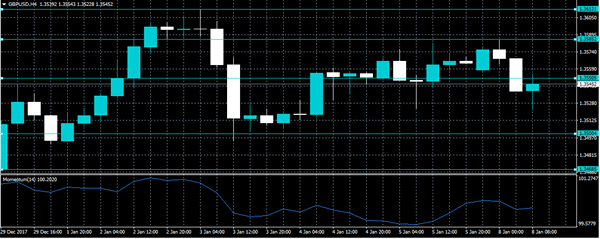
The British pound has started to trade below the key 1.3550 level against the U.S dollar, as the greenback starts to regain upside traction across the board. The GBPUSD pair earlier failed to make a new daily-high above the yearly trading high, found at 1.3613, encouraging traders to turn their attention towards the downside. Price-action currently sits around the 1.3540 level, after an earlier battle between buyers and sellers around the pivotal 1.3550 level. Headed into the U.S session, the directional bias of the U.S dollar index will likely dictate the pairs intraday price movements.
The GBPUSD pair is intraday bearish below the 1.3500 level, key downside targets remain 1.3500 and 1.3467.
Should price-action on the GBPUSD pair trade above the 1.3550 level, attention may shift back toward the 1.3567 and 1.3613 resistance levels.
EURUSD Further Beraish Below 1.1989 Level
The EURUSD pair has moved below the key 1.2000 level during the European trading session, as the U.S dollar index recovers towards the 92.30 mark. The euro has so far fallen towards the 1.1980 level, with only a tepid recovery as sellers retain control of the pair on Monday. Going forward, the 1.1989 level remains the key daily pivot point with losses towards 1.1958 expected if price-action holds below this key level. Moving into the U.S session, with a lack of macro-economic data, traders will likely focus on the greenbacks recent upside recovery.
The EURUSD pair is further bearish while trading below the 1.1989 level, further downside towards 1.1958 and 1.1910 seems possible.
Should the EURUSD pair start to move above the 1.2000 level, buyers may try to move price-action back towards the 1.2030 and 1.2050 resistance areas.