Sample Category Title
Daily Wave Analysis: EUR/USD Awaits Wave-4 Retracement After Impulsive 3rd Wave Completes
Currency pair EUR/USD
The EUR/USD seems to be continuing the uptrend within a wave 5 (purple) of a larger wave 1 (pink). The Fibonacci levels could act as potential resistance for the end of wave 1.
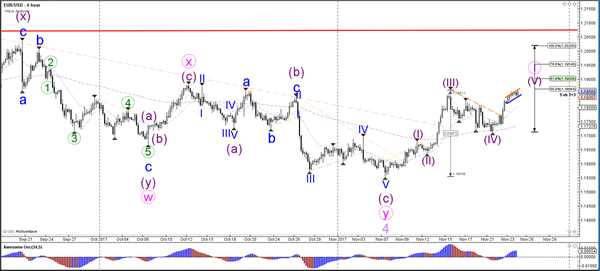
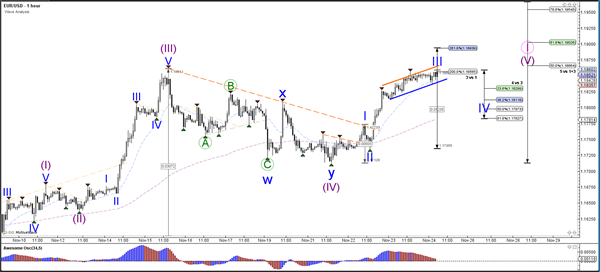
The EUR/USD is probably building a wave 5 pattern (blue) within wave 5 (purple). For the moment price seems to be in wave 3 (blue) which eventually could see a wave 4 retracement (blue).
Currency pair GBP/USD
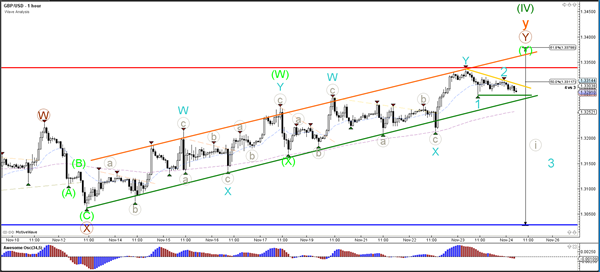
The GBP/USD channel has reached a key decision zone: the resistance of the sideways range (red). A bullish breakout above the resistance (red) could indicate a new uptrend whereas a bearish breakout could see price fall back to the bottom of the range (blue).
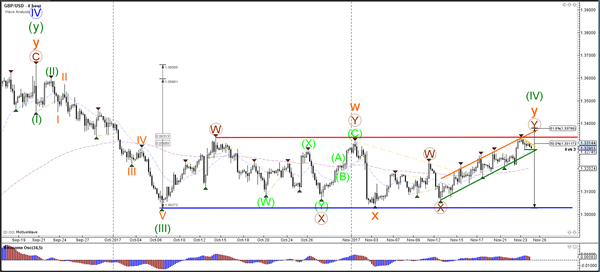
The GBP/USD has reached the bottom of the bullish channel, which is a key decision zone for a bearish bounce or bullish breakout.
Currency pair USD/JPY
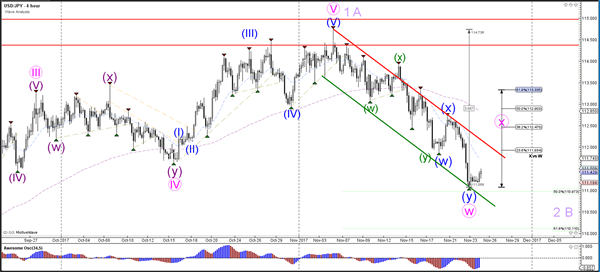
The USD/JPY is in the bearish channel but price indeed bounced at the 50% Fibonacci support level. Price could expand the bearish correction via a new WXY (pink) pattern.
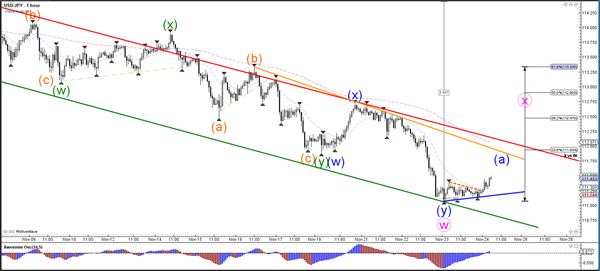
The USD/JPY bounced at the bottom of the channel and could be building an ABC (blue) pattern within the wave X (pink).
Elliott Wave View: EURAUD
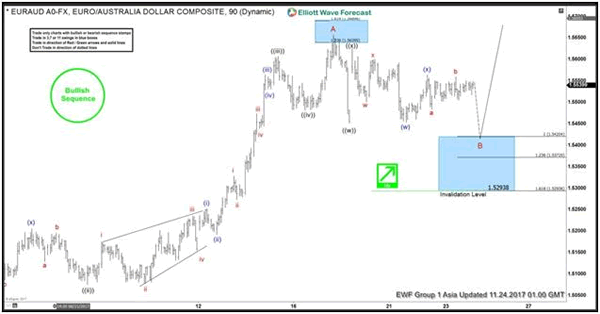
EURAUD Elliott Wave view suggests Intermediate wave (X) ended with the decline to 1.5057. The rally from there unfolded in 5 waves impulse Elliott Wave structure, and this means that while pullbacks stay above 1.5057 low, it could see further upside. Up from 1.5057, Minute wave ((i)) ended at 1.5234, decline to 1.5075 ended Minute wave ((ii)), Minute wave ((iii)) ended at 1.5606, decline to 1.5481 ended Minute wave ((iv)), and Minute wave ((v)) ended at 1.5657.
The 5 waves impulsive rally from 1.5057 low ended Minor wave A of a zigzag Elliott Wave structure. Minor wave B is currently in progress as a double three Elliott Wave structure. Minute wave ((w)) ended of B at 1.545 and Minute wave ((x)) of B ended at 1.5626. While below 1.5657, pair has scope to reach 1.529 – 1.542 area to end Minute wave ((y)) of B. Afterwards, pair should resume the rally higher or bounce in 3 waves at minimum. We don’t like selling the pair and expect buyers to appear in 3, 7, or 11 swing as far as pivot at 1.5057 low stays intact.
EURAUD 1 Hour Elliott Wave Analysis
Market Morning Briefing: Weakness In The Dollar Index
STOCKS
Dow (23526.18, -0.27%) was closed yesterday. As mentioned yesterday, some chances of testing 23750-23800 is possible in the near term. Trade within 23400-23800 is likely to continue.
Dax (13008.55, -0.05%) tested an intra-day low of 12921 yesterday before again bouncing back to close above 13000. While 13000 holds, some sideways movement within 13200-12900 is possible. In case the 12900 levels break, it would open up chances of testing lower levels of 12800-12700 in the medium term.
Nikkei (22446.13, -0.34%) is likely to move down while the 3-day resistance near 23000 holds. But a sharp rejection is not seen on the index yet. Looking at Dollar Yen (111.32), in case the currency pair moves lower to 111 and below in the coming sessions, it could lead to some fall in Nikkei too. Overall a sharp corrective dip is preferred in Nikkei so that it could get more room for an upmove in the longer run. Else the index could continue to range sideways without an immediate directional clarity.
Shanghai (3342.77, -0.27%) is trading at support near 3340 visible on the daily candles. A bounce from here would be expected towards 3380 and higher in the near term. Only on a failure to sustain above 3340, we may expect a fall to 3300. In the longer term, resistance near 3450 looks strong and has the potential to move the index to further downside.
Nifty (10348.75, +0.06%) is trapped in the 10300-10400 region since the last 3-sessions. Maximum downside for the near term is likely to be limited at 10200 while scope for a test of 10500 remains on the cards for the near term.
COMMODITIES
Gold (1292.28) and Silver (17.13) are both trading near previous levels and look stable just now.No major movement expected today. Gold could test 1300 and come back to 1285/80 while Silver may remain range-bound within 17.30-16.90.
Brent (63.38) and WTI (58.48) look bullish in the near term. Note resistance near 59 on WTI while Brent could move up to 65. In case 59 holds on WTI, a small corrective dip is possible in the coming week.
Copper (3.1505) is slowly moving up towards our mentioned target of 3.25 in the coming sessions. Near term looks bullish.
FOREX
Weakness in the Dollar Index (93.133) has persisted with the index trading just around the 93 level reached yesterday. This is in spite of some recovery in the US yields (see Interest Rates below). It could however test support near 92.60 in the next 2-3 sessions, from where a bounce is then likely.
Euro (1.1852) has moved up slightly with likelihood of testing resistance at 1.19 on the monthly charts in the coming week. However, with a slight recovery of US 10 yr yields and expected bounce in the Dollar Index soon, the resistance might hold, initiating a corrective dip back towards 1.175-1.180.
Dollar-Yen (111.34) looks set to reflect near term Dollar weakness with a test of support at 110 on the weekly candle chart. A rise in Japanese 10 yr yields (See Interest Rates below) is expected to support this bout of Yen strength in the next few sessions.
Pound (1.3297) after having moved beyond earlier resistance at 1.33, fell slightly, but with Dollar weakness expected in the near term, it is likely to test resistance at 1.135 in the daily charts soon. A breach past that and move towards resistance at 1.135 on the 3-day chart could happen with sustained bullishness.
Dollar Rupee (64.59) closed near our mentioned support at 64.60. If the currency pair does not bounce back from here today, we could see a test of 64.40 in the coming week. Also, there is some talks of a rating upgrade by S&P for India which if seen could lead to further strength in Rupee in the near term.
INTEREST RATES
While US yields have been coming down for the last few days, there is Support near current levels on the US 30Yr (2.75%) and on the 5Yr (2.06%). The 10Yr (2.33%) has Support lower down near 2.25%.
Perhaps the market is looking in the rear-view mirror instead of the rise in Brent (63.37) going ahead. Let us see if US yields pick up from here.
German yields have dipped a bit. The 2Yr (-0.71%) has strong long-term Resistance near current levels. Similarly, the Japanese 10Yr (0.03%) has an important/ strong Resistance near current levels. It will be interesting to see if they come down sharply from here. Looking at these, the US Dollar still has an overall interest rate advantage.
Looking at the US Yield Curve, the 30-5 yr Spread (0.69%) could have channel Support coming up soon, suggesting chances of a pick up in the US 30Yr (2.75%), as mentioned above as well.
In India, the 10Yr GOI (6.9861%) moved up a bit from 6.9585% earlier. There is market talk that S&P may also upgrade India's rating soon.
EUR/AUD Swing High Resistance Zone
Onto today's technicals and we're back at it today with a look at one of my favourite forex crosses: EUR/AUD. Do you remember the “Crunch time” for EUR/AUD support blog? Well the support level in question held and price has now kicked up to major swing high resistance:
EUR/AUD Daily:
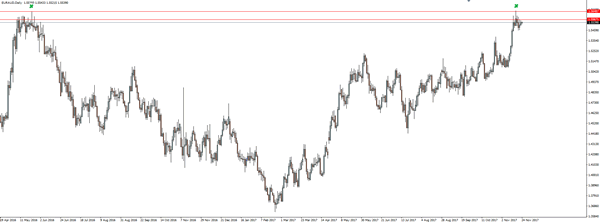
This is obviously a very crunchy resistance zone and I’m excited by the fact that price has held the zone on the higher time frame chart. Now depending on how aggressive you are as a trader, you have a few choices.
You could immediately short the level. It Is below it again and looks like holding. Alternatively, you could wait until a new low is made on an intraday chart and then sell any short term rallies back into previous short term support turned resistance.
USD Limps Out Of Thanksgiving Holiday ‘Wobble Wooble’
USD limps out of Thanksgiving Holiday 'Wobble Wobble.'
As to be expected the overnight session was very quiet as is typical with most US Traders off to celebrate Thanksgiving.However, if you were long EURUSD, there was much to be thankful as the single currency continued to gather steam and eeked out its highest level since the November 15 ramp amid positive German political developments after Martin Schulz’ suggested the SPD would “be open to talks'with Merkel. And the day was capped off with Eurozone data blasting through expectations with EU manufacturing recording the second-highest ever print.
The Euro
The positive German political developments initiated an unwind of any lingering short EUR positions undertaken on Monday following the breakdown of Merkel’s coalition talk when the early APAC Monday morning EU political headline mousetrap sprung again. Merkle is such a shrewd political warhorse and markets should never underestimate her clout. Any lingering Euro shorts are looking a bit questionable at this stage.
The robust EU economic data does suggest a more aggressive tack from the ECB, but the latest iteration of the ECB minutes suggests the Board remains divided over keeping QE open-ended while committed to keeping interest rates low for a lengthy period.
The ECB is facing the same problem as the US; the Eurozone economy continues to roar, but inflation remains to undershoot expectations. But none the less, the stellar economic data is just too juicy for dealers to ignore. We’re not far off the 1.1875 major band of resistance which if breached should open up the door to a more generous move higher towards the 1.2000 regions.
Besides the Euro move, the markets remain glued to USDJPY momentum after US Fixed income market rallied post- FOMC minutes, which continues weighing on the US$ and predominantly led by USDJPY
The Japanese Yen
USDJPY is always tricky around a significant big figure( 111) especially as the market now finds itself quite short in a falling knife scenario. Frequently at these key support lines, there are a few quick covering pullbacks before any serious attempt to re-engage the downside if it warrants. Notwithstanding that holiday thin trading conditions are making dealers reluctant to press their fortunes by taking a run at the 111. But market chatter suggests the BoJ are preparing to move their yield target rate higher. The BoJ policy shift is based on reading between the lines from Kuroda’s speech delivered last week in Zurich when he surprisingly acknowledged some negative impact BoJ’s extreme monetary accommodation and quite the departure from his typical pro easy money policy stance. Rumour mills aside, I think it safe to say that given the recent FOMC dovish tack, despite the FOMC confirming the Dec rate hike, topside USDJPY momentum should be a grind at least until the dust settles on US tax reform
The Australian Dollar
The Aussie is trading firmer this morning as the Greenback continues to falter. Also, the bullish momentum on Iron ore has caught more than a few by surprise given China’s moves to deleveraging and efforts to curb pollution by targeting steel industry
Trading the China storyline is little more than a fool’s errand at best as on the one hand, we have a 16 % surge in iron ore prices this month only to get sideswiped by a complete meltdown on the SHCOMP which suffered its worst one-day fall in 17 months on Thursday. One step forward and two steps back. But needless to say, all eyes will be on China equity markets today.
Energy Prices
Oil l prices nudged noiselessly higher overnight touching two-year highs as reports from Canada Oil sands warn of production slowdowns while the prevailing sense that OPEC production cuts are winning the war of sentiment continues to resonate.
SHCOMP
China equities sold off by 2.30% late in the afternoon session with insurers and banks leading the declines. The key driver for the weakness was news overnight that the regulators have ordered the sizeable Anbang insurance group to reduce its holdings of shares in China Minsheng Banking and China Merchants bank to no more than 5%.Given the recent ramp in Bank stocks powered on by financial deregulation, the news is especially cutting as, with only one-week, mainland investors have gone from cheer to jeer.
The Chinese Yuan
The Yuan is becoming a fantastic benchmark for gauging US dollar sensitivity as the Pboc guidance is capturing the broader G-10 move well as the pair took another leg lower on the back of the dovish FOMC. But the market is a bit muddled after $CNH short-term cash remained tight with the weekend rolls at 15 (5 pips per day). When money is tight, the CNH tends to become predictably unpredictable.
Asia FX
It’s been a dizzying week of action as the regional currencies continue to eek our fresh yearly highs. Typically, local currency activity falls to a drip over US Thanksgiving, but volumes have been staggering this year as a sense of pervasive apprehension anxiety sets in as investors don’t want to miss this party
Predictably, profit taking ensued after yesterday’s SHCOMP meltdown, but this was viewed in an isolated context, and the market is still eager for local currency exposure.
But we have come a long way fast and while the supporting scrim remains especially supportive for KRW, MYR, in the absence of a broader flood lower in the dollar, we will most likely consolidate into the weekend. But on any broader USD wobble, the local basket looks charged and ready to rumble.
Gold Quiet As US Markets Closed For Thanksgiving
Gold is showing little movement in the Thursday session. In North American trading, the spot price for an ounce of gold is $1291.23, down 0.08% on the day. U.S markets are closed for the Thanksgiving holiday, and there are no U.S events on the calendar.
Federal Reserve policymakers remain upbeat about the U.S economy, according to the minutes of the most recent policy meeting. The minutes, released on Wednesday, indicated that policymakers expected the U.S economy to continue showing strong growth, and predicted that interest rates will be raised in the “near term”. The members discussed the vexing question of why inflation has been persistently low (no quick-fix solution was provided), with most agreeing that a tight labor market should lead to higher inflation levels. Although policymakers did not provide further hints about the timetable of a rate hike, the markets remain convinced that additional rates are imminent. The odds of a rate hike in December are 91%, and the odds a January raise are at 89%.
Investors continue to monitor President Trump’s tax reform bill as it winds it way through Congress. Gold prices have been fluctuating since the House passed a tax bill last week, and traders can expect the movement to continue when the Senate votes on its version of the bill after Thanksgiving. Gold prices started the week with considerable losses, but then reversed directions and posted gains on Tuesday and Wednesday. If Congress does succeed in enacting a new tax code, the US dollar could make strong gains, at the expense of gold.
Pound Rises To 5-Week High As GDP Improves
The British pound moved higher earlier in the Thursday session, but has given up these gains. In North American trade, GBP/USD is trading at 1.3304, down 0.14% on the day. On the release front, it is a busy day in the UK. British Second Estimate GDP edged up to 0.4%, matching the estimate. Preliminary Business Investment improved to 0.2%, but missed the forecast of 0.3%. As well, CBI Realized Sales soared to 26, crushing the estimate of 5 points. U.S markets are closed for public holidays, and there are no U.S events on the calendar.
If the British economy is slowing down, someone needs to notify the CBI, whose indicators have pointed sharply higher this week. British retail sales jumped in November, as CBI Realized Sales rebounded with a strong reading of 26 points. The release was all the more impressive, as the indicator came in at -36 points in October. On Monday, CBI Industrial Order Expectations on Monday, an important barometer of activity in the manufacturing sector. The indicator surged to 17 points in October, rebounding from the September release of -2 points. Manufacturing indicators continue to point upwards, boosted by strong global demand and a weak British pound. Export order books are at their highest levels since 1995, and the markets are predicting that the export and manufacturing sectors will continue to shine in the fourth quarter.
On Wednesday, British Finance Minister Philip Hammond released the August Budget, which was noteworthy for a large contingency fund for Brexit. Hammond announced he was setting aside GBP 3 billion pounds over the next two years, beefing up the contingency fund of GBP 700 million. Meanwhile, the Office for Budget Responsibility (OBR) downgraded Britain’s GDP for 2017, from 2% to 1.5%. The OBR also revised downwards productivity growth and business investment, further signs that the economy could be headed for a down-spin.
Federal Reserve policymakers remain upbeat about the US economy, according to the minutes of the most recent policy meeting. The minutes, released on Wednesday, indicated that policymakers expected the U.S economy to continue showing strong growth, and predicted that interest rates will be raised in the “near term”. The members discussed the vexing question of why inflation has been persistently low (no quick-fix solution was provided), with most agreeing that a tight labor market should lead to higher inflation levels. Although policymakers did not provide further hints about the timetable of a rate hike, the markets remain convinced that additional rates are imminent. The odds of a rate hike in December are 91%, and the odds a January raise are at 89%.
Yen Rally Interrupted as US, Japan Mark Thanksgiving Holiday
After strong gains on Wednesday, the Japanese yen has paused in light holiday trade on Thursday. In the North American session, USD/JPY is trading at 111.26, up 0.05% on the day. Traders can expect little movement from the pair throughout the day, as Japanese and US markets are closed for public holidays. There are no US events on the calendar. Later on Thursday, Japan releases Flash Manufacturing PMI, with an estimate of 52.6 points.
There were no surprises in the Federal Reserve minutes from its last meeting, which were released on Wednesday. The minutes indicated that policymakers expected the U.S economy to continue showing strong growth, and predicted that interest rates will be raised in the "near term". The members discussed the vexing question of why inflation has been persistently low (no quick-fix solution was provided), with most agreeing that a tight labor market should lead to higher inflation levels. Although policymakers did not provide further hints about the timetable of a rate hike, the markets remain convinced that additional rates are imminent. The odds of a rate hike in December are 91%, and the odds a January raise are at 89%.
The Bank of Japan has declared more than once that it will hold the course on its massive easing program, even though the Japanese economy has rebounded in 2017, in large part due to stronger global demand for Japanese products. Recently, however, there have been some slight hints that the Bank of Japan might be having second thoughts. BoJ Governor Haruhiko Kuroda recently acknowledged that ongoing easing could hurt bank margins. Kuroda said that BoJ needed to pay attention to the "reversal rate", whereby a rate cut by the central bank discourages bank lending. Still, most economists don't expect a cutting of stimulus until in the near future, so any hints of a change in the status quo would likely shake up the Japanese yen.
Euro Boosted on Upbeat PMI Figures; Dollar Index Records 6-Week Low
The euro was on the rise during today's European trading relative to major other currencies as preliminary November eurozone PMI figures surprised to the upside. The greenback was on a negative footing after markets interpreted the Fed minutes from its latest meeting as being on the dovish side, while the Canadian dollar lost ground after retail sales out of the country came in below analysts' projections.
At 1525 GMT, the dollar's index against a basket of currencies was 0.1% lower at 93.15, touching 93.07 at its lowest, a level last experienced on October 12. Yesterday it lost 0.8% to post its worst daily performance in months as investors lowered their expectations for the number of interest rate hikes to be delivered next year after the Fed minutes of the Oct.31-Nov.1 meeting showed some FOMC members worrying about persistently low inflation, with the inflation path determining whether they will back future rate increases by the US central bank.
Dollar/yen was little changed at 111.26. Yesterday, the pair retreated by 1.1%, while it touched a two-month low of 111.05 during today's Asian trading. Trading activity is thinner today with US markets closed for Thanksgiving and Japanese markets also closed for a public holiday.
Eurozone November flash PMI data for the manufacturing and services industries, as well as the composite measure that blends the two sectors, all came in above expectations, pointing to broad-based growth in the euro area. Manufacturing PMI stood at 60.0 – the second-best reading in the index's history – versus projections of 58.3 and October's 58.5. The number for the services sector was at 56.2, with expectations and October's print at 55.1 and 55.0 respectively. Composite PMI came in at 57.5 – its highest since April 2011 – with expectations and last month's figure both standing at 56.0. All figures were comfortably above the 50-thershold that separates expansion from contraction.
The respective figures for Germany and France, eurozone's two largest economies, were released earlier in the day and broadly came in above analysts' forecasts as well, painting a positive picture ahead.
Euro/dollar, which was already on a positive footing on the back of dollar weakness, continued gaining after the release of the figures. The pair last traded 0.2% up on the day at 1.1844, little below an eight-day high tracked earlier in the day as well as not far below November 15's six-week high of 1.1860. Should it finish higher, then this would mark the third straight day of advancing for the pair.
Before the release of PMI estimates, Germany also saw the release of third quarter GDP figures. Those showed the economy expanding by 0.8% q/q, in line with projections, and by 2.3% y/y versus forecasts of 2.6%. Euro/dollar didn't react much within the first minutes of the release.
ECB minutes pertaining to the central bank's latest meeting showed policymaker's broad agreement on extending the bank's asset purchase program at half the current pace of 60 billion euros per month (starting in January 2018 up to September of the same year), though there were differing opinions on maintaining the program's open-ended nature as arguments were put forward for the need to have "a clear end date" for the scheme. Some dissenters even supported the view that the central bank should stop linking its asset purchases to the path of inflation and instead make reference to its overall monetary policy stance. Euro/dollar experienced volatility upon the release of the minutes, rising to 1.1855 on the upside – it's highest for the day – with the pair more or less settling to where it traded before the release a few minutes later.
The second release of third quarter UK GDP data showed the economy expanding by 0.4% q/q as expected and 1.5% y/y, again in line with forecasts. The data showed increased household spending but a slower pace of business investment relative to the preceding quarter, with the latter being taken as a sign of cautiousness on the back of Brexit uncertainty. Sterling was last down versus both the dollar and the euro though it managed to maintain most of yesterday's gains relative to the former. Specifically, pound/dollar was 0.2% down at 1.3305 after previously rising to 1.3336, its highest since October 2. Euro/pound was 0.4% up, just above the 0.89 mark.
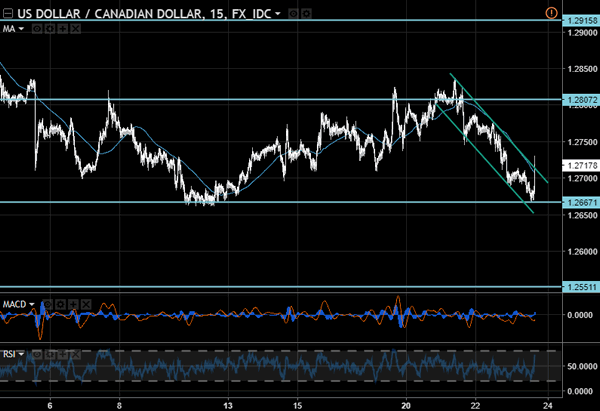
Canadian retail sales for the month of September fell short of analysts' expectations as they grew by 0.1% m/m, significantly below forecasts for a rise of 0.9%. Core retail sales that exclude automobiles, expanded by 0.3% m/m in September, with expectations standing at 1.0%. Overall, sales grew in five out of eleven sectors. The loonie lost ground relative to the greenback as the data went public with dollar/loonie jumping higher. The pair was last 0.2% up on the day at 1.2720, recovering from earlier losses that saw it fall to 1.2668 at one point in the day, its lowest since November 10.
Kiwi/dollar traded 0.15% up on the day at 0.6891 ahead of New Zealand trade data scheduled for release at 2145 GMT. The pair pierced the 0.69 handle earlier in the day to record an eight-day high.
In commodities, gold was not much changed at $1,291.12 per ounce. The dollar-denominated precious metal yesterday benefitted from the weaker greenback to finish the day higher by 0.9%. WTI was 0.45% higher at $58.28 per barrel, close to $58.31, its highest since July 2015 recorded earlier in the day. Brent crude was flat at $63.35 a barrel, trading relatively close a recently recorded more than two-year high of $64.65.
USDCAD Soars on Weak Retail Sales in Canada
The EUR/USD continued growing amid low trader activity due to the Thanksgiving celebration in the US today. Euro bulls got a boost from a block of positive data that came in today. The German economy expanded by 0.8% in the third quarter, which was in line with the forecast. Moreover, the flash manufacturing PMI in the Eurozone increased to 60.0 in November and flash services PMI reached 56.2. The average forecasts were 58.3 and 55.3 respectively.
The British pound is growing, after falling earlier, thanks to GDP growth statistics in the UK, according to which, the national economy expanded by 0.4% in the third quarter. The sterling got a further boost from the CBI realized sales which increased to 26 compared to the 5 predicted. The growth potential of the UK pound is likely to be limited by headwinds linked with the uncertainty of the outcome of the Brexit talks but the main attention for GBP/USD traders will be on the movement of the greenback.
The USD/CAD quotes rose sharply after the release of the retail sales report. The indicator increased by 0.1% in September compared to 0.9% expected. The core retail sales grew by 0.3% which was 0.6% worse than forecasted.
The volatility of the NZD/USD is likely to increase later today after the release of New Zealand's trade balance data due at 21:45 GMT.
EUR/USD
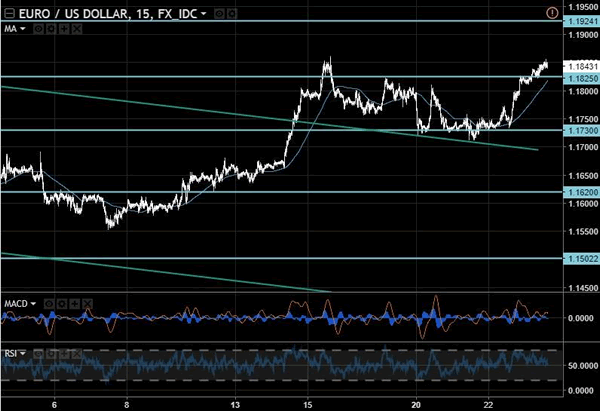
The EUR/USD quotes keep rising and are currently located near the 1.1850 line. Previously the pair was able to overcome resistance at 1.1825, which may become an additional stimulus for the bulls to push the price upwards to 1.1925 and 1.2000. On the other hand, we may see the price rollback to the support at 1.1730. Volatility is likely to remain low till the end of the week due to lower trading activity.
GBP/USD
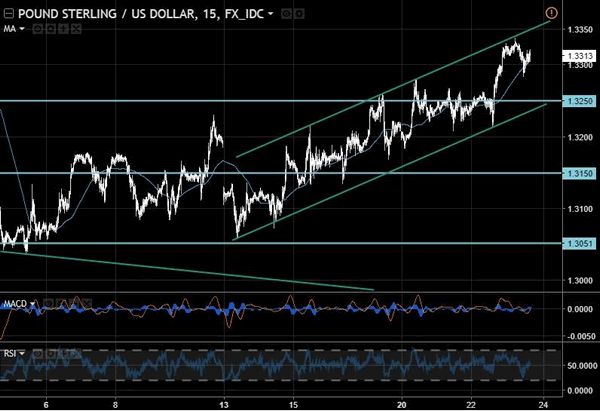
The GBP/USD resumed positive dynamics after reaching the SMA100 on the 15-minute chart. The next objective in case of price growth, within the limits of the channel, will be at 1.3400. In order to change the current positive dynamics, quotes need to fix under the 1.3250 support line, and the lower limit of the rising channel.
USD/CAD
The USD/CAD quotes rebounded from the strong support line at 1.2665. As a result, the price has broken the upper limit of the local descending channel which may become the trigger for maintaining the current positive impulse to 1.2800. The RSI on the 15-minute chart approached the overbought territory which points to a possible rollback soon.