Sample Category Title
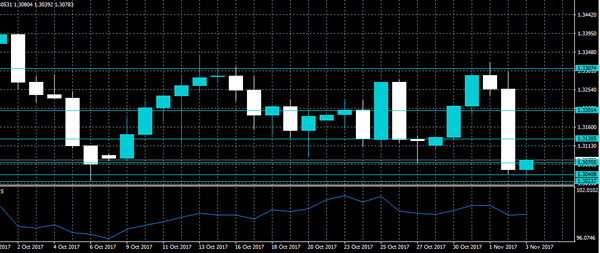
GBPUSD Strongly Bearish Below 1.3130
The British pound continues to trade towards the bottom end of its one-month range against the U.S dollar, despite better than expected UK Services PMI data earlier. The GBPUSD pair currently trades around the 1.3080 level, managing only a muted reaction to much better UK data. Sterling traders now awaits the release of the NFP jobs report, with expectations for the headline jobs figure skewed to the upside.
The GBPUSD pair is strongly bearish while trading below the 1.3130 level. Further declines towards the 1.3040 and 1.2980 levels remains likely.
Should price-action move back above the 1.3130 level for a sustained period, further upside towards the 1.3200 and 1.3307 levels remains possible.
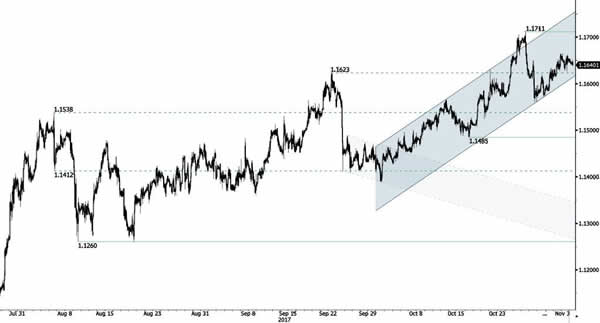
EURUSD Still Bearish Below 1.1670
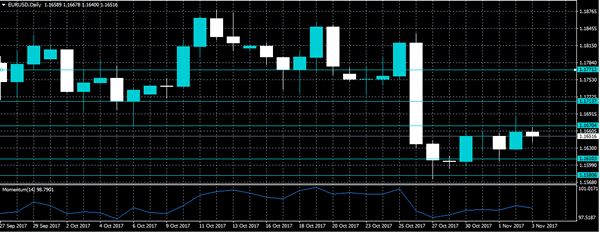
The euro remains strongly bearish against the U.S dollar, heading into today's October U.S jobs report. The EURUSD pair has repeatedly struggled to gain upside traction above the 1.1670 level this week, with numerous technical rejections. Price-action currently trades around the 1.1640 region, as traders await the release of the NFP jobs report, with expectations of a solid 300,000 new U.S jobs added in the previous month.
The EURUSD pair is likely to remain under heavy selling pressure while trading below the key 1.1670 level. Further selling towards 1.1610 and 1.1580 should be expected, extended resistance is found at the 1.1510 level.
Should price-action move back above the 1.1670 for a sustained period, further upside towards the 1.1713 and 1.1771 levels remains likely.
Canadian Dollar Steady Ahead of Canadian, US Employment Data
The Canadian dollar has ticked higher in the Friday session. Currently, USD/CAD is trading at 1.2828, up 0.15% on the day. In economic news, the spotlight is on employment indicators on both sides of the border, so we could see some movement from the pair in the North American session. US releases Average Hourly Earnings, Nonfarm Payrolls and the unemployment rate. The markets are expecting NFP to rebound to 311 thousand, but Average Hourly Earnings is forecast to slow to 0.2 percent. No change is expected in the unemployment rate, with an estimate of a sizzling 4.2 percent. As well, the US releases ISM Non-Manufacturing PMI, which is expected to drop to 58.5 points. Canada releases Employment Change, with a forecast of 15.3 thousand. The unemployment rate is forecast to hold at 6.2%, and we'll also get a look at Trade Balance.
October was a rough month for the Canadian dollar, as the currency slipped 3.4 percent. Bank of Canada Governor Stephen Poloz didn't help matters, as he spoke in sober terms about the economy in his testimony before a parliamentary committee. Poloz said that the economy is at a "crucial" spot in the economic cycle, noting concern over soft inflation and wage growth, and high household debt. Poloz said that the BoC will be cautious before raising interest rates. The markets are not expecting any moves before 2018, with the likelihood of a rate hike in December at just 21 percent. Canadian GDP declined in August, disappointing the markets. The decline of 0.1% was the first drop since October 2016. With the Federal Reserve expected to raise rates at its December meeting, the loonie's slide could continue if the BoC does not match the Fed and raise rates next month.
On Thursday, US President Trump nominated Federal Reserve Governor Jerome Powell to head the Federal Reserve. Powell will take over in February 2018 when Yellen's term expires. Powell is expected to hold the course with monetary policy, which has been marked by incremental and small rate hikes since December 2015. It's all but a given that the Fed will raise interest rates in December, but the forecast for 2018 is less clear. If the US economy continues to grow at current levels, we could see up to three rate hikes next year. Powell will also be tasked with continuing to trim the Fed's huge balance sheet of $4.2 billion. Last month, the Fed has started trimming the balance sheet by $10 billion/mth, but these cuts are expected to increase in size next year.
DAX Hits Record High As German Economy Thrives
The DAX has posted gains in the Friday session. Currently, the DAX is at 13,481.00, up 0.30% since the close on Thursday. There are no eurozone indicators on Friday. The US releases key employment numbers, led by nonfarm payrolls. The indicator is expected to soar to 311 thousand in October, after a decline a month earlier. However, wage growth could be in trouble, as Average Hourly Earnings is forecast to slow to 0.2 percent. No change is expected in the unemployment rate, with an estimate of a sizzling 4.2 percent. As well, the US releases ISM Non-Manufacturing PMI, which is expected to drop to 58.5 points.
The DAX posted strong gains this week, in response to the release of positive corporate earnings. Automobile sector posted strong gains, led by BMW, Daimler and Volkswagen. The DAX has set another record high on Friday, and the index has jumped 9.6 percent since early September. The robust German economy has helped boost German stock markets, and with the economy expected to record a strong fourth quarter, the DAX rally could continue.
German numbers looked sharp this week, as the largest economy in the eurozone continues to perform well in 2017. Manufacturing PMI remained steady at 60.6, its highest level since April 2011. The German labor market continues to impress, as unemployment rolls declined for a third straight month in October. Unemployment has now dropped in all but two readings since June 2015.
After an excellent GDP report last week, the US economy faces another report card on Friday. The US releases nonfarm payrolls and wage growth, and the readings could affect global stock markets. Nonfarm Payrolls posted a rare decline in September, a result of the hurricanes which battered the US. The markets are expecting job growth to surge in October, with an estimate of 311 thousand. However, wage growth could weigh on the markets, as Average Hourly Earnings is forecast to slow to 0.2 percent.
CRUDE OIL Starting A Consolidation Process
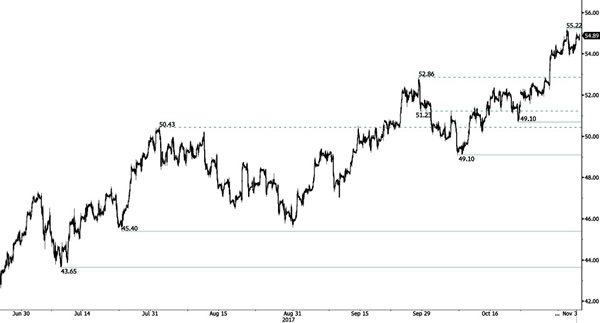
Crude oil has surged and set up a new resistance at 55.22 (.01/11/2017 high). The commodity is monitoring 1-year high. Expected to show further shot-term bearish consolidation. Indeed the technical structure has a history of decent consolidation phase.
In the long-term, crude oil has recovered after its sharp decline last year. However, we consider that further weakness are very likely. For the time being the pair lies in an upside momentum. Strong support lies at 35.24 (05/04/2016) while resistance can now be found at 55.24 (03/01/2017 high).
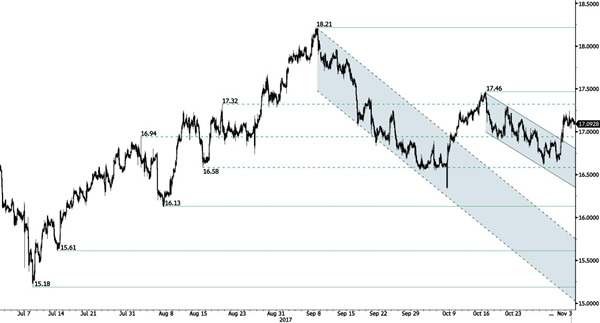
SILVER Consolidating After Bullish Breakout
Silver is now trading above 17. Hourly support can be found at 16.60 (27/10/2017 low). Hourly resistance is given at 17.46 (13/10/2017 high). Additional support can be found at 16.13 (06/10/2017 low).
In the long-term, the trend is rater negative. Further downsides are very likely. Resistance is located at 25.11 (28/08/2013 high). Strong support can be found at 11.75 (20/04/2009).
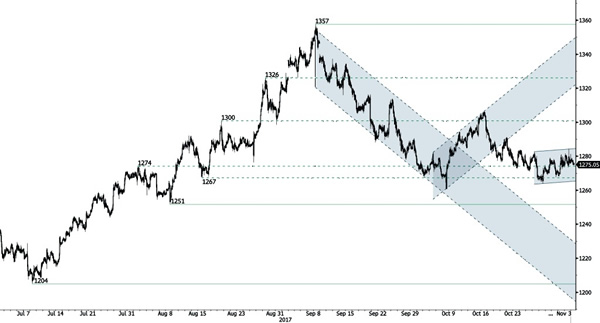
GOLD Slow Bullish Momentum
Gold remains weak. The technical structure confirms the end of the bearish trend. Support lies at a distance at 1251 (08/08/2017 high). Resistance is now located at 1288 (20/10/2017).
In the long-term, the technical structure suggests that there is a growing upside momentum. A break of 1392 (17/03/2014) is necessary ton confirm it, A major support can be found at 1045 (05/02/2010 low).
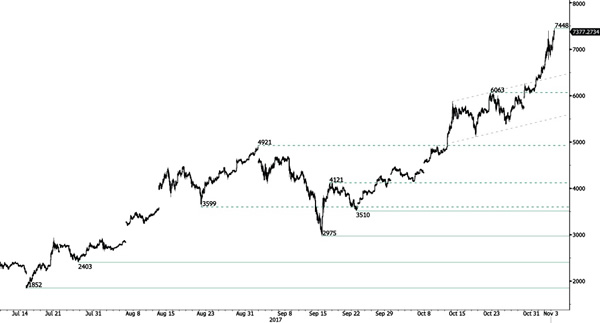
BITCOIN The Gold Rush Continues
Bitcoin has set up a new all-time high for 4 consecutive days. The technical structure shows a tremendous positive short-term momentum. Hourly support can be located at 6027 (30/10/2017 low). Strong support stands very far at 2975 (22/08/2017 low). In the short-term, the digital currency should continue rising.
In the long-term, the digital currency has had an exponential growth. There are decent likelihood that the asset will reach $10'000.
EUR/CHF Pushing Higher Within Former Uptrend Channel
EUR/CHF is back within former uptrend channel. Support is given at 1.1610 (27/10/2017 low). Rising channel suggests further bullish momentum.
In the longer term, the technical structure has reversed. Strong resistance is given at 1.20 (level before the unpeg). Yet, the ECB's QE programme is likely to cause persistent selling pressures on the euro, which should weigh on EUR/CHF. Supports can be found at 1.0184 (28/01/2015 low) and 1.0082 (27/01/2015 low).
EUR/GBP Surging
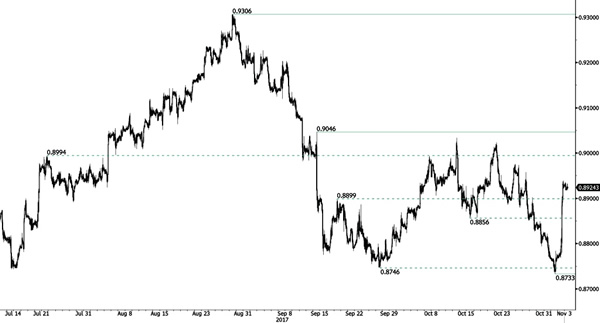
EUR/GBP has sharply increased. As long as prices are below the resistance at 0.9046 (05/09/2017 high), the short-term technical structure is biased to the downside. Hourly support is given at a distance at 0.8733 (01/11/2017 low).
In the long-term, the pair has largely recovered from recent lows in 2015. The technical structure suggests a growing upside momentum. The pair is trading above from its 200 DMA. Strong resistance can be found at 0.9500 (psychological level).