

Sample Category Title
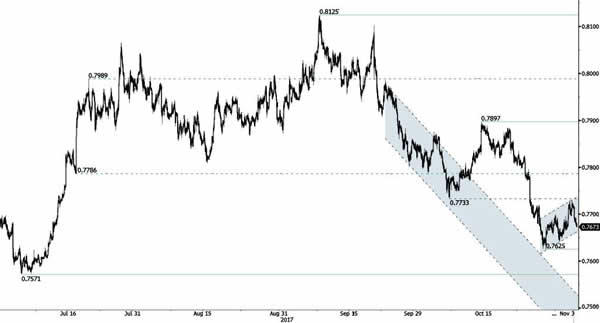
AUD/USD Short-Term Positive Technical Structure
AUD/USD is ready to bounce back but downside pressures are still lively. Hourly resistance is given at a distance at 0.7897 (13/10/2017 high). Expected to show renewed pressures towards key support at 0.7571 (05/07/2017 low).
In the long-term, the trend is turning positive. Key supports stands at 0.6009 (31/10/2008 low) . A break of the key resistance at 0.8164 (14/05/2015 high) is needed to invalidate our long-term bearish view.
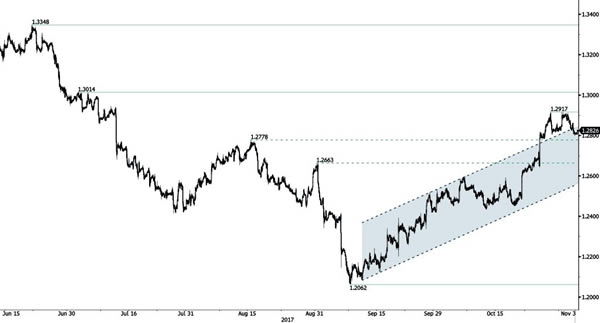
USD/CAD Profit-Taking
USD/CAD is still holding above former resistance at 1.2778 (15/08/2017 high). This suggests an extension of bullish momentum. Hourly support lies at 1.2331 (26/09/2017 high). Expected to show continued short-term bullish pressures.
In the longer term, the pair has broken longterm support that can be found at 1.2461 (16/03/2015 low). Strong resistance is given at 1.4690 (22/01/2016 high). The pair is likely to head further lower.
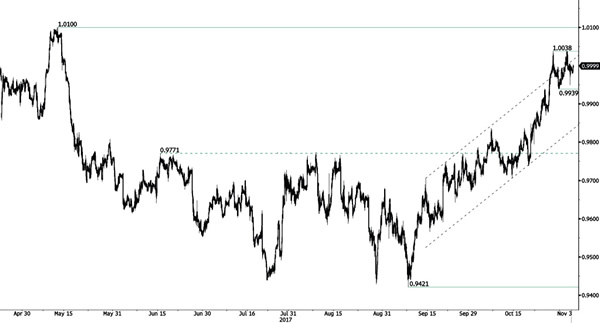
USD/CHF Holding Below Parity
USD/CHF is consolidating. Yet, the technical structure is clearly bullish. The technical structure suggests an improving short-term buying interest. Expected to show continued bullish momentum. Hourly support stands at 0.9951 (01/11/2017 low).
In the long-term, the pair is still trading in range since 2011 despite some turmoil when the SNB unpegged the CHF. Key support can be found 0.8986 (30/01/2015 low). The technical structure favours nonetheless a long term bullish bias since the unpeg in January 2015.
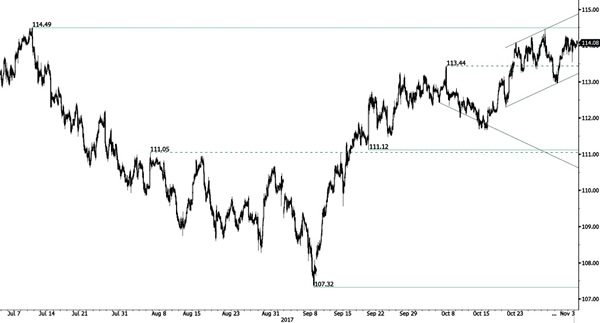
USD/JPY Stalling Below Resistance At 114.49
USD/JPY is pausing below strong resistance stands at 114.49 (11/07/2017 high). Support is located at 111.12 (20/09/2017 low).
We favor a long-term bearish bias. Support is now given at 99.02 (10/08/2013 low). A gradual rise towards the major resistance at 125.86 (05/06/2015 high) seems unlikely. Expected to decline further support at 93.79 (13/06/2013 low).
GBP/USD Strong Decline
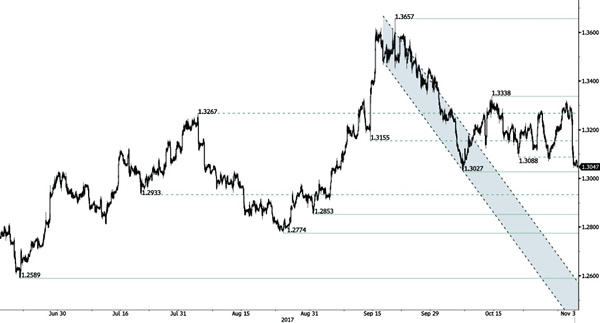
GBP/USD is back towards resistance given at 1.3027 (06/10/2017 low). String resistance is given at 1.3338 (13/10/2017 high). Expected to show continued decline.
The long-term technical pattern is reversing. The Brexit vote had paved the way for further decline. Long-term support can be found at 1.1841 (07/10/2017 low). Long-term resistance given around 1.35 is at stake and indicates a long-term reversal in the negative trend. Yet, it is very unlikely at the moment.
EUR/USD Slight Increase
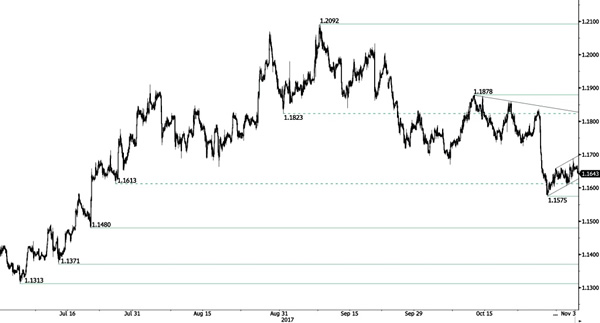
EUR/USD is edging higher after setting a new hourly support at 1.1575 (27/10/2017 low). Hourly resistance is located at 1.1658 (30/10/2017 high). Expected to show some short-term consolidation.
In the longer term, the momentum is now turning largely positive. We favour a continued bullish bias. Key resistance is holding at 1.2252 (25/12/2014 high) while strong support lies at 1.0341 (03/01/2017 low).
Next Up, U.S Jobs Report
Friday November 3: Five things the markets are talking about
The October U.S jobs report is set for release at 08:30 am EDT and after the September headline print revealing the first monthly drop in seven-years – attributed to a hurricane effect – investor expectations for last month's reading are considered very high.
Market consensus is looking for a headline print of +310k and an unemployment rate unchanged at +4.2%.
The 'mighty' dollar is holding steady across the board, a day after the greenback had slipped after Republicans in the U.S House of Representatives released proposals to overhaul the U.S tax code. Congressional passage of this legislation is far from certain, and reasons enough for the dollar to see 'red.'
President Trump's nomination yesterday of Jerome Powell to be the next Fed chair came as no surprise. To bond dealers, his successful nomination is considered more of the same – broadly extending the path that the Fed reinforced at this week's meeting – a hike in December and more to come in 2018.
Elsewhere, the U.S trade balance and Canadian unemployment numbers (08:30 am EDT) will also help to set this morning's trading tone.
1. Stocks mixed reaction
Asian equities were mixed overnight after Wall Street reacted uncertainly to emerging details of the U.S tax change proposals.
Note: Japanese markets were closed Friday for a holiday.
Down-under, Australian stocks stood out, hitting fresh 2017 highs on gains in commodity prices. Australia's S&P/ASX 200 Index rallied +0.5%, while South Korea's Kospi index rose by +0.4%.
In Hong Kong, stocks ended firmer overnight, as China slowdown worries were offset by the upbeat mood from strength on Wall Street. The Hang Seng index rose +0.3%, while the China Enterprises Index was unchanged.
Note: For the week, the Hang Seng was up +0.6%, but the HSCE lost -0.4%.
In China, the major indexes slid on Friday to end the week lower, led by Shanghai stocks posting their worst week in three-months, as weak growth in the service sector last month heightened investor worries about an economic slowdown. The blue-chip CSI300 index eased -0.1%, while the Shanghai Composite Index closed down -0.4%.
Note: For the week, CSI300 lost -0.7%, while SSEC dropped -1.3%.
In Europe, regional indices trade mostly higher across the board with the exception of the Spanish Ibex ahead of October's U.S jobs report..
U.S stocks are set to open in the 'black' (+0.1%).
Indices: Stoxx600 +0.2% at 395.6, FTSE +0.3% at 7576, DAX +0.4% at 13493, CAC-40 flat at 5511, IBEX-35 -0.9% at 10359, FTSE MIB +0.1% at 23064, SMI +0.1% at 9291, S&P 500 Futures +0.1%
2. Oil edges up to near two-year highs as market tightens, gold unchanged
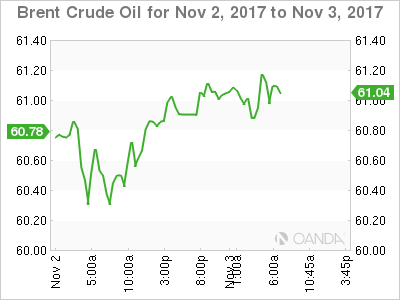
Oil prices remain better bid, trading atop of their two-year highs, as the outlook remains upbeat, as OPEC-led supply cuts have tightened the market and drained inventories.
Brent crude is up +13c, or +0.2% at +$60.62 per barrel. The contract is up by more than a third from its 2017-lows in June. U.S light crude (WTI) is up +24c, or +0.4% at +$54.54, almost +30% above its 2017-lows in June.
Investor confidence has been supported by an effort this year lead by OPEC and Russia to hold back about -1.8m bpd in oil production to tighten markets.
On Thursday, the Saudi Energy Minister Khalid al-Falih said supply and demand balances were tightening and oil inventories falling, while compliance with the OPEC-led pact to curb supplies had been “excellent”.
Note: Overall, oil markets have been slightly undersupplied this year, resulting in inventory drawdowns and the OPEC pact to withhold supplies runs to March 2018, but there is growing consensus to extend the deal to cover all of next year.
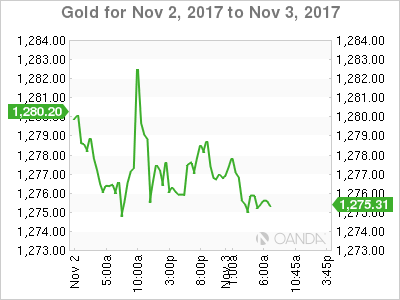
Ahead of the U.S open, gold prices are trading in a narrow range as the U.S dollar trades steady amid caution ahead of non-farm payrolls (NFP). Spot gold is mostly unchanged at +$1,275.82 per ounce, and is on track for its first weekly gain in three. Yesterday, the 'yellow' metal hit its highest in about two weeks at +$1,284.10 an ounce.
3. Sovereign yields fall
U.K bond yields haven fallen in the past 24-hours after yesterday's BoE's announcement of the first rate hike in ten-years (+25 bps to +0.50%). The 7 to 2 vote spilt, and the removal from the minutes of previous reference to monetary policy tightening by more than markets expect, meant that the move has been interpreted as a 'dovish' or 'token' hike.
U.K's 10-year gilt yield has declined -2 bps to +1.335%, the lowest in almost seven weeks.
In the U.S, the gap between 5- and 30-year Treasuries yields have shrank to the narrowest in almost a decade. The market has been happy to drive down longer-end yields after President Trump said he would nominate Jerome Powell to run the Federal Reserve from February.
Powell has shown a 'Yellen-esque' sensitivity towards emerging markets and a gradual U.S rate path – extending the path that that Fed members reinforced at this week's FOMC meeting – a hike in December and more to come in 2018.
The yield on U.S 10-year Treasuries has backed up +1 bps to +2.35%.
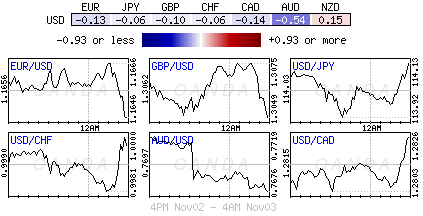
4. 'Big' dollar waiting for jobs headline
The FX market is holding steady after President Trump nominated Jerome Powell as the new Federal Reserve chair. Investors will take their cues from this morning's U.S non-farm payrolls (NFP). This morning's headline print is expected to keep the door ajar for a December Fed rate hike.
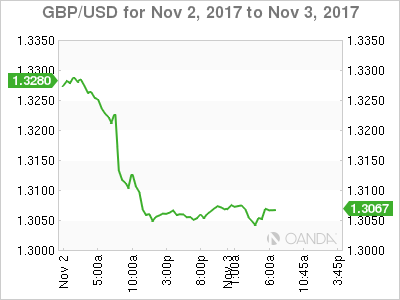
GBP/USD (£1.3067) continues its soft tone following yesterday's dovish rate hike by the BoE, but off its intraday lows after this morning's U.K services PMI print (see below) came in better than expected.
In yesterday's BoE statement, dealers noted that BoE dropped the wording that “interest rates may need to rise more than markets expected” and that Governor Carney had now linked the future path of rates to the outcome of the Brexit talks.
5. U.K services sector grows at fastest rate in six months
Data this morning showed that Business activity in the U.K's service sector grew last month at the fastest pace in six-months and significantly faster than anticipated.
IHS Markit Ltd. said its purchasing managers index for the services industry -which accounts for some +80% of the U.K economy – rose to 55.6 in October, up from 53.6 in September, and above market expectations that forecasted a -0.2 point drop. The growth in activity was supported by improved order books and resilient client demand, the survey indicated.
Today's data goes some way's to justify yesterday's first BoE rate hike in a decade.
However, the pace of job creation slowed to a seven-month low, and sentiment about future growth prospects remained subdued amid Brexit uncertainty and concerns about business investment.
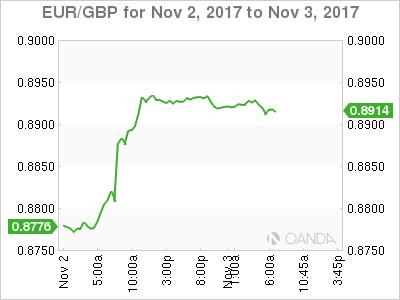
Positive UK Services PMI Fails To Inspire Sterling Bulls
Sterling bulls were hesitant to enter the scene on Friday morning, despite reports Britain’s service sector is growing at its fastest rate in six months.
Although UK Services PMI jumped 55.6 in October, up from 53.6 in September, the fairly muted reaction suggests that investors may be redirecting energy and attention elsewhere. Thursday’s dovish rate hike, has not only encouraged sellers to pummel Sterling, but has also heavily bruised buying sentiment towards the currency. With the bias towards the Pound currently tilted to the downside, any appreciation could be viewed as a technical bounce and an opportunity for bears to begin fresh rounds of selling. Taking a look at the technical picture, Sterling is under intense selling pressure on the daily charts. Sustained weakness below 1.3050 may open a path towards 1.3000 and 1.2970, respectively.
Crude Oil On A Solid Footing, NFPs In Focus
USD flat-lined amid Fed Chair nomination, tax plan in focus
The nomination of Jerome Powell as next Federal Reserve Chairman came as no surprise. The US dollar barely reacted to the news. The US Dollar Index treaded water within its weekly range, between 94.4 and 95. Donald Trump definitely made the choice of stability and continuity by choosing the New York republican Fed President. The USD edged slightly lower after the announcement as investors discounted completely the risk that a more hawkish candidate will replace Yellen. Similarly, US yields lost some ground yesterday, especially on the long-end of the curve. The 10-year eased to 2.35%, while the 30-year returned to 2.83%.
Today is NFP Friday and we’ll likely get some action following last month’s disappointing reading. NonFarm payrolls are expected to come in at 313k in October after contracting 33k in September. As usual, investors will pay a close attention to wage growth with average hourly earnings anticipated to rise 2.7%y/y versus 2.9% in September. The release of the September job report will be our best and last shot to get some volatility this week. Unfortunately, the market is more focus on developments on Trump’s Tax plan, as it will have a larger impact on inflation and growth, should it be approved. In addition, investors realized that a stronger job market do not ensure, at all, sustained inflation pressures.
Commodity Currencies lagging oil
Oil prices are looking to break resistance at $55.03 making 2017 new highs. Decline oil stocks and solid growth in demand has overcome weather and geopolitical issues. Brent is now trading above $60brl and futures backwardation has invited deeper buying in the long end of the curve. OPEC has sighted their success in supply restrain pointing to falling inventories. It seem that WTI at $55 is likely to maintain.
However, commodity liked currencies have not following oil prices higher. CAD and NOK have diverged significantly from oil prices in recent weeks. It is not uncommon for decoupling but the divergence rarely is for an extended period. The rationale is the convergence of higher oil at the same time US rates have risen, which reduced the sensitivity to external influenced. With US yields stabilizing we would watch for CAD and NOK to catch up to higher oil.
Chine Gold consumption increases while output declines
Price of gold remains above $1270. Since the start of the year, we recall that gold has gained almost 6% underlining global uncertainties. It is important to assess gold’s potential by looking at China as a significant part of the market takes place in China. The Chinese consumption has increased in the first 3 quarters of this year of 15.49% y/y. This increase has happened against the backdrop of the stock market recovery. Indeed Chinese stocks took a big hit in 2015.
In China, the gold output has strongly declined, facing a 3.76% decline since the start of the year. On top of that Chinese regulations are also stricter, in particular regarding the waste from gold mining. Chinese authorities have considered that the environmental impact of producing gold has overcome the proceeds from the sale.
In our view, we also believe that levels of production cannot be sustainable over the long haul. The reserves are falling and then the production should keep on declining. We consider that it is likely that the gold price should head higher within the next few month to reflect those data.
Euro Steady Ahead Of US Nonfarm Payrolls, Wage Growth
The euro continues has ticked lower in the Friday session. Currently, EUR/USD is trading at 1.1644, down 0.09% on the day. On the release front, there are no eurozone indicators on the schedule. Employment data will be in the spotlight on Friday, as the US releases Average Hourly Earnings, Nonfarm Payrolls and the unemployment rate. The markets are expecting NFP to rebound to 311 thousand, but Average Hourly Earnings is forecast to slow to 0.2 percent. No change is expected in the unemployment rate, with an estimate of a sizzling 4.2 percent. As well, the US releases ISM Non-Manufacturing PMI, which is expected to drop to 58.5 points.
A strong manufacturing sector has been an important factor in the stronger eurozone economy, and September Manufacturing PMIs continue to point to expansion early in the fourth quarter. The German Manufacturing PMI held at 60.6, its highest level since April 2011. Eurozone Manufacturing PMI isn’t far behind at 58.6, and accelerated for a third straight month. The German employment market remains robust, as unemployment rolls have declined for three straight months. Unemployment rolls have now dropped in all but two readings since June 2015.
There were no surprises from the Federal Reserve on Wednesday. The Fed’s rate statement was little more than a run-up to the December rate decision, as the Fed maintained interest rates at a range of 1.00 percent to 1.25 percent. The Fed indicated that a rate increase is very likely at the December meeting, and was careful not to change any of the wording in its statement regarding future rate hikes. The rate statement noted that hurricanes which hit the US had caused a decline in payrolls in September, but the Fed did not expect the hurricanes to “materially alter the course of the national economy over the medium term.” The markets are expecting a strong rebound in nonfarm payrolls – the forecast for US nonfarm payrolls is a robust 311 thousand, after a decline of 33 thousand in September. Still, wage growth, which was remained soft despite the strong economy, is expected to slow to 0.2 percent, as inflation remains the Achilles heel of a robust US economy.